- Market Value (2025): USD 1.5 Bn
- Estimated Value (2026): USD 1.5 Bn
- Forecast Value (2036): USD 3.0 Bn
- CAGR (2026-2036): 6.4%
What is the Recyclable Paperboard Laminates Market forecast to be worth by 2036?
USD 1.6 Billion in 2026 to USD 3.0 Billion by 2036, recording a 6.4% CAGR.
- The market reached USD 1.5 Billion in 2025 as converters qualified paper-led barrier structures for commercial packaging.
- The demand is estimated to push valuation from USD 1.6 Billion in 2026 to USD 3.0 Billion by 2036.
- The market is forecast to record 6.4% CAGR as recovery evidence enters specifications and contract reviews.
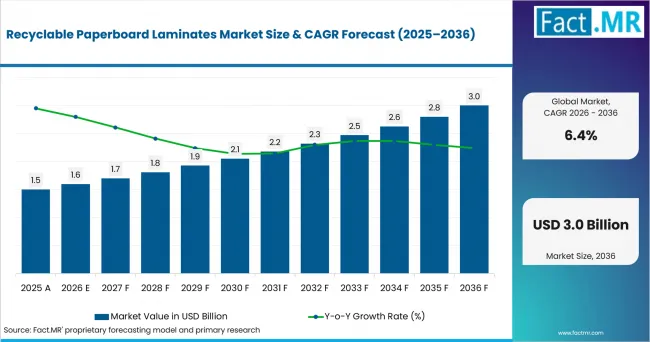
Recyclable Paperboard Laminates Market Value Analysis | Source: Fact.MR
What are the defining numbers behind Recyclable Paperboard Laminates Market growth?
USD 1.4 Billion absolute opportunity by 2036, led by paper-paper and moisture barriers alongside food packaging applications.
- Demand Drivers in the Market
- Packaging teams require transparent layer composition since producer fees increasingly reflect sorting and fiber-recovery outcomes.
- Food converters need moisture and grease protection that preserves shelf life without complicating separation during recycling.
- Packaging engineers need stable sealing and print performance on installed lines without major equipment changes.
- Direct technical collaboration supports adoption since approval depends on laboratory checks and full-speed commercial trials.
- Key Segments Analyzed
- By structure: Paper-paper is projected to account for 34.0% in 2026 due to clear fiber identification.
- By barrier: In 2026, moisture is expected to lead barrier demand with 34.0% share due to water-vapor control.
- By lamination method: Wet-bond is forecast to represent 36.0% in 2026 due to aqueous adhesive compatibility.
- By application, food packaging is estimated to hold 46.0% in 2026 owing to recurring qualification requirements.
- By end use: Food and beverage is projected to hold 60.0% share in 2026 owing to recurring volumes and varied barriers.
- By Sales Channel: Direct-OEM is expected to lead with 48.0% share in 2026 due to customer-specific trials.
- Analyst Opinion at Fact.MR
- Shambhu Nath Jha, Principal Consultant at Fact.MR states: “Repeat orders follow proof that barrier stability and fiber recovery work together across installed lines. Demand is expected to favor paper-led platforms that preserve seals and processing speed across commercial production.”
- Strategic Implications
- Paperboard mills should publish layer composition and recovery results before customer-specific commercial barrier development begins.
- Converters need to test bond strength and humidity response at intended line speeds before committing commercial volumes.
- Packaging teams should match barrier specifications with shelf-life needs so unnecessary layers do not reduce fiber recovery.
- Distributors must maintain regional support since smaller converters need trial quantities and troubleshooting before repeat orders.
High-barrier dry-food packs need paper substitutes that control oxygen and moisture without disrupting installed filling lines. Commercial acceptance depends on stable seals and aroma protection across storage or regional distribution cycles.
The United Kingdom and Brazil are anticipated to advance at 6.8% and 6.7% amid different recovery rules. Germany is expected to grow at 6.1% as detailed classifications shape barrier paper qualification decisions.
How does the Recyclable Paperboard Laminates Market break down by segment?
Paper-paper is projected to account for 34.0% share, moisture barrier is estimated to garner 34.0% share.
Which structure dominates?
Paper-paper is anticipated to account for a 34.0% share in 2026.
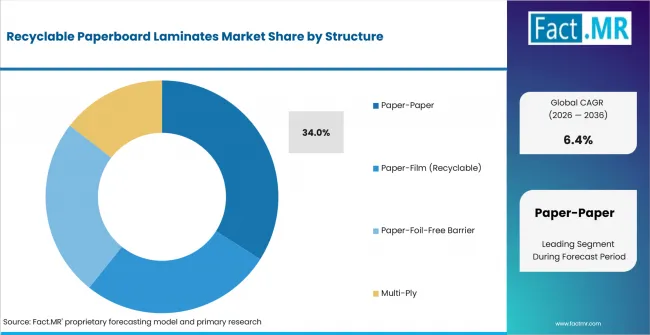
Recyclable Paperboard Laminates Market Analysis By Structure | Source: Fact.MR
The structure category is forecast to be led by paper-paper at 34.0% share in 2026 due to simple fiber-stream identification. Paper-paper keeps structural plies within one fiber family and reduces separation questions and familiar board behavior supports fiber-based packaging qualification on established equipment.
What leads the barrier segment?
Moisture is projected to hold a 34.0% share in 2026.
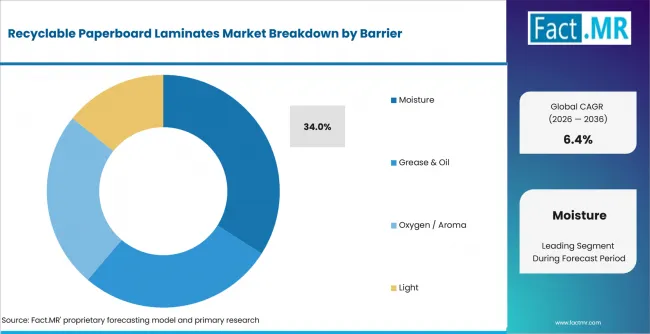
Recyclable Paperboard Laminates Market Analysis By Barrier | Source: Fact.MR
In 2026, moisture is expected to lead the barrier category with 34.0% share because water-vapor control protects board stiffness and seals. Moisture control protects stiffness and seals across dry or chilled products while paper barrier coatings serve formats needing oil resistance or aroma protection during distribution.
How does lamination method shape demand?
Wet-bond is predicted to lead with a 36.0% share in 2026.
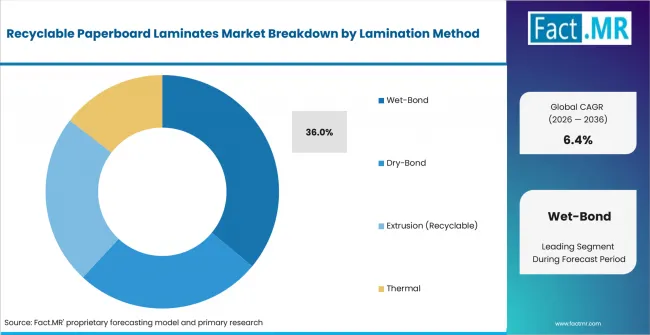
Recyclable Paperboard Laminates Market Analysis By Lamination Method | Source: Fact.MR
By lamination method, wet-bond is estimated to hold 36.0% share in 2026 owing to aqueous adhesive compatibility with porous paper surfaces. Wet-bond uses paper absorption to remove water from aqueous adhesive while familiar drying controls make coated papers practical on established converting assets.
What supports food packaging within application?
Food packaging is expected to secure a 46.0% share in 2026.
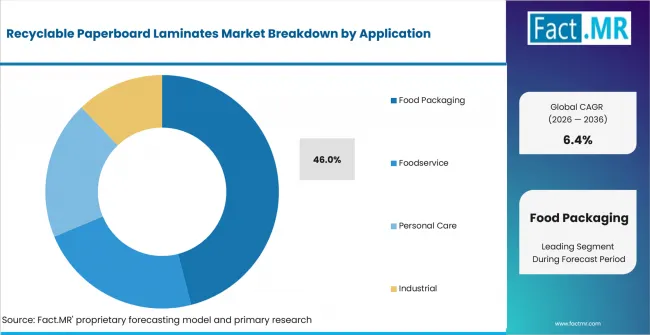
Recyclable Paperboard Laminates Market Analysis By Application | Source: Fact.MR
Based on application, food packaging is projected to account for 46.0% in 2026 due to recurring shelf-life and food-contact qualification. Food packaging requires barrier performance and verified food-contact status across snacks or chilled products and dry foods. The FDA ended 35 PFAS-related notifications in January 2025 and redirected oxygen barrier wraps toward documented alternative coatings.
Why does food and beverage hold the end use position?
Food and beverage is forecast to lead the segment with a 60.0% share in 2026.
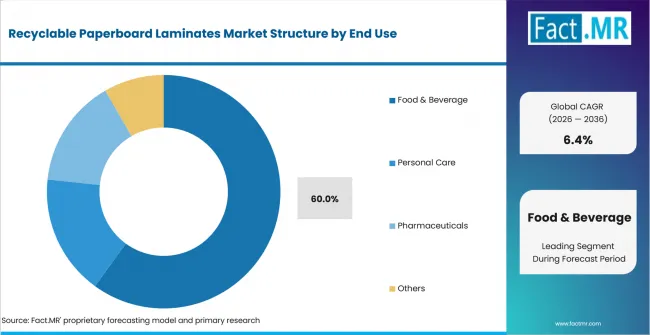
Recyclable Paperboard Laminates Market Analysis By End Use | Source: Fact.MR
The food and beverage segment is likely to capture 60.0% share in 2026 attributable to recurring consumption and varied product sensitivities. Food and beverage programs create repeat demand across dairy products or snacks while varied seals and moisture barriers broaden foodservice packaging requirements.
What drives direct-OEM within sales channel?
Direct-OEM is anticipated to account for a 48.0% share in 2026.
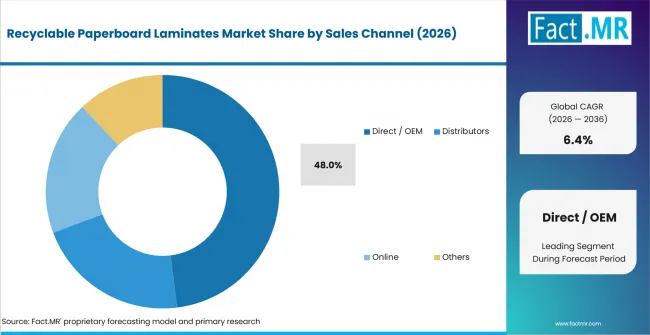
Recyclable Paperboard Laminates Market Analysis By Sales Channel | Source: Fact.MR
Direct-OEM is set to lead the sales channel category with 48.0% share in 2026 due to customer-specific specification and line-trial requirements. Direct-OEM programs require barrier targets and pilot rolls before commercial line trials on installed equipment. Customer-specific validation gives mono-material flexible packaging programs a practical route to preserve run speed and graphics during scale-up.
What is accelerating Recyclable Paperboard Laminates Market adoption, and what is holding it back?
Recyclability-linked specification change drives adoption, qualification complexity restrains conversion while foil-free high barriers create a verified opening.
Drivers Impact Analysis
| DRIVER | (~) % IMPACT ON CAGR |
GEOGRAPHIC RELEVANCE | IMPACT TIMELINE |
|---|---|---|---|
| Recyclability rules and producer fees | +0.9% | Europe, selected U.S. states | Short term |
| Food-contact barrier replacement | +0.7% | North America, Europe | Medium term |
| Paper-recovery validation | +0.6% | Global packaging accounts | Medium term |
| Installed-line compatibility | +0.5% | Europe, Asia Pacific | Medium term |
| Mill-converter trials | +0.3% | Global accounts | Long term |
Source: Fact.MR analysis. Updated Aug 1, 2026
- Recyclability regulation: Material approval requires complete layer disclosure and recovery evidence across regulated packaging programs. The February 2025 regulation is expected to favor structures prepared for recyclability assessments.
- Producer-fee exposure: Programs turn packaging design into recurring compliance costs and increase demand for material-specific recovery documentation across jurisdictions.
- Verified paper recovery: Converters require pulping results before approving laminates that could increase rejects or reduce recovered-fiber yield during recycling.
- Installed-line compatibility: Pilot rolls expose curl and sealing problems before broader conversion and favor structures using existing equipment without capital changes.
Opportunity Impact Analysis
| OPPORTUNITY | (~) % IMPACT ON CAGR |
GEOGRAPHIC RELEVANCE | IMPACT TIMELINE |
|---|---|---|---|
| Foil-free barriers for dry foods | +0.6% | Europe, North America | Medium term |
| PFAS-free grease barriers | +0.5% | North America, Europe | Short term |
| Existing-line high-fiber laminates | +0.4% | Asia Pacific, Europe | Medium term |
| Regional technical-service networks | +0.3% | India, China, Brazil | Long term |
Source: Fact.MR analysis. Updated Aug 1, 2026
- Foil-free high barriers: Dry-food packs need oxygen or moisture control without aluminum foil and create openings for laminates preserving seals and aroma protection.
- PFAS-free grease protection: Foodservice packs need oil resistance compatible with paper recovery and support coatings passing food-contact review and line testing.
- Existing-equipment conversion: Converters prefer changes using drying and sealing assets and favor structures with defined processing windows and troubleshooting routes.
Restraints Impact Analysis
| RESTRAINT | (~) % IMPACT ON CAGR |
GEOGRAPHIC RELEVANCE | IMPACT TIMELINE |
|---|---|---|---|
| National recovery-system variation | -0.6% | Global | Medium term |
| Barrier and fiber-yield tradeoffs | -0.5% | Food packaging | Medium term |
| Adhesive and coating qualification cost | -0.4% | Global accounts | Short term |
| Price pressure and trial volumes | -0.3% | India, China, Brazil | Long term |
Source: Fact.MR analysis. Updated Aug 1, 2026
- Recovery-system variation: National collection lists produce different outcomes for identical laminates and delay adoption until producers provide destination-specific recovery evidence.
- Barrier and fiber tradeoffs: Functional coatings protect products but increase pulping rejects and favor calibrated structures preserving shelf life with minimal incompatible material.
- Qualification cost: Adhesive changes trigger food-contact review and full-speed testing and slow conversion where smaller converters lack affordable trial volumes.
Which countries are scaling Recyclable Paperboard Laminates Market fastest?
United Kingdom 6.8%, Brazil 6.7%, Germany 6.1%.
Recyclable Paperboard Laminates Market covers North America, Latin America, Europe, East Asia, South Asia and Pacific, and Middle East and Africa.
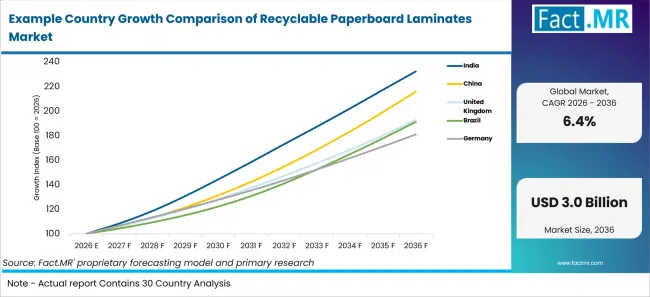
Example Country Growth Comparison Of Recyclable Paperboard Laminates Market | Source: Fact.MR
| COUNTRY | CAGR |
|---|---|
| United Kingdom | 6.8% |
| Brazil | 6.7% |
| Germany | 6.1% |
Source: Fact.MR analysis. Updated Aug 1, 2026
What supports the United Kingdom outlook?
6.8% CAGR by 2036, shaped by recyclability ratings and disposal-fee modulation across household packaging.
United Kingdom producers assess household packs through a national recyclability rating framework across regulated household formats. The market is anticipated to advance at 6.8% CAGR by 2036 as ratings influence disposal fees. September 2025 guidance separates paper from fiber composites and supports portfolio review while incomplete composition data can produce unfavorable ratings.
How is Brazil developing Recyclable Paperboard Laminates demand?
6.7% CAGR across the assessment period, influenced by domestic paperboard supply and mixed-pack recovery gaps.
Brazilian industries draw on established domestic paperboard production across regional food and consumer packaging accounts. The demand in Brazil is forecast to expand at 6.7% CAGR as local supply shortens sourcing routes. Brazil’s October 2025 decree excluded mixed paper-plastic packs and supported local trials while leaving recovery responsibility less direct.
What drives Germany’s market position?
6.1% CAGR from 2026 to 2036, reinforced by detailed sorting and recovery classifications for paper composites.
German packaging teams assess predominant material and sorting routes during package design before accepting recyclability claims. The market is expected to grow at 6.1% CAGR through 2036 as early classification reduces failed qualifications. Germany’s August 2025 minimum standard supports folding carton packaging review while non-separable layers remain material approval frictions.
Who leads the Recyclable Paperboard Laminates Market?
CompaMondi Group, Stora Enso and Sappi add integrated paper and barrier-material coverage.
Competition remains dispersed as some of the players such as Mondi Group holds dominance while integrated mills and specialists address different value-chain positions. Integrated groups compete through fiber supply and barrier development while new entrants need food-contact records and local recovery tests.
Mondi Group and Stora Enso combine paper production with barrier development while Sappi and UPM focus on functional papers. Ahlstrom supplies coating-ready bases while Huhtamaki and Amcor connect material selection with finished-pack trials and corrugated packaging competition centers on recovery evidence.
Which companies are the key providers?
Some of the key players profiled include Mondi Group, Stora Enso, Sappi, Ahlstrom, UPM, Huhtamaki, and Amcor.
- Mondi Group
- Stora Enso
- Sappi
- Ahlstrom
- UPM
- Huhtamaki
- Amcor
Bibliography
- European Parliament and Council of the European Union. (2025, January 22). Regulation (EU) 2025-40 of the European Parliament and of the Council of 19 December 2024 on packaging and packaging waste, amending Regulation (EU) 2019-1020 and Directive (EU) 2019-904, and repealing Directive 94-62-EC (Text with EEA relevance). Official Journal of the European Union.
- U.S. Food and Drug Administration. (2025, January 3). FDA Determines Authorization for 35 Food Contact Notifications Related to PFAS Are No Longer Effective.
- Department for Environment, Food & Rural Affairs, Environment Agency, and Natural Resources Wales. (2025, September 4). Recyclability assessment methodology: How to assess your packaging waste.
- Central Agency Packaging Register. (2025, August 28). Minimum standard for determining the recyclability of packaging.
- Ministry of Environment, Forest and Climate Change. (2025, August 4). PARLIAMENT QUESTION: ONE NATION ONE MISSION: END PLASTIC POLLUTION. Press Information Bureau.
- State Administration for Market Regulation. (2024, September 6). GB 23350—2021.
- Presidency of the Republic of Brazil. (2025, October 21). DECRETO Nº 12.688, DE 21 DE OUTUBRO DE 2025.
This Report Addresses
- Report coverage tracks Structure choices and Barrier design requirements in Recyclable Paperboard Laminates.
- The segment review evaluates Lamination Method applications alongside Application demand patterns.
- The country outlook examines India, China, United Kingdom, Brazil, and Germany in comparable commercial settings.
- Provider comparison reviews manufacturing readiness and customer qualification expectations in Recyclable Paperboard Laminates.
- End Use demand signals inform the practical route to market.
- Published data and primary checks support the Recyclable Paperboard Laminates forecast assumptions.
What does the Recyclable Paperboard Laminates Market cover?
Paperboard-based composite substrates that add barrier protection while retaining a practical paper-recovery route across qualified packaging applications.
The market covers rolls and sheets where paperboard provides the principal structure and bonded layers add functional barriers. Revenue reflects semi-finished laminate performance and recovery compatibility before printing or package fabrication begins.
Unlaminated paperboard lacks the bonded barrier function and plastic-led flexible packaging remains excluded when paper serves as a minor facing.
What is included in the scope?
Paper-led laminate substrates used across packaging programs that require defined barrier performance and documented converter qualification routes.
The scope includes paper-paper and recyclable paper-film structures alongside foil-free or multi-ply constructions with moisture or oxygen barriers. Wet-bond and dry-bond methods remain included with recyclable extrusion or thermal routes across the complete application and channel taxonomy.
What is excluded from the scope?
Unlaminated board and plastic-led laminates remain outside the scope alongside finished packaging revenue and standalone recycling services.
The scope excludes plain paperboard and standalone coating chemistry sold independently as separate commercial inputs. Plastic or aluminum laminates without a paperboard structural layer remain outside the boundary alongside finished packages and packaging machinery.
How Was the Analysis Built?
The analysis draws on 120+ sources, 35+ company portfolios, 25+ countries, and more than 20 industry interviews.
- Primary Research: Primary research includes discussions with manufacturers, service providers, technology developers, distributors, end users, procurement teams, and subject-matter experts. These conversations examine purchasing priorities, product adoption, operational challenges, approval requirements, competitive positioning, and the factors that influence wider market acceptance.
- Desk Research: Desk research covers government statistics, regulatory publications, company filings, trade data, technical studies, industry associations, standards, public policy, and other authoritative sources. Every source used in the analysis is documented in the bibliography.
- Market Sizing and Forecasting: Market estimates combine historical performance, demand indicators, pricing and volume trends, segment shares, company participation, country-level growth, adoption patterns, investment activity, and barriers to market expansion.
- Data Validation and Update Cycle: Findings are validated by comparing primary interviews with public data, company activity, regulatory changes, trade patterns, and industry developments. Regular updates review new product launches, capacity changes, partnerships, approvals, procurement trends, and shifts in commercial adoption.
Segmentation
What is the report’s scope and coverage?
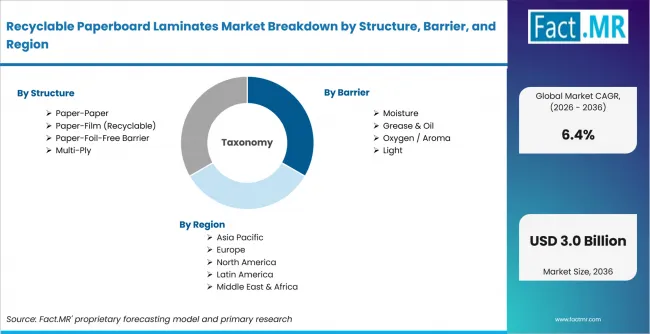
Recyclable Paperboard Laminates Market Breakdown By Structure, Barrier, And Region | Source: Fact.MR
| Coverage field | Report scope |
|---|---|
| Market Definition | Revenue from semi-finished substrates where paperboard provides the structure and bonded layers add barrier performance. |
| Structure | Paper-Paper, Paper-Film (Recyclable), Paper-Foil-Free Barrier, Multi-Ply |
| Barrier | Moisture, Grease & Oil, Oxygen - Aroma, Light |
| Lamination Method | Wet-Bond, Dry-Bond, Extrusion (Recyclable), Thermal |
| Application | Food Packaging, Foodservice, Personal Care, Industrial |
| End Use | Food & Beverage, Personal Care, Pharmaceuticals, Others |
| Sales Channel | Direct - OEM, Distributors, Online, Others |
| Regions Covered | North America, Latin America, Western Europe, Eastern Europe, East Asia, South Asia and Pacific, Middle East and Africa |
| Countries Covered | India, China, United Kingdom, Brazil, Germany, United States, Japan, and twenty-five additional countries |
| Key Companies Profiled | Mondi Group, Stora Enso, Sappi, Ahlstrom, UPM, Huhtamaki, Amcor |
| Forecast Period | 2026 to 2036 |
| Quantitative Units | USD Billion and percentage share |
Source: Fact.MR analysis. Updated Aug 1, 2026
How is the market segmented?
-
By Structure:
- Paper-Paper
- Paper-Film (Recyclable)
- Paper-Foil-Free Barrier
- Multi-Ply
-
By Barrier:
- Moisture
- Grease & Oil
- Oxygen - Aroma
- Light
-
By Lamination Method:
- Wet-Bond
- Dry-Bond
- Extrusion (Recyclable)
- Thermal
-
By Application:
- Food Packaging
- Foodservice
- Personal Care
- Industrial
-
By End Use:
- Food & Beverage
- Personal Care
- Pharmaceuticals
- Others
-
By Sales Channel:
- Direct - OEM
- Distributors
- Online
- Others
-
By Region:
- North America
- United States
- Canada
- Latin America
- Brazil
- Mexico
- Argentina
- Chile
- Western Europe
- Germany
- France
- United Kingdom
- Italy
- Spain
- Benelux
- Nordics
- Eastern Europe
- Poland
- Czech Republic
- Romania
- Hungary
- East Asia
- China
- Japan
- South Korea
- South Asia and Pacific
- India
- ASEAN
- Australia and New Zealand
- Middle East and Africa
- GCC Countries
- South Africa
- Türkiye
- Israel
- North America
Frequently Asked Questions
Which structure accounts for 34.0% share in 2026?
Why does moisture lead the barrier category?
What supports wet-bond lamination demand?
Why does food packaging hold the application position?
What supports the food and beverage end use?
Why does direct-OEM remain the main sales channel?
What is the primary market driver?
What is the main market restraint?
Who worked on this report


Preview the report firsthand - request a free sample
Free SampleGet the brochure for pricing and purchase details
Download PDF