- Market Value (2025): USD 267.9 Mn
- Estimated Value (2026): USD 292.0 Mn
- Forecast Value (2036): USD 690.0 Mn
- CAGR (2026-2036): 9.0%
What is the Parallel Screening Reactors Market forecast to be worth by 2036?
USD 292.0 million in 2026 to USD 690.0 million by 2036 at 9.0% CAGR.
- The Parallel Screening Reactors Market reached USD 267.9 million in 2025 as laboratories increased the use of structured reaction-screening workflows.
- Demand is projected to increase from USD 292.0 million in 2026 to USD 690.0 million by 2036.
- The market is forecast to record 9.0% CAGR from 2026 to 2036 owing to rising demand for faster reaction comparison, reproducible testing, and laboratory workflow automation.
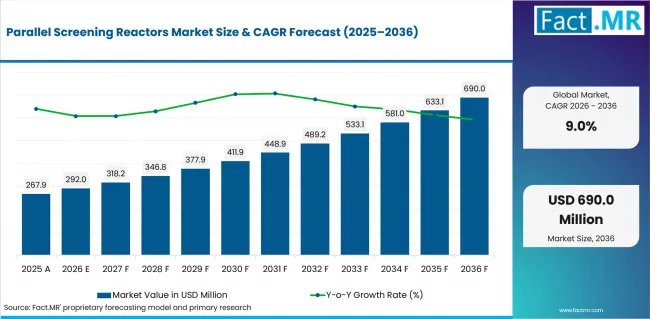
Parallel Screening Reactors Market Value Analysis | Source: Fact.MR
What are the defining numbers behind Parallel Screening Reactors Market growth?
USD 398.0 million absolute opportunity by 2036, led by Multi-well parallel reactors and 4–8-position systems alongside Manual parallel configurations and Pharma R&D users.
- Demand Drivers in the Market
- Pharmaceutical and chemical R&D teams use parallel reactors when a program requires direct comparison of catalysts or formulations under controlled conditions. Running reactions side by side shortens the decision cycle before a route moves into further development.
- Process-development groups must narrow a reaction window without consuming excessive material. Parallel systems allow those tests to run together, creating demand where laboratory capacity is constrained.
- Automation programs produce more experiments than manual bench work can manage reliably. That moves buyers toward platforms that record each run consistently and support repeated screening work.
- Buyers select a system only when it fits the reactions their teams need to study. Demand is strongest where the reactor count and pressure range avoid the need for a separate test setup.
- Key Segments Analyzed
- By System Format: Multi-well parallel reactors are projected to hold 32.0% share in 2026 because they allow laboratories to test several reaction conditions within a structured and comparable reactor arrangement.
- By Throughput: 4–8 positions are expected to account for 32.0% share in 2026 as this range provides sufficient screening capacity without requiring the cost and operating complexity of higher-position systems.
- By Automation Level: Manual parallel systems are anticipated to capture 44.0% share in 2026 because they offer laboratories a practical and comparatively affordable route for controlled reaction screening.
- By End User: Pharma R&D is estimated to represent 41.0% share in 2026 due to its need to compare formulations, catalysts, reaction conditions, and process variables during drug-development programs.
- Analyst Opinion at Fact.MR
- Shambhu Nath Jha, Sr. Consultant at Fact.MR, states, “Parallel screening reactor selection depends on matching reactor format and position count with the laboratory’s actual experimental workload. Market adoption is expected to depend on reaction reproducibility, operating control, automation compatibility, and the ability to compare multiple experiments efficiently rather than maximum position count alone.”
- Strategic Implications
- Pharma R&D teams need to define the required reactor format, position count, temperature range, pressure capability, and sampling method before comparing equipment proposals. A clear experimental plan helps laboratories avoid purchasing capacity or automation features that their current screening workflows do not require.
- Equipment providers need to demonstrate how manual, semi-automated, fully automated, and software-integrated systems improve reaction consistency and data capture. Suppliers that connect reactor control with laboratory automation and data-management systems can support faster experiment review and more reliable technology transfer.
- Investors need to separate specialized parallel reactor exposure from the broader laboratory-equipment market. Commercial value is stronger where suppliers combine reactor hardware with automation, software, application support, and configurations designed for pharmaceutical, catalyst, and chemical-development laboratories.
France is expected to lead the parallel screening reactors market with an 11.1% CAGR from 2026 to 2036, supported by pharmaceutical research, specialty-chemical development, and laboratory modernization. The USA is projected to record a 10.4% CAGR as drug-development programs and automated research workflows increase demand for controlled reaction screening. Switzerland is anticipated to grow at 9.5% through its concentrated pharmaceutical and life-sciences research base. The UK is estimated to post a 9.2% CAGR through academic, biotechnology, and contract-research activity, while Germany is forecast to expand at 8.9%, supported by chemical engineering expertise and established industrial R&D infrastructure.
How does the Parallel Screening Reactors Market break down by segment?
Multi-well parallel reactors are projected to lead System Format at 32.0% share in 2026. The 4–8 positions category is expected to lead Throughput at 32.0% share.
Which System Format dominates?
Multi-well parallel reactors are projected to account for 32.0% share in 2026.
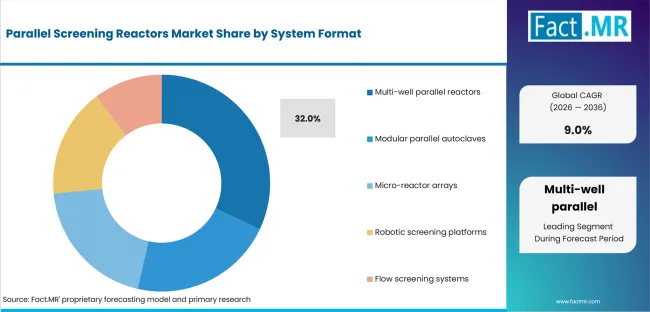
Parallel Screening Reactors Market Analysis By System Format | Source: Fact.MR
Multi-well parallel reactors hold a leading position because they allow laboratories to compare several reaction conditions within a compact and structured experimental format. Modular parallel autoclaves remain important for pressure-based chemistry, while micro-reactor arrays support smaller-volume screening. Robotic screening platforms and flow screening systems provide stronger automation and continuous-processing capabilities but generally require higher investment and more specialized workflows.
What leads the Throughput segment?
The 4–8 positions category is expected to hold 32.0% share in 2026.
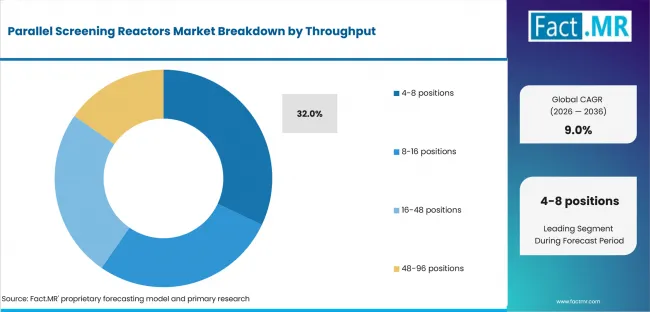
Parallel Screening Reactors Market Analysis By Throughput | Source: Fact.MR
This throughput range provides sufficient capacity for routine reaction comparison without creating the operating complexity associated with larger systems. The 8–16 and 16–48 position categories support laboratories with broader screening programs. Systems with 48–96 positions are more suitable for high-throughput environments, although their higher cost, automation requirements, and data-management needs can limit adoption among smaller laboratories.
How does Automation Level shape demand?
Manual parallel systems are anticipated to lead with 44.0% share in 2026.
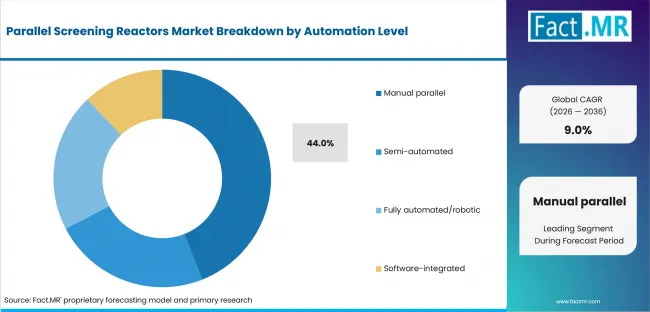
Parallel Screening Reactors Market Analysis By Automation Level | Source: Fact.MR
Manual parallel systems offer laboratories a practical entry point into controlled reaction screening while keeping equipment costs and training requirements manageable. Semi-automated systems support more consistent dosing, sampling, and operating control. Fully automated or robotic platforms become more valuable where laboratories run repetitive screening campaigns, while software-integrated systems support experiment tracking, data capture, and comparison across multiple reaction conditions.
What supports Pharma R&D within the End User segment?
Pharma R&D is estimated to represent 41.0% share in 2026.
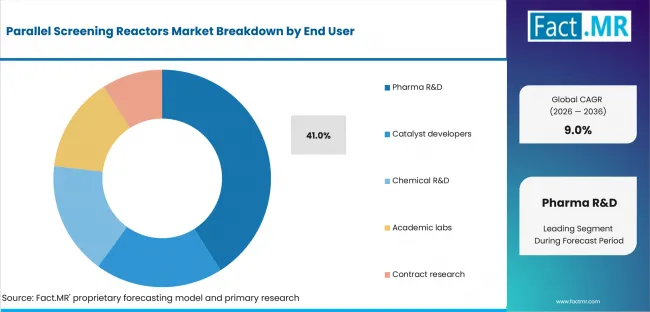
Parallel Screening Reactors Market Analysis By End User | Source: Fact.MR
Pharmaceutical research teams use parallel reactors to compare formulations, catalysts, solvents, temperatures, pressures, and reaction times during drug-development programs. Catalyst developers and chemical R&D laboratories also create demand for controlled reaction comparison. Academic laboratories and contract-research organizations generally operate with more varied project requirements, making reactor flexibility and configuration range more important than maximum throughput alone.
What is accelerating Parallel Screening Reactors Market adoption, and what is holding it back?
Demand is expected to be driven by faster reaction screening, reproducible experimental control, and laboratory automation. Adoption is expected to be held back by equipment cost, configuration mismatch, and the complexity of integrating automated systems into existing laboratory workflows.
Drivers Impact Analysis
| DRIVER | (~) % IMPACT ON CAGR | GEOGRAPHIC RELEVANCE | IMPACT TIMELINE |
|---|---|---|---|
| Faster reaction and formulation screening | +2.3% | USA, France, Switzerland | Short term (≤ 2 years) |
| Reproducibility across reaction positions | +1.9% | Pharmaceutical and chemical R&D clusters | Short term (≤ 2 years) |
| Laboratory workflow automation | +1.6% | USA, UK, Germany | Medium term (2–4 years) |
| Expansion of pharmaceutical R&D | +1.4% | USA, Switzerland, France | Medium term (2–4 years) |
| Improved experimental data capture | +0.9% | Advanced research laboratories | Long term (≥ 4 years) |
Source: Fact.MR analysis. Updated Jul 24, 2026
- Faster reaction and formulation screening: Parallel reactor systems allow several reaction conditions to be tested simultaneously. This reduces experiment cycles and helps research teams identify promising formulations, catalysts, or process settings more quickly.
- Reproducibility across reaction positions: Laboratories need consistent temperature, pressure, mixing, and sampling conditions across every reactor position. Reliable control makes the results easier to compare and reduces the need to repeat experiments.
- Laboratory workflow automation: Automated dosing, sampling, cleaning, and data collection are expected to reduce repetitive manual work. Adoption is likely to increase where laboratories run frequent or standardized screening campaigns.
- Expansion of pharmaceutical R&D: Drug developers require efficient systems for reaction optimization, route selection, formulation work, and scale-up preparation. This gives pharmaceutical R&D the largest stated end-user position.
- Improved experimental data capture: Software-linked systems are expected to make experiment tracking and result comparison more reliable. Better data records also support knowledge transfer between discovery, process-development, and scale-up teams.
Opportunity Impact Analysis
| OPPORTUNITY | (~) % IMPACT ON CAGR | GEOGRAPHIC RELEVANCE | IMPACT TIMELINE |
|---|---|---|---|
| Software-integrated reactor platforms | +1.2% | USA, UK, Germany | Medium term (2–4 years) |
| Modular and reconfigurable systems | +1.0% | Academic, contract-research, and specialty laboratories | Medium term (2–4 years) |
| Robotic high-throughput screening | +0.8% | USA, France, Switzerland | Long term (≥ 4 years) |
| Continuous-flow screening integration | +0.6% | Germany, UK, specialty-chemical clusters | Long term (≥ 4 years) |
Source: Fact.MR analysis. Updated Jul 24, 2026
- Software-integrated reactor platforms: Suppliers that connect reactor settings with experiment records and analytical results are expected to strengthen their position in laboratories seeking traceable and repeatable workflows.
- Modular and reconfigurable systems: Platforms that allow laboratories to change vessel type, position count, pressure range, or automation level can serve a wider range of pharmaceutical, catalyst, and chemical-development projects.
- Robotic high-throughput screening: Fully automated systems are expected to create opportunity in laboratories that need unattended operation, standardized dosing, rapid sampling, and large experimental datasets.
- Continuous-flow screening integration: Combining parallel experimentation with flow processing can help researchers compare reaction conditions before transferring selected routes into continuous-development or production environments.
Restraints Impact Analysis
| RESTRAINT | (~) % IMPACT ON CAGR | GEOGRAPHIC RELEVANCE | IMPACT TIMELINE |
|---|---|---|---|
| High equipment and automation cost | -1.2% | Academic laboratories and smaller research organizations | Short term (≤ 2 years) |
| Configuration mismatch | -1.0% | Global | Short term (≤ 2 years) |
| Integration with existing laboratory systems | -0.8% | Established pharmaceutical and chemical laboratories | Medium term (2–4 years) |
| Maintenance, cleaning, and validation burden | -0.6% | Regulated pharmaceutical environments | Long term (≥ 4 years) |
Source: Fact.MR analysis. Updated Jul 24, 2026
- High equipment and automation cost: Robotic platforms, pressure-capable systems, and advanced control software can require substantial capital investment. Smaller laboratories may continue using manual equipment until experiment volumes justify automation.
- Configuration mismatch: A reactor system selected for one vessel format, position range, or automation level may not suit another workflow. Poor configuration fit can lead to unused capacity or additional equipment purchases.
- Integration with existing laboratory systems: Automated reactors must connect with analytical instruments, laboratory software, and data-management platforms. Integration work can extend installation and qualification schedules.
- Maintenance, cleaning, and validation burden: Multi-position systems require consistent cleaning, calibration, sealing, and control across every reactor. Pharmaceutical laboratories may also need documented validation before systems can support regulated development work.
Which countries are scaling Parallel Screening Reactors Market fastest?
The country comparison is defined by a clear separation between the two fastest-growing markets and the remaining European cluster. France and the USA form the upper pair, with France ahead by 0.7 percentage points. Switzerland and the UK occupy a measured middle position, while Germany records the lowest CAGR among the listed countries. The total spread between France and Germany is 2.2 percentage points. This pattern reflects differences in pharmaceutical research intensity, laboratory automation, specialty-chemical development, and access to advanced research infrastructure rather than market size alone.
- France shows the strongest position because pharmaceutical research, specialty-chemical development, and laboratory modernization increase demand for controlled reaction-screening systems.
- The USA remains close to France in CAGR terms but follows a different route through large drug-development programs, automated research workflows, and broad laboratory-equipment adoption.
- Switzerland occupies the middle cluster through its concentrated pharmaceutical and life-sciences research base, where reproducibility and precise process development carry high value.
- The UK remains closely aligned with Switzerland through biotechnology, academic research, and contract-research activity that supports flexible reactor configurations.
- Germany records a measured growth position through chemical engineering expertise and established industrial R&D, although its projected CAGR remains slightly below the global market rate.
Comparable CAGRs can therefore produce different market entry conditions across these countries. Deployment timing depends on laboratory budgets, automation readiness, configuration requirements, and the availability of local application support. Commercial readiness also reflects how easily reactor platforms can connect with analytical equipment, laboratory software, and existing experimental workflows.
The full report provides country-level CAGR analysis across North America, Latin America, Europe, East Asia, South Asia, Oceania, and the Middle East and Africa.
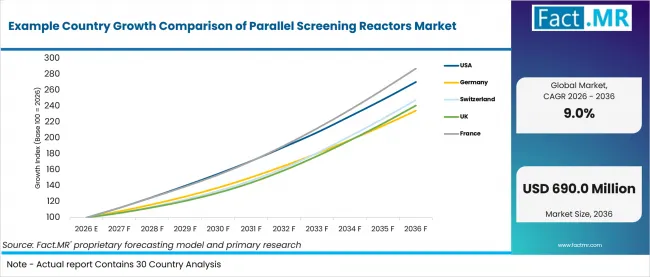
Example Country Growth Comparison Of Parallel Screening Reactors Market | Source: Fact.MR
| Country | CAGR (2026–2036) |
|---|---|
| France | 11.1% |
| USA | 10.4% |
| Switzerland | 9.5% |
| UK | 9.2% |
| Germany | 8.9% |
Source: Fact.MR analysis. Updated Jul 24, 2026
What supports France adoption?
11.1% CAGR, supported by pharmaceutical research, specialty-chemical development, and laboratory modernization.
France’s growth reflects a research environment where pharmaceutical and chemical laboratories require faster reaction comparison and dependable experimental control. Modernization of laboratory workflows is expected to increase interest in parallel reactor systems that support reproducible testing across several positions. Buyers are likely to prioritize flexible reactor formats, reliable temperature and pressure control, and compatibility with automation and analytical equipment.
How is the USA scaling demand?
10.4% CAGR, driven by drug-development programs and automated research workflows.
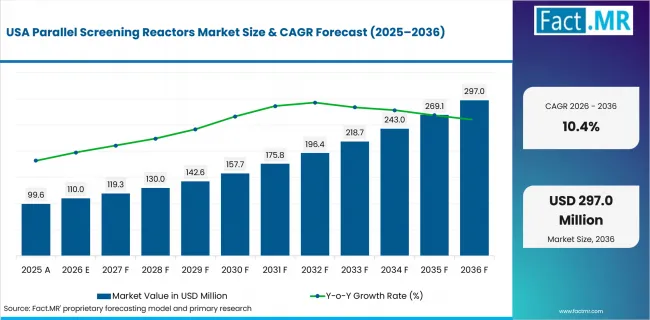
Parallel Screening Reactors Market Country Value Analysis | Source: Fact.MR
The USA’s growth is tied to its broad pharmaceutical, biotechnology, chemical, and contract-research base. Large research programs create demand for systems that can compare formulations, catalysts, solvents, and process conditions more efficiently. Laboratories are also expected to invest in automated dosing, sampling, and data capture where frequent screening campaigns justify higher equipment and software costs.
What is driving Switzerland’s growth from 2026 to 2036?
9.5% CAGR, backed by concentrated pharmaceutical and life-sciences research.
Switzerland’s growth is supported by a strong pharmaceutical research base where reaction reproducibility and process-development accuracy are important. Parallel screening reactors help teams compare several experimental conditions while maintaining consistent operating control. Demand is expected to favor compact, high-quality systems that integrate with analytical tools and support reliable transfer from discovery work into process development.
How is the UK developing demand?
9.2% CAGR, driven by biotechnology, academic research, and contract-research activity.
The UK’s growth is shaped by a diverse research environment that includes universities, biotechnology companies, pharmaceutical developers, and contract-research organizations. These users often require flexible reactor configurations because project conditions and throughput requirements can change frequently. Suppliers that offer modular systems, software integration, and practical application support are expected to gain stronger acceptance.
How does Germany perform?
8.9% CAGR, led by chemical engineering expertise and industrial R&D infrastructure.
Germany’s growth reflects its established chemical, materials, and process-engineering base. Industrial laboratories use parallel reactors to compare catalysts, reaction conditions, and operating parameters before scale-up. Buyers are expected to place particular value on pressure capability, temperature control, system durability, and integration with existing analytical and process-development equipment.
Who leads the Parallel Screening Reactors Market?
HEL Group, Unchained Labs, Parr Instrument, Chemspeed Technologies, Radleys, and Amar Equipment form the main competitive group in the Parallel Screening Reactors Market.
HEL Group supports parallel reactor demand through laboratory-scale systems designed for controlled reaction screening, process development, and automation. Unchained Labs contributes automated research platforms that support formulation and experimental workflows. Parr Instrument brings pressure-reactor and laboratory-vessel expertise, while Chemspeed Technologies strengthens the market through automated synthesis and screening systems. Radleys supports multi-position reaction and laboratory-scale process-development applications. Amar Equipment adds pressure-capable and custom reactor systems for pharmaceutical, chemical, and research users.
From 2026 to 2036, competition is expected to depend on reactor flexibility, position range, pressure and temperature capability, automation level, and software integration. Laboratories are also likely to compare dosing accuracy, sampling control, cleaning requirements, data capture, and compatibility with analytical equipment. Providers that combine reactor hardware with application support, modular configurations, and dependable automation may gain stronger demand from pharmaceutical R&D teams, catalyst developers, chemical laboratories, academic institutions, and contract-research organizations.
Who leads the Parallel Screening Reactors Market?
Key companies include HEL Group; Unchained Labs; Amar Equipment; Parr Instrument; Chemspeed Technologies; and Radleys.
- HEL Group
- Unchained Labs
- Amar Equipment
- Parr Instrument
- Chemspeed Technologies
- Radleys
Bibliography
- Office for Life Sciences. (2025, October 2). Bioscience and health technology sector statistics 2023 to 2024. Department of Health and Social Care, Department for Science, Innovation and Technology, and Department for Business and Trade.
- Institut national de la statistique et des études économiques. (2026, July 22). Enquête sur la filière du médicament 2025: Présentation statistique.
- Federal Statistical Office of Germany. (2026, March 27). Research and development expenditure increased by 3.8% in 2024.
- Eurostat. (2026, April 13). Medicinal and pharmaceutical products: €221 billion trade surplus. European Commission.
This Report Answers
- The report provides strategic intelligence on the Parallel Screening Reactors Market across System Format and Throughput choices that shape laboratory reaction-screening programs.
- Segment analysis covers Multi-well parallel reactors and the 4–8 positions category as the share leaders within the 2026 market.
- Country outlook evaluates France and the USA alongside Switzerland and the UK. Germany completes the CAGR comparison, while South Korea and Japan are included within the available country-value coverage.
- Competitive analysis profiles HEL Group and Unchained Labs alongside Amar Equipment and Parr Instrument. Chemspeed Technologies and Radleys complete the provider set.
- Automation assessment covers Manual parallel and Semi-automated systems. Fully automated/robotic and Software-integrated platforms complete the automation view.
What does the Parallel Screening Reactors Market cover?
Parallel screening reactor systems are used to run and compare several chemical reactions simultaneously where operating consistency, position count, reactor configuration, and data reproducibility determine laboratory acceptance.
The Parallel Screening Reactors Market covers multi-well parallel reactors and modular parallel autoclaves used for controlled reaction comparison. Coverage extends to micro-reactor arrays, robotic screening platforms, and flow screening systems. The market includes systems with 4–8, 8–16, 16–48, and 48–96 positions. It also covers manual, semi-automated, fully automated or robotic, and software-integrated configurations used by pharmaceutical, catalyst, chemical, academic, and contract-research laboratories.
The market differs from the broader laboratory-reactor market because commercial value comes from running multiple controlled reactions within a comparable experimental structure. Single-vessel systems used without parallel-screening capability remain outside the boundary. General laboratory mixers, analytical instruments, and unrelated process equipment are excluded unless they directly support parallel reaction screening, automation, or experiment control.
What is included in the scope?
Parallel screening reactors are used across pharmaceutical R&D and catalyst-development laboratories. Chemical R&D teams, academic laboratories, and contract-research organizations are also included.
The scope includes System Format and Throughput alongside Automation Level and End User. Coverage spans multi-well parallel reactors and modular parallel autoclaves. Micro-reactor arrays, robotic screening platforms, and flow screening systems complete the format scope. It includes throughput categories from 4–8 positions to 48–96 positions. Manual parallel and semi-automated systems are included, while fully automated/robotic and software-integrated platforms follow the same laboratory-use rule.
What is excluded from the scope?
Single-vessel laboratory reactors and unrelated laboratory-processing equipment remain outside the scope of this market.
The scope excludes reactor systems that do not support parallel reaction screening or comparison across multiple positions. General-purpose vessels used only for individual batch reactions are excluded. Standalone analytical instruments, laboratory mixers, storage vessels, and unrelated pilot-production equipment are also excluded. Flow equipment is excluded unless it is designed for parallel screening applications. Company revenue without a clear connection to parallel reactors, automated synthesis, reaction screening, or laboratory process development is also excluded.
How Was the Analysis Built?
The analysis draws on 120+ sources, 35+ company portfolios, 25+ countries, and more than 20 industry interviews.
- Primary Research: Primary research includes discussions with reactor manufacturers, technology providers, laboratory-equipment distributors, pharmaceutical researchers, chemical-development teams, academic users, contract-research organizations, procurement teams, and subject-matter experts. These conversations examine purchasing priorities, configuration requirements, automation adoption, operating challenges, and factors influencing wider market acceptance.
- Desk Research: Desk research covers government statistics, company filings, technical literature, trade information, industry associations, standards, laboratory-equipment publications, product documentation, and other authoritative sources. Every source used in the analysis is documented in the bibliography.
- Market Sizing and Forecasting: Market estimates combine historical performance, laboratory-equipment demand, pricing and volume trends, segment shares, company participation, country-level growth, pharmaceutical and chemical R&D activity, automation adoption, installed laboratory infrastructure, and barriers to market expansion.
- Data Validation and Update Cycle: Findings are validated by comparing primary interviews with public data, company activity, product portfolios, laboratory-investment patterns, and industry developments. Regular updates review new platform launches, automation improvements, partnerships, research-capacity changes, procurement trends, and shifts in commercial adoption.
Segmentation
What is the report's scope and coverage?
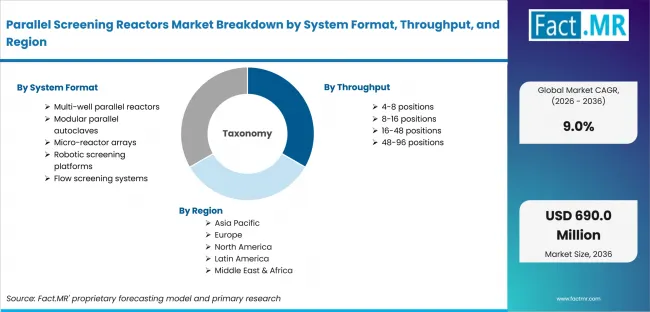
Parallel Screening Reactors Market Breakdown By System Format, Throughput, And Region | Source: Fact.MR
| Attribute | Details |
|---|---|
| Quantitative Units | USD million in 2026 to USD million by 2036 at a CAGR |
| Market Definition | Laboratory reactor systems designed to run and compare multiple chemical reactions simultaneously, where reactor configuration, position count, operating control, automation, reproducibility, and workflow compatibility determine laboratory adoption |
| System Format | Multi-well parallel reactors; Modular parallel autoclaves; Micro-reactor arrays; Robotic screening platforms; Flow screening systems |
| Throughput | 4–8 positions; 8–16 positions; 16–48 positions; 48–96 positions |
| Automation Level | Manual parallel; Semi-automated; Fully automated/robotic; Software-integrated |
| End User | Pharma R&D; Catalyst developers; Chemical R&D; Academic labs; Contract research |
| Regions Covered | North America; Europe |
| Countries Covered | USA; Germany; Switzerland; UK; France; South Korea; Japan |
| Key Companies Profiled | HEL Group; Unchained Labs; Amar Equipment; Parr Instrument; Chemspeed Technologies; Radleys |
| Forecast Period | 2026 to 2036 |
| Approach | Hybrid top-down and bottom-up approach using laboratory-equipment demand; pharmaceutical and chemical R&D activity; reaction-screening requirements; reactor position ranges; automation adoption; temperature and pressure control needs; experimental reproducibility; software integration; installed laboratory infrastructure; country-level adoption patterns; local application support; and company portfolio review |
Source: Fact.MR analysis. Updated Jul 24, 2026
How is the market segmented?
-
By System Format:
- Multi-well parallel reactors
- Modular parallel autoclaves
- Micro-reactor arrays
- Robotic screening platforms
- Flow screening systems
-
By Throughput:
- 4-8 positions
- 8-16 positions
- 16-48 positions
- 48-96 positions
-
By Automation Level:
- Manual parallel
- Semi-automated
- Fully automated/robotic
- Software-integrated
-
By End User:
- Pharma R&D
- Catalyst developers
- Chemical R&D
- Academic labs
- Contract research
-
By Region:
- North America
- Europe
Frequently Asked Questions
Which System Format leads the Parallel Screening Reactors Market?
Which Throughput band leads the Parallel Screening Reactors Market?
Which Automation Level leads the Parallel Screening Reactors Market?
Which End User leads the Parallel Screening Reactors Market?
Which country has the highest stated CAGR?
Which companies are covered in the Parallel Screening Reactors Market?
Who worked on this report


Preview the report firsthand - request a free sample
Free SampleGet the brochure for pricing and purchase details
Download PDF