- Market Value (2025): USD 700.5 Mn
- Estimated Value (2026): USD 760.0 Mn
- Forecast Value (2036): USD 1718.3 Mn
- CAGR (2026-2036): 8.5%
What is the Pectin-Carrageenan Texture Systems Market forecast to be worth by 2036?
USD 760.0 million in 2026 to USD 1,718.3 million by 2036 at an 8.5% CAGR.
- The Pectin-Carrageenan Texture Systems Market reached USD 700.5 million in 2025.
- Demand is projected to increase from USD 760.0 million in 2026 to USD 1,718.3 million by 2036.
- The market is forecast to record 8.5% CAGR from 2026 to 2036.
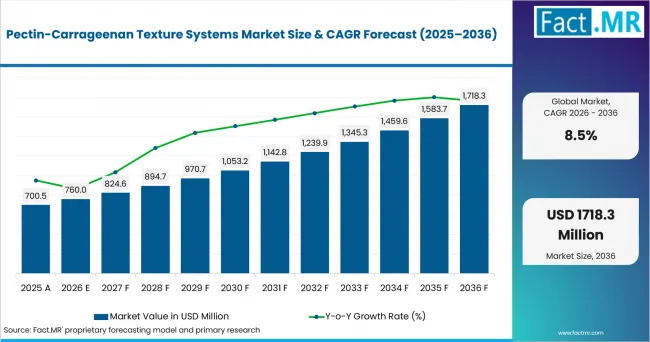
Pectin Carrageenan Texture Systems Market Value Analysis | Source: Fact.MR
What are the defining numbers behind Pectin-Carrageenan Texture Systems Market growth?
An absolute opportunity of USD 958.3 million is expected between 2026 and 2036.
- Demand Drivers in the Market
- Dairy and dessert formulators need texture systems that control water release after heat treatment and cold storage. USDA Economic Research Service reported on June 11, 2026 that inflation-adjusted U.S. food spending reached USD 2.51 trillion in 2025.
- Confectionery developers need elastic bite and melt resistance in gummies with fruit acid, reduced sugar or plant-based positioning. Pectin-carrageenan systems help build chew and melt resistance when gelatin replacement changes the bite profile. The blend must hold texture through packaging and storage.
- Dairy-alternative teams need mouthfeel without heavy gum loading. Pectin helps protein stabilization in acidic systems, while carrageenan helps body and suspension in neutral dairy-style matrices. Blends reduce trial cycles when a brand is reformulating yogurt, pudding or beverage products.
- Co-manufacturers need dry premixes that dose evenly across lines with different mixers. Pre-blended systems help reduce handling errors and simplify plant trials. The value is higher when one stabilizer package works across fruit preparations, desserts and spoonable dairy formats.
- Key Segments Analyzed
- By Blend Architecture: LM pectin + kappa carrageenan is expected to hold 31.00% share in 2026, supported by its fit in dairy gels and set desserts.
- By Target Matrix: Dairy & dairy alternatives are projected to account for 33.00% share in 2026, driven by texture needs in chilled and plant-based formulations.
- By Texture Function: Gel strength control is anticipated to capture 29.00% share in 2026, attributable to its role in bite, cutability and shape retention.
- By Delivery Format: Dry premix is estimated to represent 62.00% share in 2026, owing to simple handling and accurate dosing in factory trials.
- Analyst Opinion at Fact.MR
- Shambhu Nath Jha, Principal Consultant at Fact.MR, states, “Texture is becoming a qualification step in hydrocolloid buying. Formulators want blends that pass heat, acid and storage tests before commercial launch. Suppliers are expected to win repeat business when they combine application testing, pectin-carrageenan know-how and ready-to-use premix support.”
- Strategic Implications
- Ingredient suppliers should publish application guides that show gel strength, syneresis control and dispersion behavior by target matrix.
- Application labs should build dairy-alternative prototypes that compare LM pectin, kappa carrageenan and buffered blends under the same process conditions.
- Gummy brands should evaluate pectin-carrageenan systems early in sugar-reduction projects so bite and melt resistance are tested before scale-up.
The UK is projected to post 9.9% CAGR through 2036, supported by chilled desserts and private-label dairy work. The USA is expected to record 9.6% CAGR as dairy-alternative scale and gummy reformulation expand. Germany is forecast to advance at 8.5% CAGR through documented dairy processing depth. France is anticipated to reach 8.1% CAGR through cultured dairy and fruit preparation demand. Japan is estimated to record 7.7% CAGR owing to precise texture needs in convenience desserts and beverages.
How does the Pectin-Carrageenan Texture Systems Market break down by segment?
LM pectin + kappa carrageenan leads Blend Architecture at 31.00%; Dry premix leads Delivery Format at 62.00%.
Which Blend Architecture dominates?
LM pectin + kappa carrageenan is expected to hold 31.0% share in 2026.
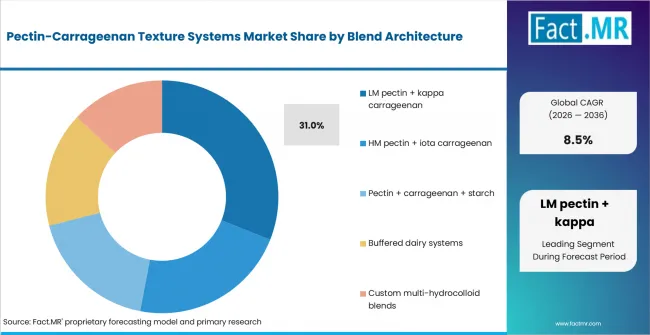
Pectin Carrageenan Texture Systems Market Analysis By Blend Architecture | Source: Fact.MR
LM pectin + kappa carrageenan is expected to lead blend architecture because it balances calcium-sensitive gel setting with firm carrageenan structure. HM pectin + iota carrageenan remains useful in softer gels and fruit-acid systems. Pectin + carrageenan + starch supports recipes where body and cost control need to move together. Buffered dairy systems are used when proteins, minerals and stabilizers need a wider processing window.
What leads the Target Matrix segment?
Dairy & dairy alternatives are projected to account for 33.0% share in 2026.
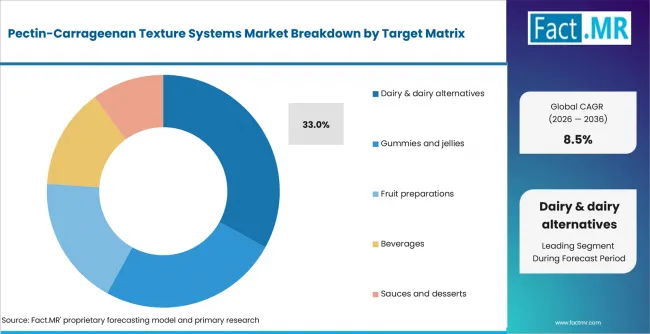
Pectin Carrageenan Texture Systems Market Analysis By Target Matrix | Source: Fact.MR
Dairy & dairy alternatives are projected to lead target matrix demand because gels, spoonable products and beverages need texture that survives storage. USDA National Agricultural Statistics Service stated in April 2026 that U.S. milk production reached 232 billion pounds in 2025. Gummies and jellies form the next matrix group, shaped by bite control and clean label recipe goals. Fruit preparations use blends where pectin sets texture and carrageenan helps water control.
How does Texture Function shape demand?
Gel strength control is anticipated to lead with 29.0% share in 2026.
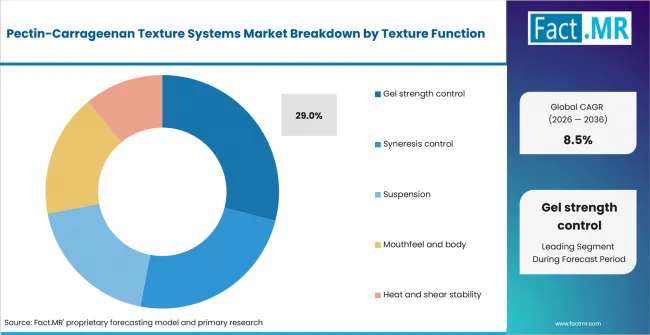
Pectin Carrageenan Texture Systems Market Analysis By Texture Function | Source: Fact.MR
Gel strength control leads because finished products need a clear bite, clean cut and stable shape after distribution. Syneresis control remains close behind in yogurt, fruit prep and spoonable desserts. Suspension is relevant in beverages where pulp, protein or cocoa particles need even distribution. Mouthfeel and body remain useful when brands reduce sugar or fat and need to rebuild texture through hydrocolloid systems.
What supports Dry Premix within Delivery Format?
Dry premix is estimated to represent 62.0% share in 2026.
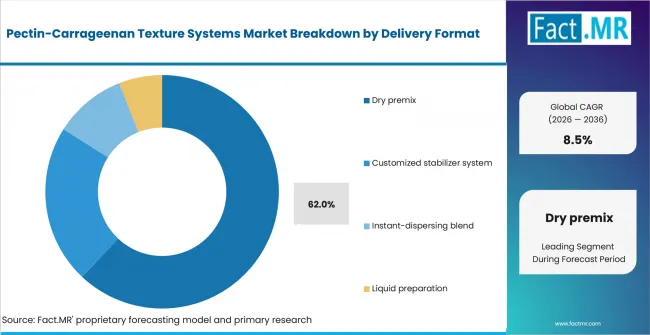
Pectin Carrageenan Texture Systems Market Analysis By Delivery Format | Source: Fact.MR
Dry premix is estimated to lead delivery format because it reduces handling complexity in factories that run several recipes on one line. Customized stabilizer systems serve premium projects where a single blend must match a narrow texture target. Instant-dispersing blends are gaining interest in beverage and dessert lines that need fast hydration. Liquid preparations remain useful where plants prefer pumpable dosing over powder handling.
What is accelerating Pectin-Carrageenan Texture Systems Market adoption, and what is holding it back?
Dairy texture control drives it; raw-material exposure restrains it.
Drivers Impact Analysis
| DRIVER | (~) % IMPACT ON CAGR | GEOGRAPHIC RELEVANCE | IMPACT TIMELINE |
|---|---|---|---|
| Dairy and dairy-alternative stabilization | +1.7% | North America, Western Europe, Japan | Short term (<= 2 years) |
| Confectionery bite and melt resistance | +1.3% | Europe, USA, Japan | Medium term (2-4 years) |
| Dry premix dosing consistency | +1.0% | Global | Short term (<= 2 years) |
| Clean-label reformulation work | +0.8% | Western Europe, North America | Long term (>= 4 years) |
- Dairy and dairy-alternative stabilization: Blends are expected to gain use where protein systems need body and low whey-off. The function is concentrated in yogurt, desserts and neutral dairy-style beverages. Suppliers with pilot-scale dairy support can shorten customer trials.
- Confectionery bite and melt resistance: Pectin-carrageenan systems are anticipated to support plant-based gummies where gelatin replacement needs elastic chew. The technical route depends on low-pH gel behavior and melt resistance. Adoption is tied to sensory testing because the bite must survive packaging and storage.
- Dry premix dosing consistency: Dry premixes are projected to remain the main delivery route where plants need accurate stabilizer dosing. The format helps reduce weighing variation and supports co-manufacturing. Premix suppliers gain an advantage when they offer application notes by pH, solids level and processing temperature.
- Clean-label reformulation work: Reformulation is expected to support blend demand when brands remove gelatin or rebuild texture after sugar reduction. Pectin helps with gel structure in acidic systems. Carrageenan helps body in dairy-style matrices, so the combined system can reduce repeated trials.
Opportunity Impact Analysis
| OPPORTUNITY | (~) % IMPACT ON CAGR | GEOGRAPHIC RELEVANCE | IMPACT TIMELINE |
|---|---|---|---|
| Plant-based dairy and chilled desserts | +1.2% | USA, UK, Germany | Medium term (2-4 years) |
| Instant-dispersing beverage premixes | +0.9% | Japan, USA, Western Europe | Long term (>= 4 years) |
| Fruit preparations and yogurt systems | +0.7% | France, Germany, USA | Short term (<= 2 years) |
- Plant-based dairy and chilled desserts: Brands can use paired hydrocolloids where almond, oat, or soy bases need creamier body and better texture. Suppliers that provide bench samples and sensory data can help buyers compare blends before moving into larger plant trials.
- Instant-dispersing beverage premixes: Beverage producers seek blends that hydrate quickly and suspend particles evenly. Instant-dispersing formats can reduce mixing time and clumping risk, making them relevant for nutrition drinks, cocoa beverages, and fruit-based systems.
- Fruit preparations and yogurt systems: Fruit preparation producers can use paired hydrocolloids where pectin builds set and carrageenan improves water control. Dairy and cultured-product applications create a steady route for these blends where texture, stability, and moisture management need to work together.
Restraints Impact Analysis
| RESTRAINT | (~) % IMPACT ON CAGR | GEOGRAPHIC RELEVANCE | IMPACT TIMELINE |
|---|---|---|---|
| Hydrocolloid raw-material exposure | -0.7% | Global | Short term (<= 2 years) |
| Recipe qualification time | -0.5% | North America, Europe, Japan | Medium term (2-4 years) |
| Hydration and process sensitivity | -0.3% | Global | Long term (>= 4 years) |
- Hydrocolloid raw-material exposure: Carrageenan depends on seaweed supply and pectin depends on citrus peel or apple pomace streams. Cost swings can affect blend pricing. Buyers may approve second sources when ingredient availability becomes a planning risk.
- Recipe qualification time: New texture systems must pass sensory checks, stability trials and plant runs. This slows switching in established dairy and confectionery products. Ingredient suppliers can reduce delays by giving use levels and process guidance with each blend.
- Hydration and process sensitivity: Blends need controlled dispersion because poor hydration can create lumps or weak gels. The risk is higher in plants with limited powder-handling control. Instant systems and clear mixing instructions help reduce reformulation friction.
Which countries are scaling the Pectin-Carrageenan Texture Systems Market through 2036?
- The country comparison spans 2.27 percentage points and forms three practical growth bands across the forecast period.
- The UK remains 0.31 percentage point above the USA through chilled desserts and retail-led reformulation.
- The USA remains 1.11 percentage points above Germany as dairy-alternative and gummy applications widen.
- Germany remains 0.42 percentage point above France through documented dairy processing depth and technical ingredient standards.
- France remains 0.43 percentage point above Japan as cultured dairy and fruit preparation projects support usage.
- Japan closes the displayed range through convenience desserts and beverage systems that require precise texture control.
Comparable CAGRs can create different entry conditions due to dairy processing depth, confectionery use, clean-label reformulation and plant-trial requirements. Full report coverage includes North America; Latin America; Western Europe; Eastern Europe; East Asia; South Asia & Pacific; and Middle East & Africa.
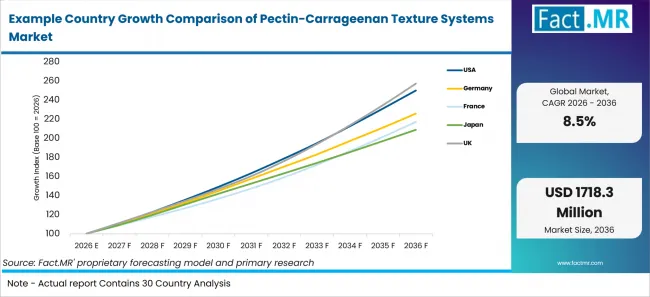
Example Country Growth Comparison Of Pectin Carrageenan Texture Systems Market | Source: Fact.MR
| COUNTRY | CAGR (2026-2036) |
|---|---|
| United Kingdom | 9.9% |
| United States | 9.6% |
| Germany | 8.5% |
| France | 8.1% |
| Japan | 7.7% |
What supports United Kingdom adoption?
9.9% CAGR, supported by chilled desserts and private-label dairy reformulation.
UK retailers give texture a direct role in chilled dessert and dairy-alternative launches. The Office for National Statistics reported on June 11, 2026 that average weekly UK household expenditure reached GBP 676.60 in FYE 2025, providing broader consumer-spending context for food and beverage categories. Private-label developers are expected to use premix systems when they need repeatable gel strength across short launch cycles.
How is USA demand scaling?
9.6% CAGR, driven by dairy alternatives, gummy formats and foodservice dessert work.
USA formulators are expected to use pectin-carrageenan blends in dairy desserts and low-pH confectionery where texture needs careful control. Large co-manufacturing networks increase the value of dry premixes that can be dosed accurately across several plants. The market gains further support from brands that need faster reformulation without changing the finished product identity.
What supports the Germany outlook?
8.5% CAGR, backed by acidified dairy, confectionery manufacturing and technical documentation.
Germany’s dairy processors are expected to favor documented blend systems that can pass plant trials and sensory checks. Eurostat reported on November 20, 2025 that Germany accounted for 27.1% of EU production of acidified milk products in 2024.
How is France developing demand?
8.1% CAGR, supported by cultured dairy, fruit preparations and premium desserts.
France is anticipated to use pectin-carrageenan systems where fruit preparation quality and dairy texture must remain stable through shelf life. INSEE reported on August 14, 2026 that prices for sugar, jam, honey, chocolate and confectionery rose 1.0% year on year in July 2026.
What supports Japan adoption?
7.7% CAGR, led by convenience desserts, beverages and precise mouthfeel expectations.
Japan’s convenience retail base is expected to support portioned desserts and beverages that need consistent gel strength or suspension. The Statistics Bureau of Japan reported on February 6, 2026 that average monthly consumption expenditure per two-or-more-person household was 314,001 yen in 2025. Local formulators value instant-dispersing systems because small texture changes can affect repeat purchases.
Who leads the Pectin Carrageenan Texture Systems Market?
Tate & Lyle, including the acquired CP Kelco portfolio, is active through pectin, carrageenan and other hydrocolloid systems used across food and beverage applications. Its July 2025 IFT FIRST showcase featured the combined portfolio in a dual-texture gummy concept using GENU® Pectin and GENUTINE® Carrageenan, demonstrating the complementary use of two hydrocolloids to create distinct textures.
IFF competes through GRINDSTED® pectin and carrageenan technologies, with GRINDSTED® DuoGel adding a June 2026 plant-based gummy application based on a synergistic pectin-and-carrageenan system. Ingredion supports the market through texture systems, plant-based ingredients and formulation expertise. Both companies provide application and formulation support aimed at achieving targeted texture and sensory outcomes.
Cargill add competitive depth through functional, emulsifier and stabilizer systems for dairy, confectionery and ice cream applications. Cargill showcased solutions for bakery, confectionery, dairy and ice cream at AAHAR in March 2025.
Which companies are the key providers?
Key companies include Tate & Lyle (including the CP Kelco portfolio), Cargill, IFF, Ingredion.
- Tate & Lyle (including CP Kelco)
- Cargill
- IFF
- Ingredion
Bibliography
- Calvino, A. (2026, March 10). Enquête annuelle laitière 2024. Agreste, Service de la statistique et de la prospective.
- Cargill. (2025, March 4). Cargill showcases full range of innovative food solutions at AAHAR 2025.
- Eurostat. (2025, November 20). Milk production reached 161.8 million tonnes in 2024.
- IFF. (2026, June 23). IFF launches first-of-its-kind stabilizer system in Europe, the Middle East and Africa.
- Ingredion Incorporated. (2025, February 4). Ingredion invests $100 million in Indianapolis plant to improve efficiency and enable future texture solutions growth.
- Institut national de la statistique et des études économiques. (2026, August 14). In July 2026, consumer prices rose by 2.1% year on year.
- Office for National Statistics. (2026, June 11). Family spending in the UK: April 2024 to March 2025.
- Statistics Bureau of Japan. (2026, February 6). 2025 yearly average [Family Income and Expenditure Survey].
- Tate & Lyle. (2024, November 15). Completion of combination of Tate & Lyle and CP Kelco to create a leading global speciality food and beverage solutions business.
- Tate & Lyle. (2025, July 7). Tate & Lyle debuts expanded portfolio and mouthfeel leadership at IFT FIRST 2025.
- Zeballos, E., & Sinclair, W. (2026, June 11). Total U.S. food spending reached $2.51 trillion in 2025. U.S. Department of Agriculture, Economic Research Service.
- U.S. Department of Agriculture, National Agricultural Statistics Service. (2026, April 30). Milk production, disposition, and income 2025 summary.
This Report Answers
- The report explains where pectin-carrageenan texture systems are used across blend architecture and target matrix. It also covers texture function and delivery format.
- Segment analysis identifies the leading subsegments and the formulation reasons buyers prioritize them.
- Country analysis examines the listed markets and the dairy, confectionery or retail mechanisms supporting blend adoption.
- Competitive analysis reviews current providers across pectin, carrageenan, stabilizer systems and application support.
- Application analysis assesses how gel strength, syneresis control and mouthfeel influence supplier shortlisting.
What does the Pectin-Carrageenan Texture Systems Market cover?
The carrageenan gum link is relevant because carrageenan supplies gelling, thickening and stabilizing function in food systems. Food stabilizers coverage is adjacent where brands compare pectin, carrageenan and other stabilizers for dairy and confectionery formulation.
The market covers blended systems that pair pectin and carrageenan to control gel structure, water release and mouthfeel in food and beverage products. The scope includes customized stabilizer systems, instant-dispersing blends and dry premixes used before full commercial launch.
What is included in the scope?
The scope includes label-friendly LM pectins when they are paired with carrageenan to improve dairy or dessert texture. Citrus pectin coverage is relevant where peel-derived pectin supports acidic gels and fruit preparation systems.
It also includes food thickening agents where the formulation need involves viscosity, suspension or spoonable body. Gum hydrocolloid analysis is adjacent because pectin and carrageenan compete with other gums during stabilizer selection.
What is excluded from the scope?
The scope excludes single-ingredient gums sold without a designed pectin-carrageenan function, although alternative hydrocolloids are reviewed as substitutes. Texture modifier coverage is adjacent where broader ingredient systems address texture outside pectin-carrageenan blends.
Energy-efficient hydrocolloids are outside the core scope unless the system uses pectin and carrageenan for verified processing benefits. Food additives coverage is broader and only overlaps where additive functionality is tied to texture in finished food products.
How Was the Analysis Built?
The analysis draws on 120+ sources, 35+ company portfolios, 25+ countries, and more than 20 industry interviews.
- Primary Research: Primary research includes discussions with manufacturers, service providers, technology developers, distributors, end users, and subject-matter experts. These conversations examine purchasing priorities, product adoption, operational challenges, approval requirements, competitive positioning, and the factors that influence wider market acceptance.
- Desk Research: Desk research covers government statistics, regulatory publications, company filings, trade data, technical studies, industry associations, standards, public policy, and other authoritative sources. Every source used in the analysis is documented in the bibliography.
- Market Sizing and Forecasting: Market estimates combine historical performance, demand indicators, pricing and volume trends, segment shares, company participation, country-level growth, adoption patterns, investment activity, and barriers to market expansion.
- Data Validation and Update Cycle: Findings are validated by comparing primary interviews with public data, company activity, regulatory changes, trade patterns, and industry developments. Regular updates review new product launches, capacity changes, partnerships, approvals, and shifts in commercial adoption.
What is the report’s scope and coverage?
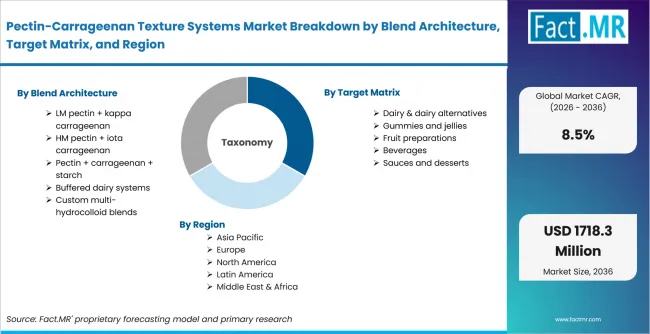
Pectin Carrageenan Texture Systems Market Breakdown By Blend Architecture, Target Matrix, And Region | Source: Fact.MR
| ATTRIBUTE | DETAILS |
|---|---|
| Quantitative Units | USD million |
| Market Definition | Blended pectin-carrageenan systems used to deliver gel strength, syneresis control, suspension, mouthfeel and process stability in food and beverage formulations. |
| Blend Architecture | LM pectin + kappa carrageenan; HM pectin + iota carrageenan; Pectin + carrageenan + starch; Buffered dairy systems; Custom multi-hydrocolloid blends |
| Target Matrix | Dairy & dairy alternatives; Gummies and jellies; Fruit preparations; Beverages; Sauces and desserts |
| Texture Function | Gel strength control; Syneresis control; Suspension; Mouthfeel and body; Heat and shear stability |
| Delivery Format | Dry premix; Customized stabilizer system; Instant-dispersing blend; Liquid preparation |
| Regions Covered | North America; Latin America; Western Europe; Eastern Europe; East Asia; South Asia & Pacific; Middle East & Africa |
| Countries Covered | United Kingdom; United States; Germany; France; Japan |
| Key Companies Profiled | Tate & Lyle (including CP Kelco); Cargill; IFF; Ingredion |
| Forecast Period | 2026 to 2036 |
| Approach | Hybrid top-down and bottom-up approach using food formulation demand, hydrocolloid functionality, country adoption, application testing and provider portfolio review. |
How is the market segmented?
-
By Blend Architecture:
- LM pectin + kappa carrageenan
- HM pectin + iota carrageenan
- Pectin + carrageenan + starch
- Buffered dairy systems
- Custom multi-hydrocolloid blends
-
By Target Matrix:
- Dairy & dairy alternatives
- Gummies and jellies
- Fruit preparations
- Beverages
- Sauces and desserts
-
By Texture Function:
- Gel strength control
- Syneresis control
- Suspension
- Mouthfeel and body
- Heat and shear stability
-
By Delivery Format:
- Dry premix
- Customized stabilizer system
- Instant-dispersing blend
- Liquid preparation
-
By Region:
- North America
- Latin America
- Western Europe
- Eastern Europe
- East Asia
- South Asia & Pacific
- Middle East & Africa