- Market Value (2025): USD 530.1 Mn
- Estimated Value (2026): USD 565.7 Mn
- Forecast Value (2036): USD 1084.1 Mn
- CAGR (2026-2036): 6.7%
What is the Penile Cancer Drug Market forecast to be worth by 2036?
USD 565.7 million in 2026 to USD 1084.1 million by 2036, at a CAGR of 6.7%.
- As per Fact.MR analysis, the market was valued at USD 530.1 million in 2025.
- Demand is forecast to rise from USD 565.7 million in 2026 to USD 1084.1 million by 2036.
- The forecast represents a 6.7% CAGR over the 2026–2036 period owing to increasing awareness of early cancer diagnosis.
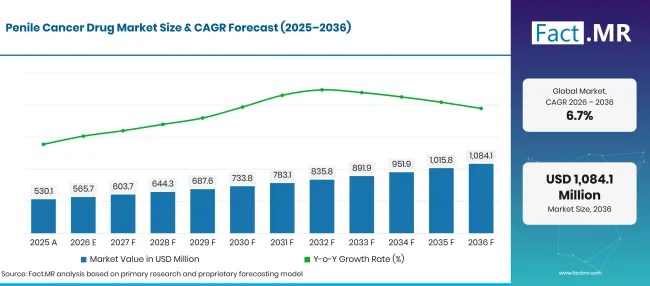
Penile Cancer Drug Market Forecast Global | Source: Fact.MR
| Year | Basis | Market Value (USD million) |
|---|---|---|
| 2025 | Actual | 530.1 |
| 2026 | Estimate | 565.7 |
| 2036 | Forecast | 1084.1 |
| CAGR 2026 to 2036 | Forecast period | 6.7% |
Source: Fact.MR analysis. Updated Nov 5, 2026
What are the defining numbers behind Penile Cancer Drug Market growth?
USD 518.4 million in absolute opportunity is expected between 2026 and 2036.
- Demand Drivers in the Market
- Greater attention to advanced disease treatment has driven the growth of the market. Patients with locally advanced or metastatic penile cancer may require systemic treatment. The European Association of Urology (EAU) recommends platinum-based chemotherapy as the preferred first-line palliative systemic therapy for patients with distant metastatic disease [6].
- Use of combination chemotherapy has increased the demand for the penile cancer drug. Treatment protocols include platinum-based combinations such as cisplatin with 5-fluorouracil or carboplatin with paclitaxel [2].
- Interest in biomarker-guided treatment support the market growth. Molecular testing can identify selected patients whose tumours have characteristics such as high tumour mutational burden or mismatch repair deficiency.
- Continued need for clinical research have risen the demand for the penile cancer drug. Penile cancer is uncommon in many countries, limiting the size of disease-specific clinical trials. The EAU recommends clinical trial enrolment for patients with advanced penile squamous cell carcinoma where possible.
- Key Segments Analyzed
- By Drug Type: Chemotherapy is projected to account for 42.5% of the market in 2026, reflecting the established role of systemic chemotherapy in advanced disease.
- By Treatment Type: Surgical care is outside the pharmaceutical market scope; drug-treatment segmentation requires validation against the original Fact.MR dataset.
- By Distribution Channel: Hospital Pharmacies segment hold 52.1% share in 2026, consistent with the specialist and hospital-based nature of cancer treatment.
- Analyst Opinion at Fact.MR
- Shambhu Nath Jha, Principal Consultant at Fact.MR, states, “The penile cancer drug market is shaped by the need for effective systemic treatment in advanced disease. Chemotherapy remains an important treatment option, while biomarker-led research may create additional opportunities for immunotherapy and targeted medicines. Wider adoption will depend on clinical evidence, patient eligibility and access to specialist oncology care.”
- Strategic Implications
- Drug developers should prioritize clinical research that addresses the limited evidence base for advanced penile cancer.
- Oncology providers need to assess tumour characteristics and patient fitness before selecting systemic treatment.
- Pharmaceutical companies must distinguish approved indications from investigational use when communicating the role of immunotherapies and targeted therapies.
- Healthcare systems can strengthen access to specialist diagnosis and multidisciplinary cancer care.
Germany is projected to record a 7.5% CAGR through 2036. The UK is projected to lead the listed countries at 8.7%, followed by Brazil at 8.4%. Japan is forecast to advance at 6.7%, while the USA is estimated to grow at 4.7%.
How does the Penile Cancer Drug Market break down by segment?
Fact.MR's segmentation identifies Chemotherapy as the leading Drug Type at 42.5%, Surgical care as a separate clinical pathway outside the pharmaceutical market, and Hospital Pharmacies as the leading Distribution Channel at 52.1%. The treatment-type classification requires revision because surgical procedures are not pharmaceutical products.
Which Drug Type dominates?
Chemotherapy is set to hold 42.5% share in 2026.
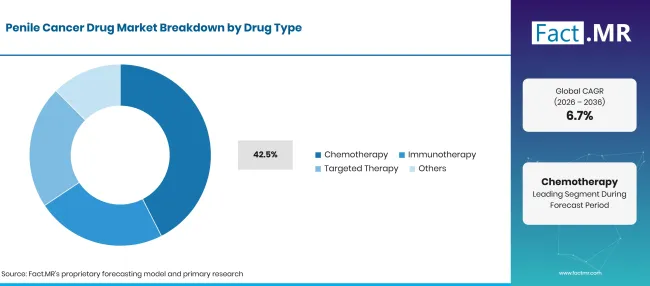
Penile Cancer Drug Market Breakdown Drug Type | Source: Fact.MR
| Drug Type | Share (2026) |
|---|---|
| Chemotherapy (Leading segment) | 42.5% |
| Other segments combined | 57.5%* |
| Total | 100.0% |
Source: Fact.MR analysis. Updated Nov 5, 2026
Chemotherapy remains an established systemic treatment option for advanced penile cancer. Platinum-based combinations are used in selected patients, with the regimen depending on disease extent and the patient's general health. Immunotherapy and targeted therapy are being evaluated or considered in selected clinical settings, particularly where tumour biomarkers provide a rationale for treatment.
What leads the Treatment Type segment?
Surgical treatment is a clinical care pathway, not a pharmaceutical product category; the original treatment-type breakdown requires reclassification.
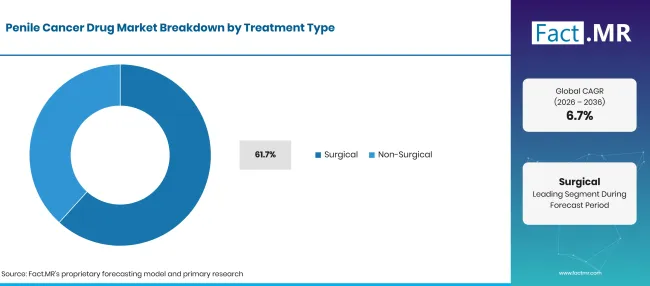
Penile Cancer Drug Market Breakdown Treatment Type | Source: Fact.MR
| Treatment Type | Share (2026) |
|---|---|
| Surgical care (outside drug-market scope) | N/A — reclassification required |
| Other segments combined | N/A — reclassification required |
| Total | N/A — reclassification required |
Source: Fact.MR analysis. Updated Nov 5, 2026
Surgery remains a primary clinical treatment approach for many patients with localized penile cancer, but surgical procedures should not be counted as sales within a drug market. Early-stage tumours can often be managed through organ-preserving procedures or partial and total penectomy, depending on tumor extent. Surgical intervention also plays an important role in managing regional lymph node involvement. Although surgery is not a drug treatment, its widespread use influences demand for perioperative medicines and systemic therapies used alongside treatment. Patients with advanced or metastatic disease may require chemotherapy or immunotherapy. This creates demand for drug-based treatment options in addition to surgical management.
Which Distribution Channel accounts for the largest share?
Hospital Pharmacies are projected to account for 52.1% share in 2026.
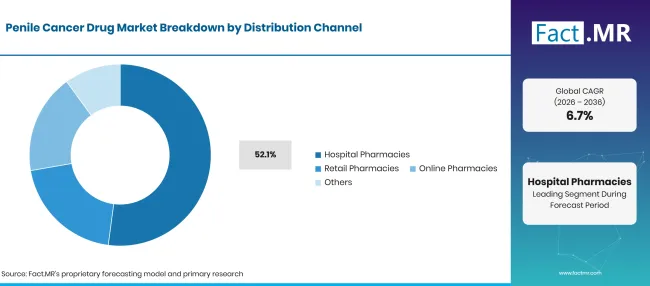
Penile Cancer Drug Market Breakdown Distribution Channel | Source: Fact.MR
| Distribution Channel | Share (2026) |
|---|---|
| Hospital Pharmacies (Leading segment) | 52.1% |
| Other segments combined | 47.9%* |
| Total | 100.0% |
Source: Fact.MR analysis. Updated Nov 5, 2026
Hospital pharmacies are an important channel for oncology medicines supplied through specialist treatment centres. Treatment protocols often require prescription oversight and coordination with oncology teams. Retail and online pharmacies may serve selected outpatient prescriptions, subject to local dispensing rules and medicine availability.
What is accelerating Penile Cancer Drug Market adoption, and what is holding it back?
Demand for systemic treatment in advanced disease supports market development, while the rarity of the cancer and limited disease-specific clinical evidence constrain wider adoption.
Drivers Impact Analysis
| DRIVER | (~) % IMPACT ON CAGR | GEOGRAPHIC RELEVANCE | IMPACT TIMELINE |
|---|---|---|---|
| Use of platinum-based chemotherapy | +0.9% | Global | Short term (≤ 2 years) |
| Greater diagnosis and management of advanced disease | +0.8% | Global | Medium term (2–4 years) |
| Biomarker testing for treatment selection | +0.6% | North America, Europe | Medium term (2–4 years) |
| Specialist oncology treatment access | +0.5% | Global | Medium term (2–4 years) |
| Clinical research into new systemic therapies | +0.4% | North America, Europe, Asia | Long term (≥ 4 years) |
Source: Fact.MR analysis. Updated Nov 5, 2026
Opportunity Impact Analysis
| OPPORTUNITY | (~) % IMPACT ON CAGR | GEOGRAPHIC RELEVANCE | IMPACT TIMELINE |
|---|---|---|---|
| Biomarker-guided immunotherapy research | +0.8% | North America, Europe | Medium term (2–4 years) |
| Development of disease-specific clinical trials | +0.7% | Global | Long term (≥ 4 years) |
| Research into targeted treatment approaches | +0.6% | Global | Long term (≥ 4 years) |
| Improved access to specialist cancer centres | +0.5% | Asia, Latin America | Medium term (2–4 years) |
| Evidence-based treatment pathways | +0.4% | Global | Medium term (2–4 years) |
Source: Fact.MR analysis. Updated Nov 5, 2026
Restraints Impact Analysis
| RESTRAINT | (~) % IMPACT ON CAGR | GEOGRAPHIC RELEVANCE | IMPACT TIMELINE |
|---|---|---|---|
| Low disease incidence in many markets | -0.8% | North America, Europe | Long term (≥ 4 years) |
| Limited disease-specific clinical trial evidence | -0.7% | Global | Long term (≥ 4 years) |
| Adverse effects and tolerability of systemic therapy | -0.6% | Global | Short term (≤ 2 years) |
| High cost of advanced oncology medicines | -0.5% | Global | Medium term (2–4 years) |
| Limited access to specialist diagnosis and care | -0.4% | Emerging markets | Medium term (2–4 years) |
Source: Fact.MR analysis. Updated Nov 5, 2026
Which countries are scaling the Penile Cancer Drug Market through 2036?
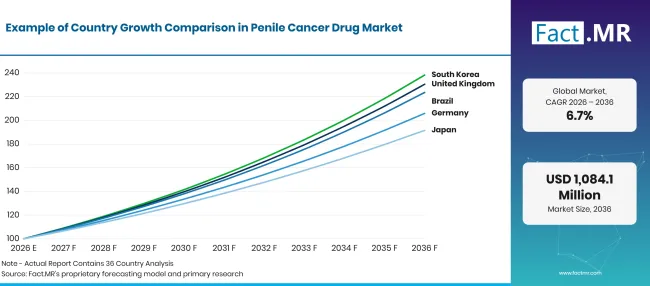
Penile Cancer Drug Market Growth Index | Source: Fact.MR
| Country | CAGR (2026–2036) |
|---|---|
| Germany | 7.5% |
| Brazil | 8.4% |
| USA | 4.7% |
| UK | 8.7% |
| Japan | 6.7% |
Source: Fact.MR analysis. Updated Nov 5, 2026
What supports Germany adoption?
7.5% CAGR, supported by specialist oncology services and the need for systemic treatment in advanced disease.
Germany is among the European countries with an intermediate incidence of penile cancer, although rates vary across regional registries. The availability of specialist urology and oncology services can support access to systemic treatment for eligible patients.
What supports market development in the Brazil?
8.4% CAGR, driven by a comparatively high disease burden and demand for improved cancer care access.
Brazil’s market outlook reflects a relatively high disease burden and the need to improve access to cancer diagnosis and treatment. Expanding oncology services, wider patient identification and efforts to strengthen specialist care can support demand. However, affordability, uneven access to advanced therapies and regional differences in healthcare capacity may influence adoption
How is the United States supporting market growth?
4.7% CAGR, shaped by a relatively low incidence rate and access to advanced oncology treatment.
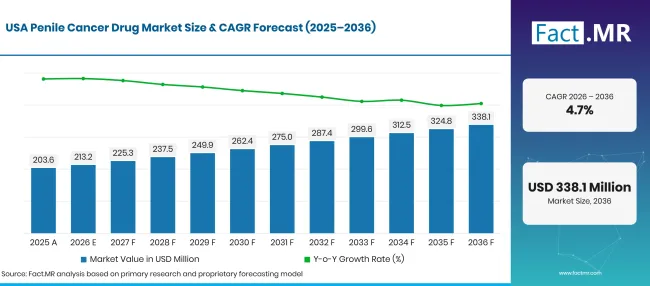
Penile Cancer Drug Market Forecast Usa | Source: Fact.MR
Penile cancer is rare in the United States, with an incidence rate below one case per 100,000 men annually. The National Cancer Institute estimated 2,190 new cases and 510 deaths from penile and other male genital cancers combined in 2025 [1]. Specialist cancer centres provide access to systemic chemotherapy and clinical research. Biomarker-guided treatment may also be considered for selected patients when tumour characteristics meet the relevant treatment criteria.
How is the United Kingdom advancing in the market?
8.7% CAGR, led by specialist cancer services and the need for treatment of advanced disease.
Cancer Research UK reports around 820 new penile cancer cases annually in the UK based on 2019 and 2021–2022 data; 34% of cases occurred in people aged 75 or older during those periods [7]. These patterns highlight the importance of age-appropriate diagnosis and treatment planning.
What supports Japan adoption?
6.7% CAGR, backed by specialist cancer management and access to advanced pharmaceutical treatment.
Penile cancer remains uncommon in Japan. Treatment decisions depend on tumour stage and patient condition. Access to specialist urological oncology services can support the use of systemic therapies in advanced cases, while clinical research may create opportunities for newer treatment approaches.
Who leads the Penile Cancer Drug Market?
Fact.MR profiles Pfizer, Bristol Myers Squibb, Merck & Co., and Roche Holding AG as companies with established oncology portfolios and relevant pharmaceutical capabilities.
Penile cancer treatment remains heavily dependent on established chemotherapy regimens. Immunotherapy and targeted treatments are under investigation in advanced penile cancer; their use requires careful consideration of tumour biomarkers, regulatory indications and the limited penile cancer-specific clinical evidence [6]. The EAU recommends clinical trial enrolment for patients whose disease progresses during platinum chemotherapy, given the limited evidence for subsequent systemic treatment options [6]. Pfizer Inc. has an oncology portfolio covering genitourinary cancers and multiple drug modalities, including antibody-drug conjugates and biologics [5].
Bristol Myers Squibb markets nivolumab and ipilimumab and maintains a broad oncology pipeline. Its current published pipeline includes several solid-tumour programmes, but the cited portfolio information does not establish an approved penile cancer indication. Merck & Co. markets pembrolizumab (KEYTRUDA), a PD-1 inhibitor.
Which companies are the key providers?
The following companies are included in the competitive set because of their oncology drug portfolios and pharmaceutical development capabilities.
- Pfizer Inc.
- Bristol Myers Squibb
- Merck & Co.
- Roche Holding AG
Bibliography
- [1] National Cancer Institute. (2025, May 7). Penile Cancer Treatment (PDQ®)–Health Professional Version.
- [2] NHS. (n.d.). Treatment for penile cancer.
- [3] National Cancer Institute. (n.d.). What is penile cancer?
- [4] NHS England. (2024). Implementing timed urology cancer diagnostic pathway: Penile best practice timed pathway.
- [5] Pfizer Inc. (2026, November 3). Oncology drug pipeline & cancer clinical trials.
- [6] European Association of Urology. (2026). EAU guidelines on penile cancer: Disease management.
- https://uroweb.org/guidelines/penile-cancer/chapter/disease-management
- [7] Cancer Research UK. (2026). Penile cancer incidence statistics (2019 and 2021–2022 datasets).
- https://www.cancerresearchuk.org/health-professional/cancer-statistics/statistics-by-cancer-type/penile-cancer/incidence
This Report Answers
- The report describes the market for pharmaceutical therapies used in penile cancer treatment.
- Drug type analysis compares chemotherapy, immunotherapy and targeted therapy.
- Country analysis discusses Germany, Brazil, the USA, the UK and Japan alongside available epidemiological evidence.
- The competitive overview profiles Pfizer, Bristol Myers Squibb, Merck & Co., Roche.
- Distribution analysis examines hospital pharmacies, retail pharmacies and online pharmacies.
- Treatment analysis requires a clarified distinction between pharmaceutical treatment and surgical procedures.
What does the Penile Cancer Drug Market cover?
The market covers pharmaceutical products used in the management of penile cancer. It includes chemotherapy medicines and selected immunotherapies or targeted therapies used in appropriate clinical settings. Demand depends on disease stage, tumour characteristics, treatment eligibility and access to specialist oncology services. The market excludes surgical procedures and radiotherapy equipment when measuring pharmaceutical revenue.
What is included in the scope?
Included products are medicines used for systemic treatment of penile cancer.
These include chemotherapy regimens and selected immunotherapy or targeted medicines where their use is supported by an approved indication, biomarker-defined eligibility or clinical research. The distribution analysis covers hospital pharmacies and other pharmaceutical supply channels.
What is excluded from the scope?
The analysis excludes surgical procedures, radiotherapy services and diagnostic procedures from pharmaceutical revenue.
It also excludes medicines used solely for unrelated cancer types unless they have a relevant approved or clinically supported role in penile cancer treatment. Hospital infrastructure, surgical instruments and radiation equipment are outside the defined drug market.
How Was the Analysis Built?
The analysis draws on 120+ sources, 35+ company portfolios, 25+ countries and more than 20 industry interviews.
- Primary Research: Primary research includes discussions with pharmaceutical manufacturers, oncology specialists, distributors, healthcare providers and subject-matter experts. These discussions examine treatment preferences, medicine access, clinical adoption, pricing and the factors influencing pharmaceutical demand.
- Desk Research: Desk research covers clinical practice guidelines, cancer registries, government health statistics, regulatory publications, company filings, clinical trial records and peer-reviewed research. Sources are documented in the bibliography.
- Market Sizing and Forecasting: Market estimates combine historical performance, treatment patterns, drug pricing, patient populations, product availability, segment shares, country-level growth and barriers to treatment access.
- Data Validation and Update Cycle: Findings are reviewed against clinical guidelines, regulatory changes, company pipeline updates, product approvals and changes in treatment practice. Market analysis revisited as new clinical evidence becomes available.
Segmentation
What is the report’s scope and coverage?
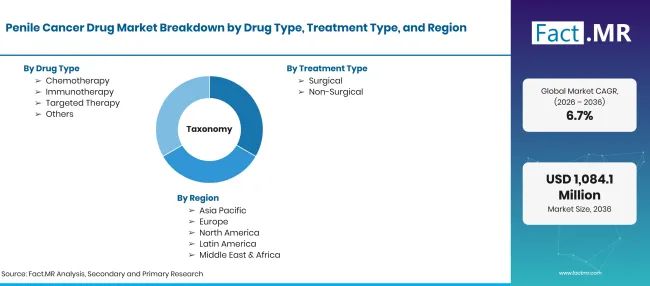
Penile Cancer Drug Market Taxonomy 1 | Source: Fact.MR
| Attribute | Details |
|---|---|
| Quantitative Units | USD billion in 2026 to USD billion by 2036, at CAGR |
| Market Definition | The penile cancer drug market comprises pharmaceutical products used to treat penile cancer across different stages of the disease. It includes chemotherapy drugs and immunotherapy agents as well as targeted therapies investigated or used in eligible patients. |
| Drug Type | Chemotherapy; Immunotherapy; Targeted Therapy; Others |
| Treatment Type | Surgical; Non-Surgical |
| Distribution Channel | Hospital Pharmacies; Retail Pharmacies; Online Pharmacies; Others |
| Regions Covered | North America; Latin America; Western Europe; Eastern Europe; East Asia; South Asia & Pacific; Middle East & Africa |
| Countries Covered | Germany; Brazil; USA; UK; Japan |
| Companies Profiled | Pfizer; Bristol Myers Squibb; Merck & Co.; Roche |
| Forecast Period | 2026 to 2036 |
| Approach | Market segmentation and scenario-based analysis supported by clinical guidelines, cancer statistics and company portfolio information |
Source: Fact.MR analysis. Updated Nov 5, 2026
How is the market segmented?
-
By Drug Type
- Chemotherapy
- Immunotherapy
- Targeted Therapy
- Others
-
By Treatment Type
- Surgical
- Non-Surgical
-
By Distribution Channel
- Hospital Pharmacies
- Retail Pharmacies
- Online Pharmacies
- Others
-
By Region
- North America
- Latin America
- Western Europe
- Eastern Europe
- East Asia
- South Asia & Pacific
- Middle East & Africa
Frequently Asked Questions
How big is the Penile Cancer Drug Market in 2026?
What is the CAGR from 2026 to 2036?
Which drug type has the largest share?
Which treatment type has the largest share?
Which distribution channel leads?
Which country is projected to grow fastest?
Which companies are covered?
Who worked on this report


Preview the report firsthand - request a free sample
Free SampleGet the brochure for pricing and purchase details
Download PDF