- Market Value (2025): USD 833.9 Mn
- Estimated Value (2026): USD 891.7 Mn
- Forecast Value (2036): USD 1742.7 Mn
- CAGR (2026-2036): 6.9%
What is the Percutaneous Screw Placement Systems Market forecast to be worth by 2036?
USD 891.7 million in 2026 to USD 1742.7 million by 2036 at a 6.9% CAGR.
- At USD 833.9 million in 2025, the percutaneous screw placement systems market drew most of its revenue from hospital-based spinal procedures.
- Revenue will advance from USD 891.7 million in 2026 to USD 1742.7 million by 2036 as minimally invasive fixation spreads across spinal, orthopedic and trauma surgery.
- A 6.9% CAGR will carry the market through 2036, with shorter recovery and outpatient suitability widening clinical use.
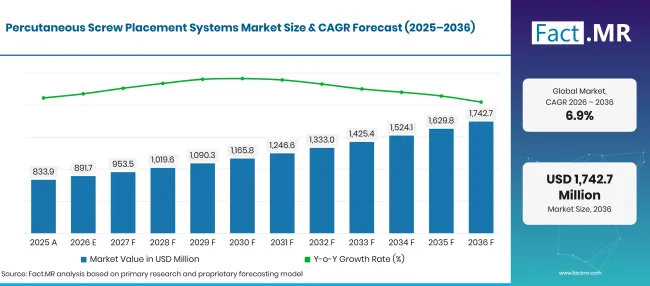
Percutaneous Screw Placement Systems Market Forecast Global | Source: Fact.MR
| Year | Basis | Market Value (USD million) |
|---|---|---|
| 2025 | Actual | 833.9 |
| 2026 | Estimate | 891.7 |
| 2036 | Forecast | 1,742.7 |
| CAGR 2026 to 2036 | Forecast period | 6.9% |
Source: Fact.MR analysis. Updated Oct 26, 2026
What are the defining numbers behind Percutaneous Screw Placement Systems Market growth?
The 2026 to 2036 period will add USD 851.0 million in new value, led by hospital spinal fixation and solid screw systems.
Demand Drivers in the Market
- Aging populations widen the pool of degenerative spine and fragility fracture patients. The World Health Organization reported in October 2025 that 1.4 billion people will be aged 60 or older by 2030, up from 1 billion in 2020 [1]. Older patients tend to tolerate a small-incision fixation better than open fusion.
- Payers in the United States are opening outpatient routes for orthopedic surgery. In its CY 2026 outpatient payment final rule, the Centers for Medicare & Medicaid Services added 289 procedures to the ambulatory surgical center covered procedures list and removed 285 procedures, mostly musculoskeletal, from the inpatient only list [2]. Short stays reward instrumentation that limits blood loss and tissue trauma.
- Navigation and robotics are tightening control over screw trajectory. The U.S. Food and Drug Administration cleared the Stealth AXiS surgical system with its spine clinical application on February 12, 2026 [3]. Integrated planning and guidance lower the risk of pedicle breach when the surgeon cannot see the bone directly.
- Surgeons trained in minimally invasive technique now treat single and two-level degenerative cases percutaneously as routine work. Fellowship programs and vendor courses have shortened the learning period for guidewire-based insertion.
- Trauma teams use cannulated screws for pelvic ring and femoral neck fractures in older patients. A small incision reduces wound complications and gets the patient walking sooner.
Key Segments Analyzed
- By Product Type: Solid Screws will capture 58.3% share in 2026, since single-pass insertion without a guidewire exchange suits high-volume routine fixation.
- By Application: Spinal Surgery will account for 43.2% share in 2026, driven by steady caseloads in degenerative disc disease, stenosis and deformity correction.
- By End-User: Hospitals will command 61.2% share in 2026, given that their imaging suites and inpatient beds absorb complex reconstruction and trauma cases.
Analyst Opinion at Fact.MR
Shambhu Nath Jha, Principal Consultant at Fact.MR, states, “Accuracy, revision risk and fit with existing imaging and navigation equipment now weigh heavily when surgeons pick a percutaneous screw system. Hospitals keep the bulk of demand, since multi-level reconstructions and trauma cases need full surgical support. As outpatient spine surgery grows, companies that pair versatile screw sets with dependable navigation links and hands-on clinical support will gain ground.”
Strategic Implications
- Implant manufacturers should keep solid and cannulated screws within one tray family, so hospitals and specialty clinics can match the screw to bone quality and case complexity.
- Ambulatory surgical center operators should standardize on complete percutaneous kits with single-use instruments, which cut room turnover time between cases.
- Navigation and imaging vendors should open their interfaces to third-party screw sets, as purchasing committees increasingly resist being locked into one platform.
- Hospital procurement teams should spread implant contracts across more than one manufacturing region to limit tariff exposure on titanium and cobalt-chrome components.
At 8.4% CAGR, Germany will stay ahead, where established spine centers and an older population keep caseloads high. Brazil comes next at 7.7% as private hospital groups add orthopedic capacity for a large insured population. In the United States, a 6.9% pace reflects elective fixation shifting into ambulatory surgical centers. For the United Kingdom, growth of 6.2% ties to NHS surgical hubs that move suitable cases through faster. Japan closes the group at 5.5%, with fragility fractures in an aged population sustaining steady but measured uptake.
How does the Percutaneous Screw Placement Systems Market break down by segment?
Solid Screws will lead Product Type at 58.3%; Spinal Surgery will top Application at 43.2%; Hospitals will head End-User at 61.2%.
Why do Solid Screws lead Product Type?
Solid Screws take 58.3% of 2026 sales.
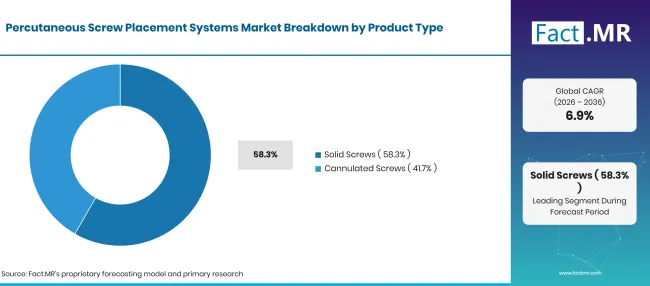
Percutaneous Screw Placement Systems Market Breakdown Product Type | Source: Fact.MR
| Product Type | Share (2026) |
|---|---|
| Solid Screws (Leading segment) | 58.3% |
| Other segments combined | 41.7%* |
| Total | 100.0% |
Source: Fact.MR analysis. Updated Oct 26, 2026
A solid screw goes in with one pass and no guidewire exchange, which trims steps from single and two-level spinal fixation. That simplicity fits the routine lumbar cases that fill most spine lists. Many hospitals buy these screws inside broader spinal implants and devices contracts. Cannulated screws serve a different set of cases. Surgeons choose them for osteoporotic bone, deformity and revision work, where a guidewire helps hold the planned path. For high-volume hospitals, the lower unit cost and lighter instrument trays of solid screws keep them the practical default.
What supports Spinal Surgery within Application?
Spinal Surgery holds 43.2% of 2026 revenue.
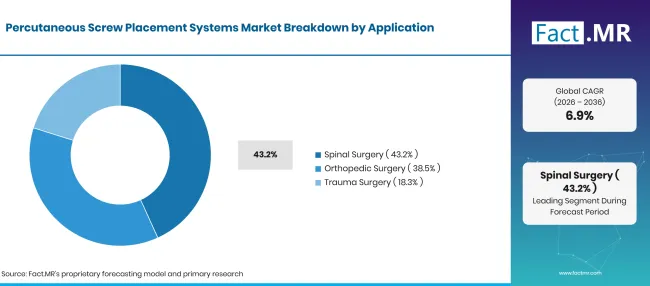
Percutaneous Screw Placement Systems Market Breakdown Application | Source: Fact.MR
| Application | Share (2026) |
|---|---|
| Spinal Surgery (Leading segment) | 43.2% |
| Other segments combined | 56.8%* |
| Total | 100.0% |
Source: Fact.MR analysis. Updated Oct 26, 2026
Degenerative disc disease, spinal stenosis and adult deformity generate a continuous queue of fusion cases. Procedures that once required long midline exposure now proceed through stab incisions, even in multi-level constructs. Fixation remains the core revenue pool within the wider spine devices category. Orthopedic surgery applies percutaneous screws to pelvic and long-bone fixation where soft tissue protection speeds rehabilitation. Trauma surgery is a smaller application. Fragility fractures among older adults still create a steady need for percutaneous fixation within orthopedic devices budgets.
What leads the End-User segment?
Hospitals represent 61.2% of 2026 demand.
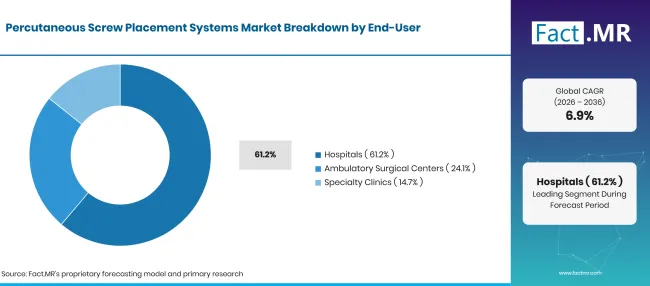
Percutaneous Screw Placement Systems Market Breakdown End User | Source: Fact.MR
| End-User | Share (2026) |
|---|---|
| Hospitals (Leading segment) | 61.2% |
| Other segments combined | 38.8%* |
| Total | 100.0% |
Source: Fact.MR analysis. Updated Oct 26, 2026
Complex spinal reconstructions, polytrauma and revision surgery require advanced intraoperative imaging, anesthesia cover and postoperative beds. Those capabilities keep high-acuity percutaneous cases inside hospital theaters. Many large hospitals also run robotic surgery programs that pair with navigated screw placement. Ambulatory surgical centers are taking on elective single and two-level fixation for patients fit for same-day discharge. The CY 2026 Medicare changes widen that opening [2]. Specialty clinics handle a narrower set of less complex spinal and orthopedic cases that need no overnight monitoring.
What is accelerating Percutaneous Screw Placement Systems Market adoption, and what is holding it back?
Faster recovery, wider outpatient coverage and navigation-assisted accuracy draw surgeons toward percutaneous screw placement. High instrumentation costs, a learning curve for less experienced surgeons and payment limits in some outpatient settings slow uptake among cost-sensitive providers.
Drivers Impact Analysis
| DRIVER | (~) % IMPACT ON CAGR | GEOGRAPHIC RELEVANCE | IMPACT TIMELINE |
|---|---|---|---|
| Surgeon shift toward minimally invasive spine fixation | +2.6% | Global | Short term (<= 2 years) |
| Expansion of ambulatory surgical center capacity | +2.1% | North America, Western Europe | Medium term (2-4 years) |
| Rising trauma caseloads in aging populations | +1.4% | Global | Medium term (2-4 years) |
| Navigation and imaging-guided placement gaining ground | +0.8% | Global | Long term (>= 4 years) |
Source: Fact.MR analysis. Updated Oct 26, 2026
Opportunity Impact Analysis
| OPPORTUNITY | (~) % IMPACT ON CAGR | GEOGRAPHIC RELEVANCE | IMPACT TIMELINE |
|---|---|---|---|
| Bundled percutaneous kits tailored for ambulatory centers | +1.2% | North America, Western Europe | Medium term (2-4 years) |
| Private hospital network expansion across emerging markets | +0.9% | Latin America | Medium term (2-4 years) |
| Partnerships linking screw makers with navigation vendors | +0.6% | Global | Long term (>= 4 years) |
| Revision-focused cannulated screw lines | +0.3% | Global | Long term (>= 4 years) |
Source: Fact.MR analysis. Updated Oct 26, 2026
Restraints Impact Analysis
| RESTRAINT | (~) % IMPACT ON CAGR | GEOGRAPHIC RELEVANCE | IMPACT TIMELINE |
|---|---|---|---|
| Premium pricing on navigation-compatible instrumentation | -0.6% | Global | Medium term (2-4 years) |
| Payment ceilings on outpatient spine procedures | -0.4% | North America | Short term (<= 2 years) |
| Learning curve for surgeons adapting to percutaneous technique | -0.3% | Global | Long term (>= 4 years) |
Source: Fact.MR analysis. Updated Oct 26, 2026
Which countries are scaling the Percutaneous Screw Placement Systems Market through 2036?
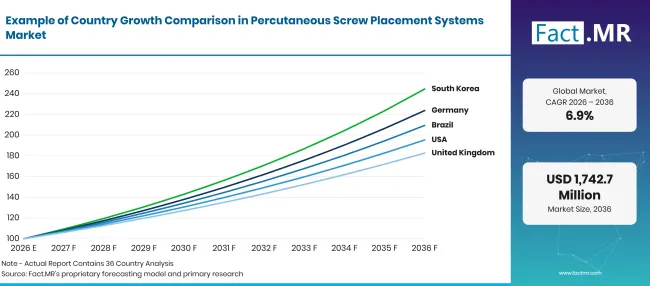
Percutaneous Screw Placement Systems Market Growth Index | Source: Fact.MR
| Country | CAGR (2026 to 2036) |
|---|---|
| Germany | 8.4% |
| Brazil | 7.7% |
| United States | 6.9% |
| United Kingdom | 6.2% |
| Japan | 5.5% |
Source: Fact.MR analysis. Updated Oct 26, 2026
What supports Germany’s adoption?
8.4% CAGR, reflecting established spine-surgery services and an aging population.
Germany runs a dense network of spine centers that already perform navigated fusion, so percutaneous instrumentation fits existing workflows. Destatis reported that the share of people aged 65 and over rose from 15% in 1991 to 23% in 2025 [4]. That older base adds degenerative spine and osteoporotic fracture cases each year. Hospital buyers favor screw systems that work with their installed navigation equipment.
How is Brazil scaling demand?
7.7% CAGR, driven by expanding private hospital networks.
Private hospital groups in São Paulo, Rio de Janeiro and other large cities are adding spine and orthopedic capacity. The supplementary health regulator ANS counted 53,055,406 beneficiaries in medical assistance plans in June 2026 [5]. That insured population gives private hospitals the case volume to justify navigation-compatible percutaneous kits. Urban road trauma adds further fixation demand.
How does the United States perform?
6.9% CAGR, as elective fixation moves into outpatient settings.
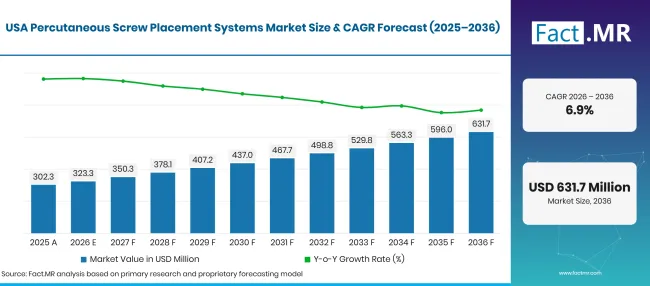
Percutaneous Screw Placement Systems Market Forecast Usa | Source: Fact.MR
The U.S. Census Bureau reported that the population aged 65 and older reached 61.2 million in 2024, up 13.0% from 2020 [6]. Medicare’s CY 2026 rule opened more musculoskeletal procedures to outpatient billing, which lets ambulatory centers schedule more single-level fusion cases [2]. Recent navigation clearances also encourage established spine centers to upgrade their screw placement technology [3].
What is supporting the United Kingdom’s adoption?
6.2% CAGR, helped by a gradual shift of spine surgery into day-case pathways.
NHS England reported a waiting list of 7.29 million in early 2026 and credited elective surgery hubs and high-intensity theatre lists with raising throughput [7]. Percutaneous fixation suits this model because patients mobilize sooner and free beds faster. The Office for National Statistics reported that England’s population aged 65 and over grew 2.0% in the year to mid-2025 [8].
How is Japan developing demand?
5.5% CAGR, backed by age-related spinal conditions and fragility fractures.
The Statistics Bureau of Japan estimated 36.24 million residents aged 65 and over in September 2026, a record 29.6% of the population [9]. Osteoporotic vertebral and hip fractures in this group keep fixation caseloads steady. New systems spread more gradually in Japan’s mature device market, which tempers growth despite strong clinical need.
Who leads the Percutaneous Screw Placement Systems Market?
Competition splits into two tiers. Full-line spine companies pair screw systems with their own navigation or robotics, so a hospital that buys the platform tends to buy the implants too. Medtronic links its spinal screw systems to its navigation range and announced FDA clearance in February 2026 for Stealth AXiS, which combines planning, navigation and robotics for spine surgery [10]. Globus Medical ties its screw sets to ExcelsiusGPS.
In September 2026 it won a CE mark for the Excelsius3D imaging system, and in October 2026 it showed SCRIPT patient-specific plans that import into ExcelsiusGPS [11, 12]. DePuy Synthes offers the VIPER PRIME percutaneous system, while Alphatec builds around its Valence navigation and robotics platform. A second tier competes on narrower strengths: B. Braun through Ennovate navigation-ready screws, Orthofix through posterior fixation supported by 7D FLASH navigation, and Zimmer Biomet through cannulated screws for trauma. Placement accuracy, platform compatibility and surgeon training will separate the suppliers that win new accounts.
Which companies are the key providers?
Key companies include Medtronic plc; DePuy Synthes; Globus Medical, Inc.; Alphatec Holdings, Inc.; B. Braun SE; Orthofix Medical Inc.; and Zimmer Biomet Holdings, Inc.
- Medtronic plc
- DePuy Synthes
- Globus Medical, Inc.
- Alphatec Holdings, Inc.
- B. Braun SE
- Orthofix Medical Inc.
- Zimmer Biomet Holdings, Inc.
Bibliography
- [1] World Health Organization. (2025, October 1). Ageing and health.
- [2] Centers for Medicare & Medicaid Services. (2025, November 21). Calendar Year 2026 Hospital Outpatient Prospective Payment System (OPPS) and Ambulatory Surgical Center Final Rule (CMS-1834-FC).
- [3] U.S. Food and Drug Administration. (2026, February 12). 510(k) Premarket Notification K253381: Stealth AXiS Surgical System with Stealth AXiS Spine clinical application.
- [4] Statistisches Bundesamt (Destatis). (2026, August 18). Ältere Menschen: Bevölkerung ab 65 Jahren [Older people: Population aged 65 and over].
- [5] Agência Nacional de Saúde Suplementar. (2026, October 5). Dados gerais [General data].
- [6] U.S. Census Bureau. (2025, June 26). Older Adults Outnumber Children in 11 States and Nearly Half of U.S. Counties.
- [7] NHS England. (2026, February 12). NHS waiting list lowest in almost 3 years as NHS battled busiest winter on record.
- [8] Office for National Statistics. (2026, October 1). Population estimates for the UK, England, Wales, Scotland and Northern Ireland: mid-2025.
- [9] Statistics Bureau of Japan. (2026, September 20). Statistical Topics No. 149: The elderly in Japan from a statistical perspective, on Respect for the Aged Day.
- [10] Medtronic. (2026, February 13). Medtronic receives FDA clearance for Stealth AXiS surgical system, first integrated planning, navigation and robotics platform for spine surgery.
- [11] Globus Medical. (2026, September 3). Globus Medical Announces CE Mark for Excelsius3D Imaging System.
- [12] Globus Medical. (2026, October 14). Globus Medical to Showcase SCRIPT Patient-Specific Implants and New XLIF Prone Procedural Solution at NASS 2026.
This Report Answers
- Revenue is broken out by product type, application and end-user, built up from procedure volumes.
- For every segment, readers learn which subsegment comes first and the clinical need behind its 2026 share.
- Spine caseloads, reimbursement conditions and hospital capacity frame how the five listed countries compare.
- Supplier profiles group full-line spine companies and focused trauma and navigation specialists by how each one competes.
- Screw design, navigation compatibility and the shift between care settings are tracked to show where adoption is heading.
What does the Percutaneous Screw Placement Systems Market cover?
Systems that insert screws through small incisions for spinal, orthopedic and trauma fixation form this market. Its two product categories are solid screw systems and cannulated screw systems, which use guidewires to position each screw.
Demand is assessed across spinal, orthopedic and trauma procedures, with hospitals, ambulatory surgical centers and specialty clinics as the end-user groups. Revenue is counted when healthcare providers purchase the systems.
What is included in the scope?
Complete solid and cannulated screw kits used in spinal, orthopedic and trauma procedures are counted, including screws, insertion instruments and any accompanying guidewires. Compatible drivers, taps and cannulated access instruments are included when sold as part of the screw system.
Percutaneous screws sold within wider orthopedic implant portfolios are counted at the value of the screw system alone.
What is excluded from the scope?
Conventional open-surgery screw and plate systems not designed for percutaneous insertion are left out. Separately sold navigation and imaging platforms are also excluded.
Spinal cages and other implants that do not function as screw systems are outside the boundary, as are bone grafts and substitutes used alongside fixation.
How Was the Analysis Built?
The analysis draws on 120+ sources, 35+ company portfolios, 25+ countries, and more than 20 industry interviews.
- Primary Research: Primary research includes discussions with manufacturers, service providers, technology developers, distributors, end users, and subject-matter experts. These conversations examine purchasing priorities, product adoption, operational challenges, approval requirements, competitive positioning, and the factors that influence wider market acceptance.
- Desk Research: Desk research covers government statistics, regulatory publications, company filings, trade data, technical studies, industry associations, standards, public policy, and other authoritative sources. Every source used in the analysis is documented in the bibliography.
- Market Sizing and Forecasting: Market estimates combine historical performance, demand indicators, pricing and volume trends, segment shares, company participation, country-level growth, adoption patterns, investment activity, and barriers to market expansion.
- Data Validation and Update Cycle: Findings are validated by comparing primary interviews with public data, company activity, regulatory changes, trade patterns, and industry developments. Regular updates review new product launches, capacity changes, partnerships, approvals, and shifts in commercial adoption.
Segmentation
What is the report’s scope and coverage?
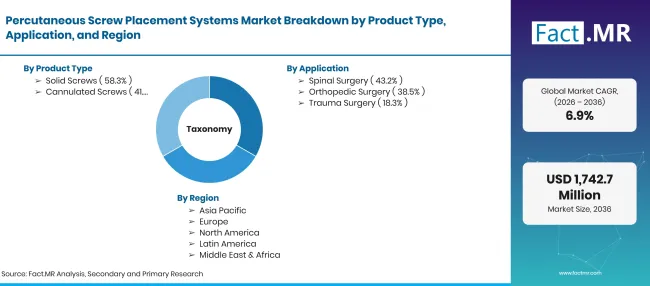
Percutaneous Screw Placement Systems Market Taxonomy | Source: Fact.MR
| Attribute | Details |
|---|---|
| Quantitative Units | USD million in 2026 to USD million by 2036 at CAGR |
| Market Definition | Instrumentation and implants used to place solid and cannulated screws through small incisions for spinal, orthopedic and trauma fixation, sold as screw systems to hospitals, ambulatory surgical centers and specialty clinics. |
| Product Type | Solid Screws; Cannulated Screws |
| Application | Spinal Surgery; Orthopedic Surgery; Trauma Surgery |
| End-User | Hospitals; Ambulatory Surgical Centers; Specialty Clinics |
| Regions Covered | North America; Latin America; Western Europe; Eastern Europe; East Asia; South Asia & Pacific; Middle East & Africa |
| Countries Covered | Germany; Brazil; United States; United Kingdom; Japan |
| Companies Profiled | Medtronic plc; DePuy Synthes; Globus Medical, Inc.; Alphatec Holdings, Inc.; B. Braun SE; Orthofix Medical Inc.; Zimmer Biomet Holdings, Inc. |
| Forecast Period | 2026 to 2036 |
| Approach | Top-down and bottom-up approach using procedure volumes and average selling prices by screw type; care-setting split across hospitals, ambulatory surgical centers and specialty clinics; country-level adoption; and supplier portfolio review. |
Source: Fact.MR analysis. Updated Oct 26, 2026
How is the market segmented?
-
By Product Type
- Solid Screws
- Cannulated Screws
-
By Application
- Spinal Surgery
- Orthopedic Surgery
- Trauma Surgery
-
By End-User
- Hospitals
- Ambulatory Surgical Centers
- Specialty Clinics
-
By Region
- North America
- Latin America
- Western Europe
- Eastern Europe
- East Asia
- South Asia & Pacific
- Middle East & Africa
Frequently Asked Questions
How large is the percutaneous screw placement systems market in 2025?
What growth rate will the percutaneous screw placement systems market record from 2026 to 2036?
Which product type leads the percutaneous screw placement systems market?
Which application holds the greatest share of the percutaneous screw placement systems market?
Which end-user contributes the most to the percutaneous screw placement systems market?
Which country will record the strongest growth in the percutaneous screw placement systems market?
Who are the main companies in the percutaneous screw placement systems market?
Who worked on this report


Preview the report firsthand - request a free sample
Free SampleGet the brochure for pricing and purchase details
Download PDF