- Base Value(2025): 741.2 Mn
- Estimated Value(2026): 792.8 Mn
- Forecast Value (2036): 2138 Mn
- CAGR (2026 - 2036): 6.9%
Permeate Market Forecast and Outlook By Fact.MR
In 2025, the permeate market was valued at USD 741.2 million. Based on Fact MR analysis, demand for permeate is estimated to grow to USD 792.8 million in 2026 and USD 2,138 million by 2036. FMR projects a CAGR of 6.9% during the forecast period.
The absolute dollar growth from 2026 to 2036 is USD 1,345.2 million. This increase reflects steady expansion in dairy ingredient utilization rather than a structural shift in food processing markets. Permeate is widely used in bakery products, processed foods, and animal nutrition as a cost efficient source of lactose and minerals. Food manufacturers continue incorporating permeate powders to improve flavor balance and reduce formulation costs across packaged food categories. Market growth remains moderated by volatility in dairy feedstock prices, fluctuations in milk supply, and regulatory standards governing dairy derived ingredients in processed foods.
India leads with a CAGR of 5.8%, supported by expanding dairy processing capacity and rising demand for cost efficient food ingredients in packaged foods. China follows with a CAGR of 5.3%, reflecting growing dairy ingredient utilization across food manufacturing and animal feed applications. Japan records a CAGR of 4.8%, supported by steady use of permeate in bakery and processed food formulations. The United Kingdom, Germany, and the United States show CAGRs of 4.2%, 4.1%, and 3.9% respectively, reflecting mature dairy processing sectors where permeate demand is largely linked to replacement and formulation adjustments. Strict dairy quality regulations and fluctuations in milk supply act as structural constraints across these established markets.
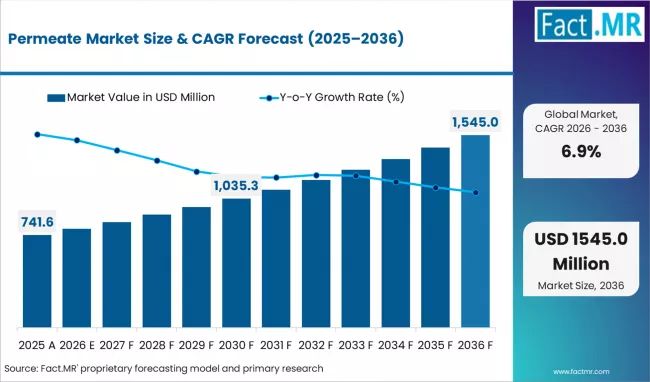
Permeate Market Market Value Analysis | Source: Fact.MR
Permeate Market
| Metric | Details |
|---|---|
| Industry Size (2026E) | USD 792.8 million |
| Industry Value (2036F) | USD 2,138 million |
| CAGR (2026 to 2036) | 6.9% |
Source: Fact.MR analysis. Updated Mar 16, 2026
Permeate Market Definition
The Permeate Market covers dairy by products obtained during the filtration of milk or whey through membrane separation processes such as ultrafiltration. Permeate contains lactose, minerals, and water that pass through the membrane after proteins and fats are removed. It is commonly produced during the manufacture of whey protein concentrate and milk protein concentrate. Permeate is used as a cost effective ingredient in food processing, animal feed, and dairy formulations. Its primary function is to provide lactose based solids that improve texture, sweetness, and nutritional value in processed food and feed products.
Market Inclusions
This report covers global and regional market sizes for permeate products with forecast analysis for the study period. The market is segmented by product type including whey permeate and milk permeate. Application segments include bakery products, dairy beverages, confectionery, animal feed, and processed food formulations. End users include food manufacturers, dairy processors, and livestock feed producers. The report also evaluates pricing patterns, supply structures, and selected trade flow analysis across major dairy producing and consuming regions.
Market Exclusions
The report excludes primary dairy products such as milk powder, cheese, butter, and yogurt. Whey protein concentrates, whey protein isolates, and milk protein concentrates are also excluded since they represent different dairy ingredient categories. The analysis does not include finished consumer dairy foods that contain permeate as a minor ingredient. Non dairy lactose substitutes and synthetic sweeteners are outside the defined scope, as the study focuses strictly on permeate derived from dairy filtration processes.
Research Methodology
- Primary Research: Interviews were conducted with dairy processors, ingredient suppliers, food manufacturers, and animal feed producers.
- Desk Research: Public information was collected from dairy industry publications, government agricultural statistics, company reports, and international trade databases.
- Market-Sizing and Forecasting: A hybrid model combining bottom up production analysis with top down demand assessment across food and feed industries was applied.
- Data Validation and Update Cycle: Findings were cross verified through multiple dairy industry sources and expert reviews, with periodic updates conducted as new production and trade data becomes available.
Summary of the Permeate Market
- Market Definition
- The market comprises dairy derived permeate ingredients produced during filtration of milk or whey through membrane separation processes. Permeate contains lactose, minerals, and water remaining after proteins and fats are removed, and it is used as a functional ingredient in food processing and animal nutrition.
- Demand Drivers
- Rising production of whey protein and milk protein concentrates generating permeate as a byproduct in dairy processing facilities.
- Increasing use of permeate powders in bakery products, confectionery items, and processed food formulations.
- Adoption of permeate as a cost efficient lactose source that improves flavor balance and ingredient functionality in packaged foods.
- Growing demand for carbohydrate rich ingredients in livestock feed formulations.
- Key Segments Analyzed
- Type: Whey permeate accounts for about 60% share supported by its availability as a byproduct of whey protein processing.
- Application: Food and beverage applications represent around 55% share due to use in bakery products, confectionery, and dairy beverages.
- Food Processing Use: Bakery products, snack formulations, and dairy beverages represent key food industry applications for permeate ingredients.
- Geography: India records the fastest expansion supported by increasing dairy processing capacity and food ingredient demand.
- Analyst Opinion at Fact MR
- Shambhu Nath Jha, Principal Consultant, Fact MR, opines, "In this updated edition of the Permeate Market report, industry participants will observe that permeate continues to evolve from a dairy processing byproduct toward a functional ingredient used in industrial food formulations. Dairy processors and food manufacturers incorporate permeate to improve formulation efficiency and maintain ingredient cost control across processed food categories. Companies with large scale dairy processing capacity and stable milk supply networks will maintain advantages in permeate production and distribution."
- Strategic Implications or Executive Takeaways
- Expand processing technologies that convert dairy filtration byproducts into standardized permeate powders for food and feed applications.
- Strengthen supply chain coordination between dairy processors and food manufacturers to ensure stable ingredient availability.
- Develop food grade permeate formulations that meet quality and labeling standards in international food markets.
- Invest in product development programs supporting permeate use in bakery, confectionery, and dairy beverage formulations.
- Methodology
- Primary interviews conducted with dairy processors, ingredient suppliers, food manufacturers, and livestock feed producers.
- Desk research based on dairy industry publications, agricultural statistics databases, company reports, and international trade information.
- Market sizing developed using a hybrid approach combining bottom up production analysis and top down demand assessment across food and feed industries.
- Findings validated through multiple dairy industry data sources and expert consultations following Fact MR internal modeling standards.
Segmental Analysis
Permeate Market Analysis by Type
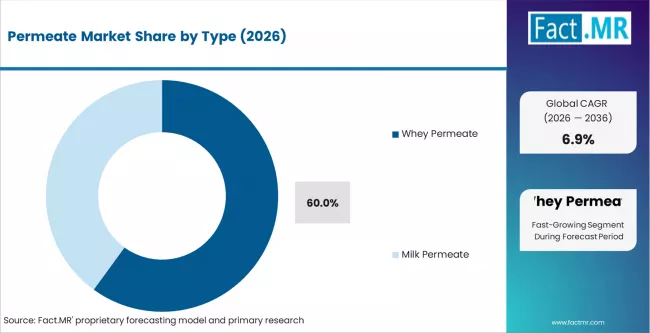
Permeate Market Analysis By Type | Source: Fact.MR
- Market Overview: Whey permeate is projected to account for around 60% share of the permeate market by 2026. Whey permeate is produced as a byproduct during whey protein concentration and ultrafiltration processes used in dairy processing facilities. The ingredient contains lactose, minerals, and small amounts of protein, which makes it suitable for use in food manufacturing and animal feed formulations. Dairy processors utilize whey permeate as a functional ingredient to improve texture, flavor balance, and cost efficiency in food products. The availability of whey permeate from large scale dairy production supports its continued dominance within the permeate market.
- Demand Drivers:
- Dairy Processing Byproduct Utilization: Whey permeate is generated during whey protein processing, allowing dairy manufacturers to utilize byproducts within food and feed applications.
- Cost Efficient Ingredient Source: Food manufacturers incorporate whey permeate as a lactose and mineral source that supports product formulation while maintaining cost control.
- Livestock Feed Applications: Whey permeate is widely used in animal feed formulations due to its carbohydrate content and nutritional profile.
Permeate Market Analysis by Application
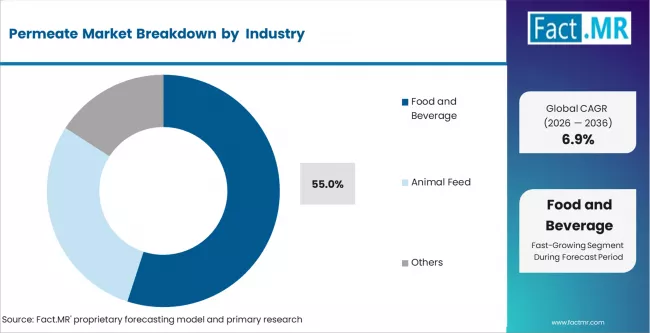
Permeate Market Analysis By Application | Source: Fact.MR
- Market Overview: Food and beverage applications are expected to represent approximately 55% share of the permeate market in 2026. Permeate ingredients are incorporated in bakery products, confectionery items, dairy beverages, and processed foods. The ingredient contributes mild sweetness, mineral content, and functional properties that support food formulation processes. Food manufacturers utilize permeate to improve texture and flavor balance while optimizing ingredient costs. Growing demand for processed foods and dairy based ingredients continues to sustain permeate utilization in food and beverage manufacturing.
- Demand Drivers:
- Processed Food Formulation: Food manufacturers incorporate permeate in bakery, confectionery, and dairy based products to support flavor development and ingredient functionality.
- Ingredient Cost Optimization: Permeate is used as a cost effective dairy ingredient that supports food production efficiency.
- Dairy Based Beverage Production: Beverage manufacturers utilize permeate in flavored milk and dairy beverages to maintain mineral balance and mild sweetness.
Permeate Market Drivers, Restraints, and Opportunities
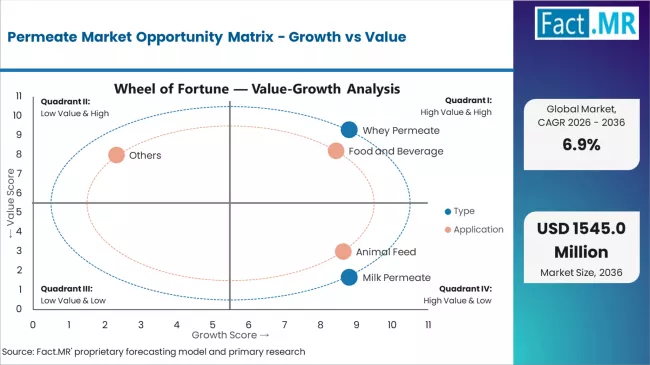
Permeate Market Opportunity Matrix Growth Vs Value | Source: Fact.MR
Fact MR analysis indicates that the permeate market emerged as a byproduct stream from dairy filtration processes used in modern milk and whey processing facilities. Permeate is generated during ultrafiltration and reverse osmosis operations where protein and fat are separated from milk or whey concentrates. The current market valuation reflects the scale of global dairy processing industries where permeate serves as a cost-effective ingredient in food, beverage, and animal feed formulations. Demand persists because permeate contains lactose and minerals that support bulk formulation in bakery, confectionery, and dairy-based food manufacturing.
A structural shift is occurring as permeate transitions from a low-value dairy processing byproduct toward a functional ingredient used in industrial food production. Historically, permeate was often directed toward feed or waste streams due to limited food-grade applications. Food manufacturers now incorporate dairy permeate into bakery products, confectionery fillings, and beverage powders to improve sweetness balance and mineral content while reducing formulation costs. Food-grade permeate ingredients carry higher processing and quality control requirements. Even when total permeate volumes remain linked to dairy production levels, value growth reflects the increasing use of refined permeate powders in commercial food formulations.
- Dairy Processing Output: Growth in whey protein and milk protein concentrate production increases permeate supply generated during filtration-based dairy processing operations.
- Food Ingredient Standards: Regulatory frameworks such as Codex Alimentarius dairy product standards and U.S. Food and Drug Administration dairy ingredient labeling regulations influence permeate classification in food manufacturing.
- Europe Dairy Industry: Countries such as Germany, France, and the Netherlands maintain large dairy processing sectors that generate substantial volumes of milk and whey permeate for food and feed applications.
Regional Analysis
The market analysis covers key global regions, including South Asia, East Asia, North America, and Western Europe. It is segmented geographically, with specific market dynamics for each region. The full report provides a detailed market attractiveness analysis.
.webp "Top Country Growth Comparison Permeate Market Cagr (2026 2036)")
Top Country Growth Comparison Permeate Market Cagr (2026 2036) | Source: Fact.MR
| Country | CAGR (2026-2036) |
|---|---|
| India | 5.8% |
| China | 5.3% |
| Japan | 4.8% |
| United Kingdom | 4.2% |
| Germany | 4.1% |
| USA | 3.9% |
Source: Fact.MR analysis. Updated Mar 16, 2026
Source: Fact MR (FMR) analysis, based on proprietary forecasting model and primary research
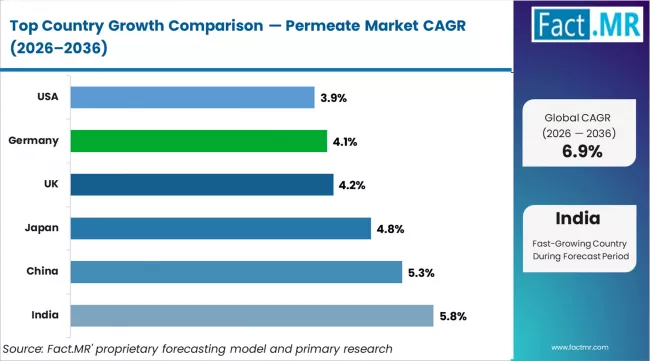
Permeate Market Cagr Analysis By Country | Source: Fact.MR
South Asia
India represents a significant market supported by dairy processing expansion, growth of food ingredient manufacturing, and increasing use of permeate in animal feed and bakery products. Key companies include Gujarat Cooperative Milk Marketing Federation, Fonterra Co-operative Group, and Lactalis Group.
- India: Demand for permeate in India is projected to rise at 5.8% CAGR through 2036. Growth is supported by dairy processing expansion initiatives promoted by the National Dairy Development Board (04-2025) and production capacity expansion by Gujarat Cooperative Milk Marketing Federation (08-2025).
East Asia
China and Japan represent major markets supported by dairy product consumption, processed food production, and ingredient innovation.
- China: Demand for permeate in China is projected to rise at 5.3% CAGR through 2036. Growth is supported by dairy ingredient manufacturing programs (03-2025) and expansion of dairy processing facilities by Fonterra Co-operative Group (07-2025).
- Japan: Demand for permeate in Japan is projected to rise at 4.8% CAGR through 2036. Growth is supported by processed food manufacturing programs promoted by the Ministry of Agriculture, Forestry and Fisheries (04-2025) and dairy ingredient supply expansion by Lactalis Group (08-2025).
North America
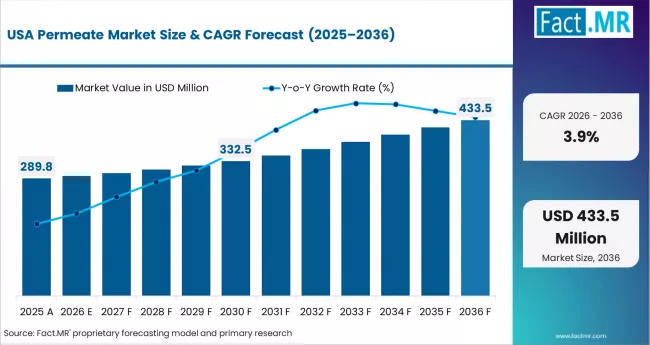
Permeate Market Country Value Analysis | Source: Fact.MR
The USA represents an important market supported by dairy processing industries, feed ingredient demand, and food manufacturing.
- USA: Demand for permeate in the U.S. is projected to rise at 3.9% CAGR through 2036. Growth is supported by dairy ingredient production programs (05-2025) and expansion of permeate ingredient supply by Dairy Farmers of America (09-2025).
Western Europe
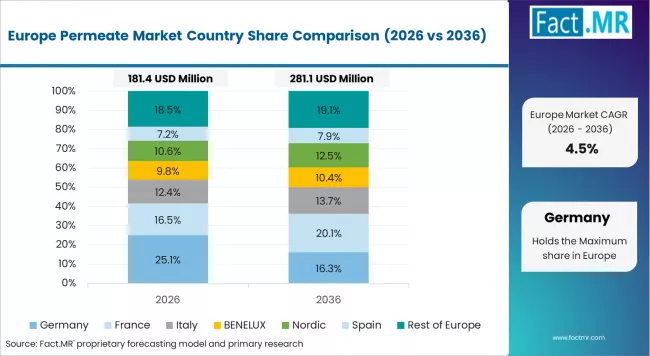
Permeate Market Europe Country Market Share Analysis, 2026 & 2036 | Source: Fact.MR
The United Kingdom and Germany represent key markets supported by dairy ingredient innovation, processed food manufacturing, and feed ingredient demand.
- United Kingdom: Demand for permeate in the UK is projected to rise at 4.2% CAGR through 2036. Growth is supported by dairy ingredient manufacturing programs (03-2025) and product development initiatives by Lactalis Group (07-2025).
- Germany: Demand for permeate in Germany is projected to rise at 4.1% CAGR through 2036. Growth is supported by dairy processing industry expansion (02-2025) and ingredient production initiatives by DMK Group (06-2025).
Fact MR's analysis of the permeate market in South Asia, East Asia, North America, and Western Europe consists of country-wise assessments that include India, China, Japan, the USA, the United Kingdom, and Germany. Readers can find detailed trends, regulatory updates, and company-specific investments shaping market growth in these countries.
Competitive Structure and Buyer Dynamics in the Permeate Market
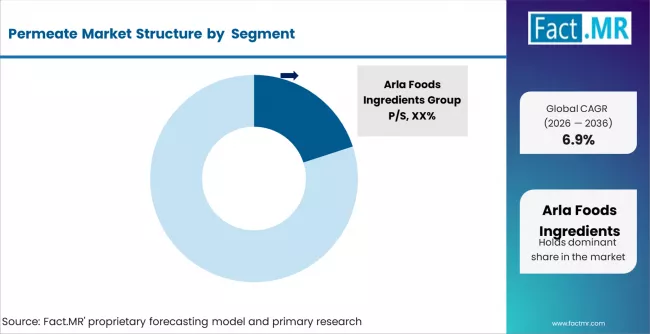
Permeate Market Analysis By Company | Source: Fact.MR
The competitive structure of the Permeate Market is moderately fragmented, with dairy cooperatives and ingredient processors participating across regional supply networks. Major producers such as Arla Foods Ingredients Group P/S, Volac International Limited, Milcobel CV, Foremost Farms USA Cooperative, and Michigan Milk Producers Association maintain strong market positions due to their established dairy processing infrastructure. These organizations produce permeate as a byproduct of whey or milk protein concentration processes and supply it to food manufacturers, animal feed producers, and nutritional product formulators. Companies such as Actus Nutrition, LLC, Dairy Distillery Inc., and NoPalm Ingredients B.V. operate within specialized ingredient processing or value added dairy component segments. Competition within the market is primarily determined by product consistency, mineral composition control, supply reliability, and the ability to meet functional formulation requirements across food and feed applications.
Several companies maintain structural advantages through vertically integrated dairy supply chains and long term relationships with milk producers. Dairy cooperatives such as Foremost Farms USA Cooperative and Michigan Milk Producers Association benefit from direct access to raw milk supplies sourced from member farms. Arla Foods Ingredients Group P/S and Volac International Limited possess advanced dairy processing technologies and established global ingredient distribution networks. Buyers including food processors, feed manufacturers, and nutritional product companies often maintain diversified sourcing strategies to reduce dependency on a single permeate supplier. Procurement teams evaluate suppliers based on product composition, processing quality standards, and long term supply stability. This purchasing structure moderates supplier pricing leverage across the market. Producers with large scale dairy processing capacity and stable milk sourcing networks maintain stronger negotiating positions within long term ingredient supply agreements.
Key Players of the Permeate Market
- Arla Foods Ingredients Group P/S
- Volac International Limited
- Milcobel CV
- NoPalm Ingredients B.V.
- Foremost Farms USA Cooperative
- Actus Nutrition, LLC
- Dairy Distillery Inc.
- Michigan Milk Producers Association
Report Scope
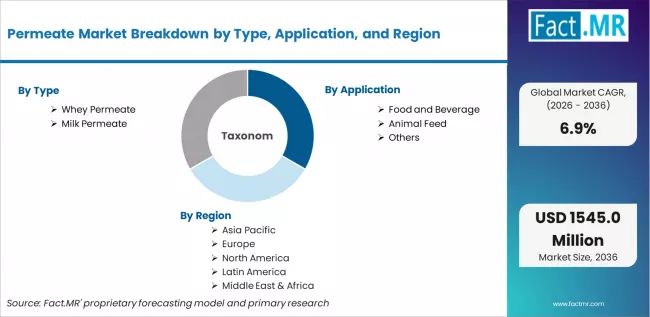
Permeate Market Breakdown By Type, Application, And Region | Source: Fact.MR
| Metric | Value |
|---|---|
| Quantitative Units | USD 792.8 million (2026) to USD 2,138 million (2036), at a CAGR of 6.9% |
| Market Definition | The permeate market includes production and utilization of dairy-derived permeate obtained during milk and whey filtration processes, commonly used as a functional ingredient in food formulations and animal feed applications. |
| Type Segmentation | Whey Permeate, Milk Permeate |
| Application Coverage | Food & Beverage, Animal Feed, Others |
| Key Companies Profiled | Arla Foods Ingredients Group P/S, Volac International Limited, Milcobel CV, NoPalm Ingredients B.V., Foremost Farms USA Cooperative, Actus Nutrition, LLC, Dairy Distillery Inc., Michigan Milk Producers Association |
| Forecast Period | 2026 to 2036 |
| Approach | Hybrid top-down and bottom-up market modeling validated through interviews with dairy ingredient producers and feed manufacturers, supported by milk processing data analysis, production benchmarking, and trade data evaluation. |
Source: Fact.MR analysis. Updated Mar 16, 2026
Bibliographies
- [1] National Dairy Development Board, India. (2025). Dairy processing expansion initiatives.
- [2] Gujarat Cooperative Milk Marketing Federation. (2025). Production capacity expansion.
- [3] Fonterra Co-operative Group. (2025). Dairy processing facilities expansion.
- [4] Ministry of Agriculture, Forestry and Fisheries, Japan. (2025). Processed food manufacturing programs.
- [5] Dairy Farmers of America. (2025). Permeate ingredient supply expansion.
- [6] Lactalis Group. (2025). Dairy ingredient supply expansion.
- [7] DMK Group. (2025). Dairy processing industry expansion.
- [8] U.S. Food and Drug Administration. (2025). Dairy ingredient labeling regulations.
- [9] Codex Alimentarius Commission. (2023). Dairy product standards.
This Report Addresses
- Market size estimation and revenue forecasts for the Permeate Market from 2026 to 2036, supported by dairy processing output benchmarks and ingredient trade flow indicators.
- Growth opportunity mapping across whey permeate and milk permeate ingredients generated through dairy filtration processes and utilized in food and feed formulations.
- Segment and regional revenue forecasts covering food and beverage applications, livestock feed formulations, and industrial dairy ingredient utilization across major dairy processing regions.
- Competition strategy assessment including dairy processing capability benchmarking, ingredient supply chain integration, and permeate powder production capacity analysis among leading dairy ingredient producers.
- Regulatory and food ingredient standards analysis covering Codex Alimentarius dairy ingredient guidelines and dairy labeling frameworks governing permeate utilization in food manufacturing.
- Market report delivery in PDF, Excel, PPT, and interactive dashboard formats designed for dairy ingredient procurement planning, food formulation strategy, and livestock feed production analysis.
- Supply chain vulnerability assessments identifying raw milk supply volatility, dairy filtration processing concentration, and regional dairy ingredient production dependencies affecting permeate availability.
Segmentation
Permeate Market Key Segments
-
Type :
- Whey Permeate
- Milk Permeate
-
Application :
- Food and Beverage
- Animal Feed
- Others
-
Region :
- North America
- USA
- Canada
- Mexico
- Europe
- Germany
- UK
- France
- Italy
- Spain
- Nordic Countries
- BENELUX
- Rest of Europe
- Asia Pacific
- China
- Japan
- South Korea
- India
- Australia
- Rest of Asia Pacific
- Latin America
- Brazil
- Argentina
- Rest of Latin America
- Middle East and Africa
- Kingdom of Saudi Arabia
- United Arab Emirates
- South Africa
- Rest of Middle East and Africa
- Other Regions
- Oceania
- Central Asia
- Other Markets
- North America
Frequently Asked Questions
How large is the demand for Permeate in the global market in 2026?
What will be the market size of Permeate in the global market by 2036?
What is the expected demand growth for Permeate in the global market between 2026 and 2036?
Which Type Segment is poised to lead global demand by 2026?
Which Company is Identified as a Leading Participant in the Permeate Market?
What is Driving Permeate Demand in the United States?
What is the United States Growth Outlook in this Report?
Why is China an Important Market for Permeate?
What is the China Growth Outlook in this Report?
What Factors Support Permeate Demand in India?
What is the India Growth Outlook in this Report?
Why is Japan Considered an Important Market for Permeate?
What is the Japan Growth Outlook in this Report?
What Factors Support Permeate Consumption in the United Kingdom?
What is the United Kingdom Growth Outlook in this Report?
Why is Germany an Important Market for Permeate in Europe?
What is the Germany Growth Outlook in this Report?
What are Permeate Ingredients and What are They Mainly Used For?
What does Permeate Market Mean in this Report?
What is Included in the Scope of this Permeate Market Report?
What is Excluded from the Scope of this Report?
What does Market Forecast Mean on this Page?
How is the Permeate Market Forecast Developed in this Report?
Who worked on this report


Preview the report firsthand - request a free sample
Free SampleGet the brochure for pricing and purchase details
Download PDF