Personal Dental Water Flosser Market Size, Share, Growth and Forecast (2026 - 2036)
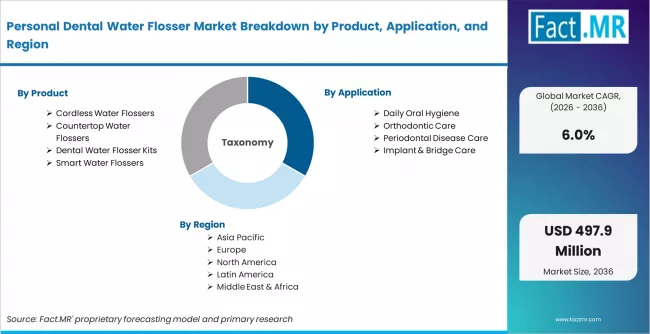
Personal Dental Water Flosser Market is segmented by Product (Cordless Water Flossers, Countertop Water Flossers, Dental Water Flosser Kits, Smart Water Flossers), Application (Daily Oral Hygiene, Orthodontic Care, Periodontal Disease Care, Implant & Bridge Care), End Use (Individual Users, Dental Clinics, Hospitals, Specialty Dental Centers), and Region, with forecasts covering the period from 2026 to 2036.
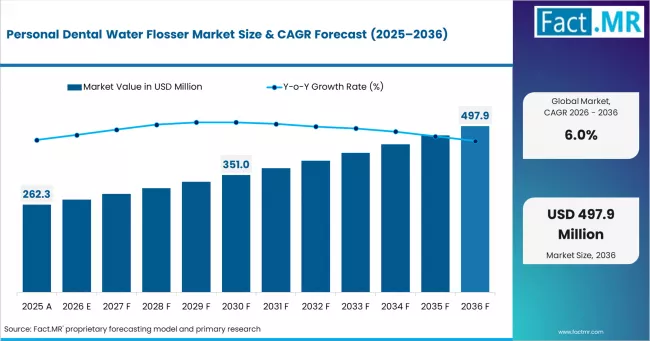
According to Fact.MR estimates, the global personal dental water flosser market market was valued at USD 262.3 million in 2025. The market is projected to reach USD 278.0 million in 2026 and is expected to grow to USD 497.9 million by 2036, expanding at a CAGR of 6.0%. Cordless Water Flossers is anticipated to account for 46.0% of the product segment in 2026, while Daily Oral Hygiene is expected to remain the leading application with around 49.0% share.
Personal Dental Water Flosser Market Analysis and Forecast by Fact.MR
The global market for personal dental water flosser is estimated to be around USD 278.0 million in 2026 and has been forecast to expand at a CAGR of 6.0% to end up at USD 497.9 million by 2036. The Personal Dental Water Flosser segment is led by Cordless Water Flossers, which is anticipated to account for 46.0% of the product segment in 2026, while Daily Oral Hygiene is expected to remain the leading application with around 49.0% share. The market was valued at USD 262.3 million in 2025 and is poised for steady growth driven by evolving industry dynamics and regional demand patterns.
Summary of Personal Dental Water Flosser Market
- Market Snapshot
- In 2025, the global Personal Dental Water Flosser Market was valued at approximately USD 262.3 million.
- The market is estimated to reach USD 278.0 million in 2026 and is projected to attain USD 497.9 million by 2036
- The personal dental water flosser market is likely to expand at a CAGR of 6.0% during the forecast period.
- The market is anticipated to create an absolute dollar opportunity of USD 219.9 million between 2026 and 2036.
- Cordless Water Flossers account for 46.0% of market share in 2026.
- India (7.5%) and Germany (6.9%) are the key growth markets during the forecast period
- Demand and Growth Drivers
- Demand is shaped by the rising consumer focus on preventive dental care, where routine oral hygiene has expanded beyond brushing to include interdental cleaning with water-based irrigation.
- Growth reflects the increased prevalence of orthodontic treatments, dental implants, and periodontal care protocols that benefit from daily water flosser use.
- Adoption is increasing due to dental professional recommendations, online retail availability, and consumer willingness to invest in higher-end oral care appliances.
- Product and Segment View
- Cordless water flossers lead the product segment with a 46% share in 2026, supported by consumer preference for portable and rechargeable devices.
- Daily oral hygiene holds 49% of the application segment, anchored by routine use across healthy consumer populations.
- Individual users account for 62% of end-use demand, while dental clinics, hospitals, and specialty dental centers form secondary distribution channels.
- Geography and Competitive Outlook
- North America remains the largest regional market, supported by Waterpik's dominant brand position, high consumer awareness, and broad retail distribution.
- Asia Pacific is the fastest-growing region, led by India where rising middle-class income and oral hygiene awareness are both expanding rapidly.
- The competitive field is led by Waterpik, Panasonic, Philips, and Procter and Gamble Professional, with specialist players such as Waterpulse, Nicefeel, H2ofloss, and Dexta holding positions in mid-range and value segments.
- Analyst Opinion
- The personal dental water flosser category sits at an attractive intersection of consumer wellness spending and professional dental recommendation. Growth is not explosive, but it is durable. The commercial economics are dominated by Waterpik's brand strength, which commands category leadership across North America and significant global share. The commercial lever that matters is retail distribution combined with dental professional endorsement, because consumers often make purchase decisions based on clinician recommendations reinforced through online reviews. Players that combine strong brand equity with expanding product form factors, particularly cordless and smart app-connected models, will continue to capture premium share while mid-range competitors from Asia compete primarily on price.
Why is Personal Dental Water Flosser Market Growing?
- Growth reflects the broadening of preventive dental care behavior, where interdental cleaning has become a standard part of daily oral hygiene routines.
- Demand is shaped by the rising prevalence of orthodontic treatments, dental implants, and periodontal care protocols that benefit from water flosser use.
- Adoption is increasing due to dental professional endorsement, expanding retail distribution, and consumer willingness to invest in higher-end oral care appliances.
The demand base rests on preventive dental care behavior, which has expanded steadily as dental insurance coverage, consumer wellness spending, and professional dental education have all reinforced the importance of interdental cleaning. Water flossers address the compliance gap with traditional string flossing, which most consumers struggle to perform consistently. This behavioral shift translates directly into device demand.
Orthodontic and implant care expansion is the second structural driver. Patients with braces, aligners, dental implants, or bridges face cleaning challenges that water flossers address more effectively than traditional flossing. Dental professionals routinely recommend water flossers for these patient populations, which creates a reliable referral channel for device adoption. The growth of clear aligner therapy and dental implant procedures has directly lifted water flosser demand.
The third driver is product innovation and category diversification. Cordless and travel-friendly designs have broadened consumer appeal beyond countertop use. Smart water flossers with app connectivity, usage tracking, and AI-assisted monitoring are creating premium product tiers that justify higher price points and support margin expansion for scaled brands.
Segment-wise Analysis of Personal Dental Water Flosser Market
- Cordless water flossers lead the product segment with 46% share in 2026, anchored by consumer preference for portable and rechargeable formats.
- Daily oral hygiene dominates the application segment at 49%, reflecting the routine use pattern across healthy consumer populations.
- Individual users hold 62% of end-use demand, while dental clinics and specialty dental centers form secondary distribution channels.
The segmentation view shows a consumer-led category with strong product concentration around cordless formats and daily hygiene use cases. Competitive advantage sits in retail distribution, brand equity, and product differentiation through form factor innovation and smart features. Growth over the forecast period is expected to tilt toward cordless and smart app-connected devices rather than traditional countertop formats.
Why Do Cordless Water Flossers Lead the Product Segment?
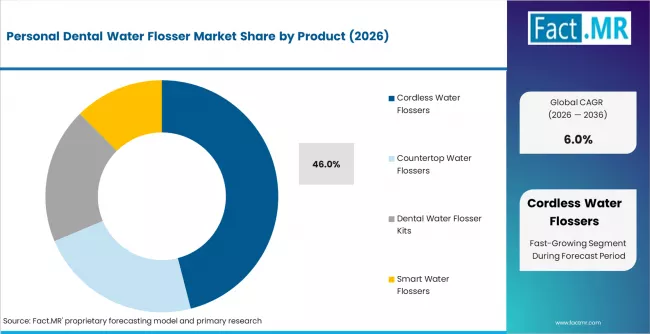
Cordless water flossers lead the product segment because they address the primary consumer friction points of countertop models: bathroom counter space, cord management, and portability for travel. Rechargeable lithium-ion technology has made cordless devices practical for daily home use, while smaller reservoir capacity is increasingly offset by improved flow efficiency. Brands such as Waterpik, Panasonic, and Philips have built out cordless portfolios that span entry-level to premium price points.
The segment leadership is reinforced by retail channel preferences. E-commerce platforms and mass retailers favor cordless products because they are easier to ship, display, and market than countertop models. Travel-friendly designs also address the gifting and replacement purchase cycles that drive repeat category demand, which further supports cordless share growth over the forecast period.
Why Does Daily Oral Hygiene Dominate the Application Segment?
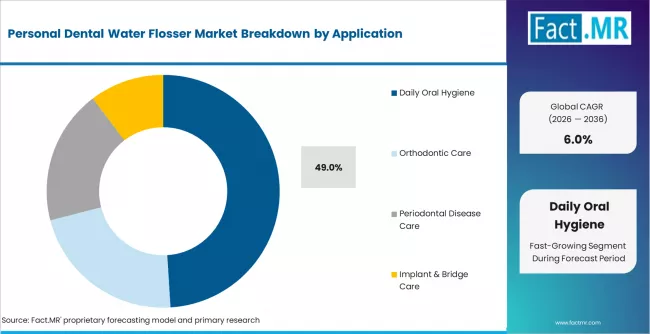
Daily oral hygiene dominates the application segment because it represents the universal use case across every water flosser purchase. Whether consumers buy for preventive care, orthodontic support, or periodontal treatment, daily use is the common thread that drives device utility and replacement purchase cycles. Dental professional recommendations consistently position water flossers as daily-use devices rather than occasional tools, which reinforces this application concentration.
Growth within daily oral hygiene is being lifted by expanding consumer awareness of gum health and periodontal disease prevention. Educational campaigns from dental associations and oral care brands have raised consumer understanding of the link between daily interdental cleaning and long-term dental outcomes, which supports broader category adoption and consistent device use.
Key Growth Drivers, Constraints, and Market Scope
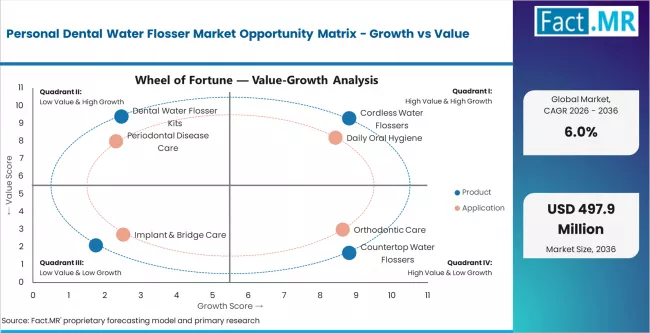
- Consumer wellness spending and preventive dental care behavior are the structural demand foundations.
- Orthodontic and dental implant expansion is the key compositional shift creating new user segments.
- Category competition from electric toothbrushes and low-price imports remains the leading constraint.
The market scope is shaped by steady consumer-driven demand combined with product innovation in cordless and smart formats. Competitive advantage sits in brand equity, retail distribution, and dental professional endorsement rather than in pure price competition.
Growth Drivers
The primary driver is consumer wellness spending on preventive oral care, which has expanded steadily across developed markets and is accelerating in emerging economies. A second driver is the clinical expansion of orthodontic treatment, dental implants, and periodontal care, each of which creates patient populations that benefit directly from water flosser use. A third driver is product innovation, where cordless formats, smart features, and travel-friendly designs are expanding the total addressable market and justifying premium pricing tiers.
Constraints
The leading constraint is category competition from electric toothbrushes, which share retail shelf space and marketing dollars with water flossers. A second constraint is low-price competition from Chinese and Southeast Asian manufacturers in the entry-level segment, which compresses margins for global brands. A third constraint is consumer awareness gaps in emerging markets, where water flossers remain a premium category with limited distribution outside major cities and online channels.
Opportunities
The strongest opportunity lies in smart water flossers with app connectivity and AI-assisted monitoring, which create new premium tiers and support recurring engagement through mobile health ecosystems. A second opportunity is orthodontic and implant care specialization, where dental professional channels can drive device adoption among patient populations with clear clinical need. A third opportunity is emerging market penetration, particularly in India and Brazil, where rising middle-class spending and expanding organized dental retail are both supporting category growth.
Regional Outlook Across Key Markets
.webp)
- India leads country-level growth at 7.5% CAGR, supported by rising middle-class spending on oral care, expanding organized dental retail, and growing awareness of preventive dental hygiene.
- Germany follows at 6.9%, driven by strong consumer wellness behavior, dental insurance coverage, and broad professional dental endorsement.
- North America remains the largest regional pool by absolute value, with the USA at 5.7% supported by Waterpik's dominant brand position and mature retail distribution.
- European demand is led by Germany at 6.9% and the UK at 5.1%, with both countries showing strong professional dental recommendation channels.
Country CAGR Table
| Country | CAGR (%) |
|---|---|
| India | 7.5% |
| Germany | 6.9% |
| Brazil | 6.3% |
| USA | 5.7% |
| UK | 5.1% |
| Japan | 4.5% |
Source: Fact.MR analysis, based on proprietary forecasting model and primary research.
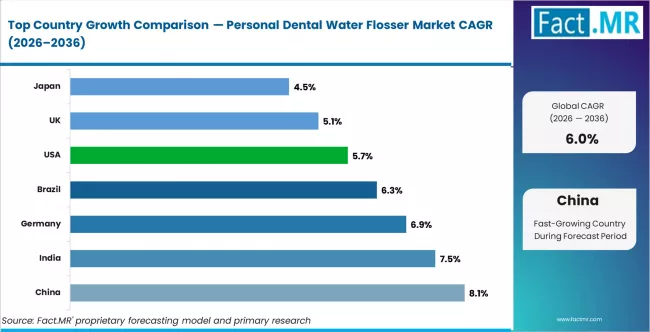
Regional dynamics split into three profiles. Asia Pacific leads on growth rate, pulled by rising middle-class consumer spending on oral care and expanding organized retail. Europe grows at steady mid-single-digit rates driven by strong consumer wellness behavior and professional dental recommendation channels. North America remains the largest dollar market, anchored by Waterpik's dominant brand position and mature retail infrastructure.
United States
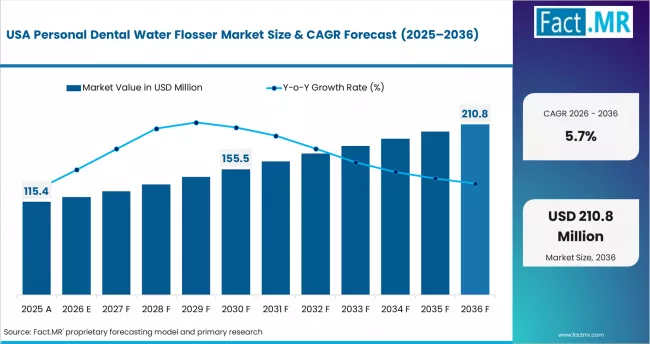
The United States anchors global demand through Waterpik's dominant brand position, high consumer awareness of preventive oral care, and broad retail distribution across mass retailers, specialty retail, and e-commerce platforms. Dental professional recommendations consistently favor Waterpik, which reinforces the brand's category leadership. Orthodontic and dental implant patient populations form durable secondary demand channels.
- Waterpik's dominant brand position anchors category leadership.
- Dental professional recommendations support consistent brand preference.
- Orthodontic and dental implant patient populations drive secondary demand.
Canada
Canada represents a steady mid-single-digit growth market shaped by consumer wellness behavior that mirrors US patterns and by broad availability of Waterpik and other international brands. Dental professional recommendations support category growth, while cross-border brand availability ensures product access across major retail channels.
- Consumer wellness behavior mirrors US patterns.
- Waterpik and international brands dominate retail distribution.
- Dental professional recommendations support category growth.
United Kingdom
The United Kingdom market is shaped by growing consumer awareness of preventive dental care, NHS and private dental channel endorsement, and expanding retail distribution across pharmacies, drug stores, and online platforms. Waterpik, Philips, and Panasonic hold the strongest retail positions, while specialist brands such as H2ofloss and Dexta compete in value tiers.
- Growing consumer awareness of preventive dental care supports category growth.
- NHS and private dental channel endorsement reinforces brand preference.
- Expanding retail distribution broadens category access.
Germany
Germany leads European growth on the strength of consumer wellness behavior, dental insurance coverage for preventive care, and strong professional dental endorsement of water flossers. Retail distribution is broad across pharmacies, drug stores, and electronics retailers, while online marketplaces support value-tier competitors. Orthodontic and implant care populations provide durable demand alongside general consumer use.
- Consumer wellness behavior supports strong category adoption.
- Dental insurance coverage for preventive care reinforces utilization.
- Orthodontic and implant care populations create durable demand channels.
India
India is the fastest-growing country in the forecast, driven by rising middle-class spending on oral care, expanding organized dental retail, and growing awareness of preventive dental hygiene. Metropolitan consumers are adopting water flossers through e-commerce platforms at accelerating rates, while Waterpik, Panasonic, and Philips compete with Chinese and domestic brands across price tiers. Corporate dental benefit programs are also expanding, creating incremental B2B distribution channels.
- Rising middle-class spending drives category adoption in metropolitan markets.
- E-commerce platforms are the primary distribution channel for emerging adopters.
- Chinese and domestic brands compete across value and entry-level tiers.
Brazil
Brazil represents a steady growth market shaped by expanding middle-class oral care spending, growing organized dental retail, and professional dental endorsement. Waterpik, Philips, and Panasonic hold strong positions in premium tiers, while regional brands compete in value segments. E-commerce and specialty retail are the primary distribution channels.
- Expanding middle-class oral care spending supports category growth.
- Growing organized dental retail improves product access.
- E-commerce and specialty retail drive primary distribution.
Competitive Benchmarking and Company Positioning
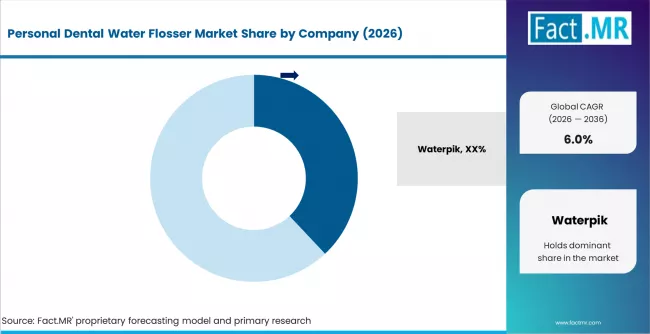
- Waterpik leads with an estimated 38% share, supported by dominant brand equity, broad dental professional endorsement, and extensive retail distribution.
- Panasonic, Philips, and Procter and Gamble Professional compete through established oral care portfolios and global retail presence.
- Specialist players such as Waterpulse, Nicefeel, H2ofloss, and Dexta hold positions in mid-range and value segments, particularly in Asia Pacific.
The competitive field is highly concentrated at the top, with Waterpik holding a dominant position built on decades of brand equity, dental professional endorsement, and retail channel depth. Panasonic competes through its established oral care portfolio and strength in Asian markets, while Philips leverages its Sonicare brand heritage to extend into water flossers. Procter and Gamble Professional holds positions through Oral-B and related brand extensions.
The second tier of the market is occupied by Waterpulse, Nicefeel, H2ofloss, and Dexta, which have built positions primarily in mid-range and value segments through e-commerce distribution and price-competitive offerings. These companies compete primarily on price and feature breadth rather than brand equity or professional endorsement, which limits their ability to move up-market into premium tiers dominated by Waterpik and established oral care brands.
Strategic priorities across the field include expanding cordless product portfolios, investing in smart and app-connected features, and deepening dental professional endorsement relationships. Waterpik's category leadership is protected by its brand equity and professional channel depth, while challenger brands compete through value pricing, feature innovation, and e-commerce distribution.
Competitive Analysis
Competitive positioning rests on three dimensions: brand equity, retail distribution depth, and product portfolio breadth. Waterpik leads on all three through its dominant US position, broad dental professional endorsement, and extensive cordless and countertop product range. Panasonic, Philips, and Procter and Gamble Professional compete through established oral care heritage and global retail presence. Chinese value-tier brands such as Waterpulse, Nicefeel, H2ofloss, and Dexta compete primarily on price and e-commerce availability.
Second-tier competitors maintain relevance through value positioning, e-commerce specialization, or regional channel strength. The gap between Waterpik and the rest of the field is substantial in North America but narrower in Asia Pacific, where Panasonic and domestic brands hold stronger positions. Category entry barriers are modest, but scaling from value tier into premium pricing requires brand equity investment that most challengers have not made.
Benchmarking Table
| Company | Scale Reach | Brand Equity | Product Portfolio | Professional Endorsement |
|---|---|---|---|---|
| Waterpik | Global | Strong | Broad | Strong |
| Panasonic | Global | Strong | Broad | Medium-Strong |
| Philips | Global | Strong | Medium-Broad | Medium-Strong |
| P&G Professional | Global | Strong | Medium | Medium-Strong |
| Waterpulse | Select Markets | Medium | Medium | Low |
| Nicefeel | Select Markets | Medium | Medium | Low |
| H2ofloss | Select Markets | Medium | Medium | Low |
Recent Developments
- In 2025, Waterpik expanded its cordless water flosser portfolio with new premium models targeting travel-friendly and professional-grade use cases.
- In 2025, Philips continued to extend its oral care platform through water flosser product updates aligned with its Sonicare brand family.
- In 2026, Panasonic advanced its water flosser product line with upgraded rechargeable and portable format offerings.
Leading Companies Shaping Personal Dental Water Flosser Market
-
Major Players
- Waterpik
- Panasonic
- Philips
- Procter and Gamble Professional
- Waterpulse
- Nicefeel
- H2ofloss
- Dexta
-
Emerging Players
- Oral-B (Braun)
- Colgate-Palmolive
- Xiaomi Corporation
- Jetpik
- Mornwell
- Binxinjinkou
- ToiletTree Products
- Fairywill
Sources and Research References
- United States Food and Drug Administration (FDA) - Registration Database for Oral Care Medical Devices
- American Dental Association (ADA) - Clinical Recommendations on Interdental Cleaning
- World Health Organization (WHO) - Global Oral Health Status Reports
- European Federation of Periodontology - Clinical Guidelines on Periodontal Disease Prevention
- Waterpik - Product Portfolio and Retail Channel Information
- Procter and Gamble - Annual Report and Oral Care Segment Disclosures
- Primary interviews with dental professionals, oral care brand managers, and retail channel partners
This bibliography is provided for reader reference and is not exhaustive. The full report contains the complete reference list and detailed citations.
Key Questions This Report Addresses
- What is the current and future size of the personal dental water flosser market?
- How fast is the market expected to grow between 2026 and 2036?
- Which product segment is likely to lead the market by 2026?
- Which application segment will account for the highest demand by 2026?
- How is Waterpik's brand dominance shaping competitive dynamics?
- Why are India and Germany emerging as key growth markets?
- Which countries are projected to show the fastest growth through 2036?
- Who are the key companies active in the personal dental water flosser market?
- How does the shift toward cordless and smart water flossers affect market structure?
Personal Dental Water Flosser Market Definition
The personal dental water flosser market covers oral care appliances that use pulsed streams of water to clean between teeth and below the gumline, serving as an alternative or complement to traditional string flossing. This includes cordless, countertop, and smart water flosser systems, along with related accessories such as nozzles, reservoirs, and charging stations used by individual consumers and dental professionals.
Personal Dental Water Flosser Market Inclusions
The scope includes cordless water flossers, countertop water flossers, dental water flosser kits, and smart water flossers. It covers applications across daily oral hygiene, plaque removal, orthodontic care, periodontal disease care, and implant and bridge care. Coverage spans individual users, dental clinics, hospitals, and specialty dental centers from 2026 to 2036, along with supporting technologies including pulsed water jet systems, lithium-ion rechargeable power, smart pressure control, and AI-assisted usage monitoring.
Personal Dental Water Flosser Market Exclusions
The scope excludes traditional string dental floss, manual interdental brushes, electric toothbrushes without water flosser functionality, and professional-grade dental equipment used only in clinical settings. It also excludes oral rinses, mouthwashes, toothpaste, and other consumable oral care products that do not involve mechanical water irrigation hardware.
Personal Dental Water Flosser Market Research Methodology
- Primary Research: Interviews with oral care brand managers, retail channel partners, dental professionals, and component suppliers to validate product adoption, category mix shifts, and pricing dynamics.
- Desk Research: Review of brand shipment disclosures, e-commerce platform sell-through data, dental professional association publications, and consumer survey data on oral hygiene behavior.
- Market Sizing: Demand-side model built on consumer spending on oral care, dental appliance penetration rates, replacement cycle patterns, and disposable income tiers, triangulated with top-down retail audit data.
- Data Validation: Cross-validation across primary interviews, retail sell-through data, and brand financial disclosures, with sensitivity checks on category mix shifts between cordless and countertop formats.
Scope of Analysis

| Parameter | Details |
|---|---|
| Quantitative Units | USD 278.03 million to USD 497.91 million, at a CAGR of 6.0% |
| Market Definition | The personal dental water flosser market covers oral care appliances that use pulsed streams of water to clean between teeth and below the gumline, including cordless, countertop, and smart water flosser systems. |
| Regions Covered | North America, Latin America, Europe, East Asia, South Asia and Pacific, Middle East and Africa |
| Countries Covered | USA, Canada, UK, Germany, India, Brazil, Japan, 30 plus countries |
| Key Companies | Waterpik, Panasonic, Philips, Procter and Gamble Professional, Waterpulse, Nicefeel, H2ofloss, Dexta |
| Forecast Period | 2026 to 2036 |
| Approach | Hybrid demand-side and top-down methodology built on consumer oral care spending, dental appliance penetration rates, replacement cycle patterns, disposable income tiers, and primary interviews across brand managers, retail partners, and dental professionals |
Market Segmentation Analysis
-
Personal Dental Water Flosser Market Market Segmented by Product:
- Cordless Water Flossers
- Portable Water Flossers
- Rechargeable Travel Flossers
- Portable Water Flossers
- Countertop Water Flossers
- Large Reservoir Systems
- Multi-Pressure Dental Units
- Large Reservoir Systems
- Dental Water Flosser Kits
- Personal Oral Irrigation Devices
- Multi-Nozzle Flosser Systems
- Personal Oral Irrigation Devices
- Smart Water Flossers
- Bluetooth Enabled Flossers
- App-Connected Oral Care Devices
- Bluetooth Enabled Flossers
- Cordless Water Flossers
-
Personal Dental Water Flosser Market Market Segmented by Application:
- Daily Oral Hygiene
- Plaque Removal
- Gum Health Maintenance
- Plaque Removal
- Orthodontic Care
- Braces & Aligners Cleaning
- Dental Appliance Maintenance
- Braces & Aligners Cleaning
- Periodontal Disease Care
- Gum Disease Prevention
- Deep Gum Cleaning Therapy
- Gum Disease Prevention
- Implant & Bridge Care
- Dental Implant Cleaning
- Prosthetic Dental Maintenance
- Dental Implant Cleaning
- Daily Oral Hygiene
-
Personal Dental Water Flosser Market Market Segmented by End Use:
- Individual Users
- Home Oral Care Users
- Preventive Dental Care Consumers
- Home Oral Care Users
- Dental Clinics
- Professional Oral Hygiene Use
- Patient Post-Treatment Care
- Professional Oral Hygiene Use
- Hospitals
- Dental Departments
- Oral Surgery Follow-Up Care
- Dental Departments
- Specialty Dental Centers
- Orthodontic Clinics
- Periodontic Treatment Centers
- Orthodontic Clinics
- Individual Users
-
Personal Dental Water Flosser Market Market Segmented by Technology:
- Pulsed Water Jet Technology
- Micro-Bubble Irrigation Systems
- Pressure-Controlled Flushing Systems
- Micro-Bubble Irrigation Systems
- Cordless Battery Technology
- Lithium-Ion Rechargeable Systems
- Portable Power Management Tech
- Lithium-Ion Rechargeable Systems
- Smart Pressure Control Systems
- Multi-Level Water Pressure Adjustment
- AI-Assisted Usage Monitoring
- Multi-Level Water Pressure Adjustment
- Pulsed Water Jet Technology
-
Personal Dental Water Flosser Market Market Segmented by Distribution Channel:
- Online Retail
- E-Commerce Platforms
- Brand Websites
- E-Commerce Platforms
- Offline Retail
- Pharmacies & Drug Stores
- Supermarkets & Hypermarkets
- Pharmacies & Drug Stores
- Specialty Stores
- Dental Care Stores
- Medical Supply Shops
- Dental Care Stores
- Online Retail
-
Personal Dental Water Flosser Market Market Segmented by Packaging:
- Retail Device Boxes
- Consumer Dental Kits
- Portable Flosser Kits
- Consumer Dental Kits
- Sterile Packaging
- Hygienic Device Seals
- Medical Grade Packaging
- Hygienic Device Seals
- Combo Kits
- Multi-Nozzle Starter Kits
- Family Oral Care Packs
- Multi-Nozzle Starter Kits
- Retail Device Boxes
-
Personal Dental Water Flosser Market Market by Region:
- North America
- USA
- Canada
- Mexico
- Latin America
- Brazil
- Chile
- Rest of Latin America
- Western Europe
- Germany
- UK
- Italy
- Spain
- France
- Nordic
- BENELUX
- Rest of Western Europe
- Eastern Europe
- Russia
- Poland
- Hungary
- Balkan & Baltic
- Rest of Eastern Europe
- East Asia
- China
- Japan
- South Korea
- South Asia and Pacific
- India
- ASEAN
- Australia & New Zealand
- Rest of South Asia and Pacific
- Middle East & Africa
- Kingdom of Saudi Arabia
- Other GCC Countries
- Turkiye
- South Africa
- Other African Union
- Rest of Middle East & Africa
- North America
- Frequently Asked Questions -
How big is the personal dental water flosser market in 2026?
The global personal dental water flosser market is estimated to be valued at USD 278.03 million in 2026.
What will be the size of the personal dental water flosser market in 2036?
The market size is projected to reach USD 497.91 million by 2036.
How much will the personal dental water flosser market grow between 2026 and 2036?
The market is expected to grow at a 6.0% CAGR between 2026 and 2036.
Which product segment is expected to lead the market in 2026?
Cordless water flossers are expected to lead the product segment with a 46% share in 2026.
Which country is the fastest-growing market?
China is the fastest-growing country in the forecast, projected to grow at an 8.1% CAGR through 2036.
Why is Germany a key growth market?
Germany is projected to grow at a 6.9% CAGR, driven by strong consumer wellness behavior, dental insurance coverage for preventive care, and broad dental professional endorsement.
What does the personal dental water flosser market cover?
The market covers oral care appliances that use pulsed streams of water to clean between teeth and below the gumline, including cordless, countertop, and smart water flosser systems.
How is the market forecast estimated and validated?
The forecast is built on a hybrid demand-side and top-down model using consumer oral care spending, dental appliance penetration rates, replacement cycle patterns, disposable income tiers, and primary interviews across brand managers, retail partners, and dental professionals.
Table of Content
- Executive Summary
- Global Market Outlook
- Demand to side Trends
- Supply to side Trends
- Technology Roadmap Analysis
- Analysis and Recommendations
- Market Overview
- Market Coverage / Taxonomy
- Market Definition / Scope / Limitations
- Research Methodology
- Chapter Orientation
- Analytical Lens and Working Hypotheses
- Market Structure, Signals, and Trend Drivers
- Benchmarking and Cross-market Comparability
- Market Sizing, Forecasting, and Opportunity Mapping
- Research Design and Evidence Framework
- Desk Research Programme (Secondary Evidence)
- Company Annual and Sustainability Reports
- Peer-reviewed Journals and Academic Literature
- Corporate Websites, Product Literature, and Technical Notes
- Earnings Decks and Investor Briefings
- Statutory Filings and Regulatory Disclosures
- Technical White Papers and Standards Notes
- Trade Journals, Industry Magazines, and Analyst Briefs
- Conference Proceedings, Webinars, and Seminar Materials
- Government Statistics Portals and Public Data Releases
- Press Releases and Reputable Media Coverage
- Specialist Newsletters and Curated Briefings
- Sector Databases and Reference Repositories
- Fact.MR Internal Proprietary Databases and Historical Market Datasets
- Subscription Datasets and Paid Sources
- Social Channels, Communities, and Digital Listening Inputs
- Additional Desk Sources
- Expert Input and Fieldwork (Primary Evidence)
- Primary Modes
- Qualitative Interviews and Expert Elicitation
- Quantitative Surveys and Structured Data Capture
- Blended Approach
- Why Primary Evidence is Used
- Field Techniques
- Interviews
- Surveys
- Focus Groups
- Observational and In-context Research
- Social and Community Interactions
- Stakeholder Universe Engaged
- C-suite Leaders
- Board Members
- Presidents and Vice Presidents
- R&D and Innovation Heads
- Technical Specialists
- Domain Subject-matter Experts
- Scientists
- Physicians and Other Healthcare Professionals
- Governance, Ethics, and Data Stewardship
- Research Ethics
- Data Integrity and Handling
- Primary Modes
- Tooling, Models, and Reference Databases
- Desk Research Programme (Secondary Evidence)
- Data Engineering and Model Build
- Data Acquisition and Ingestion
- Cleaning, Normalisation, and Verification
- Synthesis, Triangulation, and Analysis
- Quality Assurance and Audit Trail
- Market Background
- Market Dynamics
- Drivers
- Restraints
- Opportunity
- Trends
- Scenario Forecast
- Demand in Optimistic Scenario
- Demand in Likely Scenario
- Demand in Conservative Scenario
- Opportunity Map Analysis
- Product Life Cycle Analysis
- Supply Chain Analysis
- Investment Feasibility Matrix
- Value Chain Analysis
- PESTLE and Porter’s Analysis
- Regulatory Landscape
- Regional Parent Market Outlook
- Production and Consumption Statistics
- Import and Export Statistics
- Market Dynamics
- Global Market Analysis 2021 to 2025 and Forecast, 2026 to 2036
- Historical Market Size Value (USD Million) Analysis, 2021 to 2025
- Current and Future Market Size Value (USD Million) Projections, 2026 to 2036
- Y to o to Y Growth Trend Analysis
- Absolute $ Opportunity Analysis
- Global Market Pricing Analysis 2021 to 2025 and Forecast 2026 to 2036
- Global Market Analysis 2021 to 2025 and Forecast 2026 to 2036, By Product
- Introduction / Key Findings
- Historical Market Size Value (USD Million) Analysis By Product , 2021 to 2025
- Current and Future Market Size Value (USD Million) Analysis and Forecast By Product , 2026 to 2036
- Cordless Water Flossers
- Portable Water Flossers
- _Rechargeable Travel Flossers
- Countertop Water Flossers
- Large Reservoir Systems
- _Multi-Pressure Dental Value (USD Million)s
- Dental Water Flosser Kits
- Personal Oral Irrigation Devices
- _Multi-Nozzle Flosser Systems
- Smart Water Flossers
- Bluetooth Enabled Flossers
- _App-Connected Oral Care Devices
- Cordless Water Flossers
- Y to o to Y Growth Trend Analysis By Product , 2021 to 2025
- Absolute $ Opportunity Analysis By Product , 2026 to 2036
- Global Market Analysis 2021 to 2025 and Forecast 2026 to 2036, By Application
- Introduction / Key Findings
- Historical Market Size Value (USD Million) Analysis By Application, 2021 to 2025
- Current and Future Market Size Value (USD Million) Analysis and Forecast By Application, 2026 to 2036
- Daily Oral Hygiene
- Plaque Removal
- _Gum Health Maintenance
- Orthodontic Care
- Braces & Aligners Cleaning
- _Dental Appliance Maintenance
- Periodontal Disease Care
- Gum Disease Prevention
- _Deep Gum Cleaning Therapy
- Implant & Bridge Care
- Dental Implant Cleaning
- _Prosthetic Dental Maintenance
- Daily Oral Hygiene
- Y to o to Y Growth Trend Analysis By Application, 2021 to 2025
- Absolute $ Opportunity Analysis By Application, 2026 to 2036
- Global Market Analysis 2021 to 2025 and Forecast 2026 to 2036, By End Use
- Introduction / Key Findings
- Historical Market Size Value (USD Million) Analysis By End Use, 2021 to 2025
- Current and Future Market Size Value (USD Million) Analysis and Forecast By End Use, 2026 to 2036
- Individual Users
- Home Oral Care Users
- _Preventive Dental Care Consumers
- Dental Clinics
- Professional Oral Hygiene Use
- _Patient Post-Treatment Care
- Hospitals
- Dental Departments
- _Oral Surgery Follow-Up Care
- Specialty Dental Centers
- Orthodontic Clinics
- _Periodontic Treatment Centers
- Individual Users
- Y to o to Y Growth Trend Analysis By End Use, 2021 to 2025
- Absolute $ Opportunity Analysis By End Use, 2026 to 2036
- Global Market Analysis 2021 to 2025 and Forecast 2026 to 2036, By Technology
- Introduction / Key Findings
- Historical Market Size Value (USD Million) Analysis By Technology, 2021 to 2025
- Current and Future Market Size Value (USD Million) Analysis and Forecast By Technology, 2026 to 2036
- Pulsed Water Jet Technology
- Micro-Bubble Irrigation Systems
- _Pressure-Controlled Flushing Systems
- Cordless Battery Technology
- Lithium-Ion Rechargeable Systems
- _Portable Power Management Tech
- Smart Pressure Control Systems
- Multi-Level Water Pressure Adjustment
- _AI-Assisted Usage Monitoring
- Pulsed Water Jet Technology
- Y to o to Y Growth Trend Analysis By Technology, 2021 to 2025
- Absolute $ Opportunity Analysis By Technology, 2026 to 2036
- Global Market Analysis 2021 to 2025 and Forecast 2026 to 2036, By Distribution Channel
- Introduction / Key Findings
- Historical Market Size Value (USD Million) Analysis By Distribution Channel, 2021 to 2025
- Current and Future Market Size Value (USD Million) Analysis and Forecast By Distribution Channel, 2026 to 2036
- Online Retail
- E-Commerce Platforms
- _Brand Websites
- Offline Retail
- Pharmacies & Drug Stores
- _Supermarkets & Hypermarkets
- Specialty Stores
- Dental Care Stores
- _Medical Supply Shops
- Online Retail
- Y to o to Y Growth Trend Analysis By Distribution Channel, 2021 to 2025
- Absolute $ Opportunity Analysis By Distribution Channel, 2026 to 2036
- Global Market Analysis 2021 to 2025 and Forecast 2026 to 2036, By Packaging
- Introduction / Key Findings
- Historical Market Size Value (USD Million) Analysis By Packaging, 2021 to 2025
- Current and Future Market Size Value (USD Million) Analysis and Forecast By Packaging, 2026 to 2036
- Retail Device Boxes
- Consumer Dental Kits
- _Portable Flosser Kits
- Sterile Packaging
- Hygienic Device Seals
- _Medical Grade Packaging
- Combo Kits
- Multi-Nozzle Starter Kits
- _Family Oral Care Packs
- Retail Device Boxes
- Y to o to Y Growth Trend Analysis By Packaging, 2021 to 2025
- Absolute $ Opportunity Analysis By Packaging, 2026 to 2036
- Global Market Analysis 2021 to 2025 and Forecast 2026 to 2036, By Region
- Introduction
- Historical Market Size Value (USD Million) Analysis By Region, 2021 to 2025
- Current Market Size Value (USD Million) Analysis and Forecast By Region, 2026 to 2036
- North America
- Latin America
- Western Europe
- Eastern Europe
- East Asia
- South Asia and Pacific
- Middle East & Africa
- Market Attractiveness Analysis By Region
- North America Market Analysis 2021 to 2025 and Forecast 2026 to 2036, By Country
- Historical Market Size Value (USD Million) Trend Analysis By Market Taxonomy, 2021 to 2025
- Market Size Value (USD Million) Forecast By Market Taxonomy, 2026 to 2036
- By Country
- USA
- Canada
- Mexico
- By Product
- By Application
- By End Use
- By Technology
- By Distribution Channel
- By Packaging
- By Country
- Market Attractiveness Analysis
- By Country
- By Product
- By Application
- By End Use
- By Technology
- By Distribution Channel
- By Packaging
- Key Takeaways
- Latin America Market Analysis 2021 to 2025 and Forecast 2026 to 2036, By Country
- Historical Market Size Value (USD Million) Trend Analysis By Market Taxonomy, 2021 to 2025
- Market Size Value (USD Million) Forecast By Market Taxonomy, 2026 to 2036
- By Country
- Brazil
- Chile
- Rest of Latin America
- By Product
- By Application
- By End Use
- By Technology
- By Distribution Channel
- By Packaging
- By Country
- Market Attractiveness Analysis
- By Country
- By Product
- By Application
- By End Use
- By Technology
- By Distribution Channel
- By Packaging
- Key Takeaways
- Western Europe Market Analysis 2021 to 2025 and Forecast 2026 to 2036, By Country
- Historical Market Size Value (USD Million) Trend Analysis By Market Taxonomy, 2021 to 2025
- Market Size Value (USD Million) Forecast By Market Taxonomy, 2026 to 2036
- By Country
- Germany
- UK
- Italy
- Spain
- France
- Nordic
- BENELUX
- Rest of Western Europe
- By Product
- By Application
- By End Use
- By Technology
- By Distribution Channel
- By Packaging
- By Country
- Market Attractiveness Analysis
- By Country
- By Product
- By Application
- By End Use
- By Technology
- By Distribution Channel
- By Packaging
- Key Takeaways
- Eastern Europe Market Analysis 2021 to 2025 and Forecast 2026 to 2036, By Country
- Historical Market Size Value (USD Million) Trend Analysis By Market Taxonomy, 2021 to 2025
- Market Size Value (USD Million) Forecast By Market Taxonomy, 2026 to 2036
- By Country
- Russia
- Poland
- Hungary
- Balkan & Baltic
- Rest of Eastern Europe
- By Product
- By Application
- By End Use
- By Technology
- By Distribution Channel
- By Packaging
- By Country
- Market Attractiveness Analysis
- By Country
- By Product
- By Application
- By End Use
- By Technology
- By Distribution Channel
- By Packaging
- Key Takeaways
- East Asia Market Analysis 2021 to 2025 and Forecast 2026 to 2036, By Country
- Historical Market Size Value (USD Million) Trend Analysis By Market Taxonomy, 2021 to 2025
- Market Size Value (USD Million) Forecast By Market Taxonomy, 2026 to 2036
- By Country
- China
- Japan
- South Korea
- By Product
- By Application
- By End Use
- By Technology
- By Distribution Channel
- By Packaging
- By Country
- Market Attractiveness Analysis
- By Country
- By Product
- By Application
- By End Use
- By Technology
- By Distribution Channel
- By Packaging
- Key Takeaways
- South Asia and Pacific Market Analysis 2021 to 2025 and Forecast 2026 to 2036, By Country
- Historical Market Size Value (USD Million) Trend Analysis By Market Taxonomy, 2021 to 2025
- Market Size Value (USD Million) Forecast By Market Taxonomy, 2026 to 2036
- By Country
- India
- ASEAN
- Australia & New Zealand
- Rest of South Asia and Pacific
- By Product
- By Application
- By End Use
- By Technology
- By Distribution Channel
- By Packaging
- By Country
- Market Attractiveness Analysis
- By Country
- By Product
- By Application
- By End Use
- By Technology
- By Distribution Channel
- By Packaging
- Key Takeaways
- Middle East & Africa Market Analysis 2021 to 2025 and Forecast 2026 to 2036, By Country
- Historical Market Size Value (USD Million) Trend Analysis By Market Taxonomy, 2021 to 2025
- Market Size Value (USD Million) Forecast By Market Taxonomy, 2026 to 2036
- By Country
- Kingdom of Saudi Arabia
- Other GCC Countries
- Turkiye
- South Africa
- Other African Union
- Rest of Middle East & Africa
- By Product
- By Application
- By End Use
- By Technology
- By Distribution Channel
- By Packaging
- By Country
- Market Attractiveness Analysis
- By Country
- By Product
- By Application
- By End Use
- By Technology
- By Distribution Channel
- By Packaging
- Key Takeaways
- Key Countries Market Analysis
- USA
- Pricing Analysis
- Market Share Analysis, 2025
- By Product
- By Application
- By End Use
- By Technology
- By Distribution Channel
- By Packaging
- Canada
- Pricing Analysis
- Market Share Analysis, 2025
- By Product
- By Application
- By End Use
- By Technology
- By Distribution Channel
- By Packaging
- Mexico
- Pricing Analysis
- Market Share Analysis, 2025
- By Product
- By Application
- By End Use
- By Technology
- By Distribution Channel
- By Packaging
- Brazil
- Pricing Analysis
- Market Share Analysis, 2025
- By Product
- By Application
- By End Use
- By Technology
- By Distribution Channel
- By Packaging
- Chile
- Pricing Analysis
- Market Share Analysis, 2025
- By Product
- By Application
- By End Use
- By Technology
- By Distribution Channel
- By Packaging
- Germany
- Pricing Analysis
- Market Share Analysis, 2025
- By Product
- By Application
- By End Use
- By Technology
- By Distribution Channel
- By Packaging
- UK
- Pricing Analysis
- Market Share Analysis, 2025
- By Product
- By Application
- By End Use
- By Technology
- By Distribution Channel
- By Packaging
- Italy
- Pricing Analysis
- Market Share Analysis, 2025
- By Product
- By Application
- By End Use
- By Technology
- By Distribution Channel
- By Packaging
- Spain
- Pricing Analysis
- Market Share Analysis, 2025
- By Product
- By Application
- By End Use
- By Technology
- By Distribution Channel
- By Packaging
- France
- Pricing Analysis
- Market Share Analysis, 2025
- By Product
- By Application
- By End Use
- By Technology
- By Distribution Channel
- By Packaging
- India
- Pricing Analysis
- Market Share Analysis, 2025
- By Product
- By Application
- By End Use
- By Technology
- By Distribution Channel
- By Packaging
- ASEAN
- Pricing Analysis
- Market Share Analysis, 2025
- By Product
- By Application
- By End Use
- By Technology
- By Distribution Channel
- By Packaging
- Australia & New Zealand
- Pricing Analysis
- Market Share Analysis, 2025
- By Product
- By Application
- By End Use
- By Technology
- By Distribution Channel
- By Packaging
- China
- Pricing Analysis
- Market Share Analysis, 2025
- By Product
- By Application
- By End Use
- By Technology
- By Distribution Channel
- By Packaging
- Japan
- Pricing Analysis
- Market Share Analysis, 2025
- By Product
- By Application
- By End Use
- By Technology
- By Distribution Channel
- By Packaging
- South Korea
- Pricing Analysis
- Market Share Analysis, 2025
- By Product
- By Application
- By End Use
- By Technology
- By Distribution Channel
- By Packaging
- Russia
- Pricing Analysis
- Market Share Analysis, 2025
- By Product
- By Application
- By End Use
- By Technology
- By Distribution Channel
- By Packaging
- Poland
- Pricing Analysis
- Market Share Analysis, 2025
- By Product
- By Application
- By End Use
- By Technology
- By Distribution Channel
- By Packaging
- Hungary
- Pricing Analysis
- Market Share Analysis, 2025
- By Product
- By Application
- By End Use
- By Technology
- By Distribution Channel
- By Packaging
- Kingdom of Saudi Arabia
- Pricing Analysis
- Market Share Analysis, 2025
- By Product
- By Application
- By End Use
- By Technology
- By Distribution Channel
- By Packaging
- Turkiye
- Pricing Analysis
- Market Share Analysis, 2025
- By Product
- By Application
- By End Use
- By Technology
- By Distribution Channel
- By Packaging
- South Africa
- Pricing Analysis
- Market Share Analysis, 2025
- By Product
- By Application
- By End Use
- By Technology
- By Distribution Channel
- By Packaging
- USA
- Market Structure Analysis
- Competition Dashboard
- Competition Benchmarking
- Market Share Analysis of Top Players
- By Regional
- By Product
- By Application
- By End Use
- By Technology
- By Distribution Channel
- By Packaging
- Competition Analysis
- Competition Deep Dive
- Waterpik
- Overview
- Product Portfolio
- Profitability by Market Segments (Product/Age /Sales Channel/Region)
- Sales Footprint
- Strategy Overview
- Marketing Strategy
- Product Strategy
- Channel Strategy
- Panasonic
- Waterpulse
- Waterpik
- Philips
- Nicefeel
- P&G Professional
- H2ofloss
- Dexta
- Waterpik
- Competition Deep Dive
- Assumptions & Acronyms Used
List Of Table
- Table 1: Global Market Value (USD Million) Forecast by Region, 2021 to 2036
- Table 2: Global Market Value (USD Million) Forecast by Product , 2021 to 2036
- Table 3: Global Market Value (USD Million) Forecast by Application, 2021 to 2036
- Table 4: Global Market Value (USD Million) Forecast by End Use, 2021 to 2036
- Table 5: Global Market Value (USD Million) Forecast by Technology, 2021 to 2036
- Table 6: Global Market Value (USD Million) Forecast by Distribution Channel, 2021 to 2036
- Table 7: Global Market Value (USD Million) Forecast by Packaging, 2021 to 2036
- Table 8: North America Market Value (USD Million) Forecast by Country, 2021 to 2036
- Table 9: North America Market Value (USD Million) Forecast by Product , 2021 to 2036
- Table 10: North America Market Value (USD Million) Forecast by Application, 2021 to 2036
- Table 11: North America Market Value (USD Million) Forecast by End Use, 2021 to 2036
- Table 12: North America Market Value (USD Million) Forecast by Technology, 2021 to 2036
- Table 13: North America Market Value (USD Million) Forecast by Distribution Channel, 2021 to 2036
- Table 14: North America Market Value (USD Million) Forecast by Packaging, 2021 to 2036
- Table 15: Latin America Market Value (USD Million) Forecast by Country, 2021 to 2036
- Table 16: Latin America Market Value (USD Million) Forecast by Product , 2021 to 2036
- Table 17: Latin America Market Value (USD Million) Forecast by Application, 2021 to 2036
- Table 18: Latin America Market Value (USD Million) Forecast by End Use, 2021 to 2036
- Table 19: Latin America Market Value (USD Million) Forecast by Technology, 2021 to 2036
- Table 20: Latin America Market Value (USD Million) Forecast by Distribution Channel, 2021 to 2036
- Table 21: Latin America Market Value (USD Million) Forecast by Packaging, 2021 to 2036
- Table 22: Western Europe Market Value (USD Million) Forecast by Country, 2021 to 2036
- Table 23: Western Europe Market Value (USD Million) Forecast by Product , 2021 to 2036
- Table 24: Western Europe Market Value (USD Million) Forecast by Application, 2021 to 2036
- Table 25: Western Europe Market Value (USD Million) Forecast by End Use, 2021 to 2036
- Table 26: Western Europe Market Value (USD Million) Forecast by Technology, 2021 to 2036
- Table 27: Western Europe Market Value (USD Million) Forecast by Distribution Channel, 2021 to 2036
- Table 28: Western Europe Market Value (USD Million) Forecast by Packaging, 2021 to 2036
- Table 29: Eastern Europe Market Value (USD Million) Forecast by Country, 2021 to 2036
- Table 30: Eastern Europe Market Value (USD Million) Forecast by Product , 2021 to 2036
- Table 31: Eastern Europe Market Value (USD Million) Forecast by Application, 2021 to 2036
- Table 32: Eastern Europe Market Value (USD Million) Forecast by End Use, 2021 to 2036
- Table 33: Eastern Europe Market Value (USD Million) Forecast by Technology, 2021 to 2036
- Table 34: Eastern Europe Market Value (USD Million) Forecast by Distribution Channel, 2021 to 2036
- Table 35: Eastern Europe Market Value (USD Million) Forecast by Packaging, 2021 to 2036
- Table 36: East Asia Market Value (USD Million) Forecast by Country, 2021 to 2036
- Table 37: East Asia Market Value (USD Million) Forecast by Product , 2021 to 2036
- Table 38: East Asia Market Value (USD Million) Forecast by Application, 2021 to 2036
- Table 39: East Asia Market Value (USD Million) Forecast by End Use, 2021 to 2036
- Table 40: East Asia Market Value (USD Million) Forecast by Technology, 2021 to 2036
- Table 41: East Asia Market Value (USD Million) Forecast by Distribution Channel, 2021 to 2036
- Table 42: East Asia Market Value (USD Million) Forecast by Packaging, 2021 to 2036
- Table 43: South Asia and Pacific Market Value (USD Million) Forecast by Country, 2021 to 2036
- Table 44: South Asia and Pacific Market Value (USD Million) Forecast by Product , 2021 to 2036
- Table 45: South Asia and Pacific Market Value (USD Million) Forecast by Application, 2021 to 2036
- Table 46: South Asia and Pacific Market Value (USD Million) Forecast by End Use, 2021 to 2036
- Table 47: South Asia and Pacific Market Value (USD Million) Forecast by Technology, 2021 to 2036
- Table 48: South Asia and Pacific Market Value (USD Million) Forecast by Distribution Channel, 2021 to 2036
- Table 49: South Asia and Pacific Market Value (USD Million) Forecast by Packaging, 2021 to 2036
- Table 50: Middle East & Africa Market Value (USD Million) Forecast by Country, 2021 to 2036
- Table 51: Middle East & Africa Market Value (USD Million) Forecast by Product , 2021 to 2036
- Table 52: Middle East & Africa Market Value (USD Million) Forecast by Application, 2021 to 2036
- Table 53: Middle East & Africa Market Value (USD Million) Forecast by End Use, 2021 to 2036
- Table 54: Middle East & Africa Market Value (USD Million) Forecast by Technology, 2021 to 2036
- Table 55: Middle East & Africa Market Value (USD Million) Forecast by Distribution Channel, 2021 to 2036
- Table 56: Middle East & Africa Market Value (USD Million) Forecast by Packaging, 2021 to 2036
List Of Figures
- Figure 1: Global Market Pricing Analysis
- Figure 2: Global Market Value (USD Million) Forecast 2021-2036
- Figure 3: Global Market Value Share and BPS Analysis by Product, 2026 and 2036
- Figure 4: Global Market Y-o-Y Growth Comparison by Product,2026 to 2036
- Figure 5: Global Market Attractiveness Analysis by Product
- Figure 6: Global Market Value Share and BPS Analysis by Application, 2026 and 2036
- Figure 7: Global Market Y-o-Y Growth Comparison by Application,2026 to 2036
- Figure 8: Global Market Attractiveness Analysis by Application
- Figure 9: Global Market Value Share and BPS Analysis by End Use, 2026 and 2036
- Figure 10: Global Market Y-o-Y Growth Comparison by End Use,2026 to 2036
- Figure 11: Global Market Attractiveness Analysis by End Use
- Figure 12: Global Market Value Share and BPS Analysis by Technology, 2026 and 2036
- Figure 13: Global Market Y-o-Y Growth Comparison by Technology,2026 to 2036
- Figure 14: Global Market Attractiveness Analysis by Technology
- Figure 15: Global Market Value Share and BPS Analysis by Distribution Channel, 2026 and 2036
- Figure 16: Global Market Y-o-Y Growth Comparison by Distribution Channel,2026 to 2036
- Figure 17: Global Market Attractiveness Analysis by Distribution Channel
- Figure 18: Global Market Value Share and BPS Analysis by Packaging, 2026 and 2036
- Figure 19: Global Market Y-o-Y Growth Comparison by Packaging,2026 to 2036
- Figure 20: Global Market Attractiveness Analysis by Packaging
- Figure 21: Global Market Value (USD Million) Share and BPS Analysis by Region, 2026 and 2036
- Figure 22: Global Market Y-o-Y Growth Comparison by Region,2026 to 2036
- Figure 23: Global Market Attractiveness Analysis by Region
- Figure 24: North America Market Incremental Dollar Opportunity,2026 to 2036
- Figure 25: Latin America Market Incremental Dollar Opportunity,2026 to 2036
- Figure 26: Western Europe Market Incremental Dollar Opportunity,2026 to 2036
- Figure 27: Eastern Europe Market Incremental Dollar Opportunity,2026 to 2036
- Figure 28: East Asia Market Incremental Dollar Opportunity,2026 to 2036
- Figure 29: South Asia and Pacific Market Incremental Dollar Opportunity,2026 to 2036
- Figure 30: Middle East & Africa Market Incremental Dollar Opportunity,2026 to 2036
- Figure 31: North America Market Value Share and BPS Analysis by Country, 2026 and 2036
- Figure 32: North America Market Value Share and BPS Analysis by Product, 2026 and 2036
- Figure 33: North America Market Y-o-Y Growth Comparison by Product,2026 to 2036
- Figure 34: North America Market Attractiveness Analysis by Product
- Figure 35: North America Market Value Share and BPS Analysis by Application, 2026 and 2036
- Figure 36: North America Market Y-o-Y Growth Comparison by Application,2026 to 2036
- Figure 37: North America Market Attractiveness Analysis by Application
- Figure 38: North America Market Value Share and BPS Analysis by End Use, 2026 and 2036
- Figure 39: North America Market Y-o-Y Growth Comparison by End Use,2026 to 2036
- Figure 40: North America Market Attractiveness Analysis by End Use
- Figure 41: North America Market Value Share and BPS Analysis by Technology, 2026 and 2036
- Figure 42: North America Market Y-o-Y Growth Comparison by Technology,2026 to 2036
- Figure 43: North America Market Attractiveness Analysis by Technology
- Figure 44: North America Market Value Share and BPS Analysis by Distribution Channel, 2026 and 2036
- Figure 45: North America Market Y-o-Y Growth Comparison by Distribution Channel,2026 to 2036
- Figure 46: North America Market Attractiveness Analysis by Distribution Channel
- Figure 47: North America Market Value Share and BPS Analysis by Packaging, 2026 and 2036
- Figure 48: North America Market Y-o-Y Growth Comparison by Packaging,2026 to 2036
- Figure 49: North America Market Attractiveness Analysis by Packaging
- Figure 50: Latin America Market Value Share and BPS Analysis by Country, 2026 and 2036
- Figure 51: Latin America Market Value Share and BPS Analysis by Product, 2026 and 2036
- Figure 52: Latin America Market Y-o-Y Growth Comparison by Product,2026 to 2036
- Figure 53: Latin America Market Attractiveness Analysis by Product
- Figure 54: Latin America Market Value Share and BPS Analysis by Application, 2026 and 2036
- Figure 55: Latin America Market Y-o-Y Growth Comparison by Application,2026 to 2036
- Figure 56: Latin America Market Attractiveness Analysis by Application
- Figure 57: Latin America Market Value Share and BPS Analysis by End Use, 2026 and 2036
- Figure 58: Latin America Market Y-o-Y Growth Comparison by End Use,2026 to 2036
- Figure 59: Latin America Market Attractiveness Analysis by End Use
- Figure 60: Latin America Market Value Share and BPS Analysis by Technology, 2026 and 2036
- Figure 61: Latin America Market Y-o-Y Growth Comparison by Technology,2026 to 2036
- Figure 62: Latin America Market Attractiveness Analysis by Technology
- Figure 63: Latin America Market Value Share and BPS Analysis by Distribution Channel, 2026 and 2036
- Figure 64: Latin America Market Y-o-Y Growth Comparison by Distribution Channel,2026 to 2036
- Figure 65: Latin America Market Attractiveness Analysis by Distribution Channel
- Figure 66: Latin America Market Value Share and BPS Analysis by Packaging, 2026 and 2036
- Figure 67: Latin America Market Y-o-Y Growth Comparison by Packaging,2026 to 2036
- Figure 68: Latin America Market Attractiveness Analysis by Packaging
- Figure 69: Western Europe Market Value Share and BPS Analysis by Country, 2026 and 2036
- Figure 70: Western Europe Market Value Share and BPS Analysis by Product, 2026 and 2036
- Figure 71: Western Europe Market Y-o-Y Growth Comparison by Product,2026 to 2036
- Figure 72: Western Europe Market Attractiveness Analysis by Product
- Figure 73: Western Europe Market Value Share and BPS Analysis by Application, 2026 and 2036
- Figure 74: Western Europe Market Y-o-Y Growth Comparison by Application,2026 to 2036
- Figure 75: Western Europe Market Attractiveness Analysis by Application
- Figure 76: Western Europe Market Value Share and BPS Analysis by End Use, 2026 and 2036
- Figure 77: Western Europe Market Y-o-Y Growth Comparison by End Use,2026 to 2036
- Figure 78: Western Europe Market Attractiveness Analysis by End Use
- Figure 79: Western Europe Market Value Share and BPS Analysis by Technology, 2026 and 2036
- Figure 80: Western Europe Market Y-o-Y Growth Comparison by Technology,2026 to 2036
- Figure 81: Western Europe Market Attractiveness Analysis by Technology
- Figure 82: Western Europe Market Value Share and BPS Analysis by Distribution Channel, 2026 and 2036
- Figure 83: Western Europe Market Y-o-Y Growth Comparison by Distribution Channel,2026 to 2036
- Figure 84: Western Europe Market Attractiveness Analysis by Distribution Channel
- Figure 85: Western Europe Market Value Share and BPS Analysis by Packaging, 2026 and 2036
- Figure 86: Western Europe Market Y-o-Y Growth Comparison by Packaging,2026 to 2036
- Figure 87: Western Europe Market Attractiveness Analysis by Packaging
- Figure 88: Eastern Europe Market Value Share and BPS Analysis by Country, 2026 and 2036
- Figure 89: Eastern Europe Market Value Share and BPS Analysis by Product, 2026 and 2036
- Figure 90: Eastern Europe Market Y-o-Y Growth Comparison by Product,2026 to 2036
- Figure 91: Eastern Europe Market Attractiveness Analysis by Product
- Figure 92: Eastern Europe Market Value Share and BPS Analysis by Application, 2026 and 2036
- Figure 93: Eastern Europe Market Y-o-Y Growth Comparison by Application,2026 to 2036
- Figure 94: Eastern Europe Market Attractiveness Analysis by Application
- Figure 95: Eastern Europe Market Value Share and BPS Analysis by End Use, 2026 and 2036
- Figure 96: Eastern Europe Market Y-o-Y Growth Comparison by End Use,2026 to 2036
- Figure 97: Eastern Europe Market Attractiveness Analysis by End Use
- Figure 98: Eastern Europe Market Value Share and BPS Analysis by Technology, 2026 and 2036
- Figure 99: Eastern Europe Market Y-o-Y Growth Comparison by Technology,2026 to 2036
- Figure 100: Eastern Europe Market Attractiveness Analysis by Technology
- Figure 101: Eastern Europe Market Value Share and BPS Analysis by Distribution Channel, 2026 and 2036
- Figure 102: Eastern Europe Market Y-o-Y Growth Comparison by Distribution Channel,2026 to 2036
- Figure 103: Eastern Europe Market Attractiveness Analysis by Distribution Channel
- Figure 104: Eastern Europe Market Value Share and BPS Analysis by Packaging, 2026 and 2036
- Figure 105: Eastern Europe Market Y-o-Y Growth Comparison by Packaging,2026 to 2036
- Figure 106: Eastern Europe Market Attractiveness Analysis by Packaging
- Figure 107: East Asia Market Value Share and BPS Analysis by Country, 2026 and 2036
- Figure 108: East Asia Market Value Share and BPS Analysis by Product, 2026 and 2036
- Figure 109: East Asia Market Y-o-Y Growth Comparison by Product,2026 to 2036
- Figure 110: East Asia Market Attractiveness Analysis by Product
- Figure 111: East Asia Market Value Share and BPS Analysis by Application, 2026 and 2036
- Figure 112: East Asia Market Y-o-Y Growth Comparison by Application,2026 to 2036
- Figure 113: East Asia Market Attractiveness Analysis by Application
- Figure 114: East Asia Market Value Share and BPS Analysis by End Use, 2026 and 2036
- Figure 115: East Asia Market Y-o-Y Growth Comparison by End Use,2026 to 2036
- Figure 116: East Asia Market Attractiveness Analysis by End Use
- Figure 117: East Asia Market Value Share and BPS Analysis by Technology, 2026 and 2036
- Figure 118: East Asia Market Y-o-Y Growth Comparison by Technology,2026 to 2036
- Figure 119: East Asia Market Attractiveness Analysis by Technology
- Figure 120: East Asia Market Value Share and BPS Analysis by Distribution Channel, 2026 and 2036
- Figure 121: East Asia Market Y-o-Y Growth Comparison by Distribution Channel,2026 to 2036
- Figure 122: East Asia Market Attractiveness Analysis by Distribution Channel
- Figure 123: East Asia Market Value Share and BPS Analysis by Packaging, 2026 and 2036
- Figure 124: East Asia Market Y-o-Y Growth Comparison by Packaging,2026 to 2036
- Figure 125: East Asia Market Attractiveness Analysis by Packaging
- Figure 126: South Asia and Pacific Market Value Share and BPS Analysis by Country, 2026 and 2036
- Figure 127: South Asia and Pacific Market Value Share and BPS Analysis by Product, 2026 and 2036
- Figure 128: South Asia and Pacific Market Y-o-Y Growth Comparison by Product,2026 to 2036
- Figure 129: South Asia and Pacific Market Attractiveness Analysis by Product
- Figure 130: South Asia and Pacific Market Value Share and BPS Analysis by Application, 2026 and 2036
- Figure 131: South Asia and Pacific Market Y-o-Y Growth Comparison by Application,2026 to 2036
- Figure 132: South Asia and Pacific Market Attractiveness Analysis by Application
- Figure 133: South Asia and Pacific Market Value Share and BPS Analysis by End Use, 2026 and 2036
- Figure 134: South Asia and Pacific Market Y-o-Y Growth Comparison by End Use,2026 to 2036
- Figure 135: South Asia and Pacific Market Attractiveness Analysis by End Use
- Figure 136: South Asia and Pacific Market Value Share and BPS Analysis by Technology, 2026 and 2036
- Figure 137: South Asia and Pacific Market Y-o-Y Growth Comparison by Technology,2026 to 2036
- Figure 138: South Asia and Pacific Market Attractiveness Analysis by Technology
- Figure 139: South Asia and Pacific Market Value Share and BPS Analysis by Distribution Channel, 2026 and 2036
- Figure 140: South Asia and Pacific Market Y-o-Y Growth Comparison by Distribution Channel,2026 to 2036
- Figure 141: South Asia and Pacific Market Attractiveness Analysis by Distribution Channel
- Figure 142: South Asia and Pacific Market Value Share and BPS Analysis by Packaging, 2026 and 2036
- Figure 143: South Asia and Pacific Market Y-o-Y Growth Comparison by Packaging,2026 to 2036
- Figure 144: South Asia and Pacific Market Attractiveness Analysis by Packaging
- Figure 145: Middle East & Africa Market Value Share and BPS Analysis by Country, 2026 and 2036
- Figure 146: Middle East & Africa Market Value Share and BPS Analysis by Product, 2026 and 2036
- Figure 147: Middle East & Africa Market Y-o-Y Growth Comparison by Product,2026 to 2036
- Figure 148: Middle East & Africa Market Attractiveness Analysis by Product
- Figure 149: Middle East & Africa Market Value Share and BPS Analysis by Application, 2026 and 2036
- Figure 150: Middle East & Africa Market Y-o-Y Growth Comparison by Application,2026 to 2036
- Figure 151: Middle East & Africa Market Attractiveness Analysis by Application
- Figure 152: Middle East & Africa Market Value Share and BPS Analysis by End Use, 2026 and 2036
- Figure 153: Middle East & Africa Market Y-o-Y Growth Comparison by End Use,2026 to 2036
- Figure 154: Middle East & Africa Market Attractiveness Analysis by End Use
- Figure 155: Middle East & Africa Market Value Share and BPS Analysis by Technology, 2026 and 2036
- Figure 156: Middle East & Africa Market Y-o-Y Growth Comparison by Technology,2026 to 2036
- Figure 157: Middle East & Africa Market Attractiveness Analysis by Technology
- Figure 158: Middle East & Africa Market Value Share and BPS Analysis by Distribution Channel, 2026 and 2036
- Figure 159: Middle East & Africa Market Y-o-Y Growth Comparison by Distribution Channel,2026 to 2036
- Figure 160: Middle East & Africa Market Attractiveness Analysis by Distribution Channel
- Figure 161: Middle East & Africa Market Value Share and BPS Analysis by Packaging, 2026 and 2036
- Figure 162: Middle East & Africa Market Y-o-Y Growth Comparison by Packaging,2026 to 2036
- Figure 163: Middle East & Africa Market Attractiveness Analysis by Packaging
- Figure 164: Global Market - Tier Structure Analysis
- Figure 165: Global Market - Company Share Analysis