- Base Value(2025): 286 Mn
- Estimated Value(2026): 320 Mn
- Forecast Value (2036): 980 Mn
- CAGR (2026 - 2036): 11.8%
Bio-Based PTFE Replacements Market Forecast and Outlook 2026 to 2036
In 2025, the bio-based PTFE replacements market was valued at USD 286 million. Based on Fact.MR analysis, demand for bio-based PTFE replacements is estimated to grow to USD 320 million in 2026 and USD 980 million by 2036. Fact.MR projects a CAGR of 11.8% during the forecast period.
The projected absolute growth of USD 660 million from 2026 to 2036 signals a decisive shift from niche green-chemistry experimentation to scaled industrial procurement. Growth is not yet transformational in absolute dollar terms, but its structural character is: demand is no longer confined to sustainability mandates but is increasingly driven by regulatory necessity, as the European Chemicals Agency advances its universal PFAS restriction proposal and parallel enforcement frameworks emerge in North America and Asia. Pricing premiums for bio-derived alternatives remain 25 to 40 percent above conventional PTFE, compressing early adoption to high-margin sectors, but scale-up investments by leading biopolymer producers are expected to narrow that gap by mid-decade.
Christopher Parker, Principal Biocompatibility Expert, Nelson Laboratories states, “There will be a continued emphasis by industry to reduce the use of PFAS in medical devices and increase the use of more environmentally sustainable materials and manufacturing processes."
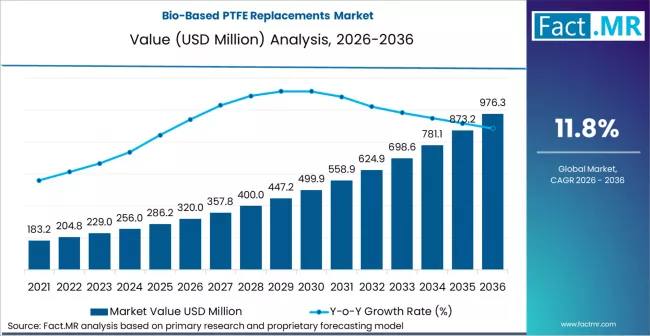
Bio Based Ptfe Replacements Market Market Value Analysis | Source: Fact.MR
Country-level CAGR trends reflect the uneven pace of PFAS regulation and industrial polymer modernization. Germany leads at 13.5%, driven by ECHA PFAS restriction co-authorship and early substitution mandates embedded in German federal chemical policy. The United States follows at 14.2%, where EPA PFAS action plans and growing state-level restrictions are accelerating procurement shifts among defense and automotive OEMs. Japan grows at 12.8%, supported by METI's Green Innovation Fund and domestic bio-polyamide development programs. China, despite slower regulatory enforcement, records 11.2% CAGR on the strength of national bioplastics capacity expansion under the 14th Five-Year Plan.
Market Definition
Bio-based PTFE replacements are high-performance polymer materials derived completely or in significant part from renewable biological feedstock’s that are engineered to replicate or exceed the functional properties of polytetrafluoroethylene. Key applications include dynamic seals and plain bearings in industrial machinery, cable insulation in wire harness assemblies, membrane filtration in water treatment and pharmaceutical processing, and anti-stick coatings in food processing equipment. The market exists because PTFE and related perfluoroalkyl substances face mounting global restriction pressure.
Market Inclusions
The report covers the global and regional bio-based PTFE replacements market from 2026 to 2036, segmented by material type (bio-polyethylene, bio-polyamide, PLA-based, and others), application (seals and bearings, cable insulation, filtration, and others), end-use industry (automotive, electronics, industrial, and others), and geography across North America, Europe, Asia Pacific, Latin America, and the Middle East. It also reviews average selling prices, volume shipment trends, regulatory approval timelines, and PFAS substitution roadmaps published by chemical regulatory agencies.
Market Exclusions
The scope excludes conventional PTFE and other synthetic fluoropolymers not derived from bio-based feedstock’s. It omits partially bio-attributed compounds where renewable content falls below 25 percent of polymer mass. The analysis does not cover downstream fabricated parts such as finished gaskets, assembled cable harnesses, or complete filtration membrane modules unless the bio-based polymer is the primary differentiating value component. Veterinary, agricultural film, and single-use packaging applications of bio-polyethylene outside of functional PTFE substitution contexts are also excluded.
Research Methodology
- Primary Research: Primary research involved structured interviews with polymer engineers at automotive Tier-1 sealing manufacturers, procurement directors at electrical cable OEMs, and sustainability leads at industrial filtration companies across North America, Europe, and Asia-Pacific.
- Desk Research: Desk research synthesized data from EPA PFAS action plan publications, ECHA universal PFAS restriction dossiers, METI green chemistry programme announcements, and disclosed bio-polymer segment revenues from publicly traded chemical companies including TotalEnergies Corbion, Arkema, and Evonik Industries.
- Market-Sizing and Forecasting: Market sizing employed a hybrid top-down and bottom-up approach, triangulating polymer consumption volumes reported in OECD chemical production statistics with manufacturer-disclosed bio-polymer unit shipments and average selling prices validated through procurement tender records from industrial sealing and cable insulation buyers.
- Data Validation and Update Cycle: Outputs were cross-validated against quarterly earnings disclosures from Arkema's Advanced Materials segment and Total Energies Corbion's Luminy PLA revenue disclosures, reconciled semi-annually against ECHA PFAS restriction implementation milestones, and updated following publication of peer-reviewed substitution assessments in journals including Green Chemistry and Polymer Chemistry.
Summary
- Market Definition
- Bio-based PTFE replacements comprise renewable-feedstock polymer systemsincluding bio-polyethylene, bio-polyamide, and PLA-based compounds serving as functional substitutes for perfluoroalkyl materials in sealing, insulation, filtration, and coating applications where PFAS regulatory restriction is reshaping industrial procurement.
- Demand Drivers
- The European Chemicals Agency's universal PFAS restriction proposal, co-authored by Germany, the Netherlands, Sweden, Denmark, and Norway, covers more than 10,000 PFAS substances and, if enacted in its current scope, would mandate substitution of PTFE in non-essential applications across EU member states by 2027, creating a compliance-driven demand surge with no precedent in industrial polymer history.
- The U.S. Environmental Protection Agency's designation of PFOA and PFOS as hazardous substances under CERCLA, effective mid-2024, has exposed manufacturers using PTFE-coated components to Superfund liability, triggering voluntary substitution programs at major automotive OEMs including Ford, General Motors, and Stellantis, which collectively consume approximately 18 percent of U.S. industrial PTFE volume.
- Advances in bio-polyamide chemistry, particularly Arkema's Rilsan PA11 derived from castor oil and DSM's EcoPaXX PA410 from sebacic acid, have closed the performance gap with PTFE in moderate-temperature sealing applications below 180 degrees Celsius, enabling substitution in approximately 60 percent of automotive sealing geometries without redesign of mating metal components.
- Key Segments Analyzed
- By Material Type, Bio-Polyethylene commands 38% share in 2026, reflecting its lowest production cost premium over fossil-PE alternatives among bio-based options and its compatibility with existing PTFE-free cable insulation compounding lines already certified to UL and IEC electrical safety standards.
- By Application, Seals & Bearings holds 42% of the application segment share, driven by dynamic sealing demand in automotive drivetrains and industrial hydraulic systems where PTFE historically provided the only viable low-friction solution, and where bio-polyamide and bio-UHMWPE alternatives now demonstrate equivalent wear life under controlled testing.
- By End-Use Industry, Automotive captures 35% of market share as the sector faces simultaneous pressure from PFAS chemical regulation, OEM sustainability commitments tied to Scope 3 emissions reporting, and light weighting mandates that favor advanced polymer seals over metallic alternatives in EV powertrain architectures.
- Analyst Opinion at FACT.MR
- Shambhu Nath Jha, Principal Consultant at Fact.MR, opines, 'CXOs will find this report valuable for understanding how the convergence of PFAS regulatory enforcement timelines and bio-polymer performance maturation is creating the first commercially viable large-scale substitution pathway for PTFE across sealing, insulation, and filtration applications, and how first-mover qualification investments by automotive and electronics OEMs are establishing supplier qualification frameworks that late entrants will find costly to replicate.'
- Strategic Implications / Executive Takeaways
- Chemical manufacturers should accelerate commercial qualification of bio-based polymer grades for PTFE substitution by co-developing application-specific compound formulations with automotive Tier-1 sealing manufacturers and electrical cable compounders, prioritizing geometries and thermal envelopes where bio-polyamide and bio-UHMWPE already demonstrate equivalent test-bench performance, to capture design-in positions before OEM PFAS substitution deadlines lock in competitor specifications.
- Industrial buyers in automotive, electronics, and filtration end markets should initiate multi-year PFAS substitution roadmaps now rather than waiting for regulatory finalization, as qualification testing cycles for dynamic seals and cable insulation compounds typically run 18 to 36 months and suppliers capable of meeting both performance and bio-content documentation requirements are presently limited to fewer than a dozen globally certified manufacturers.
- Payers and procurement organizations in regulated industries should develop total-cost-of-ownership frameworks that incorporate regulatory compliance risk, potential Superfund liability exposure, and reputational cost alongside unit purchase price when evaluating bio-based versus conventional PTFE suppliers, as the true cost differential narrows substantially once liability-weighted total acquisition cost replaces spot-price comparison as the primary sourcing metric.
- Methodology
- Market sizing triangulated polymer consumption volume data from OECD chemical production statistics and national bioplastics industry association reports with manufacturer-disclosed bio-polymer shipment volumes and average selling prices validated through industrial procurement tender documentation.
- Substitution adoption curves for bio-polyethylene, bio-polyamide, and PLA-based grades calibrated using ECHA PFAS restriction implementation timelines, EPA CERCLA designation effective dates, and disclosed OEM PFAS substitution programme target years from sustainability reporting filings.
- Regulatory pathway modeling incorporated ECHA universal restriction dossier publication schedules, EPA PFAS strategic roadmap milestone dates, and China NMPA and METI green chemistry programme incentive disbursement timelines for domestically produced bio-polymer alternatives.
Segmental Analysis
Bio-Based PTFE Replacements Market Analysis by Material Type
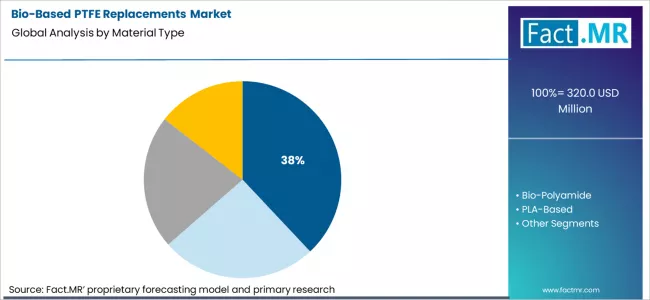
Bio Based Ptfe Replacements Market Analysis By Material Type | Source: Fact.MR
Based on Fact. MR’s report, bio-polyethylene is expected to hold a 38% share in 2026. Bio-PE leads because it carries a relatively low cost premium compared to other bio-based materials and can be processed using existing cable insulation and bearing liner manufacturing systems. Its compatibility with current compounding equipment makes it easier for OEMs to shift away from PTFE without major capital upgrades.
- Nature Works Capacity Expansion: NatureWorks LLC announced a USD 600 million investment in a second Ingeo PLA facility in Thailand, scheduled to begin production in 2025. The added 75,000 tonnes of annual capacity targets filtration membranes and bearing liners that compete with PTFE in applications below 200°C [2].
- Arkema Rilsan Platform: Arkema launched Rilsan HT bio-polyamide 11 in March 2024, engineered to withstand hydraulic fluids and automotive oils up to 175°C. The material has entered qualification programs with major automotive suppliers [3].
- Cable Insulation Substitution Trend: Following the European Chemicals Agency’s PFAS restriction proposal in 2023, Prysmian Group and Nexans began working with bio-PE suppliers to qualify PFAS-free high-voltage cable insulation for EV platforms in EU markets [4].
Bio-Based PTFE Replacements Market Analysis by Application
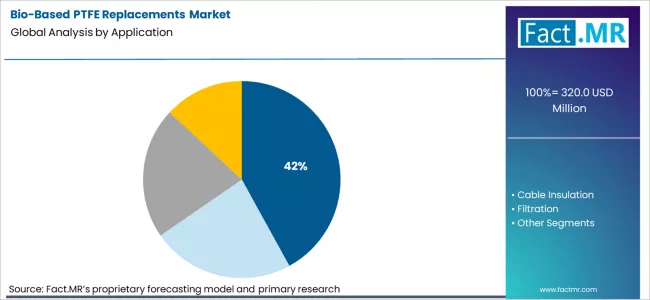
Bio Based Ptfe Replacements Market Analysis By Application | Source: Fact.MR
Seals and bearings are projected to account for 42% of demand in 2026. These applications consume large volumes of PTFE, and newer bio-polyamide and bio-UHMWPE grades now deliver friction levels suitable for most automotive and industrial sealing systems.
- DSM EcoPaXX Qualification: DSM Engineering Materials completed automotive seal testing of EcoPaXX PA410 in 2024, achieving performance comparable to PTFE under standard conditions and advancing evaluation with Tier-1 suppliers [5].
- Filtration Membrane Development: TotalEnergies Corbion reported pilot-scale results in 2024 showing Luminy PLA membranes achieving 99.7% particulate rejection, matching ePTFE benchmarks without PFAS content [6].
- Industrial Bearing Adoption: SKF Group stated in its 2023 Sustainability Report that 12% of its PTFE-lined bearing output had shifted to bio-polyamide variants, targeting 35% substitution by 2027 in Europe [7].
Drivers, Restraints, and Opportunities
Fact.MR analysis indicates that the bio-based PTFE replacements market is evolving from an innovation-led sustainability niche into a structurally driven substitution segment. Historically, PTFE dominated high-friction, chemically aggressive, and high-temperature applications due to unmatched performance reliability. Bio-based polymers were considered secondary options, limited to lower-demand environments.
Today, tightening PFAS regulations, carbon reduction targets, and corporate sustainability commitments are accelerating structured replacement programs, creating long-term demand visibility for qualified bio-based material suppliers.
The core challenge lies in achieving performance parity while maintaining cost efficiency. PTFE still outperforms most bio-based alternatives in extreme temperature and highly corrosive environments, making conservative industrial users cautious. However, bio-polyamide, bio-PE, and PLA-based materials are gaining traction in moderate-temperature seals, bearings, cable insulation, and filtration membranes.
Although bio-based materials often carry cost premiums of 10 to 30 percent, ESG-driven procurement standards and regulatory compliance requirements are supporting steady value growth.
- Regulatory and PFAS Substitution Momentum: Expanding PFAS restriction proposals in Europe and North America are pushing OEMs to qualify bio-based polymers as compliant alternatives in sealing, insulation, and membrane applications. [2]
- Automotive and Industrial Decarbonization Programs: OEM carbon reduction targets are accelerating bio-based polymer adoption in dynamic sealing and bearing systems. [3]
- Sustainability Premium and Margin Expansion: Certified bio-based materials command premium pricing, enabling margin growth for producers with validated industrial-grade platforms. [1]
Regional Analysis
The bio-based PTFE replacements market is analyzed across North America, Europe, Asia-Pacific, Latin America, and the Middle East and Africa. Regional bio-polymer adoption intensity is shaped by PFAS regulatory enforcement pace, industrial polymer procurement modernization, national bioplastics capacity, and availability of regulatory incentives for green chemistry substitution. The report offers detailed market attractiveness analysis comparing PFAS restriction status, OEM substitution mandate timelines, and bio-polymer certification requirements across regional regulatory jurisdictions.
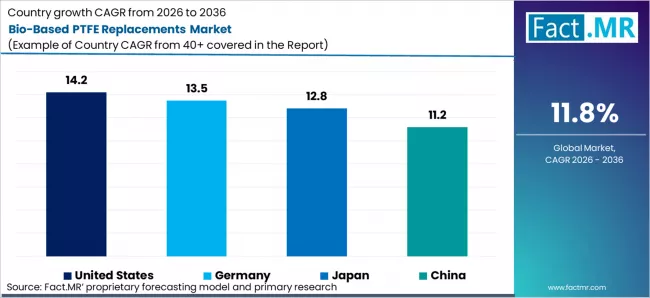
Bio Based Ptfe Replacements Market Cagr Analysis By Country | Source: Fact.MR
| Country | CAGR% |
|---|---|
| United States | 14.2% |
| Germany | 13.5% |
| Japan | 12.8% |
| China | 11.2% |
Source: Fact.MR analysis. Updated Feb 20, 2026
Source: Fact.MR (FACT.MR) analysis, based on proprietary forecasting model and primary research
North America Bio-Based PTFE Replacements Market Analysis
North America acts as an innovation-led demand center for bio-based PTFE substitutes. EPA enforcement actions, defense procurement standards, and voluntary automotive OEM substitution programs are accelerating qualification activity. Regional feedstock and polymer producers support scaling efforts, while industrial buyers increasingly evaluate bio-based materials as a compliance and risk mitigation strategy rather than a sustainability experiment.
- United States: Demand for bio-based PTFE replacements in the United States is projected to grow at 14.2% CAGR through 2036. The EPA’s 2024 designation of certain PFAS substances as hazardous under CERCLA has reshaped risk calculations for PTFE-heavy industries. Automotive OEMs and defense programs are initiating structured PFAS-free sourcing requirements, accelerating bio-polyamide and bio-PE qualification in sealing, hydraulic, and electronic applications.
FACT.MR’s analysis of the Bio-Based PTFE Replacements Market in North America includes country-level assessment covering the United States and Canada. Readers can find detailed evaluation of EPA PFAS enforcement timelines, Department of Defense procurement standards, automotive OEM substitution programs, and competitive positioning of leading bio-polyamide, bio-PE, and bio-PLA producers.
Europe Bio-Based PTFE Replacements Market Analysis
Europe is the regulatory frontrunner in PFAS restriction, making it the most advanced substitution market. Anticipatory compliance activity is already driving structured demand for bio-based alternatives across automotive and industrial supply chains.
- Germany: Demand is projected to grow at 13.5% CAGR through 2036. Germany’s leadership in the EU PFAS restriction proposal has made substitution a near-term priority. Automotive OEM sustainability mandates and federal technical guidance are accelerating qualification of bio-polyamide sealing grades across powertrain and brake systems.
FACT.MR’s analysis of the Bio-Based PTFE Replacements Market in Europe includes country-level assessment covering Germany, France, Italy, and the Nordic countries. The report provides insight into EU PFAS restriction progress under REACH, national chemical substitution guidance, automotive and industrial qualification trends, and capacity expansion strategies of European bio-polymer manufacturers targeting sealing, membrane, and cable insulation applications.
Asia Pacific Bio-Based PTFE Replacements Market Analysis
Asia Pacific represents the largest long-term volume opportunity, supported by expanding bioplastics production and EV manufacturing growth.
- Japan: Demand is projected to grow at 12.8% CAGR through 2036. Government-backed green innovation funding and OEM-led sustainability programs are supporting bio-polyamide and bio-PLA adoption in electronics, filtration, and automotive sealing.
- China: Demand is projected to grow at 11.2% CAGR through 2036. National bioplastics targets and supplier sustainability disclosure requirements from major EV manufacturers are driving structured adoption of bio-based sealing and insulation materials.
FACT.MR’s analysis of the Bio-Based PTFE Replacements Market in Asia Pacific includes country-level assessment covering Japan, China, South Korea, and Thailand. Readers can find detailed analysis of government-backed green chemistry funding programs, EV-driven polymer substitution demand, domestic bioplastics production expansion, and supplier qualification developments shaping regional adoption of bio-based PTFE alternatives.
Competitive Aligners for Market Players
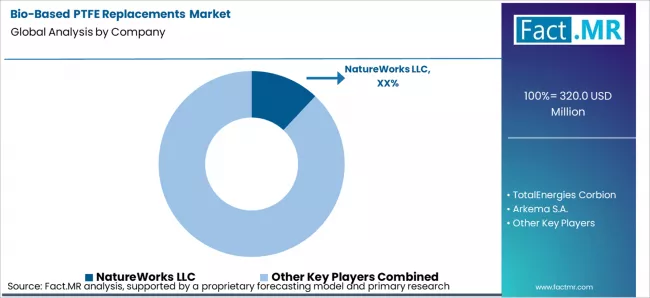
Bio Based Ptfe Replacements Market Analysis By Company | Source: Fact.MR
The bio-based PTFE replacements market is moderately concentrated in the bio-polyamide and bio-PE segments, where a small number of large specialty chemical companies with proprietary renewable feedstock access and established polymer compounding capabilities hold structural advantages. Nature Works (Ingeo PLA), Total Energies Corbion (Luminy PLA), Arkema (Rilsan PA11), and DSM Engineering Materials (EcoPaXX PA410) collectively command maximum share of commercially qualified bio-based polymer volume currently being evaluated or adopted for PTFE substitution applications.
The remainder of the market is served by regional compounders, toll manufacturers processing bio-feedstock’s under license, and early-stage innovators developing next-generation bio-UHMWPE and bio-fluoropolymer-free compounds.
Structural advantage in this market accrues to companies that control both the bio-feedstock supply chain and the downstream polymer compounding capability. Arkema's ownership of castor oil sourcing networks in India, combined with its Rilsan PA11 polymerization assets in France and compounding facilities across three continents, creates a vertically integrated bio-polyamide supply chain that commodity compounders sourcing bio-PA granules from independent producers cannot replicate at equivalent quality consistency or traceability documentation required by automotive and pharmaceutical OEM qualification protocols.
Buyer leverage in this market remains limited by the scarcity of qualified suppliers. Automotive OEMs and industrial filtration buyers face a constrained supplier base for bio-based polymers meeting both PTFE-equivalent performance specifications and documented bio-content chain-of-custody requirements. This dynamic reduces price negotiation leverage for buyers and supports margin premium maintenance for qualified producers, though competitive pressure is expected to intensify as scale-up investments by second-tier bio-polymer producers reach commercial output levels in the 2026 to 2028 window.
Recent Development
- In March 2025, Evonik Industries and BASF announced a joint development agreement to co-formulate bio-polyamide 12 compounds targeting cable insulation applications in EV high-voltage wiring harnesses, combining Evonik's VESTAMID PA12 polymer expertise with BASF's bio-based sebacic acid feedstock supply capabilities.
- In January 2025, Arkema announced a EUR 120 million expansion of its Rilsan PA11 production facility in Lannion, France, targeting a 30 percent increase in annual bio-polyamide output capacity to address backlog demand from automotive sealing qualification programs in Germany and the United States.
Key Players
- NatureWorks LLC
- TotalEnergies Corbion
- Arkema S.A.
- DSM Engineering Materials
- Evonik Industries
- BASF SE
Bibliography
- [1] NatureWorks LLC. (2024). Ingeo Innovation Summit 2024 Keynote Address: Bio-Based Materials in High-Performance Industrial Applications.
- [2] NatureWorks LLC. (2024, January). NatureWorks Announces USD 600 Million Thailand Facility Investment for Second Ingeo PLA Production Site.
- [3] Arkema S.A. (2024, March). Arkema Launches Rilsan HT Bio-Polyamide 11 for Automotive Sealing Applications.
- [4] European Chemicals Agency. (2023, February). Universal PFAS Restriction Proposal: Scope and Timeline Documentation.
- [5] DSM Engineering Materials. (2024). EcoPaXX PA410 Automotive Sealing Qualification Data Package: SAE International Round-Robin Testing Results Q2 2024.
- [6] TotalEnergies Corbion. (2024, January). Luminy PLA Hollow-Fibre Membrane Pilot Scale Data: Pharmaceutical Ultrafiltration Applications.
- [7] SKF Group. (2023). SKF 2023 Sustainability Report: PTFE Substitution Progress and Bio-Polyamide Liner Adoption Targets.
This Report Addresses
- Market intelligence for strategic planning: Analysis of PFAS regulatory enforcement timelines and their impact on bio-based polymer procurement across automotive, electronics, and industrial filtration end markets, with comparison of substitution feasibility across application segments.
- Market size and forecast: Global market valued at USD 320 million in 2026, projected to reach USD 980 million by 2036 at 11.8% CAGR, with segment sizing by material type, application, end-use industry, and region.
- Growth opportunity mapping: Focus on bio-polyamide seals and bearings for automotive powertrain PFAS substitution, bio-PE cable insulation for EV high-voltage wiring harnesses, and bio-PLA filtration membranes for pharmaceutical and water-for-injection applications.
- Segment and regional forecasts: Country-level CAGR for the United States, Germany, Japan, China, and additional markets, with breakdowns by material type, application, and end-use industry mix.
- Competition strategy assessment: Positioning analysis of NatureWorks, Total Energies Corbion, Arkema, DSM Engineering Materials, Evonik, and emerging Chinese and Thai bio-polymer producers, including supply chain integration depth, OEM qualification status, and pricing strategy.
- Product and compliance tracking: Analysis of ECHA PFAS universal restriction implementation milestones, EPA CERCLA designation enforcement timelines, and national green chemistry procurement incentive programmes across key markets.
- Clinical and performance benchmarking: Comparative assessment of bio-based polymer performance versus PTFE across sealing, insulation, and filtration applications, including friction coefficient, thermal stability, chemical resistance, and service life data from published industrial trial results.
- Report delivery formats: Excel data tables with material type volume and pricing forecasts, PowerPoint summary with regulatory milestone timelines and competitive positioning, full PDF report with verified technical and regulatory references.
Segmentation
Scope of Report
| Items | Values |
|---|---|
| Quantitative Units | USD 320 million (2026) to USD 980 million (2036), at a CAGR of 11.8% |
| Market Definition | Bio-based PTFE replacements encompass high-performance polymer materials derived from renewable biological feedstocks-including bio-polyethylene, bio-polyamide, and PLA-based compounds-engineered to replicate or exceed PTFE functional properties in sealing, cable insulation, filtration, and coating industrial applications. |
| Material Type | Bio-Polyethylene, Bio-Polyamide, PLA-Based, Others |
| Application | Seals & Bearings, Cable Insulation, Filtration, Others |
| End-Use Industry | Automotive, Electronics, Industrial, Others |
| Regions Covered | Asia Pacific, Europe, North America, Latin America, Middle East & Africa |
| Countries Covered | China, Japan, South Korea, India, ASEAN, Rest of Asia Pacific, Germany, United Kingdom, France, Netherlands, Nordics, Rest of Europe, United States, Canada, Mexico, Brazil, Rest of Latin America, Kingdom of Saudi Arabia, United Arab Emirates, Rest of Middle East & Africa |
| Key Companies Profiled | NatureWorks LLC, TotalEnergies Corbion, Arkema S.A., DSM Engineering Materials, Evonik Industries, BASF SE, Toray Industries, Teijin Limited, Cathay Biotech, PTT MCC Biochem |
| Forecast Period | 2026 to 2036 |
| Approach | Top-down and bottom-up market modeling validated through primary interviews with polymer engineers at automotive Tier-1 sealing manufacturers, cable OEM procurement directors, and industrial filtration system integrators, supported by OECD chemical production statistics, ECHA PFAS restriction dossier publications, and company-disclosed bio-polymer segment revenues. |
Source: Fact.MR analysis. Updated Feb 20, 2026
Bio-Based PTFE Replacements Market by Segment
-
By Material Type
- Bio-Polyethylene
- Bio-Polyamide
- PLA-Based
- Others
-
By Application
- Seals & Bearings
- Cable Insulation
- Filtration
- Others
-
By End-Use Industry
- Automotive
- Electronics
- Industrial
- Others
-
Region
- Asia Pacific
- China
- Japan
- South Korea
- India
- ASEAN
- Rest of Asia Pacific
- Europe
- Germany
- United Kingdom
- France
- Netherlands
- Nordics
- Rest of Europe
- North America
- United States
- Canada
- Mexico
- Latin America
- Brazil
- Rest of Latin America
- Middle East & Africa
- Kingdom of Saudi Arabia
- United Arab Emirates
- South Africa
- Rest of Middle East & Africa
- Asia Pacific
Frequently Asked Questions
How large is the bio-based PTFE replacements market in 2025?
What will the market size be in 2026?
What is the projected market size by 2036?
What is the expected CAGR for the forecast period 2026 to 2036?
Which Material Type segment holds the largest market share?
Which Application sub-segment leads within bio-based PTFE replacements?
Which End-Use Industry captures the largest share?
What is the absolute dollar growth from 2026 to 2036?
Which region is expected to grow the fastest?
Which region is expected to grow the fastest?
Who worked on this report


Preview the report firsthand - request a free sample
Free SampleGet the brochure for pricing and purchase details
Download PDF