- Base Value(2025): 1.0 Bn
- Estimated Value(2026): 1.2 Bn
- Forecast Value (2036): 4.2 Bn
- CAGR (2026 - 2036): 12.9%
PFAS-Free Fluoropolymer Alternatives Market Forecast and Outlook 2026 to 2036
In 2025, the PFAS-free fluoropolymer alternatives market was valued at USD 1.0 billion. Based on Fact.MR analysis, demand for PFAS-free fluoropolymer alternatives is estimated to grow to USD 1.2 billion in 2026 and USD 4.2 billion by 2036. Fact.MR projects a CAGR of 12.9% during the forecast period.
The absolute dollar growth from 2026 to 2036 represents an incremental gain of USD 3.0 billion, a transformational expansion that reflects a fundamental materials substitution cycle rather than organic volume growth. Structural forces sustaining this trajectory include mandatory PFAS phase-out timelines under EU REACH restrictions, rising procurement compliance requirements from electronics and automotive OEMs, and accelerating investment by specialty chemical producers in non-fluorinated polymer platforms that match legacy performance thresholds for thermal resistance, chemical inertness, and dielectric properties.
As Mark Newman, Chief Technology Officer at Chemours Company, noted regarding the materials transition in high-performance polymer markets, the company is focused on developing next-generation solutions that meet both performance and regulatory requirements across its industrial product portfolio. [1]
Growth is strongest in regulatory-driven markets. The United States leads at 13.8% CAGR, supported by strict EPA enforcement and OEM compliance mandates. Germany follows at 12.5% under REACH implementation. Japan grows at 11.8% due to strong electronics and automotive adoption. China records 10.5%, driven by chemical safety reforms and export-focused manufacturing compliance requirements.
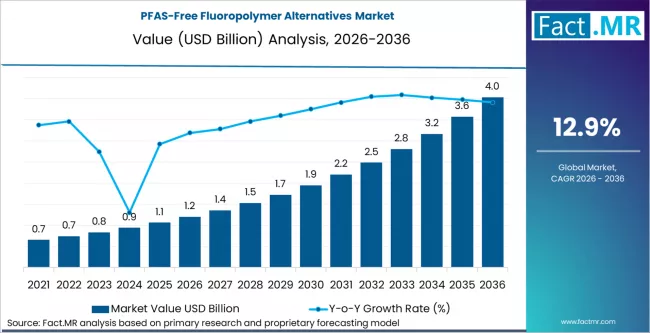
Pfas Free Fluoropolymer Alternatives Market Market Value Analysis | Source: Fact.MR
Market Definition
The PFAS-free fluoropolymer alternatives market covers non-perfluoroalkyl and non-polyfluoroalkyl substance materials engineered to replicate the functional performance of traditional fluoropolymers in demanding industrial applications. These include silicone-based elastomers and resins, hydrocarbon-based polymers, and modified polyolefin compounds used in surface coatings, sealing components, and filtration membranes. The primary end-use sectors are electronics, automotive, chemical processing, and construction. What is being bought and sold is chemistry that replicates chemical resistance, thermal stability, and low surface energy without the environmental persistence of legacy PFAS compounds.
Market Inclusions
The report covers global and regional market size forecasts from 2026 to 2036, segmented by material type, application, and end-use industry. It evaluates regulatory compliance timelines, material performance comparisons with legacy fluoropolymers, pricing dynamics of alternative chemistries, competitive positioning of key producers, and adoption rates across electronics, automotive, chemical processing, and construction sectors.
Market Exclusions
The scope excludes legacy PFAS-containing fluoropolymers such as PTFE, PVDF, and FEP unless they are part of a documented substitution or reformulation program. It also omits finished consumer goods containing fluoropolymer components, pharmaceutical fluorinated compounds, and agrochemical PFAS applications, focusing strictly on industrial-grade PFAS-free alternative polymers and their immediate material supply chain.
Research Methodology
- Primary Research: Primary research involved structured interviews with R&D and materials science directors at specialty chemical producers, procurement and compliance managers at electronics and automotive OEMs, regulatory affairs specialists at chemical industry associations, and application engineers at coatings, seals, and membrane manufacturers across India, China, the United States, Germany, and Brazil.
- Desk Research: Desk research synthesized data from EPA PFAS action plan publications, EU REACH restriction dossiers, corporate R&D investment disclosures from Daikin Industries, 3M Company, Chemours, Solvay, and AGC Inc., industry association chemical substitution guidance from the European Chemicals Agency, and national environmental agency regulatory timelines in key markets.
- Market-Sizing and Forecasting: Market sizing employed a hybrid top-down and bottom-up approach, combining total addressable PFAS-regulated product volume estimates by end-use industry with average alternative materials pricing per unit, validated against disclosed specialty polymer segment revenues from major producers and benchmarked against regulatory compliance transition timelines published by national chemical management agencies.
- Data Validation and Update Cycle: Outputs were cross-validated against disclosed specialty materials segment revenues from Chemours, Solvay, and Daikin Industries, reconciled semi-annually with corporate earnings disclosures and regulatory agency PFAS restriction implementation milestones, and updated annually with national environmental agency enforcement data and OEM procurement compliance announcements.
Summary
Market Definition
- The PFAS-free fluoropolymer alternatives market covers the full range of non-PFAS engineered polymer materials including silicone-based resins, hydrocarbon polymers, and modified polyolefins used in industrial coatings, sealing systems, and filtration membranes as regulated replacements for perfluoroalkyl and polyfluoroalkyl substances across electronics, automotive, and industrial sectors.
Demand Drivers
- The European Chemicals Agency's REACH universal restriction proposal for PFAS, covering over 10,000 substances across industrial use cases, is compelling European and export-focused manufacturers to accelerate qualification of alternative materials well ahead of formal restriction deadlines, creating a front-loaded adoption wave for compliant polymer producers.
- Electronics OEMs in Asia Pacific are embedding PFAS-free material requirements into component supplier qualification programs, driven by export compliance requirements for products sold in regulated markets including the European Union and the United States, creating a cascading compliance mandate through tier-one and tier-two supply chains.
- The U.S. Environmental Protection Agency's PFAS Strategic Roadmap and proposed manufacturing reporting rules are increasing domestic cost pressure on legacy fluoropolymer supply chains, incentivizing major industrial end-users to proactively substitute compliant alternatives ahead of formal market restrictions.
Key Segments Analyzed
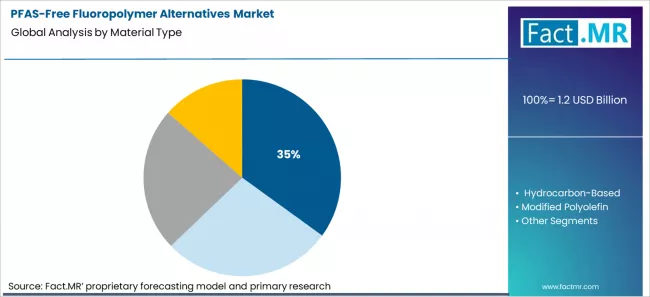
- By material type, silicone-based alternatives hold the leading 35% share, reflecting their established performance profile across high-temperature sealing, dielectric coating, and flexible membrane applications that previously relied on PFAS-based fluoroelastomers.
- By end-use industry, electronics accounts for 30% share, driven by demand for high-performance sealing, thermal management, and insulation materials in semiconductors and consumer devices.
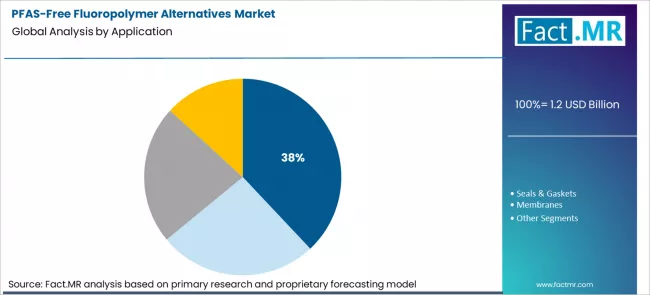
- By application, coatings account for the largest 38% share, driven by widespread regulatory scrutiny of PFAS-containing surface treatments in electronics, industrial equipment, and architectural construction where non-stick and chemical-resistant coatings are high-volume, high-visibility use cases.
- By geography, Asia Pacific contributes the largest share of volume-driven growth, supported by India's electronics manufacturing expansion and China's domestic PFAS reform agenda, while Europe generates the highest regulatory-driven conversion premiums.
Analyst Opinion at FACT.MR
- Shambhu Nath Jha, Principal Consultant at Fact.MR, opines, 'CXOs will find this report essential for understanding how the mandatory PFAS phase-out cycle across electronics, automotive, and chemical processing industries is creating durable and high-margin substitution demand for silicone-based and hydrocarbon-based alternative materials, and which material platforms, application segments, and geographic markets offer the most defensible growth through the forecast period.'
Strategic Implications / Executive Takeaways
- Specialty polymer producers should accelerate qualification of silicone-based and modified polyolefin alternatives with tier-one electronics and automotive OEMs ahead of formal regulatory deadlines, as early supplier qualification locks in multi-year supply agreements that late entrants cannot displace once product specifications are certified.
- Industrial coatings manufacturers operating in EU and U.S. markets should map their full product portfolio against PFAS restriction timelines and prioritize reformulation in the highest-volume application categories, specifically electronics conformal coatings and industrial sealing compounds, where regulatory scrutiny is most concentrated and customer switching costs are high.
- Chemical distributors serving the chemical processing and construction industries should build technical service capabilities around PFAS-free material qualification, as end-users in these sectors face long product approval cycles and require hands-on application support to justify switching from legacy fluoropolymer suppliers.
Methodology
- Market size estimates were based on PFAS-regulated product volumes by end-use industry combined with alternative material pricing data, cross-checked with specialty polymer revenue disclosures from major producers.
- Segment analysis used regulatory restriction dossiers from the European Chemicals Agency and EPA enforcement data combined with OEM procurement compliance disclosures.
- Country forecasts were validated using national environmental agency timelines, corporate investment announcements, and electronics and automotive sector PFAS compliance program disclosures.
Segmental Analysis
PFAS-Free Fluoropolymer Alternatives Market Analysis by Material Type
Pfas Free Fluoropolymer Alternatives Market Analysis By Material Type | Source: Fact.MR
Silicone-based alternatives are projected to hold 35% share in 2026 due to their balanced performance in sealing and coating applications. Hydrocarbon polymers, holding 28%, are expanding in membranes and gaskets where mid-range temperature resistance is sufficient.
- Daikin Industries R&D Investment: Continued investment in next-generation compliant polymers was disclosed in its 2023 annual report. [4]
- Chemours Technology Development: Chemours highlighted expansion of non-PFAS specialty coatings platforms in its 2023 sustainability roadmap. [1]
- Hydrocarbon Polymer Adoption Trend: Adoption is increasing in regulated industrial processing environments. [5]
PFAS-Free Fluoropolymer Alternatives Market Analysis by Application
Pfas Free Fluoropolymer Alternatives Market Analysis By Application | Source: Fact.MR
Coatings lead with 38% share in 2026 as regulatory scrutiny on surface treatments drives substitution. Membranes, at 22%, represent the fastest-growing segment due to filtration and emissions compliance demand.
- 3M Company Coatings Transition: 3M announced cessation of PFAS manufacturing by end of 2025, creating supply transition opportunities. [6]
- Solvay Specialty Polymer Expansion: Solvay disclosed capacity investments targeting regulatory-driven demand. [7]
- Membrane Application Growth: Demand is rising across water filtration and gas separation under stricter environmental standards. [8]
Drivers, Restraints, and Opportunities
Fact.MR analysis indicates that the PFAS-free fluoropolymer alternatives market has shifted from a niche substitution space to a regulation-driven growth category. Fluoropolymers were historically preferred for their superior chemical and thermal resistance, and alternatives were only used where performance trade-offs were acceptable. Now, tightening regulations across Europe and North America are forcing structured replacement cycles, creating predictable long-term demand for compliant material suppliers.
The key challenge is maintaining performance while staying cost competitive. Legacy PFAS materials still outperform alternatives in extreme conditions, making some users cautious. Silicone-based materials are gaining traction in moderate-temperature sealing and coatings, while hydrocarbon polymers are expanding in membranes and gaskets. Although PFAS-free materials carry 15 to 35 percent price premiums, regulatory mandates and qualification approvals are supporting overall market value growth.
- Regulatory Phase-Out Mandates: The European Chemicals Agency’s REACH restriction proposal is expected to begin phased implementation from 2026, pushing manufacturers to accelerate material qualification timelines. [2]
- Electronics Sector OEM Compliance Cascades: Major Asia Pacific electronics OEMs are embedding PFAS-free requirements into supplier contracts, triggering early upstream substitution. [3]
- Premium Pricing Dynamics in Specialty Segments: Certified PFAS-free materials command pricing premiums, supporting margin expansion for qualified producers. [1]
Regional Analysis
The PFAS-free fluoropolymer alternatives market is analyzed across North America, Europe, Asia Pacific, Latin America, and Middle East and Africa. Regional demand patterns reflect the maturity of chemical regulation enforcement, electronics and automotive OEM concentration, and the depth of industrial chemical management infrastructure in each market. The full report offers detailed market attractiveness analysis comparing regulatory transition timelines, production capacity of alternative materials, and competitive intensity by region.
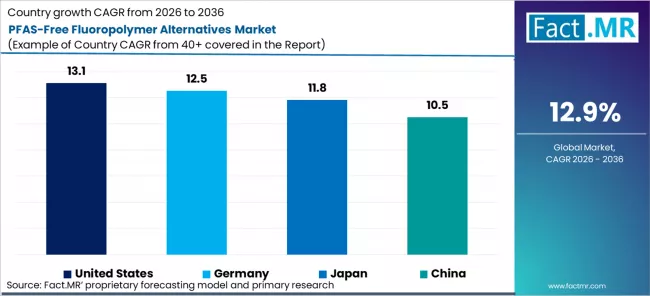
Pfas Free Fluoropolymer Alternatives Market Cagr Analysis By Country | Source: Fact.MR
| Country | CAGR% |
|---|---|
| United States | 13.1% |
| Germany | 12.5% |
| Japan | 11.8% |
| China | 10.5% |
Source: Fact.MR analysis. Updated Feb 23, 2026
Source: Fact.MR (FACT.MR) analysis, based on proprietary forecasting model and primary research
North America PFAS-Free Fluoropolymer Alternatives Market Analysis
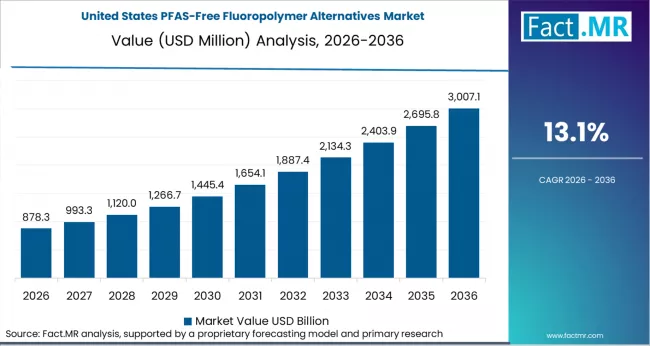
Pfas Free Fluoropolymer Alternatives Market Country Value Analysis | Source: Fact.MR
North America is the global regulatory enforcement epicenter for PFAS restriction, anchored by the U.S. Environmental Protection Agency's PFAS Strategic Roadmap and state-level restrictions in over 30 states. Major specialty chemical producers including Chemours and 3M have established alternative materials development programs explicitly addressing North American regulatory timelines. The region benefits from advanced materials research infrastructure and strong demand from aerospace, defense, and electronics manufacturing sectors that are converting legacy PFAS specifications under federal procurement compliance requirements.
- United States: Demand for PFAS-free fluoropolymer alternatives in the United States is projected to rise at 13.1% CAGR through 2036. Growth is driven by EPA enforcement under the Toxic Substances Control Act Section 8(a)(7) PFAS, which increase cost visibility of legacy PFAS use and accelerate substitution planning among industrial manufacturers. The semiconductor and electronics manufacturing sector is the primary conversion driver, as U.S. fabrication facilities serving global OEMs are required to comply with international buyer material standards that mandate PFAS-free component certification.
FACT.MR's analysis of the PFAS-free fluoropolymer alternatives market in North America includes country-level assessment covering the United States and Canada. Readers can find detailed EPA regulatory timeline analysis, electronics sector adoption curves, and competitive positioning of leading alternative materials producers serving North American industrial markets.
Europe PFAS-Free Fluoropolymer Alternatives Market Analysis
Europe is the global regulatory laboratory for PFAS restriction, with the European Chemicals Agency overseeing the most comprehensive universal PFAS restriction framework under REACH that spans manufacturing, import, and use across nearly all industrial categories. The region's specialty chemical industry, led by producers such as Solvay and Arkema, is simultaneously managing legacy fluoropolymer product obligations and investing in next-generation PFAS-free platforms.
- Germany: Demand for PFAS-free fluoropolymer alternatives in Germany is projected to rise at 12.5% CAGR through 2036. Germany serves as the production and compliance hub of the European PFAS-free materials market, housing major chemical research facilities and automotive OEM headquarters that are defining supplier qualification standards. The German Chemicals Act implementation of REACH universal restrictions is compelling domestic chemical producers and end-users to accelerate alternative material qualification programs.
FACT.MR's analysis of the PFAS-free fluoropolymer alternatives market in Europe includes country-level assessment covering Germany, the United Kingdom, France, the Netherlands, and Nordic markets. Readers can find REACH restriction timeline analysis, automotive and electronics sector adoption trends, and specialty chemical producer investment patterns by country.
Asia Pacific PFAS-Free Fluoropolymer Alternatives Market Analysis
Asia Pacific is the fastest-growing PFAS-free fluoropolymer alternatives region, driven by electronics manufacturing expansion, OEM export compliance requirements, and increasing domestic chemical safety reforms in China and India. Regional producers including Daikin Industries and AGC Inc. are positioned as both alternative materials suppliers and legacy fluoropolymer transition managers.
- Japan: Demand for PFAS-free fluoropolymer alternatives in Japan is projected to rise at 11.8% CAGR through 2036. Japan’s advanced electronics, semiconductor, and automotive manufacturing sectors are the primary demand drivers, as domestic OEMs are proactively aligning with EU and U.S. regulatory standards by embedding PFAS-free material requirements into supplier qualification frameworks and next-generation product development programs.
- China: Demand for PFAS-free fluoropolymer alternatives in China is projected to rise at 10.5% CAGR through 2036. China's domestic electronics manufacturing sector, the world's largest, is the primary demand driver, as global OEM customers are imposing PFAS-free material requirements on Chinese component suppliers through supply chain compliance programs.
FACT.MR's analysis of the PFAS-free fluoropolymer alternatives market in Asia Pacific includes country-level assessment covering India, China, Japan, South Korea, Australia, and ASEAN markets. Readers can find electronics sector compliance program timelines, OEM supply chain PFAS requirements, and regional chemical safety reform analysis by country.
Competitive Aligners for Market Players
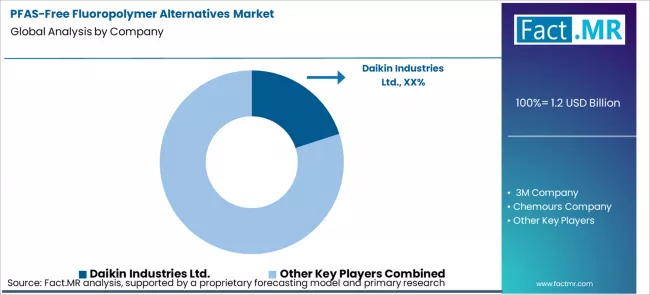
Pfas Free Fluoropolymer Alternatives Market Analysis By Company | Source: Fact.MR
The global PFAS-free fluoropolymer alternatives market is moderately concentrated at the tier-one level, where Daikin Industries, Chemours, Solvay, 3M, and AGC together account for an estimated maximum share of qualified alternative material supply capacity. Below this level, the market includes numerous regional specialty polymer producers, compounders, and distributors competing on specific application certifications, local service capabilities, and pricing. At the top tier, competition centers on materials performance validation, regulatory certification status, and the ability to offer multi-category PFAS-free portfolios that allow large industrial customers to consolidate their supplier transitions.
Structural competitive advantage in this market rests on the possession of certified, tested material platforms that have been qualified by demanding electronics and automotive OEMs. Daikin Industries benefits from its position as the world's leading fluorochemistry producer and its investment in developing PFAS-free alternatives that leverage its underlying polymer process technology. Solvay and AGC compete through their specialty polymer divisions, which have multi-decade application engineering relationships with key industrial end-users. These relationships and qualification histories create significant barriers to displacement even as new alternative material entrants emerge from the broader specialty polymer industry.
Large industrial customers including electronics OEMs and automotive manufacturers are managing supplier dependency by qualifying two to three alternative material suppliers per application category, maintaining pricing pressure while ensuring supply continuity during the transition period. This buyer behavior limits the ability of any single alternative material supplier to capture monopolistic pricing power during the regulatory transition cycle, even where performance advantages are significant. Specialist producers that combine application engineering support with certified material supply are better positioned to retain multi-year supply agreements.
Recent Developments
- In 2025, Clariant introduced a new AddWorks™ PFAS-free polymer processing aid range for polyolefin extrusion in June 2025, offering high performance without PFAS and tailored for global packaging and film applications under tightening sustainability and regulatory demands.
- In 2025, Dow unveiled its DOWSIL 5-1050 silicone-based polymer processing aid in September 2025 as a PFAS-free alternative for film packaging extrusion, meeting EU and FDA food-contact requirements while improving processing performance.
Key Players
- Daikin Industries Ltd.
- 3M Company
- Chemours Company
- Solvay S.A.
- AGC Inc.
- Arkema S.A.
- Donaldson Company Inc.
- W.L. Gore & Associates Inc.
- Saint-Gobain S.A.
Bibliography
- [1] Chemours Company, Annual Report 2023, February 2024.
- [2] European Chemicals Agency, Universal PFAS Restriction Proposal under REACH, February 2023.
- [3] U.S. Environmental Protection Agency, PFAS Strategic Roadmap: EPA's Commitments to Action 2021-2024, October 2021.
- [4] Daikin Industries Ltd., Annual Report 2023, June 2023.
- [5] AGC Inc., Annual Report and ESG Data 2023, March 2024.
- [6] 3M Company, PFAS Transition Press Release, May 2023.
- [7] Solvay S.A., 2023 Annual Results Presentation, February 2024.
- [8] U.S. Environmental Protection Agency, TSCA Section 8(a)(7) PFAS Reporting Rule, October 2023.
- [9] AGC Inc., Electronics Business Segment Investor Presentation, February 2024.
This Report Addresses
- Market intelligence for strategic planning with analysis of PFAS-free fluoropolymer alternatives adoption from voluntary substitution toward mandated regulatory replacement across electronics, automotive, chemical processing, and construction sectors globally.
- Market size and forecast showing global valuation of USD 1.2 billion in 2026 and projected USD 4.2 billion by 2036 at a CAGR of 12.9%.
- Growth opportunity mapping across silicone-based high-performance polymer platforms, PFAS-free membrane materials for water and gas separation, and compliant sealing solutions for automotive and chemical processing OEM qualification programs.
- Segment and regional forecasts covering all major countries with material type, application, and end-use industry breakdowns including electronics, automotive, chemical processing, and construction sector analysis.
- Competition strategy assessment of leading PFAS-free materials producers including alternative material portfolio depth, OEM qualification status, production capacity investment, and regulatory certification coverage by market.
- Regulatory compliance tracking of EU REACH universal PFAS restriction proposals, U.S. EPA PFAS Strategic Roadmap enforcement milestones, national PFAS management frameworks in China and India, and OEM supply chain compliance program timelines affecting material substitution demand.
- Technology adoption analysis covering silicone-based polymer innovations, hydrocarbon-based membrane chemistry advances, modified polyolefin compound development, and material qualification testing infrastructure being built by leading specialty chemical producers.
- Report delivery in Excel, PowerPoint, and PDF formats with fully validated data, primary research evidence, and verified regulatory and company source documentation.
Segmentation
Scope of Report
| Items | Values |
|---|---|
| Quantitative Units | USD 1.2 billion (2026) to USD 4.2 billion (2036), at a CAGR of 12.9% |
| Market Definition | The PFAS-free fluoropolymer alternatives market covers non-PFAS materials including silicone-based, hydrocarbon-based, and modified polyolefin compounds used in coatings, seals and gaskets, and membranes across electronics, automotive, chemical processing, and construction industries as substitutes for legacy perfluoroalkyl and polyfluoroalkyl substances. |
| By Material Type | Silicone-Based, Hydrocarbon-Based, Modified Polyolefin, Others |
| By Application | Coatings, Seals & Gaskets, Membranes, Others |
| By End-Use Industry | Electronics, Automotive, Chemical Processing, Construction, Others |
| Regions Covered | Asia Pacific, Europe, North America, Latin America, Middle East & Africa |
| Countries Covered | China, Japan, South Korea, Australia & New Zealand, India, ASEAN, Rest of Asia Pacific, Norway, Germany, United Kingdom, France, Spain, Netherlands, Nordics, Rest of Europe, United States, Canada, Mexico, Brazil, Chile, Ecuador, Rest of Latin America, Kingdom of Saudi Arabia, United Arab Emirates, South Africa, Turkey, Rest of Middle East & Africa |
| Key Companies Profiled | Daikin Industries Ltd., 3M Company, Chemours Company, Solvay S.A., AGC Inc., Arkema S.A., Donaldson Company Inc., W.L. Gore & Associates Inc., Saint-Gobain S.A. |
| Forecast Period | 2026 to 2036 |
| Approach | Top-down and bottom-up market modeling validated through primary interviews with material scientists, procurement managers, compliance officers, and end-use industry engineers, supported by regulatory agency disclosures, corporate investment filings, and national environmental agency data. |
Source: Fact.MR analysis. Updated Feb 23, 2026
PFAS-Free Fluoropolymer Alternatives Market by Segment
-
By Material Type :
- Silicone-Based
- Hydrocarbon-Based
- Modified Polyolefin
- Others
-
By Application :
- Coatings
- Seals & Gaskets
- Membranes
- Others
-
By End-Use Industry :
- Electronics
- Automotive
- Chemical Processing
- Construction
- Others
-
Region :
- Asia Pacific
- China
- Japan
- South Korea
- Australia & New Zealand
- India
- ASEAN
- Rest of Asia Pacific
- Europe
- Norway
- Germany
- United Kingdom
- France
- Spain
- Netherlands
- Nordics
- Rest of Europe
- North America
- United States
- Canada
- Mexico
- Latin America
- Brazil
- Chile
- Ecuador
- Rest of Latin America
- Middle East & Africa
- Kingdom of Saudi Arabia
- United Arab Emirates
- South Africa
- Turkey
- Rest of Middle East & Africa
- Asia Pacific
Frequently Asked Questions
How large is the PFAS-free fluoropolymer alternatives market in 2025?
What will the market size be in 2026?
What is the projected market size by 2036?
What is the expected CAGR for the forecast period 2026 to 2036?
Which Material Type segment holds the largest share?
Which Application segment dominates in 2026?
Which country shows the fastest CAGR?
What is the absolute dollar growth from 2026 to 2036?
How significant is the Electronics end-use industry?
Who worked on this report


Preview the report firsthand - request a free sample
Free SampleGet the brochure for pricing and purchase details
Download PDF