Next-Generation PFAS Destruction Reagents Market

Next-Generation PFAS Destruction Reagents Market Size and Share Forecast Outlook 2026 to 2036

Next-generation pfas destruction reagents market is projected to grow from USD 150.0 million in 2026 to USD 650.4 million by 2036, at a CAGR of 15.8%. Electrochemical Oxidation Reagents & Catalysts will dominate with a 32.0% market share, while concentrated industrial wastewater & landfill leachate will lead the treated medium segment with a 34.0% share.

Next-Generation PFAS Destruction Reagents Market Forecast and Outlook 2026 to 2036

The global market for next-generation PFAS destruction reagents is projected to reach USD 650.39 million by 2036. The market is valued at USD 150.00 million in 2026 and is set to rise at a CAGR of 15.8% during the assessment period.

Key Takeaways from the Next-Generation PFAS Destruction Reagents Market

  • Market Value for 2026: USD 150.00 Million
  • Market Value for 2036: USD 650.39 Million
  • Forecast CAGR (2026-2036): 15.8%
  • Leading Technology Share (2026): Electrochemical Oxidation Reagents & Catalysts (32%)
  • Leading Treated Medium Share (2026): Concentrated Industrial Wastewater & Landfill Leachate (34%)
  • Leading End-Use Sector Share (2026): Environmental Services & PFAS Waste Management Firms (30%)
  • Key Players in the Market: Aclarity, Revive Environmental, AECOM (DE-FLUORO Technology), Ovivo (incl. E2metrix/Evocra PFAS Destruction), General Atomics Electromagnetic Systems (PERSES iSCWO)
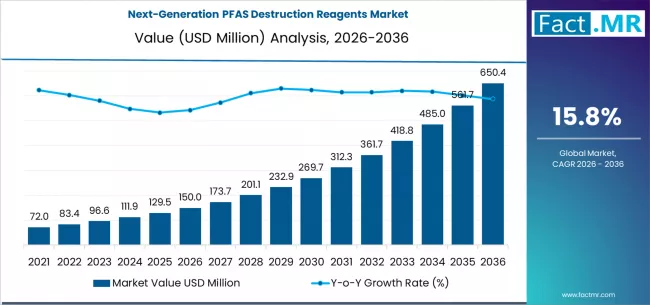
Next Generation Pfas Destruction Reagents Market Market Value Analysis

By technology, electrochemical oxidation reagents and catalysts hold a leading 32% share. The treated medium segment for concentrated industrial wastewater and landfill leachate represents the dominant application at 34%. This explosive growth is driven by an urgent global regulatory mandate to not just remove, but permanently destroy persistent per- and polyfluoroalkyl substances (PFAS). Legacy methods like sequestration or incineration are increasingly seen as interim or insufficient solutions, creating a definitive demand for advanced chemical reagents that enable complete mineralization of these "forever chemicals."

These next-generation reagents are the critical enablers of destructive technologies, designed to break the ultra-strong carbon-fluorine bonds at the core of PFAS. Their development and deployment are central to addressing widespread contamination in water, soil, and waste streams, moving beyond containment to true elimination and closing the environmental remediation loop.

Next-Generation PFAS Destruction Reagents Market

Metric Value
Market Value (2026) USD 150.00 Million
Market Forecast Value (2036) USD 650.39 Million
Forecast CAGR (2026-2036) 15.8%

Category

Category Segments
Technology Electrochemical Oxidation Reagents & Catalysts, Supercritical/Hydrothermal Oxidation Reagents, Reductive / Defluorination Reagents, Plasma/UV-Activated Oxidation Chemistries, Other Hybrid / Bio-Enhanced Reagent Systems
Treated Medium Concentrated Industrial Wastewater & Landfill Leachate, Municipal Drinking Water & Wastewater Streams, Groundwater & In-Situ Remediation Streams, Solid & Semi-Solid PFAS Waste (GAC, Resins, Sludges)
End-Use Sector Environmental Services & PFAS Waste Management Firms, Municipal & Regional Utilities, Industrial & Chemical Manufacturing Sites, Defense, Airports & AFFF Transition Programs, Other Commercial & Institutional Users
Region North America, Latin America, Western Europe, Eastern Europe, East Asia, South Asia & Pacific, MEA

Segmental Insights: Core Technologies and Target Streams

Which Destructive Technology is Garnering the Most Strategic Investment?
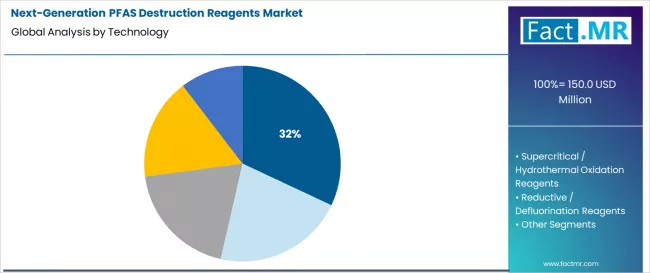
Next Generation Pfas Destruction Reagents Market Analysis By Technology

lectrochemical oxidation reagents and catalysts lead the technology segment with a 32% share. This prominence is due to the technology's scalability and adaptability. It can be deployed as modular, on-site treatment units for concentrated waste streams, minimizing transportation liabilities.

The performance and cost-effectiveness of the core electrochemical process are directly tied to the innovation in specialized anode materials and catalyst-infused reagents, making this a focal point for R&D aimed at improving energy efficiency and destruction completeness.

Which Contaminated Stream Presents the Most Complex Destruction Challenge?
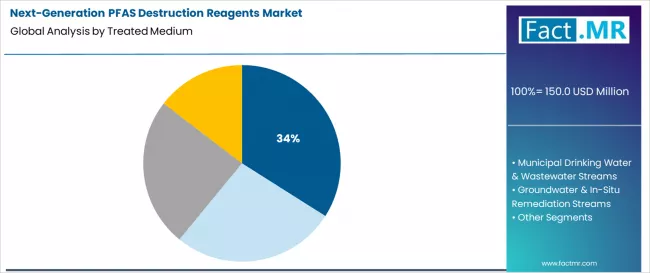
Next Generation Pfas Destruction Reagents Market Analysis By Treated Medium

Concentrated industrial wastewater and landfill leachate represent the largest treated medium segment at 34%. These streams contain extremely high and variable concentrations of PFAS alongside a complex cocktail of other contaminants.

Designing reagents that can selectively and efficiently destroy PFAS in this challenging matrix without producing toxic by-products or being fouled by co-contaminants is a primary technical hurdle, driving demand for the most robust and advanced chemical formulations.

Who are the First Movers in Deploying Full-Scale Destruction Solutions?
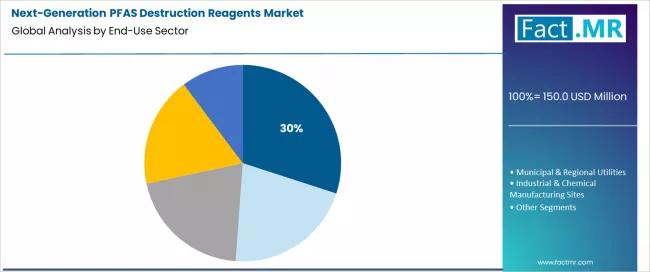
Next Generation Pfas Destruction Reagents Market Analysis By End Use Sector

Environmental services and specialized PFAS waste management firms lead the end-use sector with a 30% share. These companies are at the forefront of the contamination crisis, handling waste from multiple clients. They have the economic incentive and technical capability to invest in and operate advanced destruction units.

Their role as centralized processors of contaminated media, from spent filter cartridges to remediation waste, makes them critical early adopters and volume drivers for next-generation reagent systems.

What are the Drivers, Restraints, and Key Trends of the Next-Generation PFAS Destruction Reagents Market?

The paramount market driver is the rapid evolution of environmental regulations from focusing on PFAS concentration limits in water to mandating destruction as the preferred disposal method for certain wastes. Liability concerns are pushing industries and governments to seek permanent solutions. Massive funding allocations, particularly in the U.S. through legislation like the Bipartisan Infrastructure Law, are de-risking the adoption of these emerging technologies.

A significant restraint is the high operational cost and energy intensity associated with many destructive processes, which is directly influenced by reagent consumption and catalyst longevity. The lack of standardized validation protocols for confirming complete mineralization across diverse PFAS compounds and waste matrices also creates uncertainty for regulators and purchasers, potentially slowing procurement cycles.

Key trends include the development of regenerable or self-healing catalytic reagents to drastically reduce long-term consumable costs. There is intense research into broad-spectrum reagent cocktails capable of destroying both long- and short-chain PFAS simultaneously. The market is moving toward integrated treatment trains, where specialized reagents are used in tandem with concentration technologies to improve overall system economics. Furthermore, field-deployable analytical tools to verify destruction efficiency in real-time are becoming a crucial adjunct to reagent sales.

Analysis of the Next-Generation PFAS Destruction Reagents Market by Key Countries
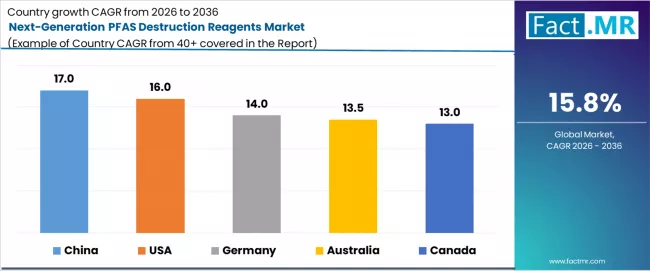
Next Generation Pfas Destruction Reagents Market Cagr Analysis By Country

Country CAGR (2026-2036)
China 17.00%
USA 16.00%
Germany 14.00%
Australia 13.50%
Canada 13.00%

How is China's Regulatory Momentum Accelerating Market Formation?

China's leading CAGR of 17.00% is fueled by its recent inclusion of specific PFAS in its strict Pollutant Discharge Permit system and evolving chemical management priorities. As the world's manufacturing hub, China faces significant internal contamination challenges and is now directing substantial state-backed research and pilot funding towards destructive technologies, aiming to develop both domestic solutions and exportable expertise in managing this global problem.

What Makes the USA the Epicenter of Commercial Technology Deployment?
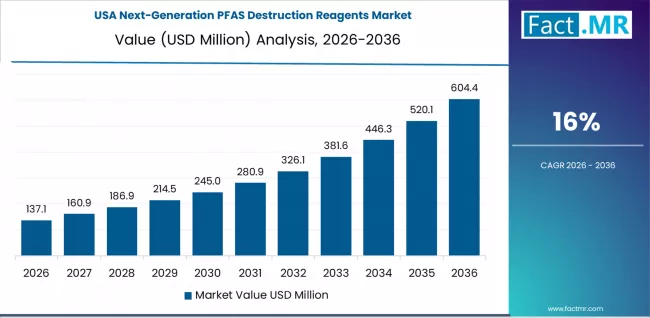
Next Generation Pfas Destruction Reagents Market Country Value Analysis

The most aggressive regulatory timeline and unprecedented federal funding for PFAS remediation underpin the USA’s 16.00% growth. The presence of numerous technology start-ups, coupled with demand from a large, liability-conscious industrial base and the Department of Defense's massive AFFF cleanup program, creates a dynamic ecosystem for testing, scaling, and commercializing diverse destruction reagent approaches.

Why is Germany a Benchmark for Stringent Destruction Standards in Europe?

Germany's 14.00% CAGR reflects its role as a European regulatory trendsetter. German authorities are advancing strict waste code revisions that classify PFAS-containing materials as requiring destruction. This regulatory push, combined with the country's strong environmental engineering sector and contaminated site legacy, creates a high-compliance market that prioritizes technologically verified and thoroughly documented destruction efficacy.

How are Australia's Proactive Policies Shaping an Early-Adopter Market?

Australia's 13.50% growth is driven by some of the world's most precautionary PFAS investigation zones and stringent interim drinking water guidelines. Facing significant contamination around defense and fire-training sites, Australian state and federal governments are proactively funding and mandating pilot-scale destructive technology trials, providing a fertile testing ground for reagent-based solutions in diverse environmental conditions.

What Role does Canada's Cross-Border Contamination Dynamic Play?

Canada's 13.00% CAGR is supported by its coordination with U.S. regulatory actions on PFAS and its own identified contamination hotspots, particularly from aerospace and military activities. The shared waterways and integrated economies with the U.S. create parallel pressure to adopt advanced remediation solutions, with a focus on technologies suitable for cold climates and sensitive ecosystems.

Competitive Landscape of the Next-Generation PFAS Destruction Reagents Market
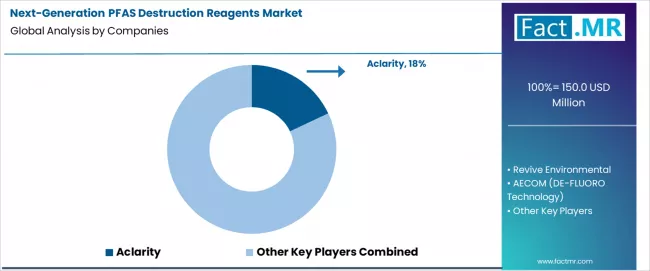
Next Generation Pfas Destruction Reagents Market Analysis By Company

A mix of venture-backed technology startups, established environmental engineering giants, characterizes the competitive landscape and defense contractors diversifying into environmental tech. Firms compete on the core intellectual property surrounding their reagent formulas and catalytic processes.

Success hinges on moving from successful pilot demonstrations to securing full-scale, permitted commercial contracts. Key competitive battlegrounds include third-party validation of destruction efficiency, partnerships with waste management conglomerates for channel access, and the ability to offer flexible deployment models, from reagent sales to full "destruction-as-a-service" contracts.

Key Players in the Next-Generation PFAS Destruction Reagents Market

  • Aclarity
  • Revive Environmental
  • AECOM (DE-FLUORO Technology)
  • Ovivo (incl. E2metrix / Evocra PFAS Destruction)
  • General Atomics Electromagnetic Systems (PERSES iSCWO)
  • Other Players

Scope of Report

Items Values
Quantitative Units USD Million
Technology Electrochemical Oxidation, Supercritical/Hydrothermal Oxidation, Reductive/Defluorination, Plasma/UV-Activated, Hybrid Systems
Treated Medium Concentrated Wastewater/Leachate, Municipal Water, Groundwater, Solid Waste (GAC, Sludges)
End-Use Sector Environmental Services, Municipal Utilities, Industrial Sites, Defense/Airports, Other
Key Countries China, USA, Germany, Australia, Canada
Key Companies Aclarity, Revive Environmental, AECOM, Ovivo, General Atomics Electromagnetic Systems
Additional Analysis Analysis of destruction verification analytics (e.g., TOP Assay, PFAS sum parameters); reagent lifecycle and residual waste management; total cost of ownership models vs. incineration; regulatory pathways for new destruction process approvals; supply chain for critical catalyst materials (e.g., rare earth elements, boron-doped diamond).

Market by Segments

  • Technology :

    • Electrochemical Oxidation Reagents & Catalysts
    • Supercritical/Hydrothermal Oxidation Reagents
    • Reductive/Defluorination Reagents
    • Plasma/UV-Activated Oxidation Chemistries
    • Other Hybrid/Bio-Enhanced Reagent Systems
  • Treated Medium :

    • Concentrated Industrial Wastewater & Landfill Leachate
    • Municipal Drinking Water & Wastewater Streams
    • Groundwater & In-Situ Remediation Streams
    • Solid & Semi-Solid PFAS Waste (GAC, Resins, Sludges)
  • End-Use Sector :

    • Environmental Services & PFAS Waste Management Firms
    • Municipal & Regional Utilities
    • Industrial & Chemical Manufacturing Sites
    • Defense, Airports & AFFF Transition Programs
    • Other Commercial & Institutional Users
  • Region :

    • North America
      • USA
      • Canada
    • Latin America
      • Brazil
      • Mexico
      • Argentina
      • Rest of Latin America
    • Western Europe
      • Germany
      • UK
      • France
      • Spain
      • Italy
      • BENELUX
      • Rest of Western Europe
    • Eastern Europe
      • Russia
      • Poland
      • Czech Republic
      • Rest of Eastern Europe
    • East Asia
      • China
      • Japan
      • South Korea
      • Rest of East Asia
    • South Asia & Pacific
      • India
      • ASEAN
      • Australia
      • Rest of South Asia & Pacific
    • MEA
      • Saudi Arabia
      • UAE
      • Turkiye
      • Rest of MEA

Table of Content

  1. Executive Summary
    • Global Market Outlook
    • Demand to side Trends
    • Supply to side Trends
    • Technology Roadmap Analysis
    • Analysis and Recommendations
  2. Market Overview
    • Market Coverage / Taxonomy
    • Market Definition / Scope / Limitations
  3. Market Background
    • Market Dynamics
      • Drivers
      • Restraints
      • Opportunity
      • Trends
    • Scenario Forecast
      • Demand in Optimistic Scenario
      • Demand in Likely Scenario
      • Demand in Conservative Scenario
    • Opportunity Map Analysis
    • Product Life Cycle Analysis
    • Supply Chain Analysis
    • Investment Feasibility Matrix
    • Value Chain Analysis
    • PESTLE and Porter’s Analysis
    • Regulatory Landscape
    • Regional Parent Market Outlook
    • Production and Consumption Statistics
    • Import and Export Statistics
  4. Global Market Analysis 2021 to 2025 and Forecast, 2026 to 2036
    • Historical Market Size Value (USD Million) Analysis, 2021 to 2025
    • Current and Future Market Size Value (USD Million) Projections, 2026 to 2036
      • Y to o to Y Growth Trend Analysis
      • Absolute $ Opportunity Analysis
  5. Global Market Pricing Analysis 2021 to 2025 and Forecast 2026 to 2036
  6. Global Market Analysis 2021 to 2025 and Forecast 2026 to 2036, By Technology
    • Introduction / Key Findings
    • Historical Market Size Value (USD Million) Analysis By Technology, 2021 to 2025
    • Current and Future Market Size Value (USD Million) Analysis and Forecast By Technology, 2026 to 2036
      • Electrochemical Oxidation Reagents & Catalysts
      • Supercritical / Hydrothermal Oxidation Reagents
      • Reductive / Defluorination Reagents
      • Plasma / UV-Activated Oxidation Chemistries
      • Other Hybrid / Bio-Enhanced Reagent Systems
    • Y to o to Y Growth Trend Analysis By Technology, 2021 to 2025
    • Absolute $ Opportunity Analysis By Technology, 2026 to 2036
  7. Global Market Analysis 2021 to 2025 and Forecast 2026 to 2036, By Treated Medium
    • Introduction / Key Findings
    • Historical Market Size Value (USD Million) Analysis By Treated Medium, 2021 to 2025
    • Current and Future Market Size Value (USD Million) Analysis and Forecast By Treated Medium, 2026 to 2036
      • Concentrated Industrial Wastewater & Landfill Leachate
      • Municipal Drinking Water & Wastewater Streams
      • Groundwater & In-Situ Remediation Streams
      • Solid & Semi-Solid PFAS Waste (GAC, Resins, Sludges)
    • Y to o to Y Growth Trend Analysis By Treated Medium, 2021 to 2025
    • Absolute $ Opportunity Analysis By Treated Medium, 2026 to 2036
  8. Global Market Analysis 2021 to 2025 and Forecast 2026 to 2036, By End-Use Sector
    • Introduction / Key Findings
    • Historical Market Size Value (USD Million) Analysis By End-Use Sector, 2021 to 2025
    • Current and Future Market Size Value (USD Million) Analysis and Forecast By End-Use Sector, 2026 to 2036
      • Environmental Services & PFAS Waste Management Firms
      • Municipal & Regional Utilities
      • Industrial & Chemical Manufacturing Sites
      • Defense, Airports & AFFF Transition Programs
      • Other Commercial & Institutional Users
    • Y to o to Y Growth Trend Analysis By End-Use Sector, 2021 to 2025
    • Absolute $ Opportunity Analysis By End-Use Sector, 2026 to 2036
  9. Global Market Analysis 2021 to 2025 and Forecast 2026 to 2036, By Region
    • Introduction
    • Historical Market Size Value (USD Million) Analysis By Region, 2021 to 2025
    • Current Market Size Value (USD Million) Analysis and Forecast By Region, 2026 to 2036
      • North America
      • Latin America
      • Western Europe
      • Eastern Europe
      • East Asia
      • South Asia and Pacific
      • Middle East & Africa
    • Market Attractiveness Analysis By Region
  10. North America Market Analysis 2021 to 2025 and Forecast 2026 to 2036, By Country
    • Historical Market Size Value (USD Million) Trend Analysis By Market Taxonomy, 2021 to 2025
    • Market Size Value (USD Million) Forecast By Market Taxonomy, 2026 to 2036
      • By Country
        • USA
        • Canada
        • Mexico
      • By Technology
      • By Treated Medium
      • By End-Use Sector
    • Market Attractiveness Analysis
      • By Country
      • By Technology
      • By Treated Medium
      • By End-Use Sector
    • Key Takeaways
  11. Latin America Market Analysis 2021 to 2025 and Forecast 2026 to 2036, By Country
    • Historical Market Size Value (USD Million) Trend Analysis By Market Taxonomy, 2021 to 2025
    • Market Size Value (USD Million) Forecast By Market Taxonomy, 2026 to 2036
      • By Country
        • Brazil
        • Chile
        • Rest of Latin America
      • By Technology
      • By Treated Medium
      • By End-Use Sector
    • Market Attractiveness Analysis
      • By Country
      • By Technology
      • By Treated Medium
      • By End-Use Sector
    • Key Takeaways
  12. Western Europe Market Analysis 2021 to 2025 and Forecast 2026 to 2036, By Country
    • Historical Market Size Value (USD Million) Trend Analysis By Market Taxonomy, 2021 to 2025
    • Market Size Value (USD Million) Forecast By Market Taxonomy, 2026 to 2036
      • By Country
        • Germany
        • UK
        • Italy
        • Spain
        • France
        • Nordic
        • BENELUX
        • Rest of Western Europe
      • By Technology
      • By Treated Medium
      • By End-Use Sector
    • Market Attractiveness Analysis
      • By Country
      • By Technology
      • By Treated Medium
      • By End-Use Sector
    • Key Takeaways
  13. Eastern Europe Market Analysis 2021 to 2025 and Forecast 2026 to 2036, By Country
    • Historical Market Size Value (USD Million) Trend Analysis By Market Taxonomy, 2021 to 2025
    • Market Size Value (USD Million) Forecast By Market Taxonomy, 2026 to 2036
      • By Country
        • Russia
        • Poland
        • Hungary
        • Balkan & Baltic
        • Rest of Eastern Europe
      • By Technology
      • By Treated Medium
      • By End-Use Sector
    • Market Attractiveness Analysis
      • By Country
      • By Technology
      • By Treated Medium
      • By End-Use Sector
    • Key Takeaways
  14. East Asia Market Analysis 2021 to 2025 and Forecast 2026 to 2036, By Country
    • Historical Market Size Value (USD Million) Trend Analysis By Market Taxonomy, 2021 to 2025
    • Market Size Value (USD Million) Forecast By Market Taxonomy, 2026 to 2036
      • By Country
        • China
        • Japan
        • South Korea
      • By Technology
      • By Treated Medium
      • By End-Use Sector
    • Market Attractiveness Analysis
      • By Country
      • By Technology
      • By Treated Medium
      • By End-Use Sector
    • Key Takeaways
  15. South Asia and Pacific Market Analysis 2021 to 2025 and Forecast 2026 to 2036, By Country
    • Historical Market Size Value (USD Million) Trend Analysis By Market Taxonomy, 2021 to 2025
    • Market Size Value (USD Million) Forecast By Market Taxonomy, 2026 to 2036
      • By Country
        • India
        • ASEAN
        • Australia & New Zealand
        • Rest of South Asia and Pacific
      • By Technology
      • By Treated Medium
      • By End-Use Sector
    • Market Attractiveness Analysis
      • By Country
      • By Technology
      • By Treated Medium
      • By End-Use Sector
    • Key Takeaways
  16. Middle East & Africa Market Analysis 2021 to 2025 and Forecast 2026 to 2036, By Country
    • Historical Market Size Value (USD Million) Trend Analysis By Market Taxonomy, 2021 to 2025
    • Market Size Value (USD Million) Forecast By Market Taxonomy, 2026 to 2036
      • By Country
        • Kingdom of Saudi Arabia
        • Other GCC Countries
        • Turkiye
        • South Africa
        • Other African Union
        • Rest of Middle East & Africa
      • By Technology
      • By Treated Medium
      • By End-Use Sector
    • Market Attractiveness Analysis
      • By Country
      • By Technology
      • By Treated Medium
      • By End-Use Sector
    • Key Takeaways
  17. Key Countries Market Analysis
    • USA
      • Pricing Analysis
      • Market Share Analysis, 2025
        • By Technology
        • By Treated Medium
        • By End-Use Sector
    • Canada
      • Pricing Analysis
      • Market Share Analysis, 2025
        • By Technology
        • By Treated Medium
        • By End-Use Sector
    • Mexico
      • Pricing Analysis
      • Market Share Analysis, 2025
        • By Technology
        • By Treated Medium
        • By End-Use Sector
    • Brazil
      • Pricing Analysis
      • Market Share Analysis, 2025
        • By Technology
        • By Treated Medium
        • By End-Use Sector
    • Chile
      • Pricing Analysis
      • Market Share Analysis, 2025
        • By Technology
        • By Treated Medium
        • By End-Use Sector
    • Germany
      • Pricing Analysis
      • Market Share Analysis, 2025
        • By Technology
        • By Treated Medium
        • By End-Use Sector
    • UK
      • Pricing Analysis
      • Market Share Analysis, 2025
        • By Technology
        • By Treated Medium
        • By End-Use Sector
    • Italy
      • Pricing Analysis
      • Market Share Analysis, 2025
        • By Technology
        • By Treated Medium
        • By End-Use Sector
    • Spain
      • Pricing Analysis
      • Market Share Analysis, 2025
        • By Technology
        • By Treated Medium
        • By End-Use Sector
    • France
      • Pricing Analysis
      • Market Share Analysis, 2025
        • By Technology
        • By Treated Medium
        • By End-Use Sector
    • India
      • Pricing Analysis
      • Market Share Analysis, 2025
        • By Technology
        • By Treated Medium
        • By End-Use Sector
    • ASEAN
      • Pricing Analysis
      • Market Share Analysis, 2025
        • By Technology
        • By Treated Medium
        • By End-Use Sector
    • Australia & New Zealand
      • Pricing Analysis
      • Market Share Analysis, 2025
        • By Technology
        • By Treated Medium
        • By End-Use Sector
    • China
      • Pricing Analysis
      • Market Share Analysis, 2025
        • By Technology
        • By Treated Medium
        • By End-Use Sector
    • Japan
      • Pricing Analysis
      • Market Share Analysis, 2025
        • By Technology
        • By Treated Medium
        • By End-Use Sector
    • South Korea
      • Pricing Analysis
      • Market Share Analysis, 2025
        • By Technology
        • By Treated Medium
        • By End-Use Sector
    • Russia
      • Pricing Analysis
      • Market Share Analysis, 2025
        • By Technology
        • By Treated Medium
        • By End-Use Sector
    • Poland
      • Pricing Analysis
      • Market Share Analysis, 2025
        • By Technology
        • By Treated Medium
        • By End-Use Sector
    • Hungary
      • Pricing Analysis
      • Market Share Analysis, 2025
        • By Technology
        • By Treated Medium
        • By End-Use Sector
    • Kingdom of Saudi Arabia
      • Pricing Analysis
      • Market Share Analysis, 2025
        • By Technology
        • By Treated Medium
        • By End-Use Sector
    • Turkiye
      • Pricing Analysis
      • Market Share Analysis, 2025
        • By Technology
        • By Treated Medium
        • By End-Use Sector
    • South Africa
      • Pricing Analysis
      • Market Share Analysis, 2025
        • By Technology
        • By Treated Medium
        • By End-Use Sector
  18. Market Structure Analysis
    • Competition Dashboard
    • Competition Benchmarking
    • Market Share Analysis of Top Players
      • By Regional
      • By Technology
      • By Treated Medium
      • By End-Use Sector
  19. Competition Analysis
    • Competition Deep Dive
      • Aclarity
        • Overview
        • Product Portfolio
        • Profitability by Market Segments (Product/Age /Sales Channel/Region)
        • Sales Footprint
        • Strategy Overview
          • Marketing Strategy
          • Product Strategy
          • Channel Strategy
      • Revive Environmental
      • AECOM (DE-FLUORO Technology)
      • Ovivo (incl. E2metrix / Evocra PFAS Destruction)
      • General Atomics Electromagnetic Systems (PERSES iSCWO)
  20. Assumptions & Acronyms Used
  21. Research Methodology

List Of Table

  • Table 1: Global Market Value (USD Million) Forecast by Region, 2021 to 2036
  • Table 2: Global Market Value (USD Million) Forecast by Technology, 2021 to 2036
  • Table 3: Global Market Value (USD Million) Forecast by Treated Medium, 2021 to 2036
  • Table 4: Global Market Value (USD Million) Forecast by End-Use Sector, 2021 to 2036
  • Table 5: North America Market Value (USD Million) Forecast by Country, 2021 to 2036
  • Table 6: North America Market Value (USD Million) Forecast by Technology, 2021 to 2036
  • Table 7: North America Market Value (USD Million) Forecast by Treated Medium, 2021 to 2036
  • Table 8: North America Market Value (USD Million) Forecast by End-Use Sector, 2021 to 2036
  • Table 9: Latin America Market Value (USD Million) Forecast by Country, 2021 to 2036
  • Table 10: Latin America Market Value (USD Million) Forecast by Technology, 2021 to 2036
  • Table 11: Latin America Market Value (USD Million) Forecast by Treated Medium, 2021 to 2036
  • Table 12: Latin America Market Value (USD Million) Forecast by End-Use Sector, 2021 to 2036
  • Table 13: Western Europe Market Value (USD Million) Forecast by Country, 2021 to 2036
  • Table 14: Western Europe Market Value (USD Million) Forecast by Technology, 2021 to 2036
  • Table 15: Western Europe Market Value (USD Million) Forecast by Treated Medium, 2021 to 2036
  • Table 16: Western Europe Market Value (USD Million) Forecast by End-Use Sector, 2021 to 2036
  • Table 17: Eastern Europe Market Value (USD Million) Forecast by Country, 2021 to 2036
  • Table 18: Eastern Europe Market Value (USD Million) Forecast by Technology, 2021 to 2036
  • Table 19: Eastern Europe Market Value (USD Million) Forecast by Treated Medium, 2021 to 2036
  • Table 20: Eastern Europe Market Value (USD Million) Forecast by End-Use Sector, 2021 to 2036
  • Table 21: East Asia Market Value (USD Million) Forecast by Country, 2021 to 2036
  • Table 22: East Asia Market Value (USD Million) Forecast by Technology, 2021 to 2036
  • Table 23: East Asia Market Value (USD Million) Forecast by Treated Medium, 2021 to 2036
  • Table 24: East Asia Market Value (USD Million) Forecast by End-Use Sector, 2021 to 2036
  • Table 25: South Asia and Pacific Market Value (USD Million) Forecast by Country, 2021 to 2036
  • Table 26: South Asia and Pacific Market Value (USD Million) Forecast by Technology, 2021 to 2036
  • Table 27: South Asia and Pacific Market Value (USD Million) Forecast by Treated Medium, 2021 to 2036
  • Table 28: South Asia and Pacific Market Value (USD Million) Forecast by End-Use Sector, 2021 to 2036
  • Table 29: Middle East & Africa Market Value (USD Million) Forecast by Country, 2021 to 2036
  • Table 30: Middle East & Africa Market Value (USD Million) Forecast by Technology, 2021 to 2036
  • Table 31: Middle East & Africa Market Value (USD Million) Forecast by Treated Medium, 2021 to 2036
  • Table 32: Middle East & Africa Market Value (USD Million) Forecast by End-Use Sector, 2021 to 2036

List Of Figures

  • Figure 1: Global Market Pricing Analysis
  • Figure 2: Global Market Value (USD Million) Forecast 2021 to 2036
  • Figure 3: Global Market Value Share and BPS Analysis by Technology, 2026 and 2036
  • Figure 4: Global Market Y to o to Y Growth Comparison by Technology, 2026 to 2036
  • Figure 5: Global Market Attractiveness Analysis by Technology
  • Figure 6: Global Market Value Share and BPS Analysis by Treated Medium, 2026 and 2036
  • Figure 7: Global Market Y to o to Y Growth Comparison by Treated Medium, 2026 to 2036
  • Figure 8: Global Market Attractiveness Analysis by Treated Medium
  • Figure 9: Global Market Value Share and BPS Analysis by End-Use Sector, 2026 and 2036
  • Figure 10: Global Market Y to o to Y Growth Comparison by End-Use Sector, 2026 to 2036
  • Figure 11: Global Market Attractiveness Analysis by End-Use Sector
  • Figure 12: Global Market Value (USD Million) Share and BPS Analysis by Region, 2026 and 2036
  • Figure 13: Global Market Y to o to Y Growth Comparison by Region, 2026 to 2036
  • Figure 14: Global Market Attractiveness Analysis by Region
  • Figure 15: North America Market Incremental Dollar Opportunity, 2026 to 2036
  • Figure 16: Latin America Market Incremental Dollar Opportunity, 2026 to 2036
  • Figure 17: Western Europe Market Incremental Dollar Opportunity, 2026 to 2036
  • Figure 18: Eastern Europe Market Incremental Dollar Opportunity, 2026 to 2036
  • Figure 19: East Asia Market Incremental Dollar Opportunity, 2026 to 2036
  • Figure 20: South Asia and Pacific Market Incremental Dollar Opportunity, 2026 to 2036
  • Figure 21: Middle East & Africa Market Incremental Dollar Opportunity, 2026 to 2036
  • Figure 22: North America Market Value Share and BPS Analysis by Country, 2026 and 2036
  • Figure 23: North America Market Value Share and BPS Analysis by Technology, 2026 and 2036
  • Figure 24: North America Market Y to o to Y Growth Comparison by Technology, 2026 to 2036
  • Figure 25: North America Market Attractiveness Analysis by Technology
  • Figure 26: North America Market Value Share and BPS Analysis by Treated Medium, 2026 and 2036
  • Figure 27: North America Market Y to o to Y Growth Comparison by Treated Medium, 2026 to 2036
  • Figure 28: North America Market Attractiveness Analysis by Treated Medium
  • Figure 29: North America Market Value Share and BPS Analysis by End-Use Sector, 2026 and 2036
  • Figure 30: North America Market Y to o to Y Growth Comparison by End-Use Sector, 2026 to 2036
  • Figure 31: North America Market Attractiveness Analysis by End-Use Sector
  • Figure 32: Latin America Market Value Share and BPS Analysis by Country, 2026 and 2036
  • Figure 33: Latin America Market Value Share and BPS Analysis by Technology, 2026 and 2036
  • Figure 34: Latin America Market Y to o to Y Growth Comparison by Technology, 2026 to 2036
  • Figure 35: Latin America Market Attractiveness Analysis by Technology
  • Figure 36: Latin America Market Value Share and BPS Analysis by Treated Medium, 2026 and 2036
  • Figure 37: Latin America Market Y to o to Y Growth Comparison by Treated Medium, 2026 to 2036
  • Figure 38: Latin America Market Attractiveness Analysis by Treated Medium
  • Figure 39: Latin America Market Value Share and BPS Analysis by End-Use Sector, 2026 and 2036
  • Figure 40: Latin America Market Y to o to Y Growth Comparison by End-Use Sector, 2026 to 2036
  • Figure 41: Latin America Market Attractiveness Analysis by End-Use Sector
  • Figure 42: Western Europe Market Value Share and BPS Analysis by Country, 2026 and 2036
  • Figure 43: Western Europe Market Value Share and BPS Analysis by Technology, 2026 and 2036
  • Figure 44: Western Europe Market Y to o to Y Growth Comparison by Technology, 2026 to 2036
  • Figure 45: Western Europe Market Attractiveness Analysis by Technology
  • Figure 46: Western Europe Market Value Share and BPS Analysis by Treated Medium, 2026 and 2036
  • Figure 47: Western Europe Market Y to o to Y Growth Comparison by Treated Medium, 2026 to 2036
  • Figure 48: Western Europe Market Attractiveness Analysis by Treated Medium
  • Figure 49: Western Europe Market Value Share and BPS Analysis by End-Use Sector, 2026 and 2036
  • Figure 50: Western Europe Market Y to o to Y Growth Comparison by End-Use Sector, 2026 to 2036
  • Figure 51: Western Europe Market Attractiveness Analysis by End-Use Sector
  • Figure 52: Eastern Europe Market Value Share and BPS Analysis by Country, 2026 and 2036
  • Figure 53: Eastern Europe Market Value Share and BPS Analysis by Technology, 2026 and 2036
  • Figure 54: Eastern Europe Market Y to o to Y Growth Comparison by Technology, 2026 to 2036
  • Figure 55: Eastern Europe Market Attractiveness Analysis by Technology
  • Figure 56: Eastern Europe Market Value Share and BPS Analysis by Treated Medium, 2026 and 2036
  • Figure 57: Eastern Europe Market Y to o to Y Growth Comparison by Treated Medium, 2026 to 2036
  • Figure 58: Eastern Europe Market Attractiveness Analysis by Treated Medium
  • Figure 59: Eastern Europe Market Value Share and BPS Analysis by End-Use Sector, 2026 and 2036
  • Figure 60: Eastern Europe Market Y to o to Y Growth Comparison by End-Use Sector, 2026 to 2036
  • Figure 61: Eastern Europe Market Attractiveness Analysis by End-Use Sector
  • Figure 62: East Asia Market Value Share and BPS Analysis by Country, 2026 and 2036
  • Figure 63: East Asia Market Value Share and BPS Analysis by Technology, 2026 and 2036
  • Figure 64: East Asia Market Y to o to Y Growth Comparison by Technology, 2026 to 2036
  • Figure 65: East Asia Market Attractiveness Analysis by Technology
  • Figure 66: East Asia Market Value Share and BPS Analysis by Treated Medium, 2026 and 2036
  • Figure 67: East Asia Market Y to o to Y Growth Comparison by Treated Medium, 2026 to 2036
  • Figure 68: East Asia Market Attractiveness Analysis by Treated Medium
  • Figure 69: East Asia Market Value Share and BPS Analysis by End-Use Sector, 2026 and 2036
  • Figure 70: East Asia Market Y to o to Y Growth Comparison by End-Use Sector, 2026 to 2036
  • Figure 71: East Asia Market Attractiveness Analysis by End-Use Sector
  • Figure 72: South Asia and Pacific Market Value Share and BPS Analysis by Country, 2026 and 2036
  • Figure 73: South Asia and Pacific Market Value Share and BPS Analysis by Technology, 2026 and 2036
  • Figure 74: South Asia and Pacific Market Y to o to Y Growth Comparison by Technology, 2026 to 2036
  • Figure 75: South Asia and Pacific Market Attractiveness Analysis by Technology
  • Figure 76: South Asia and Pacific Market Value Share and BPS Analysis by Treated Medium, 2026 and 2036
  • Figure 77: South Asia and Pacific Market Y to o to Y Growth Comparison by Treated Medium, 2026 to 2036
  • Figure 78: South Asia and Pacific Market Attractiveness Analysis by Treated Medium
  • Figure 79: South Asia and Pacific Market Value Share and BPS Analysis by End-Use Sector, 2026 and 2036
  • Figure 80: South Asia and Pacific Market Y to o to Y Growth Comparison by End-Use Sector, 2026 to 2036
  • Figure 81: South Asia and Pacific Market Attractiveness Analysis by End-Use Sector
  • Figure 82: Middle East & Africa Market Value Share and BPS Analysis by Country, 2026 and 2036
  • Figure 83: Middle East & Africa Market Value Share and BPS Analysis by Technology, 2026 and 2036
  • Figure 84: Middle East & Africa Market Y to o to Y Growth Comparison by Technology, 2026 to 2036
  • Figure 85: Middle East & Africa Market Attractiveness Analysis by Technology
  • Figure 86: Middle East & Africa Market Value Share and BPS Analysis by Treated Medium, 2026 and 2036
  • Figure 87: Middle East & Africa Market Y to o to Y Growth Comparison by Treated Medium, 2026 to 2036
  • Figure 88: Middle East & Africa Market Attractiveness Analysis by Treated Medium
  • Figure 89: Middle East & Africa Market Value Share and BPS Analysis by End-Use Sector, 2026 and 2036
  • Figure 90: Middle East & Africa Market Y to o to Y Growth Comparison by End-Use Sector, 2026 to 2036
  • Figure 91: Middle East & Africa Market Attractiveness Analysis by End-Use Sector
  • Figure 92: Global Market - Tier Structure Analysis
  • Figure 93: Global Market - Company Share Analysis

- FAQs -

How big is the next-generation pfas destruction reagents market in 2026?

The global next-generation pfas destruction reagents market is estimated to be valued at USD 150.0 million in 2026.

What will be the size of next-generation pfas destruction reagents market in 2036?

The market size for the next-generation pfas destruction reagents market is projected to reach USD 650.4 million by 2036.

How much will be the next-generation pfas destruction reagents market growth between 2026 and 2036?

The next-generation pfas destruction reagents market is expected to grow at a 15.8% CAGR between 2026 and 2036.

What are the key product types in the next-generation pfas destruction reagents market?

The key product types in next-generation pfas destruction reagents market are electrochemical oxidation reagents & catalysts, supercritical / hydrothermal oxidation reagents, reductive / defluorination reagents, plasma / uv-activated oxidation chemistries and other hybrid / bio-enhanced reagent systems.

Which treated medium segment to contribute significant share in the next-generation pfas destruction reagents market in 2026?

In terms of treated medium, concentrated industrial wastewater & landfill leachate segment to command 34.0% share in the next-generation pfas destruction reagents market in 2026.

Next-Generation PFAS Destruction Reagents Market