Pharmaceutical Cold Chain Packaging Market
Pharmaceutical Cold Chain Packaging Market Size and Share Forecast Outlook 2026 to 2036
Pharmaceutical cold chain packaging market is projected to grow from USD 20.3 billion in 2026 to USD 85.8 billion by 2036, at a CAGR of 15.5%. Plastic will dominate with a 74.0% market share, while small boxes will lead the product segment with a 42.0% share.
Pharmaceutical Cold Chain Packaging Market Forecast and Outlook 2026 to 2036
The global pharmaceutical cold chain packaging market is projected to reach USD 85.8 billion by 2036. The market is valued at USD 20.3 billion in 2026 and is set to rise at a CAGR of 15.5% during the assessment period. Prospects for pharmaceutical cold chain packaging appear bright, expected to grow by approximately 4.2 times during the same period, supported by increasing biologics and biosimilar drug development worldwide, driving adoption of temperature-controlled packaging solutions with advanced thermal insulation properties and real-time monitoring capabilities across pharmaceutical manufacturing and distribution sectors globally.
Key Takeaways from the Pharmaceutical Cold Chain Packaging Market
- Pharmaceutical Cold Chain Packaging Market Value (2026): USD 20.3 billion
- Pharmaceutical Cold Chain Packaging Market Forecast Value (2036): USD 85.8 billion
- Pharmaceutical Cold Chain Packaging Market Forecast CAGR: 15.5%
- Leading Material in Pharmaceutical Cold Chain Packaging Market: Plastic (74.0%)
- Key Growth Regions in Pharmaceutical Cold Chain Packaging Market: Asia Pacific, North America, and Europe
- Top Players in Pharmaceutical Cold Chain Packaging Market: Sonoco ThermoSafe, Sealed Air, Peli BioThermal, CSafe, Intelsius, Cryoport Systems, LLC, Envirotainer, SkyCell AG, va-Q-tec AG, Inmark Global Holdings, LLC
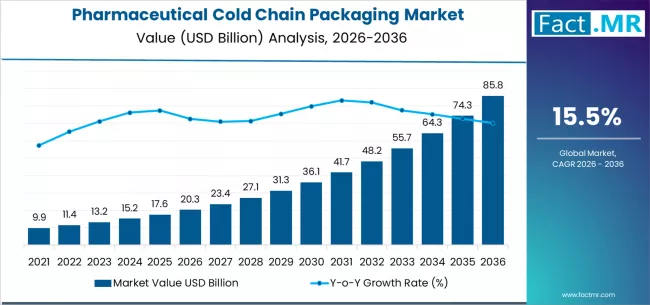
Pharmaceutical manufacturers and logistics providers face mounting pressure to maintain product integrity and regulatory compliance while addressing expanding cold chain requirements and global distribution challenges, with modern pharmaceutical cold chain packaging solutions providing documented benefits including precise temperature maintenance, validated thermal performance, and comprehensive data logging compared to conventional packaging approaches alone.
The plastic materials segment dominates market activity, driven by superior thermal insulation properties and lightweight characteristics enabling cost-effective temperature-controlled shipping worldwide. Pharmaceutical companies increasingly recognize the performance advantages of plastic-based cold chain packaging, with typical solutions providing reliable temperature maintenance and versatile design configurations at competitive lifecycle costs through established supply networks. The small boxes product segment demonstrates robust market presence, supported by individual patient dose shipping requirements and clinical trial sample distribution demanding compact temperature-controlled packaging.
Pharmaceutical Cold Chain Packaging Market
| Metric | Value |
|---|---|
| Market Value (2026) | USD 20.3 billion |
| Market Forecast Value (2036) | USD 85.8 billion |
| Forecast CAGR (2026-2036) | 15.5% |
Category
| Category | Segments |
|---|---|
| Material | Plastic (Polyethylene [PE]; Polypropylene [PP]; Polyethylene Terephthalate [PET]; Expanded Polystyrene [EPS]; Polyurethane [PU]; Others); Paper; Metal; Others |
| Product | Small Boxes; Pallets; Large Sized Pallet Containers; Others |
| End-Use | Biopharmaceutical Companies; Clinical Research Organizations; Hospitals; Research Institutes; Logistics and Distribution Companies; Others |
| Region | Asia Pacific; North America; Europe; Latin America; MEA |
Segmental Analysis
By Material, Which Segment Accounts for the Dominant Market Share?
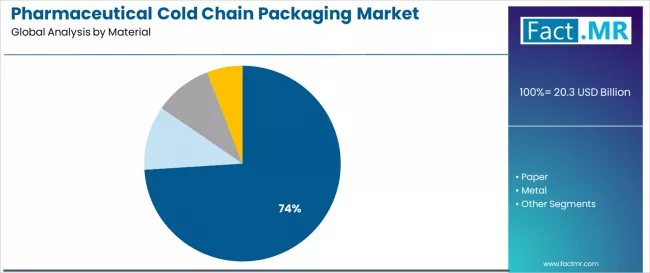
The plastic materials segment represents the dominant force in the pharmaceutical cold chain packaging market, capturing approximately 74.0% of total market share in 2026. This established material category encompasses solutions featuring expanded polystyrene foam insulation, polyurethane rigid panels, and polyethylene structural components, including advanced vacuum insulation panel technologies and phase change material integration that enable superior thermal performance across diverse temperature ranges and shipping duration requirements worldwide.
By Product, Which Segment Accounts for the Largest Market Share?
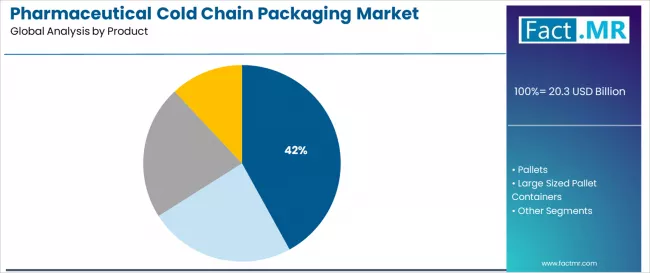
Small boxes dominate the pharmaceutical cold chain packaging product landscape with a 42.0% market share in 2026, reflecting the critical role of compact temperature-controlled shipping containers in supporting individual patient prescriptions, clinical trial investigational product distribution, and direct-to-patient specialty pharmaceutical delivery worldwide. Growing personalized medicine adoption, decentralized clinical trial expansion, and direct-to-consumer pharmaceutical distribution models requiring individual dose shipment capabilities reinforce the small boxes segment’s market leadership.
By End-Use, Which Segment Accounts for a Significant Market Share?
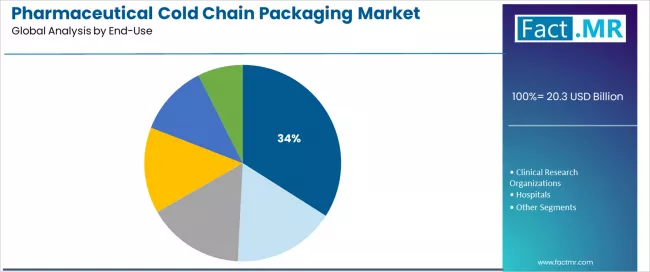
Biopharmaceutical companies represent a leading end-use segment in the pharmaceutical cold chain packaging market with approximately 34.0% market share in 2026, reflecting the fundamental role of temperature-controlled packaging in supporting biologics manufacturing, clinical development, and commercial distribution operations.
The biopharmaceutical companies segment demonstrates consistent demand driven by expanding biologics pipelines, biosimilar launches, and direct distribution models requiring integrated cold chain capabilities from manufacturing through patient delivery.
What are the Drivers, Restraints, and Key Trends of the Pharmaceutical Cold Chain Packaging Market?
The pharmaceutical cold-chain packaging market is driven by rapid growth in biologics, biosimilars, and vaccines that require strict temperature control throughout global distribution. Expansion of immunization programs and increasing volumes of temperature-sensitive drugs are reinforcing demand for validated thermal packaging solutions. Growth in direct-to-patient delivery models and decentralized clinical trials is further increasing need for reliable, small-batch cold-chain packaging.
Market restraints include high costs of advanced temperature-controlled packaging, which can pressure distribution economics, particularly for low-volume specialty therapies. Infrastructure limitations and last-mile delivery challenges in emerging markets restrict consistent cold-chain integrity. Regulatory complexity and extensive qualification requirements also increase development time and compliance costs.
Key trends include rising adoption of IoT-enabled smart packaging with real-time temperature monitoring and data logging. Sustainability initiatives are accelerating use of reusable and returnable cold-chain packaging systems, while efforts to reduce environmental impact are influencing material selection and logistics strategies.
Analysis of the Pharmaceutical Cold Chain Packaging Market by Key Countries
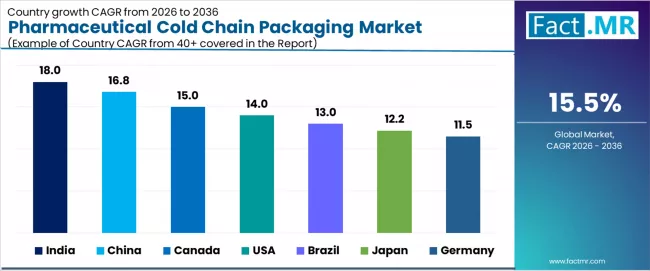
| Country | CAGR (2026-2036) |
|---|---|
| India | 18.0% |
| China | 16.8% |
| Canada | 15.0% |
| USA | 14.0% |
| Brazil | 13.0% |
| Japan | 12.2% |
| Germany | 11.5% |
How is India’s Automotive Upswing Reshaping Injection Molding Demand?
India’s injection molding market is expanding steadily as automotive production, packaging demand, and consumer goods manufacturing scale up together. Growth is most visible in industrial clusters across Maharashtra, Gujarat, and Tamil Nadu, where suppliers are upgrading molding capacity to meet volume, cost, and export quality requirements.
Policy support through Make in India, combined with competitive manufacturing costs and a growing technical workforce, continues to encourage investment in electric and automated molding systems.
Why does China Continue to Anchor Global Injection Molding Volumes?
China’s dominance in injection molding is rooted in its unmatched manufacturing scale and deep automation integration. Producers across coastal industrial corridors are increasingly deploying precision and energy-efficient machines to support high-volume consumer electronics and automotive component production. As manufacturers shift toward higher-value output and tighter quality control, demand remains strong for advanced molding systems that can sustain throughput while improving consistency.
How is Construction-Led Industrialisation Driving Saudi Arabia’s Market?
Saudi Arabia’s injection molding demand is closely tied to construction growth and industrial diversification under Vision 2030. Expanding infrastructure programs are increasing the need for molded building components and industrial parts, encouraging manufacturers to invest in reliable, scalable molding equipment. The focus remains on production capacity and operational stability rather than customization, reflecting the market’s early-stage manufacturing maturity.
What Sustains Mexico’s Role as a North American Molding Hub?
Mexico’s injection molding market benefits from its integration into automotive and export manufacturing supply chains. Facilities in key industrial regions are expanding molding capacity to serve OEMs and Tier-1 suppliers, balancing cost efficiency with rising quality expectations. Proximity to US markets and trade agreement advantages continue to underpin steady equipment investment across automotive and consumer goods production.
How is Domestic Consumption Supporting Brazil’s Injection Molding Expansion?
Brazil’s market growth is shaped by rising domestic demand for packaged goods and consumer products. Manufacturers are modernising molding operations to improve efficiency and reduce production costs, particularly in packaging and household goods. While capital spending remains selective, industrial expansion and market scale continue to support gradual adoption of newer molding technologies.
Why does Germany Remain a Benchmark for Precision Molding?
Germany’s injection molding market reflects its broader engineering culture, where precision, documentation, and long-term performance guide equipment decisions. Automotive suppliers and medical device manufacturers invest in high-specification machines that integrate tightly with automated production lines. Growth is moderate but consistent, anchored in quality-driven applications rather than volume expansion.
What Keeps the USA Focused on High-Precision Injection Molding?
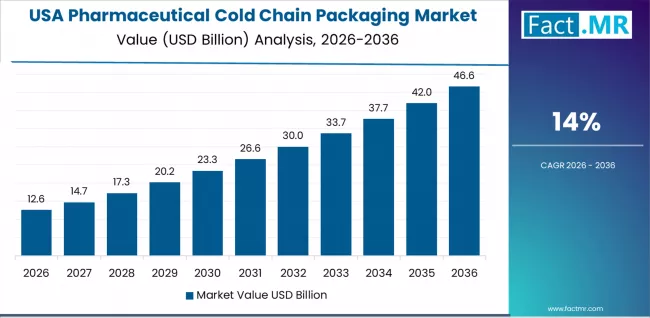
In the USA, injection molding growth is concentrated in medical devices, electronics, and specialised components rather than mass production. Manufacturers prioritise machines capable of meeting strict regulatory standards, cleanroom compatibility, and repeatable precision. Investment decisions are driven less by scale and more by compliance, reliability, and advanced process control.
Competitive Landscape of the Pharmaceutical Cold Chain Packaging Market
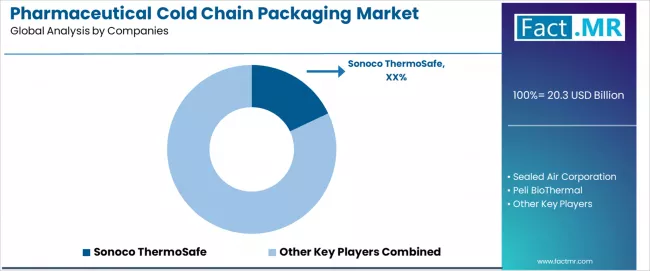
The pharmaceutical cold chain packaging market is moderately concentrated, with around 10–15 key participants competing across passive and active temperature-controlled packaging solutions. Competition is driven by thermal performance reliability, validation depth, regulatory compliance support, and integration with pharmaceutical logistics rather than price-based differentiation.
Market leaders such as Sonoco ThermoSafe, Sealed Air, and Peli BioThermal maintain strong positions through advanced thermal engineering, phase change material expertise, and global manufacturing and service networks. Their offerings are supported by comprehensive qualification services covering design validation, lane testing, and distribution performance monitoring, which are critical for biopharmaceutical customers managing complex cold chain requirements.
Challengers including CSafe, Intelsius, and Cryoport Systems compete through active temperature control technologies, high-performance passive systems, and cryogenic shipping capabilities tailored to cell and gene therapies. Other global providers such as Envirotainer, SkyCell AG, and va-Q-tec AG focus on air cargo containers, hybrid reusable shippers, and vacuum insulation technologies.
Emerging innovators add competitive pressure through IoT-enabled smart packaging and sustainability-focused designs. Overall competitiveness favors suppliers combining proven thermal performance, robust validation services, reusable system economics, and digital supply chain visibility.
Key Players in the Pharmaceutical Cold Chain Packaging Market
- Sonoco ThermoSafe
- Sealed Air Corporation
- Peli BioThermal
- CSafe
- Intelsius
- Cryoport Systems, LLC
- Envirotainer
- SkyCell AG
- va-Q-tec AG
- Inmark Global Holdings, LLC
Scope of the Report
| Items | Values |
|---|---|
| Quantitative Units | USD 20.3 Billion |
| Material | Plastic (Polyethylene, Polypropylene, Polyethylene Terephthalate, Expanded Polystyrene, Polyurethane, Others), Paper, Metal, Others |
| Product | Small Boxes, Pallets, Large Sized Pallet Containers, Others |
| End-Use | Biopharmaceutical Companies, Clinical Research Organizations, Hospitals, Research Institutes, Logistics and Distribution Companies, Others |
| Regions Covered | Asia Pacific, North America, Europe, Latin America, MEA |
| Country Covered | India, China, Canada, USA, Brazil, Japan, Germany, and 40+ countries |
| Key Companies Profiled | Sonoco ThermoSafe, Sealed Air, Peli BioThermal, CSafe, Intelsius, Cryoport Systems, LLC, Envirotainer, SkyCell AG, va-Q-tec AG, Inmark Global Holdings, LLC |
| Additional Attributes | Dollar sales by material and product categories, regional cold chain infrastructure trends across Asia Pacific, North America, and Europe, competitive landscape with thermal packaging manufacturers and logistics service providers, product specifications and thermal performance requirements, integration with pharmaceutical distribution networks and regulatory compliance systems, innovations in phase change materials and vacuum insulation technologies, and development of specialized applications with IoT connectivity and sustainability capabilities. |
Pharmaceutical Cold Chain Packaging Market by Segments
-
Material :
- Plastic
- Polyethylene (PE)
- Polypropylene (PP)
- Polyethylene Terephthalate (PET)
- Expanded Polystyrene (EPS)
- Polyurethane (PU)
- Others
- Paper
- Metal
- Others
- Plastic
-
Product :
- Small Boxes
- Pallets
- Large Sized Pallet Containers
- Others
-
End-Use :
- Biopharmaceutical Companies
- Clinical Research Organizations
- Hospitals
- Research Institutes
- Logistics and Distribution Companies
- Others
-
Region :
- Asia Pacific
- China
- Japan
- South Korea
- India
- Australia
- Thailand
- Rest of Asia Pacific
- North America
- USA
- Canada
- Mexico
- Europe
- Germany
- UK
- France
- Italy
- Spain
- Denmark
- Sweden
- Norway
- Rest of Europe
- Latin America
- Brazil
- Argentina
- Rest of Latin America
- MEA
- South Africa
- Saudi Arabia
- UAE
- Kuwait
- Rest of MEA
- Asia Pacific
Table of Content
- Executive Summary
- Global Market Outlook
- Demand to side Trends
- Supply to side Trends
- Technology Roadmap Analysis
- Analysis and Recommendations
- Market Overview
- Market Coverage / Taxonomy
- Market Definition / Scope / Limitations
- Market Background
- Market Dynamics
- Drivers
- Restraints
- Opportunity
- Trends
- Scenario Forecast
- Demand in Optimistic Scenario
- Demand in Likely Scenario
- Demand in Conservative Scenario
- Opportunity Map Analysis
- Product Life Cycle Analysis
- Supply Chain Analysis
- Investment Feasibility Matrix
- Value Chain Analysis
- PESTLE and Porter’s Analysis
- Regulatory Landscape
- Regional Parent Market Outlook
- Production and Consumption Statistics
- Import and Export Statistics
- Market Dynamics
- Global Market Analysis 2021 to 2025 and Forecast, 2026 to 2036
- Historical Market Size Value (USD Million) Analysis, 2021 to 2025
- Current and Future Market Size Value (USD Million) Projections, 2026 to 2036
- Y to o to Y Growth Trend Analysis
- Absolute $ Opportunity Analysis
- Global Market Pricing Analysis 2021 to 2025 and Forecast 2026 to 2036
- Global Market Analysis 2021 to 2025 and Forecast 2026 to 2036, By Material
- Introduction / Key Findings
- Historical Market Size Value (USD Million) Analysis By Material, 2021 to 2025
- Current and Future Market Size Value (USD Million) Analysis and Forecast By Material, 2026 to 2036
- Plastic
- Paper
- Metal
- Others
- Plastic
- Y to o to Y Growth Trend Analysis By Material, 2021 to 2025
- Absolute $ Opportunity Analysis By Material, 2026 to 2036
- Global Market Analysis 2021 to 2025 and Forecast 2026 to 2036, By Product
- Introduction / Key Findings
- Historical Market Size Value (USD Million) Analysis By Product, 2021 to 2025
- Current and Future Market Size Value (USD Million) Analysis and Forecast By Product, 2026 to 2036
- Small Boxes
- Pallets
- Large Sized Pallet Containers
- Others
- Small Boxes
- Y to o to Y Growth Trend Analysis By Product, 2021 to 2025
- Absolute $ Opportunity Analysis By Product, 2026 to 2036
- Global Market Analysis 2021 to 2025 and Forecast 2026 to 2036, By End-Use
- Introduction / Key Findings
- Historical Market Size Value (USD Million) Analysis By End-Use, 2021 to 2025
- Current and Future Market Size Value (USD Million) Analysis and Forecast By End-Use, 2026 to 2036
- Biopharmaceutical Companies
- Clinical Research Organizations
- Hospitals
- Research Institutes
- Logistics and Distribution Companies
- Others
- Biopharmaceutical Companies
- Y to o to Y Growth Trend Analysis By End-Use, 2021 to 2025
- Absolute $ Opportunity Analysis By End-Use, 2026 to 2036
- Global Market Analysis 2021 to 2025 and Forecast 2026 to 2036, By Region
- Introduction
- Historical Market Size Value (USD Million) Analysis By Region, 2021 to 2025
- Current Market Size Value (USD Million) Analysis and Forecast By Region, 2026 to 2036
- North America
- Latin America
- Western Europe
- Eastern Europe
- East Asia
- South Asia and Pacific
- Middle East & Africa
- Market Attractiveness Analysis By Region
- North America Market Analysis 2021 to 2025 and Forecast 2026 to 2036, By Country
- Historical Market Size Value (USD Million) Trend Analysis By Market Taxonomy, 2021 to 2025
- Market Size Value (USD Million) Forecast By Market Taxonomy, 2026 to 2036
- By Country
- USA
- Canada
- Mexico
- By Material
- By Product
- By End-Use
- By Country
- Market Attractiveness Analysis
- By Country
- By Material
- By Product
- By End-Use
- Key Takeaways
- Latin America Market Analysis 2021 to 2025 and Forecast 2026 to 2036, By Country
- Historical Market Size Value (USD Million) Trend Analysis By Market Taxonomy, 2021 to 2025
- Market Size Value (USD Million) Forecast By Market Taxonomy, 2026 to 2036
- By Country
- Brazil
- Chile
- Rest of Latin America
- By Material
- By Product
- By End-Use
- By Country
- Market Attractiveness Analysis
- By Country
- By Material
- By Product
- By End-Use
- Key Takeaways
- Western Europe Market Analysis 2021 to 2025 and Forecast 2026 to 2036, By Country
- Historical Market Size Value (USD Million) Trend Analysis By Market Taxonomy, 2021 to 2025
- Market Size Value (USD Million) Forecast By Market Taxonomy, 2026 to 2036
- By Country
- Germany
- UK
- Italy
- Spain
- France
- Nordic
- BENELUX
- Rest of Western Europe
- By Material
- By Product
- By End-Use
- By Country
- Market Attractiveness Analysis
- By Country
- By Material
- By Product
- By End-Use
- Key Takeaways
- Eastern Europe Market Analysis 2021 to 2025 and Forecast 2026 to 2036, By Country
- Historical Market Size Value (USD Million) Trend Analysis By Market Taxonomy, 2021 to 2025
- Market Size Value (USD Million) Forecast By Market Taxonomy, 2026 to 2036
- By Country
- Russia
- Poland
- Hungary
- Balkan & Baltic
- Rest of Eastern Europe
- By Material
- By Product
- By End-Use
- By Country
- Market Attractiveness Analysis
- By Country
- By Material
- By Product
- By End-Use
- Key Takeaways
- East Asia Market Analysis 2021 to 2025 and Forecast 2026 to 2036, By Country
- Historical Market Size Value (USD Million) Trend Analysis By Market Taxonomy, 2021 to 2025
- Market Size Value (USD Million) Forecast By Market Taxonomy, 2026 to 2036
- By Country
- China
- Japan
- South Korea
- By Material
- By Product
- By End-Use
- By Country
- Market Attractiveness Analysis
- By Country
- By Material
- By Product
- By End-Use
- Key Takeaways
- South Asia and Pacific Market Analysis 2021 to 2025 and Forecast 2026 to 2036, By Country
- Historical Market Size Value (USD Million) Trend Analysis By Market Taxonomy, 2021 to 2025
- Market Size Value (USD Million) Forecast By Market Taxonomy, 2026 to 2036
- By Country
- India
- ASEAN
- Australia & New Zealand
- Rest of South Asia and Pacific
- By Material
- By Product
- By End-Use
- By Country
- Market Attractiveness Analysis
- By Country
- By Material
- By Product
- By End-Use
- Key Takeaways
- Middle East & Africa Market Analysis 2021 to 2025 and Forecast 2026 to 2036, By Country
- Historical Market Size Value (USD Million) Trend Analysis By Market Taxonomy, 2021 to 2025
- Market Size Value (USD Million) Forecast By Market Taxonomy, 2026 to 2036
- By Country
- Kingdom of Saudi Arabia
- Other GCC Countries
- Turkiye
- South Africa
- Other African Union
- Rest of Middle East & Africa
- By Material
- By Product
- By End-Use
- By Country
- Market Attractiveness Analysis
- By Country
- By Material
- By Product
- By End-Use
- Key Takeaways
- Key Countries Market Analysis
- USA
- Pricing Analysis
- Market Share Analysis, 2025
- By Material
- By Product
- By End-Use
- Canada
- Pricing Analysis
- Market Share Analysis, 2025
- By Material
- By Product
- By End-Use
- Mexico
- Pricing Analysis
- Market Share Analysis, 2025
- By Material
- By Product
- By End-Use
- Brazil
- Pricing Analysis
- Market Share Analysis, 2025
- By Material
- By Product
- By End-Use
- Chile
- Pricing Analysis
- Market Share Analysis, 2025
- By Material
- By Product
- By End-Use
- Germany
- Pricing Analysis
- Market Share Analysis, 2025
- By Material
- By Product
- By End-Use
- UK
- Pricing Analysis
- Market Share Analysis, 2025
- By Material
- By Product
- By End-Use
- Italy
- Pricing Analysis
- Market Share Analysis, 2025
- By Material
- By Product
- By End-Use
- Spain
- Pricing Analysis
- Market Share Analysis, 2025
- By Material
- By Product
- By End-Use
- France
- Pricing Analysis
- Market Share Analysis, 2025
- By Material
- By Product
- By End-Use
- India
- Pricing Analysis
- Market Share Analysis, 2025
- By Material
- By Product
- By End-Use
- ASEAN
- Pricing Analysis
- Market Share Analysis, 2025
- By Material
- By Product
- By End-Use
- Australia & New Zealand
- Pricing Analysis
- Market Share Analysis, 2025
- By Material
- By Product
- By End-Use
- China
- Pricing Analysis
- Market Share Analysis, 2025
- By Material
- By Product
- By End-Use
- Japan
- Pricing Analysis
- Market Share Analysis, 2025
- By Material
- By Product
- By End-Use
- South Korea
- Pricing Analysis
- Market Share Analysis, 2025
- By Material
- By Product
- By End-Use
- Russia
- Pricing Analysis
- Market Share Analysis, 2025
- By Material
- By Product
- By End-Use
- Poland
- Pricing Analysis
- Market Share Analysis, 2025
- By Material
- By Product
- By End-Use
- Hungary
- Pricing Analysis
- Market Share Analysis, 2025
- By Material
- By Product
- By End-Use
- Kingdom of Saudi Arabia
- Pricing Analysis
- Market Share Analysis, 2025
- By Material
- By Product
- By End-Use
- Turkiye
- Pricing Analysis
- Market Share Analysis, 2025
- By Material
- By Product
- By End-Use
- South Africa
- Pricing Analysis
- Market Share Analysis, 2025
- By Material
- By Product
- By End-Use
- USA
- Market Structure Analysis
- Competition Dashboard
- Competition Benchmarking
- Market Share Analysis of Top Players
- By Regional
- By Material
- By Product
- By End-Use
- Competition Analysis
- Competition Deep Dive
- Sonoco ThermoSafe
- Overview
- Product Portfolio
- Profitability by Market Segments (Product/Age /Sales Channel/Region)
- Sales Footprint
- Strategy Overview
- Marketing Strategy
- Product Strategy
- Channel Strategy
- Sealed Air Corporation
- Peli BioThermal
- CSafe
- Intelsius
- Cryoport Systems, LLC
- Envirotainer
- SkyCell AG
- va-Q-tec AG
- Inmark Global Holdings, LLC
- Sonoco ThermoSafe
- Competition Deep Dive
- Assumptions & Acronyms Used
- Research Methodology
List Of Table
- Table 1: Global Market Value (USD Million) Forecast by Region, 2021 to 2036
- Table 2: Global Market Value (USD Million) Forecast by Material, 2021 to 2036
- Table 3: Global Market Value (USD Million) Forecast by Product, 2021 to 2036
- Table 4: Global Market Value (USD Million) Forecast by End-Use, 2021 to 2036
- Table 5: North America Market Value (USD Million) Forecast by Country, 2021 to 2036
- Table 6: North America Market Value (USD Million) Forecast by Material, 2021 to 2036
- Table 7: North America Market Value (USD Million) Forecast by Product, 2021 to 2036
- Table 8: North America Market Value (USD Million) Forecast by End-Use, 2021 to 2036
- Table 9: Latin America Market Value (USD Million) Forecast by Country, 2021 to 2036
- Table 10: Latin America Market Value (USD Million) Forecast by Material, 2021 to 2036
- Table 11: Latin America Market Value (USD Million) Forecast by Product, 2021 to 2036
- Table 12: Latin America Market Value (USD Million) Forecast by End-Use, 2021 to 2036
- Table 13: Western Europe Market Value (USD Million) Forecast by Country, 2021 to 2036
- Table 14: Western Europe Market Value (USD Million) Forecast by Material, 2021 to 2036
- Table 15: Western Europe Market Value (USD Million) Forecast by Product, 2021 to 2036
- Table 16: Western Europe Market Value (USD Million) Forecast by End-Use, 2021 to 2036
- Table 17: Eastern Europe Market Value (USD Million) Forecast by Country, 2021 to 2036
- Table 18: Eastern Europe Market Value (USD Million) Forecast by Material, 2021 to 2036
- Table 19: Eastern Europe Market Value (USD Million) Forecast by Product, 2021 to 2036
- Table 20: Eastern Europe Market Value (USD Million) Forecast by End-Use, 2021 to 2036
- Table 21: East Asia Market Value (USD Million) Forecast by Country, 2021 to 2036
- Table 22: East Asia Market Value (USD Million) Forecast by Material, 2021 to 2036
- Table 23: East Asia Market Value (USD Million) Forecast by Product, 2021 to 2036
- Table 24: East Asia Market Value (USD Million) Forecast by End-Use, 2021 to 2036
- Table 25: South Asia and Pacific Market Value (USD Million) Forecast by Country, 2021 to 2036
- Table 26: South Asia and Pacific Market Value (USD Million) Forecast by Material, 2021 to 2036
- Table 27: South Asia and Pacific Market Value (USD Million) Forecast by Product, 2021 to 2036
- Table 28: South Asia and Pacific Market Value (USD Million) Forecast by End-Use, 2021 to 2036
- Table 29: Middle East & Africa Market Value (USD Million) Forecast by Country, 2021 to 2036
- Table 30: Middle East & Africa Market Value (USD Million) Forecast by Material, 2021 to 2036
- Table 31: Middle East & Africa Market Value (USD Million) Forecast by Product, 2021 to 2036
- Table 32: Middle East & Africa Market Value (USD Million) Forecast by End-Use, 2021 to 2036
List Of Figures
- Figure 1: Global Market Pricing Analysis
- Figure 2: Global Market Value (USD Million) Forecast 2021 to 2036
- Figure 3: Global Market Value Share and BPS Analysis by Material, 2026 and 2036
- Figure 4: Global Market Y to o to Y Growth Comparison by Material, 2026 to 2036
- Figure 5: Global Market Attractiveness Analysis by Material
- Figure 6: Global Market Value Share and BPS Analysis by Product, 2026 and 2036
- Figure 7: Global Market Y to o to Y Growth Comparison by Product, 2026 to 2036
- Figure 8: Global Market Attractiveness Analysis by Product
- Figure 9: Global Market Value Share and BPS Analysis by End-Use, 2026 and 2036
- Figure 10: Global Market Y to o to Y Growth Comparison by End-Use, 2026 to 2036
- Figure 11: Global Market Attractiveness Analysis by End-Use
- Figure 12: Global Market Value (USD Million) Share and BPS Analysis by Region, 2026 and 2036
- Figure 13: Global Market Y to o to Y Growth Comparison by Region, 2026 to 2036
- Figure 14: Global Market Attractiveness Analysis by Region
- Figure 15: North America Market Incremental Dollar Opportunity, 2026 to 2036
- Figure 16: Latin America Market Incremental Dollar Opportunity, 2026 to 2036
- Figure 17: Western Europe Market Incremental Dollar Opportunity, 2026 to 2036
- Figure 18: Eastern Europe Market Incremental Dollar Opportunity, 2026 to 2036
- Figure 19: East Asia Market Incremental Dollar Opportunity, 2026 to 2036
- Figure 20: South Asia and Pacific Market Incremental Dollar Opportunity, 2026 to 2036
- Figure 21: Middle East & Africa Market Incremental Dollar Opportunity, 2026 to 2036
- Figure 22: North America Market Value Share and BPS Analysis by Country, 2026 and 2036
- Figure 23: North America Market Value Share and BPS Analysis by Material, 2026 and 2036
- Figure 24: North America Market Y to o to Y Growth Comparison by Material, 2026 to 2036
- Figure 25: North America Market Attractiveness Analysis by Material
- Figure 26: North America Market Value Share and BPS Analysis by Product, 2026 and 2036
- Figure 27: North America Market Y to o to Y Growth Comparison by Product, 2026 to 2036
- Figure 28: North America Market Attractiveness Analysis by Product
- Figure 29: North America Market Value Share and BPS Analysis by End-Use, 2026 and 2036
- Figure 30: North America Market Y to o to Y Growth Comparison by End-Use, 2026 to 2036
- Figure 31: North America Market Attractiveness Analysis by End-Use
- Figure 32: Latin America Market Value Share and BPS Analysis by Country, 2026 and 2036
- Figure 33: Latin America Market Value Share and BPS Analysis by Material, 2026 and 2036
- Figure 34: Latin America Market Y to o to Y Growth Comparison by Material, 2026 to 2036
- Figure 35: Latin America Market Attractiveness Analysis by Material
- Figure 36: Latin America Market Value Share and BPS Analysis by Product, 2026 and 2036
- Figure 37: Latin America Market Y to o to Y Growth Comparison by Product, 2026 to 2036
- Figure 38: Latin America Market Attractiveness Analysis by Product
- Figure 39: Latin America Market Value Share and BPS Analysis by End-Use, 2026 and 2036
- Figure 40: Latin America Market Y to o to Y Growth Comparison by End-Use, 2026 to 2036
- Figure 41: Latin America Market Attractiveness Analysis by End-Use
- Figure 42: Western Europe Market Value Share and BPS Analysis by Country, 2026 and 2036
- Figure 43: Western Europe Market Value Share and BPS Analysis by Material, 2026 and 2036
- Figure 44: Western Europe Market Y to o to Y Growth Comparison by Material, 2026 to 2036
- Figure 45: Western Europe Market Attractiveness Analysis by Material
- Figure 46: Western Europe Market Value Share and BPS Analysis by Product, 2026 and 2036
- Figure 47: Western Europe Market Y to o to Y Growth Comparison by Product, 2026 to 2036
- Figure 48: Western Europe Market Attractiveness Analysis by Product
- Figure 49: Western Europe Market Value Share and BPS Analysis by End-Use, 2026 and 2036
- Figure 50: Western Europe Market Y to o to Y Growth Comparison by End-Use, 2026 to 2036
- Figure 51: Western Europe Market Attractiveness Analysis by End-Use
- Figure 52: Eastern Europe Market Value Share and BPS Analysis by Country, 2026 and 2036
- Figure 53: Eastern Europe Market Value Share and BPS Analysis by Material, 2026 and 2036
- Figure 54: Eastern Europe Market Y to o to Y Growth Comparison by Material, 2026 to 2036
- Figure 55: Eastern Europe Market Attractiveness Analysis by Material
- Figure 56: Eastern Europe Market Value Share and BPS Analysis by Product, 2026 and 2036
- Figure 57: Eastern Europe Market Y to o to Y Growth Comparison by Product, 2026 to 2036
- Figure 58: Eastern Europe Market Attractiveness Analysis by Product
- Figure 59: Eastern Europe Market Value Share and BPS Analysis by End-Use, 2026 and 2036
- Figure 60: Eastern Europe Market Y to o to Y Growth Comparison by End-Use, 2026 to 2036
- Figure 61: Eastern Europe Market Attractiveness Analysis by End-Use
- Figure 62: East Asia Market Value Share and BPS Analysis by Country, 2026 and 2036
- Figure 63: East Asia Market Value Share and BPS Analysis by Material, 2026 and 2036
- Figure 64: East Asia Market Y to o to Y Growth Comparison by Material, 2026 to 2036
- Figure 65: East Asia Market Attractiveness Analysis by Material
- Figure 66: East Asia Market Value Share and BPS Analysis by Product, 2026 and 2036
- Figure 67: East Asia Market Y to o to Y Growth Comparison by Product, 2026 to 2036
- Figure 68: East Asia Market Attractiveness Analysis by Product
- Figure 69: East Asia Market Value Share and BPS Analysis by End-Use, 2026 and 2036
- Figure 70: East Asia Market Y to o to Y Growth Comparison by End-Use, 2026 to 2036
- Figure 71: East Asia Market Attractiveness Analysis by End-Use
- Figure 72: South Asia and Pacific Market Value Share and BPS Analysis by Country, 2026 and 2036
- Figure 73: South Asia and Pacific Market Value Share and BPS Analysis by Material, 2026 and 2036
- Figure 74: South Asia and Pacific Market Y to o to Y Growth Comparison by Material, 2026 to 2036
- Figure 75: South Asia and Pacific Market Attractiveness Analysis by Material
- Figure 76: South Asia and Pacific Market Value Share and BPS Analysis by Product, 2026 and 2036
- Figure 77: South Asia and Pacific Market Y to o to Y Growth Comparison by Product, 2026 to 2036
- Figure 78: South Asia and Pacific Market Attractiveness Analysis by Product
- Figure 79: South Asia and Pacific Market Value Share and BPS Analysis by End-Use, 2026 and 2036
- Figure 80: South Asia and Pacific Market Y to o to Y Growth Comparison by End-Use, 2026 to 2036
- Figure 81: South Asia and Pacific Market Attractiveness Analysis by End-Use
- Figure 82: Middle East & Africa Market Value Share and BPS Analysis by Country, 2026 and 2036
- Figure 83: Middle East & Africa Market Value Share and BPS Analysis by Material, 2026 and 2036
- Figure 84: Middle East & Africa Market Y to o to Y Growth Comparison by Material, 2026 to 2036
- Figure 85: Middle East & Africa Market Attractiveness Analysis by Material
- Figure 86: Middle East & Africa Market Value Share and BPS Analysis by Product, 2026 and 2036
- Figure 87: Middle East & Africa Market Y to o to Y Growth Comparison by Product, 2026 to 2036
- Figure 88: Middle East & Africa Market Attractiveness Analysis by Product
- Figure 89: Middle East & Africa Market Value Share and BPS Analysis by End-Use, 2026 and 2036
- Figure 90: Middle East & Africa Market Y to o to Y Growth Comparison by End-Use, 2026 to 2036
- Figure 91: Middle East & Africa Market Attractiveness Analysis by End-Use
- Figure 92: Global Market - Tier Structure Analysis
- Figure 93: Global Market - Company Share Analysis
- FAQs -
How big is the pharmaceutical cold chain packaging market in 2026?
The global pharmaceutical cold chain packaging market is estimated to be valued at USD 20.3 billion in 2026.
What will be the size of pharmaceutical cold chain packaging market in 2036?
The market size for the pharmaceutical cold chain packaging market is projected to reach USD 85.8 billion by 2036.
How much will be the pharmaceutical cold chain packaging market growth between 2026 and 2036?
The pharmaceutical cold chain packaging market is expected to grow at a 15.5% CAGR between 2026 and 2036.
What are the key product types in the pharmaceutical cold chain packaging market?
The key product types in pharmaceutical cold chain packaging market are plastic , paper, metal and others.
Which product segment to contribute significant share in the pharmaceutical cold chain packaging market in 2026?
In terms of product, small boxes segment to command 42.0% share in the pharmaceutical cold chain packaging market in 2026.