- Market Value (2025): USD 6.93 Bn
- Estimated Value (2026): USD 7.22 Bn
- Forecast Value (2036): USD 10.9 Bn
- CAGR (2026-2036): 4.2%
What is the Photo Merchandising Market forecast to be worth by 2036?
USD 7.2 billion in 2026 to USD 10.9 billion by 2036 at a 4.2% CAGR.
- As per Fact.MR analysis, the photo merchandising market is estimated at USD 6.93 billion in 2025.
- Market value is projected to increase from USD 7.22 billion in 2026 to USD 10.9 billion by 2036.
- The photo merchandising market is forecast to expand at a 4.2% CAGR from 2026 to 2036.
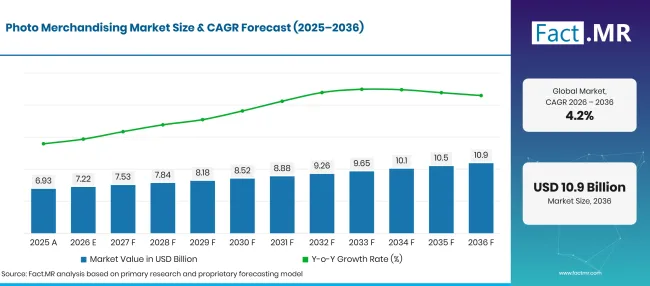
Factmr Photo Merchandising Market Forecast Global | Source: Fact.MR
| Year | Basis | Market Value (USD Billion) |
|---|---|---|
| 2025 | Actual | 6.93 |
| 2026 | Estimate | 7.22 |
| 2036 | Forecast | 10.90 |
| CAGR 2026 to 2036 | Forecast period | 4.2% |
Source: Fact.MR analysis. Updated Oct 14, 2026
What are the defining numbers behind Photo Merchandising Market growth?
An absolute opportunity of USD 3.7 billion will be created between 2026 and 2036.
- Demand Drivers in the Market
- Consumers are increasingly selecting photo books, customized cards, calendars, and photographic gifts for birthdays, weddings, anniversaries, festive occasions, and family celebrations. These products will continue to appeal to buyers seeking meaningful keepsakes, while personalized designs will offer greater emotional value than conventional, mass-produced gifts.
- Online storefronts and digital design tools are simplifying photo uploads, layout adjustments, product previews, and order placement. Compared with traditional offline ordering, digital platforms are providing greater convenience, wider product selection, and easier access to customization services, supporting further market expansion.
- The growing volume of photographs captured on smartphones is creating more opportunities to convert digital images into printed keepsakes. Photo books and calendars will continue to provide alternatives to digital-only storage, while customized printed products will support consumers seeking lasting ways to preserve and display personal memories.
- Businesses are increasingly incorporating personalized photo products into employee recognition programs, client appreciation initiatives, promotional campaigns, and branded gifting activities. Compared with generic promotional merchandise, customized photo products will offer greater scope for personal relevance and brand engagement, while bulk orders from corporate buyers will contribute to additional market demand.
- Key Segments Analyzed
- By Product Type: Photo Books are estimated to hold a 28.5% market share in 2026, supported by demand for organized photo collections, personalized keepsakes, and milestone-based gifts.
- By Distribution Channel: Online Stores are forecast to dominate with a 72.3% market share in 2026, reflecting the convenience of digital customization, online ordering, and direct delivery.
- By End-User: Individual Consumers are anticipated to contribute 63.2% of the market in 2026, driven by personal gifting, family memories, celebrations, and customized home products.
- Analyst Opinion at Fact.MR
- Shambhu Nath Jha, Principal Consultant at Fact.MR, states, “Photo merchandising is evolving beyond traditional photo printing into a personalized gifting and visual communication category. Consumers will increasingly favor platforms offering flexible customization, premium print quality, and convenient delivery. Suppliers that combine innovative product designs with seamless online ordering and reliable fulfillment will be well positioned to capture growing demand from individual consumers and corporate buyers through 2036.”.
- Strategic Implications
- Suppliers are encouraged to enhance print quality, packaging standards, and delivery reliability to improve customer satisfaction and foster repeat purchases.
- Digital platform operators are advised to simplify photo uploads, editing features, product previews, and checkout procedures, as seamless online experiences will continue to support the dominant distribution channel.
- Corporate merchandise providers are recommended to strengthen bulk-order management and scalable personalization capabilities to accommodate businesses seeking customized promotional materials and employee recognition products.
- Product developers are urged to diversify customization options across photo books, cards, calendars, and photo gifts, enabling buyers to create products that reflect personal milestones, individual preferences, and special occasions.
The Photo Merchandising Market is positioned to expand across all five countries between 2026 and 2036, with Japan recording the highest CAGR of 5.2%, followed by Germany at 4.5%, the United Kingdom at 3.8%, the United States at 3.4%, and Brazil at 3.1%. These forecasts indicate varying growth trajectories across the selected markets, with Japan demonstrating the strongest anticipated expansion and Brazil exhibiting the most moderate growth.
How does the Photo Merchandising Market break down by segment?
Photo Books will lead Product Type at 28.5%; Online Stores will lead Distribution Channel at 72.3%; Individual Consumers will lead End-User at 63.2%.
Which Product Type dominates?
Photo Books will hold 28.5% share in 2026.
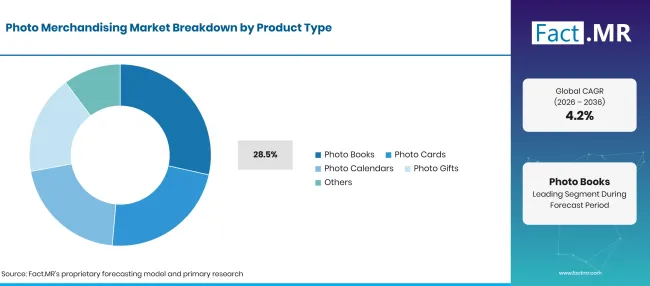
Factmr Photo Merchandising Market Breakdown Product Type | Source: Fact.MR
| Product Type | Share (2026) |
|---|---|
| Photo Books (leading segment) | 28.5% |
| Other segments combined | 71.5% |
| Total | 100.0% |
Source: Fact.MR analysis. Updated Oct 14, 2026
Photo books are maintaining a leading position as consumers seek personalized formats to preserve memories of family occasions, travel experiences, weddings, and milestone celebrations. Flexible layouts, tailored captions, and distinctive cover designs strengthen their appeal as keepsakes and gifting options. Photo cards serve seasonal greetings and special events, while photo calendars combine personal imagery with everyday utility. Customized merchandise broadens the appeal of photo gifts, with other product formats contributing to the remaining market share.
What supports Online Stores within Distribution Channel?
Online Stores will account for 72.3% share in 2026.
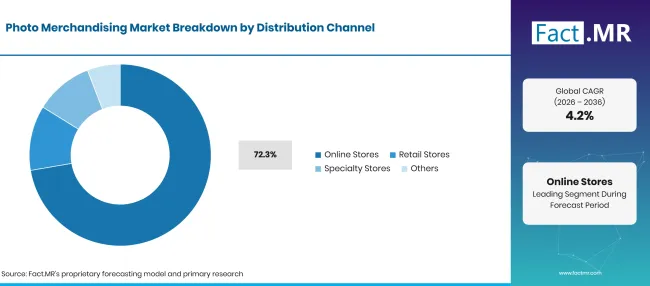
Factmr Photo Merchandising Market Breakdown Distribution Channel | Source: Fact.MR
| Distribution Channel | Share (2026) |
|---|---|
| Online Stores (leading segment) | 72.3% |
| Other segments combined | 27.7% |
| Total | 100.0% |
Source: Fact.MR analysis. Updated Oct 14, 2026
Online stores are securing a dominant position by enabling customers to upload photographs, personalize designs, compare product formats, and place orders remotely. Digital platforms also provide extensive template libraries and editing capabilities, giving them a competitive advantage over physical outlets with limited display space. Retail stores continue to facilitate access to photo printing and customized merchandise through in-person services. Specialty outlets appeal to customers seeking expert guidance, distinctive printing techniques, and tailored product recommendations. Their market contribution depends on service quality, pricing competitiveness, and regional purchasing habits.
How does End-User shape demand?
Individual Consumers will represent 63.2% share in 2026.
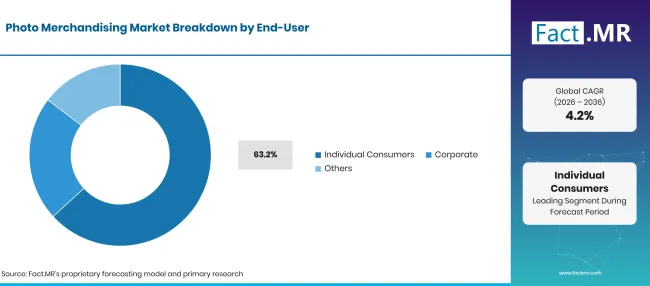
Factmr Photo Merchandising Market Breakdown End User | Source: Fact.MR
| End-User | Share (2026) |
|---|---|
| Individual Consumers (leading segment) | 63.2% |
| Other segments combined | 36.8% |
| Total | 100.0% |
Source: Fact.MR analysis. Updated Oct 14, 2026
Individual consumers maintain the largest demand share as photographs become personalized keepsakes and thoughtful gifts for birthdays, weddings, anniversaries, graduations, and family celebrations. These recurring occasions sustain purchasing across diverse photo merchandise formats. Corporate customers leverage customized photo products for promotional initiatives, employee appreciation, branded merchandise, and client engagement. Other end-user groups contribute through institutional requirements, event-based orders, and specialized printing projects, broadening demand beyond personal and business gifting applications.
What is accelerating Photo Merchandising Market adoption, and what is holding it back?
Demand is expected to increase through online customization, personalized gifting, and the conversion of digital photographs into physical products. Growth may be constrained by price sensitivity, competition from digital sharing, printing and delivery costs, and concerns about handling personal photographs.
Drivers Impact Analysis
| Driver | (~)% Impact on CAGR | Geographic Relevance | Impact Timeline |
|---|---|---|---|
| Rising consumer demand for personalized gifts and keepsakes | +1.4% | Global | Short term (≤2 years) |
| Increasing volume of smartphone photography | +0.9% | Global | Medium term (2-4years) |
| Growth of e-commerce and mobile app ordering platforms | +0.7% | North America, Western Europe, East Asia | Medium term (2-4years) |
| Expanding use of photo products for gifting and celebrations | +0.4% | South Asia & Pacific, Latin America | Long term (≥ 4years) |
Source: Fact.MR analysis. Updated Oct 14, 2026
Opportunity Impact Analysis
| Opportunity | (~) % Impact on CAGR | Geographic Relevance | Impact Timeline |
|---|---|---|---|
| AI-enabled design tools and automated photo product creation | +0.7% | Global | Medium term (2-4 years) |
| On-demand digital printing and short-run production | +0.5% | North America, Western Europe | Medium term (2-4 years) |
| Growing demand for personalized corporate gifting and promotional merchandise | +0.3% | North America, East Asia | Long term (≥ 4 years) |
| Rising disposable income in emerging markets | +0.3% | South Asia & Pacific, Latin America | Long term (≥ 4 years) |
Source: Fact.MR analysis. Updated Oct 14, 2026
Restraints Impact Analysis
| Restraint | (~) % Impact on CAGR | Geographic Relevance | Impact Timeline |
|---|---|---|---|
| Preference for digital photo sharing over physical products | -0.5% | Global | Short term (≤ 2 years) |
| Volatility in raw material and shipping costs | -0.3% | Global | Medium term (2-4 years) |
| Data privacy concerns around uploading personal photos | -0.2% | Global | Long term (≥ 4 years) |
Source: Fact.MR analysis. Updated Oct 14, 2026
Which countries are scaling the Photo Merchandising Market through 2036?
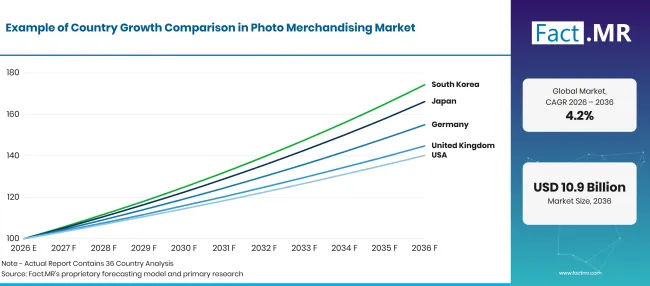
Factmr Photo Merchandising Market Growth Index | Source: Fact.MR
| Country | CAGR (2026–2036) |
|---|---|
| Japan | 5.2% |
| Germany | 4.5% |
| United Kingdom | 3.8% |
| United States | 3.4% |
| Brazil | 3.1% |
Source: Fact.MR analysis. Updated Oct 14, 2026
What supports Germany adoption?
4.5% CAGR, supported by personalized gifting, photo products, and convenient digital ordering.
Demand in Germany is supported by personalized gifts, printed photo books, and customized products for family occasions. Online ordering and digital design tools simplify purchasing, while retail access, print quality, and delivery reliability shape competitiveness. Country-specific evidence is required to identify the largest contributor to projected growth.
How is Brazil scaling demand?
3.1% CAGR, led by personalized gifting, online purchasing, and local customization needs.
Brazil’s demand is shaped by personalized gifting, access to online purchasing, and customized products for family celebrations. Online platforms let buyers compare designs and place orders without visiting a print location. Affordability, delivery coverage, and local production capacity will determine how far demand scales.
What supports United States adoption?
3.4% CAGR, backed by photo products, customized gifts, and corporate merchandise.
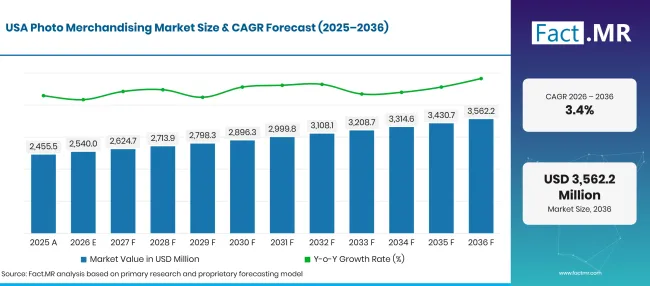
Factmr Photo Merchandising Market Forecast Usa | Source: Fact.MR
The United States offers demand across personalized photo books, greeting cards, calendars, and customized gifts. Digital photography and online design services make it easy to turn images into printed products, while corporate gifting and promotional merchandise add demand beyond households. Primary industry research is needed to confirm each factor’s contribution.
How does the United Kingdom perform?
3.8% CAGR, driven by personalized gifts, seasonal products, and online customization.
The United Kingdom’s market is supported by demand for personalized gifts, photo books, seasonal cards, and event-related merchandise. Online ordering enables customization and home delivery, while retail and specialty channels serve buyers who want printing assistance. Competition, production costs, and consumer spending will influence performance.
How is Japan developing demand?
5.2% CAGR, shaped by personalized photo products, commemorative gifting, and digital design tools.
Japan has the highest projected growth rate among the five countries. Demand centers on personalized photo books, commemorative products, seasonal gifting, and customized merchandise. Digital ordering and design tools support purchasing, while product presentation, print quality, and compact gift formats may influence preferences. These drivers should be validated against Japan-specific industry data.
Who leads the Photo Merchandising Market?
Competition falls into three groups. Consumer-focused photo product providers compete on design tools, product variety and delivery reliability: Shutterfly offer photo books, cards, calendars and gifts, while Photobox and Mixbook specialize in customized photo books and printed keepsakes. Design-led and print-focused players compete on creative range and production capability: Vistaprint supplies customized print and business marketing products, Minted offers designer stationery, cards and personalized products, and Zazzle provides customizable merchandise across broad categories.
CEWE, which replaces Cimpress in the competitive set, offers photo printing and personalized photo products. Picaboo and Blurb serve niche segments through personalized photo products and photo-book publishing. Through 2036, positioning will depend on intuitive design tools, consistent print quality, product innovation, efficient fulfillment and customer retention. Market shares and rankings were not provided and should not be inferred from this list.
Which companies are the key providers?
Key companies include Shutterfly, Vistaprint, Minted, Zazzle, CEWE, Photobox, Mixbook, Picaboo, and Blurb.
- Shutterfly
- Vistaprint
- Minted
- Zazzle
- CEWE
- Photobox
- Mixbook
- Picaboo
- Blurb
Bibliography
- [1] CEWE Stiftung & Co. KGaA. (2026, March 30). 100 million CEWE PHOTOBOOK copies: A landmark moment in the culture of memory.
- [2] Statistisches Bundesamt. (2025, November 27). Internet users and online shoppers.
- [3] Office for National Statistics. (2026, September 18). Internet sales as a percentage of total retail sales (ratio) (%).
- [4] U.S. Census Bureau. (2026, August 18). Quarterly retail e-commerce sales: Second quarter 2026.
- [5] Statistics Bureau of Japan. (2026, February 6). Family Income and Expenditure Survey: 2025 yearly average.
- [6] Instituto Brasileiro de Geografia e Estatística. (2026, February 13). Vendas no varejo fecham 2025 com alta de 1,6% [Retail sales close 2025 with rise of 1.6%].
This Report Answers
- The report explains how the photo merchandising market is segmented by product type, distribution channel, and end-user.
- Segment analysis identifies the leading product, distribution channel, and end-user categories based on their stated 2026 shares.
- Country analysis compares the five listed markets using their projected CAGRs from 2026 to 2036.
- Competitive analysis reviews the listed photo printing, personalized gifting, and customized merchandise providers.
- Market analysis examines potential demand drivers, opportunities, and restraints affecting adoption through 2036.
What does the Photo Merchandising Market cover?
The Photo Merchandising Market covers personalized products created from photographs, including photo books, photo cards, photo calendars, and customized photo gifts. These products enable consumers and organizations to convert digital images into printed keepsakes, personalized gifts, promotional items, and commemorative merchandise.
The assessment evaluates the market by product category, distribution channel, and end user, with a geographic focus on Germany, Brazil, the United States, the United Kingdom, and Japan.
What is included in the scope?
The scope includes photo books, photo cards, photo calendars, and photo gifts produced with personalized photographs or customized designs. It covers purchases by individual consumers for personal use and gifting, as well as purchases by corporate customers for promotional activities, employee recognition, and client engagement.
Products ordered through online stores, retail stores, specialty stores, and other distribution channels fall within the stated market segmentation.
What is excluded from the scope?
The market excludes standard photographic prints that carry no merchandising or personalization component, digital photo storage subscriptions, standalone photography services, and unrelated promotional merchandise. Products that do not feature a personalized photo, or that fall outside the defined categories of photo books, photo cards, photo calendars, and photo gifts, are not counted in market revenue.
How Was the Analysis Built?
The analysis draws on 120+ sources, 35+ company portfolios, 25+ countries, and more than 20 industry interviews.
- Primary Research: Primary research includes discussions with manufacturers, service providers, technology developers, distributors, end users, and subject-matter experts. These conversations examine purchasing priorities, product adoption, operational challenges, approval requirements, competitive positioning, and the factors that influence wider market acceptance.
- Desk Research: Desk research covers government statistics, regulatory publications, company filings, trade data, technical studies, industry associations, standards, public policy, and other authoritative sources. Every source used in the analysis is documented in the bibliography.
- Market Sizing and Forecasting: Market estimates combine historical performance, demand indicators, pricing and volume trends, segment shares, company participation, country-level growth, adoption patterns, investment activity, and barriers to market expansion.
- Data Validation and Update Cycle: Findings are validated by comparing primary interviews with public data, company activity, regulatory changes, trade patterns, and industry developments. Regular updates review new product launches, capacity changes, partnerships, approvals, and shifts in commercial adoption.
Segmentation
What is the report’s scope and coverage?
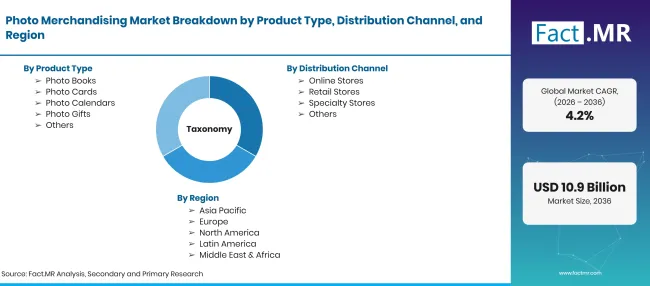
Factmr Photo Merchandising Market Taxonomy | Source: Fact.MR
| Attribute | Details |
|---|---|
| Quantitative Units | USD Billion |
| Market Definition | Personalized photo products, including photo books, photo cards, photo calendars, and photo gifts, sold through online, retail, and specialty channels |
| Product Type | Photo Books; Photo Cards; Photo Calendars; Photo Gifts; Others |
| Distribution Channel | Online Stores; Retail Stores; Specialty Stores; Others |
| End-User | Individual Consumers; Corporate; Others |
| Regions Covered | North America; Latin America; Western Europe; Eastern Europe; East Asia; South Asia & Pacific; Middle East & Africa |
| Countries Covered | Germany; Brazil; United States; United Kingdom; Japan |
| Key Companies Profiled | Shutterfly; Vistaprint; Minted; Zazzle; CEWE; Photobox; Mixbook; Picaboo; Blurb |
| Forecast Period | 2026 to 2036 |
| Approach | Proposed assessment using product demand, distribution channel mix, end-user demand, country-level growth, and supplier portfolio reviews |
Source: Fact.MR analysis. Updated Oct 14, 2026
How is the market segmented?
-
By Product Type:
- Photo Books
- Photo Cards
- Photo Calendars
- Photo Gifts
- Others
-
By Distribution Channel:
- Online Stores
- Retail Stores
- Specialty Stores
- Others
-
By End-User:
- Individual Consumers
- Corporate
- Others
-
By Country:
- North America
- Latin America
- Western Europe
- Eastern Europe
- East Asia
- South Asia & Pacific
- Middle East & Africa
Frequently Asked Questions
How big is the Photo Merchandising Market in 2026?
What is the CAGR of the Photo Merchandising Market from 2026 to 2036?
Which product type leads the Photo Merchandising Market?
Which distribution channel leads the Photo Merchandising Market?
Which end-user leads the Photo Merchandising Market?
Which country will grow the most in the Photo Merchandising Market?
Who are the main companies in the Photo Merchandising Market?
Who worked on this report


Preview the report firsthand - request a free sample
Free SampleGet the brochure for pricing and purchase details
Download PDF