- Market Value (2025): USD 361.6 Mn
- Estimated Value (2026): USD 380.7 Mn
- Forecast Value (2036): USD 636.9 Mn
- CAGR (2026-2036): 5.3%
What is the DCPD Application to Fine Chemicals Market forecast to be worth by 2036?
USD 380.7 million in 2026 to USD 636.9 million by 2036 at a 5.3% CAGR.
- According to Fact.MR analysis, DCPD application to fine chemicals market reached USD 361.6 million in 2025.
- Sales are projected to reach from USD 380.7 million to USD 636.9 million by 2036.
- The market is forecast to record a 5.3% CAGR from 2026 to 2036, subject to chemical feedstock supply and customer testing.
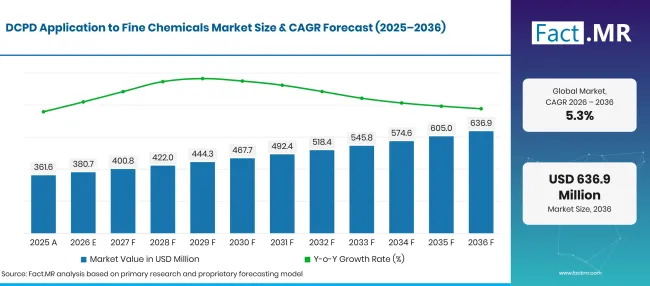
Factmr Dcpd Application To Fine Chemicals Market Forecast Global | Source: Fact.MR
| Year | Basis | Market value (USD million) |
|---|---|---|
| 2025 | Actual | 361.6 |
| 2026 | Estimate | 380.7 |
| 2036 | Forecast | 636.9 |
| CAGR 2026 to 2036 | Forecast period | 5.3% |
Source: Fact.MR analysis. Updated Oct 14, 2026
What are the defining numbers behind DCPD Application to Fine Chemicals Market growth?
Fact.MR estimates that USD 256.2 million absolute opportunity between 2026 and 2036.
- Demand Drivers in the Market
- Specialty resin producers use DCPD-based materials in resin products that require specific performance and processing properties. Dow offers DCPD resin grades for specialty resin and chemical applications [1].
- Chemical producers value a steady supply of raw materials because consistent inputs help maintain product quality. LyondellBasell includes DCPD-101 in its chemical product range [3].
- Coating companies use DCPD-based resin ingredients in products where performance and compatibility meet application requirements. Each formulation is assessed according to its intended use.
- Key Segments Analyzed
- By Product Type: Resins account for 42.5% share in 2026, reflecting their role as a direct outlet for DCPD-derived intermediates.
- By Application: Automotive holds 40.0% share in 2026, with qualifying materials used in selected manufacturing applications.
- By End-User: Commercial accounts for 43.1% share in 2026 because specialized formulations are purchased for defined performance needs.
- Analyst Opinion at Fact.MR
- Shambhu Nath Jha, Principal Consultant at Fact.MR, states, “For DCPD fine chemicals, consistent quality are more important than having a long list of potential applications. Suppliers can build repeat business by providing reliable product quality, successful performance in resin applications, and clear handling guidance.”
- Strategic Implications
- DCPD suppliers can provide clear information on product grades and shipping requirements. This makes it easier for buyers to compare materials across different batches.
- Resin companies often test DCPD-based materials in their products before placing larger orders. Performance in the final application is usually an important factor in the decision.
- Automotive material teams often review formulation changes through their regular material approval process. This helps ensure the new material meets existing requirements.
- Distributors can maintain clear records between supplied batches and customer trial results. Good record-keeping helps avoid delays during product evaluation.
Japan leads the country forecasts at 6.5% CAGR. Germany follows with 6.0%, ahead of the UK at 5.7%. The USA records 5.2% and Brazil 4.5%, reflecting different manufacturing conditions.
How does the DCPD Application to Fine Chemicals Market break down by segment?
Fact.MR estimates that resins account for 42.5%; Automotive accounts for 40.0%; Commercial accounts for 43.1% in 2026.
Which Product Type dominates?
Resins are projected to hold 42.5% share in 2026.
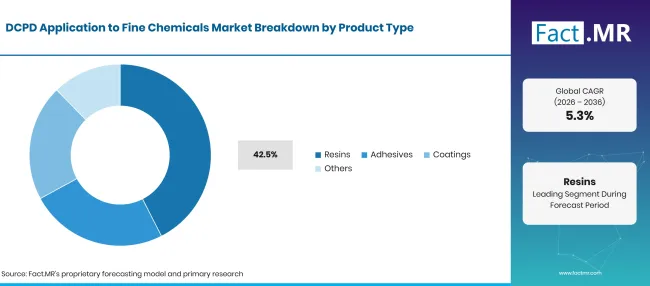
Factmr Dcpd Application To Fine Chemicals Market Breakdown Product Type 1 | Source: Fact.MR
| Product Type | Share (2026) |
| Resins (Leading segment) | 42.5% |
| Other segments combined | 57.5%* |
| Total | 100.0% |
Source: Fact.MR analysis. Updated Oct 14, 2026
Resins are one of the main uses of DCPD in specialty chemical production. Resin producers select DCPD based on the processing needs and performance requirements of the final product. Dow lists unsaturated polyester resins as one application for its DCPD resin grade. The company also identifies phenolic and epoxy resins as additional uses, showing that DCPD can be used in different resin types.
What leads the Application segment?
Automotive is forecast to account for 40.0% share in 2026.
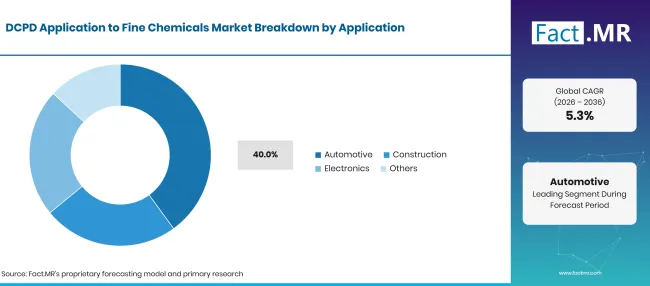
Factmr Dcpd Application To Fine Chemicals Market Breakdown Application | Source: Fact.MR
| Application | Share (2026) |
| Automotive (Leading segment) | 40.0% |
| Other segments combined | 60.0%* |
| Total | 100.0% |
Source: Fact.MR analysis. Updated Oct 14, 2026
Automotive applications require consistent performance and approval for production use. Companies assess whether a resin-based material is suitable for a specific part or coating. Germany produced about 4.15 million passenger cars in 2025 [2]. This keeps demand steady for materials that meet automotive requirements.
How does End-User shape purchasing?
Commercial is expected to account for 43.1% share in 2026.
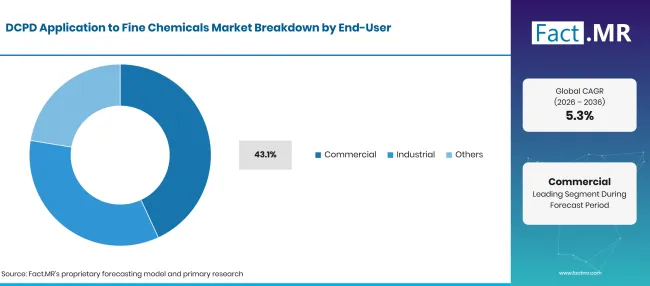
Factmr Dcpd Application To Fine Chemicals Market Breakdown End User | Source: Fact.MR
| End-User | Share (2026) |
| Commercial (Leading segment) | 43.1% |
| Other segments combined | 56.9%* |
| Total | 100.0% |
Source: Fact.MR analysis. Updated Oct 14, 2026
Commercial chemical buyers select materials based on the needs of the final product. DCPD-based ingredients must meet required handling and performance standards before they are used in regular production.
What is accelerating DCPD Application to Fine Chemicals Market adoption, and what is holding it back?
Resin demand supports DCPD sales, while differences in raw material quality and handling requirements can limit its use in some applications.
Drivers Impact Analysis
| DRIVER | (~) % IMPACT ON CAGR | GEOGRAPHIC RELEVANCE | IMPACT TIMELINE |
|---|---|---|---|
| Specialty resin formulation | +0.9% | Global | Medium term (2–4 years) |
| Automotive material qualification | +0.7% | Japan, Germany, USA | Long term (>= 4 years) |
| Reliable C5 feedstock access | +0.6% | North America, Europe | Short term (<= 2 years) |
| Coatings and adhesive formulations | +0.5% | Global | Medium term (2–4 years) |
| Custom intermediate chemistry | +0.4% | Global | Long term (>= 4 years) |
Source: Fact.MR analysis. Updated Oct 14, 2026
Opportunity Impact Analysis
| OPPORTUNITY | (~) % IMPACT ON CAGR | GEOGRAPHIC RELEVANCE | IMPACT TIMELINE |
|---|---|---|---|
| Grade-specific technical support | +0.7% | Global | Medium term (2–4 years) |
| Resin supply agreements | +0.6% | Europe, North America | Long term (>= 4 years) |
| Controlled feedstock logistics | +0.5% | Global | Short term (<= 2 years) |
| Qualified specialty uses | +0.4% | Japan, USA | Long term (>= 4 years) |
Source: Fact.MR analysis. Updated Oct 14, 2026
Restraints Impact Analysis
| RESTRAINT | (~) % IMPACT ON CAGR | GEOGRAPHIC RELEVANCE | IMPACT TIMELINE |
|---|---|---|---|
| Feedstock composition variation | -0.8% | Global | Short term (<= 2 years) |
| Application approval cycles | -0.6% | Automotive hubs | Medium term (2–4 years) |
| Handling and emissions costs | -0.5% | North America, Europe | Long term (>= 4 years) |
| Competition from other chemistry | -0.4% | Global | Medium term (2–4 years) |
Source: Fact.MR analysis. Updated Oct 14, 2026
Which countries are scaling the DCPD Application to Fine Chemicals Market through 2036?
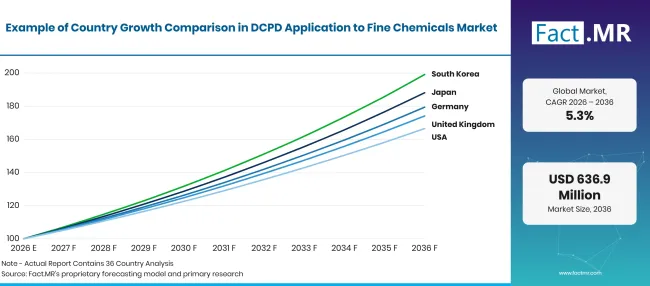
Factmr Dcpd Application To Fine Chemicals Market Growth Index | Source: Fact.MR
| Country | CAGR (2026–2036) |
|---|---|
| Japan | 6.5% |
| Germany | 6.0% |
| United Kingdom | 5.7% |
| United States | 5.2% |
| Brazil | 4.5% |
Source: Fact.MR analysis. Updated Oct 14, 2026
How is Japan developing DCPD fine chemical use?
6.5% CAGR, supported by chemical processing capability and customer qualification.
Japan has a strong specialty chemicals industry, where materials are carefully reviewed before commercial use. Companies compare product quality, material specifications, and batch consistency before selecting DCPD-based ingredients. Japan's Ministry of Economy, Trade and Industry continued its Current Survey of Production in June 2026 [4].
What supports Germany’s DCPD fine chemical applications?
6.0% CAGR, shaped by resin manufacturing and demanding automotive material approvals.
Large automotive production keeps Germany an important market for resin materials. Many companies prefer to keep proven formulations in place unless a new material offers a clear advantage. Product quality, supporting documentation, and fit with existing processes all play a role in feedstock selection.
How are UK formulators developing DCPD applications?
5.7% CAGR, influenced by specialty formulation activity and performance-focused product testing.
The UK has a strong market for coatings, adhesives, and other specialty products. The Office for National Statistics reported GBP 452.0 billion in manufacturers' product sales during 2025 [6]. Companies test new materials carefully before adding them to existing products. Product quality, batch records, and customer approval requirements often influence material purchasing decisions.
What shapes DCPD feedstock purchases in the United States?
5.2% CAGR, supported by direct resin-grade availability and domestic chemical distribution.
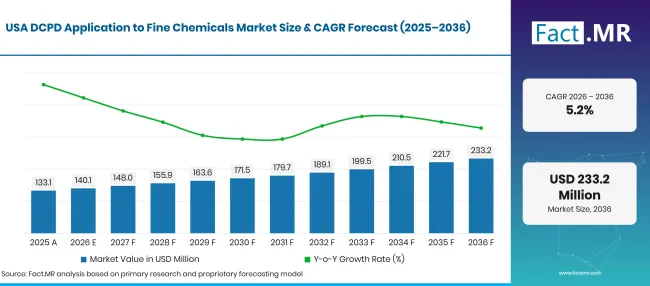
Factmr Dcpd Application To Fine Chemicals Market Forecast Usa | Source: Fact.MR
The United States has a well-established market for DCPD products used in resin and chemical applications. Companies usually test new materials carefully before adding them to existing products. Storage needs and competition from alternative resin materials all affect wider use.
How is Brazil developing DCPD resin applications?
4.5% CAGR, linked to automotive resin demand and local chemical purchasing conditions.
Brazil's market is closely linked to vehicle production and the ability of local suppliers to meet customer requirements. ANFAVEA reported 2.644 million vehicles produced in 2025 [5]. This creates demand for resin materials used in automotive applications. Companies often consider delivery reliability, product records, and raw material availability when selecting suppliers. Long transport distances and the need for product testing can slow the adoption of new resin ingredients.
Who leads the DCPD Application to Fine Chemicals Market?
Competition in the DCPD market includes both dedicated DCPD suppliers and larger chemical companies with resin businesses.
Dow offers DCPD resin grades for resin and specialty chemical applications, while LyondellBasell supplies DCPD-101 as part of its chemical product range. Shell also produces dicyclopentadiene at its facilities in the Netherlands.
Dow and LyondellBasell provide technical information and product specifications for industrial customers. Buyers often compare product grades closely because material quality and composition can affect performance in downstream production processes.
Which companies are the relevant providers?
Key companies include Dow Inc.; Braskem; Shell Chemicals; and LyondellBasell Industries.
- Dow Inc.
- Braskem
- Shell Chemicals
- LyondellBasell Industries
Bibliography
- [1] Dow Inc. (2026). DOW™ DCPD Resins Grade (RG).
- [2] German Association of the Automotive Industry. (2026, January 5). Passenger car production in 2025 slightly above previous year's level.
- [3] LyondellBasell. (2026). Chemicals.
- [4] Ministry of Economy, Trade and Industry. (2026, June 30). Current Survey of Production: Preliminary Report for May 2026.
- [5] Associação Nacional dos Fabricantes de Veículos Automotores. (2026, January 15). Produção e venda de autoveículos crescem em 2025 e Anfavea projeta nova alta em 2026.
- [6] Office for National Statistics. (2026, July 24). UK manufacturers' sales by product: 2025.
- [7] Board of Governors of the Federal Reserve System. (2026, June 15). Industrial Production and Capacity Utilization: May 2026.
- [8] Instituto Brasileiro de Geografia e Estatística. (2026, March 6). Industrial production up 1.8% in January.
This Report Answers
- The analysis explains the use of DCPD in specialty resin and fine chemical production.
- Segment coverage compares product groups and end-user purchase requirements.
- Country forecasts assess five manufacturing markets and the conditions that influence qualification.
- Competitive coverage distinguishes direct DCPD products from broader chemical company activities.
- The supply-chain assessment considers feedstock availability, batch consistency and handling requirements.
What does the DCPD Application to Fine Chemicals Market cover?
The market covers DCPD uses in resin manufacture and other fine-chemical conversion routes. It includes the value associated with those downstream uses rather than the entire petrochemical C5 stream. Resin chemistry remains the central product type in the forecast.
What is included in the scope?
Coverage includes DCPD material used in qualifying commercial fine-chemical uses and resin systems. Formulators may also consult the related Fact.MR analysis of hydrocarbon resins.
The market scope follows resins, adhesives, coatings and other product categories, alongside automotive, construction and electronics uses. It also compares commercial and industrial end-user groups.
What is excluded from the scope?
The scope excludes total worldwide DCPD commodity sales outside the defined fine-chemical uses. It also excludes finished vehicles and complete construction or electronics products. Sales of unrelated monomers are outside the market boundary.
How Was the Analysis Built?
The analysis draws on 120+ sources, 35+ company portfolios, 25+ countries, and more than 20 industry interviews.
- Primary Research: Primary research includes discussions with manufacturers, service providers, technology developers, distributors, end users, and subject-matter experts. These conversations examine purchasing priorities, product adoption, operational challenges, approval requirements, competitive positioning, and the factors that influence wider market acceptance.
- Desk Research: Desk research covers government statistics, regulatory publications, company filings, trade data, technical studies, industry associations, standards, public policy, and other authoritative sources. Every source used in the analysis is documented in the bibliography.
- Market Sizing and Forecasting: Market estimates combine historical performance, demand indicators, pricing and volume trends, segment shares, company participation, country-level growth, adoption patterns, investment activity, and barriers to market expansion.
- Data Validation and Update Cycle: Findings are validated by comparing primary interviews with public data, company activity, regulatory changes, trade patterns, and industry developments. Regular updates review new product launches, capacity changes, partnerships, approvals, and shifts in commercial adoption.
Segmentation
What is the report’s scope and coverage?
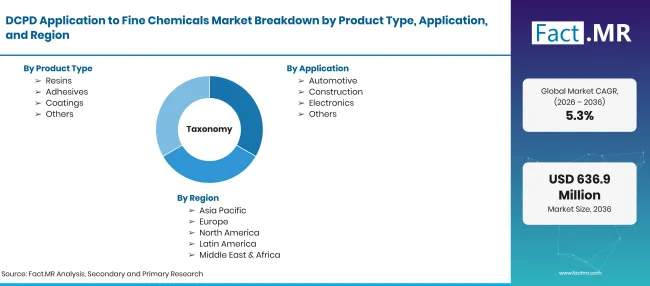
Factmr Dcpd Application To Fine Chemicals Market Taxonomy | Source: Fact.MR
| Attribute | Details |
|---|---|
| Quantitative units | USD million in 2026 to USD million by 2036 at a CAGR |
| Market definition | DCPD used as a raw-material input for specialty resins and fine chemical formulations |
| Product Type | Resins; Adhesives; Coatings; Others |
| Application | Automotive; Construction; Electronics; Others |
| End-User | Commercial; Industrial; Others |
| Regions covered | North America; Latin America; Western Europe; Eastern Europe; East Asia; South Asia & Pacific; Middle East & Africa |
| Countries covered | Japan; Germany; United Kingdom; United States; Brazil |
| Forecast period | 2026 to 2036 |
| Research approach | Technical product review; official manufacturing statistics; country and application analysis |
Source: Fact.MR analysis. Updated Oct 14, 2026
How is the market segmented?
-
By Product Type
- Resins
- Adhesives
- Coatings
- Others
-
By Application
- Automotive
- Construction
- Electronics
- Others
-
By End-User
- Commercial
- Industrial
- Others
-
By Region
- North America
- Latin America
- Western Europe
- Eastern Europe
- East Asia
- South Asia & Pacific
- Middle East & Africa
Frequently Asked Questions
How big is the DCPD application to fine chemicals market in 2026?
What CAGR does the market record through 2036?
Which product type accounts for the highest share?
Which end-user category leads?
Who are the main companies in the DCPD Application to Fine Chemicals Market?
Who worked on this report


Preview the report firsthand - request a free sample
Free SampleGet the brochure for pricing and purchase details
Download PDF