- Market Value (2025): USD 1.55 Bn
- Estimated Value (2026): USD 1.65 Bn
- Forecast Value (2036): USD 3.05 Bn
- CAGR (2026-2036): 6.2%
How Big Is the Photoluminescent Products Market in 2026?
The global photoluminescent products market is valued at USD 1.65 billion in 2026, up from USD 1.55 billion in 2025, and is projected by Fact.MR to reach USD 3.05 billion by 2036, expanding at a 6.2% CAGR from 2026 to 2036 and generating USD 1.40 billion in incremental revenue over the 10-year forecast period.
| Market Metric | Valuation / Share / Forecast Benchmark |
|---|---|
| 2025 Market Size (Historical) | USD 1.55 billion |
| 2026 Market Size (Estimated) | USD 1.65 billion |
| 2036 Market Size (Projected) | USD 3.05 billion |
| CAGR (2026 to 2036) | 6.2% |
| Incremental Dollar Opportunity (2026 to 2036) | USD 1.40 billion (1.82x the 2026 base) |
| Dominant Product Type (2026 share) | Signs, 35.8% (about USD 608.6 million) |
| Leading Application (2026 share) | Safety and emergency, 42.3% (about USD 719.1 million) |
| Leading Material (2026 share) | Strontium aluminate, 52.3% (about USD 889.1 million) |
| Largest Country Markets (2026 share) | United States 12.0%, Japan 10.0%, Germany 7.0% |
| Fastest-Growing Countries (CAGR, 2026 to 2036) | Germany 7.5%, United Kingdom 6.5%, United States 5.8% |
| Leading Tier-1 Companies | Nemoto & Co., Jessup Manufacturing, EverGlow, Ecoglo International, Zhejiang Minhui Luminous Technology |
Source: Fact.MR analysis. Updated Nov 13, 2026
Source: Fact.MR analysis of the photoluminescent products market, 2026.
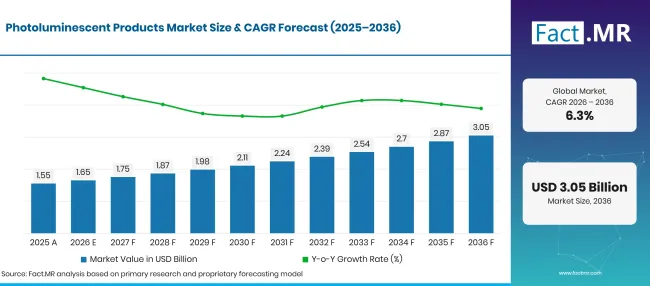
Photoluminescent Products Market Forecast Global | Source: Fact.MR
Executive Market Overview
Sales of photoluminescent products are driven mainly by building codes and workplace rules that require escape routes to stay visible during a power failure. The main products are exit signs, stair-edge and handrail markings, floor-level guidance strips and safety tapes, all of which store energy from ambient light and glow without wiring or batteries. In the United States, luminous egress path markings have been required in high-rise exit stairways since the 2009 editions of the International Building Code, International Fire Code and NFPA 101, according to iDigHardware (May 2026). Revenue is spread widely across countries. The five named countries hold only 35.0% of 2026 revenue, led by the United States (12.0%) and Japan (10.0%), while the rest of the world holds 65.0% and grows at 6.3%, faster than the global rate, as new high-rise, transit and industrial projects in Asia and the Middle East adopt the same codes.
Basic zinc sulfide signs and tapes sell on price, but revenue per unit rises with strontium aluminate grades that glow longer and brighter, certified egress systems and anti-slip stair products. Strontium aluminate already accounts for 52.3% of 2026 revenue. Rules that specify tested luminance classes put Germany (7.5% CAGR) and the United Kingdom (6.5% CAGR) ahead of the global 6.2%, while Japan (5.0%) and Brazil (4.6%) trail. Fact.MR counts photoluminescent signs, tapes, films, paints, coatings, rigid sheets and egress marking systems, along with photoluminescent pigments sold for these products, while excluding retroreflective-only materials, electrically powered exit and emergency lighting, and tritium (radioluminescent) signs.
Analyst Perspective
"Building owners are moving from single glow signs to certified strontium aluminate systems that mark stairs, handrails and floors, so spending per project is rising faster than the number of projects. Europium is the weak link, because strontium aluminate needs it as an activator, and if China's suspended export licensing for europium returns, pigment costs will rise for every sign and tape maker outside China."
Shambhu Nath Jha, Principal Consultant, Fact.MR
Major Market Trends and Insights
- Code-Driven Egress Systems Replace Single Exit Signs: Codes now require marking of stairs, handrails, landings and door hardware, not only exit doors, so buyers order complete egress systems instead of single signs. iDigHardware (May 2026) notes that IBC, IFC and NFPA 101 accept self-luminous or photoluminescent markings listed to UL 1994 or ASTM E2072. Ecoglo International (accessed November 2026) sells cast-in-place and tile stair nosings that combine photoluminescent strips with slip resistance, so one product meets two requirements.
- Strontium Aluminate Displaces Zinc Sulfide: Adoption of strontium aluminate pigments continues because they glow far brighter and longer than zinc sulfide, which is needed to meet tested luminance classes. Nemoto & Co. (accessed November 2026) invented its LumiNova strontium aluminate series in 1993 and supplies it in pigments, sheets and plastic chains. Zhejiang Minhui Luminous Technology (accessed November 2026) produces strontium aluminate pigment and photoluminescent film on nine automated coating lines, with annual film output of 15 million m² tested to the DIN 67510-1 method.
- Tested Luminance Classes Raise the Specification Floor: Sales of higher-luminance products are rising as buyers replace older signs that do not meet current classes. KomNet (November 2024), the occupational safety advisory service of North Rhine-Westphalia, confirms that signs rated 55/8 must be replaced with signs meeting at least Class C (150/22) under DIN 67510-1, as required by Germany's workplace rules ASR A1.3 and ASR A2.3. EverGlow (January 2026) markets its 2026 range of emergency exit signs to ASR A1.3.
What Are the Main Drivers, Restraints, and Opportunities?
Codes requiring power-free escape guidance are the main growth engine for photoluminescent products. Dependence on adequate charging light and europium supply risk are the main restraints, and integrated stair and floor marking systems are the main opportunity.
Driver: Building and Workplace Codes Requiring Power-Free Escape Guidance
When mains and emergency power both fail, codes still require escape routes to stay visible, and that rule underpins most photoluminescent product sales.
In the United States, iDigHardware (May 2026) notes that luminous egress path markings have been required in high-rise exit stairways since the 2009 codes, covering steps, landings, handrails, door frames and door hardware. In New York City, the NYC Department of Buildings (accessed November 2026) approves products such as Jessup's Glo Brite 7550R under its Local Law 26 requirements for high-rise egress markings. Each new high-rise and each retrofit of an existing tower creates a recurring order for signs, strips and stair markings that must be replaced as they wear.
Restraint: Charging-Light Dependence and Europium Supply Risk
Adoption of photoluminescent products is limited in poorly lit areas, because the products only glow after enough ambient light has charged them, so sites must check lighting levels before installation. Material supply adds a second restraint.
Strontium aluminate pigments are activated with europium, and China Briefing (November 2025) reports that China's Ministry of Commerce added europium to its export licensing controls on 9 October 2025 and then suspended those controls until 10 November 2026. Materials Dispatch (October 2026) reports that the Ministry said on 28 September 2026 that the wider China–US arrangement runs to 10 January 2027. If licensing returns, pigment costs could rise for sign and tape makers outside China, and buyers in the strontium aluminate market may face longer lead times.
Opportunity: Integrated Stair, Handrail and Floor Marking Systems
The largest value opportunity lies in integrated egress systems, because one project can need exit signs, stair nosings, handrail strips, floor guidance lines and door markings from a single supplier.
Ecoglo International (accessed November 2026) packages photoluminescent and non-slip stair products for commercial and transit sites. EverGlow (January 2026) offers aluminium and plastic signs, guidance strips and markings in one catalogue. Suppliers that can deliver certified, installed systems can win larger contracts than sign-only sellers in the safety signs market.
How Is the Photoluminescent Products Market Segmented?
Five segmentation axes are used, product type, application, material, end user and country, all valued in USD at the point of sale.
| Segmentation Axis | Sub-Segments Covered | 2026 Leading Segment & Share | Main Growth Benchmark (2026 to 2036) |
|---|---|---|---|
| Product Type | Signs, tapes, paints, others | Signs, 35.8% (USD 608.6 million) | Global market 6.2% CAGR, USD 1.70 billion to USD 3.10 billion |
| Application | Safety and emergency, building and construction, transportation, others | Safety and emergency, 42.3% (USD 719.1 million) | USD 1.40 billion added across all applications |
| Material | Strontium aluminate, zinc sulfide, others | Strontium aluminate, 52.3% (USD 889.1 million) | Global market grows 1.82x by 2036 |
| End User | Commercial, industrial, residential, others | Commercial, 38.6% (USD 656.2 million) | Germany 7.5% and UK 6.5% CAGR outpace the global 6.2% |
| Region / Country | North America, Latin America, Europe, East Asia, South Asia and Pacific, Middle East and Africa | United States, 12.0% (USD 204.0 million) | Germany fastest at 7.5% CAGR; Brazil slowest named country at 4.6% |
Source: Fact.MR analysis. Updated Nov 13, 2026
Source: Fact.MR analysis of the photoluminescent products market, 2026.
Why Does the Signs Segment Lead by Product Type?
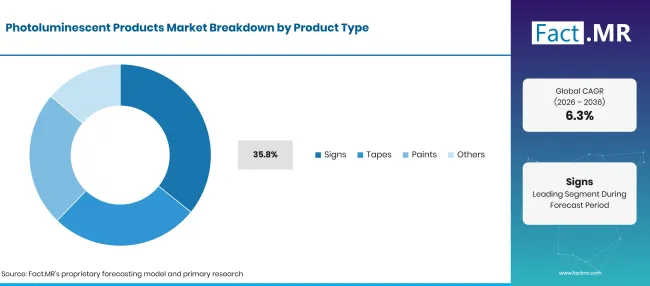
Photoluminescent Products Market Breakdown Product Type | Source: Fact.MR
Signs are the biggest product group, at 35.8% of 2026 revenue, about USD 608.6 million. Every escape route needs exit, direction and fire-equipment signs, and many buildings use photoluminescent versions instead of, or alongside, lit signs because they need no wiring, battery testing or power. Germany's ASR A1.3 requires photoluminescent signs to meet at least Class C under DIN 67510-1, according to KomNet (November 2024), which turns older signs into replacement demand. Photoluminescent signs also compete with lit signs in the exit signs market. Tapes and paints follow, mainly for marking stairs, handrails and floors.
Why Does the Safety and Emergency Segment Lead by Application?
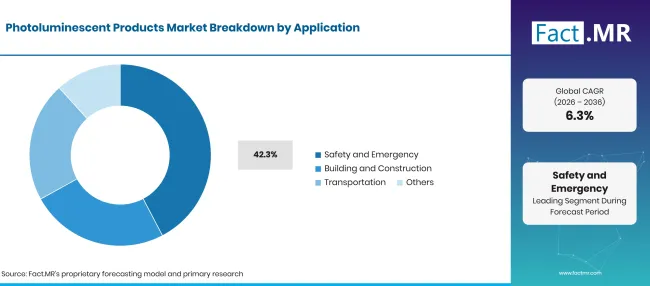
Photoluminescent Products Market Breakdown Application | Source: Fact.MR
Safety and emergency uses take 42.3% of 2026 revenue, about USD 719.1 million, covering exit routes, stairwells, fire-equipment locations and assembly points, where codes set minimum luminance and placement rules. Building and construction is the next-largest application, covering products installed during fit-out, while transportation uses photoluminescent markings in tunnels, stations, ships and aircraft cabins.
Why Does the Strontium Aluminate Segment Lead by Material?
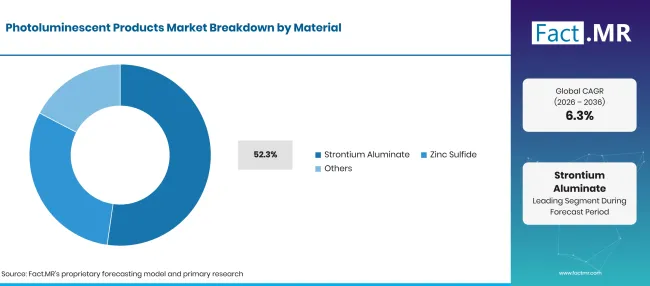
Photoluminescent Products Market Breakdown Material | Source: Fact.MR
Strontium aluminate products already make up more than half of revenue, at 52.3% in 2026 or about USD 889.1 million. Strontium aluminate doped with europium glows several times brighter and longer than zinc sulfide, so it is the only practical way to meet the higher luminance classes in current codes. Nemoto & Co. (accessed November 2026) markets its LumiNova series as long-afterglow pigments with strong light fastness, and Zhejiang Minhui Luminous Technology (accessed November 2026) produces strontium aluminate (SrAl₂O₄:Eu²⁺) pigment for its own films, boards and signs. Zinc sulfide keeps a share in low-cost decorative and short-afterglow products.
Why Does the Commercial Segment Lead by End User?
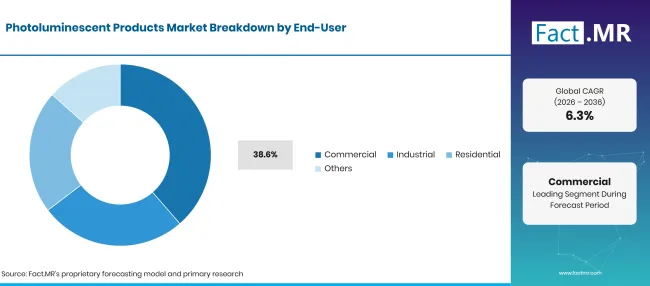
Photoluminescent Products Market Breakdown End User | Source: Fact.MR
Commercial buildings are the largest end user, at 38.6% of 2026 revenue, about USD 656.2 million. Offices, hotels, hospitals, shopping centres and high-rise mixed-use towers have the most code-driven marking requirements and the largest stair and corridor areas. Industrial sites follow, using photoluminescent floor lines and equipment markings, while residential demand is concentrated in apartment towers covered by high-rise rules.
Photoluminescent Products Market by Region and Country (2026 to 2036)
The five named countries hold just 35.0% of 2026 revenue (USD 595.0 million), falling to 34.2% by 2036 as the rest of the world grows faster. Germany gains the most share among named countries, rising from 7.0% to 7.9%, while Japan loses the most, falling from 10.0% to 8.9%.
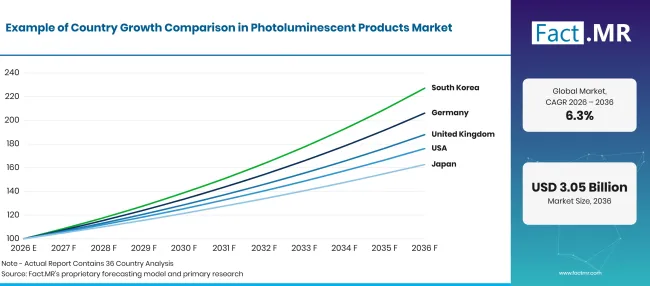
Photoluminescent Products Market Growth Index | Source: Fact.MR
| Country | 2026 Revenue | 2036 Revenue | 10-Year Addition | 2026 to 2036 CAGR | Global Share (2026 → 2036) |
|---|---|---|---|---|---|
| United States | USD 204.0 million | USD 358.5 million | USD 154.5 million | 5.8% | 12.0% → 11.6% |
| Japan | USD 170.0 million | USD 276.9 million | USD 106.9 million | 5.0% | 10.0% → 8.9% |
| Germany | USD 119.0 million | USD 245.3 million | USD 126.3 million | 7.5% | 7.0% → 7.9% |
| United Kingdom | USD 68.0 million | USD 127.6 million | USD 59.6 million | 6.5% | 4.0% → 4.1% |
| Brazil | USD 34.0 million | USD 53.3 million | USD 19.3 million | 4.6% | 2.0% → 1.7% |
| Rest of world | USD 1,105.0 million | USD 2,038.4 million | USD 933.4 million | 6.3% | 65.0% → 65.8% |
| Global total | USD 1,700.0 million | USD 3,100.0 million | USD 1,400.0 million | 6.2% | 100.0% → 100.0% |
Source: Fact.MR analysis. Updated Nov 13, 2026
Source: Fact.MR analysis of the photoluminescent products market, 2026.
United States
The United States is the largest named market and adds the most revenue, as a 5.8% CAGR takes it from USD 204.0 million in 2026 to USD 358.5 million by 2036, an addition of USD 154.5 million (1.76x), while the US share eases from 12.0% to 11.6%. Demand rests on IBC, IFC and NFPA 101 luminous egress path marking rules for high-rise buildings, described by iDigHardware (May 2026), and on New York City's Local Law 26 approvals. Jessup Manufacturing (accessed November 2026) supplies Glo Brite films, tapes and exit signs for these code-driven projects.
Japan
Japan's market, worth USD 170.0 million in 2026, is projected to reach USD 276.9 million by 2036 at a 5.0% CAGR. The USD 106.9 million addition (1.63x) still leaves Japan losing share, from 10.0% to 8.9%. Japan has a large installed base of photoluminescent signs in rail stations, subways and public buildings, built up over decades of disaster-preparedness planning, so much of its demand is replacement and growth is slower. Nemoto & Co. (accessed November 2026), the domestic inventor of LumiNova, supplies pigment to sign makers in Japan and abroad.
Germany
Germany grows fastest of the named countries, at a 7.5% CAGR, and more than doubles its market from USD 119.0 million in 2026 to USD 245.3 million by 2036. Adding USD 126.3 million (2.06x) lifts its share from 7.0% to 7.9%. Germany's workplace rules ASR A1.3 and ASR A2.3 require photoluminescent safety signs to meet at least Class C under DIN 67510-1, and KomNet (November 2024) confirms that older 55/8 signs must be replaced. EverGlow (March 2026) issued its 2026/2027 price list covering exit signs and aluminium sign formats.
United Kingdom
Demand for photoluminescent products in the United Kingdom is projected to nearly double, from USD 68.0 million in 2026 to USD 127.6 million by 2036, at a 6.5% CAGR. That adds USD 59.6 million (1.88x) and lifts the UK share from 4.0% to 4.1%. Fire-safety upgrades in high-rise residential and commercial buildings, together with replacement in hospitals, schools and transport hubs, are the main sources of demand. Many buyers compare these products directly with battery-backed units from the emergency lighting market and choose photoluminescent signs where they want to cut testing and maintenance.
Brazil
Brazil remains the smallest named market and grows slowest, at a 4.6% CAGR from USD 34.0 million in 2026 to USD 53.3 million by 2036. It adds USD 19.3 million (1.57x), and its share falls from 2.0% to 1.7%. Demand comes from shopping centres, hospitals, factories and transport projects in the larger cities, where state fire departments require marked escape routes. Price sensitivity keeps zinc sulfide and lower-grade products more common than in Europe or the United States.
Rest of World
Most of the market sits outside the five named countries. That remainder is projected to grow from USD 1,105.0 million in 2026 to USD 2,038.4 million by 2036 at a 6.3% CAGR, adding USD 933.4 million (1.84x) and lifting its share from 65.0% to 65.8%. China, the Middle East, India and Southeast Asia account for most of this demand, driven by high-rise construction, metro systems and code adoption. China is also the largest production base, and Zhejiang Minhui Luminous Technology (June 2026) exhibited its photoluminescent and reflective materials at FEC Beijing from 3 to 5 June 2026.
Competitive Environment and Notable Companies
The photoluminescent products industry has a small Tier-1 group of pigment innovators and certified system suppliers, made up of Nemoto & Co., Jessup Manufacturing, EverGlow, Ecoglo International and Zhejiang Minhui Luminous Technology. Below them sit pigment producers such as GloTech International and many regional sign makers that buy pigment or film and print their own signs. Much of the market runs on private label, because sign makers often buy certified film from a few producers and sell it under their own brands.
How Are Companies Positioned in the Photoluminescent Products Market?
Suppliers sit at three points in the value chain. Pigment makers such as Nemoto & Co. and GloTech International sell strontium aluminate powders to coaters and sign makers. Film and tape makers such as Jessup Manufacturing and Zhejiang Minhui Luminous Technology turn pigment into certified films, tapes and rigid boards. System suppliers such as EverGlow and Ecoglo International sell complete signs, stair nosings and guidance systems to contractors and building owners.
What Matters When a Buyer Selects a Photoluminescent Products Supplier?
Certified luminance comes first, so buyers check the luminance class or listing (DIN 67510-1, ISO 17398, UL 1994 or ASTM E2072) required by the local code. They then compare afterglow duration, charging time under the site's actual lighting, abrasion and slip resistance for floor and stair products, UV and moisture resistance, and fire behaviour of the substrate. Approval in local schemes, such as New York City's Department of Buildings approvals, often decides between otherwise similar products.
Which Capabilities Distinguish Product Offers?
Pigment grade, product format and combined functions are what set offers apart. Nemoto & Co. (accessed November 2026) differentiates on pigment brightness and light fastness. Zhejiang Minhui Luminous Technology (accessed November 2026) publishes measured luminance values per batch and tests to the DIN 67510-1 method. Ecoglo International (accessed November 2026) combines glow and slip resistance in stair nosings, and Jessup Manufacturing (accessed November 2026) offers anti-slip Safety Track tape alongside Glo Brite films, competing with suppliers in the anti-slip tapes market.
How Does Geographic Reach Affect Competition?
Each country tests and approves products against its own code, so local certification and distribution decide how far a supplier can reach. Japanese and Chinese suppliers lead in pigment and film exports, while US and European suppliers lead in certified finished systems sold through safety distributors and contractors. Zhejiang Minhui Luminous Technology (April 2026) exhibited at CIOSH 2026 in Shanghai, the main occupational safety fair in China, to reach domestic and export buyers.
| Verified Company Evidence (2026) | Commercial Effect | Buyer Action |
|---|---|---|
| 15 January 2026: EverGlow published its 2026 catalogue of emergency exit signs to ASR A1.3, covering aluminium and plastic sign formats and guidance markings (EverGlow, January 2026). | Keeps a compliant German range available as older 55/8 signs are replaced with Class C products. | Check existing signs against DIN 67510-1 Class C and plan replacement of non-compliant units. |
| 1 March 2026: EverGlow issued its 2026/2027 photoluminescent product price list (EverGlow, March 2026). | Gives contractors fixed list prices for the next two years of German and European projects. | Lock in pricing for multi-site replacement programmes before list prices change. |
| 3 June 2026: Zhejiang Minhui Luminous Technology exhibited photoluminescent and reflective materials at FEC Beijing, 3 to 5 June 2026 (Zhejiang Minhui Luminous Technology, June 2026). | Broadens the reach of a vertically integrated Chinese pigment, film and sign producer. | Request batch luminance data and DIN 67510-1 test reports when comparing Chinese film with Western suppliers. |
| 28 September 2026: China's Ministry of Commerce said the China–US arrangement covering suspended rare earth export controls, including europium, runs to 10 January 2027 (Materials Dispatch, October 2026). | Keeps strontium aluminate pigment supply open for now, but leaves licensing risk for europium-based pigments in 2027. | Hold extra pigment or film stock and qualify a second supplier to cover a possible return of licensing. |
Source: Fact.MR analysis. Updated Nov 13, 2026
Source: Verified corporate disclosures and Fact.MR analysis, 2026.
| Company | Core Positioning | Verified Activity & Source Attribution |
|---|---|---|
| Nemoto & Co. (Tier-1) | Japanese inventor of LumiNova strontium aluminate pigments | LumiNova long-afterglow series invented in 1993, supplied as pigments, sheets and plastic chains (Nemoto & Co., accessed November 2026). |
| Jessup Manufacturing (Tier-1) | US maker of Glo Brite photoluminescent films, tapes and exit signs | Glo Brite 7550R film on rigid substrate approved by the NYC Department of Buildings for Local Law 26 use (NYC Department of Buildings, accessed November 2026). |
| EverGlow (Tier-1) | German and US supplier of photoluminescent signs and guidance systems | Published its 2026 ASR A1.3 exit sign catalogue and 2026/2027 price list (EverGlow, January 2026 and March 2026). |
| Ecoglo International (Tier-1) | Photoluminescent, non-slip stair nosings and egress markings | Offers cast-in-place and tile stair nosings combining glow and slip resistance (Ecoglo International, accessed November 2026). |
| Zhejiang Minhui Luminous Technology (Tier-1) | Chinese integrated producer of pigment, film, boards and signs | Nine coating lines and 15 million m² annual film output; exhibited at CIOSH in April 2026 and FEC Beijing in June 2026 (Zhejiang Minhui Luminous Technology, April 2026 and June 2026). |
| GloTech International (Tier-2) | Photoluminescent pigment powders for safety, construction and marine uses | Markets pigment powders and glow products to customers in more than 80 countries (GloTech International, accessed November 2026). |
Source: Fact.MR analysis. Updated Nov 13, 2026
Photoluminescent Products Market Report Scope and Research Methodology
Fact.MR estimates the photoluminescent products market from the building stock upward. Its first input is the stock of buildings, transit assets and industrial sites covered by egress-marking codes in each country, applies installation and replacement rates for signs, tapes, paints and marking systems, and multiplies volumes by average selling prices for strontium aluminate and zinc sulfide grades. Fact.MR then cross-checks the totals against supplier catalogues and price lists, code requirements and approvals, and pigment trade data. Only the five named countries are modelled individually, with all other countries grouped as a residual.
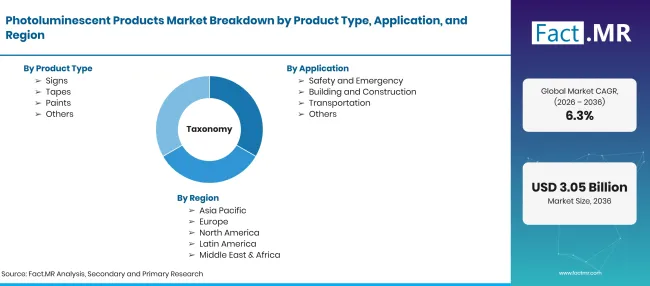
Photoluminescent Products Market Taxonomy | Source: Fact.MR
| Coverage Field | Report Scope |
|---|---|
| Market definition | Products that absorb natural or artificial light and re-emit it as visible light in darkness, used for safety guidance, escape-route marking and identification |
| Product types | Signs, tapes, paints and other photoluminescent products |
| Variants | Strontium aluminate and zinc sulfide grades; luminance classes such as DIN 67510-1 Class A to G |
| Ingredients included | Photoluminescent pigments, binders, films, adhesives and substrates incorporated in finished products |
| Packaging formats | Rigid signs, self-adhesive films and tapes, paints and coatings, stair nosings, rolls and sheets |
| Distribution channels | Safety distributors, contractors and installers, direct project sales, online B2B channels |
| End users | Commercial, industrial, residential and other users |
| Exclusions | Retroreflective-only materials, electrically powered exit and emergency lighting, tritium (radioluminescent) signs |
| Quantitative units | USD billion and USD million for value; percentage for share and CAGR |
| Volume basis | Square metres of photoluminescent material and units of signs shipped, counted once at first sale |
| Value basis | Manufacturer selling price revenue in the country of sale, constant 2026 USD |
| Regions covered | North America, Latin America, Europe, East Asia, South Asia and Pacific, Middle East and Africa |
| National coverage | United States, Japan, Germany, United Kingdom, Brazil, with the rest of the world as a residual |
| Companies covered | Nemoto & Co., Jessup Manufacturing, EverGlow, Ecoglo International, Zhejiang Minhui Luminous Technology, GloTech International |
Source: Fact.MR analysis. Updated Nov 13, 2026
Research Sources and Bibliography
- China Briefing. (2025, November 7). How will China's rare earth export controls impact industries and businesses? https://www.china-briefing.com/news/chinas-rare-earth-export-controls-impacts-on-businesses/
- Ecoglo International. (Accessed 2026, November 11). Photoluminescent cast-in-place stair nosings.
- EverGlow. (2026, January 15). Catalogue 2026: Emergency exit signs according to ASR A1.3.
- EverGlow. (2026, March 1). Price list 2026/2027: Photoluminescent products.
- GloTech International. (Accessed 2026, November 11). GloTech International
- iDigHardware. (2026, May). Decoded: Luminous egress path markings.
- Jessup Manufacturing. (Accessed 2026, November 11). Glo Brite photoluminescent glow films
- KomNet. (2024, November 5). Müssen Sicherheitszeichen mit einer Leuchtdichte von 55/8 zwingend gegen Zeichen mit einer Leuchtdichte von 150/22 ausgetauscht werden? (Dialog 44021).
- Materials Dispatch. (2026, October). China's November 2026 export-control cliff: What happens on Nov 10 and Nov 27.
- NYC Department of Buildings. (Accessed 2026, November 11). MEA 239-05-M: Glo Brite #7550R film on rigid substrate.
- Zhejiang Minhui Luminous Technology. (2026, April). From reflective to photoluminescent: Minhui redefines high-visibility material at CIOSH 2026 Shanghai.
- Zhejiang Minhui Luminous Technology. (2026, June). Minhui Luminous showcases reflective fabric and glow-in-the-dark and reflective fabric at FEC Beijing 2026.
Frequently Asked Questions
How big is the photoluminescent products market in 2026?
How fast is the photoluminescent products market expected to grow through 2036?
Which product type leads the photoluminescent products market?
Which application leads the photoluminescent products market?
Which material leads the photoluminescent products market?
Which country is the largest photoluminescent products market?
Which countries are expected to grow fastest in the photoluminescent products market?
What limits adoption of photoluminescent products?
Who worked on this report


Preview the report firsthand - request a free sample
Free SampleGet the brochure for pricing and purchase details
Download PDF