- Market Value (2025): USD 26.4 Bn
- Estimated Value (2026): USD 41.5 Bn
- Forecast Value (2036): USD 27.5 Bn
- CAGR (2026-2036): 4.2%
What is the Body Wash and Shower Gel Products Market forecast to be worth by 2036?
USD 27.5 billion in 2026 to USD 41.5 billion by 2036 at a 4.2% CAGR.
- The body wash and shower gel products market was valued at USD 26.4 billion in 2025, with pump bottles and refills bought for the family bathroom making up the bulk of that spend.
- By 2036 the market will reach USD 41.5 billion, from USD 27.5 billion in 2026, as more shoppers trade up to moisturizing and fragranced formulas.
- Shower gel sales will compound at a 4.2% CAGR across 2026 to 2036, a pace held in check by mature demand in Europe and Japan but lifted by new buyers in Latin America and Asia.
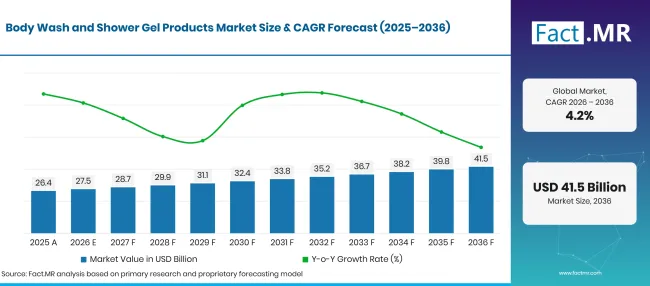
Body Wash And Shower Gel Products Market Forecast Global | Source: Fact.MR
| Year | Basis | Market Value (USD billion) |
|---|---|---|
| 2025 | Actual | 26.4 |
| 2026 | Estimate | 27.5 |
| 2036 | Forecast | 41.5 |
| CAGR 2026 to 2036 | Forecast period | 4.2% |
Source: Fact.MR analysis. Updated Oct 26, 2026
What are the defining numbers behind Body Wash and Shower Gel Products Market growth?
The market will gain USD 14.0 billion in annual value from 2026 to 2036, led by premium formulas and growing use in emerging economies.
- Demand Drivers in the Market
- Personal hygiene habits set the floor for liquid cleanser demand. The World Health Organization reported that 1.7 billion people still lacked basic hand hygiene services at home in 2024, including 611 million with no facility at all [1]. Each household that gains running water and a washroom becomes a likely buyer of soap, and later of a bottled body wash.
- Body wash prices move with wider personal care costs. The U.S. Bureau of Labor Statistics reported that the consumer price index for personal care products rose 2.1% in the 12 months to September 2026 [2]. Modest price gains let brands protect margins without pushing shoppers back to bars.
- Moisturizing body wash for dry skin is a frequent search, and brands answer it with serums, oils and ceramides in the bottle. These claims allow a higher shelf price than a plain gel and move the bottle closer to skin care.
- Fragrance drives repeat buying in shower gel. Shoppers choose a scent first and a brand second, so seasonal and limited editions keep the aisle fresh and prompt trial.
- Refill packs for liquid soap and body wash cut plastic per wash. Large pouches and bulk bottles also lower the price per milliliter, which appeals to families that use the product every day.
- Key Segments Analyzed
- By Type: Surfactant Type will hold 44.8% share in 2026, since synthetic cleansing agents give rich foam and a mild pH at a low cost per wash.
- By Application: Women will account for 47.3% share in 2026, reflecting wider fragrance choice and more frequent use of moisturizing variants.
- By Distribution Channel: Offline will command 54.6% share in 2026, because shoppers still add body wash to the weekly grocery and drugstore basket.
- Analyst Opinion at Fact.MR
- Shambhu Nath Jha, Principal Consultant at Fact.MR, states, “Body wash is a habit product, and the brand that owns a family’s shower shelf tends to keep it for years. Volume gains will be slow in mature countries, so value will come from skin-care claims, mild cleansing systems and fragrance. Players that pair these with refill packs and steady shelf presence will hold the most ground.”
- Strategic Implications
- Brand owners should build each range around a mild surfactant base that can carry several fragrance and skin-care claims, which keeps formula costs down.
- Retailers should give refill pouches and family sizes a fixed space next to standard bottles, since price per milliliter guides most grocery purchases.
- Surfactant suppliers should offer sulfate-free and bio-based grades with full safety files, so brands can reformulate quickly when ingredient rules change.
- Children’s care brands should keep tear-free and fragrance-light washes on shelf, because parents switch products slowly once a child tolerates one formula.
Shower gel demand in Germany will grow at 4.8% CAGR, the quickest among the five profiled countries, with drugstores and pharmacies turning over a wide body care range. Brazil comes next at 4.4%, where near-universal private bathrooms support daily showering. The United States will advance 4.0% a year, helped by steady price gains for personal care products. A 3.6% rate in the United Kingdom reflects a mature market with flat births. Japan rounds out the list at 3.2%, served by an aging population that buys gentle, moisturizing washes.
How does the Body Wash and Shower Gel Products Market break down by segment?
In 2026, Surfactant Type will head Type at 44.8%; Women will lead Application at 47.3%; Offline will top Distribution Channel at 54.6%.
Which Type dominates?
Surfactant Type captures 44.8% of 2026 sales.
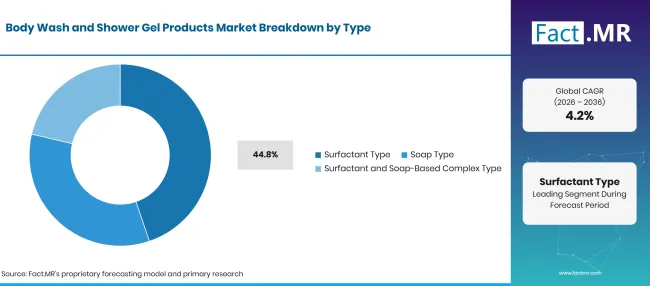
Body Wash And Shower Gel Products Market Breakdown Type | Source: Fact.MR
| Type | Share (2026) |
|---|---|
| Surfactant Type (Leading segment) | 44.8% |
| Other segments combined | 55.2%* |
| Total | 100.0% |
Source: Fact.MR analysis. Updated Oct 26, 2026
Formulators favor synthetic surfactants because they clean well in hard and soft water and leave no soap scum on tiles. Blends of anionic and amphoteric agents build thick lather at a skin-friendly pH, and mild grades suit sensitive and baby formulas. Many bottles now pair these agents with personal care surfactants derived from coconut or sugar. Ingredient rules shape every formula in this group. The European Commission adopted Regulation (EU) 2025/877 on 12 May 2025, amending the EU Cosmetics Regulation on substances classified as carcinogenic, mutagenic or toxic for reproduction, with entry into force on 1 September 2025 [3]. Soap Type products, made by saponifying plant oils, appeal to buyers who want a short label. Surfactant and Soap-Based Complex Type formulas combine both systems to balance foam and mildness, often with natural surfactants added for label appeal.
What leads the Application segment?
Women represent 47.3% of 2026 demand.
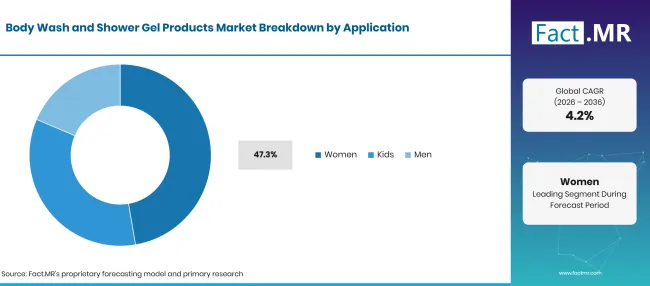
Body Wash And Shower Gel Products Market Breakdown Application | Source: Fact.MR
| Application | Share (2026) |
|---|---|
| Women (Leading segment) | 47.3% |
| Other segments combined | 52.7%* |
| Total | 100.0% |
Source: Fact.MR analysis. Updated Oct 26, 2026
Body care routines among women tend to include more steps, and shower gel is often the first product used. Women buy a wider set of scents and switch fragrances by season. They also choose more moisturizing, exfoliating and brightening variants, which carry higher prices per bottle. Men’s body wash grows through 2-in-1 and 3-in-1 formats that clean hair, face and body in one step. Kids washes focus on tear-free, low-fragrance formulas and fun packs. Birth trends set the base for this group, and the Office for National Statistics reported 585,396 live births in England and Wales in 2025, a 1.6% decrease from 2024 [4].
How does Distribution Channel shape demand?
Offline accounts for 54.6% of 2026 value.
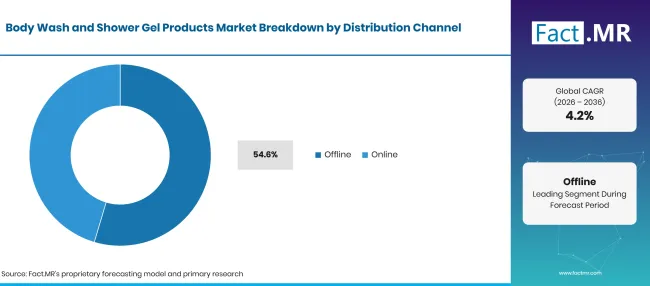
Body Wash And Shower Gel Products Market Breakdown Distribution Channel | Source: Fact.MR
| Distribution Channel | Share (2026) |
|---|---|
| Offline (Leading segment) | 54.6% |
| Other segments combined | 45.4%* |
| Total | 100.0% |
Source: Fact.MR analysis. Updated Oct 26, 2026
Supermarkets, hypermarkets, drugstores and pharmacies remain the main place to buy shower gel, since a bottle is a low-cost item added to a regular trip. In-store promotions such as two-for-one deals drive brand switching, and shoppers can smell testers before buying. Family packs and refillable personal care pouches take up more shelf space each year. Online sales grow faster from a smaller base. In Germany, Destatis reported that internet and mail-order retail turnover rose 10.1% in real terms in 2025, while sales in physical stores increased 1.1% [5]. Brand websites, marketplaces and quick-commerce apps sell bundles, subscriptions and premium bottles that many stores do not stock.
What is accelerating Body Wash and Shower Gel Products Market adoption, and what is holding it back?
Adoption will rise with better access to water and bathrooms, wider skin-care claims and new fragrance launches. Price competition from private labels, a return of bar soap among plastic-conscious buyers and slow volume growth in aging countries will hold back gains.
Drivers Impact Analysis
| DRIVER | (~) % IMPACT ON CAGR | GEOGRAPHIC RELEVANCE | IMPACT TIMELINE |
|---|---|---|---|
| Shift from bar soap to liquid cleansers in daily showering | +1.2% | Latin America, South Asia & Pacific, Middle East & Africa | Short term (<= 2 years) |
| Demand for moisturizing and skin-care claims in body wash | +1.0% | North America, Western Europe, East Asia | Medium term (2-4 years) |
| Seasonal and premium fragrance launches | +0.8% | Western Europe, North America | Short term (<= 2 years) |
| Wider access to piped water and private bathrooms | +0.6% | Latin America, South Asia & Pacific | Long term (>= 4 years) |
Source: Fact.MR analysis. Updated Oct 26, 2026
Opportunity Impact Analysis
| OPPORTUNITY | (~) % IMPACT ON CAGR | GEOGRAPHIC RELEVANCE | IMPACT TIMELINE |
|---|---|---|---|
| Refill pouches and concentrated formats | +0.8% | Western Europe, East Asia | Medium term (2-4 years) |
| Sulfate-free and dermatologist-tested washes for sensitive skin | +0.7% | North America, Western Europe | Short term (<= 2 years) |
| Men’s multi-use body, hair and face washes | +0.5% | Global | Medium term (2-4 years) |
Source: Fact.MR analysis. Updated Oct 26, 2026
Restraints Impact Analysis
| RESTRAINT | (~) % IMPACT ON CAGR | GEOGRAPHIC RELEVANCE | IMPACT TIMELINE |
|---|---|---|---|
| Private label price competition in grocery chains | -0.6% | Western Europe, North America | Short term (<= 2 years) |
| Return of solid bars among plastic-conscious buyers | -0.4% | Western Europe | Medium term (2-4 years) |
| Stricter rules on cosmetic ingredients and fragrance allergens | -0.3% | Western Europe | Long term (>= 4 years) |
Source: Fact.MR analysis. Updated Oct 26, 2026
Which countries are scaling the Body Wash and Shower Gel Products Market through 2036?
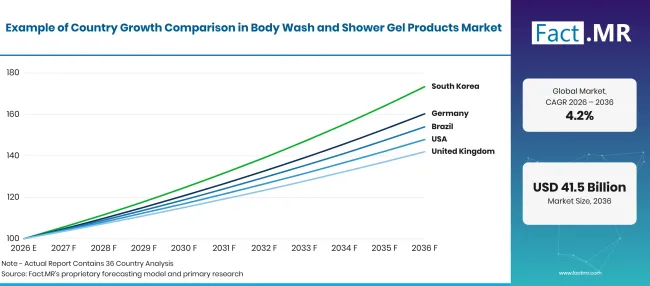
Body Wash And Shower Gel Products Market Growth Index | Source: Fact.MR
| Country | CAGR (2026 to 2036) |
|---|---|
| Germany | 4.8% |
| Brazil | 4.4% |
| United States | 4.0% |
| United Kingdom | 3.6% |
| Japan | 3.2% |
Source: Fact.MR analysis. Updated Oct 26, 2026
What supports Germany’s adoption?
4.8% CAGR, as drugstore and pharmacy chains widen their body care ranges.
Duschgel sales in Germany run mainly through drugstore chains, discounters and supermarkets. Destatis reported that retail sales at pharmacies and stores for cosmetic, pharmaceutical and medical goods rose 3.5% in real terms in 2025, ahead of the 2.7% gain for retail overall [5]. German shoppers compare ingredient lists and buy many shower creams and gels with oil or almond care claims. Store brands compete on price next to national labels.
How is Brazil scaling demand?
4.4% CAGR, driven by near-universal private bathrooms and a warm climate that encourages several showers a day.
Brazilian households shower often, and liquid soap is replacing bars in many urban homes. IBGE reported that 98.4% of the country’s 79.3 million permanent private households had a bathroom for their own use in 2025, while 86.1% were connected to the general water supply network [6]. Pharmacies and supermarket chains carry both global and local brands. Light, fresh fragrances sell best in the hot season.
What supports United States adoption?
4.0% CAGR, backed by a large online channel and steady trade-up to skin-care formulas.
American body wash buyers use both big-box stores and online orders. The U.S. Census Bureau estimated that e-commerce made up 17.1% of total retail sales in the second quarter of 2026, at USD 340.2 billion [7]. Warehouse clubs sell large pump bottles, while drugstores push serum and oil-infused washes. Men’s body wash is a sizable shelf of its own in U.S. stores.
How is the United Kingdom developing demand?
3.6% CAGR, reflecting slow but steady consumer spending growth.
British shoppers buy shower gel mostly in supermarkets and health and beauty chains, where multibuy deals are common. The Office for National Statistics estimated that household spending grew 0.3% in volume terms in April to June 2026, and was 1.2% higher than a year earlier [8]. Consumer prices rose 3.5% in the 12 months to September 2026, according to the ONS [9], so shoppers watch the cost of each bottle closely. Budget pressure keeps own-label gels in demand, while premium fragranced washes sell well as gifts.
How does Japan perform?
3.2% CAGR, with older consumers favoring mild, moisturizing body soaps.
Japanese households call these products body soap, and foam pump bottles with refill pouches are the standard format. The Statistics Bureau of Japan estimated that people aged 65 and over numbered 36.24 million as of September 15, 2026, or 29.6% of the total population [10]. Older skin is drier, so brands stress gentle cleansing and moisture retention. Refill pouches cut cost and plastic for regular buyers.
Who leads the Body Wash and Shower Gel Products Market?
Three groups shape competition. Mass personal care groups such as Unilever, Procter & Gamble, Beiersdorf and Kenvue sell body wash under Dove, Olay, NIVEA and Neutrogena across grocery and drug channels, where shelf space and price per milliliter decide trial. In August 2026, Unilever signed a partnership charter with Galaxy Surfactants and said Galaxy’s surfactant science helped reformulate Dove body wash [11].
Regional leaders hold strong home positions. Shanghai Jahwa reported in August 2025 that its Liushen fragranced shower gel topped Tmall’s new body wash chart [12]. Kao launched Bioré The Body Totonoihada in Japan in April 2025 with its own sebum-selective cleansing ingredient [13]. Prestige houses compete on fragrance and price. Chanel sells N°5 and Coco Mademoiselle shower gels, and L’Oréal offers bath and shower cleansers through Kiehl’s. Gentle cleansing systems, scent range and refill formats will separate the stronger brands.
Which companies are the key providers?
Key companies include Unilever PLC; The Procter & Gamble Company; Beiersdorf AG; Kenvue Inc.; Kao Corporation; Shanghai Jahwa United Co., Ltd.; L’Oréal Groupe (Kiehl’s); and Chanel.
- Unilever PLC
- The Procter & Gamble Company
- Beiersdorf AG
- Kenvue Inc.
- Kao Corporation
- Shanghai Jahwa United Co., Ltd.
- L’Oréal Groupe (Kiehl’s)
- Chanel
Bibliography
- [1] World Health Organization. (2025, October 15). New guidelines on community hand hygiene to help governments reduce the spread of infectious diseases.
- [2] U.S. Bureau of Labor Statistics. (2026, October). Table 2. Consumer Price Index for All Urban Consumers (CPI-U): U.S. city average, detailed expenditure categories, 2026 M09 Results.
- [3] European Commission. (2025, May 12). Commission Regulation (EU) 2025/877 amending Regulation (EC) No 1223/2009 as regards the use in cosmetic products of certain substances classified as carcinogenic, mutagenic or toxic for reproduction.
- [4] Office for National Statistics. (2026, May 27). Births in England and Wales: 2025.
- [5] Statistisches Bundesamt (Destatis). (2026, February 2). Einzelhandelsumsatz im Jahr 2025 real um 2,7 % höher als im Vorjahr [Retail turnover in 2025 up 2.7% in real terms on the previous year].
- [6] Instituto Brasileiro de Geografia e Estatística (IBGE). (2026, April 17). Domicílios alugados cresceram mais de 50% desde 2016 [Rented households grew more than 50% since 2016].
- [7] U.S. Census Bureau. (2026, August 18). Quarterly Retail E-Commerce Sales, 2nd Quarter 2026.
- [8] Office for National Statistics. (2026, September 30). Consumer trends, UK: April to June 2026.
- [9] Office for National Statistics. (2026, October 21). Consumer price inflation, UK: September 2026.
- [10] Statistics Bureau of Japan. (2026, September 20).[Japan’s older people seen through statistics: for Respect for the Aged Day].
- [11] Unilever. (2026, August 19). Unilever and Galaxy Surfactants deepen partnership to accelerate innovation and growth.
- [12] Shanghai Jahwa United Co., Ltd. (2025, August 21).[Shanghai Jahwa posts revenue and profit growth in the first half of 2025 as multiple brands perform strongly].
- [13] Kao Corporation. (2025, March 12).[Launch of Bioré The Body Totonoihada body wash with a sebum-selective cleansing ingredient].
This Report Answers
- What will body wash and shower gel sales be worth in 2036, and where will the new value come from?
- Which cleansing type, user group and sales channel hold the top position in each segment for 2026?
- How do water access, retail habits and population age explain the gaps between Germany, Brazil, the United States, the United Kingdom and Japan?
- Which personal care groups, regional specialists and prestige houses sell shower gel, and on what do they compete?
- How are ingredient rules and surfactant supply changing body wash formulas?
What does the Body Wash and Shower Gel Products Market cover?
Body washes, shower gels, shower creams and shower oils sold in bottles, pumps, tubes and refill pouches are counted. The study belongs to the wider bath and shower toiletries category but tracks only rinse-off body cleansers.
Demand is split by cleansing type, by the user group the product targets and by the channel where it is sold. Values are taken at the price received by brand owners and private label makers.
What is included in the scope?
Products marketed for women, men and children are included, along with unisex family formats. Medicated and dermatologist-branded body washes sold without prescription are in scope.
Hair and body 2-in-1 washes count when the body claim appears on the front label. Private label gels made by contract manufacturers for retailers are also included.
What is excluded from the scope?
Bar soaps, hand washes and liquid soap sold for sinks are excluded. Bath salts, bubble baths without a body wash claim and bath bombs are outside the revenue boundary.
No-rinse cleansers such as waterless body wash used in care homes are left out. Bulk surfactants and fragrance oils sold before filling are also excluded.
How Was the Analysis Built?
The analysis draws on 120+ sources, 35+ company portfolios, 25+ countries, and more than 20 industry interviews.
- Primary Research: Primary research includes discussions with manufacturers, service providers, technology developers, distributors, end users, and subject-matter experts. These conversations examine purchasing priorities, product adoption, operational challenges, approval requirements, competitive positioning, and the factors that influence wider market acceptance.
- Desk Research: Desk research covers government statistics, regulatory publications, company filings, trade data, technical studies, industry associations, standards, public policy, and other authoritative sources. Every source used in the analysis is documented in the bibliography.
- Market Sizing and Forecasting: Market estimates combine historical performance, demand indicators, pricing and volume trends, segment shares, company participation, country-level growth, adoption patterns, investment activity, and barriers to market expansion.
- Data Validation and Update Cycle: Findings are validated by comparing primary interviews with public data, company activity, regulatory changes, trade patterns, and industry developments. Regular updates review new product launches, capacity changes, partnerships, approvals, and shifts in commercial adoption.
Segmentation
What is the report’s scope and coverage?
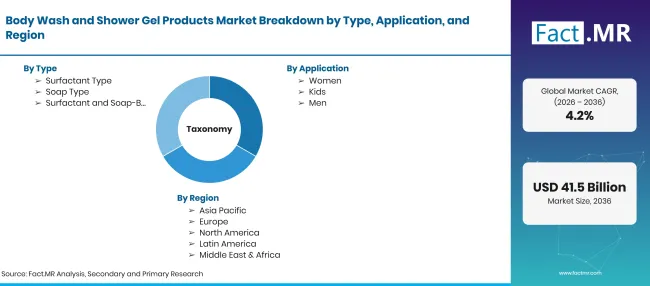
Body Wash And Shower Gel Products Market Taxonomy | Source: Fact.MR
| Attribute | Details |
|---|---|
| Quantitative Units | USD billion |
| Market Definition | Liquid and gel cleansers made for washing the body in the shower or bath, including body washes, shower gels, shower creams and shower oils. Sales are measured at manufacturer level across store and online channels. |
| Type | Surfactant Type; Soap Type; Surfactant and Soap-Based Complex Type |
| Application | Women; Kids; Men |
| Distribution Channel | Offline; Online |
| Regions Covered | North America; Latin America; Western Europe; Eastern Europe; East Asia; South Asia & Pacific; Middle East & Africa |
| Countries Covered | Germany; Brazil; United States; United Kingdom; Japan |
| Companies Profiled | Unilever PLC; The Procter & Gamble Company; Beiersdorf AG; Kenvue Inc.; Kao Corporation; Shanghai Jahwa United Co., Ltd.; L’Oréal Groupe (Kiehl’s); Chanel |
| Forecast Period | 2026 to 2036 |
| Approach | Bottom-up estimate of showering households, liters used per person and average price per liter, checked against brand owner revenue and retail channel data by country. |
Source: Fact.MR analysis. Updated Oct 26, 2026
How is the market segmented?
-
By Type
- Surfactant Type
- Soap Type
- Surfactant and Soap-Based Complex Type
-
By Application
- Women
- Kids
- Men
-
By Distribution Channel
- Offline
- Online
-
By Region
- North America
- Latin America
- Western Europe
- Eastern Europe
- East Asia
- South Asia & Pacific
- Middle East & Africa
Frequently Asked Questions
How big is the body wash and shower gel products market in 2026?
What is the CAGR of the body wash and shower gel products market from 2026 to 2036?
Which type leads the body wash and shower gel products market?
Which application leads the body wash and shower gel products market?
Which distribution channel leads the body wash and shower gel products market?
Which country will grow the most in the body wash and shower gel products market?
Who are the main companies in the body wash and shower gel products market?
Who worked on this report


Preview the report firsthand - request a free sample
Free SampleGet the brochure for pricing and purchase details
Download PDF