- Market Value (2025): USD 88.8 Mn
- Estimated Value (2026): USD 96.0 Mn
- Forecast Value (2036): USD 210.0 Mn
- CAGR (2026-2036): 8.1%
What is the Pinched Tube Reactors Market forecast to be worth by 2036?
USD 96.0 million in 2026 to USD 210.0 million by 2036 at 8.1% CAGR.
- The Pinched Tube Reactors Market reached USD 88.8 million in 2025 as demand expanded for equipment capable of handling abrasive slurries and chemically demanding process streams.
- Demand is projected to increase from USD 96.0 million in 2026 to USD 210.0 million by 2036.
- The market is forecast to record 8.1% CAGR from 2026 to 2036 owing to growing demand for replaceable flow paths, material compatibility, and controlled handling of solids-bearing media.
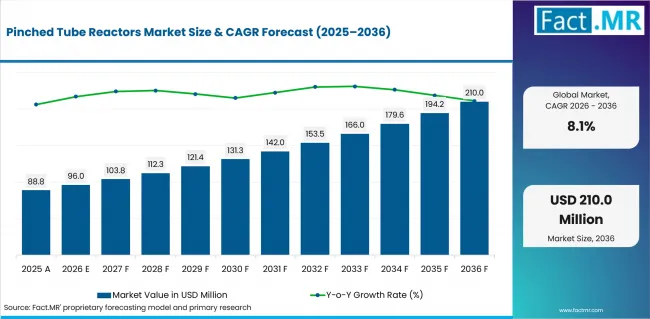
Pinched Tube Reactors Market Value Analysis | Source: Fact.MR
What are the defining numbers behind Pinched Tube Reactors Market growth?
USD 114.0 million absolute opportunity by 2036, led by Single-tube pinch reactors and PTFE/fluoropolymer tubes alongside Abrasive slurries and Specialty chemical applications.
- Demand Drivers in the Market
- Plants handling abrasive slurry need a flow path that can be replaced during maintenance without dismantling the full reactor system. That service advantage drives demand for pinched tube designs in wear-intensive duties.
- Chemical exposure can make a standard reactor path unsuitable. Demand grows when an operator needs tube material selected for the actual solvent, temperature or abrasion load.
- Production teams seeking more capacity cannot always accept a lengthy shutdown. Multi-tube and cascade systems help increase throughput while keeping individual flow paths accessible.
- Mineral processing and specialty chemical operations often handle material that is difficult to move through conventional equipment. Those applications create recurring demand for reactors built around replaceable tubing.
- Key Segments Analyzed
- By Reactor Configuration: Single-tube pinch reactors are expected to hold 37.0% share in 2026 because they provide a direct flow path that is easier to inspect, isolate, service, and replace.
- By Tube Material: PTFE/fluoropolymer tubes are projected to account for 40.0% share in 2026 as chemical compatibility remains a central requirement in tube and reactor selection.
- By Media Type: Abrasive slurries are anticipated to represent 31.0% share in 2026 because solids-bearing streams place significant wear and maintenance demands on conventional wetted flow paths.
- By Application: Specialty chemicals are estimated to capture 39.0% share in 2026 due to the sector’s varied formulation, media-handling, and material-compatibility requirements.
- Analyst Opinion at Fact.MR
- Shambhu Nath Jha, Sr. Consultant at Fact.MR, states, “Pinched tube reactor selection must begin with the actual media duty rather than reactor configuration alone. Buyers are expected to prioritize tube compatibility, service life, replacement access, and stable handling of abrasive or solids-bearing streams instead of comparing equipment only on throughput.”
- Strategic Implications
- Process engineering teams need to qualify tube materials against abrasion, corrosion, fouling, and multiphase behavior before selecting a reactor arrangement. This step helps prevent premature wear, unplanned replacement, and process instability after installation.
- Equipment providers need to define the usable media envelope, tube service requirements, and replacement procedure for every reactor configuration. Buyers are more likely to favor suppliers that connect reactor design with material compatibility and maintenance planning.
- Procurement teams need to compare single-tube, multi-tube, coiled, and cascade designs against throughput, service access, scale-up requirements, and operating stability. The lowest-cost configuration may not remain economical when tube wear and cleaning complexity are considered.
Australia is expected to lead the Pinched Tube Reactors Market with a 10.0% CAGR from 2026 to 2036, supported by mineral-processing activity and demand for equipment capable of handling abrasive and solids-bearing streams. The USA is projected to record a 9.6% CAGR as specialty chemical and advanced process industries increase demand for configurable reactor systems. Canada is anticipated to grow at 9.3% through resource-processing applications and material-specific equipment requirements. The UK is estimated to post a 9.0% CAGR through specialty chemical and pharmaceutical process demand. Germany is forecast at 8.0%, supported by established chemical engineering capabilities and demand for reactors with reliable material compatibility and maintenance access.
How does the Pinched Tube Reactors Market break down by segment?
PTFE/fluoropolymer tubes lead Tube Material with 40.0% share, while Specialty chemicals lead Application with 39.0% share in 2026. Reactor selection remains tied to how each configuration, material, media class, and application changes the operating duty.
Why do Single-tube pinch reactors lead Reactor Configuration?
Single-tube pinch reactors are projected to account for 37.0% of the market in 2026.
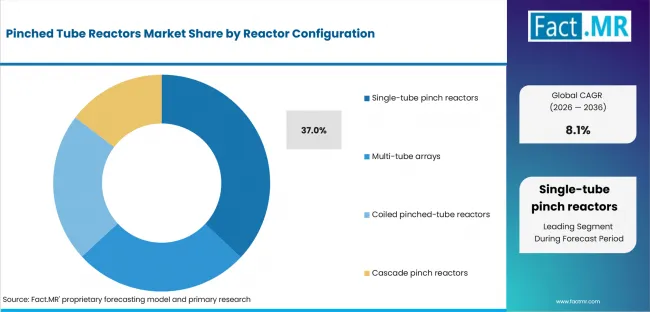
Pinched Tube Reactors Market Analysis By Reactor Configuration | Source: Fact.MR
A single flow path provides a direct arrangement for controlling and servicing the compressible tube. It avoids the distribution requirements of Multi-tube arrays and the added geometry of Coiled pinched-tube reactors or Cascade pinch reactors. Buyers can inspect the tube route, isolate wear, and replace the wetted element without managing several parallel paths. That simplicity supports its leading position where one defined process stream must be handled reliably.
Why do PTFE/fluoropolymer tubes lead Tube Material?
PTFE/fluoropolymer tubes lead with 40.0% of the market in 2026.
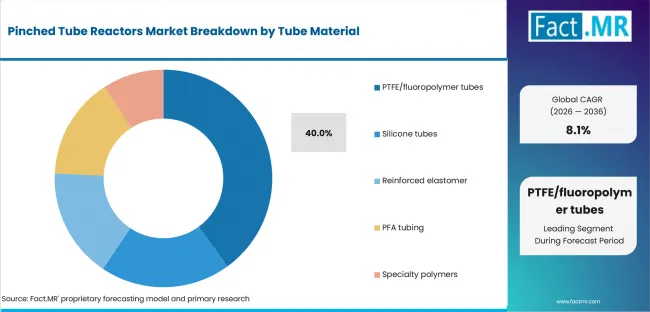
Pinched Tube Reactors Market Analysis By Tube Material | Source: Fact.MR
Tube Material determines which process fluids can contact the reactor's flexible flow path. PTFE/fluoropolymer tubes provide a distinct option alongside Silicone tubes, Reinforced elastomer, PFA tubing, and Specialty polymers. Their leading share reflects demand for a fluoropolymer category where chemical compatibility is central to equipment choice. Alternative materials remain relevant when flexibility, reinforcement, or a different polymer specification carries greater weight.
Why do Abrasive slurries lead Media Type?
Abrasive slurries hold 31.0% of the market in 2026.
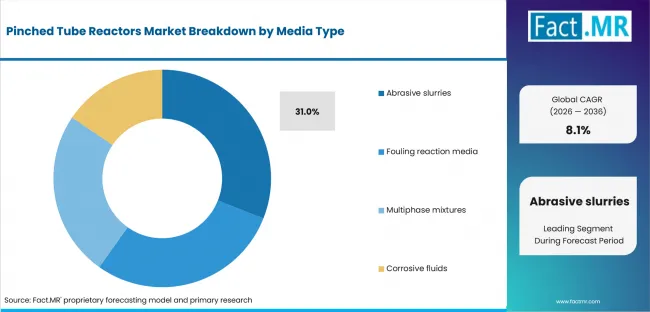
Pinched Tube Reactors Market Analysis By Media Type | Source: Fact.MR
Abrasive slurries place wear and solids-handling demands directly on the wetted flow path. Pinched tube arrangements separate this duty from Fouling reaction media, Multiphase mixtures, and Corrosive fluids. A replaceable tube can concentrate maintenance on the component exposed to the moving slurry. This operating logic makes abrasive service a clear use case without treating every difficult fluid as the same media class.
Why do Specialty chemicals lead Application?
Specialty chemicals account for 39.0% of the market in 2026.
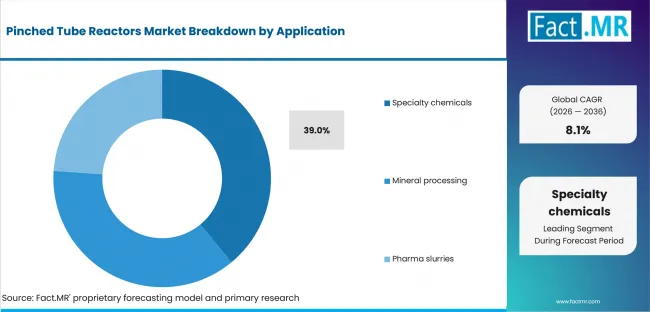
Pinched Tube Reactors Market Analysis By Application | Source: Fact.MR
Specialty chemical processes often require equipment choices to follow a defined formulation, media behavior, and material compatibility requirement. Pinched tube reactors offer several configurations and tube materials that can be matched to those conditions. Mineral processing emphasizes slurry duty, while Pharma slurries carry a separate application profile. The breadth of process requirements within specialty chemicals supports the segment's leading share.
What is accelerating Pinched Tube Reactors Market adoption, and what is holding it back?
Demand is expected to be driven by abrasive-slurry handling, material compatibility, and the need for replaceable flow paths. Adoption is expected to be held back by tube wear, material qualification requirements, and configuration-specific scale-up challenges.
Drivers Impact Analysis
| DRIVER | (~) % IMPACT ON CAGR | GEOGRAPHIC RELEVANCE | IMPACT TIMELINE |
|---|---|---|---|
| Abrasive-slurry handling | +2.0% | Australia, Canada, USA | Short term (≤ 2 years) |
| Material compatibility | +1.7% | USA, Germany, UK | Short term (≤ 2 years) |
| Fouling management | +1.3% | Specialty chemical and mineral-processing markets | Medium term (2–4 years) |
| Replaceable tube flow paths | +1.1% | Global | Medium term (2–4 years) |
| Configuration flexibility | +0.8% | USA, UK, Germany | Long term (≥ 4 years) |
Source: Fact.MR analysis. Updated Jul 24, 2026
- Abrasive-slurry handling: Flexible tube flow paths are expected to support applications where solids create wear, blockage, or maintenance challenges in conventional reactor systems.
- Material compatibility: Buyers are expected to place greater weight on matching PTFE, fluoropolymer, silicone, elastomer, PFA, or specialty-polymer tubes with the actual process chemistry.
- Fouling management: Replaceable wetted tubes can concentrate cleaning and maintenance on the flow path exposed to fouling media, reducing the need to service the complete reactor assembly.
- Replaceable tube flow paths: Tube replacement can help operators restore the main wetted component without replacing the full reactor, supporting maintenance planning and equipment life.
- Configuration flexibility: Single-tube, multi-tube, coiled, and cascade arrangements give engineers different options for throughput, service access, process stability, and solids handling.
Opportunity Impact Analysis
| OPPORTUNITY | (~) % IMPACT ON CAGR | GEOGRAPHIC RELEVANCE | IMPACT TIMELINE |
|---|---|---|---|
| Specialty chemical processing | +1.2% | USA, Germany, UK | Medium term (2–4 years) |
| Mineral-processing applications | +1.0% | Australia and Canada | Medium term (2–4 years) |
| Pharmaceutical slurry handling | +0.7% | USA, UK, Germany | Medium term (2–4 years) |
| Multi-tube scale-up | +0.6% | Industrial processing markets | Long term (≥ 4 years) |
| Application-specific tube systems | +0.5% | Global specialty-processing sites | Long term (≥ 4 years) |
Source: Fact.MR analysis. Updated Jul 24, 2026
- Specialty chemical processing: Varied formulations and material-compatibility requirements are expected to create demand for reactor systems that can be configured around a defined process duty.
- Mineral-processing applications: Abrasive and solids-bearing streams are expected to create opportunities for replaceable tube systems where wear is concentrated on the wetted flow path.
- Pharmaceutical slurry handling: Application-specific tube materials and controlled flow paths may support processes that require careful media handling and easier cleaning access.
- Multi-tube scale-up: Multi-tube arrays are expected to create opportunities where buyers require greater throughput while retaining the operating benefits of replaceable flow paths.
- Application-specific tube systems: Suppliers that combine reactor configuration, tube material, and maintenance requirements around the actual media duty are expected to gain stronger qualification support.
Restraints Impact Analysis
| RESTRAINT | (~) % IMPACT ON CAGR | GEOGRAPHIC RELEVANCE | IMPACT TIMELINE |
|---|---|---|---|
| Tube wear | -1.2% | Mineral-processing and slurry applications | Short term (≤ 2 years) |
| Material qualification | -0.9% | Global | Short term (≤ 2 years) |
| Flow-path scale-up | -0.7% | Multi-tube and high-throughput installations | Medium term (2–4 years) |
| Cleaning and replacement frequency | -0.5% | Fouling-prone process sites | Medium term (2–4 years) |
| Configuration-specific engineering | -0.4% | Smaller processors and custom installations | Long term (≥ 4 years) |
Source: Fact.MR analysis. Updated Jul 24, 2026
- Tube wear: Abrasive particles can shorten tube service life. Operators therefore need inspection schedules and replacement planning before adopting the equipment.
- Material qualification: Tube materials cannot be substituted freely because chemical exposure, temperature, pressure, flexibility, and abrasion resistance differ by process.
- Flow-path scale-up: Moving from a single tube to multi-tube, coiled, or cascade arrangements requires additional engineering around flow distribution, pressure behavior, and service access.
- Cleaning and replacement frequency: Fouling or solids accumulation can increase maintenance requirements and reduce operating availability when the tube route is not easily accessible.
- Configuration-specific engineering: Each reactor arrangement must be matched with the actual media, throughput, and maintenance duty, which can extend purchasing and qualification cycles.
Which countries are scaling Pinched Tube Reactors Market fastest?
The country comparison shows a wider separation between the leading and lower-growth markets than a tightly grouped regional pattern. Australia leads through mineral-processing demand and abrasive-slurry handling requirements. The USA follows with a strong specialty-chemical and configurable-process equipment base. Canada remains closely connected to resource-processing applications, while the UK benefits from specialty chemical and pharmaceutical process demand. Germany grows more moderately but retains a stable position through chemical engineering expertise and material-specific reactor selection.
- Australia holds the leading position because mineral-processing operations create direct demand for equipment that can handle abrasive, solids-bearing, and wear-intensive streams.
- The USA follows through specialty chemical activity and demand for reactors that can be configured around process chemistry, throughput, and maintenance requirements.
- Canada maintains a strong position through resource-processing applications where tube wear, solids handling, and replaceable wetted components influence equipment selection.
- The UK benefits from specialty chemical and pharmaceutical processing where material compatibility and service access can support adoption.
- Germany records a measured growth rate through its established chemical engineering base and demand for reliable, application-specific reactor systems.
Comparable reactor configurations can create different market-entry conditions across these countries. Deployment depends on the actual media duty, tube-material qualification, maintenance access, and whether the selected arrangement can scale without creating avoidable flow-distribution or cleaning complexity.
The full report provides country-level CAGR analysis across North America, Europe, South Asia, Oceania, and other application-relevant markets.
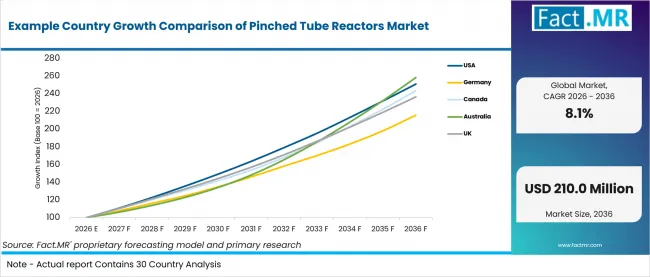
Example Country Growth Comparison Of Pinched Tube Reactors Market | Source: Fact.MR
| Country | CAGR (2026–2036) |
|---|---|
| Australia | 10.0% |
| USA | 9.6% |
| Canada | 9.3% |
| UK | 9.0% |
| Germany | 8.0% |
Source: Fact.MR analysis. Updated Jul 24, 2026
What is driving Australia’s growth through 2036?
10.0% CAGR, supported by mineral processing and abrasive-slurry handling.
Australia’s growth is tied to resource-processing operations that handle solids-bearing and abrasive media. These duties create demand for reactor systems where wear can be concentrated on a replaceable tube instead of the complete equipment body. Buyers are expected to compare tube durability, inspection access, replacement frequency, and the ability to maintain stable flow under demanding slurry conditions.
What supports USA adoption?
9.6% CAGR, driven by specialty chemical processing and configurable equipment demand.
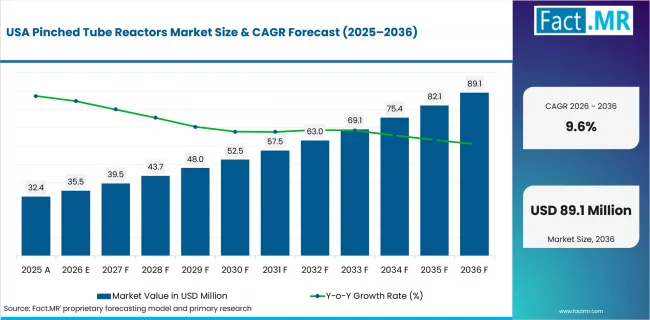
Pinched Tube Reactors Market Country Value Analysis | Source: Fact.MR
The USA’s growth reflects demand from specialty chemical and advanced process industries that require equipment to match specific media and material conditions. Buyers are expected to compare reactor configurations against throughput, chemical compatibility, tube service life, and cleaning access. Suppliers that define the usable media range and replacement procedure clearly may gain stronger acceptance.
How is Canada scaling demand?
9.3% CAGR, supported by resource processing and solids-bearing applications.
Canada’s growth is expected to follow mineral and resource-processing duties where abrasive particles increase wear on conventional wetted components. Pinched tube reactor systems can support these applications by using replaceable flow paths and application-specific tube materials. Adoption is likely to depend on tube life, maintenance intervals, and reliable operation under variable solids loading.
What is driving the UK’s growth through 2036?
9.0% CAGR, backed by specialty chemical and pharmaceutical processing.
The UK’s growth is supported by process industries that require careful material selection and flexible equipment configurations. Specialty chemical and pharmaceutical slurry applications are expected to favor systems that provide controlled media handling and accessible replacement of wetted components. Qualification is likely to focus on chemical compatibility, cleaning requirements, and process repeatability.
How does Germany perform?
8.0% CAGR, led by chemical engineering expertise and material-specific reactor demand.
Germany’s growth reflects its established chemical-processing base and emphasis on engineered equipment selection. Buyers are expected to evaluate pinched tube reactors against process chemistry, abrasion, corrosion, fouling behavior, and maintenance access. Demand may remain strongest where suppliers can connect tube-material selection with the actual operating duty and service requirements.
Who leads the Pinched Tube Reactors Market?
Amar Equipment is the directly evidenced provider in the competitive set through its PinchFLO continuous pinched-tube reactor platform.
Amar Equipment offers the PinchFLO reactor, a continuous tubular system with a periodically constricted flow path for passive mixing and heat-transfer-intensive processing.
Which companies are the key providers?
Amar Equipment is the directly evidenced pinched-tube reactor provider.
- Amar Equipment
Bibliography
- Australian Bureau of Statistics. (2026, June 2). Mineral and petroleum exploration, Australia, March 2026.
- Eurostat. (2025, December 16). EU chemical production: 15% lower over 10 years. European Commission.
- Statistics Canada. (2026, February 25). Annual Mineral Production Survey, 2024.
- U.S. Geological Survey. (2025, January 31). Mineral commodity summaries 2025 (Version 1.2). U.S. Department of the Interior.
This Report Answers
- The report provides strategic intelligence on the Pinched Tube Reactors Market across Reactor Configuration and Tube Material choices that shape equipment selection for demanding process media.
- Segment analysis covers Single-tube pinch reactors and PTFE/fluoropolymer tubes as the leading categories within the 2026 market.
- Media analysis evaluates Abrasive slurries alongside Fouling reaction media, Multiphase mixtures, and Corrosive fluids.
- Application analysis covers Specialty chemicals, Mineral processing, and Pharma slurries, with Specialty chemicals identified as the leading application.
- Country outlook evaluates Australia and the USA alongside Canada and the UK. Germany completes the growth comparison across the profiled markets.
- Competitive analysis identifies Amar Equipment as the directly evidenced provider of a continuous pinched-tube reactor platform.
What does the Pinched Tube Reactors Market cover?
Pinched tube reactor systems use flexible or compressible tubes as the working flow path for reaction media that can be difficult to process through conventional reactor arrangements.
The Pinched Tube Reactors Market covers Single-tube pinch reactors, Multi-tube arrays, Coiled pinched-tube reactors, and Cascade pinch reactors. Coverage extends across PTFE or fluoropolymer tubes, Silicone tubes, Reinforced elastomer, PFA tubing, and Specialty polymers. The market includes systems configured for Abrasive slurries, Fouling reaction media, Multiphase mixtures, and Corrosive fluids across Specialty chemicals, Mineral processing, and Pharma slurries.
The market differs from general fluid-handling equipment because commercial value comes from combining a defined reactor arrangement with a replaceable tube flow path suited to the actual media duty. Standalone tubing, pinch valves, pumps, and fluid-handling components remain outside the boundary when they are not supplied as part of a configured pinched tube reactor system.
What is included in the scope?
Configured pinched tube reactor systems used across specialty chemical, mineral-processing, and pharmaceutical slurry applications are included.
The scope includes Reactor Configuration, Tube Material, Media Type, and Application. Coverage spans Single-tube pinch reactors, Multi-tube arrays, Coiled pinched-tube reactors, and Cascade pinch reactors. It includes PTFE or fluoropolymer, Silicone, Reinforced elastomer, PFA, and Specialty polymer tube options. Abrasive slurries, Fouling reaction media, Multiphase mixtures, and Corrosive fluids are included where the reactor design and tube material are selected for the stated operating duty.
What is excluded from the scope?
Standalone tubing and unrelated fluid-handling components remain outside the scope of this market.
The scope excludes tubing, pinch valves, pumps, fittings, and control components sold without a configured pinched tube reactor arrangement. Conventional reactors that do not use a flexible or compressible tube as the principal working flow path are excluded. General laboratory equipment, pressure vessels, and slurry-handling systems are also excluded unless they are supplied specifically as part of a pinched tube reactor configuration. Company revenue without a clear connection to configured reactor systems is not included.
How Was the Analysis Built?
The analysis draws on 120+ sources, 35+ company portfolios, 25+ countries, and more than 20 industry interviews.
- Primary Research: Primary research includes discussions with manufacturers, service providers, technology developers, distributors, end users, procurement teams, and subject-matter experts. These conversations examine purchasing priorities, product adoption, operational challenges, approval requirements, competitive positioning, and the factors that influence wider market acceptance.
- Desk Research: Desk research covers government statistics, regulatory publications, company filings, trade data, technical studies, industry associations, standards, public policy, and other authoritative sources. Every source used in the analysis is documented in the bibliography.
- Market Sizing and Forecasting: Market estimates combine historical performance, demand indicators, pricing and volume trends, segment shares, company participation, country-level growth, adoption patterns, investment activity, and barriers to market expansion.
- Data Validation and Update Cycle: Findings are validated by comparing primary interviews with public data, company activity, regulatory changes, trade patterns, and industry developments. Regular updates review new product launches, capacity changes, partnerships, approvals, procurement trends, and shifts in commercial adoption.
Segmentation
What is the report’s scope and coverage?
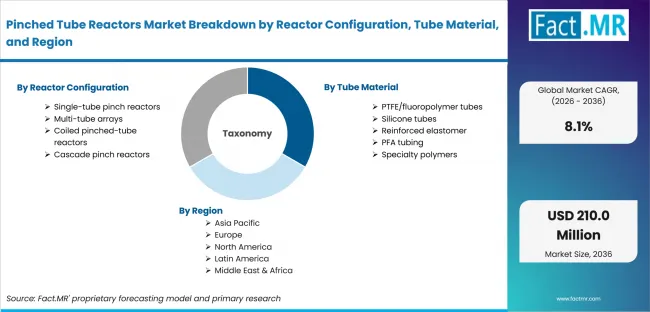
Pinched Tube Reactors Market Breakdown By Reactor Configuration, Tube Material, And Region | Source: Fact.MR
| Attribute | Details |
|---|---|
| Quantitative Units | USD 96.0 million in 2026 to USD 210.0 million by 2036 at 8.1% CAGR |
| Market Definition | Continuous tubular reactor systems that use engineered periodic constrictions in the flow path to improve mixing and heat transfer for chemical and multiphase processing |
| Reactor Configuration | Single-tube pinch reactors; Multi-tube arrays; Coiled pinched-tube reactors; Cascade pinch reactors |
| Tube Material | PTFE/fluoropolymer tubes; Silicone tubes; Reinforced elastomer; PFA tubing; Specialty polymers |
| Media Type | Abrasive slurries; Fouling reaction media; Multiphase mixtures; Corrosive fluids |
| Application | Specialty chemicals; Mineral processing; Pharma slurries |
| Regions Covered | North America; Europe; South Asia and Oceania |
| Countries Covered | Australia; USA; Canada; UK; Germany |
| Key Companies Profiled | Amar Equipment |
| Forecast Period | 2026 to 2036 |
| Approach | Hybrid top-down and bottom-up approach using process-equipment demand, installed-base patterns, replacement cycles, media-handling requirements, tube-material compatibility, reactor-configuration fit, application intensity, country adoption patterns, supplier participation, maintenance requirements, and company portfolio review |
Source: Fact.MR analysis. Updated Jul 24, 2026
How is the market segmented?
-
By Reactor Configuration:
- Single-tube pinch reactors
- Multi-tube arrays
- Coiled pinched-tube reactors
- Cascade pinch reactors
-
By Tube Material:
- PTFE/fluoropolymer tubes
- Silicone tubes
- Reinforced elastomer
- PFA tubing
- Specialty polymers
-
By Media Type:
- Abrasive slurries
- Fouling reaction media
- Multiphase mixtures
- Corrosive fluids
-
By Application:
- Specialty chemicals
- Mineral processing
- Pharma slurries
-
By Region:
- North America
- Europe
- South Asia & Oceania
Frequently Asked Questions
Which Reactor Configuration leads?
Which Tube Material leads?
Which Media Type leads?
Which Application leads?
Which country has the highest stated CAGR?
Who worked on this report


Preview the report firsthand - request a free sample
Free SampleGet the brochure for pricing and purchase details
Download PDF