- Market Value (2025): USD 860.6 Mn
- Estimated Value (2026): USD 919.1 Mn
- Forecast Value (2036): USD 1774.5 Mn
- CAGR (2026-2036): 6.8%
What is the Plant-based Egg Replacers Market forecast to be worth by 2036?
USD 919.1 million in 2026 to USD 1,774.5 million by 2036 at 6.8% CAGR.
- The plant-based egg replacers market crossed a valuation of USD 860.6 million in 2025 as bakery reformulation widened across industrial production accounts.
- Demand is projected to increase from USD 919.1 million in 2026 to USD 1,774.5 million by 2036 across food formulation programs.
- The market is forecast to record a 6.8% CAGR from 2026 to 2036 as bakery manufacturers and sauce formulators reduce egg exposure through functional blends.
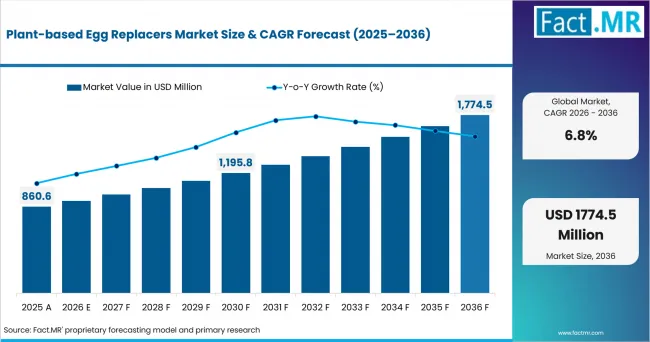
Plant Based Egg Replacers Market Market Value Analysis | Source: Fact.MR
What are the defining numbers behind Plant-based Egg Replacers Market growth?
USD 855.4 million absolute opportunity by 2036, led by Starch-based sources and Powder formats across Bakery & Confectionery applications.
- Demand Drivers in the Market
- Industrial bakers need dependable aeration and crumb structure supported by ingredient systems that perform consistently during commercial mixing and baking cycles.
- Sauce formulators require stable oil-water emulsions driven by plant fibers and proteins that maintain viscosity during processing and refrigerated distribution.
- Private-label food brands need clearer allergen control owing to egg labeling obligations and retailer review of ingredient statements across packaged foods.
- Contract manufacturers require dry dosing accuracy shaped by powder systems that fit existing batching equipment and simplify storage across multi-product facilities.
- Key Segments Analyzed
- By Source: Starch-based is expected to represent 41.0% share in 2026 due to broad use across bakery structure and sauce viscosity systems.
- By Form: Powder is projected to account for 57.0% share in 2026 owing to dry blending compatibility and easier warehouse handling.
- By Application: Bakery & Confectionery is anticipated to capture 44.0% share in 2026 as cakes and sweet goods require several egg functions within one production process.
- By End Use: Food Manufacturers are estimated to represent 52.0% share in 2026 due to recurring reformulation work across commercial production lines.
- Analyst Opinion at Fact.MR
- Shambhu Nath Jha, Senior Analyst at Fact.MR notes: “Egg replacement is primarily a process-fit challenge across industrial recipes. Adoption is expected to favor systems tested under actual industrial mixing and heating conditions before commercial scale-up. Suppliers should combine ingredient functionality with application trials and clearly documented allergen controls for each intended product line.”
- Strategic Implications
- Bakery ingredient producers should build application protocols for cakes and sweet breads before offering replacement ratios to industrial formulation teams.
- Food formulators should test binding and emulsification separately because each function responds differently to heat and mechanical shear during processing.
- Ingredient distributors should maintain technical sample programs that let regional manufacturers compare powder systems before committing to commercial recipe changes.
- Private-label brands should align vegan and allergen-free claims with documented ingredient controls before final artwork approval and retailer specification review.
India is expected to record 8.6% CAGR during the forecast period, driven by food-processing investment and wider bakery manufacturing capacity. China is projected to post 7.9% CAGR by 2036, supported by packaged-food sales and regional ingredient application work. Australia is anticipated to advance at 6.6% CAGR over the assessment period, owing to active food manufacturing and reformulation around cost control. The United Kingdom is estimated to record 6.3% CAGR between 2026 and 2036, attributable to a large food manufacturing base and retailer specification changes. The United States is forecast to post 6.1% CAGR across the forecast horizon, shaped by egg-price volatility and repeated supply disruptions affecting bakery input planning. Germany is projected to record 5.8% CAGR through 2036, supported by bakery cost pressure and demand for formulation flexibility. Japan is expected to post 5.5% CAGR over the assessment period, supported by food manufacturing scale and recipe reformulation needs.
How does the Plant-based Egg Replacers Market break down by segment?
Powder formats are predicted to hold 57.0% share while Food Manufacturers accounts for 52.0%
Which source accounts for the largest share?
Starch-based sources account for 41.0% share in 2026
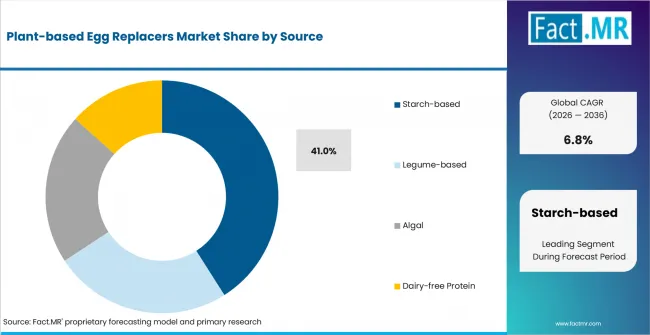
Plant Based Egg Replacers Market Analysis By Source | Source: Fact.MR
Starch-based sources are forecast to account for 41.0% share in 2026 as commercial formulators use starch systems for structure and viscosity control. Legume-based systems support protein-led replacement routes across bakery products that need aeration and binding. Algal sources serve specialized formulations where oil or protein functionality supports egg-free development. Dairy-free protein systems address broader reformulation programs that require non-dairy functionality across baked goods and nutritional products. In May 2025 Ingredion described powder-form pea protein as an egg substitute for baking mixes and baked goods.
Which Form garners the largest share?
Powder formats garner 57.0% share in 2026
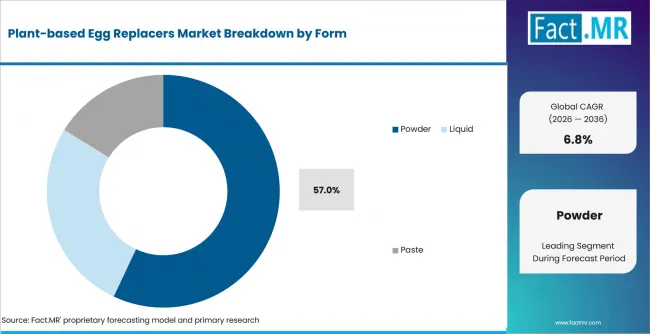
Plant Based Egg Replacers Market Analysis By Form | Source: Fact.MR
Powder is projected to account for 57.0% share in 2026 due to storage stability and direct fit with industrial dry blending systems. Liquid formats support sauces and dressings where rapid dispersion reduces preparation steps before homogenization.
What supports Bakery & Confectionery within Application?
Bakery & Confectionery records 44.0% share in 2026
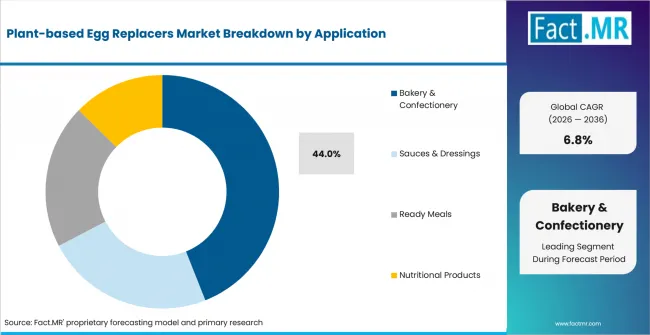
Plant Based Egg Replacers Market Analysis By Application | Source: Fact.MR
Bakery & Confectionery is anticipated to capture 44.0% share in 2026 because cakes and sweet goods require structure plus aeration after egg removal. Sauces & Dressings follow where formulators must preserve emulsion stability and refrigerated texture. Ready Meals use replacement systems when egg contributes binding inside prepared components or coatings. Nutritional Products create demand for systems that combine egg-free positioning with protein or fiber delivery.
Which End Use accounts for the largest share?
Food Manufacturers account for 52.0% share in 2026
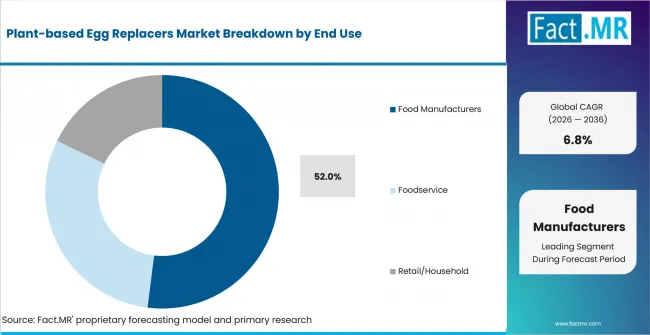
Plant Based Egg Replacers Market Analysis By End Use | Source: Fact.MR
Food Manufacturers are estimated to represent 52.0% share in 2026 as industrial bakeries and prepared-food producers run recurring reformulation programs. Foodservice demand centers on operational consistency across high-volume kitchens and centralized preparation systems. Retail and household use remains relevant for consumer-facing powders and plant-based egg products that simplify home preparation. Supplier access to pilot trials and production-scale validation remains important for manufacturers that need dependable performance across established process windows.
What is accelerating Plant-based Egg Replacers Market adoption, and what is holding it back?
Egg price and supply volatility remains the primary driver while multi-function performance gaps continue to restrain wider adoption.
Drivers Impact Analysis
| DRIVER | (~) % IMPACT ON CAGR | GEOGRAPHIC RELEVANCE | IMPACT TIMELINE |
|---|---|---|---|
| Egg price and supply volatility | +0.9% | North America and Europe | Short term (<= 2 years) |
| Vegan bakery recipe development | +0.7% | Europe and North America | Medium term (2-4 years) |
| Allergen-control reformulation | +0.6% | North America and United Kingdom | Medium term (2-4 years) |
| Plant protein processing capacity | +0.5% | Europe and Asia Pacific | Long term (>= 4 years) |
| Industrial bakery capacity expansion | +0.3% | India and China | Long term (>= 4 years) |
Source: Fact.MR analysis. Updated Jul 10, 2026
- Egg price and supply volatility: Food manufacturers reconsider egg exposure when input costs change quickly and supply planning becomes difficult across repeated production cycles. In June 2026 USDA Economic Research Service reported that average retail egg prices were 21.9% higher in 2025 than during 2024. Reformulation teams are expected to keep partial replacement systems in qualification pipelines even after spot egg prices ease.
- Vegan bakery recipe development: Commercial bakeries are expanding egg-free recipes across cakes and sweet breads while protecting volume and crumb structure under factory conditions. Ingredient systems need application-specific balance because one component rarely replaces every egg function inside a complex batter. Development activity is projected to favor blended systems that combine proteins with fibers or starches for defined processing targets.
- Allergen-control reformulation: Egg removal gives selected brands a clearer route toward free-from product lines when cross-contact controls and supplier documentation remain adequate. The U.S. Food and Drug Administration published updated food allergen labeling guidance in March 2025 covering ingredient declarations for major allergens. Adoption is anticipated to expand where manufacturers pair replacement work with validated sanitation and traceability procedures.
- Plant protein processing capacity: Regional ingredient processing reduces dependence on long supply routes and gives formulators faster access to pilot quantities for technical trials. The European plant-protein ecosystem is estimated to gain from dedicated faba bean and pea processing assets that support foaming or binding applications. Manufacturers are expected to qualify regional sources where sensory performance and batch consistency meet existing product specifications.
- Industrial bakery capacity expansion: New bakery lines create opportunities to specify egg replacement systems before recipes and operating windows become fixed across commercial production. India’s food processing sector represented 12.83% of employment in the registered manufacturing sector according to a February 2026 government statement. Ingredient suppliers are forecast to gain access where application support is located near expanding food manufacturing clusters.
Opportunity Impact Analysis
| OPPORTUNITY | (~) % IMPACT ON CAGR | GEOGRAPHIC RELEVANCE | IMPACT TIMELINE |
|---|---|---|---|
| Faba bean protein systems | +0.6% | Europe and India | Medium term (2-4 years) |
| Egg-free sauces and dressings | +0.5% | North America and Europe | Medium term (2-4 years) |
| Allergen-free product platforms | +0.4% | United States and United Kingdom | Long term (>= 4 years) |
| Regional bakery application centers | +0.3% | India and Australia | Long term (>= 4 years) |
Source: Fact.MR analysis. Updated Jul 10, 2026
- Faba bean protein systems: Faba bean protein gives formulation teams another route to foaming and binding without concentrating every plant recipe around pea or soy ingredients. Dry fractionation also supports regional processing strategies where local crop supply is available and processors want simpler separation routes. Opportunity is projected to widen when neutral taste and consistent functionality reduce the number of masking steps required during bakery reformulation.
- Egg-free sauces and dressings: Mayonnaise-style spreads and dressings create a practical route for ingredients that combine water binding with emulsion stability under chilled storage. Plant fibers and emulsifying starches support formulation work where egg yolk removal changes viscosity and mouthfeel. Supplier programs are anticipated to focus on process trials that test shear tolerance before full recipe transfer to commercial lines.
- Allergen-free product platforms: Food allergy programs create room for product families that remove egg alongside other controlled allergens under documented factory procedures. A September 2025 FAO and WHO workshop report noted that about 15% of people with food allergies also have asthma. Free-from brands are estimated to favor ingredient partners that support formulation performance together with traceability and cross-contact controls.
- Regional bakery application centers: Application centers shorten the distance between bench recipes and industrial scale-up for manufacturers that need local flour or process adaptation. Palsgaard opened a Navi Mumbai application centre in July 2025 with pilot equipment for bakery and other food categories. Regional technical support is expected to improve trial speed where customers need egg-free recipes adjusted for local production conditions.
Restraints Impact Analysis
| RESTRAINT | (~) % IMPACT ON CAGR | GEOGRAPHIC RELEVANCE | IMPACT TIMELINE |
|---|---|---|---|
| Multi-function performance gap | -0.6% | Global industrial bakery accounts | Long term (>= 4 years) |
| Off-flavor and color limits | -0.4% | Bakery and ready meals globally | Medium term (2-4 years) |
| Plant ingredient input cost pressure | -0.3% | Australia and Europe | Medium term (2-4 years) |
| Claim and allergen control complexity | -0.2% | North America and Europe | Long term (>= 4 years) |
Source: Fact.MR analysis. Updated Jul 10, 2026
- Multi-function performance gap: Whole egg contributes structure and emulsification while also affecting color and flavor across many bakery recipes. A replacement system that solves one function often changes another part of the product profile during heat treatment. Adoption is expected to remain selective where application teams lack time for repeated plant trials across several product formats.
- Off-flavor and color limits: Some plant proteins introduce cereal or beany notes that become visible in lightly flavored cakes and sauces after egg removal. Color differences also affect products where consumers expect a familiar yellow tone or pale crumb appearance. Suppliers are projected to invest more work in low-flavor protein selection and recipe balancing before recommending higher replacement levels.
- Plant ingredient input cost pressure: Replacement economics weaken when specialty proteins and functional fibers rise in cost while egg prices stabilize for extended periods. The Australian Bureau of Statistics reported 3.4% annual final-demand price growth through the June quarter of 2025. Procurement teams are anticipated to compare full recipe cost and process yield instead of judging only ingredient price per kilogram.
- Claim and allergen control complexity: Removing egg from a formula does not automatically create an allergen-free product where shared equipment and supplier controls remain unresolved. The U.S. Food and Drug Administration stated in March 2026 that the original major allergens accounted for 90% of food allergies and serious reactions. Brands are forecast to keep stronger documentation gates before placing free-from claims on reformulated products.
Which countries are scaling Plant-based Egg Replacers Market fastest?
India 8.6%; China 7.9%; Australia 6.6%; United Kingdom 6.3%; United States 6.1%.
Plant-based egg replacers are assessed across North America and Europe plus Asia Pacific within the regional forecast framework. Central and South America are also covered together with the Middle East and Africa for complete regional comparison.
.webp "Top Country Growth Comparison Plant Based Egg Replacers Market Cagr (2026 2036)")
Top Country Growth Comparison Plant Based Egg Replacers Market Cagr (2026 2036) | Source: Fact.MR
| COUNTRY | CAGR |
|---|---|
| India | 8.6% |
| China | 7.9% |
| Australia | 6.6% |
| United Kingdom | 6.3% |
| United States | 6.1% |
Source: Fact.MR analysis. Updated Jul 10, 2026
What is powering India's growth?
8.6% CAGR, driven by food-processing expansion and bakery capacity investment.
India gives ingredient suppliers a broad food-processing base where bakery reformulation and local technical support scale together across regional manufacturing clusters. The market is expected to record 8.6% CAGR between 2026 and 2036, supported by packaged-food expansion and plant-protein application work. In February 2026 India’s Press Information Bureau reported food-processing GVA of Rs 2.24 lakh crore for 2023-24. Local trial capability gives suppliers a practical route into formulations that require flour-specific and process-specific adjustment.
How is China scaling Plant-based Egg Replacers demand?
7.9% CAGR, supported by online food sales and packaged-food product renewal.
Packaged-food channels create frequent product renovation work across cakes and prepared foods where plant-based formulation claims support new line extensions. In June 2026 the National Bureau of Statistics reported that online retail sales of food increased 15.5% during January through May 2026. The market is projected to post 7.9% CAGR over the assessment period, owing to broad manufacturing scale and closer technical support around formulation clusters. Local application teams gain when suppliers shorten sample turnaround and adapt texture systems to regional recipes.
What supports the Australia outlook?
6.6% CAGR, owing to food manufacturing activity and recipe cost control.
Australian food manufacturers balance formulation consistency against input costs across bakery and prepared-food categories that rely on imported or local functional ingredients. The market is anticipated to advance at 6.6% CAGR across the forecast horizon, shaped by cost management and plant-based product development. In June 2026 the Australian Bureau of Statistics reported food product manufacturing earnings growth of 7.8% during 2024-25. Suppliers gain a clearer route where technical support reduces trial waste and fits local production schedules.
What underpins the United Kingdom outlook?
6.3% CAGR, attributable to food manufacturing depth and retailer specification changes.
Retailer specifications keep formulation teams focused on ingredient declarations and recipe consistency across private-label bakery and prepared foods. The Office for National Statistics reported that food manufacturing represented 21% of total manufacturers’ product sales during 2024. Demand is estimated to record 6.3% CAGR during the forecast period, supported by recurring reformulation cycles and established industrial bakery capacity. Ingredient providers benefit when they document allergen controls and validate texture under the customer process profile.
How is the United States developing Plant-based Egg Replacers demand?
6.1% CAGR, shaped by egg supply volatility and allergen-conscious formulation programs.
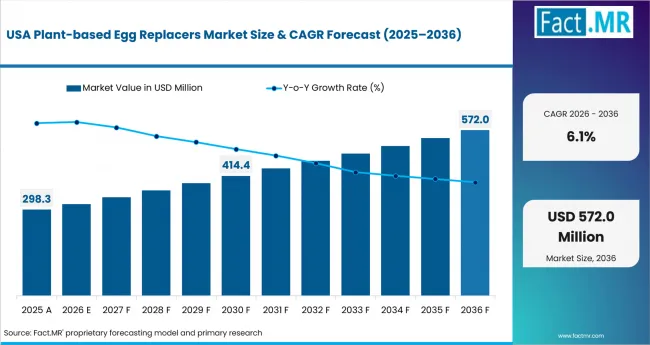
Plant Based Egg Replacers Market Country Value Analysis | Source: Fact.MR
Egg supply disruptions have kept replacement systems visible to bakery procurement teams even when short-term prices retreat from earlier peaks. The market is forecast to post 6.1% CAGR over the ten-year assessment period, driven by partial replacement programs and free-from recipe development. USDA reported in February 2026 that U.S. egg production totaled 105 billion eggs during 2025 and declined from the prior year. Manufacturers favor suppliers that provide process testing and formulation support before recipes move into high-volume commercial production.
What supports Germany's Plant-based Egg Replacers outlook?
5.8% CAGR, supported by bakery cost pressure and ingredient reformulation across industrial food production.
Germany's bakery and confectionery manufacturers face cost pressure that keeps substitution trials relevant across large production accounts. The market is projected to record 5.8% CAGR through 2036, supported by recipe flexibility and broader use of functional blends. In January 2026 the Federal Statistical Office reported that the wholesale category covering sugar and confectionery plus bakery products was 14.7% higher during 2025. Suppliers gain when they show process stability and total recipe economics under customer production conditions.
How is Japan developing Plant-based Egg Replacers demand?
5.5% CAGR, supported by food manufacturing scale and recipe reformulation needs.
Japan combines a broad food manufacturing base with product development needs across bakery and prepared foods. The market is expected to post 5.5% CAGR over the assessment period, supported by formulation work around texture and input control. In January 2026 the Statistics Bureau of Japan reported that the food price index rose 6.8% during 2025. Ingredient suppliers benefit when application support addresses local texture expectations and existing production equipment.
Which companies are the key providers?
Ingredion Incorporated; Cargill; Puratos; Tate & Lyle; Eat Just; Archer Daniels Midland.
- Ingredion Incorporated
- Cargill
- Puratos
- Tate & Lyle
- Eat Just
- Archer Daniels Midland
Bibliography
- Archer Daniels Midland Company. (2026, May 20). ADM advances protein innovation with new ingredient solutions. Archer Daniels Midland Company.
- Australian Bureau of Statistics. (2026, June 19). Australian Industry, 2024-25 financial year. Australian Bureau of Statistics.
- Cargill. (2025, September). Bakery Product Portfolio Guide. Cargill, Incorporated.
- Federal Statistical Office of Germany. (2026, January 15). Wholesale prices in December 2025: +1.2% on December 2024. Federal Statistical Office of Germany.
- Food and Agriculture Organization of the United Nations & World Health Organization. (2025, September 20). FAO/WHO workshop on risk assessment of food allergens. World Health Organization.
- Ingredion Incorporated. (2025, May 26). Revolutionizing recipes with plant-based egg substitutes. Ingredion Incorporated.
- National Bureau of Statistics of China. (2026, June 17). Total retail sales of consumer goods from January to May 2026. National Bureau of Statistics of China.
- Office for National Statistics. (2026, June 12). Manufacturing and production industry. Office for National Statistics.
- Palsgaard A/S. (2025, July 8). Palsgaard inaugurates state-of-the-art application centre in Navi Mumbai to strengthen regional customer support. Palsgaard A/S.
- Press Information Bureau. (2026, February 6). Status and progress of food processing sector. Government of India.
- Puratos Group. (2026, March 30). Egg prices keep rising: Cost-cutting ingredients to try in 2026. Puratos Group.
- Statistics Bureau of Japan. (2026, January 23). Consumer Price Index Japan 2025. Statistics Bureau of Japan.
- Tate & Lyle PLC. (2025, July 7). Tate & Lyle debuts expanded portfolio and mouthfeel leadership at IFT FIRST 2025. Tate & Lyle PLC.
- U.S. Department of Agriculture, Economic Research Service. (2026, June 25). Food Price Outlook - Summary findings. U.S. Department of Agriculture.
- U.S. Department of Agriculture, National Agricultural Statistics Service. (2026, February 17). Chickens and Eggs 2025 Summary. U.S. Department of Agriculture.
- U.S. Department of Agriculture. (2025, February 26). USDA invests up to $1 billion to combat avian flu and reduce egg prices. U.S. Department of Agriculture.
- U.S. Food and Drug Administration. (2025, January 6). FDA releases allergen, food safety, and plant-based alternative labeling guidances. U.S. Food and Drug Administration.
- U.S. Food and Drug Administration. (2025, March 26). Food allergen labeling guidance for industry. U.S. Food and Drug Administration.
- U.S. Food and Drug Administration. (2026, March 11). Food allergies. U.S. Food and Drug Administration.
This Report Addresses
- The report provides strategic intelligence on Plant-based Egg Replacers across Source and Form choices that shape industrial food formulation programs.
- Segment analysis covers Starch-based sources and Powder formats alongside Bakery & Confectionery applications and Food Manufacturers.
- Regional outlook evaluates India and China alongside Australia plus the United Kingdom and United States while Germany and Japan complete the country comparison.
- Competitive analysis profiles Ingredion Incorporated and Cargill alongside Puratos before assessing four additional providers.
- Source assessment covers Starch-based and Legume-based systems alongside Algal and Dairy-free Protein routes with different functional roles.
- Application assessment covers Bakery & Confectionery and Sauces & Dressings alongside Ready Meals and Nutritional Products while end-use analysis compares Food Manufacturers with Foodservice and Retail/Household demand.
What does the Plant-based Egg Replacers Market cover?
Starch-based and Legume-based systems join Algal and Dairy-free Protein solutions for egg replacement across commercial food formulations.
The Plant-based Egg Replacers Market covers ingredient systems designed to replace egg functionality across commercial recipes. Coverage includes Starch-based and Legume-based sources together with Algal and Dairy-free Protein systems used for defined replacement functions. Forms include Powder plus Liquid and Paste formats used across Bakery & Confectionery or Sauces & Dressings. Ready Meals and Nutritional Products are included when egg replacement is a defined formulation objective.
The market differs from the broader plant-based ingredients category because commercial value depends on replacing a defined egg function inside a finished food process. General proteins and hydrocolloids remain outside the boundary unless they are sold or formulated for an egg-replacement application.
What is included in the scope?
Plant-based egg replacement systems support bakery and confectionery processes plus sauces and prepared foods across industrial production environments.
The scope includes Starch-based and Legume-based sources together with Algal and Dairy-free Protein systems used for egg replacement. Powder and Liquid formats are covered together with Paste products sold for egg replacement within defined commercial formulations. Applications include Bakery & Confectionery plus Sauces & Dressings and Ready Meals across industrial food production programs. Nutritional Products are included when the purchased ingredient performs a specific egg-replacement role within the finished formulation. End-use coverage spans Food Manufacturers and Foodservice together with Retail/Household buyers across the commercial demand framework.
What is excluded from the scope?
Conventional shell eggs and general plant proteins without an egg-replacement use are outside the scope.
The scope excludes shell eggs and liquid egg products that are sold as conventional food ingredients for direct recipe use. General plant proteins and fibers are excluded when their commercial use is protein enrichment or texture adjustment without a defined egg-replacement role. Finished vegan foods are also excluded unless the analysis concerns the ingredient systems used to replace egg functionality.
How was the analysis built?
120+ sources, 40+ company portfolios, 25+ countries, 20+ interviews.
- Primary Research
- Primary research includes interviews with plant-based ingredient manufacturers, egg replacer developers, food formulators and bakery product manufacturers. It also includes input from alternative protein specialists, R&D professionals, procurement managers and distributors involved in plant-based food production and ingredient commercialization.
- Desk Research
- Desk research reviews plant-based food industry statistics, alternative protein research, food ingredient regulations, company product portfolios and supplier product catalogs. Industry publications, corporate announcements, technical papers and food innovation reports are also assessed to evaluate market trends and competitive positioning.
- Market-Sizing and Forecasting
- Forecasting uses plant-based food consumption trends, bakery and processed food production activity, egg replacement rates, ingredient pricing and adoption of alternative protein solutions across major regions. Models consider clean-label demand, vegan product launches, foodservice adoption and reformulation activity influencing plant-based egg replacer demand.
- Data Validation and Update Cycle
- Forecasts are validated through industry interviews that test assumptions on ingredient adoption, application demand and product development trends. Portfolio mapping, end-use industry assessment and distributor feedback help confirm market direction, while ongoing reviews of regulatory developments, product launches and investment activity support forecast updates.
Segmentation
What is the report’s scope and coverage?
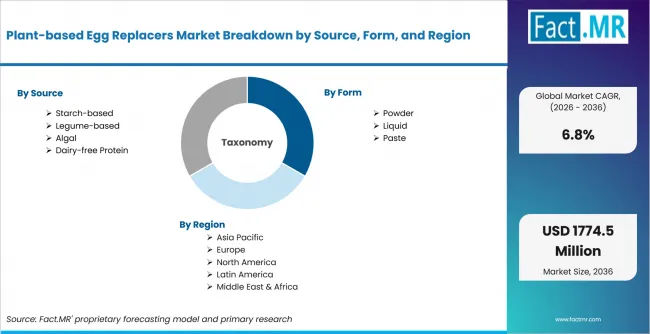
Plant Based Egg Replacers Market Breakdown By Source, Form, And Region | Source: Fact.MR
| Attribute | Details |
|---|---|
| Quantitative Units | USD million |
| Market Definition | Ingredient systems designed to replace binding and emulsification alongside aeration or structure in commercial food formulations |
| Source | Starch-based; Legume-based; Algal; Dairy-free Protein |
| Form | Powder; Liquid; Paste |
| Application | Bakery & Confectionery; Sauces & Dressings; Ready Meals; Nutritional Products |
| End Use | Food Manufacturers; Foodservice; Retail/Household |
| Regions Covered | North America; Europe; Asia Pacific; Central and South America; Middle East and Africa |
| Countries Covered | India; China; Australia; United Kingdom; United States; Germany; Japan |
| Key Companies Profiled | Ingredion Incorporated; Cargill; Puratos; Tate & Lyle; Eat Just; Archer Daniels Midland; |
| Forecast Period | 2026 to 2036 |
| Approach | Hybrid top-down and bottom-up approach using egg supply exposure; food-manufacturing activity; bakery and sauce formulation demand; source adoption; form preferences; application mix; end-use procurement patterns and supplier portfolio validation |
Source: Fact.MR analysis. Updated Jul 10, 2026
How is the market segmented?
-
By Source
- Starch-based
- Legume-based
- Algal
- Dairy-free Protein
-
By Form
- Powder
- Liquid
- Paste
-
By Application
- Bakery & Confectionery
- Sauces & Dressings
- Ready Meals
- Nutritional Products
-
By End Use
- Food Manufacturers
- Foodservice
- Retail/Household
-
By Region
- North America
- United States
- Canada
- Europe
- Germany
- United Kingdom
- France
- Italy
- Spain
- Asia Pacific
- India
- China
- Japan
- South Korea
- Australia
- Latin America
- Brazil
- Argentina
- Mexico
- Chile
- Middle East and Africa
- UAE
- Saudi Arabia
- South Africa
- North America
Frequently Asked Questions
Which Source category holds the dominant position in the Plant-based Egg Replacers Market?
How prominent is the Powder segment in the Plant-based Egg Replacers Market?
What role does Bakery & Confectionery play in application demand?
Which end-use segment generates the largest market demand?
Which country exhibits the strongest growth outlook in the Plant-based Egg Replacers Market?
How is the Plant-based Egg Replacers Market expected to progress in China?
What growth prospects are anticipated for Australia?
How will the United Kingdom perform in the Plant-based Egg Replacers Market?
What expansion trend characterizes the United States market?
How is Germany positioned within the market outlook?
What pace of growth is forecast for Japan?
Which factor most strongly supports market adoption?
What challenge most significantly limits market expansion?
Why do Powder formats remain commercially important?
Why does Bakery & Confectionery account for the largest application share?
Who worked on this report


Preview the report firsthand - request a free sample
Free SampleGet the brochure for pricing and purchase details
Download PDF