- Market Value (2025): USD 64.8 Mn
- Estimated Value (2026): USD 70.0 Mn
- Forecast Value (2036): USD 152.5 Mn
- CAGR (2026-2036): 8.1%
Plant Sterol Emulsions Market Forecast and Outlook 2026 to 2036
According to the Fact.MR analysis, the plant sterol emulsions market surpassed a value of USD 64.8 million in 2025 and is projected to grow from USD 70.0 million in 2026 to USD 152.5 million by 2036. Demand for plant sterol emulsions is likely to grow at a CAGR of 8.1% over the forecast period.
Demand for plant sterol emulsions is rising as food and supplement makers add cholesterol-lowering sterols to drinks, yogurts, shots and gummies, where waxy, water-insoluble sterols must first be turned into a stable dispersion. Manufacturers of plant sterol emulsions are offering sterol ester emulsions, micro- and nanoemulsions and protein-stabilized systems that blend into low-fat and water-based products without grittiness. For example, in March 2026, the American College of Cardiology and American Heart Association published an updated dyslipidemia guideline with lower LDL cholesterol targets. Similar clinical guidance is projected to drive sales of plant sterol emulsions.
Key Takeaways from the Plant Sterol Emulsions Market
- Plant Sterol Emulsions Market Value (2025): USD 64.8 million
- Plant Sterol Emulsions Market Value (2026): USD 70.0 million
- Plant Sterol Emulsions Market Forecast Value (2036): USD 152.5 million
- Plant Sterol Emulsions Market Forecast CAGR (2026-2036): 8.1%
- Leading Product Type: Sterol ester emulsion (28.2%)
- Key Market Participants: BASF, ADM, Cargill, Raisio, Arboris
- Key Growth Regions: Finland, United States, Netherlands, Germany, United Kingdom
In 2026, an Epic Research analysis found that under the new U.S. guideline, 54.6% of adults aged 20 to 79 without established cardiovascular disease were eligible for lipid-lowering treatment, up from about 41%. Demand for plant sterol emulsions is growing as more adults are told their cholesterol is too high and look for dietary options alongside medication. Manufacturers of plant sterol emulsions are positioning daily-dose foods and drinks for this group. Similar awareness is projected to drive sales of plant sterol emulsions across Europe and North America.
Plant Sterol Emulsions Market
| Metric | Value |
|---|---|
| Estimated Value in (2026) | USD 70.0 million |
| Forecast Value in (2036) | USD 152.5 million |
| Forecast CAGR (2026 to 2036) | 8.1% |
Source: Fact.MR analysis. Updated Nov 23, 2026
Source: Fact.MR analysis.
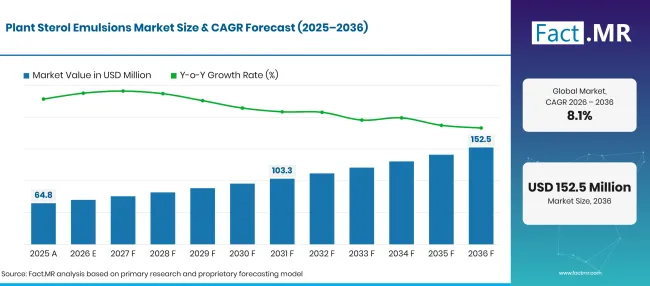
Plant Sterol Emulsions Forecast Global | Source: Fact.MR
Category
| Category | Segments |
|---|---|
| Product Type | Sterol ester emulsion, Sterol microemulsion, Sterol-protein stabilized, Sterol nanoemulsion, Free sterol emulsion |
| Product Form | Granule and agglomerate, Dry powder, Encapsulated, Custom premix, Liquid concentrate |
| Application | Beverages, Bakery and confectionery, Nutrition and supplements, Savory and other, Dairy and alternatives |
| Buyer Type | Ingredient blender, Contract formulator, Beverage producer, Food manufacturer, Nutrition brand |
| Region | Finland; United States; Netherlands; Germany; United Kingdom |
Source: Fact.MR analysis. Updated Nov 23, 2026
Source: Fact.MR analysis.
Segmental Analysis
Why do sterol ester emulsions lead product demand in the Plant Sterol Emulsions Market?
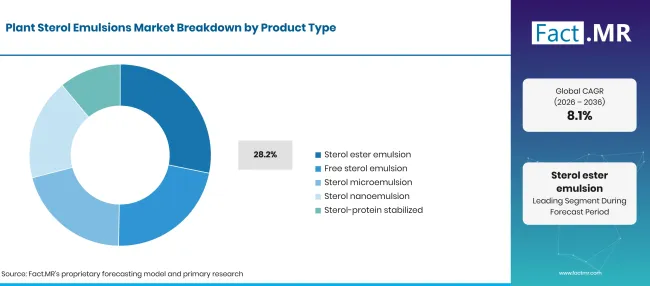
Plant Sterol Emulsions Breakdown Product Type | Source: Fact.MR
Demand for sterol ester emulsions account for 28.2% of the plant sterol emulsions market in 2026, about USD 19.7 million, because esterified sterols are fat-soluble and emulsify readily, which makes them the established route into spreads, milk drinks and yogurt. Their efficacy is backed by long clinical use. Manufacturers of plant sterol emulsions are offering concentrated ester emulsions for single-shot drinks. Similar formulation ease is projected to keep sterol ester emulsions the leading product type.
How are granules and agglomerates leading form demand in the Plant Sterol Emulsions Market?
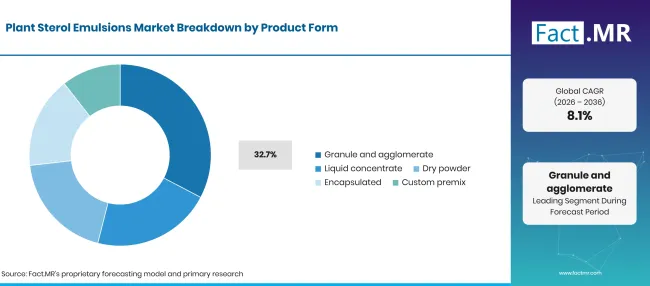
Plant Sterol Emulsions Breakdown Product Form | Source: Fact.MR
Sales of granule and agglomerate formats holds 32.7% of plant sterol emulsions revenue in 2026, about USD 22.9 million, because spray-dried emulsion powders can be stored and shipped dry and then re-form an emulsion in water. This suits powdered drinks, sachets and tablets. Manufacturers of plant sterol emulsions are improving cold-water dispersibility of dried emulsions. Similar convenience is projected to keep granules and agglomerates the leading product form.
Why do beverages lead application demand in the Plant Sterol Emulsions Market?
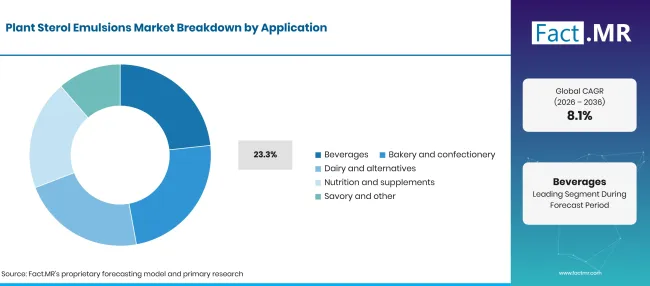
Plant Sterol Emulsions Breakdown Application | Source: Fact.MR
Beverages leads with 23.3% of plant sterol emulsions revenue in 2026, about USD 16.3 million, as dairy shots, plant-based drinks and juices offer an easy daily dose of about two grams of sterols. Drinks need stable emulsions that do not ring or separate. Manufacturers of plant sterol emulsions are developing clear and low-fat beverage systems. Similar daily-dose formats are projected to keep beverages the leading application.
How are ingredient blenders leading buyer demand in the Plant Sterol Emulsions Market?
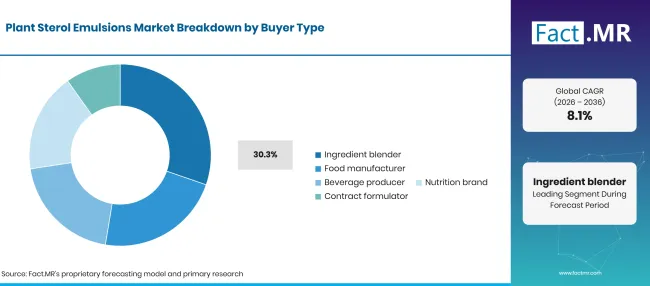
Plant Sterol Emulsions Breakdown Buyer Type | Source: Fact.MR
Demand for ingredient blenders account for 30.3% of plant sterol emulsions revenue in 2026, about USD 21.2 million, because premix companies combine sterol emulsions with vitamins, omega-3 and fibers into heart-health blends for brand owners. Blenders manage dosing and claims support. Manufacturers of plant sterol emulsions are working with blenders that also use ingredients from the emulsifier market. Similar premix models are projected to keep ingredient blenders the leading buyer type.
Plant Sterol Emulsions Market-Drivers, Restraints & Trends
Drivers:
Demand for plant sterol emulsions is rising as cholesterol guidelines tighten on both sides of the Atlantic. For example, Finland's national Current Care cholesterol guideline was updated in September 2026, following the U.S. guideline update in March 2026 that set LDL targets as low as 55 mg/dL for people at highest risk. Manufacturers of plant sterol emulsions are supplying brands that communicate approved cholesterol-lowering claims. Similar guidance is projected to drive sales of plant sterol emulsions.
Restraints:
Sales of plant sterol emulsions is constrained by weak sales of some established sterol and stanol foods and by competition from statins and new lipid-lowering drugs. For example, in November 2026, Raisio, owner of the Benecol brand, lowered its 2026 guidance after reporting January to September net sales of EUR 171.3 million and comparable EBIT of EUR 21.5 million, down from EUR 22.7 million. Similar softness is projected to slow orders from mature spread categories. Manufacturers of plant sterol emulsions must open new formats.
Opportunity: Sterols in Supplements and Gummies
Demand for sterols in capsules, gummies and stick packs is rising as heart-health supplements grow. Manufacturers are creating powder emulsions that compress and disperse well. Fi Europe 2026, held in Frankfurt from 17 to 19 November, featured a dedicated health ingredients zone. Similar interest is projected to drive sales of plant sterol emulsions in supplement formats, alongside protein supplements.
Trend: Plant-Based and Low-Fat Carriers
In June 2026, GFI Europe reported that Europe's plant-based food retail market grew as prices became more competitive. Demand for sterol emulsions that work in oat, soy and almond drinks is rising. Similar category growth is projected to drive sales of plant sterol emulsions stabilized with plant proteins. Manufacturers of plant sterol emulsions are replacing dairy emulsifiers with plant protein ingredients.
Plant Sterol Emulsions Market by Analysis by Key Country
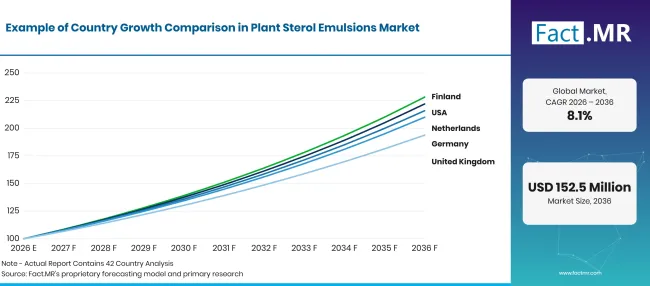
Plant Sterol Emulsions Growth Index | Source: Fact.MR
| Country | CAGR (2026-2036) |
|---|---|
| Finland | 8.6% |
| United States | 8.3% |
| Netherlands | 8.0% |
| Germany | 7.7% |
| United Kingdom | 6.8% |
Source: Fact.MR analysis. Updated Nov 23, 2026
Source: Fact.MR analysis.
What is driving plant sterol emulsions demand in Finland?
In September 2026, Finland's Current Care guideline on cholesterol was updated, keeping attention on diet and LDL targets in the country where stanol and sterol foods were first commercialized.
Demand for plant sterol emulsions in Finland is projected to increase at an 8.6% CAGR, the fastest among the five key countries, as producers move sterols from spreads into drinks and supplements. Manufacturers of plant sterol emulsions, including Raisio, are developing new formats. Similar guidance is projected to drive sales in Finland.
How are new guidelines supporting plant sterol emulsions sales in the United States?
Sales of plant sterol emulsions in the United States are estimated to grow at an 8.3% CAGR through 2036, supported by increasing attention to cholesterol screening and cardiovascular risk management.
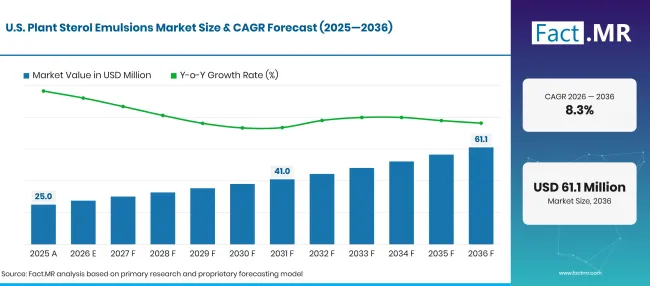
Plant Sterol Emulsions Forecast Usa | Source: Fact.MR
In March 2026, the American College of Cardiology and American Heart Association issued updated dyslipidemia guidelines emphasizing earlier intervention, improved lipid assessment and lower LDL cholesterol targets for higher-risk individuals. The recommendations also reinforce the importance of dietary and lifestyle modifications alongside medical treatment. Ingredient suppliers such as ADM and Cargill are positioned to serve beverage and supplement manufacturers developing functional cholesterol-management products. Growing awareness of preventive cardiovascular health is expected to support demand for plant sterol emulsions.
What is shaping plant sterol emulsions demand in the Netherlands?
Demand for plant sterol emulsions in the Netherlands is projected to increase at an 8.0% CAGR through 2036, supported by innovation in functional foods and growing interest in fortified dairy and plant-based beverages.
In October 2026, Corbion reported nine-month sales of EUR 971.6 million, representing 3.9% organic growth, while volume and mix increased by 5.3%. Its Health & Nutrition segment also recorded strong volume-led performance, reflecting demand for specialized nutritional ingredients. These developments highlight opportunities in the broader functional ingredient industry. Manufacturers of plant sterol emulsions are targeting Dutch producers of fortified drinks, dairy shots and nutritional beverages. Continued product innovation and interest in cholesterol-management formulations are expected to support market growth.
How is the plant-based market shaping plant sterol emulsions sales in Germany?
Sales of plant sterol emulsions in Germany are estimated to grow at a 7.7% CAGR through 2036, supported by expanding demand for plant-based beverages and functional food ingredients.
In June 2026, GFI Europe reported that Germany remained Europe's largest plant-based food market, with retail sales reaching EUR 1.71 billion in 2025. Plant-based milk and drinks recorded 8.1% value growth, while 31.2% of German households purchased plant-based meat during the year. These developments indicate opportunities for ingredient suppliers such as BASF to serve manufacturers developing fortified dairy alternatives and functional beverages. Growing interest in plant-based nutrition and cholesterol-management formulations is expected to support market expansion.
Why is growth slower for plant sterol emulsions in the United Kingdom?
Demand for plant sterol emulsions in the United Kingdom is anticipated to increase at a 6.8% CAGR through 2036, the slowest among the five key countries.
Growth is moderated by the established availability of cholesterol-lowering spreads and yogurt drinks, alongside price-conscious purchasing behaviour. However, advertising restrictions on less healthy food and drink products, effective from 5 January 2026, are reshaping food marketing priorities. Manufacturers of plant sterol emulsions are focusing on retailer own-label fortified drinks and functional dairy alternatives to address demand for cholesterol-management products. Continued competition and category maturity are expected to moderate sales growth over the forecast period.
Competitive Landscape for Plant Sterol Emulsions Market
Competition in the plant sterol emulsions market is led by sterol producers and lipid ingredient companies. BASF, ADM and Cargill compete through vegetable-oil and tall-oil sterol supply and formulated sterol products, Arboris competes as a pine-derived sterol specialist, and Raisio competes through Benecol stanol ester know-how and licensing. Buyers select plant sterol emulsions on sterol load, emulsion stability, taste, particle size and claims support.
From 2025 onward, competition shifted toward new delivery formats. U.S. and Finnish cholesterol guidelines were updated in 2026, Raisio lowered guidance as traditional categories softened, plant-based drinks grew in Europe, and health ingredients featured at Fi Europe. Manufacturers that offer stable emulsions for beverages and supplements are best placed to grow.
Recent Developments
- In November 2026, Raisio lowered its 2026 guidance after nine-month net sales of EUR 171.3 million.
- In September 2026, Finland's Current Care cholesterol guideline was updated.
- In June 2026, GFI Europe reported growth in Europe's plant-based food retail market.
- In March 2026, the ACC and AHA published the 2026 guideline on the management of dyslipidemia.
Key Players in Plant Sterol Emulsions Market
Key companies operating in the market include BASF, ADM, Cargill, Raisio, and Arboris.
- BASF
- ADM
- Cargill
- Raisio
- Arboris
Bibliography
- American College of Cardiology. (2026, March 13). ACC/AHA issue updated guideline for managing lipids, cholesterol.
- American Heart Association. (2026). 2026 guideline on the management of dyslipidemia.
- Corbion N.V. (2026, October 28). Corbion delivers strong volume-led sales growth and significant margin improvement in Q3; full-year guidance maintained.
- Epic Research. (2026, August 5). New 2026 hyperlipidemia guideline expands treatment eligibility from 41% to 55% of adults.
- Good Food Institute Europe. (2026, June 9). Germany remains Europe's leading market for plant-based foods with 3.1% growth in sales value.
- Raisio plc. (2026, November 6). Inside information: Raisio lowers its guidance for 2026 and provides preliminary information on the financial development of the third quarter.
- Raisio plc. (2026). Interim report for January–September 2026.
- Suomalainen Lääkäriseura Duodecim & Suomen Sisätautilääkärien Yhdistys ry. (2026, September 24). Dyslipidemiat: Current Care guideline.
- UK Department of Health and Social Care. (2026, March 25). Less healthy food or drink: Advertising and promotions restrictions.
- UK Government. (2025, June 3). The Communications Act 2003 (Restrictions on the Advertising of Less Healthy Food) (Effective Date) (Amendment) Regulations 2025.
Segmentation
Scope of Report
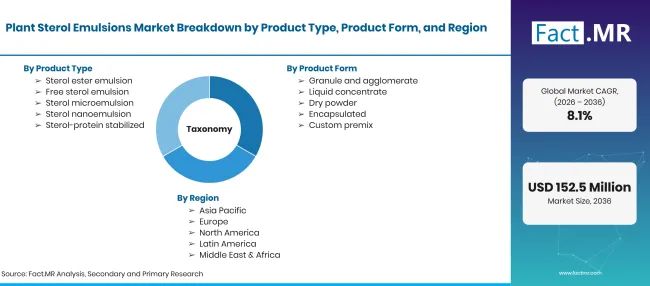
Plant Sterol Emulsions Taxonomy | Source: Fact.MR
| Items | Values |
|---|---|
| Quantitative Units (2026) | USD 70.0 Million |
| Product Type | Sterol ester emulsion, Sterol microemulsion, Sterol-protein stabilized, Sterol nanoemulsion, Free sterol emulsion |
| Product Form | Granule and agglomerate, Dry powder, Encapsulated, Custom premix, Liquid concentrate |
| Application | Beverages, Bakery and confectionery, Nutrition and supplements, Savory and other, Dairy and alternatives |
| Buyer Type | Ingredient blender, Contract formulator, Beverage producer, Food manufacturer, Nutrition brand |
| Regions Covered | North America, Latin America, Europe, East Asia, South Asia and Pacific, Middle East & Africa |
| Countries Covered | Finland, United States, Netherlands, Germany, United Kingdom, and other countries |
| Key Companies Profiled | BASF, ADM, Cargill, Raisio, Arboris |
| Additional Attributes | Dollar revenue in the Plant Sterol Emulsions Market is segmented by product type (sterol ester emulsion, microemulsion, nanoemulsion, protein-stabilized, free sterol), product form, application, buyer type and region. |
Source: Fact.MR analysis. Updated Nov 23, 2026
Source: Fact.MR analysis.
Plant Sterol Emulsions Market by Segments
-
Product Type
- Sterol ester emulsion
- Sterol microemulsion
- Sterol-protein stabilized
- Sterol nanoemulsion
- Free sterol emulsion
-
Product Form
- Granule and agglomerate
- Dry powder
- Encapsulated
- Custom premix
- Liquid concentrate
-
Application
- Beverages
- Bakery and confectionery
- Nutrition and supplements
- Savory and other
- Dairy and alternatives
-
Buyer Type
- Ingredient blender
- Contract formulator
- Beverage producer
- Food manufacturer
- Nutrition brand
-
Region:
- North America
- United States
- Canada
- Mexico
- Europe
- Germany
- United Kingdom
- France
- Italy
- Spain
- Rest of Europe
- Asia Pacific
- China
- India
- Japan
- South Korea
- Australia
- Rest of Asia Pacific
- Latin America
- Brazil
- Mexico
- Argentina
- Rest of Latin America
- Middle East & Africa
- GCC Countries
- South Africa
- Rest of Middle East & Africa
- North America
Frequently Asked Questions
How big is the global Plant Sterol Emulsions Market in 2026?
What will be the size of the Plant Sterol Emulsions Market by 2036?
How fast will the Plant Sterol Emulsions Market grow during the forecast period?
Which product type segment holds the largest share of the Plant Sterol Emulsions Market?
Who worked on this report


Preview the report firsthand - request a free sample
Free SampleGet the brochure for pricing and purchase details
Download PDF