- Market Value (2025): USD 65.0 Mn
- Estimated Value (2026): USD 70.0 Mn
- Forecast Value (2036): USD 147.0 Mn
- CAGR (2026-2036): 7.7%
Heat-Stable Whey Proteins Market Forecast and Outlook 2026 to 2036
As per the Fact.MR analysis, the heat-stable whey proteins market surpassed a value of USD 65.0 million in 2025 and is projected to grow from USD 70.0 million in 2026 to USD 147.0 million by 2036. Demand for heat-stable whey proteins is likely to grow at a CAGR of 7.7% over the forecast period.
Demand for heat-stable whey proteins is rising as makers of ready-to-drink shakes, medical nutrition, protein bars and baked snacks need whey that survives UHT treatment, retorting and oven heat without gelling, thickening or turning gritty. Manufacturers of heat-stable whey proteins are offering microparticulated whey, heat-stable isolates and concentrates, and hydrolyzed grades with controlled denaturation and mineral balance. For example, in September 2026, Fonterra reported that it had completed an advanced protein hub at Studholme to add capacity for higher-value functional dairy proteins. Similar investment is projected to drive sales of heat-stable whey proteins.
Key Takeaways from the Heat-Stable Whey Proteins Market
- Heat-Stable Whey Proteins Market Value (2025): USD 65.0 million
- Heat-Stable Whey Proteins Market Value (2026): USD 70.0 million
- Heat-Stable Whey Proteins Market Forecast Value (2036): USD 147.0 million
- Heat-Stable Whey Proteins Market Forecast CAGR (2026-2036): 7.7%
- Leading Product Type: Microparticulated whey (28.1%)
- Key Market Participants: Arla Foods Ingredients, FrieslandCampina Ingredients, Fonterra, Lactalis Ingredients, Glanbia Nutritionals, Hilmar Ingredients
- Key Growth Regions: Netherlands, Denmark, New Zealand, Germany, United States
In November 2026, Glanbia reported that whey inflation pushed its third-quarter pricing up by about 26% and said it expected higher whey costs in early 2027. Demand for heat-stable whey proteins is growing as brands raise protein levels in long-life drinks despite higher costs, because a stable product avoids expensive rejects. Manufacturers of heat-stable whey proteins are helping customers get more protein per bottle at a given viscosity. Similar cost and quality pressure is projected to shape sales of heat-stable whey proteins across Europe, Oceania and North America.
Heat-Stable Whey Proteins Market
| Metric | Value |
|---|---|
| Estimated Value in (2026) | USD 70.0 million |
| Forecast Value in (2036) | USD 147.0 million |
| Forecast CAGR (2026 to 2036) | 7.7% |
Source: Fact.MR analysis. Updated Nov 21, 2026
Source: Fact.MR analysis.
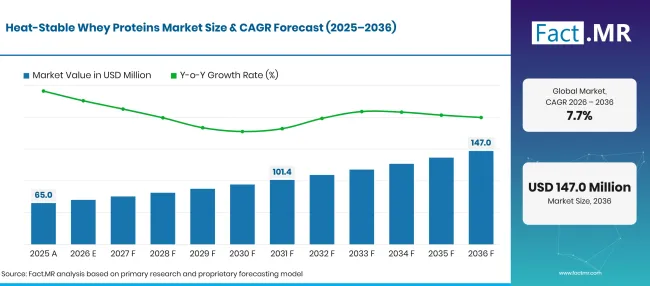
Heat Stable Whey Proteins Forecast Global | Source: Fact.MR
Category
| Category | Segments |
|---|---|
| Product Type | Microparticulated whey, Whey-protein blend, Heat-stable WPI, Hydrolyzed heat-stable whey, Heat-stable WPC |
| Product Form | Custom premix, Granule and agglomerate, Dry powder, Encapsulated, Liquid concentrate |
| Application | Bakery and confectionery, Savory and other, Nutrition and supplements, Dairy and alternatives, Beverages |
| Buyer Type | Beverage producer, Food manufacturer, Ingredient blender, Nutrition brand, Contract formulator |
| Region | Netherlands; Denmark; New Zealand; Germany; United States |
Source: Fact.MR analysis. Updated Nov 21, 2026
Source: Fact.MR analysis.
Segmental Analysis
Why does microparticulated whey lead product demand in the Heat-Stable Whey Proteins Market?
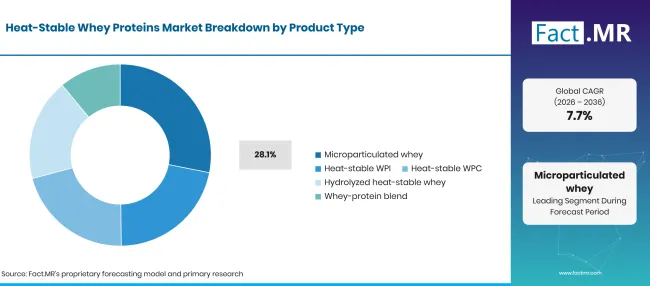
Heat Stable Whey Proteins Breakdown Product Type | Source: Fact.MR
Demand for microparticulated whey accounts for 28.1% of the heat-stable whey proteins market in 2026, about USD 19.7 million, because whey that has already been heat-denatured into fine particles does not aggregate further when the final product is heated. The particles also give a creamy, fat-like mouthfeel. Manufacturers of heat-stable whey proteins are controlling particle size for smooth texture. Similar process tolerance is projected to keep microparticulated whey the leading product type, as also described in the protein lubrication fat replacers market.
How is custom premix leading form demand in the Heat-Stable Whey Proteins Market?
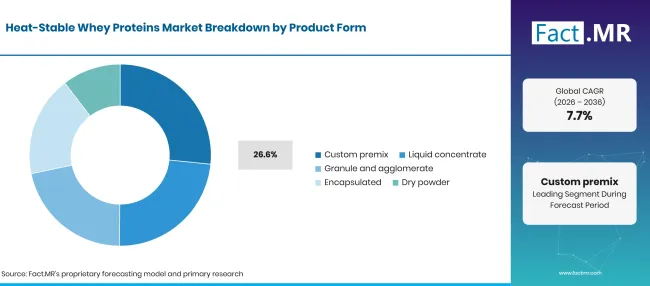
Heat Stable Whey Proteins Breakdown Product Form | Source: Fact.MR
Sales of custom premix segment to represent 26.6% of heat-stable whey proteins revenue in 2026, about USD 18.6 million, because heat stability depends on the whole recipe, so customers buy whey pre-blended with stabilizing salts, emulsifiers and other proteins. A tested premix lowers the risk of fouling on UHT plants. Manufacturers of heat-stable whey proteins are designing premixes for specific protein levels and processes. Similar process risk is projected to keep custom premix the leading product form.
Why do bakery and confectionery lead application demand in the Heat-Stable Whey Proteins Market?
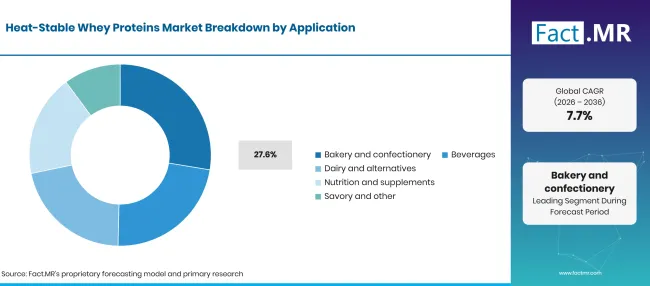
Heat Stable Whey Proteins Breakdown Application | Source: Fact.MR
Demand for bakery and confectionery holds 27.6% of heat-stable whey proteins revenue in 2026, about USD 19.3 million, as protein bars, cookies, wafers and fillings need whey that stays soft after baking and during shelf life. Standard whey hardens bars over time. Manufacturers of heat-stable whey proteins are offering grades that limit bar hardening and browning. Similar growth of protein snacks is projected to keep bakery and confectionery the leading application.
How are beverage producers leading buyer demand in the Heat-Stable Whey Proteins Market?
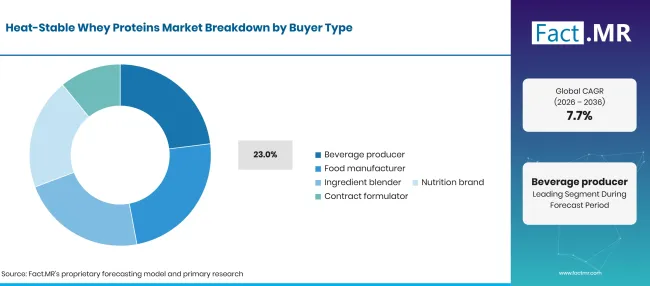
Heat Stable Whey Proteins Breakdown Buyer Type | Source: Fact.MR
Beverage producers account for 23.0% of heat-stable whey proteins revenue in 2026, about USD 16.1 million, because ready-to-drink protein shakes and clinical drinks are sterilized at high temperature and must stay fluid for months. Gelation in the pack is the main failure. Manufacturers of heat-stable whey proteins are running UHT trials with beverage customers, who also use high-solubility protein isolates. Similar ready-to-drink growth is projected to keep beverage producers the leading buyer type.
Heat-Stable Whey Proteins Market-Drivers, Restraints & Trends
Drivers:
Demand for heat-stable whey proteins is rising as dairy companies invest in specialty whey capacity. For example, in May 2026, FrieslandCampina announced an investment programme of more than EUR 90 million in high-value whey proteins, and in January 2026 DairyReporter reported that Fonterra, Glanbia, Arla and others were expanding whey protein capacity as demand outstripped supply. Manufacturers of heat-stable whey proteins are directing new capacity to functional grades. Similar investment is projected to drive sales of heat-stable whey proteins.
Restraints:
Sales of heat-stable whey proteins is constrained by tight whey supply and record prices. For example, industry reports in June 2026 put whey protein isolate prices at about USD 11 per pound, a level not seen before. Similar costs are projected to push some brands toward milk protein or plant protein blends. Manufacturers of heat-stable whey proteins must justify premiums with processing yield and shelf-life data.
Opportunity: High-Protein Ready-to-Drink Formats
Demand for long-life drinks with 30 grams or more of protein is rising among fitness and weight-management consumers. Manufacturers are developing whey that stays thin at high concentration. In August 2026, Glanbia said weight-loss drugs were boosting demand for protein products. Similar consumer demand is projected to drive sales of heat-stable whey proteins for ready-to-drink shakes.
Trend: Lower-Carbon Whey Processing
In August 2026, Arla Foods Ingredients announced an investment of EUR 8.3 million at its Danmark Protein plant in Videbæk to cut carbon emissions. Demand for dairy proteins with a lower footprint is rising as brands report scope 3 emissions. Similar investment is projected to support sales of heat-stable whey proteins from efficient plants. Manufacturers of heat-stable whey proteins are documenting energy use, alongside launches such as ready-to-stir BLG proteins.
Heat-Stable Whey Proteins Market by Analysis by Key Country
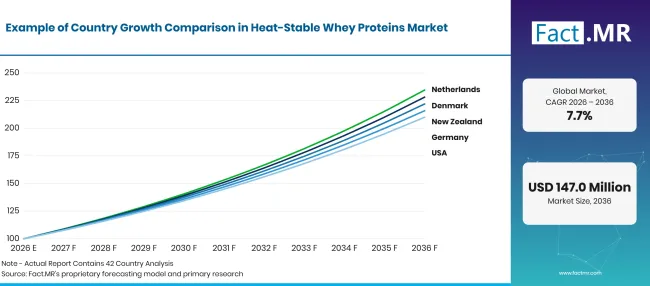
Heat Stable Whey Proteins Growth Index | Source: Fact.MR
| Country | CAGR (2026-2036) |
|---|---|
| Netherlands | 8.9% |
| Denmark | 8.6% |
| New Zealand | 8.3% |
| Germany | 8.0% |
| United States | 7.7% |
Source: Fact.MR analysis. Updated Nov 21, 2026
Source: Fact.MR analysis.
What is driving heat-stable whey proteins demand in the Netherlands?
Demand for heat-stable whey proteins in the Netherlands is projected to increase at an 8.9% CAGR through 2036, supported by investments in domestic whey processing and growing demand for functional protein ingredients.
In May 2026, FrieslandCampina announced an investment programme exceeding EUR 90 million to expand high-value whey protein production and upgrade facilities in Bedum, Veghel and Workum. The programme includes technologies for producing specialty ingredients such as Nutri Whey ProHeat, designed for demanding food applications. These developments strengthen the domestic supply of functional whey ingredients for performance, medical and early-life nutrition. Growing requirements for proteins that retain functionality during thermal processing are expected to support further adoption among Dutch beverage and nutrition manufacturers.
How is ingredient expertise supporting heat-stable whey proteins sales in Denmark?
Sales of heat-stable whey proteins in Denmark are estimated to register an 8.6% CAGR through 2036, shaped by established dairy processing expertise and the country's strong specialty whey ingredient industry.
Arla Foods Ingredients continues to strengthen its position in premium nutrition through investments in ingredient innovation, processing capabilities and international customer partnerships. In November 2026, the company announced a joint exhibition with wheyco at Fi Europe, highlighting expanded collaboration following the merger of their parent cooperatives. Its showcased concepts included high-protein beverages, protein shots and yogurt applications. These developments demonstrate the industry's focus on functional dairy ingredients for different processing requirements. Growing demand from sports, clinical and beverage nutrition manufacturers is expected to reinforce Denmark's role as a specialty whey ingredient supplier.
What is shaping heat-stable whey proteins demand in New Zealand?
Demand for heat-stable whey proteins in New Zealand is anticipated to rise at an 8.3% CAGR through 2036, driven by the country's established dairy processing infrastructure and growing focus on value-added protein ingredients.
Fonterra's September 2026 FY26 results reported NZD 1,293 million in operating profit from its Ingredients channel, reflecting strong global protein demand, favourable pricing and product mix decisions. The company also highlighted the contribution of higher-value protein products to its Ingredients performance. These developments demonstrate the commercial importance of specialty dairy ingredients within New Zealand's export-oriented dairy industry. Manufacturers supplying ready-to-drink beverages, sports nutrition and clinical nutrition applications are expected to support demand for whey proteins that maintain functionality during high-temperature processing.
How is retail pressure shaping heat-stable whey proteins sales in Germany?
Sales of heat-stable whey proteins in Germany are estimated to grow at an 8.0% CAGR through 2036, supported by demand for high-protein dairy beverages, functional puddings and convenient nutrition products.
However, competitive pricing and pressure on food manufacturers' margins may influence purchasing decisions. In October 2026, the German Federation of Food and Drink Industries (BVE) reported that industry revenue declined by 2.3% during the first half of 2026, reflecting lower selling prices and persistent production costs. Despite these challenges, dairy processors continue to require functional protein ingredients for chilled and long-life products. Demand for whey grades that maintain stability, texture and protein quality during thermal processing is expected to support market expansion.
Why is growth slower for heat-stable whey proteins in the United States?
Demand for heat-stable whey proteins in the United States is anticipated to expand at a 7.7% CAGR through 2036, representing the slowest growth among the five countries considered.
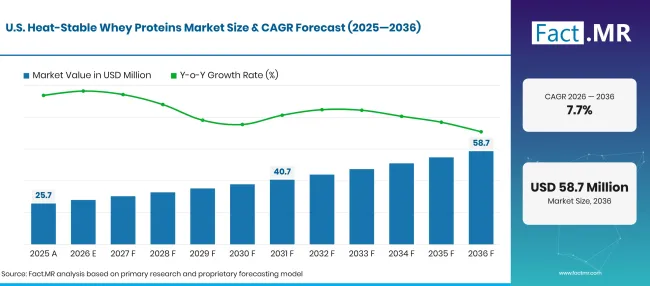
Heat Stable Whey Proteins Forecast Usa | Source: Fact.MR
High ingredient costs, supply constraints and competition for premium whey protein ingredients are expected to influence purchasing patterns. In November 2025, Glanbia announced an investment with its Southwest Cheese joint venture partners to add 10 million pounds of whey protein isolate capacity in New Mexico by 2027. This expansion is expected to strengthen domestic ingredient availability over time. However, manufacturers such as Glanbia Nutritionals and Hilmar Ingredients must balance capacity allocation with customer commitments. Growing demand from sports and medical nutrition applications will support sales, although elevated input costs may moderate adoption among price-sensitive processors.
Competitive Landscape for Heat-Stable Whey Proteins Market
Competition in the heat-stable whey proteins market is led by dairy ingredient companies with denaturation and microparticulation technology. Arla Foods Ingredients, FrieslandCampina Ingredients and Lactalis Ingredients compete from Europe, Fonterra competes from New Zealand, and Glanbia Nutritionals and Hilmar Ingredients compete in the United States. Buyers select heat-stable whey proteins on viscosity after heat treatment, shelf-life stability, taste, protein content and security of supply.
From 2025 onward, competition shifted toward capacity and application support in a short market. FrieslandCampina and Fonterra invested in protein plants, Arla upgraded its Danish site, Glanbia reported sharp whey inflation, and isolate prices hit records in 2026. Manufacturers that can supply consistent functional whey with process guidance are best placed to grow.
Recent Developments
- In November 2026, Glanbia reported third-quarter pricing up about 26% because of whey inflation.
- In September 2026, Fonterra confirmed completion of its Studholme advanced protein hub.
- In August 2026, Arla Foods Ingredients announced a EUR 8.3 million investment at Danmark Protein.
- In May 2026, FrieslandCampina announced more than EUR 90 million of investment in whey proteins.
Key Players in Heat-Stable Whey Proteins Market
- Arla Foods Ingredients
- FrieslandCampina Ingredients
- Fonterra
- Lactalis Ingredients
- Glanbia Nutritionals
- Hilmar Ingredients
Bibliography
- Arla Foods Ingredients. (2026, August 19). Arla Foods Ingredients reduces gas emissions through significant investment in Videbæk.
- DairyReporter. (2026, January 16). Whey protein suppliers race to expand capacity amid tight markets.
- FrieslandCampina. (2026, May 5). FrieslandCampina announces major investment programme to accelerate growth in high-value whey proteins.
- Glanbia plc. (2026, November 4). Q3 2026 interim management statement.
- Nutraceutical Business Review. (2026, June 3). Whey protein supply crunch deepens as surging demand outpaces global capacity.
- Fonterra Co-operative Group. (2026). Annual report 2026.
Segmentation
Scope of Report
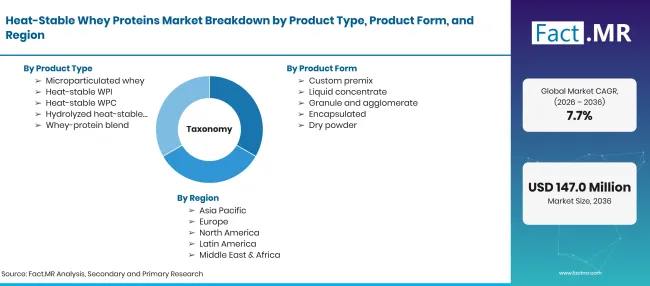
Heat Stable Whey Proteins Taxonomy | Source: Fact.MR
| Items | Values |
|---|---|
| Quantitative Units (2026) | USD 70.0 Million |
| Product Type | Microparticulated whey, Whey-protein blend, Heat-stable WPI, Hydrolyzed heat-stable whey, Heat-stable WPC |
| Product Form | Custom premix, Granule and agglomerate, Dry powder, Encapsulated, Liquid concentrate |
| Application | Bakery and confectionery, Savory and other, Nutrition and supplements, Dairy and alternatives, Beverages |
| Buyer Type | Beverage producer, Food manufacturer, Ingredient blender, Nutrition brand, Contract formulator |
| Regions Covered | North America, Latin America, Europe, East Asia, South Asia and Pacific, Middle East & Africa |
| Countries Covered | Netherlands, Denmark, New Zealand, Germany, United States, and other countries |
| Key Companies Profiled | Arla Foods Ingredients, FrieslandCampina Ingredients, Fonterra, Lactalis Ingredients, Glanbia Nutritionals, Hilmar Ingredients |
| Additional Attributes | Dollar revenue in the Heat-Stable Whey Proteins Market is segmented by product type (microparticulated whey, heat-stable WPI, heat-stable WPC, hydrolyzed, blends), product form, application, buyer type and region. |
Source: Fact.MR analysis. Updated Nov 21, 2026
Source: Fact.MR analysis.
Heat-Stable Whey Proteins Market by Segments
-
Product Type
- Microparticulated whey
- Whey-protein blend
- Heat-stable WPI
- Hydrolyzed heat-stable whey
- Heat-stable WPC
-
Product Form
- Custom premix
- Granule and agglomerate
- Dry powder
- Encapsulated
- Liquid concentrate
-
Application
- Bakery and confectionery
- Savory and other
- Nutrition and supplements
- Dairy and alternatives
- Beverages
-
Buyer Type
- Beverage producer
- Food manufacturer
- Ingredient blender
- Nutrition brand
- Contract formulator
-
Region:
- North America
- United States
- Canada
- Mexico
- Europe
- Germany
- United Kingdom
- France
- Italy
- Spain
- Rest of Europe
- Asia Pacific
- China
- India
- Japan
- South Korea
- Australia
- Rest of Asia Pacific
- Latin America
- Brazil
- Mexico
- Argentina
- Rest of Latin America
- Middle East & Africa
- GCC Countries
- South Africa
- Rest of Middle East & Africa
- North America
Frequently Asked Questions
How big is the global Heat-Stable Whey Proteins Market in 2026?
What will be the size of the Heat-Stable Whey Proteins Market by 2036?
How fast will the Heat-Stable Whey Proteins Market grow during the forecast period?
Which product type segment holds the largest share of the Heat-Stable Whey Proteins Market?
Who worked on this report


Preview the report firsthand - request a free sample
Free SampleGet the brochure for pricing and purchase details
Download PDF