Platelet Aggregation Devices Market (2026 - 2036)
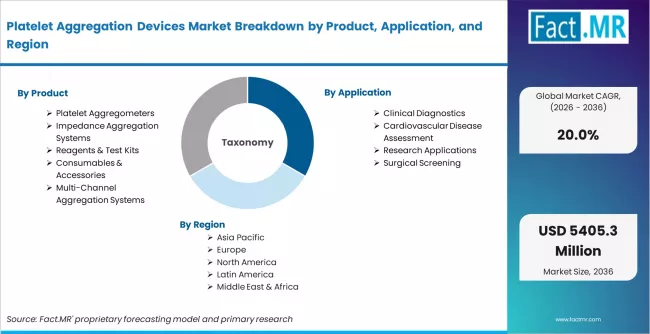
Platelet Aggregation Devices Market is segmented by Product (Platelet Aggregometers, Impedance Aggregation Systems, Reagents & Test Kits, Consumables & Accessories, Multi-Channel Aggregation Systems), Application (Clinical Diagnostics, Cardiovascular Disease Assessment, Research Applications, Surgical Screening), End Use (Hospitals, Diagnostic Laboratories, Research & Academic Institutes, Blood Banks), and Region, with forecasts covering the period from 2026 to 2036.
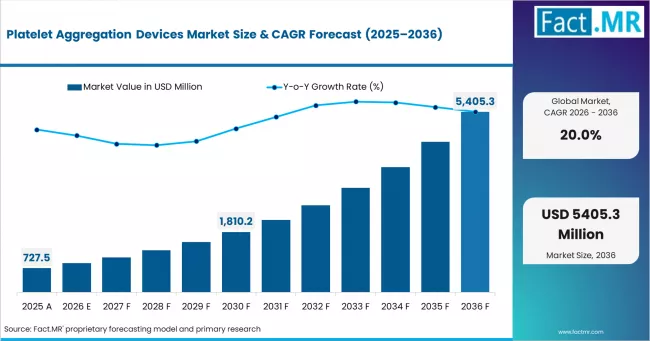
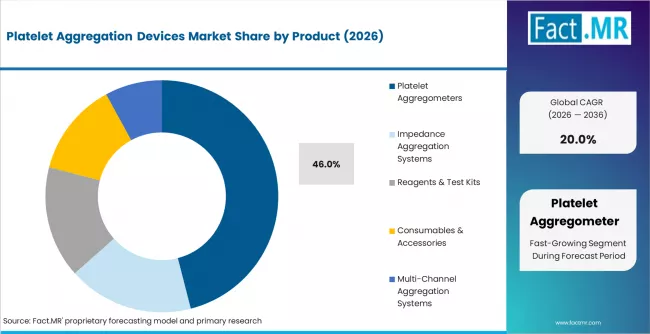
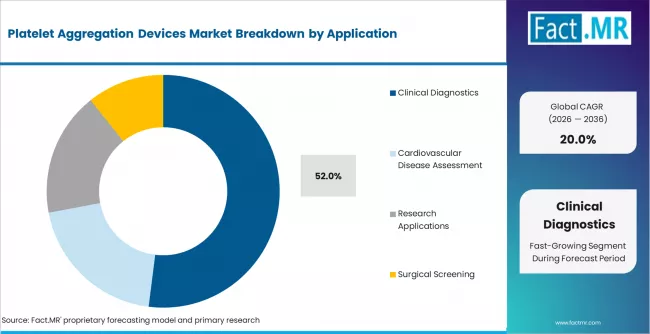
According to Fact.MR estimates, the global platelet aggregation devices market market was valued at USD 727.5 million in 2025. The market is projected to reach USD 873.0 million in 2026 and is expected to grow to USD 5,405.3 million by 2036, expanding at a CAGR of 20.0%. Platelet Aggregometers is anticipated to account for 46.0% of the product segment in 2026, while Clinical Diagnostics is expected to remain the leading application with around 52.0% share.
Platelet Aggregation Devices Market Analysis and Forecast by Fact.MR
The global market for platelet aggregation devices is estimated to be around USD 873.0 million in 2026 and has been forecast to expand at a CAGR of 20.0% to end up at USD 5,405.3 million by 2036. The Platelet Aggregation Devices segment is led by Platelet Aggregometers, which is anticipated to account for 46.0% of the product segment in 2026, while Clinical Diagnostics is expected to remain the leading application with around 52.0% share. The market was valued at USD 727.5 million in 2025 and is poised for steady growth driven by evolving industry dynamics and regional demand patterns.
Summary of Platelet Aggregation Devices Market
- Market Snapshot
- In 2025, the global Platelet Aggregation Devices Market was valued at approximately USD 727.5 million.
- The market is estimated to reach USD 873.0 million in 2026 and is projected to attain USD 5,405.3 million by 2036
- The platelet aggregation devices market is likely to expand at a CAGR of 20.0% during the forecast period.
- The market is anticipated to create an absolute dollar opportunity of USD 4,532.3 million between 2026 and 2036.
- Platelet Aggregometers account for 46.0% of market share in 2026.
- China (27%) and India (25%) are the key growth markets during the forecast period
- Demand and Growth Drivers
- Demand is shaped by the rising prevalence of cardiovascular disease, bleeding disorders, and thrombotic conditions, all of which require platelet function assessment as part of routine clinical diagnostics.
- Growth reflects the accelerating adoption of antiplatelet drug monitoring protocols across cardiology departments, particularly in post-stent and acute coronary syndrome management.
- Adoption is increasing due to broader incorporation of platelet function testing into pre-operative bleeding risk screening and the expansion of personalized antiplatelet therapy across developed healthcare systems.
- Product and Segment View
- Platelet aggregometers lead the product segment with a 46% share in 2026, supported by their foundational role in both clinical diagnostic and research laboratory workflows.
- Clinical diagnostics hold 52% of the application segment, anchored by routine platelet function assessment across cardiology, hematology, and surgical screening use cases.
- Hospitals account for 49% of end-use demand, while clinical pathology labs, cardiology departments, and research institutes form secondary channels.
- Geography and Competitive Outlook
- North America remains the largest regional market, supported by mature cardiology infrastructure, broad antiplatelet therapy monitoring, and high per-capita diagnostic spending.
- Asia Pacific is the fastest-growing region, led by China where expanding cardiac care capacity and rising cardiovascular disease burden are both supporting device adoption.
- The competitive field is led by Werfen with an estimated 25% share, followed by Helena Laboratories Corporation, Bio/Data Corporation, Chrono-Log Corporation, and F. Hoffmann-La Roche Ltd.
- Analyst Opinion
- Platelet aggregation diagnostics has shifted from a niche specialty test to a more routine part of cardiovascular and surgical decision making, and the commercial economics reflect that shift. The category is structurally attractive because the 20 percent CAGR is built on two reinforcing tailwinds: rising cardiovascular disease incidence in Asia and broad antiplatelet monitoring protocols across cardiology practice. The commercial lever that matters most is the transition from traditional light transmission aggregometry toward faster whole-blood and impedance-based systems, because these formats reduce hands-on time and fit better into high-volume cardiology workflows. Players that combine a broad reagent portfolio with automated platforms and strong cardiology channel relationships will capture premium positioning, while vendors focused solely on research-grade instruments without clinical workflow integration face margin pressure as the category matures.
Why is Platelet Aggregation Devices Market Growing?
- Growth reflects rising cardiovascular disease prevalence and the widespread clinical use of antiplatelet drugs that require laboratory monitoring.
- Demand is shaped by surgical screening protocols that increasingly incorporate pre-operative platelet function testing to manage bleeding risk.
- Adoption is increasing due to technology improvements in whole-blood and impedance testing that reduce hands-on time and improve workflow fit in cardiology settings.
The demand base rests on the growing global burden of cardiovascular disease, which drives both antiplatelet prescription volumes and associated laboratory monitoring. Drugs such as clopidogrel, prasugrel, and ticagrelor are prescribed to hundreds of millions of patients for coronary artery disease, acute coronary syndrome, and post-stent management, and variable individual response rates create a clinical case for platelet function monitoring to guide dose adjustment and identify non-responders.
The second structural driver is surgical screening. Pre-operative platelet function assessment is becoming standard practice in cardiac surgery, major orthopedic surgery, and other bleeding-risk procedures, particularly in patients on antiplatelet therapy. This expansion from specialty use into routine pre-operative workup meaningfully enlarges the addressable test volume and shifts demand toward automated platforms that integrate with hospital laboratory information systems.
The third driver is technology evolution. Traditional light transmission aggregometry requires platelet-rich plasma preparation and meaningful hands-on time, which limits throughput. Newer whole-blood impedance systems and multi-channel aggregation platforms reduce sample preparation time and fit better into high-volume clinical labs. As cardiology departments push for same-day antiplatelet response results, the technology shift toward faster formats is accelerating.
Segment-wise Analysis of Platelet Aggregation Devices Market
- Platelet aggregometers lead the product segment with 46% share in 2026, anchored by central role in both clinical and research laboratory workflows.
- Reagents and test kits represent the fastest-growing product sub-segment, supported by recurring consumption tied to the installed instrument base.
- Clinical diagnostics hold 52% of the application segment, followed by research applications and surgical screening as secondary use cases.
The segmentation view shows a category where instrument placement drives baseline positioning while reagent and consumable revenue delivers recurring economics. Competitive advantage rests on reagent portfolio breadth, instrument automation, and clinical lab channel depth. Growth over the forecast period is expected to tilt toward consumable revenue and whole-blood testing platforms as clinical laboratories prioritize workflow automation and faster turnaround times.
Why Do Platelet Aggregometers Lead the Product Segment?
Platelet aggregometers lead the product segment because they represent the foundational instrument platform across the entire category. Every clinical platelet function testing workflow, research study, and surgical screening protocol requires an aggregometer as the core measurement device. The installed base spans academic medical centers, reference laboratories, cardiology departments, and research institutes, which creates stable baseline demand both for new instrument placements and for replacement of aging equipment.
The segment leadership is reinforced by multiple buying triggers. New clinical laboratories require aggregometer placements as part of standard hematology and coagulation capability, existing labs upgrade aging optical systems to newer whole-blood or impedance platforms, and research centers periodically refresh instrumentation based on grant funding cycles. These overlapping demand sources create stable baseline volume that other category components must build on.
Why are Reagents and Test Kits the Fastest-Growing Sub-Segment?
Reagents and test kits are the fastest-growing sub-segment because they follow the razor-and-blade economics of the installed instrument base. As more aggregometers are placed in hospitals and labs, reagent consumption expands proportionally with test volume. Unlike instruments, which are capital purchases with multi-year replacement cycles, reagents are consumed with every test, which creates recurring revenue streams that expand as antiplatelet monitoring protocols widen.
Growth within reagents is being lifted by the expansion of antiplatelet testing protocols and pre-operative screening volumes. As cardiology departments adopt routine clopidogrel and ticagrelor response testing, reagent consumption per cardiac patient increases meaningfully. Reagent manufacturers with broad panels covering ADP, collagen, ristocetin, arachidonic acid, and epinephrine stimuli also capture more of each test workflow, which supports premium pricing and stronger margin positions than commodity consumables.
Key Growth Drivers, Constraints, and Market Scope
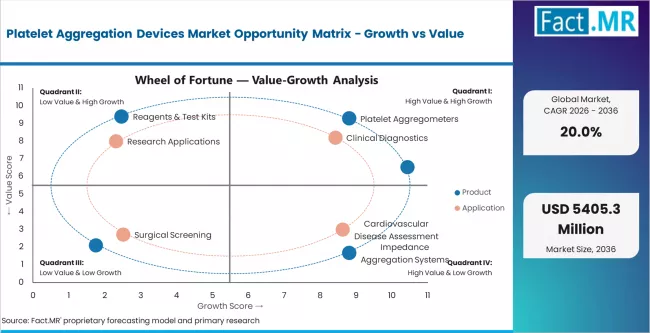
- Rising cardiovascular disease prevalence and antiplatelet drug monitoring adoption are the structural demand foundations.
- Pre-operative surgical screening is the key compositional shift driving premium growth above category rates.
- Test standardization variability, reagent cost pressure, and technician skill requirements remain the leading constraints.
The market scope is shaped by the combination of recurring reagent consumption across the installed base and premium growth in whole-blood testing platforms tied to cardiology workflows. Competitive advantage sits in reagent portfolio breadth, platform automation depth, and clinical lab channel integration.
Growth Drivers
The primary driver is the rising global burden of cardiovascular disease, which drives antiplatelet prescription volumes and associated laboratory monitoring. A second driver is the expansion of pre-operative platelet function screening in cardiac surgery, major orthopedic procedures, and other bleeding-risk contexts, which shifts demand toward high-volume automated platforms. A third driver is technology improvement in whole-blood impedance testing and multi-channel systems, which reduces sample preparation time and improves workflow fit. These three forces combine to deliver a high 20 percent CAGR with premium uplift from reagent consumption tied to the expanding installed base.
Constraints
The leading constraint is test standardization variability. Light transmission aggregometry remains the clinical reference method but suffers from meaningful inter-lab variability, which limits clinical confidence in cross-site comparisons. A second constraint is reagent cost pressure, particularly in price-sensitive emerging markets where hospital lab budgets are tight. A third constraint is technician skill requirements. Traditional aggregometry requires specialized technologist training that not all clinical labs can support, which limits adoption in smaller community hospital settings despite clinical interest.
Opportunities
The strongest opportunity lies in whole-blood testing platform expansion, where automated systems can capture premium revenue from high-volume cardiology labs seeking faster turnaround times. A second opportunity is reagent panel expansion, where vendors with broader stimulus reagent portfolios can capture more of each test workflow and strengthen margin positions. A third opportunity is emerging market penetration, particularly in China and India, where cardiac care capacity expansion and rising cardiovascular disease burden are both supporting device and reagent demand in metropolitan hospital networks.
Regional Outlook Across Key Markets
.webp)
- China leads country-level growth at 27% CAGR, supported by expanding cardiac care capacity, rising cardiovascular disease burden, and domestic diagnostic device manufacturing.
- India follows at 25%, driven by private hospital infrastructure expansion, rising antiplatelet prescription volumes, and growing cardiology specialty center presence.
- North America remains the largest regional pool by absolute value, with the USA at 19% supported by broad antiplatelet monitoring protocols and high per-capita diagnostic spending.
- European demand is led by Germany at 23% and the UK at 17%, with both countries showing strong cardiology screening infrastructure.
Country CAGR Table
| Country | CAGR (%) |
|---|---|
| China | 27% |
| India | 25% |
| Germany | 23% |
| Brazil | 21% |
| USA | 19% |
| UK | 17% |
| Japan | 15% |
Source: Fact.MR analysis, based on proprietary forecasting model and primary research.
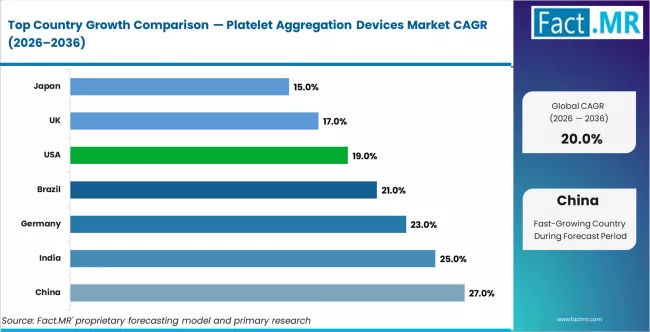
Regional dynamics split into three profiles. Asia Pacific leads on growth rate, pulled by expanding cardiac care capacity and rising cardiovascular disease burden across metropolitan areas. Europe grows at premium rates driven by mature cardiology infrastructure and active antiplatelet monitoring protocols. North America remains the largest dollar market, anchored by broad clinical adoption patterns and high per-capita diagnostic spending.
United States
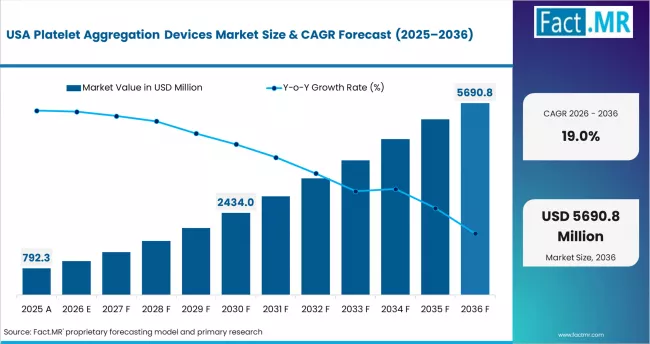
The United States anchors global demand through its large base of cardiology practices, broad antiplatelet therapy monitoring protocols, and established reimbursement for platelet function testing. Academic medical centers such as Cleveland Clinic, Mayo Clinic, and Johns Hopkins have long-standing platelet function laboratories, while community hospital networks are increasingly adopting whole-blood impedance systems for surgical screening. Werfen and Chrono-Log Corporation hold strong positions across the clinical lab channel.
- Broad antiplatelet monitoring protocols support recurring reagent consumption.
- Academic medical center concentration drives premium instrument placements.
- Community hospital networks are adopting whole-blood systems for surgical screening.
Canada
Canada represents a steady growth market shaped by provincial health system coverage for platelet function testing, hospital-led procurement patterns, and cross-border distribution relationships with US manufacturers. Academic hematology laboratories in Toronto, Montreal, and Vancouver drive the majority of test volumes, while provincial cardiac programs are expanding antiplatelet monitoring protocols.
- Provincial health system coverage supports predictable reagent consumption.
- Academic hematology laboratories drive test volume concentration.
- Cross-border distribution relationships with US manufacturers support product availability.
United Kingdom
The United Kingdom market is shaped by NHS England's cardiology service networks and the mix of NHS pathology labs and private diagnostic providers driving platelet function testing demand. NHS trusts deploy aggregometers across hematology departments, while private healthcare groups such as BUPA Healthcare and Nuffield Health support additional test volumes. Antiplatelet monitoring protocols in post-stent and acute coronary syndrome management are well established.
- NHS hematology pathology networks support broad aggregometer deployment.
- Private healthcare providers expand test access beyond NHS channels.
- Established antiplatelet monitoring protocols support recurring reagent demand.
Germany
Germany leads European growth on the strength of mature cardiology infrastructure, statutory insurance coverage for platelet function testing, and active research involvement in antiplatelet therapy clinical studies. German academic medical centers and university hospitals run some of the highest-volume platelet function laboratories in Europe, which creates stable baseline demand for both instruments and reagents. Werfen and Siemens Healthcare GmbH compete actively across the German clinical lab channel.
- Mature cardiology infrastructure supports high test volumes.
- Statutory insurance coverage provides predictable reimbursement.
- Research involvement in antiplatelet studies reinforces clinical demand.
China
China is the fastest-growing country in the forecast, driven by expanding cardiac care capacity, rising cardiovascular disease burden, and domestic diagnostic device manufacturing capability. Tier-1 hospital systems in Beijing, Shanghai, Guangzhou, and Shenzhen are adopting platelet function testing as part of standard cardiology workflows, while domestic manufacturers are building value-tier competition against imported brands. Provincial cardiac program expansion also creates demand for automated whole-blood testing systems in tier-2 cities.
- Tier-1 hospital adoption of platelet function testing drives premium instrument placements.
- Rising cardiovascular disease burden supports expanding reagent consumption.
- Domestic manufacturing capability creates value-tier competition in mid-market segments.
India
India represents a strong growth market driven by private hospital infrastructure expansion, rising antiplatelet prescription volumes, and the emergence of dedicated cardiology specialty centers. Apollo Hospitals, Fortis Healthcare, Max Healthcare, and other corporate hospital chains are expanding cardiology capabilities and adopting platelet function testing across their networks. Out-of-pocket payment dynamics create sensitivity to reagent pricing but also support premium hospital positioning in metropolitan areas.
- Corporate hospital chain expansion drives concentrated instrument and reagent procurement.
- Rising antiplatelet prescription volumes support reagent consumption growth.
- Specialty cardiology center expansion widens platelet testing access beyond academic medical centers.
Competitive Benchmarking and Company Positioning
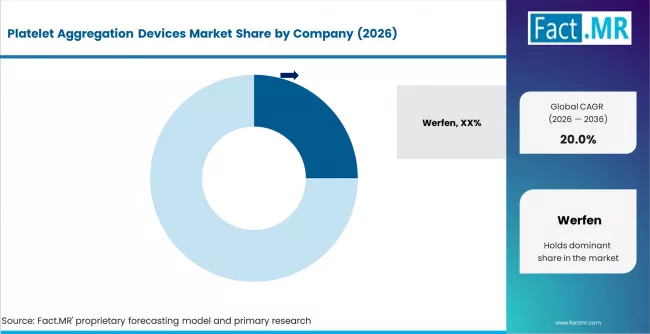
- Werfen leads with an estimated 25% share, supported by its Instrumentation Laboratory platform heritage, broad reagent portfolio, and strong clinical lab channel relationships.
- Helena Laboratories Corporation, Bio/Data Corporation, Chrono-Log Corporation, and F. Hoffmann-La Roche Ltd. compete through differentiated product portfolios and established clinical lab presence.
- Specialty platelet function players such as Aggredyne Inc., Pathway Diagnostics Limited, Haemochrom Diagnostica GmbH, and Tem Group hold focused positions in specific applications and geographies.
The competitive field is moderately concentrated, with Werfen commanding the leading share position through its Instrumentation Laboratory brand, which covers light transmission aggregometry, whole-blood systems, and automated platelet function analysis. Werfen's scale reach, reagent portfolio depth, and clinical lab channel relationships create meaningful competitive advantages that newer entrants have struggled to displace in established markets.
Helena Laboratories Corporation and Bio/Data Corporation anchor their positions through dedicated platelet function portfolios and strong reference laboratory presence in North America. Chrono-Log Corporation competes through its whole-blood aggregometer platform, which has been adopted across cardiology labs seeking faster turnaround times. F. Hoffmann-La Roche Ltd. and Siemens Healthcare GmbH compete across broader coagulation and hematology portfolios extended into platelet function applications. Haemonetics Corporation holds a position through its thromboelastography and platelet function platforms.
Strategic priorities across the field include expanding whole-blood testing platforms, deepening reagent panel portfolios, and building clinical evidence supporting antiplatelet monitoring protocols. Scaled manufacturers with broad product portfolios, strong reagent ecosystems, and dedicated clinical lab channel relationships will capture the bulk of forecast period growth, while specialty research-only players must differentiate through targeted innovation or niche application focus to sustain margins.
Competitive Analysis
Competitive positioning rests on three dimensions: instrument platform breadth, reagent portfolio depth, and clinical lab channel integration. Werfen leads across all three with Instrumentation Laboratory platforms covering optical, impedance, and whole-blood testing. Helena Laboratories Corporation and Bio/Data Corporation compete through dedicated platelet function specialization. Chrono-Log Corporation holds a strong position in whole-blood aggregometry particularly in North American cardiology labs.
Second-tier competitors maintain relevance through specialized platform designs, focused indication strategies, or regional market concentration. F. Hoffmann-La Roche Ltd., Siemens Healthcare GmbH, and Haemonetics Corporation leverage broader diagnostic portfolios to extend into platelet function applications. The gap between platform-level companies with integrated reagent ecosystems and specialty instrument manufacturers is widening as clinical labs prioritize workflow integration and reagent consolidation.
Benchmarking Table
| Company | Scale Reach | Product Breadth | Reagent Ecosystem | Clinical Lab Channel |
|---|---|---|---|---|
| Werfen | Global | Broad | Strong | Strong |
| Helena Laboratories Corporation | Global | Medium-Broad | Medium-Strong | Strong |
| Chrono-Log Corporation | Global | Medium | Medium | Strong (NA) |
| Bio/Data Corporation | Regional | Medium | Medium | Strong (NA) |
| F. Hoffmann-La Roche Ltd. | Global | Broad | Strong | Medium |
| Siemens Healthcare GmbH | Global | Broad | Medium | Strong |
| Haemonetics Corporation | Global | Medium | Medium | Medium-Strong |
Recent Developments
- In 2025, Werfen continued expanding its Instrumentation Laboratory platelet function portfolio with upgraded automated analyzers targeting high-volume cardiology lab workflows.
- In 2025, Haemonetics Corporation advanced its platelet function testing platform through product line updates tied to its broader hemostasis portfolio.
- In 2026, Siemens Healthcare GmbH strengthened its hematology and platelet function capabilities through integration with broader laboratory automation platforms.
Leading Companies Shaping Platelet Aggregation Devices Market
-
Major Players
- Werfen
- Helena Laboratories Corporation
- Bio/Data Corporation
- Chrono-Log Corporation
- F. Hoffmann-La Roche Ltd.
- Instrumentation Laboratory
- Haemonetics Corporation
- Siemens Healthcare GmbH
-
Emerging Players
- SENTINEL CH. SpA
- Aggredyne Inc.
- Pathway Diagnostics Limited
- Haemochrom Diagnostica GmbH
- Tem Group
- Nihon Kohden Corporation
- Diagnostica Stago
- Sysmex Corporation
Sources and Research References
- United States Food and Drug Administration (FDA) - 510(k) Clearance Database for Platelet Function Devices
- International Society on Thrombosis and Haemostasis (ISTH) - Clinical Practice Guidelines on Platelet Function Testing
- World Health Organization (WHO) - Global Cardiovascular Disease Burden Publications
- American Society of Hematology (ASH) - Platelet Disorder Diagnostic Guidelines
- Werfen - Annual Report and Hemostasis Segment Disclosures
- Haemonetics Corporation - Platelet Function Platform Portfolio Updates
- Primary interviews with hematology lab directors, cardiology specialists, and diagnostic distribution partners
This bibliography is provided for reader reference and is not exhaustive. The full report contains the complete reference list and detailed citations.
Key Questions This Report Addresses
- What is the current and future size of the platelet aggregation devices market?
- How fast is the market expected to grow between 2026 and 2036?
- Which product segment is likely to lead the market by 2026?
- Which application segment will account for the highest demand by 2026?
- How is antiplatelet drug monitoring reshaping demand patterns?
- Why are China and India emerging as the fastest-growing markets?
- Which countries are projected to show the fastest growth through 2036?
- Who are the key companies active in the platelet aggregation devices market?
- How is whole-blood testing technology changing the competitive dynamics?
Platelet Aggregation Devices Market Definition
The platelet aggregation devices market covers instruments, reagents, and consumables used to measure platelet function in blood samples for clinical diagnostic, surgical screening, and research applications. This includes platelet aggregometers based on light transmission, impedance, and whole-blood testing principles, along with reagent kits, calibration materials, cuvettes, and automated platelet function analysis platforms. The market spans hospitals, clinical pathology labs, cardiology departments, research institutes, and blood banks across primary use cases including clinical diagnostics, platelet function testing, bleeding disorder diagnosis, antiplatelet drug monitoring, and surgical screening.
Platelet Aggregation Devices Market Inclusions
The scope includes platelet aggregometers across optical aggregation systems, light transmission aggregometers (LTA), impedance aggregation systems, whole blood aggregometers, electrical impedance devices, multi-channel aggregation systems, reagents and test kits including ADP, collagen, and ristocetin reagents, platelet function test panels, and consumables including cuvettes, sampling tubes, calibration materials, and control materials. It covers applications across clinical diagnostics, platelet function testing, bleeding disorder diagnosis, cardiovascular disease assessment, thrombosis risk evaluation, myocardial infarction monitoring, research applications, drug development studies, antiplatelet drug testing, surgical screening, pre-operative bleeding risk analysis, and coagulation function assessment. Coverage spans hospitals, clinical pathology labs, cardiology departments, diagnostic laboratories, independent diagnostic centers, reference testing labs, research and academic institutes, biomedical research labs, university medical centers, blood banks, transfusion medicine units, and hemostasis testing facilities from 2026 to 2036.
Platelet Aggregation Devices Market Exclusions
The scope excludes general coagulation analyzers without dedicated platelet function testing capability, hematology cell counters used for platelet count rather than function, point-of-care anticoagulation monitoring devices, and stand-alone thromboelastography systems. It also excludes blood typing equipment, flow cytometers not configured for platelet function applications, and software-only platforms without instrument integration. Reusable general-purpose laboratory pipettes and consumables outside platelet-specific workflows are outside the scope.
Platelet Aggregation Devices Market Research Methodology
- Primary Research: Interviews with hematology and cardiology lab directors, clinical pathology managers, platelet aggregation device manufacturers, and specialty diagnostic distribution partners to validate test volumes, pricing dynamics, and clinical adoption patterns.
- Desk Research: Review of FDA 510(k) clearances for platelet function devices, CE mark filings, clinical society guidelines from ISTH and ASCLS, and published studies on antiplatelet therapy monitoring outcomes.
- Market Sizing: Demand-side model built on hospital and lab counts, cardiology procedure volumes, surgical screening test rates, reagent consumption per instrument, and per-test pricing, triangulated with top-down shipment disclosures from listed players.
- Data Validation: Cross-validation across primary interviews, regulatory filings, diagnostic coding data, and hematology society publications, with sensitivity analysis on antiplatelet monitoring penetration rates and whole-blood testing adoption timelines.
Scope of Analysis

| Parameter | Details |
|---|---|
| Quantitative Units | USD 872.99 million to USD 5,405.30 million, at a CAGR of 20.0% |
| Market Definition | The platelet aggregation devices market covers instruments, reagents, and consumables used to measure platelet function in blood samples for clinical diagnostic, surgical screening, and research applications, spanning aggregometers, reagent kits, and consumables. |
| Regions Covered | North America, Latin America, Europe, East Asia, South Asia and Pacific, Middle East and Africa |
| Countries Covered | USA, Canada, UK, Germany, China, India, Brazil, Japan, 30 plus countries |
| Key Companies | Werfen, Helena Laboratories Corporation, Bio/Data Corporation, Chrono-Log Corporation, F. Hoffmann-La Roche Ltd., Instrumentation Laboratory, Haemonetics Corporation, Siemens Healthcare GmbH |
| Forecast Period | 2026 to 2036 |
| Approach | Hybrid demand-side and top-down methodology built on hospital and lab counts, cardiology procedure volumes, surgical screening test rates, reagent consumption per instrument, per-test pricing, and primary interviews across hematology lab directors, manufacturers, and distribution partners |
Market Segmentation Analysis
-
Platelet Aggregation Devices Market Market Segmented by Product:
- Platelet Aggregometers
- Optical Aggregation Systems
- Light Transmission Aggregometers (LTA)
- Optical Aggregation Systems
- Impedance Aggregation Systems
- Whole Blood Aggregometers
- Electrical Impedance Devices
- Whole Blood Aggregometers
- Reagents & Test Kits
- ADP / Collagen / Ristocetin Reagents
- Platelet Function Test Panels
- ADP / Collagen / Ristocetin Reagents
- Consumables & Accessories
- Cuvettes & Sampling Tubes
- Calibration & Control Materials
- Cuvettes & Sampling Tubes
- Multi-Channel Aggregation Systems
- Dual / Four / Eight Channel Systems
- Automated Platelet Analyzers
- Dual / Four / Eight Channel Systems
- Platelet Aggregometers
-
Platelet Aggregation Devices Market Market Segmented by Application:
- Clinical Diagnostics
- Platelet Function Testing
- Bleeding Disorder Diagnosis
- Platelet Function Testing
- Cardiovascular Disease Assessment
- Thrombosis Risk Evaluation
- Myocardial Infarction Monitoring
- Thrombosis Risk Evaluation
- Research Applications
- Drug Development Studies
- Antiplatelet Drug Testing
- Drug Development Studies
- Surgical Screening
- Pre-Operative Bleeding Risk Analysis
- Coagulation Function Assessment
- Pre-Operative Bleeding Risk Analysis
- Clinical Diagnostics
-
Platelet Aggregation Devices Market Market Segmented by End Use:
- Hospitals
- Clinical Pathology Labs
- Cardiology Departments
- Clinical Pathology Labs
- Diagnostic Laboratories
- Independent Diagnostic Centers
- Reference Testing Labs
- Independent Diagnostic Centers
- Research & Academic Institutes
- Biomedical Research Labs
- University Medical Centers
- Biomedical Research Labs
- Blood Banks
- Transfusion Medicine Units
- Hemostasis Testing Facilities
- Transfusion Medicine Units
- Hospitals
-
Platelet Aggregation Devices Market Market Segmented by Technology:
- Light Transmission Aggregometry
- Optical Density Measurement Systems
- Photometric Platelet Analysis
- Optical Density Measurement Systems
- Impedance Aggregometry
- Electrical Resistance Measurement
- Whole Blood Testing Technology
- Electrical Resistance Measurement
- Automated Platelet Function Analysis
- Computerized Diagnostic Systems
- Real-Time Data Analysis Platforms
- Computerized Diagnostic Systems
- Multi-Channel Testing Technology
- Parallel Sample Processing Systems
- High-Throughput Aggregation Systems
- Parallel Sample Processing Systems
- Light Transmission Aggregometry
-
Platelet Aggregation Devices Market Market Segmented by Distribution Channel:
- Direct Sales
- Medical Device Manufacturers
- Hospital Procurement Contracts
- Medical Device Manufacturers
- Specialty Distributors
- Diagnostic Equipment Suppliers
- Regional Lab Vendors
- Diagnostic Equipment Suppliers
- Online Medical Supply
- B2B Healthcare Platforms
- Digital Procurement Systems
- B2B Healthcare Platforms
- Direct Sales
-
Platelet Aggregation Devices Market Market Segmented by Packaging:
- Laboratory Instrument Kits
- Pre-Assembled Aggregation Systems
- Installation Ready Analyzer Kits
- Pre-Assembled Aggregation Systems
- Reagent Packaging
- Cold Storage Test Kits
- Sealed Diagnostic Reagent Packs
- Cold Storage Test Kits
- Consumable Packs
- Disposable Lab Accessories Kits
- Cuvette & Tube Packaging Sets
- Disposable Lab Accessories Kits
- Laboratory Instrument Kits
-
Platelet Aggregation Devices Market Market by Region:
- North America
- USA
- Canada
- Mexico
- Latin America
- Brazil
- Chile
- Rest of Latin America
- Western Europe
- Germany
- UK
- Italy
- Spain
- France
- Nordic
- BENELUX
- Rest of Western Europe
- Eastern Europe
- Russia
- Poland
- Hungary
- Balkan & Baltic
- Rest of Eastern Europe
- East Asia
- China
- Japan
- South Korea
- South Asia and Pacific
- India
- ASEAN
- Australia & New Zealand
- Rest of South Asia and Pacific
- Middle East & Africa
- Kingdom of Saudi Arabia
- Other GCC Countries
- Turkiye
- South Africa
- Other African Union
- Rest of Middle East & Africa
- North America
Table of Content
- Executive Summary
- Global Market Outlook
- Demand to side Trends
- Supply to side Trends
- Technology Roadmap Analysis
- Analysis and Recommendations
- Market Overview
- Market Coverage / Taxonomy
- Market Definition / Scope / Limitations
- Research Methodology
- Chapter Orientation
- Analytical Lens and Working Hypotheses
- Market Structure, Signals, and Trend Drivers
- Benchmarking and Cross-market Comparability
- Market Sizing, Forecasting, and Opportunity Mapping
- Research Design and Evidence Framework
- Desk Research Programme (Secondary Evidence)
- Company Annual and Sustainability Reports
- Peer-reviewed Journals and Academic Literature
- Corporate Websites, Product Literature, and Technical Notes
- Earnings Decks and Investor Briefings
- Statutory Filings and Regulatory Disclosures
- Technical White Papers and Standards Notes
- Trade Journals, Industry Magazines, and Analyst Briefs
- Conference Proceedings, Webinars, and Seminar Materials
- Government Statistics Portals and Public Data Releases
- Press Releases and Reputable Media Coverage
- Specialist Newsletters and Curated Briefings
- Sector Databases and Reference Repositories
- Fact.MR Internal Proprietary Databases and Historical Market Datasets
- Subscription Datasets and Paid Sources
- Social Channels, Communities, and Digital Listening Inputs
- Additional Desk Sources
- Expert Input and Fieldwork (Primary Evidence)
- Primary Modes
- Qualitative Interviews and Expert Elicitation
- Quantitative Surveys and Structured Data Capture
- Blended Approach
- Why Primary Evidence is Used
- Field Techniques
- Interviews
- Surveys
- Focus Groups
- Observational and In-context Research
- Social and Community Interactions
- Stakeholder Universe Engaged
- C-suite Leaders
- Board Members
- Presidents and Vice Presidents
- R&D and Innovation Heads
- Technical Specialists
- Domain Subject-matter Experts
- Scientists
- Physicians and Other Healthcare Professionals
- Governance, Ethics, and Data Stewardship
- Research Ethics
- Data Integrity and Handling
- Primary Modes
- Tooling, Models, and Reference Databases
- Desk Research Programme (Secondary Evidence)
- Data Engineering and Model Build
- Data Acquisition and Ingestion
- Cleaning, Normalisation, and Verification
- Synthesis, Triangulation, and Analysis
- Quality Assurance and Audit Trail
- Market Background
- Market Dynamics
- Drivers
- Restraints
- Opportunity
- Trends
- Scenario Forecast
- Demand in Optimistic Scenario
- Demand in Likely Scenario
- Demand in Conservative Scenario
- Opportunity Map Analysis
- Product Life Cycle Analysis
- Supply Chain Analysis
- Investment Feasibility Matrix
- Value Chain Analysis
- PESTLE and Porter’s Analysis
- Regulatory Landscape
- Regional Parent Market Outlook
- Production and Consumption Statistics
- Import and Export Statistics
- Market Dynamics
- Global Market Analysis 2021 to 2025 and Forecast, 2026 to 2036
- Historical Market Size Value (USD Million) Analysis, 2021 to 2025
- Current and Future Market Size Value (USD Million) Projections, 2026 to 2036
- Y to o to Y Growth Trend Analysis
- Absolute $ Opportunity Analysis
- Global Market Pricing Analysis 2021 to 2025 and Forecast 2026 to 2036
- Global Market Analysis 2021 to 2025 and Forecast 2026 to 2036, By Product
- Introduction / Key Findings
- Historical Market Size Value (USD Million) Analysis By Product , 2021 to 2025
- Current and Future Market Size Value (USD Million) Analysis and Forecast By Product , 2026 to 2036
- Platelet Aggregometers
- Optical Aggregation Systems
- _Light Transmission Aggregometers (LTA)
- Impedance Aggregation Systems
- Whole Blood Aggregometers
- _Electrical Impedance Devices
- Reagents & Test Kits
- ADP / Collagen / Ristocetin Reagents
- _Platelet Function Test Panels
- Consumables & Accessories
- Cuvettes & Sampling Tubes
- _Calibration & Control Materials
- Multi-Channel Aggregation Systems
- Dual / Four / Eight Channel Systems
- _Automated Platelet Analyzers
- Platelet Aggregometers
- Y to o to Y Growth Trend Analysis By Product , 2021 to 2025
- Absolute $ Opportunity Analysis By Product , 2026 to 2036
- Global Market Analysis 2021 to 2025 and Forecast 2026 to 2036, By Application
- Introduction / Key Findings
- Historical Market Size Value (USD Million) Analysis By Application, 2021 to 2025
- Current and Future Market Size Value (USD Million) Analysis and Forecast By Application, 2026 to 2036
- Clinical Diagnostics
- Platelet Function Testing
- _Bleeding Disorder Diagnosis
- Cardiovascular Disease Assessment
- Thrombosis Risk Evaluation
- _Myocardial Infarction Monitoring
- Research Applications
- Drug Development Studies
- _Antiplatelet Drug Testing
- Surgical Screening
- Pre-Operative Bleeding Risk Analysis
- _Coagulation Function Assessment
- Clinical Diagnostics
- Y to o to Y Growth Trend Analysis By Application, 2021 to 2025
- Absolute $ Opportunity Analysis By Application, 2026 to 2036
- Global Market Analysis 2021 to 2025 and Forecast 2026 to 2036, By End Use
- Introduction / Key Findings
- Historical Market Size Value (USD Million) Analysis By End Use, 2021 to 2025
- Current and Future Market Size Value (USD Million) Analysis and Forecast By End Use, 2026 to 2036
- Hospitals
- Clinical Pathology Labs
- _Cardiology Departments
- Diagnostic Laboratories
- Independent Diagnostic Centers
- _Reference Testing Labs
- Research & Academic Institutes
- Biomedical Research Labs
- _University Medical Centers
- Blood Banks
- Transfusion Medicine Value (USD Million)s
- _Hemostasis Testing Facilities
- Hospitals
- Y to o to Y Growth Trend Analysis By End Use, 2021 to 2025
- Absolute $ Opportunity Analysis By End Use, 2026 to 2036
- Global Market Analysis 2021 to 2025 and Forecast 2026 to 2036, By Technology
- Introduction / Key Findings
- Historical Market Size Value (USD Million) Analysis By Technology, 2021 to 2025
- Current and Future Market Size Value (USD Million) Analysis and Forecast By Technology, 2026 to 2036
- Light Transmission Aggregometry
- Optical Density Measurement Systems
- _Photometric Platelet Analysis
- Impedance Aggregometry
- Electrical Resistance Measurement
- _Whole Blood Testing Technology
- Automated Platelet Function Analysis
- Computerized Diagnostic Systems
- _Real-Time Data Analysis Platforms
- Multi-Channel Testing Technology
- Parallel Sample Processing Systems
- _High-Throughput Aggregation Systems
- Light Transmission Aggregometry
- Y to o to Y Growth Trend Analysis By Technology, 2021 to 2025
- Absolute $ Opportunity Analysis By Technology, 2026 to 2036
- Global Market Analysis 2021 to 2025 and Forecast 2026 to 2036, By Distribution Channel
- Introduction / Key Findings
- Historical Market Size Value (USD Million) Analysis By Distribution Channel, 2021 to 2025
- Current and Future Market Size Value (USD Million) Analysis and Forecast By Distribution Channel, 2026 to 2036
- Direct Sales
- Medical Device Manufacturers
- _Hospital Procurement Contracts
- Specialty Distributors
- Diagnostic Equipment Suppliers
- _Regional Lab Vendors
- Online Medical Supply
- B2B Healthcare Platforms
- _Digital Procurement Systems
- Direct Sales
- Y to o to Y Growth Trend Analysis By Distribution Channel, 2021 to 2025
- Absolute $ Opportunity Analysis By Distribution Channel, 2026 to 2036
- Global Market Analysis 2021 to 2025 and Forecast 2026 to 2036, By Packaging
- Introduction / Key Findings
- Historical Market Size Value (USD Million) Analysis By Packaging, 2021 to 2025
- Current and Future Market Size Value (USD Million) Analysis and Forecast By Packaging, 2026 to 2036
- Laboratory Instrument Kits
- Pre-Assembled Aggregation Systems
- _Installation Ready Analyzer Kits
- Reagent Packaging
- Cold Storage Test Kits
- _Sealed Diagnostic Reagent Packs
- Consumable Packs
- Disposable Lab Accessories Kits
- _Cuvette & Tube Packaging Sets
- Laboratory Instrument Kits
- Y to o to Y Growth Trend Analysis By Packaging, 2021 to 2025
- Absolute $ Opportunity Analysis By Packaging, 2026 to 2036
- Global Market Analysis 2021 to 2025 and Forecast 2026 to 2036, By Region
- Introduction
- Historical Market Size Value (USD Million) Analysis By Region, 2021 to 2025
- Current Market Size Value (USD Million) Analysis and Forecast By Region, 2026 to 2036
- North America
- Latin America
- Western Europe
- Eastern Europe
- East Asia
- South Asia and Pacific
- Middle East & Africa
- Market Attractiveness Analysis By Region
- North America Market Analysis 2021 to 2025 and Forecast 2026 to 2036, By Country
- Historical Market Size Value (USD Million) Trend Analysis By Market Taxonomy, 2021 to 2025
- Market Size Value (USD Million) Forecast By Market Taxonomy, 2026 to 2036
- By Country
- USA
- Canada
- Mexico
- By Product
- By Application
- By End Use
- By Technology
- By Distribution Channel
- By Packaging
- By Country
- Market Attractiveness Analysis
- By Country
- By Product
- By Application
- By End Use
- By Technology
- By Distribution Channel
- By Packaging
- Key Takeaways
- Latin America Market Analysis 2021 to 2025 and Forecast 2026 to 2036, By Country
- Historical Market Size Value (USD Million) Trend Analysis By Market Taxonomy, 2021 to 2025
- Market Size Value (USD Million) Forecast By Market Taxonomy, 2026 to 2036
- By Country
- Brazil
- Chile
- Rest of Latin America
- By Product
- By Application
- By End Use
- By Technology
- By Distribution Channel
- By Packaging
- By Country
- Market Attractiveness Analysis
- By Country
- By Product
- By Application
- By End Use
- By Technology
- By Distribution Channel
- By Packaging
- Key Takeaways
- Western Europe Market Analysis 2021 to 2025 and Forecast 2026 to 2036, By Country
- Historical Market Size Value (USD Million) Trend Analysis By Market Taxonomy, 2021 to 2025
- Market Size Value (USD Million) Forecast By Market Taxonomy, 2026 to 2036
- By Country
- Germany
- UK
- Italy
- Spain
- France
- Nordic
- BENELUX
- Rest of Western Europe
- By Product
- By Application
- By End Use
- By Technology
- By Distribution Channel
- By Packaging
- By Country
- Market Attractiveness Analysis
- By Country
- By Product
- By Application
- By End Use
- By Technology
- By Distribution Channel
- By Packaging
- Key Takeaways
- Eastern Europe Market Analysis 2021 to 2025 and Forecast 2026 to 2036, By Country
- Historical Market Size Value (USD Million) Trend Analysis By Market Taxonomy, 2021 to 2025
- Market Size Value (USD Million) Forecast By Market Taxonomy, 2026 to 2036
- By Country
- Russia
- Poland
- Hungary
- Balkan & Baltic
- Rest of Eastern Europe
- By Product
- By Application
- By End Use
- By Technology
- By Distribution Channel
- By Packaging
- By Country
- Market Attractiveness Analysis
- By Country
- By Product
- By Application
- By End Use
- By Technology
- By Distribution Channel
- By Packaging
- Key Takeaways
- East Asia Market Analysis 2021 to 2025 and Forecast 2026 to 2036, By Country
- Historical Market Size Value (USD Million) Trend Analysis By Market Taxonomy, 2021 to 2025
- Market Size Value (USD Million) Forecast By Market Taxonomy, 2026 to 2036
- By Country
- China
- Japan
- South Korea
- By Product
- By Application
- By End Use
- By Technology
- By Distribution Channel
- By Packaging
- By Country
- Market Attractiveness Analysis
- By Country
- By Product
- By Application
- By End Use
- By Technology
- By Distribution Channel
- By Packaging
- Key Takeaways
- South Asia and Pacific Market Analysis 2021 to 2025 and Forecast 2026 to 2036, By Country
- Historical Market Size Value (USD Million) Trend Analysis By Market Taxonomy, 2021 to 2025
- Market Size Value (USD Million) Forecast By Market Taxonomy, 2026 to 2036
- By Country
- India
- ASEAN
- Australia & New Zealand
- Rest of South Asia and Pacific
- By Product
- By Application
- By End Use
- By Technology
- By Distribution Channel
- By Packaging
- By Country
- Market Attractiveness Analysis
- By Country
- By Product
- By Application
- By End Use
- By Technology
- By Distribution Channel
- By Packaging
- Key Takeaways
- Middle East & Africa Market Analysis 2021 to 2025 and Forecast 2026 to 2036, By Country
- Historical Market Size Value (USD Million) Trend Analysis By Market Taxonomy, 2021 to 2025
- Market Size Value (USD Million) Forecast By Market Taxonomy, 2026 to 2036
- By Country
- Kingdom of Saudi Arabia
- Other GCC Countries
- Turkiye
- South Africa
- Other African Union
- Rest of Middle East & Africa
- By Product
- By Application
- By End Use
- By Technology
- By Distribution Channel
- By Packaging
- By Country
- Market Attractiveness Analysis
- By Country
- By Product
- By Application
- By End Use
- By Technology
- By Distribution Channel
- By Packaging
- Key Takeaways
- Key Countries Market Analysis
- USA
- Pricing Analysis
- Market Share Analysis, 2025
- By Product
- By Application
- By End Use
- By Technology
- By Distribution Channel
- By Packaging
- Canada
- Pricing Analysis
- Market Share Analysis, 2025
- By Product
- By Application
- By End Use
- By Technology
- By Distribution Channel
- By Packaging
- Mexico
- Pricing Analysis
- Market Share Analysis, 2025
- By Product
- By Application
- By End Use
- By Technology
- By Distribution Channel
- By Packaging
- Brazil
- Pricing Analysis
- Market Share Analysis, 2025
- By Product
- By Application
- By End Use
- By Technology
- By Distribution Channel
- By Packaging
- Chile
- Pricing Analysis
- Market Share Analysis, 2025
- By Product
- By Application
- By End Use
- By Technology
- By Distribution Channel
- By Packaging
- Germany
- Pricing Analysis
- Market Share Analysis, 2025
- By Product
- By Application
- By End Use
- By Technology
- By Distribution Channel
- By Packaging
- UK
- Pricing Analysis
- Market Share Analysis, 2025
- By Product
- By Application
- By End Use
- By Technology
- By Distribution Channel
- By Packaging
- Italy
- Pricing Analysis
- Market Share Analysis, 2025
- By Product
- By Application
- By End Use
- By Technology
- By Distribution Channel
- By Packaging
- Spain
- Pricing Analysis
- Market Share Analysis, 2025
- By Product
- By Application
- By End Use
- By Technology
- By Distribution Channel
- By Packaging
- France
- Pricing Analysis
- Market Share Analysis, 2025
- By Product
- By Application
- By End Use
- By Technology
- By Distribution Channel
- By Packaging
- India
- Pricing Analysis
- Market Share Analysis, 2025
- By Product
- By Application
- By End Use
- By Technology
- By Distribution Channel
- By Packaging
- ASEAN
- Pricing Analysis
- Market Share Analysis, 2025
- By Product
- By Application
- By End Use
- By Technology
- By Distribution Channel
- By Packaging
- Australia & New Zealand
- Pricing Analysis
- Market Share Analysis, 2025
- By Product
- By Application
- By End Use
- By Technology
- By Distribution Channel
- By Packaging
- China
- Pricing Analysis
- Market Share Analysis, 2025
- By Product
- By Application
- By End Use
- By Technology
- By Distribution Channel
- By Packaging
- Japan
- Pricing Analysis
- Market Share Analysis, 2025
- By Product
- By Application
- By End Use
- By Technology
- By Distribution Channel
- By Packaging
- South Korea
- Pricing Analysis
- Market Share Analysis, 2025
- By Product
- By Application
- By End Use
- By Technology
- By Distribution Channel
- By Packaging
- Russia
- Pricing Analysis
- Market Share Analysis, 2025
- By Product
- By Application
- By End Use
- By Technology
- By Distribution Channel
- By Packaging
- Poland
- Pricing Analysis
- Market Share Analysis, 2025
- By Product
- By Application
- By End Use
- By Technology
- By Distribution Channel
- By Packaging
- Hungary
- Pricing Analysis
- Market Share Analysis, 2025
- By Product
- By Application
- By End Use
- By Technology
- By Distribution Channel
- By Packaging
- Kingdom of Saudi Arabia
- Pricing Analysis
- Market Share Analysis, 2025
- By Product
- By Application
- By End Use
- By Technology
- By Distribution Channel
- By Packaging
- Turkiye
- Pricing Analysis
- Market Share Analysis, 2025
- By Product
- By Application
- By End Use
- By Technology
- By Distribution Channel
- By Packaging
- South Africa
- Pricing Analysis
- Market Share Analysis, 2025
- By Product
- By Application
- By End Use
- By Technology
- By Distribution Channel
- By Packaging
- USA
- Market Structure Analysis
- Competition Dashboard
- Competition Benchmarking
- Market Share Analysis of Top Players
- By Regional
- By Product
- By Application
- By End Use
- By Technology
- By Distribution Channel
- By Packaging
- Competition Analysis
- Competition Deep Dive
- Werfen
- Overview
- Product Portfolio
- Profitability by Market Segments (Product/Age /Sales Channel/Region)
- Sales Footprint
- Strategy Overview
- Marketing Strategy
- Product Strategy
- Channel Strategy
- Helena Laboratories Corporation
- Bio/Data Corporation
- Chrono-Log Corporation
- F. Hoffmann-La Roche Ltd.
- Instrumentation Laboratory
- Haemonetics Corporation
- Siemens Healthcare GmbH
- SENTINEL CH. SpA
- Aggredyne Inc.
- Pathway Diagnostics Limited
- Haemochrom Diagnostica GmbH
- Tem Group
- Werfen
- Competition Deep Dive
- Assumptions & Acronyms Used
List Of Table
- Table 1: Global Market Value (USD Million) Forecast by Region, 2021 to 2036
- Table 2: Global Market Value (USD Million) Forecast by Product , 2021 to 2036
- Table 3: Global Market Value (USD Million) Forecast by Application, 2021 to 2036
- Table 4: Global Market Value (USD Million) Forecast by End Use, 2021 to 2036
- Table 5: Global Market Value (USD Million) Forecast by Technology, 2021 to 2036
- Table 6: Global Market Value (USD Million) Forecast by Distribution Channel, 2021 to 2036
- Table 7: Global Market Value (USD Million) Forecast by Packaging, 2021 to 2036
- Table 8: North America Market Value (USD Million) Forecast by Country, 2021 to 2036
- Table 9: North America Market Value (USD Million) Forecast by Product , 2021 to 2036
- Table 10: North America Market Value (USD Million) Forecast by Application, 2021 to 2036
- Table 11: North America Market Value (USD Million) Forecast by End Use, 2021 to 2036
- Table 12: North America Market Value (USD Million) Forecast by Technology, 2021 to 2036
- Table 13: North America Market Value (USD Million) Forecast by Distribution Channel, 2021 to 2036
- Table 14: North America Market Value (USD Million) Forecast by Packaging, 2021 to 2036
- Table 15: Latin America Market Value (USD Million) Forecast by Country, 2021 to 2036
- Table 16: Latin America Market Value (USD Million) Forecast by Product , 2021 to 2036
- Table 17: Latin America Market Value (USD Million) Forecast by Application, 2021 to 2036
- Table 18: Latin America Market Value (USD Million) Forecast by End Use, 2021 to 2036
- Table 19: Latin America Market Value (USD Million) Forecast by Technology, 2021 to 2036
- Table 20: Latin America Market Value (USD Million) Forecast by Distribution Channel, 2021 to 2036
- Table 21: Latin America Market Value (USD Million) Forecast by Packaging, 2021 to 2036
- Table 22: Western Europe Market Value (USD Million) Forecast by Country, 2021 to 2036
- Table 23: Western Europe Market Value (USD Million) Forecast by Product , 2021 to 2036
- Table 24: Western Europe Market Value (USD Million) Forecast by Application, 2021 to 2036
- Table 25: Western Europe Market Value (USD Million) Forecast by End Use, 2021 to 2036
- Table 26: Western Europe Market Value (USD Million) Forecast by Technology, 2021 to 2036
- Table 27: Western Europe Market Value (USD Million) Forecast by Distribution Channel, 2021 to 2036
- Table 28: Western Europe Market Value (USD Million) Forecast by Packaging, 2021 to 2036
- Table 29: Eastern Europe Market Value (USD Million) Forecast by Country, 2021 to 2036
- Table 30: Eastern Europe Market Value (USD Million) Forecast by Product , 2021 to 2036
- Table 31: Eastern Europe Market Value (USD Million) Forecast by Application, 2021 to 2036
- Table 32: Eastern Europe Market Value (USD Million) Forecast by End Use, 2021 to 2036
- Table 33: Eastern Europe Market Value (USD Million) Forecast by Technology, 2021 to 2036
- Table 34: Eastern Europe Market Value (USD Million) Forecast by Distribution Channel, 2021 to 2036
- Table 35: Eastern Europe Market Value (USD Million) Forecast by Packaging, 2021 to 2036
- Table 36: East Asia Market Value (USD Million) Forecast by Country, 2021 to 2036
- Table 37: East Asia Market Value (USD Million) Forecast by Product , 2021 to 2036
- Table 38: East Asia Market Value (USD Million) Forecast by Application, 2021 to 2036
- Table 39: East Asia Market Value (USD Million) Forecast by End Use, 2021 to 2036
- Table 40: East Asia Market Value (USD Million) Forecast by Technology, 2021 to 2036
- Table 41: East Asia Market Value (USD Million) Forecast by Distribution Channel, 2021 to 2036
- Table 42: East Asia Market Value (USD Million) Forecast by Packaging, 2021 to 2036
- Table 43: South Asia and Pacific Market Value (USD Million) Forecast by Country, 2021 to 2036
- Table 44: South Asia and Pacific Market Value (USD Million) Forecast by Product , 2021 to 2036
- Table 45: South Asia and Pacific Market Value (USD Million) Forecast by Application, 2021 to 2036
- Table 46: South Asia and Pacific Market Value (USD Million) Forecast by End Use, 2021 to 2036
- Table 47: South Asia and Pacific Market Value (USD Million) Forecast by Technology, 2021 to 2036
- Table 48: South Asia and Pacific Market Value (USD Million) Forecast by Distribution Channel, 2021 to 2036
- Table 49: South Asia and Pacific Market Value (USD Million) Forecast by Packaging, 2021 to 2036
- Table 50: Middle East & Africa Market Value (USD Million) Forecast by Country, 2021 to 2036
- Table 51: Middle East & Africa Market Value (USD Million) Forecast by Product , 2021 to 2036
- Table 52: Middle East & Africa Market Value (USD Million) Forecast by Application, 2021 to 2036
- Table 53: Middle East & Africa Market Value (USD Million) Forecast by End Use, 2021 to 2036
- Table 54: Middle East & Africa Market Value (USD Million) Forecast by Technology, 2021 to 2036
- Table 55: Middle East & Africa Market Value (USD Million) Forecast by Distribution Channel, 2021 to 2036
- Table 56: Middle East & Africa Market Value (USD Million) Forecast by Packaging, 2021 to 2036
List Of Figures
- Figure 1: Global Market Pricing Analysis
- Figure 2: Global Market Value (USD Million) Forecast 2021-2036
- Figure 3: Global Market Value Share and BPS Analysis by Product, 2026 and 2036
- Figure 4: Global Market Y-o-Y Growth Comparison by Product,2026 to 2036
- Figure 5: Global Market Attractiveness Analysis by Product
- Figure 6: Global Market Value Share and BPS Analysis by Application, 2026 and 2036
- Figure 7: Global Market Y-o-Y Growth Comparison by Application,2026 to 2036
- Figure 8: Global Market Attractiveness Analysis by Application
- Figure 9: Global Market Value Share and BPS Analysis by End Use, 2026 and 2036
- Figure 10: Global Market Y-o-Y Growth Comparison by End Use,2026 to 2036
- Figure 11: Global Market Attractiveness Analysis by End Use
- Figure 12: Global Market Value Share and BPS Analysis by Technology, 2026 and 2036
- Figure 13: Global Market Y-o-Y Growth Comparison by Technology,2026 to 2036
- Figure 14: Global Market Attractiveness Analysis by Technology
- Figure 15: Global Market Value Share and BPS Analysis by Distribution Channel, 2026 and 2036
- Figure 16: Global Market Y-o-Y Growth Comparison by Distribution Channel,2026 to 2036
- Figure 17: Global Market Attractiveness Analysis by Distribution Channel
- Figure 18: Global Market Value Share and BPS Analysis by Packaging, 2026 and 2036
- Figure 19: Global Market Y-o-Y Growth Comparison by Packaging,2026 to 2036
- Figure 20: Global Market Attractiveness Analysis by Packaging
- Figure 21: Global Market Value (USD Million) Share and BPS Analysis by Region, 2026 and 2036
- Figure 22: Global Market Y-o-Y Growth Comparison by Region,2026 to 2036
- Figure 23: Global Market Attractiveness Analysis by Region
- Figure 24: North America Market Incremental Dollar Opportunity,2026 to 2036
- Figure 25: Latin America Market Incremental Dollar Opportunity,2026 to 2036
- Figure 26: Western Europe Market Incremental Dollar Opportunity,2026 to 2036
- Figure 27: Eastern Europe Market Incremental Dollar Opportunity,2026 to 2036
- Figure 28: East Asia Market Incremental Dollar Opportunity,2026 to 2036
- Figure 29: South Asia and Pacific Market Incremental Dollar Opportunity,2026 to 2036
- Figure 30: Middle East & Africa Market Incremental Dollar Opportunity,2026 to 2036
- Figure 31: North America Market Value Share and BPS Analysis by Country, 2026 and 2036
- Figure 32: North America Market Value Share and BPS Analysis by Product, 2026 and 2036
- Figure 33: North America Market Y-o-Y Growth Comparison by Product,2026 to 2036
- Figure 34: North America Market Attractiveness Analysis by Product
- Figure 35: North America Market Value Share and BPS Analysis by Application, 2026 and 2036
- Figure 36: North America Market Y-o-Y Growth Comparison by Application,2026 to 2036
- Figure 37: North America Market Attractiveness Analysis by Application
- Figure 38: North America Market Value Share and BPS Analysis by End Use, 2026 and 2036
- Figure 39: North America Market Y-o-Y Growth Comparison by End Use,2026 to 2036
- Figure 40: North America Market Attractiveness Analysis by End Use
- Figure 41: North America Market Value Share and BPS Analysis by Technology, 2026 and 2036
- Figure 42: North America Market Y-o-Y Growth Comparison by Technology,2026 to 2036
- Figure 43: North America Market Attractiveness Analysis by Technology
- Figure 44: North America Market Value Share and BPS Analysis by Distribution Channel, 2026 and 2036
- Figure 45: North America Market Y-o-Y Growth Comparison by Distribution Channel,2026 to 2036
- Figure 46: North America Market Attractiveness Analysis by Distribution Channel
- Figure 47: North America Market Value Share and BPS Analysis by Packaging, 2026 and 2036
- Figure 48: North America Market Y-o-Y Growth Comparison by Packaging,2026 to 2036
- Figure 49: North America Market Attractiveness Analysis by Packaging
- Figure 50: Latin America Market Value Share and BPS Analysis by Country, 2026 and 2036
- Figure 51: Latin America Market Value Share and BPS Analysis by Product, 2026 and 2036
- Figure 52: Latin America Market Y-o-Y Growth Comparison by Product,2026 to 2036
- Figure 53: Latin America Market Attractiveness Analysis by Product
- Figure 54: Latin America Market Value Share and BPS Analysis by Application, 2026 and 2036
- Figure 55: Latin America Market Y-o-Y Growth Comparison by Application,2026 to 2036
- Figure 56: Latin America Market Attractiveness Analysis by Application
- Figure 57: Latin America Market Value Share and BPS Analysis by End Use, 2026 and 2036
- Figure 58: Latin America Market Y-o-Y Growth Comparison by End Use,2026 to 2036
- Figure 59: Latin America Market Attractiveness Analysis by End Use
- Figure 60: Latin America Market Value Share and BPS Analysis by Technology, 2026 and 2036
- Figure 61: Latin America Market Y-o-Y Growth Comparison by Technology,2026 to 2036
- Figure 62: Latin America Market Attractiveness Analysis by Technology
- Figure 63: Latin America Market Value Share and BPS Analysis by Distribution Channel, 2026 and 2036
- Figure 64: Latin America Market Y-o-Y Growth Comparison by Distribution Channel,2026 to 2036
- Figure 65: Latin America Market Attractiveness Analysis by Distribution Channel
- Figure 66: Latin America Market Value Share and BPS Analysis by Packaging, 2026 and 2036
- Figure 67: Latin America Market Y-o-Y Growth Comparison by Packaging,2026 to 2036
- Figure 68: Latin America Market Attractiveness Analysis by Packaging
- Figure 69: Western Europe Market Value Share and BPS Analysis by Country, 2026 and 2036
- Figure 70: Western Europe Market Value Share and BPS Analysis by Product, 2026 and 2036
- Figure 71: Western Europe Market Y-o-Y Growth Comparison by Product,2026 to 2036
- Figure 72: Western Europe Market Attractiveness Analysis by Product
- Figure 73: Western Europe Market Value Share and BPS Analysis by Application, 2026 and 2036
- Figure 74: Western Europe Market Y-o-Y Growth Comparison by Application,2026 to 2036
- Figure 75: Western Europe Market Attractiveness Analysis by Application
- Figure 76: Western Europe Market Value Share and BPS Analysis by End Use, 2026 and 2036
- Figure 77: Western Europe Market Y-o-Y Growth Comparison by End Use,2026 to 2036
- Figure 78: Western Europe Market Attractiveness Analysis by End Use
- Figure 79: Western Europe Market Value Share and BPS Analysis by Technology, 2026 and 2036
- Figure 80: Western Europe Market Y-o-Y Growth Comparison by Technology,2026 to 2036
- Figure 81: Western Europe Market Attractiveness Analysis by Technology
- Figure 82: Western Europe Market Value Share and BPS Analysis by Distribution Channel, 2026 and 2036
- Figure 83: Western Europe Market Y-o-Y Growth Comparison by Distribution Channel,2026 to 2036
- Figure 84: Western Europe Market Attractiveness Analysis by Distribution Channel
- Figure 85: Western Europe Market Value Share and BPS Analysis by Packaging, 2026 and 2036
- Figure 86: Western Europe Market Y-o-Y Growth Comparison by Packaging,2026 to 2036
- Figure 87: Western Europe Market Attractiveness Analysis by Packaging
- Figure 88: Eastern Europe Market Value Share and BPS Analysis by Country, 2026 and 2036
- Figure 89: Eastern Europe Market Value Share and BPS Analysis by Product, 2026 and 2036
- Figure 90: Eastern Europe Market Y-o-Y Growth Comparison by Product,2026 to 2036
- Figure 91: Eastern Europe Market Attractiveness Analysis by Product
- Figure 92: Eastern Europe Market Value Share and BPS Analysis by Application, 2026 and 2036
- Figure 93: Eastern Europe Market Y-o-Y Growth Comparison by Application,2026 to 2036
- Figure 94: Eastern Europe Market Attractiveness Analysis by Application
- Figure 95: Eastern Europe Market Value Share and BPS Analysis by End Use, 2026 and 2036
- Figure 96: Eastern Europe Market Y-o-Y Growth Comparison by End Use,2026 to 2036
- Figure 97: Eastern Europe Market Attractiveness Analysis by End Use
- Figure 98: Eastern Europe Market Value Share and BPS Analysis by Technology, 2026 and 2036
- Figure 99: Eastern Europe Market Y-o-Y Growth Comparison by Technology,2026 to 2036
- Figure 100: Eastern Europe Market Attractiveness Analysis by Technology
- Figure 101: Eastern Europe Market Value Share and BPS Analysis by Distribution Channel, 2026 and 2036
- Figure 102: Eastern Europe Market Y-o-Y Growth Comparison by Distribution Channel,2026 to 2036
- Figure 103: Eastern Europe Market Attractiveness Analysis by Distribution Channel
- Figure 104: Eastern Europe Market Value Share and BPS Analysis by Packaging, 2026 and 2036
- Figure 105: Eastern Europe Market Y-o-Y Growth Comparison by Packaging,2026 to 2036
- Figure 106: Eastern Europe Market Attractiveness Analysis by Packaging
- Figure 107: East Asia Market Value Share and BPS Analysis by Country, 2026 and 2036
- Figure 108: East Asia Market Value Share and BPS Analysis by Product, 2026 and 2036
- Figure 109: East Asia Market Y-o-Y Growth Comparison by Product,2026 to 2036
- Figure 110: East Asia Market Attractiveness Analysis by Product
- Figure 111: East Asia Market Value Share and BPS Analysis by Application, 2026 and 2036
- Figure 112: East Asia Market Y-o-Y Growth Comparison by Application,2026 to 2036
- Figure 113: East Asia Market Attractiveness Analysis by Application
- Figure 114: East Asia Market Value Share and BPS Analysis by End Use, 2026 and 2036
- Figure 115: East Asia Market Y-o-Y Growth Comparison by End Use,2026 to 2036
- Figure 116: East Asia Market Attractiveness Analysis by End Use
- Figure 117: East Asia Market Value Share and BPS Analysis by Technology, 2026 and 2036
- Figure 118: East Asia Market Y-o-Y Growth Comparison by Technology,2026 to 2036
- Figure 119: East Asia Market Attractiveness Analysis by Technology
- Figure 120: East Asia Market Value Share and BPS Analysis by Distribution Channel, 2026 and 2036
- Figure 121: East Asia Market Y-o-Y Growth Comparison by Distribution Channel,2026 to 2036
- Figure 122: East Asia Market Attractiveness Analysis by Distribution Channel
- Figure 123: East Asia Market Value Share and BPS Analysis by Packaging, 2026 and 2036
- Figure 124: East Asia Market Y-o-Y Growth Comparison by Packaging,2026 to 2036
- Figure 125: East Asia Market Attractiveness Analysis by Packaging
- Figure 126: South Asia and Pacific Market Value Share and BPS Analysis by Country, 2026 and 2036
- Figure 127: South Asia and Pacific Market Value Share and BPS Analysis by Product, 2026 and 2036
- Figure 128: South Asia and Pacific Market Y-o-Y Growth Comparison by Product,2026 to 2036
- Figure 129: South Asia and Pacific Market Attractiveness Analysis by Product
- Figure 130: South Asia and Pacific Market Value Share and BPS Analysis by Application, 2026 and 2036
- Figure 131: South Asia and Pacific Market Y-o-Y Growth Comparison by Application,2026 to 2036
- Figure 132: South Asia and Pacific Market Attractiveness Analysis by Application
- Figure 133: South Asia and Pacific Market Value Share and BPS Analysis by End Use, 2026 and 2036
- Figure 134: South Asia and Pacific Market Y-o-Y Growth Comparison by End Use,2026 to 2036
- Figure 135: South Asia and Pacific Market Attractiveness Analysis by End Use
- Figure 136: South Asia and Pacific Market Value Share and BPS Analysis by Technology, 2026 and 2036
- Figure 137: South Asia and Pacific Market Y-o-Y Growth Comparison by Technology,2026 to 2036
- Figure 138: South Asia and Pacific Market Attractiveness Analysis by Technology
- Figure 139: South Asia and Pacific Market Value Share and BPS Analysis by Distribution Channel, 2026 and 2036
- Figure 140: South Asia and Pacific Market Y-o-Y Growth Comparison by Distribution Channel,2026 to 2036
- Figure 141: South Asia and Pacific Market Attractiveness Analysis by Distribution Channel
- Figure 142: South Asia and Pacific Market Value Share and BPS Analysis by Packaging, 2026 and 2036
- Figure 143: South Asia and Pacific Market Y-o-Y Growth Comparison by Packaging,2026 to 2036
- Figure 144: South Asia and Pacific Market Attractiveness Analysis by Packaging
- Figure 145: Middle East & Africa Market Value Share and BPS Analysis by Country, 2026 and 2036
- Figure 146: Middle East & Africa Market Value Share and BPS Analysis by Product, 2026 and 2036
- Figure 147: Middle East & Africa Market Y-o-Y Growth Comparison by Product,2026 to 2036
- Figure 148: Middle East & Africa Market Attractiveness Analysis by Product
- Figure 149: Middle East & Africa Market Value Share and BPS Analysis by Application, 2026 and 2036
- Figure 150: Middle East & Africa Market Y-o-Y Growth Comparison by Application,2026 to 2036
- Figure 151: Middle East & Africa Market Attractiveness Analysis by Application
- Figure 152: Middle East & Africa Market Value Share and BPS Analysis by End Use, 2026 and 2036
- Figure 153: Middle East & Africa Market Y-o-Y Growth Comparison by End Use,2026 to 2036
- Figure 154: Middle East & Africa Market Attractiveness Analysis by End Use
- Figure 155: Middle East & Africa Market Value Share and BPS Analysis by Technology, 2026 and 2036
- Figure 156: Middle East & Africa Market Y-o-Y Growth Comparison by Technology,2026 to 2036
- Figure 157: Middle East & Africa Market Attractiveness Analysis by Technology
- Figure 158: Middle East & Africa Market Value Share and BPS Analysis by Distribution Channel, 2026 and 2036
- Figure 159: Middle East & Africa Market Y-o-Y Growth Comparison by Distribution Channel,2026 to 2036
- Figure 160: Middle East & Africa Market Attractiveness Analysis by Distribution Channel
- Figure 161: Middle East & Africa Market Value Share and BPS Analysis by Packaging, 2026 and 2036
- Figure 162: Middle East & Africa Market Y-o-Y Growth Comparison by Packaging,2026 to 2036
- Figure 163: Middle East & Africa Market Attractiveness Analysis by Packaging
- Figure 164: Global Market - Tier Structure Analysis
- Figure 165: Global Market - Company Share Analysis
- Frequently Asked Questions -
How big is the platelet aggregation devices market in 2026?
The global platelet aggregation devices market is estimated to be valued at USD 872.99 million in 2026.
What will be the size of the platelet aggregation devices market in 2036?
The market size is projected to reach USD 5,405.30 million by 2036.
How much will the platelet aggregation devices market grow between 2026 and 2036?
The market is expected to grow at a 20.0% CAGR between 2026 and 2036.
Which product segment is expected to lead the market in 2026?
Platelet aggregometers are expected to lead the product segment with a 46% share in 2026.
Which country is the fastest-growing market?
China is the fastest-growing country in the forecast, projected to grow at a 27% CAGR through 2036.
Why is India a key growth market?
India is projected to grow at a 25% CAGR, driven by private hospital infrastructure expansion, rising antiplatelet prescription volumes, and growing cardiology specialty center presence.
What does the platelet aggregation devices market cover?
The market covers instruments, reagents, and consumables used to measure platelet function in blood samples for clinical diagnostic, surgical screening, and research applications, spanning aggregometers, reagent kits, and consumables.
How is the market forecast estimated and validated?
The forecast is built on a hybrid demand-side and top-down model using hospital and lab counts, cardiology procedure volumes, surgical screening test rates, reagent consumption per instrument, per-test pricing, and primary interviews across hematology lab directors, manufacturers, and distribution partners.