- Market Value (2025): USD 2.8 Bn
- Estimated Value (2026): USD 2.99 Bn
- Forecast Value (2036): USD 5.83 Bn
- CAGR (2026-2036): 6.9%
What is the Polymer Based Solubility Enhancement Excipients Market forecast to be worth by 2036?
USD 3.0 billion in 2026 to USD 5.8 billion by 2036 at a 6.9% CAGR.
- As per Fact.MR analysis, the market was valued at USD 2.8 billion in 2025, reflecting spending on pharmaceutical polymers used to improve the dissolution of difficult-to-formulate ingredients.
- Demand is projected to reach from USD 2.99 billion in 2026 to USD 5.83 billion by 2036 as manufacturers seek suitable carriers for medicines containing poorly soluble active ingredients.
- The market is projected to grow at a 6.9% CAGR from 2026 to 2036, with pharmaceutical formulation work accounting for most spending.
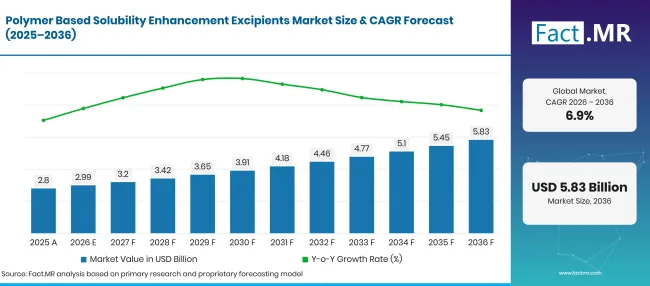
Polymer Based Solubility Enhancement Excipients Market Forecast Global | Source: Fact.MR
| Year | Basis | Market Value (USD Billion) |
|---|---|---|
| 2025 | Actual | 2.8 |
| 2026 | Estimate | 2.99 |
| 2036 | Forecast | 5.83 |
| CAGR 2026 to 2036 | Forecast period | 6.9% |
Source: Fact.MR analysis. Updated Nov 6, 2026
What are the defining numbers behind behind Polymer Based Solubility Enhancement Excipients Market growth?
The projected increase is USD 2.8 billion by 2036. Cellulose derivatives lead the polymer classification, while pharmaceutical uses, solid formulations and drug manufacturers account for the largest shares of their respective segments.
- Demand Drivers in the Market
- Poor water solubility changes how formulation teams select excipients. A polymer must help the active ingredient dissolve without compromising the stability of the finished medicine.
- Commercial formulation teams must compare amorphous solid dispersion stability against manufacturing practicality. A carrier that performs in a laboratory batch also needs repeatable processing behavior and a dependable supply grade.
- Generic medicine manufacturers sometimes revisit polymer selection when reformulating an established active ingredient. They assess the resulting dissolution profile alongside the equipment and quality checks needed to make the revised medicine consistently.
- For oral solid medicines, polymer selection also depends on how the material behaves under heat and in the presence of moisture. These properties help developers decide whether spray drying or hot-melt extrusion is more practical for the intended formulation.
- Nutraceutical producers may use compatible polymer carriers to improve ingredient dispersion, although the chosen material must still suit the finished product and its applicable quality requirements.
- Key Segments Analyzed
- By Polymer Type: Cellulose Derivatives account for 38.4% of 2026 value, reflecting their use as film-formers and carriers in oral drug development.
- By Application: Pharmaceuticals lead with 72.6% of 2026 value as drug manufacturers assess dissolution and product stability.
- By Formulation: Solid formulations make up 58.3% of 2026 value, where polymer-based dispersions provide a route for poorly soluble ingredients.
- By End-User: Pharmaceutical Companies represent 69.4% of 2026 demand because finished-dose development and commercial manufacturing require qualified excipient grades.
- Analyst Opinion at Fact.MR
- Shambhu Nath Jha, Principal Consultant at Fact.MR, states, “For pharmaceutical buyers, reliable dissolution and a process that can be repeated at commercial scale are likely to matter more than a small difference in polymer price. A material that performs well in early trials still needs consistent quality when production increases.”
- Strategic Implications
- Polymer manufacturers should document grade consistency and impurity limits clearly, helping formulation scientists compare materials during early trials.
- Drug developers benefit from testing excipient compatibility before committing to a solid-dispersion process and commercial batch specification.
- Contract development manufacturers need methods that link screening results to production equipment so a promising laboratory formula remains workable at scale.
- Distributors should preserve traceability and appropriate storage controls when supplying pharmaceutical-grade polymers to multiple production sites.
Germany is forecast to grow at 7.9% CAGR amid pharmaceutical formulation activity and specialist materials supply. Brazil follows at 7.3% as local manufacturers develop and register medicine products. The USA advances at 6.6% as development teams screen polymers for new and existing therapies. The UK records 5.9%, while Japan grows at 5.2% across its established drug-manufacturing base.
How does the Polymer Based Solubility Enhancement Excipients Market break down by segment?
Cellulose Derivatives account for 38.4%; Pharmaceuticals 72.6%; Solid formulations 58.3%; Pharmaceutical Companies 69.4%.
Which Polymer Type leads?
Cellulose Derivatives account for 38.4% of 2026 market value.
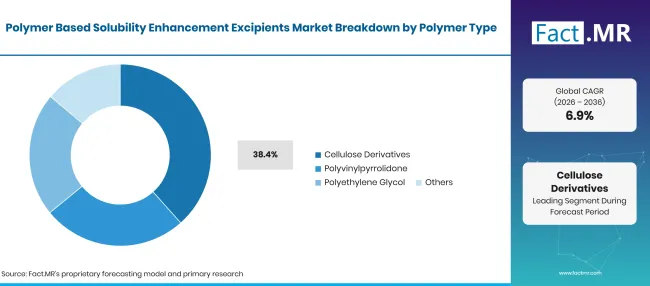
Polymer Based Solubility Enhancement Excipients Market Breakdown Polymer Type | Source: Fact.MR
| Polymer Type | Share (2026) |
|---|---|
| Cellulose Derivatives (Leading segment) | 38.4% |
| Other segments combined | 61.6% |
| Total | 100.0% |
Source: Fact.MR analysis. Updated Nov 6, 2026
Cellulose derivatives are used as carriers and film-forming materials in medicines that require better control over drug dispersion. Hydroxypropyl methylcellulose-based grades can help create solid dispersions, although their suitability depends on the active ingredient and production method. Polyvinylpyrrolidone offers another combination of solubility and binding properties. Polyethylene glycol is used in selected formulations where its dissolution and processing properties meet the product requirements.
How does Application shape sales?
Pharmaceuticals represent 72.6% of 2026 demand.
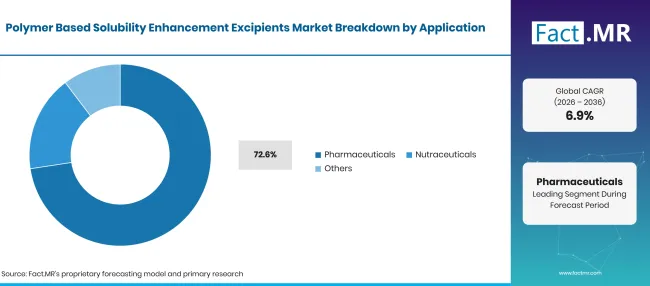
Polymer Based Solubility Enhancement Excipients Market Breakdown Application | Source: Fact.MR
| Application | Share (2026) |
|---|---|
| Pharmaceuticals (Leading segment) | 72.6% |
| Other segments combined | 27.4% |
| Total | 100.0% |
Source: Fact.MR analysis. Updated Nov 6, 2026
Pharmaceutical use is concentrated in formulations where the selected polymer must meet the finished medicine’s performance and quality targets. Drug manufacturers review compatibility and dissolution as part of development. Their supplier choice also depends on pharmacopoeial grade and supporting technical documentation. Other applications remain smaller.
What supports Solid formulations?
Solid formulations lead with 58.3% of 2026 value.
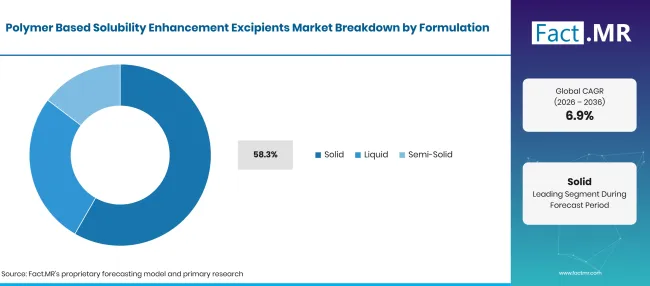
Polymer Based Solubility Enhancement Excipients Market Breakdown Formulation | Source: Fact.MR
| Formulation | Share (2026) |
|---|---|
| Solid (Leading segment) | 58.3% |
| Other segments combined | 41.7% |
| Total | 100.0% |
Source: Fact.MR analysis. Updated Nov 6, 2026
Solid formulations support poorly water-soluble active ingredients by improving dispersion within polymer-based delivery systems. Their use is relevant where formulation stability, dose consistency and manufacturing compatibility are important. The 58.3% share reflects their role in established solid dosage development and broader drug delivery applications.
Who buys these polymers?
Pharmaceutical Companies account for 69.4% of 2026 value.
| End-User | Share (2026) |
|---|---|
| Pharmaceutical Companies (Leading segment) | 69.4% |
| Other segments combined | 30.6% |
| Total | 100.0% |
Source: Fact.MR analysis. Updated Nov 6, 2026
Pharmaceutical companies use excipients during formulation development and finished-dose manufacturing to improve solubility, stability and processing performance. Selection depends on compatibility with the active ingredient, dosage form and production method. Demand also reflects wider manufacturing activity across oral solid dosage pharmaceuticals and other drug delivery formats.
What is accelerating Polymer Based Solubility Enhancement Excipients Market adoption, and what is holding it back?
Poorly soluble drug compounds support polymer selection; qualification time and formulation compatibility constrain wider use.
Drivers Impact Analysis
| DRIVER | (~) % IMPACT ON CAGR | GEOGRAPHIC RELEVANCE | IMPACT TIMELINE |
|---|---|---|---|
| Solubility work on oral medicines | +1.1% | Global | Medium term |
| Solid-dispersion development | +0.9% | Europe, North America, Japan | Medium term |
| Reformulation of existing medicines | +0.7% | Global | Long term |
| Technical supply and grade consistency | +0.5% | Global | Short term |
Source: Fact.MR analysis. Updated Nov 6, 2026
Opportunity Impact Analysis
| OPPORTUNITY | (~) % IMPACT ON CAGR | GEOGRAPHIC RELEVANCE | IMPACT TIMELINE |
|---|---|---|---|
| Amorphous solid dispersions | +0.8% | Global | Medium term |
| Co-development with manufacturers | +0.5% | Europe, USA, Japan | Medium term |
| Improved polymer processing profiles | +0.3% | Global | Long term |
Source: Fact.MR analysis. Updated Nov 6, 2026
Restraints Impact Analysis
| RESTRAINT | (~) % IMPACT ON CAGR | GEOGRAPHIC RELEVANCE | IMPACT TIMELINE |
|---|---|---|---|
| Product-specific stability testing | -0.6% | Global | Medium term |
| Documentation and grade qualification | -0.4% | Global | Short term |
| Processing and scale-up constraints | -0.3% | Global | Long term |
Source: Fact.MR analysis. Updated Nov 6, 2026
Which countries are scaling the Polymer Based Solubility Enhancement Excipients Market through 2036?
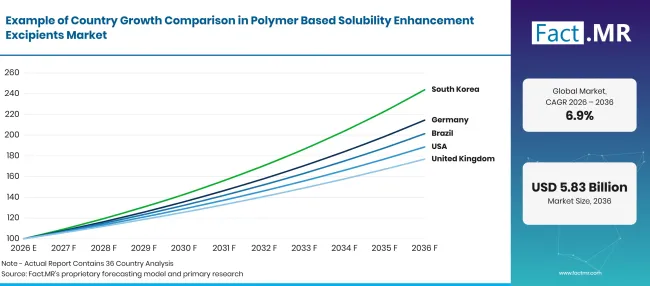
Factmr Polymer Based Solubility Enhancement Excipients Market Growth Index | Source: Fact.MR
| Country | CAGR (2026 to 2036) |
|---|---|
| Germany | 7.9% |
| Brazil | 7.3% |
| USA | 6.6% |
| UK | 5.9% |
| Japan | 5.2% |
Source: Fact.MR analysis. Updated Nov 6, 2026
What supports Germany’s polymer excipient outlook?
7.9% CAGR, linked to pharmaceutical formulation and quality requirements.
Germany's pharmaceutical manufacturers examine polymer grades for solid dosage forms where drug dissolution needs improvement. BASF's Ludwigshafen operations provide a local connection to povidone-based excipients used in formulation work. The European Medicines Agency reported in January 2026 that it had recommended 104 medicines for marketing authorisation during 2025 [2]. Germany's Federal Institute for Drugs and Medical Devices publishes monthly medicine-application statistics that inform quality planning and regulatory workloads [4].
How is Brazil developing polymer excipient demand?
7.3% CAGR, linked to pharmaceutical formulation and quality requirements.
Brazilian pharmaceutical producers assess polymer excipients when adapting oral medicines to manufacturing processes and local registration requirements. The National Health Surveillance Agency, Anvisa, reported in April 2026 that it had received 471 medicine registration applications during 2025 [6]. In September 2026, Brazil's Medicines Market Regulation Chamber published its 2025 pharmaceutical market yearbook, describing more than 6 billion medicine packages sold [9].
What is shaping demand in the USA?
6.6% CAGR, linked to pharmaceutical formulation and quality requirements.
The United States combines early drug research with established pharmaceutical manufacturing and quality review systems. Formulation scientists compare polymer carriers for compounds that dissolve poorly in water and assess their performance during processing. The Food and Drug Administration reported in January 2026 that its Center for Drug Evaluation and Research approved 46 novel drugs during 2025 [1]. The FDA's 2026 novel-drug approval list, updated during October 2026, records year-to-date decisions separately from the full-year 2025 total [10].
What supports the UK market outlook?
5.9% CAGR, linked to pharmaceutical formulation and quality requirements.
UK drug developers assess polymer excipients against dissolution results and the technical requirements of individual medicine formulations. Researchers working on oral medicines may select cellulose derivatives or povidone carriers when a compatible solid dispersion offers suitable performance. The Medicines and Healthcare products Regulatory Agency reported in July 2026 that its 2025–26 reporting year included 921 medicinal product approvals [5]. The Office for National Statistics reported in November 2025 that UK businesses spent £55.6 billion on research and development during 2024 [8].
How does Japan approach polymer selection?
5.2% CAGR, linked to pharmaceutical formulation and quality requirements.
Japan's pharmaceutical manufacturers examine the processing behavior of polymer carriers when developing oral formulations with difficult dissolution characteristics. Suppliers are expected to compete on consistent grades that can pass technical evaluation in local laboratories. The Ministry of Health, Labour and Welfare reported in December 2025 that Japan's pharmaceutical domestic production reached ¥10.2485 trillion in 2024 [7]. Export-oriented manufacturers assess polymer grades against finished-product specifications and manufacturing consistency.
Who leads the Polymer Based Solubility Enhancement Excipients Market?
BASF, Ashland, Evonik and Shin-Etsu are relevant polymer-excipient suppliers, with other chemical groups serving adjacent formulation needs.
Evonik markets EUDRAGIT polymers for drug-delivery applications and announced a new laboratory-stage platform in October 2026 [3]. Ashland supplies cellulose-based pharmaceutical excipients including hypromellose grades, while Shin-Etsu produces pharmaceutical cellulose derivatives used in drug delivery. These suppliers address different formulation functions, so product suitability depends on the selected active ingredient and dosage form.
Which companies are the key providers?
Key companies include BASF SE; Dow Inc.; Ashland Inc.; Evonik Industries AG; Clariant AG; Croda International Plc; Shin-Etsu Chemical Co., Ltd.; Lubrizol Corporation; Wacker Chemie AG.
- BASF SE
- Dow Inc.
- Ashland Inc.
- Evonik Industries AG
- Clariant AG
- Croda International Plc
- Shin-Etsu Chemical Co., Ltd.
- Lubrizol Corporation
- Wacker Chemie AG
Bibliography
- [1] U.S. Food and Drug Administration. (2026, January). Novel Drug Approvals for 2025.
- [2] European Medicines Agency. (2026, January 15). Human medicines in 2025.
- [3] Evonik. (2026, October 5). Evonik develops new biodegradable excipients for oral drug delivery.
- [4] Bundesinstitut für Arzneimittel und Medizinprodukte. (2025, December). Zulassungs-/Registrierungsanträge: Statistik 2025.
- [5] Medicines and Healthcare products Regulatory Agency. (2026, July 16). MHRA delivers record performance as 2025–26 Annual Report and Accounts confirms growing global influence.
- [6] Agência Nacional de Vigilância Sanitária. (2026, April 30). Sumário Executivo 2025.
- [7] Ministry of Health, Labour and Welfare, Japan. (2025, December 24)[Publication of the 2024 Annual Report on Pharmaceutical Industry Production Statistics].
- [8] Office for National Statistics. (2025, November 28). Business enterprise research and development, UK: 2024.
- [9] Agência Nacional de Vigilância Sanitária. (2026, September 25). CMED publica o Anuário Estatístico do Mercado Farmacêutico – Edição 2025.
- [10] U.S. Food and Drug Administration. (2026). Novel Drug Approvals for 2026.
This Report Answers
- The report explains why polymer chemistry and drug solubility shape formulation decisions for cellulose derivatives and synthetic carriers.
- Segmentation analysis distinguishes pharmaceutical and nutraceutical use while describing the roles of solid, liquid and semi-solid formats.
- Country profiles compare commercial and regulatory conditions across Germany, Brazil, the USA, the UK and Japan.
- The supplier review examines the relevance of specialist polymer portfolios, quality documentation and formulation support.
- The outlook considers how formulation screening translates into repeatable manufacturing and qualified material supply.
What does the Polymer Based Solubility Enhancement Excipients Market cover?
The report covers polymers selected to improve apparent drug solubility or dissolution in finished formulations.
What is included in the scope?
Pharmaceutical-grade polymer excipients used specifically for solubility or dissolution improvement fall within the report. The analysis includes supplier qualification conditions, material stability questions and technical requirements that affect selection of an excipient grade.
What is excluded from the scope?
Active pharmaceutical ingredients themselves are outside the revenue boundary. Drug-delivery devices and finished medicines are separate markets. The wider pharmaceuticals market is treated separately.
How Was the Analysis Built?
The analysis draws on 120+ sources, 35+ company portfolios, 25+ countries, and more than 20 industry interviews.
- Primary Research: Primary research includes discussions with manufacturers, service providers, technology developers, distributors, end users, and subject-matter experts. These conversations examine purchasing priorities, product adoption, operational challenges, approval requirements, competitive positioning, and the factors that influence wider market acceptance.
- Desk Research: Desk research covers government statistics, regulatory publications, company filings, trade data, technical studies, industry associations, standards, public policy, and other authoritative sources. Every source used in the analysis is documented in the bibliography.
- Market Sizing and Forecasting: Market estimates combine historical performance, demand indicators, pricing and volume trends, segment shares, company participation, country-level growth, adoption patterns, investment activity, and barriers to market expansion.
- Data Validation and Update Cycle: Findings are validated by comparing primary interviews with public data, company activity, regulatory changes, trade patterns, and industry developments. Regular updates review new product launches, capacity changes, partnerships, approvals, and shifts in commercial adoption.
Segmentation
What is the report’s scope and coverage?
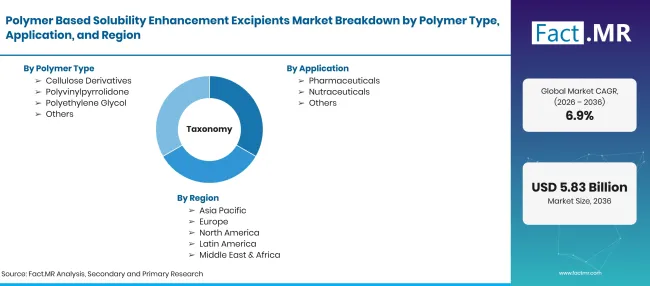
Polymer Based Solubility Enhancement Excipients Market Taxonomy | Source: Fact.MR
| Attribute | Details |
|---|---|
| Quantitative Units | USD Billion |
| Market Definition | Polymer materials used to improve apparent solubility or dissolution performance of active ingredients in pharmaceutical and related formulations. |
| Polymer Type | Cellulose Derivatives; Polyvinylpyrrolidone; Polyethylene Glycol; Others |
| Application | Pharmaceuticals; Nutraceuticals; Others |
| Formulation | Solid; Liquid; Semi-Solid |
| End-User | Pharmaceutical Companies; Research Laboratories; Others |
| Regions Covered | North America; Latin America; Western Europe; Eastern Europe; East Asia; South Asia & Pacific; Middle East & Africa |
| Countries Covered | Germany; Brazil; USA; UK; Japan |
| Companies Profiled | BASF SE; Dow Inc.; Ashland Inc.; Evonik Industries AG; Clariant AG; Croda International Plc; Shin-Etsu Chemical Co., Ltd.; Lubrizol Corporation; Wacker Chemie AG. |
| Forecast Period | 2026 to 2036 |
| Approach | Application and polymer-grade review, official drug-industry evidence and forecast segmentation |
Source: Fact.MR analysis. Updated Nov 6, 2026
How is the market segmented?
-
By Polymer Type
- Cellulose Derivatives
- Polyvinylpyrrolidone
- Polyethylene Glycol
- Others
-
By Application
- Pharmaceuticals
- Nutraceuticals
- Others
-
By Formulation
- Solid
- Liquid
- Semi-Solid
-
By End-User
- Pharmaceutical Companies
- Research Laboratories
- Others
-
By Region
- North America
- Latin America
- Western Europe
- Eastern Europe
- East Asia
- South Asia & Pacific
- Middle East & Africa
Frequently Asked Questions
How big is the market in 2026?
What is the market forecast for 2036?
Which polymer type accounts for the greatest share?
Which application accounts for the greater share?
Which formulation leads in value?
Which end-user group accounts for the greatest share?
Which country has the highest CAGR among those profiled?
Which businesses are profiled?
Who worked on this report


Preview the report firsthand - request a free sample
Free SampleGet the brochure for pricing and purchase details
Download PDF