Slope & Stockpile Stabilization Material Market Size, Share, Growth and Forecast (2026 - 2036)
The Slope & Stockpile Stabilization Material Market is segmented by Solution Type, by Application Area, by Substrate, by End User, by Application Method, and Region. Forecast for 2026 to 2036.
What is the slope & stockpile stabilization material market forecast to be worth by 2036?
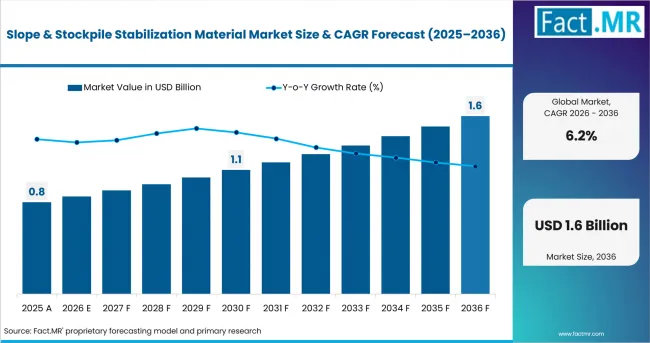
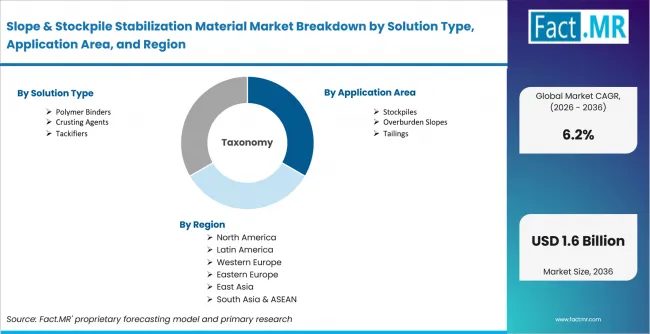
USD 0.88 billion in 2026 to USD 1.60 billion by 2036, at 6.2% CAGR.
- The slope & stockpile stabilization material market crossed a valuation of USD 0.82 billion in 2025.
- Demand is expected to increase from USD 0.88 billion in 2026 to USD 1.60 billion by 2036.
- The market is forecast to record 6.2% CAGR during 2026 to 2036 as mines, power sites, ports, and infrastructure contractors add longer-life surface control to routine site maintenance.
What are the defining numbers behind slope & stockpile stabilization material growth?
USD 0.72 billion absolute opportunity by 2036, led by India and China.
- Demand Drivers in the Market
- Mine operators need binders and crusting agents because overburden slopes and loose stockpiles face repeated wind and stormwater exposure.
- Power plants need documented coal and ash pile care as coal combustion residual rules bring closer attention to surface management.
- Ports and bulk terminals need treatment programs because coal, ore, and aggregate piles create housekeeping and complaint risks.
- Infrastructure contractors need erosion mats and hydroseeding additives when road cuts, rail embankments, and construction slopes remain exposed after grading.
- Key Segments Analyzed
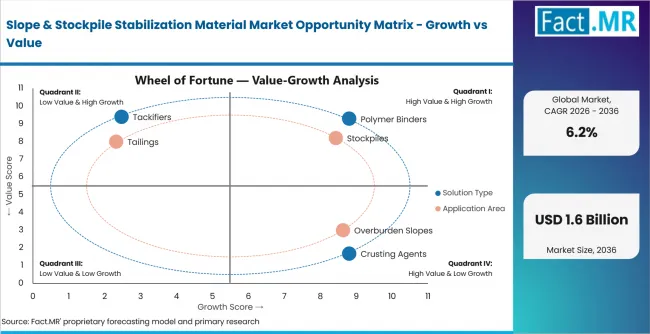
- By Solution Type: Polymer binders are expected to hold 32.8% share in 2026 because they create longer surface hold than water-only treatment.
- By Application Area: Stockpiles are projected to capture 29.6% share in 2026 as broad exposed pile surfaces need repeat control.
- By Substrate: Coal is likely to account for 24.2% share in 2026 because coal yards and mine benches carry fine particles.
- By End User: Mining is expected to hold 38.6% share in 2026 since mines combine slope, bench, tailings, and stockpile use.
- By Application Method: Spray-applied treatment is projected to hold 43.4% share in 2026 because mobile crews can cover irregular surfaces quickly.
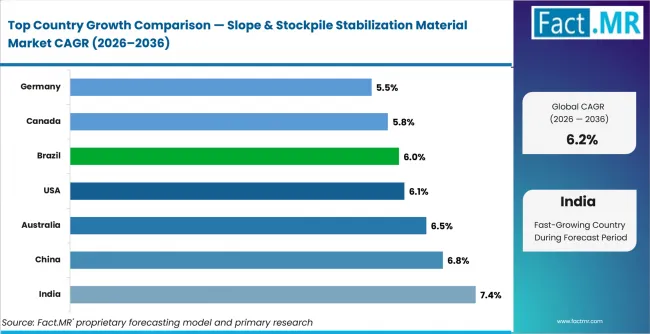
- By Geography: India is projected to record 7.4% CAGR through 2036 as coal output and overburden handling pressure expand.
- Analyst Opinion at Fact.MR
- Shambhu Nath Jha, Senior Analyst at Fact.MR, states, "Slope and stockpile stabilization is becoming a site-risk purchase, not just a material purchase. Mine and power-plant managers are asking whether a treated pile holds after wind, rain, and truck movement. Water-only spraying is easy to approve, but it often fails on hot or windy sites. Suppliers that bring dosing guidance, field checks, and substrate-specific product selection into the sale are expected to win repeat accounts."
- Strategic Implications
- Material suppliers should package binders with field dosing guidance for coal, ore, tailings, and aggregate surfaces.
- Mining companies need site-specific testing before moving from water-only spraying to longer-life chemical stabilization.
- Geosynthetic suppliers should connect erosion mats with sprayed binders where slopes need both surface cover and reinforcement.
- Applicator contractors can win recurring programs by documenting treatment life, retreatment intervals, and weather-cycle performance.
Exposed coal, ore, aggregate, tailings, and topsoil piles form the core of this market. Large handling yards still need surface crusting, slope cover, and pile treatment during storage and transfer cycles. Coal ash oversight also gives power sites a clearer reason to document surface condition and runoff-control practices.
India is projected to record 7.4% CAGR through 2036 as coal output and overburden handling pressure expand. China is expected to expand at 6.8% CAGR because coal and steel yards keep stockpile volumes high. Australia is forecast to grow at 6.5% CAGR as iron ore export hubs need mine-to-port surface control. The United States is expected to advance at 6.1% CAGR as coal stockpiles and coal ash oversight support documented site care. Brazil, Canada, and Germany are expected to grow at 6.0%, 5.8%, and 5.5% CAGR, respectively, with mineral handling and civil slope work shaping their demand.
How does the slope & stockpile stabilization material market break down by segment?
Polymer binders lead at 32.8%; spray-applied treatment leads at 43.4%.
Which solution type dominates?
Polymer Binders hold 32.8% share in 2026.
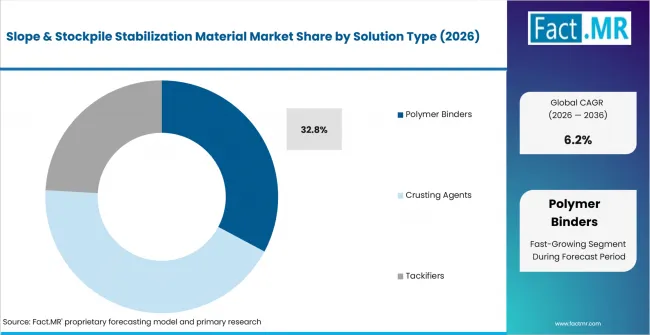
Polymer binders are expected to hold 32.8% share in 2026 because they form a surface crust on coal, ore, aggregate, and tailings piles. Buyers use them where reapplication cost matters more than the product price per liter. Demand overlaps with broader soil stabilization materials because both categories depend on substrate binding and field performance. The segment gains when suppliers can show how the binder behaves after traffic, rainfall, and dry wind.
Which application area dominates?
Stockpiles hold 29.6% share in 2026.
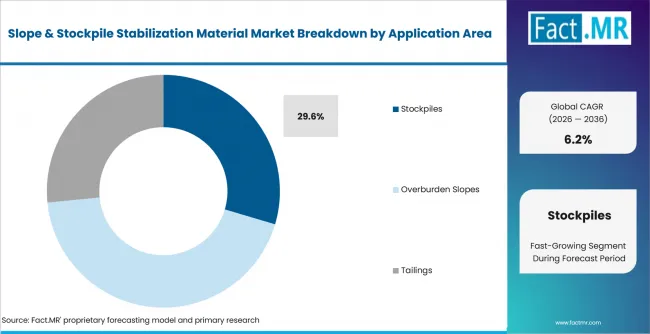
Stockpiles lead because coal, ore, bauxite, limestone, aggregate, and fly ash yards expose broad surfaces to wind and runoff. The segment is projected to capture 29.6% share in 2026 as mines and terminals treat piles between loading cycles. Some demand is connected to road dust-control additives because haul roads and pile zones are often managed in the same maintenance program. Suppliers with spray equipment partnerships are expected to gain better access to recurring site contracts.
Which substrate dominates?
Coal holds 24.2% share in 2026.
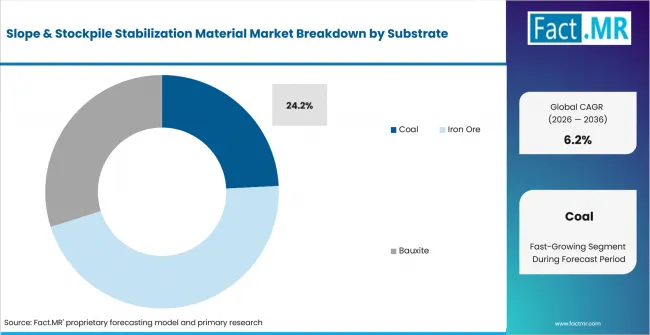
Coal is projected to account for 24.2% share in 2026 because stored coal releases fine dust during handling and wind exposure. Power utilities use crusting agents when coal is uncovered before seasonal drawdown. Export terminals also compare pile treatment with dust suppressants used at transfer points and haul roads. The U.S. Energy Information Administration reported in March 2026 that total U.S. coal stockpiles stood at 104 million tons, showing that large inventories still move through exposed yards. [3]
Which end user dominates?
Mining holds 38.6% share in 2026.
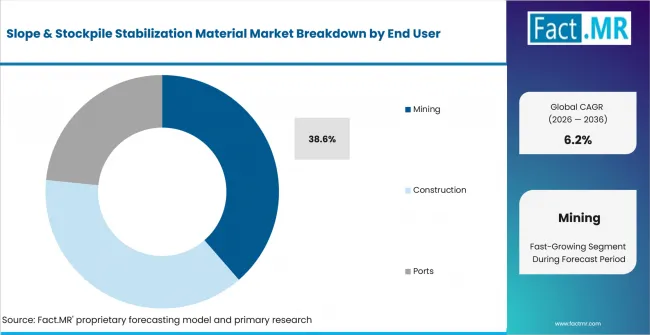
Mining is expected to account for 38.6% share in 2026 as operators treat overburden slopes, benches, haul-road edges, and stockpile surfaces in one site program. Global Energy Monitor reported in July 2025 that 2,270 million tonnes per annum of coal mining capacity was under development, which keeps mine surface control in the project pipeline. [4] This supports nearby demand for dust suppression chemicals used in mining and construction settings. Buyers value suppliers that can adjust dose by substrate instead of selling one product for every site.
Which application method dominates?
Spray-Applied Treatment holds 43.4% share in 2026.
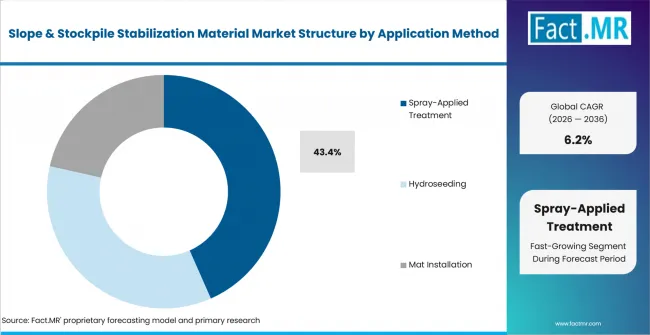
Spray-applied treatment is forecast to hold 43.4% share in 2026 because it works with water trucks, hydroseeding rigs, and contractor crews already present on industrial sites. Crews can cover stockpile crowns and slope faces without placing workers on unstable surfaces. Ore handling sites often combine surface sprays with ore handling chemicals around crushers and conveyor transfer points. Hybrid systems gain use when sprayed binders protect exposed faces while mats stabilize drainage channels.
What is accelerating slope & stockpile stabilization demand, and what is holding it back?
Open bulk handling and coal ash oversight drive it; substrate-specific dosing uncertainty restrains it.
The main driver is the need to control exposed surfaces at mines, terminals, power plants, and infrastructure sites. The United States Environmental Protection Agency finalized changes to Coal Combustion Residuals regulations on May 8, 2024, covering legacy surface impoundments and management units. [2] Sites that manage coal ash, fly ash, and related piles need stronger documentation around surface condition and runoff control. This gives chemical binders and geotextile systems a clearer place in site-care plans.
The main restraint is field variability. Coal fines, tailings, clay, sand, and aggregate surfaces do not respond to the same dose. Rainfall, slope angle, pile turnover, and application equipment also change service life. Buyers may delay switching when product trials do not match the supplier claim. This is why regional crews, repeat test plots, and simple documentation can matter more than the technical chemistry of the product alone.
Where do the biggest slope & stockpile stabilization material opportunities sit?
Polymer crust programs, geosynthetic-compatible slopes and bulk terminal yards.
- Polymer Crust Programs: Suppliers can sell binders with retreatment schedules for coal, ore, and aggregate piles.
- Geosynthetic-Compatible Slopes: Contractors can pair sprayed binders with mats where road cuts or tailings slopes need layered protection.
- Bulk Terminal Yards: Ports and power plants can use treatment programs to reduce cleanup and complaints around loading zones.
Which countries are scaling slope & stockpile stabilization material demand fastest?
India 7.4%, China 6.8%, Australia 6.5%, United States 6.1%, Brazil 6.0%, Canada 5.8%, Germany 5.5%.
Based on regional analysis, the slope & stockpile stabilization material market is segmented into North America, Latin America, Europe, East Asia, South Asia and Pacific, and Middle East and Africa.
.webp)
| Country | CAGR |
|---|---|
| India | 7.4% |
| China | 6.8% |
| Australia | 6.5% |
| United States | 6.1% |
| Brazil | 6.0% |
| Canada | 5.8% |
| Germany | 5.5% |

What is powering India’s lead?
7.4% CAGR, driven by coal output and overburden handling pressure.
India is projected to record 7.4% CAGR through 2036 as coal output and open-pit material movement expand. The Press Information Bureau reported in January 2026 that India produced 1,047.523 million tonnes of coal in 2024-25. [5] That volume creates repeated needs around overburden slopes, stockpiles, and haul-road margins. Domestic suppliers and applicators can gain when they provide site trials in coal belts and connect binders with dust-control service programs.
How is China scaling stabilization demand?
6.8% CAGR, supported by coal production and steel-linked stockpile volumes.
China is expected to expand at 6.8% CAGR through 2036 because coal handling and steel raw material yards remain large. The National Bureau of Statistics of China reported in January 2026 that raw coal production by industrial enterprises above designated size reached 4.83 billion tons in 2025. [6] High pile turnover makes application speed important, while local substrate variation makes dosage support important. Suppliers that serve both mine and industrial yard customers are expected to hold better account depth.
Why is Australia an important mineral handling market?
6.5% CAGR, supported by iron ore exports and mine-to-port control needs.
Australia is forecast to grow at 6.5% CAGR through 2036 as iron ore mines and export corridors require surface control across pits, stockpiles, and port areas. The Australian Government Department of Industry, Science and Resources reported in March 2025 that iron ore export earnings were forecast at A$117 billion in 2024-25. [7] Those export chains depend on large open handling areas where wind and traffic move fines. Global Road Technology and other local service providers can benefit where buyers want measured dust and erosion outcomes.
What supports the United States outlook?
6.1% CAGR, supported by coal stockpiles and coal ash oversight.
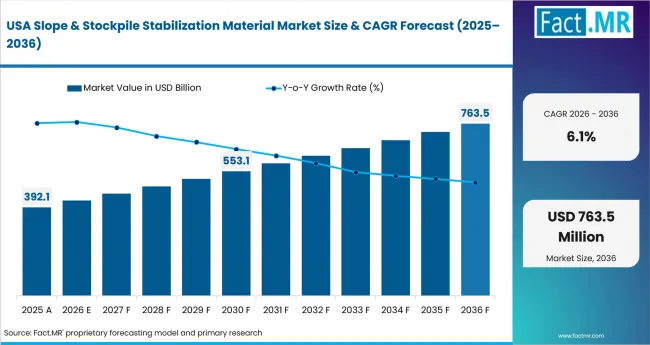
The United States is expected to advance at 6.1% CAGR through 2036 as coal yards, ash sites, and construction slopes keep surface treatment in maintenance budgets. The U.S. Energy Information Administration reported in November 2025 that U.S. coal production was 512.5 million short tons in 2024. [1] Coal ash oversight adds a compliance reason for better documentation around impoundments and management units. Buyers are likely to favor suppliers that can provide product records, field support, and safety documentation.
What strengthens Brazil’s demand base?
6.0% CAGR, supported by iron ore and steel material handling.
Brazil is projected to rise at 6.0% CAGR through 2036, where iron ore and steel sites generate recurring pile and slope control needs. World Steel Association reported in January 2025 that Brazil produced 33.8 million tonnes of crude steel in 2024. [8] Mining and steel-linked material yards create stockpile surfaces that need dust, runoff, and slope protection programs. Suppliers can gain by working with mine-service contractors that already manage site access and application scheduling.
What keeps Canada’s market steady?
5.8% CAGR, supported by coal districts and remote mine service needs.
Canada is forecast at 5.8% CAGR through 2036 as mineral handling sites remain spread across large distances and seasonal weather changes treatment windows. Natural Resources Canada reported in February 2026 that Canadian mine production of iron ore in concentrate and pellets reached 70 million tonnes in 2024. [9] Remote mine locations and seasonal weather create a need for treatments that hold between service visits. Suppliers with regional service coverage and cold-weather application guidance are expected to perform better.
What keeps Germany below the global rate?
5.5% CAGR, supported by civil works and strict site specifications.
Germany is expected to post 5.5% CAGR through 2036 because mining exposure is lower than in Asia-Pacific countries, while civil engineering works still support slope and embankment applications. World Steel Association reported in June 2025 that Germany produced 37.2 million tonnes of crude steel in 2024. [10] Buyers are expected to specify proven materials, installer training, and compatibility with drainage layers before approving sitewide use.
Who leads the slope & stockpile stabilization material landscape?
Soilworks, Global Road Technology and Dust-A-Side lead through binder, spray and field-service depth.
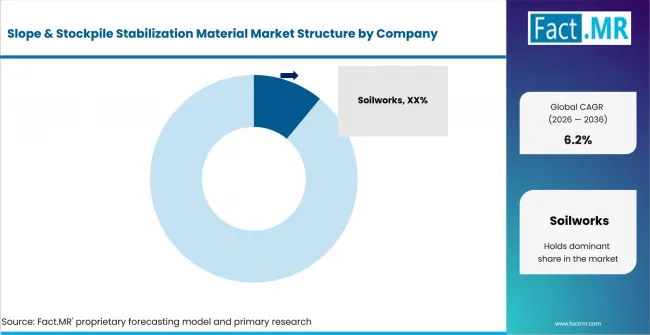
Slope and stockpile stabilization materials are supplied by chemical treatment specialists and geosynthetic companies that serve industrial sites. Soilworks provides soil stabilization and dust control products for stockpiles, laydown yards, roads, and worksite soils. Global Road Technology provides dust control, soil stabilization, erosion control, and water management products for mining and civil sites. Dust-A-Side lists dust suppression and road management for open-cut mining and processing areas. These suppliers compete with adjacent dry dust control systems in buyer budgets, but field application speed keeps sprayed materials relevant.
Geosynthetic and erosion-control suppliers compete when slope angle, rainfall, and drainage make crusting alone insufficient. Profile Products supplies hydraulically applied erosion control technologies and turf reinforcement mats. Solmax announced in December 2024 that it would consolidate EMEA nonwoven geotextile manufacturing into one facility. [11] This positions geogrids, mats, and coir erosion mats as complementary options for steeper or vegetated slope surfaces.
Commercial Metals Company owns Tensar, and its January 2026 results reported construction solutions group strength linked to the Tensar division. [12] The signal matters for buyers that compare sprayed materials with geogrid-backed slope systems on sites where surface crusting alone is not enough.
Material platform suppliers shape binder performance and supply reliability. BASF announced in February 2026 that it was adding a dispersions production line at Mangalore for architectural paints, construction chemicals, and paper applications. [13] These developments matter because polymer supply, technical support, and local logistics influence whether contractors can keep repeat treatment schedules. Buyers comparing surface-control programs may also review broader construction polymers where site compliance budgets are shared.
SNF announced in January 2024 a USD 250 million Oman expansion plan and a regional technical center in Muscat. [14] The added regional support is relevant when applicators need polymer guidance for hot, dry, and remote sites. Some industrial yards may also compare dust collector systems with surface-treatment programs when deciding how to spend site-control budgets.
Which companies are the key players?
Soilworks, Global Road Technology, Dust-A-Side, Midwest Industrial Supply, Profile Products, Solmax, Commercial Metals Company (Tensar), BASF and SNF.
- Soilworks
- Global Road Technology
- Dust-A-Side
- Midwest Industrial Supply
- Profile Products
- Solmax
- Commercial Metals Company (Tensar)
- BASF
- SNF
Bibliography
- [1] U.S. Energy Information Administration. (2025, November). Annual Coal Report 2024. U.S. Department of Energy.
- [2] U.S. Environmental Protection Agency. (2024, May 8). Final rule: Legacy Coal Combustion Residuals surface impoundments and CCR management units.
- [3] U.S. Energy Information Administration. (2026, March). Electric Power Sector Coal Stocks: March 2026. U.S. Department of Energy.
- [4] Global Energy Monitor. (2025, July). Still digging 2025: Tracking global coal mine proposals.
- [5] Press Information Bureau. (2026, January 12). Ministry of Coal’s Year End Review-2025. Government of India.
- [6] National Bureau of Statistics of China. (2026, January 20). Energy production in December 2025.
- [7] Department of Industry, Science and Resources. (2025, March 31). Resources and energy quarterly: March 2025. Australian Government.
- [8] World Steel Association. (2025, January 24). December 2024 crude steel production and 2024 global totals.
- [9] Natural Resources Canada. (2026, February 27). Iron ore facts. Government of Canada.
- [10] World Steel Association. (2025, June). World Steel in Figures 2025.
- [11] Solmax. (2024, December 4). Solmax announces strategic consolidation of European nonwoven production facilities.
- [12] Commercial Metals Company. (2026, January 8). CMC reports first quarter of fiscal 2026 results.
- [13] BASF. (2026, February 13). BASF to strengthen local production footprint in India with new dispersions line at Mangalore, India.
- [14] SNF. (2024, January 4). SNF announces $250mn expansion plan in Oman.
This Report Addresses
- Strategic intelligence on slope and stockpile stabilization materials across solution type, application area and end user.
- Segment analysis covering Polymer Binders, Stockpiles, Coal, Mining and Spray-Applied Treatment.
- Regional outlook covering India, China, Australia, United States, Brazil, Canada and Germany.
- Competitive analysis of Soilworks, Global Road Technology, Dust-A-Side, Midwest Industrial Supply, Profile Products, Solmax, Commercial Metals Company (Tensar), BASF and SNF.
- Material assessment covering binders, crusting agents, tackifiers, erosion mats and hydroseeding additives.
- Buyer assessment covering mining sites, construction slopes, ports, power plants, cement sites and infrastructure contractors.
- Primary interviews, official source review, company portfolio checks and field-use logic support the forecast.
What does the slope & stockpile stabilization material market cover?
Materials used to stabilize exposed slopes and loose industrial stockpiles.
The slope & stockpile stabilization material market covers chemical binders, crusting agents, tackifiers, erosion mats, and hydroseeding additives used to hold exposed surfaces in place. It includes materials applied to mine stockpiles, overburden slopes, tailings, road cuts, embankments, power plant yards, and port handling areas. The market differs from general earthworks because the focus is material supply for surface control, not full civil construction or retaining-wall design.
What is included in the scope?
Polymer binders, crusting agents, erosion mats and sprayed stabilization systems.
The scope includes polymer binders, low-VOC and recyclable formulations, anti-static grades, crusting agents, tackifiers, geosynthetic-compatible sprays, erosion mats, hydroseeding additives, and mixed-in stabilization materials. It covers products sold to mining companies, infrastructure contractors, ports, power plants, cement producers, waste management sites, and applicator crews.
What is excluded from the scope?
Retaining walls, paving, dust collectors and earthmoving services sold without stabilization materials.
The scope excludes full-scale earthmoving, concrete retaining structures, asphalt paving, enclosed dust extraction equipment, and geotechnical engineering services sold without material supply. It also excludes water trucks and general construction equipment unless they are part of a material application service.
How was the analysis built?
100+ sources, 35+ company portfolios, 25+ countries, 18+ interviews.
- Primary Research: Primary research includes interviews with mine maintenance teams, erosion-control contractors, distributor managers, and chemical formulation suppliers. The discussions focused on dosing practice, retreatment frequency, weather exposure, and what buyers need before approving a site trial.
- Desk Research: Desk research reviewed coal production, mineral output, steel production, stockpile activity, coal ash rules, company product portfolios, and geosynthetic capacity announcements. These sources helped identify where exposed material volumes create measurable need for stabilization materials.
- Market-Sizing and Forecasting: Forecasting uses stockpile area assumptions, treatment cost per square meter, site frequency, substrate mix, and end-user penetration by country. Values are reconciled against coal, iron ore, steel, aggregate, and supplier evidence.
- Data Validation and Update Cycle: Forecasts were checked against official mining and energy indicators, company product pages, and recent supplier developments. Updates are expected to track changes in coal output, mine approvals, port handling volumes, and geosynthetic production capacity.
What is the report’s scope and coverage?
| Attribute | Details |
|---|---|
| Quantitative Units | USD Billion in 2026 to USD Billion by 2036 at CAGR |
| Market Definition | Materials used to stabilize exposed industrial slopes and loose stockpiles through chemical binding, matting, or sprayed surface control |
| Solution Type | Polymer Binders, Crusting Agents, Tackifiers, Geosynthetic Sprays, Erosion Mats, Hydroseeding Additives |
| Application Area | Stockpiles, Overburden Slopes, Tailings, Embankments, Mine Benches, Road Cuts, Construction Slopes |
| Substrate | Coal, Iron Ore, Bauxite, Limestone, Aggregates, Topsoil, Clay, Sand, Tailings |
| End User | Mining, Construction, Ports, Power Plants, Cement, Waste Management, Infrastructure Contractors |
| Application Method | Spray-Applied Treatment, Hydroseeding, Mat Installation, Mixed-In Treatment, Hybrid Systems |
| Regions Covered | North America, Latin America, Europe, East Asia, South Asia and Pacific, Middle East and Africa |
| Countries Covered | India, China, Australia, United States, Brazil, Canada, Germany, and 30+ countries |
| Key Companies Profiled | Soilworks, Global Road Technology, Dust-A-Side, Midwest Industrial Supply, Profile Products, Solmax, Commercial Metals Company (Tensar), BASF and SNF |
| Forecast Period | 2026 to 2036 |
| Approach | Hybrid bottom-up and top-down approach using stockpile area, treatment frequency, substrate mix, country activity, company portfolios and supplier validation |
How is the market segmented?
-
By Solution Type:
- Polymer Binders
- Crusting Agents
- Tackifiers
- Geosynthetic Sprays
- Erosion Mats
- Hydroseeding Additives
-
By Application Area:
- Stockpiles
- Overburden Slopes
- Tailings
- Embankments
- Mine Benches
- Road Cuts
- Construction Slopes
-
By Substrate:
- Coal
- Iron Ore
- Bauxite
- Limestone
- Aggregates
- Topsoil
- Clay
- Sand
- Tailings
-
By End User:
- Mining
- Construction
- Ports
- Power Plants
- Cement
- Waste Management
- Infrastructure Contractors
-
By Application Method:
- Spray-Applied Treatment
- Hydroseeding
- Mat Installation
- Mixed-In Treatment
- Hybrid Systems
-
By Region:
- North America
- United States
- Canada
- Mexico
- Latin America
- Brazil
- Chile
- Rest of Latin America
- Europe
- Germany
- United Kingdom
- France
- Italy
- Spain
- Rest of Europe
- East Asia
- China
- Japan
- South Korea
- South Asia and Pacific
- India
- ASEAN
- Australia and New Zealand
- Rest of South Asia and Pacific
- Middle East & Africa
- GCC Countries
- South Africa
- United Arab Emirates
- Rest of Middle East & Africa
- North America
- Frequently Asked Questions -
Which solution type leads the Slope & Stockpile Stabilization Material Market?
Polymer Binders lead with 32.8% share in 2026 because they provide longer surface hold than water-only treatment.
Which country expands faster in the Slope & Stockpile Stabilization Material Market?
India is projected to record 7.4% CAGR through 2036 as coal output and overburden handling pressure expand.
How does China perform in the Slope & Stockpile Stabilization Material Market?
China is expected to expand at 6.8% CAGR through 2036 because coal and steel yards keep stockpile volumes high.
How does Australia perform in the Slope & Stockpile Stabilization Material Market?
Australia is forecast to grow at 6.5% CAGR through 2036 as iron ore export hubs need mine-to-port surface control.
What is the primary driver in the Slope & Stockpile Stabilization Material Market?
The primary driver is the need to stabilize exposed stockpiles, overburden slopes and loose industrial surfaces before wind and runoff cause material loss.
What is the main restraint in the Slope & Stockpile Stabilization Material Market?
The main restraint is substrate-specific dosing uncertainty because coal fines, tailings, clay, sand, and aggregate surfaces respond differently to treatment.
Why are polymer binders important in this market?
Polymer binders are important because they form a crust that helps keep fine material in place between handling cycles and weather events.
Table of Content
- Executive Summary
- Global Market Outlook
- Demand to side Trends
- Supply to side Trends
- Technology Roadmap Analysis
- Analysis and Recommendations
- Market Overview
- Market Coverage / Taxonomy
- Market Definition / Scope / Limitations
- Research Methodology
- Chapter Orientation
- Analytical Lens and Working Hypotheses
- Market Structure, Signals, and Trend Drivers
- Benchmarking and Cross-market Comparability
- Market Sizing, Forecasting, and Opportunity Mapping
- Research Design and Evidence Framework
- Desk Research Programme (Secondary Evidence)
- Company Annual and Sustainability Reports
- Peer-reviewed Journals and Academic Literature
- Corporate Websites, Product Literature, and Technical Notes
- Earnings Decks and Investor Briefings
- Statutory Filings and Regulatory Disclosures
- Technical White Papers and Standards Notes
- Trade Journals, Industry Magazines, and Analyst Briefs
- Conference Proceedings, Webinars, and Seminar Materials
- Government Statistics Portals and Public Data Releases
- Press Releases and Reputable Media Coverage
- Specialist Newsletters and Curated Briefings
- Sector Databases and Reference Repositories
- Fact.MR Internal Proprietary Databases and Historical Market Datasets
- Subscription Datasets and Paid Sources
- Social Channels, Communities, and Digital Listening Inputs
- Additional Desk Sources
- Expert Input and Fieldwork (Primary Evidence)
- Primary Modes
- Qualitative Interviews and Expert Elicitation
- Quantitative Surveys and Structured Data Capture
- Blended Approach
- Why Primary Evidence is Used
- Field Techniques
- Interviews
- Surveys
- Focus Groups
- Observational and In-context Research
- Social and Community Interactions
- Stakeholder Universe Engaged
- C-suite Leaders
- Board Members
- Presidents and Vice Presidents
- R&D and Innovation Heads
- Technical Specialists
- Domain Subject-matter Experts
- Scientists
- Physicians and Other Healthcare Professionals
- Governance, Ethics, and Data Stewardship
- Research Ethics
- Data Integrity and Handling
- Primary Modes
- Tooling, Models, and Reference Databases
- Desk Research Programme (Secondary Evidence)
- Data Engineering and Model Build
- Data Acquisition and Ingestion
- Cleaning, Normalisation, and Verification
- Synthesis, Triangulation, and Analysis
- Quality Assurance and Audit Trail
- Market Background
- Market Dynamics
- Drivers
- Restraints
- Opportunity
- Trends
- Scenario Forecast
- Demand in Optimistic Scenario
- Demand in Likely Scenario
- Demand in Conservative Scenario
- Opportunity Map Analysis
- Product Life Cycle Analysis
- Supply Chain Analysis
- Investment Feasibility Matrix
- Value Chain Analysis
- PESTLE and Porter’s Analysis
- Regulatory Landscape
- Regional Parent Market Outlook
- Production and Consumption Statistics
- Import and Export Statistics
- Market Dynamics
- Global Market Analysis 2021 to 2025 and Forecast, 2026 to 2036
- Historical Market Size Value (USD Million) Analysis, 2021 to 2025
- Current and Future Market Size Value (USD Million) Projections, 2026 to 2036
- Y to o to Y Growth Trend Analysis
- Absolute $ Opportunity Analysis
- Global Market Pricing Analysis 2021 to 2025 and Forecast 2026 to 2036
- Global Market Analysis 2021 to 2025 and Forecast 2026 to 2036, By Solution Type
- Introduction / Key Findings
- Historical Market Size Value (USD Million) Analysis By Solution Type , 2021 to 2025
- Current and Future Market Size Value (USD Million) Analysis and Forecast By Solution Type , 2026 to 2036
- Polymer Binders
- Crusting Agents
- Tackifiers
- Polymer Binders
- Y to o to Y Growth Trend Analysis By Solution Type , 2021 to 2025
- Absolute $ Opportunity Analysis By Solution Type , 2026 to 2036
- Global Market Analysis 2021 to 2025 and Forecast 2026 to 2036, By Application Area
- Introduction / Key Findings
- Historical Market Size Value (USD Million) Analysis By Application Area, 2021 to 2025
- Current and Future Market Size Value (USD Million) Analysis and Forecast By Application Area, 2026 to 2036
- Stockpiles
- Overburden Slopes
- Tailings
- Stockpiles
- Y to o to Y Growth Trend Analysis By Application Area, 2021 to 2025
- Absolute $ Opportunity Analysis By Application Area, 2026 to 2036
- Global Market Analysis 2021 to 2025 and Forecast 2026 to 2036, By Substrate
- Introduction / Key Findings
- Historical Market Size Value (USD Million) Analysis By Substrate, 2021 to 2025
- Current and Future Market Size Value (USD Million) Analysis and Forecast By Substrate, 2026 to 2036
- Coal
- Iron Ore
- Bauxite
- Coal
- Y to o to Y Growth Trend Analysis By Substrate, 2021 to 2025
- Absolute $ Opportunity Analysis By Substrate, 2026 to 2036
- Global Market Analysis 2021 to 2025 and Forecast 2026 to 2036, By End User
- Introduction / Key Findings
- Historical Market Size Value (USD Million) Analysis By End User, 2021 to 2025
- Current and Future Market Size Value (USD Million) Analysis and Forecast By End User, 2026 to 2036
- Mining
- Construction
- Ports
- Mining
- Y to o to Y Growth Trend Analysis By End User, 2021 to 2025
- Absolute $ Opportunity Analysis By End User, 2026 to 2036
- Global Market Analysis 2021 to 2025 and Forecast 2026 to 2036, By Application Method
- Introduction / Key Findings
- Historical Market Size Value (USD Million) Analysis By Application Method, 2021 to 2025
- Current and Future Market Size Value (USD Million) Analysis and Forecast By Application Method, 2026 to 2036
- Spray-Applied Treatment
- Hydroseeding
- Mat Installation
- Spray-Applied Treatment
- Y to o to Y Growth Trend Analysis By Application Method, 2021 to 2025
- Absolute $ Opportunity Analysis By Application Method, 2026 to 2036
- Global Market Analysis 2021 to 2025 and Forecast 2026 to 2036, By Region
- Introduction
- Historical Market Size Value (USD Million) Analysis By Region, 2021 to 2025
- Current Market Size Value (USD Million) Analysis and Forecast By Region, 2026 to 2036
- North America
- Latin America
- Western Europe
- Eastern Europe
- East Asia
- South Asia and Pacific
- Middle East & Africa
- Market Attractiveness Analysis By Region
- North America Market Analysis 2021 to 2025 and Forecast 2026 to 2036, By Country
- Historical Market Size Value (USD Million) Trend Analysis By Market Taxonomy, 2021 to 2025
- Market Size Value (USD Million) Forecast By Market Taxonomy, 2026 to 2036
- By Country
- USA
- Canada
- Mexico
- By Solution Type
- By Application Area
- By Substrate
- By End User
- By Application Method
- By Country
- Market Attractiveness Analysis
- By Country
- By Solution Type
- By Application Area
- By Substrate
- By End User
- By Application Method
- Key Takeaways
- Latin America Market Analysis 2021 to 2025 and Forecast 2026 to 2036, By Country
- Historical Market Size Value (USD Million) Trend Analysis By Market Taxonomy, 2021 to 2025
- Market Size Value (USD Million) Forecast By Market Taxonomy, 2026 to 2036
- By Country
- Brazil
- Chile
- Rest of Latin America
- By Solution Type
- By Application Area
- By Substrate
- By End User
- By Application Method
- By Country
- Market Attractiveness Analysis
- By Country
- By Solution Type
- By Application Area
- By Substrate
- By End User
- By Application Method
- Key Takeaways
- Western Europe Market Analysis 2021 to 2025 and Forecast 2026 to 2036, By Country
- Historical Market Size Value (USD Million) Trend Analysis By Market Taxonomy, 2021 to 2025
- Market Size Value (USD Million) Forecast By Market Taxonomy, 2026 to 2036
- By Country
- Germany
- UK
- Italy
- Spain
- France
- Nordic
- BENELUX
- Rest of Western Europe
- By Solution Type
- By Application Area
- By Substrate
- By End User
- By Application Method
- By Country
- Market Attractiveness Analysis
- By Country
- By Solution Type
- By Application Area
- By Substrate
- By End User
- By Application Method
- Key Takeaways
- Eastern Europe Market Analysis 2021 to 2025 and Forecast 2026 to 2036, By Country
- Historical Market Size Value (USD Million) Trend Analysis By Market Taxonomy, 2021 to 2025
- Market Size Value (USD Million) Forecast By Market Taxonomy, 2026 to 2036
- By Country
- Russia
- Poland
- Hungary
- Balkan & Baltic
- Rest of Eastern Europe
- By Solution Type
- By Application Area
- By Substrate
- By End User
- By Application Method
- By Country
- Market Attractiveness Analysis
- By Country
- By Solution Type
- By Application Area
- By Substrate
- By End User
- By Application Method
- Key Takeaways
- East Asia Market Analysis 2021 to 2025 and Forecast 2026 to 2036, By Country
- Historical Market Size Value (USD Million) Trend Analysis By Market Taxonomy, 2021 to 2025
- Market Size Value (USD Million) Forecast By Market Taxonomy, 2026 to 2036
- By Country
- China
- Japan
- South Korea
- By Solution Type
- By Application Area
- By Substrate
- By End User
- By Application Method
- By Country
- Market Attractiveness Analysis
- By Country
- By Solution Type
- By Application Area
- By Substrate
- By End User
- By Application Method
- Key Takeaways
- South Asia and Pacific Market Analysis 2021 to 2025 and Forecast 2026 to 2036, By Country
- Historical Market Size Value (USD Million) Trend Analysis By Market Taxonomy, 2021 to 2025
- Market Size Value (USD Million) Forecast By Market Taxonomy, 2026 to 2036
- By Country
- India
- ASEAN
- Australia & New Zealand
- Rest of South Asia and Pacific
- By Solution Type
- By Application Area
- By Substrate
- By End User
- By Application Method
- By Country
- Market Attractiveness Analysis
- By Country
- By Solution Type
- By Application Area
- By Substrate
- By End User
- By Application Method
- Key Takeaways
- Middle East & Africa Market Analysis 2021 to 2025 and Forecast 2026 to 2036, By Country
- Historical Market Size Value (USD Million) Trend Analysis By Market Taxonomy, 2021 to 2025
- Market Size Value (USD Million) Forecast By Market Taxonomy, 2026 to 2036
- By Country
- Kingdom of Saudi Arabia
- Other GCC Countries
- Turkiye
- South Africa
- Other African Union
- Rest of Middle East & Africa
- By Solution Type
- By Application Area
- By Substrate
- By End User
- By Application Method
- By Country
- Market Attractiveness Analysis
- By Country
- By Solution Type
- By Application Area
- By Substrate
- By End User
- By Application Method
- Key Takeaways
- Key Countries Market Analysis
- USA
- Pricing Analysis
- Market Share Analysis, 2025
- By Solution Type
- By Application Area
- By Substrate
- By End User
- By Application Method
- Canada
- Pricing Analysis
- Market Share Analysis, 2025
- By Solution Type
- By Application Area
- By Substrate
- By End User
- By Application Method
- Mexico
- Pricing Analysis
- Market Share Analysis, 2025
- By Solution Type
- By Application Area
- By Substrate
- By End User
- By Application Method
- Brazil
- Pricing Analysis
- Market Share Analysis, 2025
- By Solution Type
- By Application Area
- By Substrate
- By End User
- By Application Method
- Chile
- Pricing Analysis
- Market Share Analysis, 2025
- By Solution Type
- By Application Area
- By Substrate
- By End User
- By Application Method
- Germany
- Pricing Analysis
- Market Share Analysis, 2025
- By Solution Type
- By Application Area
- By Substrate
- By End User
- By Application Method
- UK
- Pricing Analysis
- Market Share Analysis, 2025
- By Solution Type
- By Application Area
- By Substrate
- By End User
- By Application Method
- Italy
- Pricing Analysis
- Market Share Analysis, 2025
- By Solution Type
- By Application Area
- By Substrate
- By End User
- By Application Method
- Spain
- Pricing Analysis
- Market Share Analysis, 2025
- By Solution Type
- By Application Area
- By Substrate
- By End User
- By Application Method
- France
- Pricing Analysis
- Market Share Analysis, 2025
- By Solution Type
- By Application Area
- By Substrate
- By End User
- By Application Method
- India
- Pricing Analysis
- Market Share Analysis, 2025
- By Solution Type
- By Application Area
- By Substrate
- By End User
- By Application Method
- ASEAN
- Pricing Analysis
- Market Share Analysis, 2025
- By Solution Type
- By Application Area
- By Substrate
- By End User
- By Application Method
- Australia & New Zealand
- Pricing Analysis
- Market Share Analysis, 2025
- By Solution Type
- By Application Area
- By Substrate
- By End User
- By Application Method
- China
- Pricing Analysis
- Market Share Analysis, 2025
- By Solution Type
- By Application Area
- By Substrate
- By End User
- By Application Method
- Japan
- Pricing Analysis
- Market Share Analysis, 2025
- By Solution Type
- By Application Area
- By Substrate
- By End User
- By Application Method
- South Korea
- Pricing Analysis
- Market Share Analysis, 2025
- By Solution Type
- By Application Area
- By Substrate
- By End User
- By Application Method
- Russia
- Pricing Analysis
- Market Share Analysis, 2025
- By Solution Type
- By Application Area
- By Substrate
- By End User
- By Application Method
- Poland
- Pricing Analysis
- Market Share Analysis, 2025
- By Solution Type
- By Application Area
- By Substrate
- By End User
- By Application Method
- Hungary
- Pricing Analysis
- Market Share Analysis, 2025
- By Solution Type
- By Application Area
- By Substrate
- By End User
- By Application Method
- Kingdom of Saudi Arabia
- Pricing Analysis
- Market Share Analysis, 2025
- By Solution Type
- By Application Area
- By Substrate
- By End User
- By Application Method
- Turkiye
- Pricing Analysis
- Market Share Analysis, 2025
- By Solution Type
- By Application Area
- By Substrate
- By End User
- By Application Method
- South Africa
- Pricing Analysis
- Market Share Analysis, 2025
- By Solution Type
- By Application Area
- By Substrate
- By End User
- By Application Method
- USA
- Market Structure Analysis
- Competition Dashboard
- Competition Benchmarking
- Market Share Analysis of Top Players
- By Regional
- By Solution Type
- By Application Area
- By Substrate
- By End User
- By Application Method
- Competition Analysis
- Competition Deep Dive
- Soilworks
- Overview
- Product Portfolio
- Profitability by Market Segments (Product/Age /Sales Channel/Region)
- Sales Footprint
- Strategy Overview
- Marketing Strategy
- Product Strategy
- Channel Strategy
- Global Road Technology
- Dust-A-Side
- Midwest Industrial Supply
- Profile Products
- Soilworks
- Competition Deep Dive
- Assumptions & Acronyms Used
List Of Table
- Table 1: Global Market Value (USD Million) Forecast by Region, 2021 to 2036
- Table 2: Global Market Value (USD Million) Forecast by Solution Type, 2021 to 2036
- Table 3: Global Market Value (USD Million) Forecast by Application Area, 2021 to 2036
- Table 4: Global Market Value (USD Million) Forecast by Substrate, 2021 to 2036
- Table 5: Global Market Value (USD Million) Forecast by End User, 2021 to 2036
- Table 6: Global Market Value (USD Million) Forecast by Application Method, 2021 to 2036
- Table 7: North America Market Value (USD Million) Forecast by Country, 2021 to 2036
- Table 8: North America Market Value (USD Million) Forecast by Solution Type, 2021 to 2036
- Table 9: North America Market Value (USD Million) Forecast by Application Area, 2021 to 2036
- Table 10: North America Market Value (USD Million) Forecast by Substrate, 2021 to 2036
- Table 11: North America Market Value (USD Million) Forecast by End User, 2021 to 2036
- Table 12: North America Market Value (USD Million) Forecast by Application Method, 2021 to 2036
- Table 13: Latin America Market Value (USD Million) Forecast by Country, 2021 to 2036
- Table 14: Latin America Market Value (USD Million) Forecast by Solution Type, 2021 to 2036
- Table 15: Latin America Market Value (USD Million) Forecast by Application Area, 2021 to 2036
- Table 16: Latin America Market Value (USD Million) Forecast by Substrate, 2021 to 2036
- Table 17: Latin America Market Value (USD Million) Forecast by End User, 2021 to 2036
- Table 18: Latin America Market Value (USD Million) Forecast by Application Method, 2021 to 2036
- Table 19: Western Europe Market Value (USD Million) Forecast by Country, 2021 to 2036
- Table 20: Western Europe Market Value (USD Million) Forecast by Solution Type, 2021 to 2036
- Table 21: Western Europe Market Value (USD Million) Forecast by Application Area, 2021 to 2036
- Table 22: Western Europe Market Value (USD Million) Forecast by Substrate, 2021 to 2036
- Table 23: Western Europe Market Value (USD Million) Forecast by End User, 2021 to 2036
- Table 24: Western Europe Market Value (USD Million) Forecast by Application Method, 2021 to 2036
- Table 25: Eastern Europe Market Value (USD Million) Forecast by Country, 2021 to 2036
- Table 26: Eastern Europe Market Value (USD Million) Forecast by Solution Type, 2021 to 2036
- Table 27: Eastern Europe Market Value (USD Million) Forecast by Application Area, 2021 to 2036
- Table 28: Eastern Europe Market Value (USD Million) Forecast by Substrate, 2021 to 2036
- Table 29: Eastern Europe Market Value (USD Million) Forecast by End User, 2021 to 2036
- Table 30: Eastern Europe Market Value (USD Million) Forecast by Application Method, 2021 to 2036
- Table 31: East Asia Market Value (USD Million) Forecast by Country, 2021 to 2036
- Table 32: East Asia Market Value (USD Million) Forecast by Solution Type, 2021 to 2036
- Table 33: East Asia Market Value (USD Million) Forecast by Application Area, 2021 to 2036
- Table 34: East Asia Market Value (USD Million) Forecast by Substrate, 2021 to 2036
- Table 35: East Asia Market Value (USD Million) Forecast by End User, 2021 to 2036
- Table 36: East Asia Market Value (USD Million) Forecast by Application Method, 2021 to 2036
- Table 37: South Asia and Pacific Market Value (USD Million) Forecast by Country, 2021 to 2036
- Table 38: South Asia and Pacific Market Value (USD Million) Forecast by Solution Type, 2021 to 2036
- Table 39: South Asia and Pacific Market Value (USD Million) Forecast by Application Area, 2021 to 2036
- Table 40: South Asia and Pacific Market Value (USD Million) Forecast by Substrate, 2021 to 2036
- Table 41: South Asia and Pacific Market Value (USD Million) Forecast by End User, 2021 to 2036
- Table 42: South Asia and Pacific Market Value (USD Million) Forecast by Application Method, 2021 to 2036
- Table 43: Middle East & Africa Market Value (USD Million) Forecast by Country, 2021 to 2036
- Table 44: Middle East & Africa Market Value (USD Million) Forecast by Solution Type, 2021 to 2036
- Table 45: Middle East & Africa Market Value (USD Million) Forecast by Application Area, 2021 to 2036
- Table 46: Middle East & Africa Market Value (USD Million) Forecast by Substrate, 2021 to 2036
- Table 47: Middle East & Africa Market Value (USD Million) Forecast by End User, 2021 to 2036
- Table 48: Middle East & Africa Market Value (USD Million) Forecast by Application Method, 2021 to 2036
List Of Figures
- Figure 1: Global Market Pricing Analysis
- Figure 2: Global Market Value (USD Million) Forecast 2021-2036
- Figure 3: Global Market Value Share and BPS Analysis by Solution Type, 2026 and 2036
- Figure 4: Global Market Y-o-Y Growth Comparison by Solution Type, 2026 to 2036
- Figure 5: Global Market Attractiveness Analysis by Solution Type
- Figure 6: Global Market Value Share and BPS Analysis by Application Area, 2026 and 2036
- Figure 7: Global Market Y-o-Y Growth Comparison by Application Area, 2026 to 2036
- Figure 8: Global Market Attractiveness Analysis by Application Area
- Figure 9: Global Market Value Share and BPS Analysis by Substrate, 2026 and 2036
- Figure 10: Global Market Y-o-Y Growth Comparison by Substrate, 2026 to 2036
- Figure 11: Global Market Attractiveness Analysis by Substrate
- Figure 12: Global Market Value Share and BPS Analysis by End User, 2026 and 2036
- Figure 13: Global Market Y-o-Y Growth Comparison by End User, 2026 to 2036
- Figure 14: Global Market Attractiveness Analysis by End User
- Figure 15: Global Market Value Share and BPS Analysis by Application Method, 2026 and 2036
- Figure 16: Global Market Y-o-Y Growth Comparison by Application Method, 2026 to 2036
- Figure 17: Global Market Attractiveness Analysis by Application Method
- Figure 18: Global Market Value (USD Million) Share and BPS Analysis by Region, 2026 and 2036
- Figure 19: Global Market Y-o-Y Growth Comparison by Region, 2026 to 2036
- Figure 20: Global Market Attractiveness Analysis by Region
- Figure 21: North America Market Incremental Dollar Opportunity, 2026 to 2036
- Figure 22: Latin America Market Incremental Dollar Opportunity, 2026 to 2036
- Figure 23: Western Europe Market Incremental Dollar Opportunity, 2026 to 2036
- Figure 24: Eastern Europe Market Incremental Dollar Opportunity, 2026 to 2036
- Figure 25: East Asia Market Incremental Dollar Opportunity, 2026 to 2036
- Figure 26: South Asia and Pacific Market Incremental Dollar Opportunity, 2026 to 2036
- Figure 27: Middle East & Africa Market Incremental Dollar Opportunity, 2026 to 2036
- Figure 28: North America Market Value Share and BPS Analysis by Country, 2026 and 2036
- Figure 29: North America Market Value Share and BPS Analysis by Solution Type, 2026 and 2036
- Figure 30: North America Market Y-o-Y Growth Comparison by Solution Type, 2026 to 2036
- Figure 31: North America Market Attractiveness Analysis by Solution Type
- Figure 32: North America Market Value Share and BPS Analysis by Application Area, 2026 and 2036
- Figure 33: North America Market Y-o-Y Growth Comparison by Application Area, 2026 to 2036
- Figure 34: North America Market Attractiveness Analysis by Application Area
- Figure 35: North America Market Value Share and BPS Analysis by Substrate, 2026 and 2036
- Figure 36: North America Market Y-o-Y Growth Comparison by Substrate, 2026 to 2036
- Figure 37: North America Market Attractiveness Analysis by Substrate
- Figure 38: North America Market Value Share and BPS Analysis by End User, 2026 and 2036
- Figure 39: North America Market Y-o-Y Growth Comparison by End User, 2026 to 2036
- Figure 40: North America Market Attractiveness Analysis by End User
- Figure 41: North America Market Value Share and BPS Analysis by Application Method, 2026 and 2036
- Figure 42: North America Market Y-o-Y Growth Comparison by Application Method, 2026 to 2036
- Figure 43: North America Market Attractiveness Analysis by Application Method
- Figure 44: Latin America Market Value Share and BPS Analysis by Country, 2026 and 2036
- Figure 45: Latin America Market Value Share and BPS Analysis by Solution Type, 2026 and 2036
- Figure 46: Latin America Market Y-o-Y Growth Comparison by Solution Type, 2026 to 2036
- Figure 47: Latin America Market Attractiveness Analysis by Solution Type
- Figure 48: Latin America Market Value Share and BPS Analysis by Application Area, 2026 and 2036
- Figure 49: Latin America Market Y-o-Y Growth Comparison by Application Area, 2026 to 2036
- Figure 50: Latin America Market Attractiveness Analysis by Application Area
- Figure 51: Latin America Market Value Share and BPS Analysis by Substrate, 2026 and 2036
- Figure 52: Latin America Market Y-o-Y Growth Comparison by Substrate, 2026 to 2036
- Figure 53: Latin America Market Attractiveness Analysis by Substrate
- Figure 54: Latin America Market Value Share and BPS Analysis by End User, 2026 and 2036
- Figure 55: Latin America Market Y-o-Y Growth Comparison by End User, 2026 to 2036
- Figure 56: Latin America Market Attractiveness Analysis by End User
- Figure 57: Latin America Market Value Share and BPS Analysis by Application Method, 2026 and 2036
- Figure 58: Latin America Market Y-o-Y Growth Comparison by Application Method, 2026 to 2036
- Figure 59: Latin America Market Attractiveness Analysis by Application Method
- Figure 60: Western Europe Market Value Share and BPS Analysis by Country, 2026 and 2036
- Figure 61: Western Europe Market Value Share and BPS Analysis by Solution Type, 2026 and 2036
- Figure 62: Western Europe Market Y-o-Y Growth Comparison by Solution Type, 2026 to 2036
- Figure 63: Western Europe Market Attractiveness Analysis by Solution Type
- Figure 64: Western Europe Market Value Share and BPS Analysis by Application Area, 2026 and 2036
- Figure 65: Western Europe Market Y-o-Y Growth Comparison by Application Area, 2026 to 2036
- Figure 66: Western Europe Market Attractiveness Analysis by Application Area
- Figure 67: Western Europe Market Value Share and BPS Analysis by Substrate, 2026 and 2036
- Figure 68: Western Europe Market Y-o-Y Growth Comparison by Substrate, 2026 to 2036
- Figure 69: Western Europe Market Attractiveness Analysis by Substrate
- Figure 70: Western Europe Market Value Share and BPS Analysis by End User, 2026 and 2036
- Figure 71: Western Europe Market Y-o-Y Growth Comparison by End User, 2026 to 2036
- Figure 72: Western Europe Market Attractiveness Analysis by End User
- Figure 73: Western Europe Market Value Share and BPS Analysis by Application Method, 2026 and 2036
- Figure 74: Western Europe Market Y-o-Y Growth Comparison by Application Method, 2026 to 2036
- Figure 75: Western Europe Market Attractiveness Analysis by Application Method
- Figure 76: Eastern Europe Market Value Share and BPS Analysis by Country, 2026 and 2036
- Figure 77: Eastern Europe Market Value Share and BPS Analysis by Solution Type, 2026 and 2036
- Figure 78: Eastern Europe Market Y-o-Y Growth Comparison by Solution Type, 2026 to 2036
- Figure 79: Eastern Europe Market Attractiveness Analysis by Solution Type
- Figure 80: Eastern Europe Market Value Share and BPS Analysis by Application Area, 2026 and 2036
- Figure 81: Eastern Europe Market Y-o-Y Growth Comparison by Application Area, 2026 to 2036
- Figure 82: Eastern Europe Market Attractiveness Analysis by Application Area
- Figure 83: Eastern Europe Market Value Share and BPS Analysis by Substrate, 2026 and 2036
- Figure 84: Eastern Europe Market Y-o-Y Growth Comparison by Substrate, 2026 to 2036
- Figure 85: Eastern Europe Market Attractiveness Analysis by Substrate
- Figure 86: Eastern Europe Market Value Share and BPS Analysis by End User, 2026 and 2036
- Figure 87: Eastern Europe Market Y-o-Y Growth Comparison by End User, 2026 to 2036
- Figure 88: Eastern Europe Market Attractiveness Analysis by End User
- Figure 89: Eastern Europe Market Value Share and BPS Analysis by Application Method, 2026 and 2036
- Figure 90: Eastern Europe Market Y-o-Y Growth Comparison by Application Method, 2026 to 2036
- Figure 91: Eastern Europe Market Attractiveness Analysis by Application Method
- Figure 92: East Asia Market Value Share and BPS Analysis by Country, 2026 and 2036
- Figure 93: East Asia Market Value Share and BPS Analysis by Solution Type, 2026 and 2036
- Figure 94: East Asia Market Y-o-Y Growth Comparison by Solution Type, 2026 to 2036
- Figure 95: East Asia Market Attractiveness Analysis by Solution Type
- Figure 96: East Asia Market Value Share and BPS Analysis by Application Area, 2026 and 2036
- Figure 97: East Asia Market Y-o-Y Growth Comparison by Application Area, 2026 to 2036
- Figure 98: East Asia Market Attractiveness Analysis by Application Area
- Figure 99: East Asia Market Value Share and BPS Analysis by Substrate, 2026 and 2036
- Figure 100: East Asia Market Y-o-Y Growth Comparison by Substrate, 2026 to 2036
- Figure 101: East Asia Market Attractiveness Analysis by Substrate
- Figure 102: East Asia Market Value Share and BPS Analysis by End User, 2026 and 2036
- Figure 103: East Asia Market Y-o-Y Growth Comparison by End User, 2026 to 2036
- Figure 104: East Asia Market Attractiveness Analysis by End User
- Figure 105: East Asia Market Value Share and BPS Analysis by Application Method, 2026 and 2036
- Figure 106: East Asia Market Y-o-Y Growth Comparison by Application Method, 2026 to 2036
- Figure 107: East Asia Market Attractiveness Analysis by Application Method
- Figure 108: South Asia and Pacific Market Value Share and BPS Analysis by Country, 2026 and 2036
- Figure 109: South Asia and Pacific Market Value Share and BPS Analysis by Solution Type, 2026 and 2036
- Figure 110: South Asia and Pacific Market Y-o-Y Growth Comparison by Solution Type, 2026 to 2036
- Figure 111: South Asia and Pacific Market Attractiveness Analysis by Solution Type
- Figure 112: South Asia and Pacific Market Value Share and BPS Analysis by Application Area, 2026 and 2036
- Figure 113: South Asia and Pacific Market Y-o-Y Growth Comparison by Application Area, 2026 to 2036
- Figure 114: South Asia and Pacific Market Attractiveness Analysis by Application Area
- Figure 115: South Asia and Pacific Market Value Share and BPS Analysis by Substrate, 2026 and 2036
- Figure 116: South Asia and Pacific Market Y-o-Y Growth Comparison by Substrate, 2026 to 2036
- Figure 117: South Asia and Pacific Market Attractiveness Analysis by Substrate
- Figure 118: South Asia and Pacific Market Value Share and BPS Analysis by End User, 2026 and 2036
- Figure 119: South Asia and Pacific Market Y-o-Y Growth Comparison by End User, 2026 to 2036
- Figure 120: South Asia and Pacific Market Attractiveness Analysis by End User
- Figure 121: South Asia and Pacific Market Value Share and BPS Analysis by Application Method, 2026 and 2036
- Figure 122: South Asia and Pacific Market Y-o-Y Growth Comparison by Application Method, 2026 to 2036
- Figure 123: South Asia and Pacific Market Attractiveness Analysis by Application Method
- Figure 124: Middle East & Africa Market Value Share and BPS Analysis by Country, 2026 and 2036
- Figure 125: Middle East & Africa Market Value Share and BPS Analysis by Solution Type, 2026 and 2036
- Figure 126: Middle East & Africa Market Y-o-Y Growth Comparison by Solution Type, 2026 to 2036
- Figure 127: Middle East & Africa Market Attractiveness Analysis by Solution Type
- Figure 128: Middle East & Africa Market Value Share and BPS Analysis by Application Area, 2026 and 2036
- Figure 129: Middle East & Africa Market Y-o-Y Growth Comparison by Application Area, 2026 to 2036
- Figure 130: Middle East & Africa Market Attractiveness Analysis by Application Area
- Figure 131: Middle East & Africa Market Value Share and BPS Analysis by Substrate, 2026 and 2036
- Figure 132: Middle East & Africa Market Y-o-Y Growth Comparison by Substrate, 2026 to 2036
- Figure 133: Middle East & Africa Market Attractiveness Analysis by Substrate
- Figure 134: Middle East & Africa Market Value Share and BPS Analysis by End User, 2026 and 2036
- Figure 135: Middle East & Africa Market Y-o-Y Growth Comparison by End User, 2026 to 2036
- Figure 136: Middle East & Africa Market Attractiveness Analysis by End User
- Figure 137: Middle East & Africa Market Value Share and BPS Analysis by Application Method, 2026 and 2036
- Figure 138: Middle East & Africa Market Y-o-Y Growth Comparison by Application Method, 2026 to 2036
- Figure 139: Middle East & Africa Market Attractiveness Analysis by Application Method
- Figure 140: Global Market - Tier Structure Analysis
- Figure 141: Global Market - Company Share Analysis