- Base Value(2025): 2.59 Bn
- Estimated Value(2025): 2.6 Bn
- Forecast Value (2035): 4.7 Bn
- CAGR (2025 - 2035): 6.1%
Polyurethane Catalyst Market Forecast and Outlook 2025 to 2035
The global polyurethane catalyst market is projected to reach USD 4.68 billion by 2035, recording an absolute increase of USD 2.09 billion over the forecast period. The market is valued at USD 2.59 billion in 2025 and is set to rise at a CAGR of 6.1% during the assessment period.
The overall market size is expected to grow by approximately 1.8 times during the same period, supported by increasing demand for flexible foam in furniture and bedding applications and expanding construction activity across emerging economies worldwide, driving demand for efficient polymerization catalysts and increasing investments in low-VOC formulations with enhanced environmental performance capabilities across foam production, coating systems, and adhesive applications globally.
Quick Stats for Polyurethane Catalyst Market
- Polyurethane Catalyst Market Value (2025): USD 2.59 billion
- Polyurethane Catalyst Market Forecast Value (2035): USD 4.68 billion
- Polyurethane Catalyst Market Forecast CAGR: 6.1%
- Leading Product in Polyurethane Catalyst Market: Amine catalysts (28.6%)
- Key Growth Regions in Polyurethane Catalyst Market: Asia Pacific, North America, and Europe
- Top Players in Polyurethane Catalyst Market: Evonik Industries, BASF, Huntsman International LLC, Covestro AG, Momentive, Shepherd Chemical, Umicore Cobalt & Specialty Materials, Tosoh Asia Pte. Ltd., Guangzhou Yourun Synthetic Material Co., Ltd., King Industries, Inc.
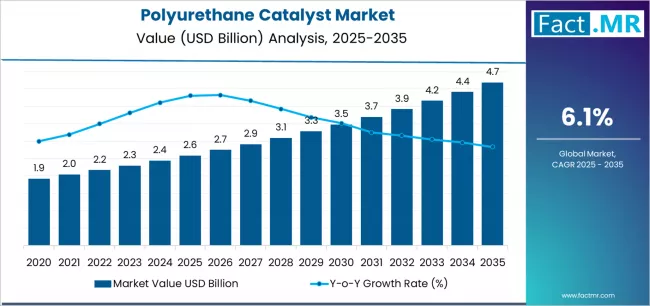
Polyurethane Catalyst Market Market Value Analysis | Source: Fact.MR
Polyurethane manufacturers face mounting pressure to optimize reaction kinetics while reducing emissions and improving processing efficiency, with modern catalyst systems providing documented production benefits including accelerated cure times, precise selectivity control, and reduced catalyst loading compared to traditional amine formulations alone.
Rising adoption of sustainable building practices and expanding automotive lightweighting initiatives enabling material substitution create substantial opportunities for catalyst suppliers and polyurethane formulators. However, stringent regulatory restrictions on certain catalyst chemistries and raw material price volatility may pose obstacles to formulation flexibility and cost competitiveness.
The amine catalysts product segment dominates market activity, driven by versatile reactivity profiles and cost-effective performance delivering reliable polyurethane curing across diverse foam and elastomer applications worldwide. Formulators increasingly recognize the catalytic advantages of tertiary amine systems, with typical catalyst products providing balanced blowing and gelling characteristics at economical dosage levels through established supply chains.
The flexible foam application segment demonstrates the strongest market presence, supported by extensive consumption in furniture, bedding, and automotive seating requiring comfortable cushioning materials. Amine catalysts emerge as the dominant product category, reflecting widespread adoption of tertiary amine formulations for polyol-isocyanate reaction acceleration supporting polyurethane production. China represents the fastest-growing market, driven by massive foam manufacturing capacity and expanding construction activity supporting comprehensive polyurethane catalyst consumption.
Regional dynamics show Asia Pacific maintaining strong growth momentum, supported by concentrated polyurethane production capacity and furniture manufacturing activity driving catalyst demand across consumer goods and industrial sectors. India demonstrates robust expansion potential driven by rapid PU expansion in furniture and construction requiring efficient catalyst systems, while USA emphasizes shift to low-VOC catalyst systems and automotive demand.
Germany leads European consumption through green catalyst innovation and EU compliance driving sustainable formulation development, followed by South Korea supported by electronics-driven PU adoption.
The competitive landscape features moderate concentration with Evonik Industries maintaining market leadership position at 16.9% market share, while established players including BASF, Huntsman International LLC, Covestro AG, and Momentive compete through comprehensive catalyst portfolios and technical formulation support across diverse polyurethane applications.
Polyurethane Catalyst Market Year-over-Year Forecast 2025 to 2035
Between 2025 and 2029, the polyurethane catalyst market is projected to expand from USD 2.59 billion to USD 3.29 billion, resulting in a value increase of USD 0.70 billion, which represents 33.5% of the total forecast growth for the period. This phase of development will be shaped by rising demand for flexible foam in residential furniture and automotive seating applications, product innovation in low-emission catalyst formulations with reduced amine content and improved environmental profiles, as well as expanding regulatory compliance requirements driving reformulation initiatives across major polyurethane markets. Companies are establishing competitive positions through investment in specialty amine development, metal catalyst technologies, and strategic partnerships across foam manufacturers, coating producers, and adhesive formulators.
From 2029 to 2035, the market is forecast to grow from USD 3.29 billion to USD 4.68 billion, adding another USD 1.39 billion, which constitutes 66.5% of the overall expansion. This period is expected to be characterized by the expansion of specialized applications, including high-resilience foam catalysts for premium seating and delayed-action systems for spray foam insulation tailored for specific processing requirements, strategic collaborations between catalyst manufacturers and polyurethane system houses, and an enhanced focus on bio-based catalyst development and circular economy principles. The growing emphasis on green building certifications and rising adoption of water-blown foam systems will drive demand for advanced catalyst solutions with precise reactivity control, minimal odor characteristics, and regulatory compliance across construction, automotive, and furniture manufacturing sectors.
Polyurethane Catalyst Market Key Takeaways
| Metric | Value |
|---|---|
| Market Value (2025) | USD 2.59 billion |
| Market Forecast Value (2035) | USD 4.68 billion |
| Forecast CAGR (2025-2035) | 6.1% |
Source: Fact.MR analysis. Updated Dec 3, 2025
Why is the Polyurethane Catalyst Market Growing?
The polyurethane catalyst market grows by enabling foam manufacturers and coating formulators to achieve optimal reaction kinetics and processing efficiency while controlling cell structure and minimizing defects without excessive processing time and energy consumption.
Polyurethane producers face mounting pressure to optimize production throughput and reduce manufacturing costs while meeting stringent emission regulations, with modern catalyst systems typically providing essential performance characteristics including balanced blowing-gelling ratios, controlled reaction exotherm, and precise cure profiles compared to single-component catalyst approaches alone, making advanced catalysts essential for comprehensive polyurethane manufacturing.
The furniture and construction industries' need for high-quality foam products and durable coating systems creates demand for specialized catalyst products that can provide consistent processing, superior physical properties, and regulatory compliance without compromising production efficiency or material performance.
Processing efficiency requirements and quality specifications drive adoption in foam manufacturing environments, coating production facilities, and adhesive formulation operations, where catalyst performance has direct impact on product quality and manufacturing productivity.
The increasing demand for flexible foam in bedding and furniture applications, affecting consumer goods sectors globally, creates expanding catalyst consumption supporting foam production requirements. Rising awareness about emission reduction and low-VOC formulations enables informed catalyst selection and adoption of environmentally preferred catalyst systems. However, regulatory restrictions on certain amine catalysts and mercury-based systems may limit formulation flexibility among certain applications with traditional catalyst dependencies or specific performance requirements.
Segmental Analysis
The market is segmented by product, application, and region. By product, the market is divided into amine catalysts, metal catalysts, bismuth catalysts, organometallic catalysts, non-metal catalysts, and others. Based on application, the market is categorized into flexible foam, rigid foam, coatings, adhesives & sealants, elastomers, and others. Regionally, the market is divided into Asia Pacific, Europe, North America, Latin America, and Middle East & Africa.
By Product, Which Segment Accounts for the Dominant Market Share?
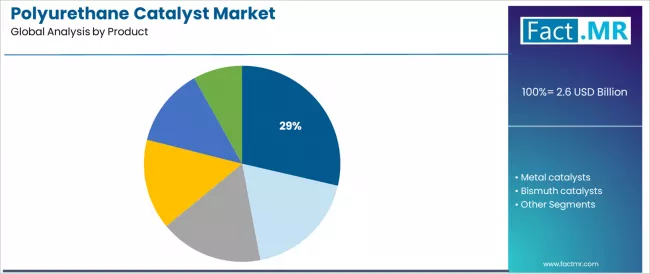
Polyurethane Catalyst Market Analysis By Product | Source: Fact.MR
The amine catalysts product segment represents the dominant force in the polyurethane catalyst market, capturing 28.6% of the total market share in 2025. This established catalyst category encompasses solutions featuring tertiary amine compounds with versatile reactivity characteristics, including advanced delayed-action formulations and balanced catalyst blends that enable precise control over blowing and gelling reactions across flexible foam, rigid foam, and elastomer production worldwide.
The amine catalysts segment's market leadership stems from its superior cost-performance balance, with solutions capable of delivering reliable polymerization acceleration, broad formulation compatibility, and established regulatory acceptance while maintaining accessible pricing and widespread commercial availability across polyurethane supply chains.
The metal catalysts segment maintains a substantial market share at 21.2%, serving applications requiring strong gelling activity and high-reactivity systems across rigid foam insulation, coatings, and adhesives where rapid cure and dimensional stability prove essential.
Metal catalysts offer excellent urethane linkage promotion for demanding processing conditions while providing sufficient performance justification through decades of commercial use. The metal catalysts segment demonstrates steady presence, driven by tin-based and other organometallic systems in established applications.
Within the product category, bismuth catalysts at 16.5% demonstrate growing adoption driven by environmental regulations restricting traditional organotin catalysts, while organometallic catalysts at 11.8% serve specialized applications. Non-metal catalysts maintain 10.4% presence through emerging technologies, while others category includes specialty and niche catalyst systems.
Key catalytic advantages driving the amine catalysts segment include:
- Versatile reactivity profiles with balanced blowing-gelling characteristics enabling broad application across flexible foam, rigid foam, and coatings without extensive reformulation complexity
- Cost-effective performance providing economical catalyst loading and competitive pricing structures while maintaining required processing efficiency and product quality
- Established supply infrastructure allowing reliable availability and consistent quality through multiple suppliers and global distribution networks
- Formulation flexibility enabling catalyst blending and customization for specific processing requirements and performance optimization across diverse polyurethane systems
By Application, Which Segment Accounts for the Largest Market Share?

Polyurethane Catalyst Market Analysis By Application | Source: Fact.MR
Flexible foam dominates the polyurethane catalyst application landscape with approximately 33.7% market share in 2025, reflecting the critical role of efficient catalysis in supporting furniture, bedding, and automotive seating production requiring comfortable cushioning materials worldwide. The flexible foam segment's market leadership is reinforced by massive production volumes, continuous processing operations, and comprehensive catalyst optimization supporting consistent foam quality and production efficiency.
Within this segment, furniture and bedding applications represent the primary consumption category, driven by residential furniture manufacturing and mattress production requiring precise foam density and comfort characteristics. This sub-segment benefits from established formulation protocols and high production volumes supporting consistent catalyst demand.
The rigid foam segment represents an important application category at 24.8% market share with robust presence, demonstrating reliable demand through construction insulation, refrigeration panels, and spray foam applications. This segment benefits from energy efficiency mandates and building code requirements supporting thermal insulation adoption.
The coatings segment maintains significant presence at 14.2% through automotive coatings, industrial finishes, and wood coatings, while adhesives & sealants at 10.5% address construction and assembly applications. Elastomers maintain 8.7% through specialty applications, while others category includes emerging and niche uses.
Key market dynamics supporting application segment growth include:
- Flexible foam expansion driven by furniture manufacturing growth and automotive seating demand, requiring balanced catalyst systems and consistent processing
- Rigid foam category maintaining growth through building insulation and energy efficiency requirements for construction applications
- Integration of low-emission catalyst formulations enabling green building compliance and indoor air quality standards
- Growing emphasis on high-resilience foam and specialty products driving advanced catalyst development for premium applications
What are the Drivers, Restraints, and Key Trends of the Polyurethane Catalyst Market?
The market is driven by three concrete demand factors tied to polyurethane production outcomes. First, expanding furniture and bedding manufacturing across emerging markets creates increasing flexible foam production requiring efficient catalyst systems, with polyurethane catalysts representing essential process chemicals for foam manufacturing in production environments, requiring consistent supply availability. Second, growing construction activity and building insulation requirements drive rigid foam production and systematic catalyst adoption, with low-emission catalyst formulations demonstrating significant advantages in regulatory compliance, indoor air quality improvement, and worker safety through reduced volatile organic compound emissions by 2030. Third, increasing automotive production and lightweighting initiatives enable expanding polyurethane applications that drive catalyst consumption while supporting fuel efficiency objectives and component integration opportunities.
Market restraints include stringent regulatory restrictions and emission limitations on certain catalyst chemistries that can challenge formulation flexibility and catalyst selection, particularly for traditional tin-based and certain amine catalysts where regulatory scrutiny proves intense and alternative catalyst validation remains time-consuming. Raw material supply concentration and price volatility pose another significant obstacle, as polyurethane catalyst production depends on specialized chemical intermediates and metal compounds, potentially affecting product availability and pricing stability. Technical performance tradeoffs between emission reduction and processing efficiency create additional challenges for low-VOC catalyst development, demanding careful formulation optimization and validation testing supporting commercial viability.
Key trends indicate accelerated low-emission catalyst adoption in developed markets, particularly North America and Europe, where foam manufacturers and coating producers demonstrate growing commitment to reduced amine emissions, metal-free formulations, and green catalyst alternatives offering improved environmental profiles and regulatory compliance advantages. Bio-based catalyst trends toward renewable feedstock utilization and sustainable chemistry approaches enable reduced carbon footprint and alignment with circular economy principles. However, the market thesis could face disruption if significant advances in non-catalyzed polyurethane systems or major shifts in foam manufacturing technologies reduce reliance on traditional catalyst-dependent polymerization processes.
Analysis of the Polyurethane Catalyst Market by Key Countries
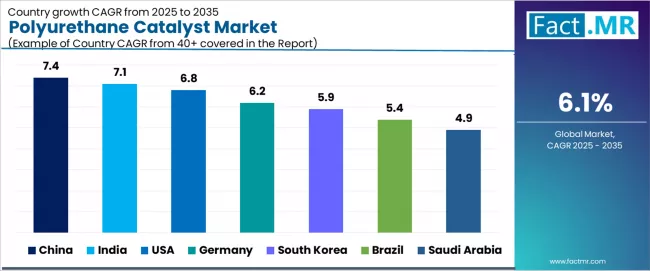
Polyurethane Catalyst Market Cagr Analysis By Country | Source: Fact.MR
| Country | CAGR (2025 to 2035) |
|---|---|
| China | 7.4% |
| India | 7.1% |
| USA | 6.8% |
| Germany | 6.2% |
| South Korea | 5.9% |
| Brazil | 5.4% |
| Saudi Arabia | 4.9% |
Source: Fact.MR analysis. Updated Dec 3, 2025
The global polyurethane catalyst market is expanding robustly, with China leading at a 7.4% CAGR through 2035, driven by largest APAC foam and catalyst manufacturing hub supporting extensive production capacity. India follows at 7.1%, supported by rapid PU expansion in furniture and construction promoting comprehensive polyurethane adoption. USA records 6.8%, reflecting shift to low-VOC catalyst systems and automotive demand supporting regulatory compliance.
Germany advances at 6.2%, leveraging green catalyst innovation and EU compliance driving sustainable formulation development. South Korea posts 5.9%, focusing on electronics-driven PU adoption requiring precision materials, while Brazil grows steadily at 5.4%, emphasizing increasing local PU manufacturing. Saudi Arabia demonstrates 4.9% growth, anchored by construction and infrastructure catalyst usage.
How is China Leading Global Market Expansion?
China demonstrates the strongest growth potential in the polyurethane catalyst market with a CAGR of 7.4% through 2035. The country's leadership position stems from world-leading polyurethane foam production capacity, extensive furniture manufacturing infrastructure, and comprehensive construction activity driving catalyst consumption across consumer goods and building materials sectors.
Growth is concentrated in major industrial regions and manufacturing clusters, including Guangdong, Jiangsu, Zhejiang, and Shandong, where foam producers are increasingly consuming polyurethane catalysts for flexible foam and rigid foam production beyond traditional manufacturing approaches.
Supply channels through chemical distributors, foam system houses, and direct catalyst suppliers expand product availability across manufacturing facilities and formulation operations. The country's comprehensive chemical manufacturing capacity and domestic catalyst production provide strong momentum for market development, including extensive adoption across furniture manufacturers and insulation producers seeking cost-effective processing solutions.
Key market factors:
- Foam manufacturing concentrated in industrial zones with extensive flexible foam and rigid foam production capacity
- Furniture production leadership through both domestic consumption and export manufacturing supporting catalyst demand
- Comprehensive construction activity, including residential buildings and infrastructure projects with proven insulation requirements
- Domestic catalyst manufacturing presence featuring international suppliers and local producers offering competitive products
Why is India Emerging as a High-Growth Market?
In major industrial regions including Gujarat, Maharashtra, Tamil Nadu, and Karnataka, the consumption of polyurethane catalysts is accelerating across foam manufacturing facilities, driven by rapid furniture sector expansion and increasing construction activity. The market demonstrates strong growth momentum with a CAGR of 7.1% through 2035, linked to rapid PU expansion in furniture and construction sectors and increasing adoption of modern foam processing technologies.
Indian manufacturers are implementing efficient catalyst systems integrated with automated foam production to optimize processing while meeting growing expectations in product quality and cost competitiveness. The country's expanding middle-class population and urbanization trends create ongoing demand for furniture and construction materials, while increasing emphasis on organized manufacturing drives adoption of standardized catalyst formulations and technical support.
Key development areas:
- Furniture manufacturing and bedding production leading polyurethane catalyst consumption with emphasis on flexible foam applications
- Construction sector growth through both residential projects and commercial developments driving rigid foam insulation demand
- Manufacturing capacity development enabling domestic foam production addressing import substitution objectives
- Growing preference for technical support and formulation assistance alongside catalyst supply supporting quality improvement
What Drives USA Market Environmental Leadership?
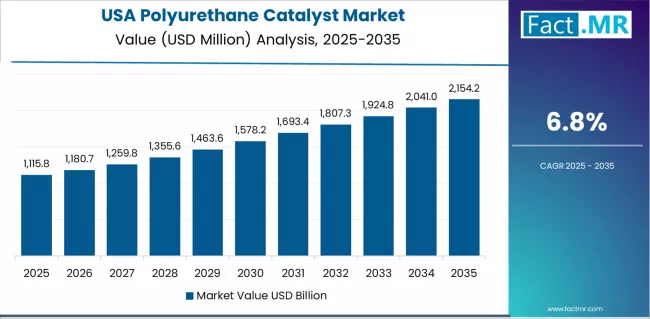
Polyurethane Catalyst Market Country Value Analysis | Source: Fact.MR
USA market expansion is driven by regulatory compliance requirements, including emission reduction mandates and low-VOC catalyst adoption across foam manufacturing and coating applications. The country demonstrates steady growth potential with a CAGR of 6.8% through 2035, supported by shift to low-VOC catalyst systems and automotive demand requiring advanced materials and processing technologies.
American manufacturers face implementation requirements related to air quality regulations and worker safety standards, necessitating catalyst reformulation and validation testing. However, established polyurethane manufacturing infrastructure and comprehensive technical expertise create favorable conditions for advanced catalyst adoption, particularly among facilities pursuing environmental leadership where low-emission processing and sustainable materials drive competitive positioning and market differentiation.
Market characteristics:
- Flexible foam producers and automotive suppliers showing robust catalyst demand with substantial emphasis on emission reduction
- Regional manufacturing dynamics varying between traditional foam centers and emerging automotive supplier locations
- Future projections indicate continued specialty catalyst growth with emphasis on metal-free systems and bio-based alternatives
- Growing emphasis on spray foam insulation and construction applications supporting rigid foam catalyst consumption
How does Germany Demonstrate Innovation Leadership?
The market in Germany leads in green catalyst development based on comprehensive research programs and stringent EU regulatory requirements driving sustainable chemistry innovation. The country shows strong potential with a CAGR of 6.2% through 2035, driven by green catalyst innovation and EU compliance in major chemical production regions including North Rhine-Westphalia, Bavaria, and Baden-Württemberg.
German manufacturers are adopting advanced catalyst systems through rigorous environmental standards and systematic formulation optimization for reduced emissions, particularly in automotive foam applications and industrial coatings demanding regulatory compliance and performance excellence. Supply channels through chemical distributors and foam system houses expand sustainable catalyst availability across manufacturing operations and formulation laboratories.
Leading market segments:
- Automotive foam applications in major production centers implementing low-emission catalyst formulations for interior components
- Industrial coatings achieving sustainable catalyst adoption through VOC reduction and regulatory compliance initiatives
- Strategic collaborations between catalyst manufacturers and polyurethane system houses expanding formulation capabilities
- Focus on bismuth catalysts and metal-free alternatives addressing regulatory restrictions on traditional tin-based systems
What Positions South Korea for Electronics Integration?
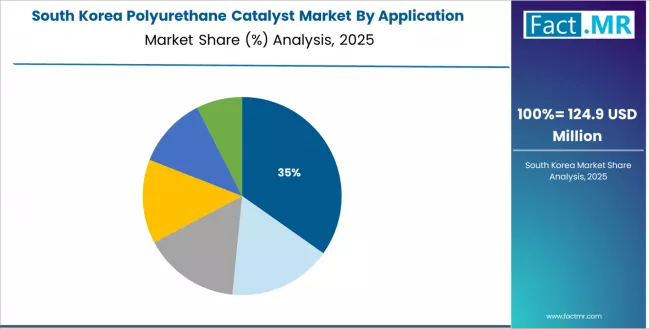
Polyurethane Catalyst Market South Korea Market Share Analysis By Application | Source: Fact.MR
South Korea's polyurethane catalyst market demonstrates specialized consumption focused on electronics applications and precision manufacturing, with documented integration of advanced catalyst systems achieving reliable processing in demanding production environments across technology sectors.
The country maintains solid growth momentum with a CAGR of 5.9% through 2035, driven by electronics-driven PU adoption and advanced manufacturing capabilities emphasizing quality-focused production methodologies that align with technology sector requirements applied to Korean manufacturing operations. Major industrial regions, including Gyeonggi, Chungcheong, and Ulsan, showcase sophisticated catalyst utilization where precision foam and coating applications integrate systematically with electronics assembly and component protection programs.
Key market characteristics:
- Electronics manufacturing utilizing specialty polyurethane foam and coating systems for component protection and assembly
- Precision processing requirements enabling advanced catalyst formulations with precise cure control and minimal defects
- Quality-focused manufacturing culture supporting technical catalyst selection and comprehensive performance validation
- Integration of environmental regulations driving low-emission catalyst adoption and sustainable processing practices
How does Brazil Show Local Manufacturing Development?
Brazil's polyurethane catalyst market demonstrates expanding consumption focused on domestic foam production and construction materials, with documented integration of catalyst systems supporting reliable manufacturing across growing furniture and building materials sectors.
The country maintains solid growth momentum with a CAGR of 5.4% through 2035, driven by increasing local PU manufacturing and import substitution initiatives emphasizing domestic production that aligns with industrial development requirements applied to Brazilian manufacturing operations. Major industrial regions, including São Paulo, Rio Grande do Sul, Paraná, and Minas Gerais, showcase growing catalyst adoption where local foam production integrates systematically with furniture manufacturing and construction material supply chains.
Key market characteristics:
- Furniture manufacturers and foam producers driving catalyst consumption for domestic market supply
- Construction sector growth enabling rigid foam insulation adoption and spray foam applications
- Local catalyst supply development supporting competitive pricing and technical service availability
- Integration of international technical standards and formulation practices supporting quality improvement
What Characterizes Saudi Arabia's Infrastructure Focus?
In major development regions including Riyadh, Jeddah, Eastern Province, and emerging mega-projects, the consumption of polyurethane catalysts serves construction insulation and infrastructure applications, driven by ongoing building activity and comprehensive urban development programs. The market demonstrates steady growth potential with a CAGR of 4.9% through 2035, linked to construction and infrastructure catalyst usage supporting thermal insulation requirements.
Saudi Arabian construction projects are implementing polyurethane foam insulation systems capable of supporting energy efficiency to enhance building performance while meeting expectations in extreme climate conditions. The country's expanding construction sector and vision-driven infrastructure development create ongoing demand for rigid foam catalysts, while commercial building projects drive comprehensive insulation material adoption.
Key development areas:
- Construction projects and infrastructure development utilizing rigid foam insulation systems incorporating polyurethane catalysts
- Building insulation requirements addressing energy efficiency in extreme temperature environments
- Mega-project specifications incorporating international standards for insulation materials and processing
- Regional catalyst supply networks serving construction material manufacturers and spray foam contractors
Europe Market Split by Country
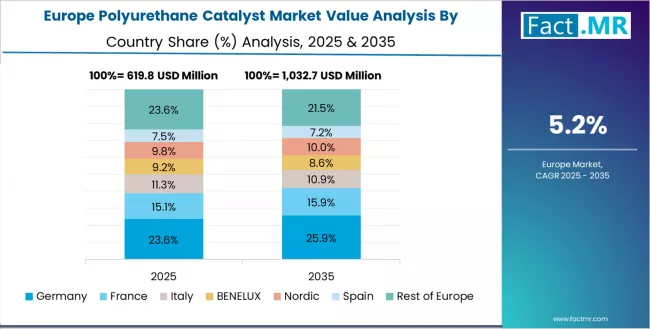
Polyurethane Catalyst Market Europe Country Market Share Analysis, 2025 & 2035 | Source: Fact.MR
The polyurethane catalyst market in Europe is projected to grow from USD 0.67 billion in 2025 to USD 1.15 billion by 2035, registering a CAGR of 5.5% over the forecast period. Germany is expected to maintain its leadership position with a 30.2% market share in 2025, adjusting to 31.1% by 2035, supported by its extensive chemical industry infrastructure, advanced automotive manufacturing, and comprehensive environmental regulations driving green catalyst innovation serving major European markets.
France follows with a 19.8% share in 2025, projected to reach 19.3% by 2035, driven by comprehensive furniture manufacturing and construction activity in major industrial regions implementing sustainable polyurethane processing. UK holds a 17.4% share in 2025, expected to maintain 17.1% by 2035 through ongoing furniture production and construction insulation applications.
Italy commands a 14.9% share, while Spain accounts for 11.2% in 2025. The Rest of Europe region is anticipated to gain momentum, expanding its collective share from 6.5% to 7.2% by 2035, attributed to increasing polyurethane catalyst consumption in Nordic furniture manufacturing and emerging Eastern European foam production facilities implementing modern catalyst systems.
Competitive Landscape of the Polyurethane Catalyst Market
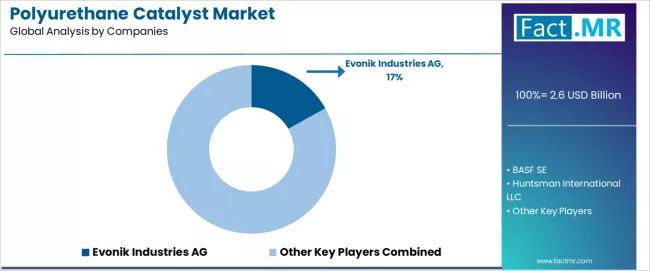
Polyurethane Catalyst Market Analysis By Company | Source: Fact.MR
The polyurethane catalyst market features approximately 20-30 meaningful players with moderate concentration, where the top three companies control roughly 40-50% of global market share through established technology platforms, comprehensive product portfolios, and technical formulation expertise. Competition centers on catalyst performance, environmental compliance, and application support rather than pricing competition alone.
Market leaders include Evonik Industries AG, maintaining a 16.9% market share, BASF SE, and Huntsman International LLC, which maintain competitive advantages through comprehensive catalyst product lines spanning amine, metal, and specialty systems, proven formulation expertise, and global technical support networks, creating stable demand patterns among foam manufacturers and coating producers seeking reliable catalyst solutions. These companies leverage vertically integrated chemical operations and ongoing research investments to defend market positions while developing next-generation low-emission formulations and sustainable catalyst alternatives.
Challengers encompass established chemical companies including Covestro AG, Momentive, and specialty catalyst producers including Shepherd Chemical and Umicore Cobalt & Specialty Materials, which compete through innovative catalyst chemistries and application-specific solutions supporting diverse polyurethane processing requirements.
Regional manufacturers, including Tosoh Asia Pte. Ltd., Guangzhou Yourun Synthetic Material Co., Ltd., and King Industries, Inc., focus on specific geographic markets or product categories, offering differentiated capabilities in cost-competitive formulations, local technical support, and specialized catalyst systems.
Emerging sustainable chemistry innovators and specialty catalyst developers create competitive pressure through bio-based alternatives and metal-free formulations, particularly in regions including North America and Europe, where environmental regulations and customer sustainability requirements provide advantages for green catalyst solutions.
Market dynamics favor companies that combine technical expertise with regulatory knowledge that addresses diverse customer requirements from furniture foam producers through construction insulation manufacturers and automotive coating applicators. Strategic emphasis on low-emission formulations, bio-based alternatives, and regulatory compliance support enables differentiation in increasingly environment-driven and performance-focused polyurethane catalyst market segments across foam, coatings, and specialty applications.
Global Polyurethane Catalyst Market - Stakeholder Contribution Framework
Polyurethane catalysts represent a critical processing chemical that enables foam manufacturers and coating formulators to achieve optimal reaction kinetics and processing efficiency while controlling cell structure and minimizing defects without excessive processing time and energy consumption, typically providing essential performance characteristics including balanced blowing-gelling ratios, controlled reaction exotherm, and precise cure profiles compared to single-component approaches alone while ensuring improved production efficiency and comprehensive product quality outcomes.
With the market projected to grow from USD 2.59 billion in 2025 to USD 4.68 billion by 2035 at a 6.1% CAGR, these products offer compelling advantages for flexible foam applications, amine catalyst systems, and diverse polyurethane manufacturing seeking reliable processing solutions. Scaling market development and sustainable growth requires coordinated action across catalyst innovation, environmental compliance, chemical manufacturers, polyurethane producers, and regulatory frameworks.
How Could Governments Spur Local Development and Adoption?
- Chemical Industry Development Programs: Include specialty catalysts in domestic manufacturing strategies, providing targeted support for catalyst production capacity and intermediate chemical synthesis and supporting technology development through research grants and innovation incentives.
- Environmental Regulation & Standards: Establish clear emission limits and catalyst restrictions based on scientific evidence, provide transition timelines for reformulation compliance supporting industry adaptation, and develop harmonized international standards facilitating cross-border trade.
- Tax Policy & Investment Support: Implement favorable tax treatment for green catalyst manufacturing investments, provide incentives for companies developing bio-based and low-emission alternatives, and establish research credits supporting sustainable chemistry innovation.
- Safety & Health Protection: Fund worker safety programs addressing catalyst handling and emission exposure, invest in air quality monitoring supporting regulatory compliance verification, and establish training initiatives promoting safe chemical management practices.
- Research & Innovation Support: Establish public-private partnerships for catalyst technology research, support collaborative development investigating sustainable alternatives and novel chemistries, and create regulatory pathways that encourage responsible innovation while maintaining safety standards.
How Could Industry Bodies Support Market Development?
- Technical Standards & Best Practices: Define standardized performance testing for polyurethane catalysts across application categories, establish quality benchmarks and reactivity classifications, and create formulation guidelines that manufacturers can implement.
- Market Education & Knowledge Sharing: Lead initiatives demonstrating catalyst optimization benefits, emphasizing processing efficiency, emission reduction, and total cost of ownership compared to suboptimal catalyst selection.
- Sustainability Guidelines: Develop frameworks for environmental impact assessment, catalyst lifecycle analysis, and sustainable chemistry principles, ensuring responsible development across research and commercialization activities.
- Professional Development: Run technical programs for formulators, process engineers, and quality managers on optimizing catalyst selection, processing parameters, and troubleshooting approaches in diverse polyurethane applications.
How Could Manufacturers and Chemical Suppliers Strengthen the Ecosystem?
- Advanced Catalyst Development: Develop next-generation catalyst systems with reduced emissions, improved selectivity, and enhanced sustainability credentials that improve performance while addressing environmental objectives and regulatory compliance.
- Formulation Support Services: Provide comprehensive technical assistance, laboratory testing capabilities, and application optimization consultation that help customers maximize catalyst effectiveness and processing efficiency.
- Regulatory Compliance Support: Offer comprehensive safety documentation, emission testing data, and regulatory guidance that enable customer compliance across global markets and evolving standards.
- Research & Development Networks: Build comprehensive R&D capabilities, application testing facilities, and collaborative innovation programs that advance catalyst technology and enable new polyurethane applications.
How Could Polyurethane Producers and Formulators Navigate the Market?
- Catalyst Optimization Strategies: Develop systematic catalyst selection protocols incorporating performance requirements, emission targets, and cost considerations, with particular focus on balanced reactivity and regulatory compliance for optimal processing outcomes.
- Environmental Compliance Programs: Implement emission monitoring systems, workplace safety protocols, and regulatory tracking addressing evolving restrictions and ensuring ongoing compliance.
- Supplier Partnership Development: Establish collaborative relationships with catalyst manufacturers ensuring technical support access, formulation assistance, and supply chain reliability through long-term agreements and joint development initiatives.
- Continuous Improvement Systems: Create systematic approaches for catalyst performance optimization, processing refinement, and quality enhancement supporting competitive advantages and cost reduction.
How Could Investors and Financial Enablers Unlock Value?
- Green Chemistry Investment: Provide growth capital for established manufacturers like Evonik Industries, BASF, and specialty companies to fund sustainable catalyst development and bio-based alternative commercialization.
- Technology Innovation Financing: Back companies developing novel catalyst chemistries, metal-free alternatives, and emission-reduction technologies that enhance environmental performance and enable regulatory compliance.
- Market Expansion Funding: Finance manufacturing capacity development for catalyst producers establishing operations in high-growth regions including China and India, supporting local production and technical service infrastructure.
- Strategic Integration Support: Enable vertical integration transactions combining catalyst manufacturing with polyurethane system houses or foam producers, creating comprehensive solution providers with enhanced competitive positioning.
Key Players in the Polyurethane Catalyst Market
- Evonik Industries AG
- BASF SE
- Huntsman International LLC
- Covestro AG
- Momentive Performance Materials Inc.
- The Shepherd Chemical Company
- Umicore Cobalt & Specialty Materials
- Tosoh Asia Pte. Ltd.
- Guangzhou Yourun Synthetic Material Co., Ltd.
- King Industries, Inc.
Segmentation
Scope of the Report
| Items | Values |
|---|---|
| Quantitative Units | USD 2.59 Billion |
| Product | Amine catalysts, Metal catalysts, Bismuth catalysts, Organometallic catalysts, Non-metal catalysts, Others |
| Application | Flexible foam, Rigid foam, Coatings, Adhesives & sealants, Elastomers, Others |
| Regions Covered | Asia Pacific, Europe, North America, Latin America, Middle East & Africa |
| Country Covered | China, India, USA, Germany, South Korea, Brazil, Saudi Arabia, and 40+ countries |
| Key Companies Profiled | Evonik Industries, BASF, Huntsman International LLC, Covestro AG, Momentive, Shepherd Chemical, Umicore Cobalt & Specialty Materials, Tosoh Asia Pte. Ltd., Guangzhou Yourun Synthetic Material Co., Ltd., King Industries, Inc. |
| Additional Attributes | Dollar sales by product and application categories, regional consumption trends across Asia Pacific, Europe, and North America, competitive landscape with chemical manufacturers and specialty catalyst producers, product specifications and reactivity requirements, integration with polyurethane formulation processes and foam manufacturing operations, innovations in low-emission technologies and bio-based alternatives, and development of specialized applications with enhanced environmental performance and regulatory compliance capabilities. |
Source: Fact.MR analysis. Updated Dec 3, 2025
Polyurethane Catalyst Market by Segments
-
Product :
- Amine catalysts
- Metal catalysts
- Bismuth catalysts
- Organometallic catalysts
- Non-metal catalysts
- Others
-
Application :
- Flexible foam
- Rigid foam
- Coatings
- Adhesives & sealants
- Elastomers
- Others
-
Region :
- Asia Pacific
- China
- Japan
- South Korea
- India
- Australia
- Thailand
- Rest of Asia Pacific
- Europe
- Germany
- UK
- France
- Italy
- Spain
- Denmark
- Sweden
- Norway
- Rest of Europe
- North America
- USA
- Canada
- Mexico
- Latin America
- Brazil
- Argentina
- Rest of Latin America
- Middle East & Africa
- South Africa
- Saudi Arabia
- UAE
- Kuwait
- Rest of Middle East & Africa
- Asia Pacific
Frequently Asked Questions
How big is the polyurethane catalyst market in 2025?
What will be the size of polyurethane catalyst market in 2035?
How much will be the polyurethane catalyst market growth between 2025 and 2035?
What are the key product types in the polyurethane catalyst market?
Which application segment to contribute significant share in the polyurethane catalyst market in 2025?
Who worked on this report


Preview the report firsthand - request a free sample
Free SampleGet the brochure for pricing and purchase details
Download PDF