- Base Value(2025): 697 Mn
- Forecast Value (2035): 1605 Mn
- CAGR (2035): 9.5%
Biocatalyst PET Pellets Market Outlook 2025 to 2035
The global biocatalyst PET pellets market is expected to reach USD 1,605 million by 2035, up from USD 697 million in 2025. During the forecast period 2025 to 2035, the industry is projected to expand at a CAGR of 8.7%.
Bio catalyst PET pellets market has grown continuously owing to the increasing need for energy saving and high-performance recycling system, which could be put under various industrial conditions. Process automation, smart monitoring, and enzyme engineering are increasingly applied to the packaging industry, textiles and manufacturing. The recovery of materials in a sustainable manner is likely to provide quality, durability, and low costs, which strengthens the steady development of the markets globally and technological diversification.
Quick Stats for Biocatalyst PET Pellets Market
- Industry Value (2025): USD 697 Million
- Projected Value (2035): USD 1,605 Million
- Forecast CAGR (2025 to 2035): 8.7%
- Leading Segment (2025): Packaging Films & Bottles (36.5% Market Share)
- Fastest Growing Country (2025-2035): India (11.3% CAGR)
- Top Key Players: BASF SE, Carbios SA, and Loop Industries, Inc.
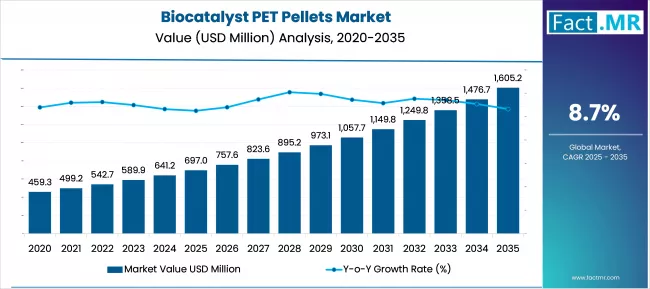
Biocatalyst Pet Pellets Market Market Value Analysis | Source: Fact.MR
What are the drivers of the biocatalyst PET pellets market?
The market of the biocatalyst PET pellets is motivated by the developments in the efficiency of enzymes, scalability of bioprocessing, and sustainable polymer regeneration. Packaging, textile, and consumer goods industries are also demanding low energy and high purity recycled plastics in large numbers. Enzyme-based depolymerization, automated reactors and accuracy of monitoring are becoming popular as manufacturers focus on productivity and recovery of resources.
Controlled biocatalyst action, corrosive resistant reactors and temperature optimum systems to achieve uniform polymer conversion increase reliability and safety. Increasing accessibility by way of working with partners, online purchases as well as licensing is promoting adoption in upcoming areas. Innovation in technologies applied to enzyme coating, design of bioreactors, and stabilization of molecules enhances the lifespan and performance of the process. Sustainability is one of the leading drivers, and recyclable feedstock and low-carbon operations as well as compliance with the regulations are consistent with the global priorities of the circular economy.
What are the regional trends of the biocatalyst PET pellets market?
In North America, the U.S. dominates the biocatalyst PET pellets market, which is backed by developed recycling facilities, high packaging, and the focus on the compliance of the circular economy on the regulations. Energy efficiency, high-purity recovery, and cost-effective enzyme systems are the priorities of buyers, enhanced by the partnerships between PET manufacturers and biotech companies. Regional innovation is enhanced by continuous R&D in enzyme engineering and automated depolymerization.
The rapid growth is experienced in Europe because of strict sustainability laws and recycling requirements in the U.K., Germany and France. Manufacturers focus on REACH-conformable, low-emission and complete traceable recycling technologies in line with the EU Green Deal goals. Open production, quality assurance, and inter-industry collaboration are strengthening the leadership of the region in the usage of bio-catalyst PET.
Asia Pacific has been the most rapidly expanding region, with China, Japan, and India at the forefront, in which the government efforts on waste valorization and smart manufacturing back the massive recycling projects using enzymes. Foreign investments and expansion of packaging and textile industries also keep on promoting localization of production and technology.
The Middle East & Africa is rising in industrial sectors focusing on the energy-efficient polymer recovery and sustainability certification. Market penetration is being stipulated by growing infrastructure and diversification in manufacturing. Other countries in Latin America, including Brazil, Mexico, and Chile, are making progress in the development of recycling networks, and in the development of enzyme-based PET pellet solutions in food packaging and consumer goods manufacturing.
What are the challenges and restraining factors of the Biocatalyst PET Pellets market?
PET pellets market of the biocatalysts has a number of challenges that inhibit mass application of technology at industrial level. The cost of production of enzymes formulation, purification, and reactor configuration are high and cost-sensitive industries have a hard time commercializing it. Absence of standardized system of biocatalyst and the lengthy certification of food-grade and environmental sustainability also postpones market penetration.
The stricter control of the material traceability and recyclability by regulators forces manufacturers to use alternative additives that have the eco-certification, which raises the costs incurred in the research and development and in the processes. The trade-offs between the stability of the enzyme, reaction efficiency, and temperature regulation remain as technical trade-offs influencing yield and the catalyst life. Enzymatic performance can also be affected in the long term by harsh industrial conditions, e.g. humidity, and chemical exposure.
The fragmentation of the supply chain makes the situation even more complex because the production scalability may be slowed by the unavailability of specialized enzymes and reactor parts. In Third World countries, poor technical training and maintenance negatively affect process reliability. The competition by mechanical and chemical recycling methods which provide an established infrastructure further discourages market penetration. Nevertheless, these limitations should be reduced due to the development of local production, standard enzyme systems, and the development of bio-based materials.
Country-Wise Insights
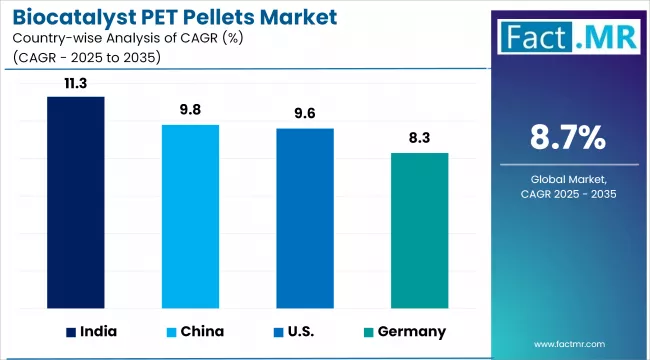
Biocatalyst Pet Pellets Market Cagr Analysis By Country | Source: Fact.MR
Sustainability Standards and Precision Engineering Drive Germany’s Biocatalyst PET Pellets Integration in Circular Manufacturing
Germany boasts of a great foundation in industrial engineering and precision production hence making it a trendsetter in adopting biocatalyst PET pellets. The growth is supported by environmental compliance and automation, with a focus on the processes that are compliant with REACH, low-emission enzyme system, and traceable feedstock. German recycles combine digital tracking, modular reactor and predictive analytics to enhance material recovery and lifecycle efficiency in packaging and industrial polymers.
Technological Innovation and Robotics Integration Accelerate Japan’s Biocatalyst PET Pellets Market Expansion
The system of the high technology robotics and automation in Japan is boosting the speed of innovation in the production of biocatalyst PET pellets. Recycling facilities based on AI-regulated depolymerization and energy-efficient bioreactors to achieve accuracy in recovering polymers are called enzyme-assisted. Domestic manufacturers implement the use of PFAS-free operations, robotized handling, and closed-loop systems, affirmed by industrial innovation centers that promote cooperation and sustainability-oriented research and development.
Energy Diversification and Industrial Resilience Propel Middle East’s Biocatalyst PET Pellets Adoption
The diversification of energy and the sustainability of industry in the Middle East market. Other countries such as Saudi Arabia and the UAE focus on localized biocatalyst PET pellets manufacturing to facilitate the packaging, building and petrochemicals recycling. The local manufacturers are concentrating on thermostat resistant reactor materials, integrative power systems, and automated enzyme production units to promote circular production in extreme environmental conditions.
Category-Wise Analysis
Virgin and Biocatalyst-Reprocessed PET Pellets Define Core Circular Efficiency
High-strength applications where virgin PET must be used and demand clarity and durability are being taken over by global manufacturers with virgin PET pellets, and biocatalyst-reprocessed pellets are becoming the viable alternative. These enzyme-modified materials provide the opportunity to depolymerize in low-energy, regenerate in high-purity, and degrade in minimum amounts. Their assurance with the current molding systems will guarantee less downtime, low risk of contamination and increased throughput of packaging and industrial production.
Enzymatic and Microbial Catalyst Technologies Anchor Recycling Advancements
The market is dominated by enzymatic catalysts, which are accurate and efficient in depolymerizing polymers at moderate temperatures. High-purity monomer recovery is often carried out using hydrolase and PET, whereas microbial catalysts are becoming popular in the area of flexible bioprocess and feedstock diversity. The sustained innovation in enzyme immobilization, optimization of bioreactor, and hybrid recycling technologies increase the scale and output.
Packaging, Textile, and Industrial Sectors Drive Core Market Utilization
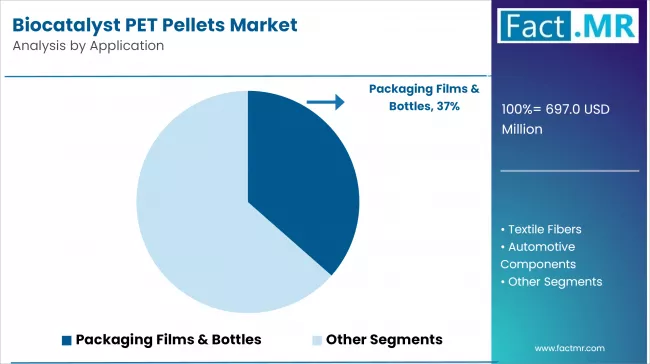
Biocatalyst Pet Pellets Market Analysis By Application | Source: Fact.MR
Packaging is the highest end-use category, as it is motivated by sustainable bottle-to-bottle recycling and the preference of consumers to circular materials. The textile sector comes second with more PET fibers being used in clothing and furniture to cut down on virgin polyester. The biocatalyst PET pellets find application in the industrial industries within component moulding, insulation, and high-performance film aiding in the material recovery and environmental conformity with production chains.
Competitive Analysis
PET pellets biocatalyst PETs are increasingly becoming popular because manufacturers and consumers are focusing on the regeneration of high-purity polymers at lower energy consumption and enzyme stability. The rising trend of sustainability and regulatory compliance is moving the trend towards enzyme as opposed to the chemical-based recycling more rapidly. Major manufacturers are producing next generation PET pellets using optimized enzyme formulations, recyclable feedstocks and closed loop production systems which are in line with REACH and RoHS requirements.
The commercialization of the enzymes, polymers, and packaging brands is growing in the global market through strategic partnerships between enzyme developers and polymer and packaging manufacturers. Other companies such as Carbios, Loop industries and Indorama Ventures are also investing in pilot-scale plants and improvement of bioreactors to improve yield and scalability. The market is open to long-term competitive development and material circularity with the ongoing innovation of enzyme engineering and reactor automation.
Key players in the biocatalyst PET pellets market include Indorama Ventures Public Co. Ltd., ALPLA Group, Plastipak Holdings, Inc., Veolia Environnement S.A., Loop Industries, Inc., Carbios SA, BASF SE, Novozymes A/S, DuPont de Nemours, Inc., AB Enzymes GmbH, Lonza Group AG, Codexis, Inc., Prozomix Limited, Biocatalysts Limited.
Recent Development
- In June 2025, Loop Industries Inc. announced a US $1.5 million engineering services agreement with its Indian joint venture Ester Loop Infinite Technologies Private Ltd. (ELITe) to advance construction of their Infinite Loop™ India facility, which uses advanced biocatalyst-enabled PET depolymerization technology for producing fully recycled PET.
Fact.MR has provided detailed information about the price points of key manufacturers of Biocatalyst PET Pellets Market positioned across regions, sales growth, production capacity, and speculative technological expansion, in the recently published report.
Segmentation
Segmentation of Biocatalyst PET Pellets Market
-
By Type :
- Virgin PET Pellets
- Recycled PET Pellets
- Biocatalyst-Reprocessed PET Pellets
-
By Catalyst Type :
- Enzymatic Catalysts
- Microbial Biocatalysts
-
By Application :
- Packaging Films & Bottles
- Textile Fibers
- Automotive Components
- Industrial Sheets & Films
- Others
-
By End User :
- Food & Beverage
- Textiles & Apparel
- Consumer Goods
- Automotive
- Construction & Industrial
-
By Region :
- North America
- Latin America
- Western Europe
- Eastern Europe
- East Asia
- South Asia & Pacific
- Middle East & Africa
Frequently Asked Questions
What was the Global Biocatalyst PET Pellets Market Size Reported by Fact.MR for 2025?
Who are the Major Players Operating in the Biocatalyst PET Pellets Market?
What is the Estimated Valuation of the Biocatalyst PET Pellets Market in 2035?
What Value CAGR did the Biocatalyst PET Pellets Market Exhibit Over the Last Five Years?
Who worked on this report


Preview the report firsthand - request a free sample
Free SampleGet the brochure for pricing and purchase details
Download PDF