- Market Value (2025): USD 254.0 Mn
- Estimated Value (2026): USD 272.8 Mn
- Forecast Value (2036): USD 557.0 Mn
- CAGR (2026-2036): 7.4%
What is the Pomegranate Powder Market forecast to be worth by 2036?
USD 272.8 million in 2026 to USD 557.0 million by 2036 at 7.4% CAGR.
- The pomegranate powder market crossed a valuation of USD 254.0 million in 2025.
- Demand is projected to increase from USD 272.8 million in 2026 to USD 557.0 million by 2036.
- The market is forecast to record 7.4% CAGR from 2026 to 2036.
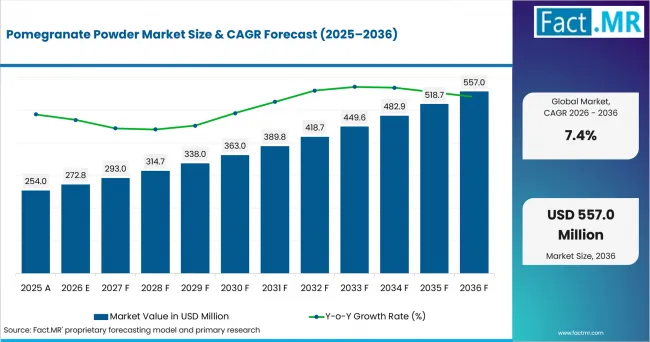
Pomegranate Powder Market Value Analysis | Source: Fact.MR
What are the defining numbers behind Pomegranate Powder Market growth?
USD 284.2 million absolute opportunity is expected between 2026 and 2036.
- Demand Drivers in the Market
- Supplement brands are expected to choose pomegranate powder when they need measured fruit ingredients.
- Food and beverage makers are anticipated to use powder where liquid handling is less practical.
- B2B channels are projected to remain important because commercial buyers need documents and repeat supply.
- Spray-dried formats are expected to support larger-volume use where blending and cost matter.
- Key Segments Analyzed
- By Product Type: Whole Fruit Powder leads with 38.0% share in 2026.
- By Application: Nutraceuticals and Supplements hold 34.0% share in 2026.
- By End Use: Nutraceutical Industry accounts for 37.0% share in 2026.
- By Distribution Channel: B2B and Ingredient Suppliers leads with 53.0% share in 2026.
- By Drying Process: Spray-Dried anticipated to hold 51.0% share in 2026.
- Analyst Opinion at Fact.MR
- Shambhu Nath Jha, Principal Consultant at Fact.MR, states, “Pomegranate powder buyers are expected to assess suppliers by product origin and drying process. Clear specifications are expected to matter as much as price when brands compare powder forms.”
- Strategic Implications
- Buyers can separate whole fruit powder from juice powder before comparing suppliers.
- Suppliers improve clarity by explaining drying-process choices in plain language.
- Channel planning benefits from separate approaches for B2B ingredient buyers and retail shoppers.
Iran follows at 7.7% CAGR. The USA reaches 7.5% CAGR. Turkey records 7.3% CAGR. Spain posts 7.0% CAGR. through 2036.
How does the Pomegranate Powder Market break down by segment?
Whole Fruit Powder leads Product Type with 38.0% share in 2026. Nutraceuticals and Supplements leads Application with 34.0% share.
What leads the Product Type segment?
Whole Fruit Powder is projected to account for 38.0% share in 2026.
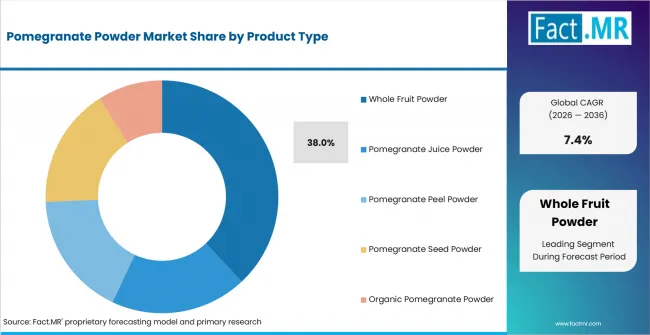
Pomegranate Powder Market Analysis By Product Type | Source: Fact.MR
Whole Fruit Powder leads because it gives buyers a broad pomegranate ingredient. Aril powder and peel-inclusive whole powder serve narrower uses. Pomegranate juice powder and pomegranate peel powder complete part of the product view. Pomegranate seed powder and organic pomegranate powder are included.
What leads the Application segment?
Nutraceuticals and Supplements is expected to hold 34.0% share in 2026.
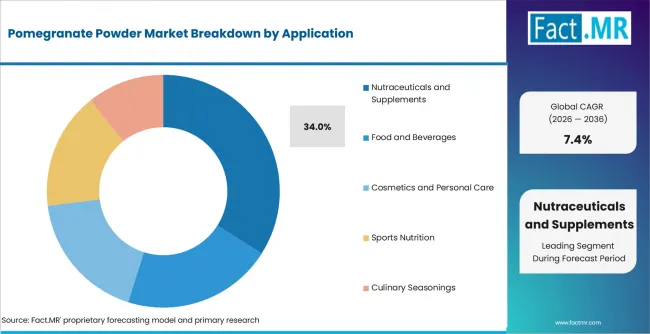
Pomegranate Powder Market Analysis By Application | Source: Fact.MR
Capsules and heart health formulations give this application the leading position. The same buyer need appears in fruit and vegetable powder categories. Food and beverages plus cosmetics and personal care add further use cases. Sports nutrition and culinary seasonings are included.
How does End Use shape demand?
Nutraceutical Industry is anticipated to lead End Use with 37.0% share in 2026.
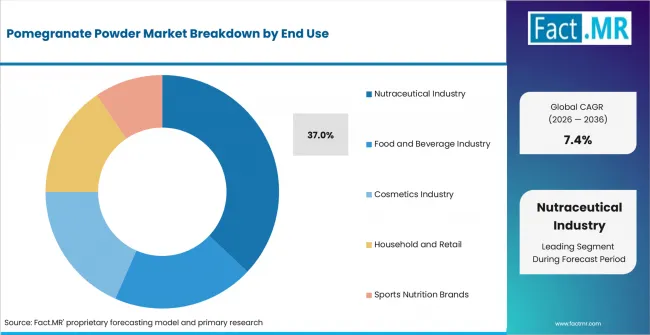
Pomegranate Powder Market Analysis By End Use | Source: Fact.MR
The nutraceutical industry leads because supplement makers need powders that can be tested and packed consistently. Supplement brands and ayurvedic product manufacturers support this base. Food and beverage industry plus cosmetics industry broaden demand. Household and retail plus sports nutrition brands are included.
Which Distribution Channel leads?
B2B and Ingredient Suppliers is estimated to account for 53.0% share in 2026.
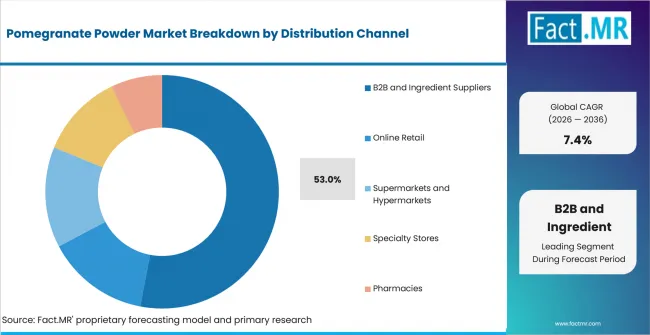
Pomegranate Powder Market Analysis By Distribution Channel | Source: Fact.MR
B2B and ingredient suppliers lead because commercial buyers need sourcing support and product documents. botanical extract distributors and contract manufacturers belong to this channel group. online retail and supermarkets and hypermarkets serve retail-facing demand.
What supports Spray-Dried within Drying Process?
Spray-Dried is forecast to lead Drying Process with 51.0% share in 2026.
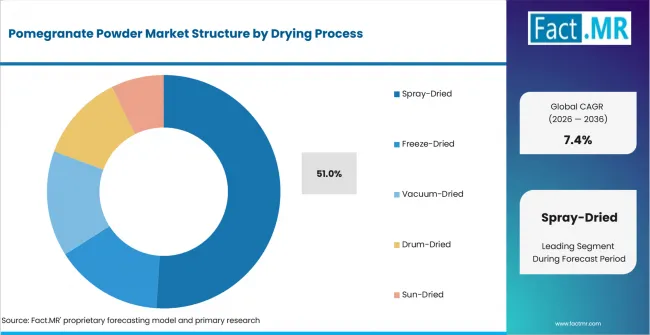
Pomegranate Powder Market Analysis By Drying Process | Source: Fact.MR
Spray-Dried products lead because the method supports scalable powder production. High-temperature spray drying and low-temperature spray drying serve different quality positions. freeze-dried and vacuum-dried products address selected process needs. Drum-dried and sun-dried products are included.
What is accelerating Pomegranate Powder Market adoption, and what is holding it back?
Adoption is expected to rise where brands need a pomegranate ingredient that stores easily and blends into finished products. Growth is restrained when buyers cannot compare product origin and drying method clearly.
Drivers Impact Analysis
| DRIVER | COMMERCIAL EFFECT | GEOGRAPHIC RELEVANCE | IMPACT TIMELINE |
|---|---|---|---|
| Nutraceutical formulation use | Supports capsules and supplement blends | India, USA, Iran | Short term (<= 2 years) |
| Whole fruit positioning | Keeps the ingredient useful across many applications | India and Spain | Short term (<= 2 years) |
| B2B ingredient supply | Supports repeat orders through documentation | Global ingredient channels | Medium term (2-4 years) |
| Spray-dried processing | Supports higher-volume powder production | India, Turkey, China | Medium term (2-4 years) |
| Retail usage education | Helps shoppers understand serving use | USA and Spain | Long term (>= 4 years) |
Source: Fact.MR analysis. Updated Aug 7, 2026
- Nutraceutical formulation use: Supplement buyers are expected to support demand where dosage consistency guides approval.
- Whole fruit positioning: Whole Fruit Powder is projected to help brands avoid a narrow juice-only message.
- B2B ingredient supply: Ingredient suppliers are anticipated to retain importance because buyers need documents and repeat availability.
Opportunity Impact Analysis
| OPPORTUNITY | COMMERCIAL EFFECT | GEOGRAPHIC RELEVANCE | IMPACT TIMELINE |
|---|---|---|---|
| Clear product identity | Improves comparison between powder forms | Global suppliers | Short term (<= 2 years) |
| Supplement brand expansion | Adds repeat capsule and formula demand | India and USA | Short term (<= 2 years) |
| Drying process differentiation | Creates premium positioning for selected formats | Spain and USA | Medium term (2-4 years) |
| Online retail education | Supports household trial through usage guidance | USA, Turkey, Spain | Medium term (2-4 years) |
Source: Fact.MR analysis. Updated Aug 7, 2026
- Clear product identity: Suppliers are expected to gain trust when labels separate whole fruit powder from juice powder.
- Supplement brand expansion: Nutraceutical brands are anticipated to create repeat demand when specifications remain consistent.
- Drying process differentiation: Freeze-dried and vacuum-dried products are projected to support applications where color and flavor receive closer review.
Restraints Impact Analysis
| RESTRAINT | COMMERCIAL EFFECT | GEOGRAPHIC RELEVANCE | IMPACT TIMELINE |
|---|---|---|---|
| Input price variability | Raises contract risk when fruit supply changes | Global | Short term (<= 2 years) |
| Specification confusion | Slows approval when buyers cannot compare forms | Retail and ingredient channels | Short term (<= 2 years) |
| Claim review burden | Requires care around wellness positioning | Nutraceutical and skincare uses | Medium term (2-4 years) |
| Premium price points | Restricts repeat purchase in value channels | USA, Spain, China | Medium term (2-4 years) |
Source: Fact.MR analysis. Updated Aug 7, 2026
- Input price variability: Fresh-fruit supply and drying yield are expected to affect supplier contracts.
- Specification confusion: Buyers are likely to delay approval when sellers do not separate powder types.
- Claim review burden: Brands are expected to use careful wording around antioxidant and heart health applications.
Which countries are scaling the Pomegranate Powder Market fastest?
India leads the country comparison. Iran follows closely. The USA and Turkey form the next growth band. Spain and China complete the displayed range.
- India remains 0.2 percentage point above Iran through nutraceutical manufacturing depth.
- Iran remains 0.2 percentage point above the USA through origin-led product positioning.
- The USA remains 0.2 percentage point above Turkey through supplement and online retail demand.
- Turkey remains 0.3 percentage point above Spain through fruit processing and ingredient supply.
- Spain remains 0.2 percentage point above China through wellness and food channels.
- China closes the displayed range through supplement production and e-commerce access.
Comparable CAGRs can create different entry conditions because each country has a different demand mix. Full report coverage includes North America and Latin America. Europe and East Asia are included. South Asia and Pacific plus Middle East and Africa complete the regional view.
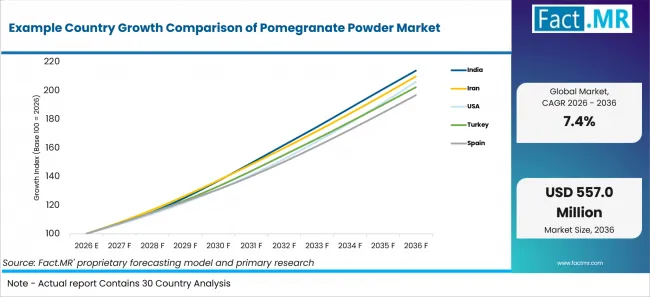
Example Country Growth Comparison Of Pomegranate Powder Market | Source: Fact.MR
| COUNTRY | CAGR (2026-2036) |
|---|---|
| Iran | 7.7% |
| USA | 7.5% |
| Turkey | 7.3% |
| Spain | 7.0% |
Source: Fact.MR analysis. Updated Aug 7, 2026
How is Iran scaling demand?
7.7% CAGR, driven by pomegranate origin strength and processing relevance.
Iran benefits from its recognized pomegranate supply and established fruit-processing base. Whole Fruit Powder gives suppliers a broader positioning route across food and ingredient applications. Export opportunities remain important, although documentation requirements and changes in drying yield can affect order timing and price stability. Household demand may stay limited without clear usage instructions.
What is driving the USA’s growth from 2026 to 2036?
7.5% CAGR, backed by supplement brands and online retail access.
The USA market expands through capsule blends, organic powder formats and direct-to-consumer sales. Natural food retailers place value on clear ingredient details, while sports nutrition brands use fruit powder for flavor and product differentiation. Competition from berry and acai powders remains strong. Retailers also review antioxidant language closely before expanding shelf space.
How is Turkey developing demand?
7.3% CAGR, supported by fruit processing and ingredient export activity.
Turkey’s growth reflects strong processing capability across spray-dried and juice-powder formats. Contract manufacturers and drink producers create recurring B2B demand, while botanical ingredient distributors help buyers compare specifications. Raw-material price movement can affect contracts, and incomplete documentation may delay approval. Retail growth also depends on simple product-use guidance.
How does Spain perform?
7.0% CAGR, led by food applications and wellness-oriented retail channels.
Spain builds demand through beverage, confectionery and supplement-facing products. Wellness retailers provide a route for premium packs, while natural beauty brands explore peel-powder applications. Higher-value drying methods can support color-sensitive uses. However, lower-cost fruit powders remain competitive, and skincare positioning requires careful claims review before wider commercial use.
Who leads the Pomegranate Powder Market?
Competition is shaped by product form and channel access. The listed company set covers pomegranate powder and fruit ingredient exposure. Superfood and dried fruit powder exposure are included. Company shares are not included.
Suppliers are expected to compete by showing whether the product is whole fruit powder or juice powder. The same clarity matters in clean label fruit and vegetable powder and fruit concentrate puree positioning.
Which companies are the key providers?
Key companies include Navitas Organics; Mevive International; Kanegrade Ltd.; NutraDry Pty Ltd.; Van Drunen Farms; Z Natural Foods, LLC; Medikonda Nutrients; Vinayak Ingredients (India) Pvt. Ltd.; and Saipro Industries Private Limited
- Navitas Organics
- Mevive International
- Kanegrade Ltd.
- NutraDry Pty Ltd.
- Van Drunen Farms
- Z Natural Foods, LLC
- Medikonda Nutrients
- Vinayak Ingredients (India) Pvt. Ltd.
- Saipro Industries Private Limited
Bibliography
- Press Information Bureau. (2026, June 11). Department of Agriculture & Farmers Welfare releases second advance estimates of horticultural crop area and production for 2025-26.
- U.S. Food and Drug Administration. (2025, January 6). FDA releases allergen, food safety, and plant-based alternative labeling guidances.
- Ministry of Agriculture & Farmers Welfare. (2025, March). Production clusters identified for horticultural crops under the cluster development programme. Press Information Bureau, Government of India.
This Report Answers
- The report provides strategic intelligence on Product Type and Application. End Use and Distribution Channel are covered. Drying Process is included.
- Segment analysis covers Whole Fruit Powder and Nutraceuticals and Supplements as 2026 leaders. Nutraceutical Industry and B2B and Ingredient Suppliers are covered. Spray-Dried processing completes the segment view.
- Country outlook evaluates India and Iran alongside the USA and Turkey. Spain and China complete the growth comparison.
- Competitive analysis profiles Navitas Organics. Mevive International and Kanegrade Ltd. are included. NutraDry Pty Ltd. and Van Drunen Farms are covered. Z Natural Foods, LLC and Medikonda Nutrients are included. Vinayak Ingredients (India) Pvt. Ltd. and Saipro Industries Private Limited complete the provider set.
What does the Pomegranate Powder Market cover?
Pomegranate powder products are used where manufacturers or retail buyers need a dry pomegranate ingredient. Coverage includes whole fruit powder and juice powder. Peel powder and seed powder are included.
Organic powder is included. The market covers supplement and food channels. Beverage and personal care channels are included. Sports nutrition and household channels complete the view. The market includes B2B ingredient supply and online retail. It covers spray-dried and freeze-dried products.
What is included in the scope?
The scope includes pomegranate powder sold across the listed product type and application categories. End-use, distribution channel, and drying process categories are included. Supplier participation is included when companies offer pomegranate powder or closely related fruit-powder formats.
Coverage extends to country demand where these products serve the assessed applications. It includes fruit powder and fruit and vegetable powder adjacency only when the product is sold or formulated as powder.
What is excluded from the scope?
The scope excludes fresh pomegranates and bottled pomegranate juice when no powder format is involved. Finished pharmaceuticals are excluded unless the product is sold as a powder ingredient for the listed applications.
Company revenue without a clear connection to pomegranate powder or related fruit-powder offerings is excluded. Company shares are not included in this document.
How Was the Analysis Built?
The analysis draws on 120+ sources, 35+ company portfolios, 25+ countries, and more than 20 industry interviews.
- Primary Research: Primary research includes discussions with manufacturers, service providers, technology developers, distributors, end users, procurement teams, and subject-matter experts. These conversations examine purchasing priorities, product adoption, operational challenges, approval requirements, competitive positioning, and the factors that influence wider market acceptance.
- Desk Research: Desk research covers government statistics, regulatory publications, company filings, trade data, technical studies, industry associations, standards, public policy, and other authoritative sources. Every source used in the analysis is documented in the bibliography.
- Market Sizing and Forecasting: Market estimates combine historical performance, demand indicators, pricing and volume trends, segment shares, company participation, country-level growth, adoption patterns, investment activity, and barriers to market expansion.
- Data Validation and Update Cycle: Findings are validated by comparing primary interviews with public data, company activity, regulatory changes, trade patterns, and industry developments. Regular updates review new product launches, capacity changes, partnerships, approvals, procurement trends, and shifts in commercial adoption.
What does the Pomegranate Powder Market cover?
Pomegranate powder products are used where manufacturers or retail buyers need a dry pomegranate ingredient. Coverage includes whole fruit powder and juice powder. Peel powder and seed powder are included.
Organic powder is included. The market covers supplement and food channels. Beverage and personal care channels are included. Sports nutrition and household channels complete the view. The market includes B2B ingredient supply and online retail. It covers spray-dried and freeze-dried products.
What is included in the scope?
The scope includes pomegranate powder sold across the listed product type and application categories. End-use, distribution channel, and drying process categories are included. Supplier participation is included when companies offer pomegranate powder or closely related fruit-powder formats.
Coverage extends to country demand where these products serve the assessed applications. It includes fruit powder and fruit and vegetable powder adjacency only when the product is sold or formulated as powder.
What is excluded from the scope?
The scope excludes fresh pomegranates and bottled pomegranate juice when no powder format is involved. Finished pharmaceuticals are excluded unless the product is sold as a powder ingredient for the listed applications.
Company revenue without a clear connection to pomegranate powder or related fruit-powder offerings is excluded. Company shares are not included in this document.
How Was the Analysis Built?
The analysis draws on 120+ sources, 35+ company portfolios, 25+ countries, and more than 20 industry interviews.
- Primary Research: Primary research includes discussions with manufacturers, service providers, technology developers, distributors, end users, procurement teams, and subject-matter experts. These conversations examine purchasing priorities, product adoption, operational challenges, approval requirements, competitive positioning, and the factors that influence wider market acceptance.
- Desk Research: Desk research covers government statistics, regulatory publications, company filings, trade data, technical studies, industry associations, standards, public policy, and other authoritative sources. Every source used in the analysis is documented in the bibliography.
- Market Sizing and Forecasting: Market estimates combine historical performance, demand indicators, pricing and volume trends, segment shares, company participation, country-level growth, adoption patterns, investment activity, and barriers to market expansion.
- Data Validation and Update Cycle: Findings are validated by comparing primary interviews with public data, company activity, regulatory changes, trade patterns, and industry developments. Regular updates review new product launches, capacity changes, partnerships, approvals, procurement trends, and shifts in commercial adoption.
Segmentation
What is the report’s scope and coverage?
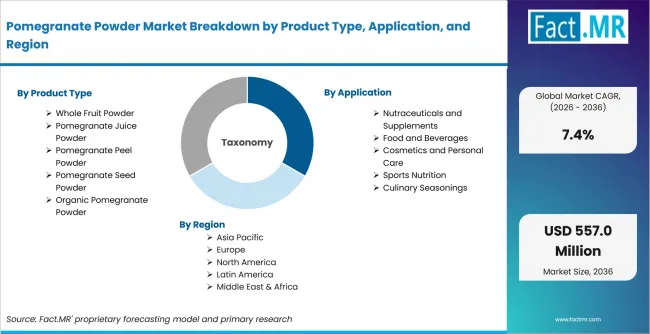
Pomegranate Powder Market Breakdown By Product Type, Application, And Region | Source: Fact.MR
| Attribute | Details |
|---|---|
| Quantitative Units | USD million |
| Market Definition | Pomegranate powder products used across supplement, food, beverage, personal care, sports nutrition, culinary, and retail applications |
| Product Type | Whole Fruit Powder; Aril Powder; Peel-Inclusive Whole Powder; Pomegranate Juice Powder; Spray-Dried Juice Powder; Freeze-Dried Juice Powder; Pomegranate Peel Powder; High-Punicalagin Peel Powder; Pomegranate Seed Powder; Organic Pomegranate Powder |
| Application | Nutraceuticals and Supplements; Antioxidant Capsules; Heart Health Formulations; Food and Beverages; Functional Drinks; Confectionery and Sweets; Cosmetics and Personal Care; Anti-Aging Skincare; Sports Nutrition; Culinary Seasonings |
| End Use | Nutraceutical Industry; Supplement Brands; Ayurvedic Product Manufacturers; Food and Beverage Industry; Juice and Drink Producers; Bakery and Confectionery Makers; Cosmetics Industry; Natural Beauty Brands; Household and Retail; Sports Nutrition Brands |
| Distribution Channel | B2B and Ingredient Suppliers; Botanical Extract Distributors; Contract Manufacturers; Online Retail; E-commerce Marketplaces; D2C Brand Websites; Supermarkets and Hypermarkets; Health and Wellness Chains; Specialty Stores; Pharmacies |
| Drying Process | Spray-Dried; High-Temperature Spray Drying; Low-Temperature Spray Drying; Freeze-Dried; Aril Freeze Drying; Juice Freeze Drying; Vacuum-Dried; Vacuum Belt Drying; Drum-Dried; Sun-Dried |
| Regions Covered | North America; Latin America; Europe; East Asia; South Asia and Pacific; Middle East and Africa |
| Countries Covered | India; Iran; USA; Turkey; Spain; China |
| Key Companies Profiled | Navitas Organics; Mevive International; Kanegrade Ltd.; NutraDry Pty Ltd.; Van Drunen Farms; Z Natural Foods, LLC; Medikonda Nutrients; Vinayak Ingredients (India) Pvt. Ltd.; Saipro Industries Private Limited |
| Forecast Period | 2026 to 2036 |
| Approach | Hybrid top-down and bottom-up assessment using product type demand; application demand; end-use demand; channel structure; drying process mix; country growth patterns; company participation; and supplier portfolio review |
Source: Fact.MR analysis. Updated Aug 7, 2026
How is the market segmented?
-
By Product Type
- Whole Fruit Powder
- Aril Powder
- Peel-Inclusive Whole Powder
- Pomegranate Juice Powder
- Spray-Dried Juice Powder
- Freeze-Dried Juice Powder
- Pomegranate Peel Powder
- High-Punicalagin Peel Powder
- Pomegranate Seed Powder
- Organic Pomegranate Powder
- Whole Fruit Powder
-
By Application
- Nutraceuticals and Supplements
- Antioxidant Capsules
- Heart Health Formulations
- Food and Beverages
- Functional Drinks
- Confectionery and Sweets
- Cosmetics and Personal Care
- Anti-Aging Skincare
- Sports Nutrition
- Culinary Seasonings
- Nutraceuticals and Supplements
-
By End Use
- Nutraceutical Industry
- Supplement Brands
- Ayurvedic Product Manufacturers
- Food and Beverage Industry
- Juice and Drink Producers
- Bakery and Confectionery Makers
- Cosmetics Industry
- Natural Beauty Brands
- Household and Retail
- Sports Nutrition Brands
- Nutraceutical Industry
-
By Distribution Channel
- B2B and Ingredient Suppliers
- Botanical Extract Distributors
- Contract Manufacturers
- Online Retail
- E-commerce Marketplaces
- D2C Brand Websites
- Supermarkets and Hypermarkets
- Health and Wellness Chains
- Specialty Stores
- Pharmacies
- B2B and Ingredient Suppliers
-
By Drying Process
- Spray-Dried
- High-Temperature Spray Drying
- Low-Temperature Spray Drying
- Freeze-Dried
- Aril Freeze Drying
- Juice Freeze Drying
- Vacuum-Dried
- Vacuum Belt Drying
- Drum-Dried
- Sun-Dried
- Spray-Dried
-
By Region
- North America
- Latin America
- Europe
- East Asia
- South Asia and Oceania
- Middle East and Africa
Frequently Asked Questions
How big is the pomegranate powder market in 2026?
What is the CAGR of the pomegranate powder market from 2026 to 2036?
Which product type leads the pomegranate powder market?
Which distribution channel leads the pomegranate powder market?
Who are the leading companies in the pomegranate powder market?
Who worked on this report


Preview the report firsthand - request a free sample
Free SampleGet the brochure for pricing and purchase details
Download PDF