Multi-Piston Viscous Filler Market
Multi-Piston Viscous Filler Market Size and Share Forecast Outlook 2026 to 2036
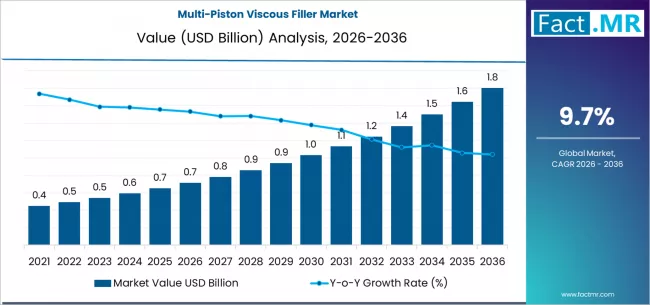
Multi-piston viscous filler market is projected to grow from USD 0.7 billion in 2026 to USD 1.8 billion by 2036, at a CAGR of 9.7%. Sauces, creams & pastes will dominate with a 44.1% market share, while servo-driven multi-piston fillers will lead the filler type segment with a 47.3% share.
Multi-Piston Viscous Filler Market Forecast and Outlook 2026 to 2036
The global multi-piston viscous filler market is projected to total USD 0.71 billion in 2026, and is projected to reach USD 1.81 billion by 2036, progressing at a 9.7% CAGR. This growth is anchored in the food and consumer goods industry’s relentless pursuit of filling precision, operational flexibility, and stringent hygiene compliance. The processing of viscous, particulate-laden products demands filling technology that can handle variable densities and solid inclusions without sacrificing speed or accuracy.
Key Takeaways from the Multi-Piston Viscous Filler Market
- Market Value for 2026: USD 0.71 Billion
- Market Value for 2036: USD 1.81 Billion
- Forecast CAGR 2026 to 2036: 9.7%
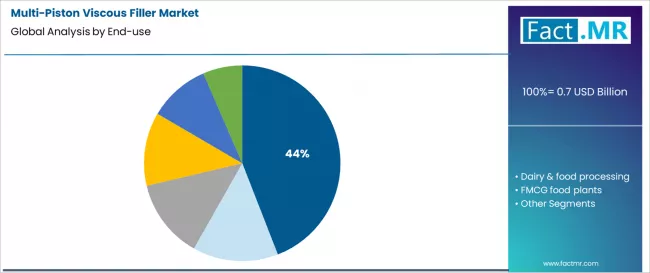
- Leading End-Use Segment (2026): Sauces, Creams & Pastes (44.1%)
- Leading Filler Type (2026): Servo-Driven Multi-Piston Fillers (47.3%)
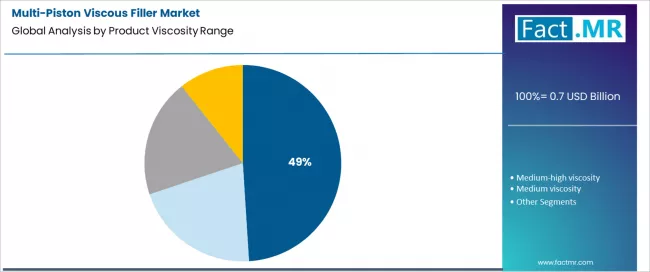
- Leading Product Viscosity Range (2026): High-Viscosity & Chunky Products (49.0%)
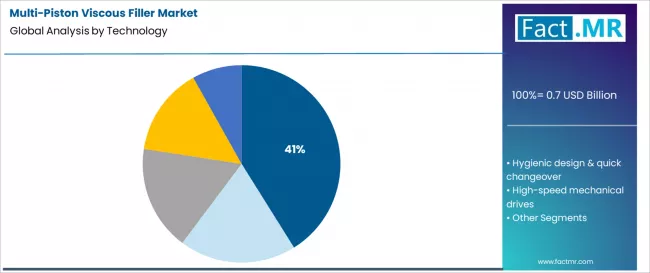
- Leading Technology Segment (2026): CIP/SIP-Ready Piston Filling (41.1%)
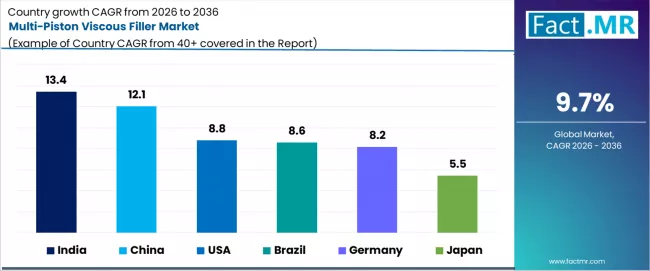
- Key Growth Countries: India (13.4% CAGR), China (12.1% CAGR), USA (8.8% CAGR), Brazil (8.6% CAGR), Germany (8.2% CAGR), Japan (5.5% CAGR)
- Key Players: Tetra Pak, Krones AG, Newamstar, Nichrome, JBT Corporation, Shibuya Corporation, Bosch Packaging Technology

Multi-piston fillers, particularly servo-driven variants, address this by providing exceptional volumetric consistency and gentle product handling. Their adoption represents a critical upgrade from older mechanical systems, enabling manufacturers to reduce product giveaway, minimize waste, and ensure package-to-package uniformity.
This technology is becoming indispensable for brand owners competing on quality and for contract packagers who require rapid changeover between diverse products on a single line, making it a cornerstone of modern, agile manufacturing.
Multi-Piston Viscous Filler Market
| Metric | Value |
|---|---|
| Market Value (2026) | USD 0.71 Billion |
| Market Forecast Value (2036) | USD 1.81 Billion |
| Forecast CAGR 2026 to 2036 | 9.7% |
Category
| Category | Segments |
|---|---|
| End-Use | Sauces, Creams & Pastes, Dairy & Food Processing, FMCG Food Plants, Local Food Brands, Condiments & Sauces, Precision Filling |
| Filler Type | Servo-Driven Multi-Piston Fillers, Volumetric Piston Fillers, Rotary Piston Fillers, Inline Piston Fillers, Others |
| Product Viscosity Range | High-Viscosity & Chunky Products, Medium-High Viscosity, Medium Viscosity, Viscous Foods, Others |
| Technology | CIP/SIP-Ready Piston Filling, Hygienic Design & Quick Changeover, High-Speed Mechanical Drives, Cost-Efficient Piston Systems, Others |
| Region | North America, Latin America, Western Europe, Eastern Europe, East Asia, South Asia & Pacific, Middle East & Africa |
How is the Shift from Mechanical drives to Servo Control Redefining Line Agility and Data Integration?
The industrial automation imperative within this market centers on replacing fixed-cycle mechanical systems with independently controlled servo pistons. This transition enables precise, recipe-driven adjustment of fill volume and piston stroke on-the-fly, which is critical for changeovers between different jar sizes or viscous products without manual tooling changes.
Rach servo axis generates performance data that feeds into line supervisory systems. This data allows for predictive maintenance of seals and valves and provides auditable proof of consistent fill volumes, directly linking machine automation to production analytics and quality assurance protocols in a way legacy systems cannot.
Segmental Analysis
By Technology, Which Feature is Non-Negotiable for Modern Food and Pharma Production Standards?

CIP/SIP-ready piston filling technology commands a leading 41.1% share. This capability is essential for manufacturers operating under strict hygiene protocols, as it allows for clean-in-place and sterilize-in-place procedures without disassembling the filling head.
This minimizes downtime between production runs, reduces labor costs, and virtually eliminates the risk of cross-contamination or biofilm formation in complex piston and valve assemblies. Its dominance reflects the industry-wide shift toward hygienic design principles and the need for validated cleaning cycles in regulated environments.
By End-Use, Which Sector Combines High-Volume Demand with Extreme Product Variability?

The sauces, creams, and pastes segment constitutes the primary end-use at 44.1%. This category encompasses a vast range of products with unique viscosity and flow characteristics. Multi-piston fillers are uniquely suited to handle this diversity with minimal adjustment, providing the gentle action needed to preserve chunk integrity.
The high-volume nature of this FMCG sector drives demand for fillers that offer both speed for mass production and the flexibility to accommodate frequent recipe changes and packaging innovations.
By Product Viscosity Range, Which Challenging Category Demands the Most Specialized Engineering?

High-viscosity and chunky products hold a dominant 49.0% share. Filling products like thick peanut butter, fruit preserves with whole pieces, or dense cosmetic creams presents the greatest engineering challenge, requiring positive displacement piston action to move product reliably.
The equipment must prevent air entrapment, avoid crushing particulates, and maintain accuracy despite the product's resistance to flow. This segment's size highlights the core technical competency of multi-piston systems and represents the highest value application where alternative filling technologies often fail.
What are the Principal Drivers, Constraints, and Evolving Dynamics of the Multi-Piston Viscous Filler Market?
Growth is principally driven by stringent food safety regulations and the global brand proliferation of premium, textured food products that cannot be filled by simpler technologies. A major constraint is the significant capital investment required for advanced servo-driven systems, which can be prohibitive for small and medium-sized enterprises.
Opportunity lies in the retrofitting of existing mechanical filler lines with modern servo-driven piston blocks, offering a cost-effective path to upgraded performance. The key trend is the integration of inline vision systems and checkweighers with the filler's control system, creating a closed-loop where the filler automatically compensates for minor volumetric deviations in real-time, ensuring near-perfect fill weight compliance and reducing giveaway.
Analysis of the Multi-Piston Viscous Filler Market by Key Countries

| Country | CAGR 2026 to 2036 |
|---|---|
| USA | 8.8% |
| Germany | 8.2% |
| China | 12.1% |
| India | 13.4% |
| Brazil | 8.6% |
| Japan | 5.5% |
How do Diversified Food Processing and High Hygiene Standards Shape the US Market?
An 8.8% CAGR is supported by a large and innovative food processing sector with strong demand for packaging automation. The primary demand driver is the sauces and condiments industry, which requires fillers capable of handling everything from liquid sauces to extra-chunky salsas.
The presence of major OEMs and stringent FDA guidelines on hygiene create a market focused on CIP/SIP-ready systems and solutions that ensure absolute batch integrity and traceability in large-scale production environments.
What Characterizes Germany's Emphasis on Engineering Precision and Hygienic Design?
An 8.2% CAGR reflects Germany’s leadership in high-precision packaging machinery and its central role in the EU's food production chain. The market is driven by the demand for ultra-reliable, hygienically designed fillers for high-value dairy products, processed meats, and ready meals.
Industry capacity for complex automation integration is high, with a focus on machinery that seamlessly connects with upstream preparation and downstream sealing operations, emphasizing total line efficiency and compliance with EU machine safety and hygiene directives.
What Underpins China's Scale in Processed Food and Dairy Manufacturing?
The massive scale of its domestic food processing industry, particularly in dairy, sauces, and condiments, fuels China’s 12.1% CAGR. The demand driver is the need for high-speed, high-volume filling solutions to meet immense domestic consumption.
This drives adoption of rotary piston fillers and systems with quick changeover capabilities to serve numerous SKUs. Significant domestic industry capacity, with players like Newamstar, supports the production of fillers optimized for local supply chains and cost points.
How is India's Booming FMCG Sector and Localized Production Driving Demand?
India’s leading 13.4% CAGR is propelled by the explosive growth of its packaged food industry and the localization of production by global FMCG brands. The demand driver is the need for cost-efficient yet reliable piston filling systems suitable for medium-viscosity products like sauces, pastes, and dairy items at competitive price points.
This fosters innovation and assembly of fillers that balance performance with affordability, with domestic players like Nichrome serving a significant portion of the market for small and mid-scale food plants.
Why is Brazil's Growth Linked to Local Food Brand Expansion and Modernization?
An 8.6% CAGR is closely tied to the growth and modernization of Brazil’s robust local food brands in categories like sauces, cheeses, and ready-to-eat foods. The demand driver is the need to upgrade from semi-automatic to fully automated inline piston systems to improve productivity and consistency for both domestic sales and regional export. Investments focus on durable, cost-efficient piston systems that can handle local fruit pulps, dairy creams, and other viscous products prevalent in the regional diet.
What defines Japan's Focus on Ultra-Precision for Premium and Specialty Foods?
Japan’s 5.5% CAGR represents a mature market focused on exceptional precision for high-value condiments, delicate sauces, and specialty food products. Demand stems from the need for fillers that guarantee exact portion control with absolutely no dripping or product smearing, which is crucial for premium presentation.
The market favors compact, servo-driven systems from specialists like Shibuya that offer meticulous accuracy and are designed for integration into space-constrained, highly automated production cells.
Competitive Landscape of the Multi-Piston Viscous Filler Market
Global packaging machinery leaders who offer filling technology as part of integrated line solutions dominate the competitive landscape. Companies like Tetra Pak and Krones compete through their extensive portfolios, providing viscous fillers that are pre-engineered to work seamlessly with their cartoning, capping, and labeling systems.
Success increasingly depends on application-specific expertise, with suppliers developing specialized piston and valve designs for challenging products like nut butters or cosmetic foundations. Strategic partnerships with ingredient handling specialists are common.
The competitive frontier is shifting toward providing full digital twins of the filling line for simulation and optimization, and offering remote diagnostics and predictive maintenance services via IIoT platforms, transforming the customer relationship from transactional to service-based.
Key Players in the Multi-Piston Viscous Filler Market
- Tetra Pak
- Krones AG
- Newamstar
- Nichrome India Ltd.
- JBT Corporation
- Shibuya Corporation
- Bosch Packaging Technology (part of Syntegon)
Scope of Report
| Items | Metrics |
|---|---|
| Quantitative Units | USD Billion |
| Technology | CIP/SIP-Ready Piston Filling, Hygienic Design & Quick Changeover, High-Speed Mechanical Drives, Cost-Efficient Piston Systems, Others |
| Filler Type | Servo-Driven Multi-Piston Fillers, Volumetric Piston Fillers, Rotary Piston Fillers, Inline Piston Fillers, Others |
| End-Use | Sauces, Creams & Pastes, Dairy & Food Processing, FMCG Food Plants, Local Food Brands, Condiments & Sauces, Precision Filling |
| Product Viscosity Range | High-Viscosity & Chunky Products, Medium-High Viscosity, Medium Viscosity, Viscous Foods, Others |
| Key Countries | India, China, USA, Brazil, Germany, Japan |
| Key Companies | Tetra Pak, Krones, Newamstar, Nichrome, JBT, Shibuya, Bosch Packaging |
| Additional Analysis | Comparative analysis of fill accuracy (servo vs. mechanical) for particulates; total cost of ownership including maintenance and downtime; study of seal technology for different product chemistries; impact of filler design on overall line OEE; analysis of modular vs. integrated filler designs. |
Market by Segments
-
End-Use :
- Sauces, Creams & Pastes
- Dairy & Food Processing
- FMCG Food Plants
- Local Food Brands
- Condiments & Sauces
- Precision Filling
-
Filler Type :
- Servo-Driven Multi-Piston Fillers
- Volumetric Piston Fillers
- Rotary Piston Fillers
- Inline Piston Fillers
- Others
-
Product Viscosity Range :
- High-Viscosity & Chunky Products
- Medium-High Viscosity
- Medium Viscosity
- Viscous Foods
- Others
-
Technology :
- CIP/SIP-Ready Piston Filling
- Hygienic Design & Quick Changeover
- High-Speed Mechanical Drives
- Cost-Efficient Piston Systems
- Others
-
Region :
- North America
- USA
- Canada
- Latin America
- Brazil
- Mexico
- Argentina
- Rest of Latin America
- Western Europe
- Germany
- France
- Italy
- Spain
- UK
- BENELUX
- Rest of Western Europe
- Eastern Europe
- Russia
- Poland
- Czech Republic
- Rest of Eastern Europe
- East Asia
- China
- Japan
- South Korea
- Rest of East Asia
- South Asia & Pacific
- India
- ASEAN
- Australia
- Rest of South Asia & Pacific
- MEA
- GCC Countries
- South Africa
- Turkiye
- Rest of MEA
- North America
References
- EHEDG (European Hygienic Engineering & Design Group). (2024). Doc 44: Hygienic Design Principles for Filling and Dosing Equipment.
- Food and Drug Administration (FDA). (2024). Guidance for Industry: Current Good Manufacturing Practice for Food.
- Process and Packaging Machinery Association (PPMA). (2025). Trends Report: Automation in Food Filling and Closing.
- SINCE (ShanghAI International Nonwovens Exhibition & Conference) & Food Processing. (2024). Asian Market Analysis for Processing and Packaging Machinery.
- The Society for Food Hygiene and Safety. (2025). White Paper: Cleaning Validation in Multi-Product Food Plants.
- World Packaging Organisation (WPO). (2024). Performance Standards for Liquid and Viscous Product Filling.
Table of Content
- Executive Summary
- Global Market Outlook
- Demand to side Trends
- Supply to side Trends
- Technology Roadmap Analysis
- Analysis and Recommendations
- Market Overview
- Market Coverage / Taxonomy
- Market Definition / Scope / Limitations
- Market Background
- Market Dynamics
- Drivers
- Restraints
- Opportunity
- Trends
- Scenario Forecast
- Demand in Optimistic Scenario
- Demand in Likely Scenario
- Demand in Conservative Scenario
- Opportunity Map Analysis
- Product Life Cycle Analysis
- Supply Chain Analysis
- Investment Feasibility Matrix
- Value Chain Analysis
- PESTLE and Porter’s Analysis
- Regulatory Landscape
- Regional Parent Market Outlook
- Production and Consumption Statistics
- Import and Export Statistics
- Market Dynamics
- Global Market Analysis 2021 to 2025 and Forecast, 2026 to 2036
- Historical Market Size Value (USD Million) Analysis, 2021 to 2025
- Current and Future Market Size Value (USD Million) Projections, 2026 to 2036
- Y to o to Y Growth Trend Analysis
- Absolute $ Opportunity Analysis
- Global Market Pricing Analysis 2021 to 2025 and Forecast 2026 to 2036
- Global Market Analysis 2021 to 2025 and Forecast 2026 to 2036, By End-use
- Introduction / Key Findings
- Historical Market Size Value (USD Million) Analysis By End-use, 2021 to 2025
- Current and Future Market Size Value (USD Million) Analysis and Forecast By End-use, 2026 to 2036
- Sauces, creams & pastes
- Dairy & food processing
- FMCG food plants
- Local food brands
- Condiments & sauces
- Precision filling
- Sauces, creams & pastes
- Y to o to Y Growth Trend Analysis By End-use, 2021 to 2025
- Absolute $ Opportunity Analysis By End-use, 2026 to 2036
- Global Market Analysis 2021 to 2025 and Forecast 2026 to 2036, By Filler Type
- Introduction / Key Findings
- Historical Market Size Value (USD Million) Analysis By Filler Type, 2021 to 2025
- Current and Future Market Size Value (USD Million) Analysis and Forecast By Filler Type, 2026 to 2036
- Servo-driven multi-piston fillers
- Volumetric piston fillers
- Rotary piston fillers
- Inline piston fillers
- Others
- Servo-driven multi-piston fillers
- Y to o to Y Growth Trend Analysis By Filler Type, 2021 to 2025
- Absolute $ Opportunity Analysis By Filler Type, 2026 to 2036
- Global Market Analysis 2021 to 2025 and Forecast 2026 to 2036, By Product Viscosity Range
- Introduction / Key Findings
- Historical Market Size Value (USD Million) Analysis By Product Viscosity Range, 2021 to 2025
- Current and Future Market Size Value (USD Million) Analysis and Forecast By Product Viscosity Range, 2026 to 2036
- High-viscosity & chunky products
- Medium-high viscosity
- Medium viscosity
- Viscous foods
- High-viscosity & chunky products
- Y to o to Y Growth Trend Analysis By Product Viscosity Range, 2021 to 2025
- Absolute $ Opportunity Analysis By Product Viscosity Range, 2026 to 2036
- Global Market Analysis 2021 to 2025 and Forecast 2026 to 2036, By Technology
- Introduction / Key Findings
- Historical Market Size Value (USD Million) Analysis By Technology, 2021 to 2025
- Current and Future Market Size Value (USD Million) Analysis and Forecast By Technology, 2026 to 2036
- CIP/SIP-ready piston filling
- Hygienic design & quick changeover
- High-speed mechanical drives
- Cost-efficient piston systems
- Others
- CIP/SIP-ready piston filling
- Y to o to Y Growth Trend Analysis By Technology, 2021 to 2025
- Absolute $ Opportunity Analysis By Technology, 2026 to 2036
- Global Market Analysis 2021 to 2025 and Forecast 2026 to 2036, By Region
- Introduction
- Historical Market Size Value (USD Million) Analysis By Region, 2021 to 2025
- Current Market Size Value (USD Million) Analysis and Forecast By Region, 2026 to 2036
- North America
- Latin America
- Western Europe
- Eastern Europe
- East Asia
- South Asia and Pacific
- Middle East & Africa
- Market Attractiveness Analysis By Region
- North America Market Analysis 2021 to 2025 and Forecast 2026 to 2036, By Country
- Historical Market Size Value (USD Million) Trend Analysis By Market Taxonomy, 2021 to 2025
- Market Size Value (USD Million) Forecast By Market Taxonomy, 2026 to 2036
- By Country
- USA
- Canada
- Mexico
- By End-use
- By Filler Type
- By Product Viscosity Range
- By Technology
- By Country
- Market Attractiveness Analysis
- By Country
- By End-use
- By Filler Type
- By Product Viscosity Range
- By Technology
- Key Takeaways
- Latin America Market Analysis 2021 to 2025 and Forecast 2026 to 2036, By Country
- Historical Market Size Value (USD Million) Trend Analysis By Market Taxonomy, 2021 to 2025
- Market Size Value (USD Million) Forecast By Market Taxonomy, 2026 to 2036
- By Country
- Brazil
- Chile
- Rest of Latin America
- By End-use
- By Filler Type
- By Product Viscosity Range
- By Technology
- By Country
- Market Attractiveness Analysis
- By Country
- By End-use
- By Filler Type
- By Product Viscosity Range
- By Technology
- Key Takeaways
- Western Europe Market Analysis 2021 to 2025 and Forecast 2026 to 2036, By Country
- Historical Market Size Value (USD Million) Trend Analysis By Market Taxonomy, 2021 to 2025
- Market Size Value (USD Million) Forecast By Market Taxonomy, 2026 to 2036
- By Country
- Germany
- UK
- Italy
- Spain
- France
- Nordic
- BENELUX
- Rest of Western Europe
- By End-use
- By Filler Type
- By Product Viscosity Range
- By Technology
- By Country
- Market Attractiveness Analysis
- By Country
- By End-use
- By Filler Type
- By Product Viscosity Range
- By Technology
- Key Takeaways
- Eastern Europe Market Analysis 2021 to 2025 and Forecast 2026 to 2036, By Country
- Historical Market Size Value (USD Million) Trend Analysis By Market Taxonomy, 2021 to 2025
- Market Size Value (USD Million) Forecast By Market Taxonomy, 2026 to 2036
- By Country
- Russia
- Poland
- Hungary
- Balkan & Baltic
- Rest of Eastern Europe
- By End-use
- By Filler Type
- By Product Viscosity Range
- By Technology
- By Country
- Market Attractiveness Analysis
- By Country
- By End-use
- By Filler Type
- By Product Viscosity Range
- By Technology
- Key Takeaways
- East Asia Market Analysis 2021 to 2025 and Forecast 2026 to 2036, By Country
- Historical Market Size Value (USD Million) Trend Analysis By Market Taxonomy, 2021 to 2025
- Market Size Value (USD Million) Forecast By Market Taxonomy, 2026 to 2036
- By Country
- China
- Japan
- South Korea
- By End-use
- By Filler Type
- By Product Viscosity Range
- By Technology
- By Country
- Market Attractiveness Analysis
- By Country
- By End-use
- By Filler Type
- By Product Viscosity Range
- By Technology
- Key Takeaways
- South Asia and Pacific Market Analysis 2021 to 2025 and Forecast 2026 to 2036, By Country
- Historical Market Size Value (USD Million) Trend Analysis By Market Taxonomy, 2021 to 2025
- Market Size Value (USD Million) Forecast By Market Taxonomy, 2026 to 2036
- By Country
- India
- ASEAN
- Australia & New Zealand
- Rest of South Asia and Pacific
- By End-use
- By Filler Type
- By Product Viscosity Range
- By Technology
- By Country
- Market Attractiveness Analysis
- By Country
- By End-use
- By Filler Type
- By Product Viscosity Range
- By Technology
- Key Takeaways
- Middle East & Africa Market Analysis 2021 to 2025 and Forecast 2026 to 2036, By Country
- Historical Market Size Value (USD Million) Trend Analysis By Market Taxonomy, 2021 to 2025
- Market Size Value (USD Million) Forecast By Market Taxonomy, 2026 to 2036
- By Country
- Kingdom of Saudi Arabia
- Other GCC Countries
- Turkiye
- South Africa
- Other African Union
- Rest of Middle East & Africa
- By End-use
- By Filler Type
- By Product Viscosity Range
- By Technology
- By Country
- Market Attractiveness Analysis
- By Country
- By End-use
- By Filler Type
- By Product Viscosity Range
- By Technology
- Key Takeaways
- Key Countries Market Analysis
- USA
- Pricing Analysis
- Market Share Analysis, 2025
- By End-use
- By Filler Type
- By Product Viscosity Range
- By Technology
- Canada
- Pricing Analysis
- Market Share Analysis, 2025
- By End-use
- By Filler Type
- By Product Viscosity Range
- By Technology
- Mexico
- Pricing Analysis
- Market Share Analysis, 2025
- By End-use
- By Filler Type
- By Product Viscosity Range
- By Technology
- Brazil
- Pricing Analysis
- Market Share Analysis, 2025
- By End-use
- By Filler Type
- By Product Viscosity Range
- By Technology
- Chile
- Pricing Analysis
- Market Share Analysis, 2025
- By End-use
- By Filler Type
- By Product Viscosity Range
- By Technology
- Germany
- Pricing Analysis
- Market Share Analysis, 2025
- By End-use
- By Filler Type
- By Product Viscosity Range
- By Technology
- UK
- Pricing Analysis
- Market Share Analysis, 2025
- By End-use
- By Filler Type
- By Product Viscosity Range
- By Technology
- Italy
- Pricing Analysis
- Market Share Analysis, 2025
- By End-use
- By Filler Type
- By Product Viscosity Range
- By Technology
- Spain
- Pricing Analysis
- Market Share Analysis, 2025
- By End-use
- By Filler Type
- By Product Viscosity Range
- By Technology
- France
- Pricing Analysis
- Market Share Analysis, 2025
- By End-use
- By Filler Type
- By Product Viscosity Range
- By Technology
- India
- Pricing Analysis
- Market Share Analysis, 2025
- By End-use
- By Filler Type
- By Product Viscosity Range
- By Technology
- ASEAN
- Pricing Analysis
- Market Share Analysis, 2025
- By End-use
- By Filler Type
- By Product Viscosity Range
- By Technology
- Australia & New Zealand
- Pricing Analysis
- Market Share Analysis, 2025
- By End-use
- By Filler Type
- By Product Viscosity Range
- By Technology
- China
- Pricing Analysis
- Market Share Analysis, 2025
- By End-use
- By Filler Type
- By Product Viscosity Range
- By Technology
- Japan
- Pricing Analysis
- Market Share Analysis, 2025
- By End-use
- By Filler Type
- By Product Viscosity Range
- By Technology
- South Korea
- Pricing Analysis
- Market Share Analysis, 2025
- By End-use
- By Filler Type
- By Product Viscosity Range
- By Technology
- Russia
- Pricing Analysis
- Market Share Analysis, 2025
- By End-use
- By Filler Type
- By Product Viscosity Range
- By Technology
- Poland
- Pricing Analysis
- Market Share Analysis, 2025
- By End-use
- By Filler Type
- By Product Viscosity Range
- By Technology
- Hungary
- Pricing Analysis
- Market Share Analysis, 2025
- By End-use
- By Filler Type
- By Product Viscosity Range
- By Technology
- Kingdom of Saudi Arabia
- Pricing Analysis
- Market Share Analysis, 2025
- By End-use
- By Filler Type
- By Product Viscosity Range
- By Technology
- Turkiye
- Pricing Analysis
- Market Share Analysis, 2025
- By End-use
- By Filler Type
- By Product Viscosity Range
- By Technology
- South Africa
- Pricing Analysis
- Market Share Analysis, 2025
- By End-use
- By Filler Type
- By Product Viscosity Range
- By Technology
- USA
- Market Structure Analysis
- Competition Dashboard
- Competition Benchmarking
- Market Share Analysis of Top Players
- By Regional
- By End-use
- By Filler Type
- By Product Viscosity Range
- By Technology
- Competition Analysis
- Competition Deep Dive
- Tetra Pak
- Overview
- Product Portfolio
- Profitability by Market Segments (Product/Age /Sales Channel/Region)
- Sales Footprint
- Strategy Overview
- Marketing Strategy
- Product Strategy
- Channel Strategy
- Krones AG
- Newamstar
- Nichrome India Ltd.
- JBT Corporation
- Shibuya Corporation
- Bosch Packaging Technology (part of Syntegon)
- Tetra Pak
- Competition Deep Dive
- Assumptions & Acronyms Used
- Research Methodology
List Of Table
- Table 1: Global Market Value (USD Million) Forecast by Region, 2021 to 2036
- Table 2: Global Market Value (USD Million) Forecast by End-use, 2021 to 2036
- Table 3: Global Market Value (USD Million) Forecast by Filler Type, 2021 to 2036
- Table 4: Global Market Value (USD Million) Forecast by Product Viscosity Range, 2021 to 2036
- Table 5: Global Market Value (USD Million) Forecast by Technology, 2021 to 2036
- Table 6: North America Market Value (USD Million) Forecast by Country, 2021 to 2036
- Table 7: North America Market Value (USD Million) Forecast by End-use, 2021 to 2036
- Table 8: North America Market Value (USD Million) Forecast by Filler Type, 2021 to 2036
- Table 9: North America Market Value (USD Million) Forecast by Product Viscosity Range, 2021 to 2036
- Table 10: North America Market Value (USD Million) Forecast by Technology, 2021 to 2036
- Table 11: Latin America Market Value (USD Million) Forecast by Country, 2021 to 2036
- Table 12: Latin America Market Value (USD Million) Forecast by End-use, 2021 to 2036
- Table 13: Latin America Market Value (USD Million) Forecast by Filler Type, 2021 to 2036
- Table 14: Latin America Market Value (USD Million) Forecast by Product Viscosity Range, 2021 to 2036
- Table 15: Latin America Market Value (USD Million) Forecast by Technology, 2021 to 2036
- Table 16: Western Europe Market Value (USD Million) Forecast by Country, 2021 to 2036
- Table 17: Western Europe Market Value (USD Million) Forecast by End-use, 2021 to 2036
- Table 18: Western Europe Market Value (USD Million) Forecast by Filler Type, 2021 to 2036
- Table 19: Western Europe Market Value (USD Million) Forecast by Product Viscosity Range, 2021 to 2036
- Table 20: Western Europe Market Value (USD Million) Forecast by Technology, 2021 to 2036
- Table 21: Eastern Europe Market Value (USD Million) Forecast by Country, 2021 to 2036
- Table 22: Eastern Europe Market Value (USD Million) Forecast by End-use, 2021 to 2036
- Table 23: Eastern Europe Market Value (USD Million) Forecast by Filler Type, 2021 to 2036
- Table 24: Eastern Europe Market Value (USD Million) Forecast by Product Viscosity Range, 2021 to 2036
- Table 25: Eastern Europe Market Value (USD Million) Forecast by Technology, 2021 to 2036
- Table 26: East Asia Market Value (USD Million) Forecast by Country, 2021 to 2036
- Table 27: East Asia Market Value (USD Million) Forecast by End-use, 2021 to 2036
- Table 28: East Asia Market Value (USD Million) Forecast by Filler Type, 2021 to 2036
- Table 29: East Asia Market Value (USD Million) Forecast by Product Viscosity Range, 2021 to 2036
- Table 30: East Asia Market Value (USD Million) Forecast by Technology, 2021 to 2036
- Table 31: South Asia and Pacific Market Value (USD Million) Forecast by Country, 2021 to 2036
- Table 32: South Asia and Pacific Market Value (USD Million) Forecast by End-use, 2021 to 2036
- Table 33: South Asia and Pacific Market Value (USD Million) Forecast by Filler Type, 2021 to 2036
- Table 34: South Asia and Pacific Market Value (USD Million) Forecast by Product Viscosity Range, 2021 to 2036
- Table 35: South Asia and Pacific Market Value (USD Million) Forecast by Technology, 2021 to 2036
- Table 36: Middle East & Africa Market Value (USD Million) Forecast by Country, 2021 to 2036
- Table 37: Middle East & Africa Market Value (USD Million) Forecast by End-use, 2021 to 2036
- Table 38: Middle East & Africa Market Value (USD Million) Forecast by Filler Type, 2021 to 2036
- Table 39: Middle East & Africa Market Value (USD Million) Forecast by Product Viscosity Range, 2021 to 2036
- Table 40: Middle East & Africa Market Value (USD Million) Forecast by Technology, 2021 to 2036
List Of Figures
- Figure 1: Global Market Pricing Analysis
- Figure 2: Global Market Value (USD Million) Forecast 2021 to 2036
- Figure 3: Global Market Value Share and BPS Analysis by End-use, 2026 and 2036
- Figure 4: Global Market Y to o to Y Growth Comparison by End-use, 2026 to 2036
- Figure 5: Global Market Attractiveness Analysis by End-use
- Figure 6: Global Market Value Share and BPS Analysis by Filler Type, 2026 and 2036
- Figure 7: Global Market Y to o to Y Growth Comparison by Filler Type, 2026 to 2036
- Figure 8: Global Market Attractiveness Analysis by Filler Type
- Figure 9: Global Market Value Share and BPS Analysis by Product Viscosity Range, 2026 and 2036
- Figure 10: Global Market Y to o to Y Growth Comparison by Product Viscosity Range, 2026 to 2036
- Figure 11: Global Market Attractiveness Analysis by Product Viscosity Range
- Figure 12: Global Market Value Share and BPS Analysis by Technology, 2026 and 2036
- Figure 13: Global Market Y to o to Y Growth Comparison by Technology, 2026 to 2036
- Figure 14: Global Market Attractiveness Analysis by Technology
- Figure 15: Global Market Value (USD Million) Share and BPS Analysis by Region, 2026 and 2036
- Figure 16: Global Market Y to o to Y Growth Comparison by Region, 2026 to 2036
- Figure 17: Global Market Attractiveness Analysis by Region
- Figure 18: North America Market Incremental Dollar Opportunity, 2026 to 2036
- Figure 19: Latin America Market Incremental Dollar Opportunity, 2026 to 2036
- Figure 20: Western Europe Market Incremental Dollar Opportunity, 2026 to 2036
- Figure 21: Eastern Europe Market Incremental Dollar Opportunity, 2026 to 2036
- Figure 22: East Asia Market Incremental Dollar Opportunity, 2026 to 2036
- Figure 23: South Asia and Pacific Market Incremental Dollar Opportunity, 2026 to 2036
- Figure 24: Middle East & Africa Market Incremental Dollar Opportunity, 2026 to 2036
- Figure 25: North America Market Value Share and BPS Analysis by Country, 2026 and 2036
- Figure 26: North America Market Value Share and BPS Analysis by End-use, 2026 and 2036
- Figure 27: North America Market Y to o to Y Growth Comparison by End-use, 2026 to 2036
- Figure 28: North America Market Attractiveness Analysis by End-use
- Figure 29: North America Market Value Share and BPS Analysis by Filler Type, 2026 and 2036
- Figure 30: North America Market Y to o to Y Growth Comparison by Filler Type, 2026 to 2036
- Figure 31: North America Market Attractiveness Analysis by Filler Type
- Figure 32: North America Market Value Share and BPS Analysis by Product Viscosity Range, 2026 and 2036
- Figure 33: North America Market Y to o to Y Growth Comparison by Product Viscosity Range, 2026 to 2036
- Figure 34: North America Market Attractiveness Analysis by Product Viscosity Range
- Figure 35: North America Market Value Share and BPS Analysis by Technology, 2026 and 2036
- Figure 36: North America Market Y to o to Y Growth Comparison by Technology, 2026 to 2036
- Figure 37: North America Market Attractiveness Analysis by Technology
- Figure 38: Latin America Market Value Share and BPS Analysis by Country, 2026 and 2036
- Figure 39: Latin America Market Value Share and BPS Analysis by End-use, 2026 and 2036
- Figure 40: Latin America Market Y to o to Y Growth Comparison by End-use, 2026 to 2036
- Figure 41: Latin America Market Attractiveness Analysis by End-use
- Figure 42: Latin America Market Value Share and BPS Analysis by Filler Type, 2026 and 2036
- Figure 43: Latin America Market Y to o to Y Growth Comparison by Filler Type, 2026 to 2036
- Figure 44: Latin America Market Attractiveness Analysis by Filler Type
- Figure 45: Latin America Market Value Share and BPS Analysis by Product Viscosity Range, 2026 and 2036
- Figure 46: Latin America Market Y to o to Y Growth Comparison by Product Viscosity Range, 2026 to 2036
- Figure 47: Latin America Market Attractiveness Analysis by Product Viscosity Range
- Figure 48: Latin America Market Value Share and BPS Analysis by Technology, 2026 and 2036
- Figure 49: Latin America Market Y to o to Y Growth Comparison by Technology, 2026 to 2036
- Figure 50: Latin America Market Attractiveness Analysis by Technology
- Figure 51: Western Europe Market Value Share and BPS Analysis by Country, 2026 and 2036
- Figure 52: Western Europe Market Value Share and BPS Analysis by End-use, 2026 and 2036
- Figure 53: Western Europe Market Y to o to Y Growth Comparison by End-use, 2026 to 2036
- Figure 54: Western Europe Market Attractiveness Analysis by End-use
- Figure 55: Western Europe Market Value Share and BPS Analysis by Filler Type, 2026 and 2036
- Figure 56: Western Europe Market Y to o to Y Growth Comparison by Filler Type, 2026 to 2036
- Figure 57: Western Europe Market Attractiveness Analysis by Filler Type
- Figure 58: Western Europe Market Value Share and BPS Analysis by Product Viscosity Range, 2026 and 2036
- Figure 59: Western Europe Market Y to o to Y Growth Comparison by Product Viscosity Range, 2026 to 2036
- Figure 60: Western Europe Market Attractiveness Analysis by Product Viscosity Range
- Figure 61: Western Europe Market Value Share and BPS Analysis by Technology, 2026 and 2036
- Figure 62: Western Europe Market Y to o to Y Growth Comparison by Technology, 2026 to 2036
- Figure 63: Western Europe Market Attractiveness Analysis by Technology
- Figure 64: Eastern Europe Market Value Share and BPS Analysis by Country, 2026 and 2036
- Figure 65: Eastern Europe Market Value Share and BPS Analysis by End-use, 2026 and 2036
- Figure 66: Eastern Europe Market Y to o to Y Growth Comparison by End-use, 2026 to 2036
- Figure 67: Eastern Europe Market Attractiveness Analysis by End-use
- Figure 68: Eastern Europe Market Value Share and BPS Analysis by Filler Type, 2026 and 2036
- Figure 69: Eastern Europe Market Y to o to Y Growth Comparison by Filler Type, 2026 to 2036
- Figure 70: Eastern Europe Market Attractiveness Analysis by Filler Type
- Figure 71: Eastern Europe Market Value Share and BPS Analysis by Product Viscosity Range, 2026 and 2036
- Figure 72: Eastern Europe Market Y to o to Y Growth Comparison by Product Viscosity Range, 2026 to 2036
- Figure 73: Eastern Europe Market Attractiveness Analysis by Product Viscosity Range
- Figure 74: Eastern Europe Market Value Share and BPS Analysis by Technology, 2026 and 2036
- Figure 75: Eastern Europe Market Y to o to Y Growth Comparison by Technology, 2026 to 2036
- Figure 76: Eastern Europe Market Attractiveness Analysis by Technology
- Figure 77: East Asia Market Value Share and BPS Analysis by Country, 2026 and 2036
- Figure 78: East Asia Market Value Share and BPS Analysis by End-use, 2026 and 2036
- Figure 79: East Asia Market Y to o to Y Growth Comparison by End-use, 2026 to 2036
- Figure 80: East Asia Market Attractiveness Analysis by End-use
- Figure 81: East Asia Market Value Share and BPS Analysis by Filler Type, 2026 and 2036
- Figure 82: East Asia Market Y to o to Y Growth Comparison by Filler Type, 2026 to 2036
- Figure 83: East Asia Market Attractiveness Analysis by Filler Type
- Figure 84: East Asia Market Value Share and BPS Analysis by Product Viscosity Range, 2026 and 2036
- Figure 85: East Asia Market Y to o to Y Growth Comparison by Product Viscosity Range, 2026 to 2036
- Figure 86: East Asia Market Attractiveness Analysis by Product Viscosity Range
- Figure 87: East Asia Market Value Share and BPS Analysis by Technology, 2026 and 2036
- Figure 88: East Asia Market Y to o to Y Growth Comparison by Technology, 2026 to 2036
- Figure 89: East Asia Market Attractiveness Analysis by Technology
- Figure 90: South Asia and Pacific Market Value Share and BPS Analysis by Country, 2026 and 2036
- Figure 91: South Asia and Pacific Market Value Share and BPS Analysis by End-use, 2026 and 2036
- Figure 92: South Asia and Pacific Market Y to o to Y Growth Comparison by End-use, 2026 to 2036
- Figure 93: South Asia and Pacific Market Attractiveness Analysis by End-use
- Figure 94: South Asia and Pacific Market Value Share and BPS Analysis by Filler Type, 2026 and 2036
- Figure 95: South Asia and Pacific Market Y to o to Y Growth Comparison by Filler Type, 2026 to 2036
- Figure 96: South Asia and Pacific Market Attractiveness Analysis by Filler Type
- Figure 97: South Asia and Pacific Market Value Share and BPS Analysis by Product Viscosity Range, 2026 and 2036
- Figure 98: South Asia and Pacific Market Y to o to Y Growth Comparison by Product Viscosity Range, 2026 to 2036
- Figure 99: South Asia and Pacific Market Attractiveness Analysis by Product Viscosity Range
- Figure 100: South Asia and Pacific Market Value Share and BPS Analysis by Technology, 2026 and 2036
- Figure 101: South Asia and Pacific Market Y to o to Y Growth Comparison by Technology, 2026 to 2036
- Figure 102: South Asia and Pacific Market Attractiveness Analysis by Technology
- Figure 103: Middle East & Africa Market Value Share and BPS Analysis by Country, 2026 and 2036
- Figure 104: Middle East & Africa Market Value Share and BPS Analysis by End-use, 2026 and 2036
- Figure 105: Middle East & Africa Market Y to o to Y Growth Comparison by End-use, 2026 to 2036
- Figure 106: Middle East & Africa Market Attractiveness Analysis by End-use
- Figure 107: Middle East & Africa Market Value Share and BPS Analysis by Filler Type, 2026 and 2036
- Figure 108: Middle East & Africa Market Y to o to Y Growth Comparison by Filler Type, 2026 to 2036
- Figure 109: Middle East & Africa Market Attractiveness Analysis by Filler Type
- Figure 110: Middle East & Africa Market Value Share and BPS Analysis by Product Viscosity Range, 2026 and 2036
- Figure 111: Middle East & Africa Market Y to o to Y Growth Comparison by Product Viscosity Range, 2026 to 2036
- Figure 112: Middle East & Africa Market Attractiveness Analysis by Product Viscosity Range
- Figure 113: Middle East & Africa Market Value Share and BPS Analysis by Technology, 2026 and 2036
- Figure 114: Middle East & Africa Market Y to o to Y Growth Comparison by Technology, 2026 to 2036
- Figure 115: Middle East & Africa Market Attractiveness Analysis by Technology
- Figure 116: Global Market - Tier Structure Analysis
- Figure 117: Global Market - Company Share Analysis
- FAQs -
How big is the multi-piston viscous filler market in 2026?
The global multi-piston viscous filler market is estimated to be valued at USD 0.7 billion in 2026.
What will be the size of multi-piston viscous filler market in 2036?
The market size for the multi-piston viscous filler market is projected to reach USD 1.8 billion by 2036.
How much will be the multi-piston viscous filler market growth between 2026 and 2036?
The multi-piston viscous filler market is expected to grow at a 9.7% CAGR between 2026 and 2036.
What are the key product types in the multi-piston viscous filler market?
The key product types in multi-piston viscous filler market are sauces, creams & pastes, dairy & food processing, fmcg food plants, local food brands, condiments & sauces and precision filling.
Which filler type segment to contribute significant share in the multi-piston viscous filler market in 2026?
In terms of filler type, servo-driven multi-piston fillers segment to command 47.3% share in the multi-piston viscous filler market in 2026.