- Base Value(2025): 2.6 Bn
- Estimated Value(2026): 2.8 Bn
- Forecast Value (2036): 7.7 Bn
- CAGR (2026 - 2036): 10.3%
Post-Extubation Respiratory Acoustic Monitoring Devices Market Forecast and Outlook By FACT.MR
In 2025, the post-extubation respiratory acoustic monitoring devices market was valued at USD 2.6 billion. Based on Fact.MR analysis, demand for post-extubation respiratory acoustic monitoring devices is estimated to grow to USD 2.8 billion in 2026 and USD 7.7 billion by 2036. FACT.MR projects a CAGR of 10.3% during the forecast period.
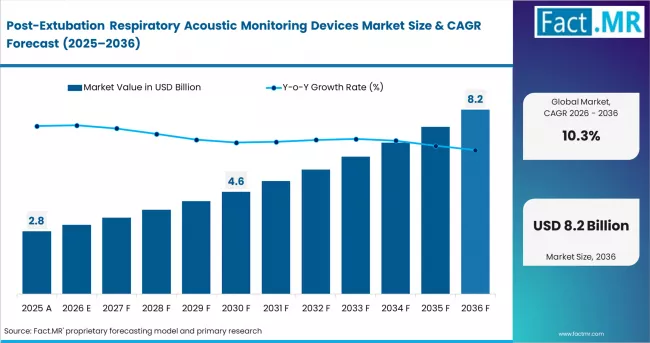
Post Extubation Respiratory Acoustic Monitoring Devices Market Value Analysis | Source: Fact.MR
Summary Of Post-Extubation Respiratory Acoustic Monitoring Devices Market
- Market Definition
- Covers wearable acoustic sensors, bedside monitors, and integrated ICU systems for non-invasive continuous respiratory monitoring in post-extubation clinical and homecare settings globally.
- Demand Drivers
- Rising ICU extubation volumes are increasing demand for continuous acoustic airway monitoring to reduce post-operative respiratory failure risk.
- U.S. and EU hospital safety mandates are expanding mandatory monitoring windows following anesthesia-led extubation procedures.
- Homecare and ambulatory care channel growth is creating new demand beyond traditional ICU deployment for chronic respiratory patients.
- Key Segments Analyzed
- By Product Type: Wearable acoustic sensors lead with 45% share in 2026. Preferred for continuous post-extubation surveillance with early obstruction detection.
- By Application: Post-extubation monitoring leads at 35% in 2026. Core ICU recovery use case with highest clinical urgency and procurement priority.
- By End User: Hospitals (ICU) dominate at 60% in 2026. Majority of extubation procedures occur in ICU settings with high device dependency.
- By Geography: India leads at 40.1% CAGR. Driven by government biotech expansion and acute care infrastructure investment.
- Analyst Opinion at FACT.MR
- Shambhu Nath Jha notes a clear transition from bedside to wearable acoustic monitoring in ICU recovery settings. FDA clearance and EHR integration are decisive for institutional contract wins.
- Strategic Implications
- Invest in FDA-cleared wearable acoustic sensor platforms with integrated EHR connectivity for hospital system contracts.
- Build reimbursement dossiers and health-economic evidence to support CMS and NICE coverage expansion beyond ICU settings.
- Develop scalable homecare-grade acoustic monitors targeting post-discharge COPD and sleep apnea monitoring as growth adjacency.
- Methodology
- Based on ICU bed counts, extubation procedure volumes, and device penetration rates by product type and end user.
- Supported by FDA, CMS, NHS, and ECRI Institute data alongside primary manufacturer and hospital interviews.
- Forecasts incorporate regulatory approval timelines, reimbursement expansion, and institutional procurement cycle trends.
| Metric | Value |
|---|---|
| Estimated Value in 2026 | USD 2.8 billion |
| Forecast Value in 2036 | USD 7.7 billion |
| Forecast CAGR (2026 to 2036) | 10.3% |
Source: Fact.MR analysis. Updated Apr 21, 2026
Between 2026 and 2036, the market is expected to create USD 4.9 billion in new opportunity. Growth is transformational rather than incremental. Demand is driven by rising ICU extubation volumes and patient safety mandates. Expansion into ambulatory surgical centers and homecare adds structural breadth. Growth is constrained by reimbursement lag in low-income markets and high device integration costs.
ICU-led adoption is rising globally. Standard stethoscope-based monitoring is losing share. Acoustic wearable sensors are replacing intermittent checks. U.S. hospitals are integrating continuous monitoring into post-operative care protocols. High-acuity care units are prioritising early detection of airway obstruction. Premium wearable systems command 35 to 50% price premiums over bedside alternatives. Vendors without connectivity and EHR integration are losing institutional contracts.
India leads with 40.1% CAGR through 2036. Government biotech investment and acute care infrastructure expansion are driving adoption. China follows at 36.5%, supported by high lactose intolerance prevalence and ICU modernisation. Germany grows at 36.0%, driven by advanced biotech ecosystem integration and EU digital health push. United States records 35.0%, supported by FDA clearances and quality system regulation partnerships. United Kingdom records 34.3%, driven by NHS vegan-care demand growth and retail-level product adoption into telehealth channels.
Segmental Analysis
Post-Extubation Respiratory Acoustic Monitoring Devices Market Analysis by Product Type
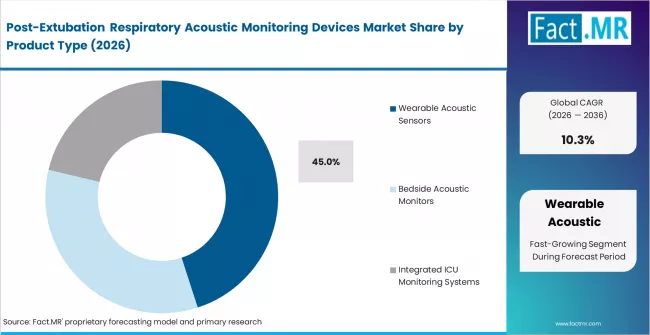
Post Extubation Respiratory Acoustic Monitoring Devices Market Analysis By Product Type | Source: Fact.MR
Based on FACT.MR, wearable acoustic sensors hold 45% share in 2026. These devices enable continuous, hands-free monitoring. They support real-time respiratory tracking without restricting patient mobility.
- Masimo Platform Expansion: Received FDA 510(k) clearance in Q3 2024. Integrated acoustic monitoring with pulse oximetry systems. Strengthens hospital network adoption. [1]
- Medtronic Technology Development: Launched wearable monitoring system in January 2025. Targets ICU step-down care. Integrates with hospital EHR systems. [2]
- ICU Procurement Trend: A 2024 ECRI report ranked acoustic monitoring among top safety technologies. Procurement interest rose 18% year-on-year. Wearables are the fastest-growing segment. [3]
Post-Extubation Respiratory Acoustic Monitoring Devices Market Analysis by Application
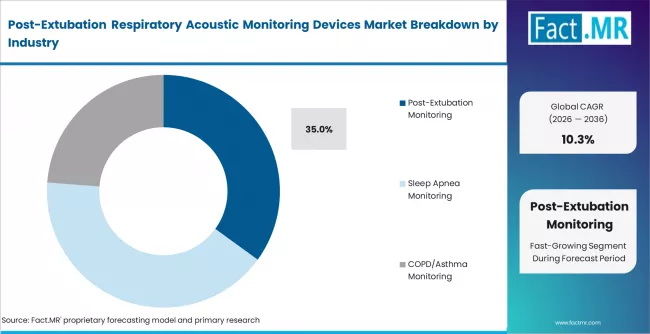
Post Extubation Respiratory Acoustic Monitoring Devices Market Analysis By Application | Source: Fact.MR
Based on FACT.MR, post-extubation monitoring holds 35% share in 2026. It is the core clinical application. Demand is linked to ICU recovery protocols. Early detection of airway obstruction is critical.
- Koninklijke Philips Investment: Expanded IntelliVue portfolio in 2024. Added acoustic monitoring for ICU care. Deployed across 150+ hospitals. [4]
- Nihon Kohden Development: Launched acoustic module in Q2 2024. Targets recovery rooms and export markets. Enables real-time respiratory analysis. [6]
- Post-Extubation Protocol Adoption: 2025 SCCM guidelines recommend monitoring within 6 hours post-extubation. Hospitals must comply with safety protocols. Adoption is rising across trauma centers in the United States and Germany.
Drivers, Restraints, and Opportunities
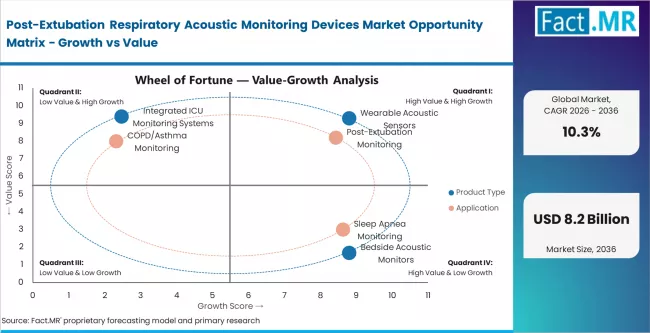
Post Extubation Respiratory Acoustic Monitoring Devices Market Opportunity Matrix Growth Vs Value | Source: Fact.MR
FACT.MR analysts note that market growth is anchored in ICU extubation volumes and patient safety regulations. Post-operative respiratory failure remains a major preventable risk. This drives demand for continuous acoustic monitoring in surgical and critical care settings.
Procurement specifications are shifting. Intermittent monitoring is losing clinical relevance. Continuous wearable acoustic systems are gaining preference. FDA-cleared connected devices command premium pricing. Vendors without reimbursement support and interoperability certification are being excluded from hospital contracts.
- ICU Safety Mandates: The Joint Commission updated guidelines in 2024. Continuous respiratory monitoring is required for high-risk patients. This is expanding adoption across U.S. hospitals. EU Medical Device Regulation frameworks are enforcing similar standards. [5]
- India Digital Health Push: Ayushman Bharat Digital Mission expanded ICU digitisation in 2024. Government hospitals are adopting connected monitoring systems. Acoustic devices are being integrated into public healthcare infrastructure. Domestic manufacturing incentives are supporting supply.
- Homecare Reimbursement Expansion: CMS introduced new reimbursement codes in early 2025. This enables remote respiratory monitoring outside ICUs. Adoption is rising among COPD patients in the United States. Europe is still in early policy stages.
Regional Analysis
The post-extubation respiratory acoustic monitoring devices market is assessed across Asia Pacific, North America, Europe, Latin America, and Middle East and Africa, covering 40+ countries with distinct demand profiles shaped by ICU infrastructure, reimbursement frameworks, regulatory clearance requirements, and clinical guideline adoption. The full report provides market attractiveness analysis by region and country.
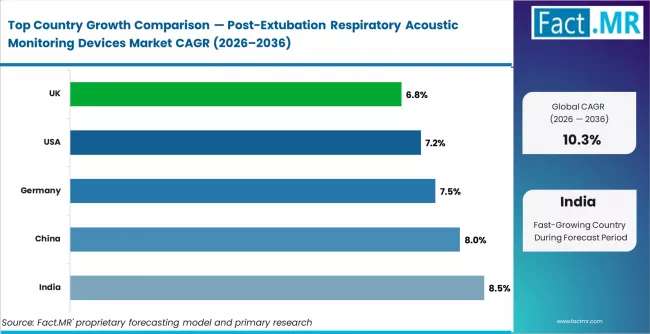
.webp "Top Country Growth Comparison Post Extubation Respiratory Acoustic Monitoring Devices Market Cagr (2026 2036)")
Top Country Growth Comparison Post Extubation Respiratory Acoustic Monitoring Devices Market Cagr (2026 2036) | Source: Fact.MR
| Country | CAGR (2026 to 2036) |
|---|---|
| India | 8.5% |
| China | 8.0% |
| Germany | 7.5% |
| United States | 7.2% |
| United Kingdom | 6.8% |
Source: Fact.MR analysis. Updated Apr 21, 2026
Source: Fact.MR (FACT.MR) analysis, based on proprietary forecasting model and primary research
Post Extubation Respiratory Acoustic Monitoring Devices Market Cagr Analysis By Country | Source: Fact.MR
Asia Pacific Post-Extubation Respiratory Acoustic Monitoring Devices Market Analysis
Asia Pacific is the fastest-growing region. Growth is driven by rapid ICU capacity expansion, rising respiratory disease burden, and increasing healthcare digitisation. Governments and private hospital networks are investing in connected monitoring infrastructure. India and China are the primary growth engines, supported by large patient populations and cost-sensitive procurement models. The region is transitioning toward wearable and continuous monitoring systems to improve patient safety outcomes.
- India: India leads with a CAGR of 8.5% through 2036. Growth is supported by expansion of critical care infrastructure and national digital health programs. Government initiatives are accelerating ICU upgrades and connected device adoption. Demand is also driven by the need for cost-effective monitoring solutions in high-volume hospital settings. Increasing private hospital investment further supports adoption of advanced respiratory monitoring technologies.
- China: China grows at 8.0% CAGR through 2036. Expansion of ICU capacity and a high burden of respiratory conditions are key drivers. Strong domestic manufacturing capabilities enable affordable device availability at scale. Hospitals are adopting continuous monitoring systems to enhance clinical outcomes and reduce post-operative complications. Integration with hospital IT systems is also improving adoption rates.
Fact.MR’s analysis covers China, India, Japan, South Korea, ASEAN, and ANZ. It includes infrastructure investment trends, regulatory developments, and adoption forecasts.
North America Post-Extubation Respiratory Acoustic Monitoring Devices Market Analysis
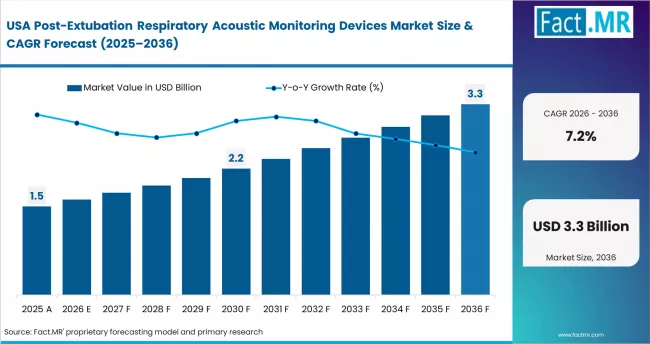
Post Extubation Respiratory Acoustic Monitoring Devices Market Country Value Analysis | Source: Fact.MR
North America remains the leading commercialization region. It benefits from advanced healthcare infrastructure, strong regulatory frameworks, and early adoption of innovative monitoring technologies. Hospitals are increasingly shifting from intermittent monitoring to continuous wearable solutions integrated with digital health systems. Reimbursement support and patient safety mandates further accelerate adoption.
- United States: The United States grows at 7.2% CAGR through 2036. It has the largest ICU infrastructure globally and the highest adoption of advanced monitoring technologies. Demand is driven by regulatory requirements, patient safety protocols, and increasing focus on reducing post-extubation complications. Hospitals are investing in wearable acoustic monitoring devices that integrate with electronic health records and enable real-time clinical decision-making.
Fact. MR’s analysis covers the United States and Canada. It includes regulatory pathways, reimbursement expansion, and hospital procurement trends.
Europe Post-Extubation Respiratory Acoustic Monitoring Devices Market Analysis
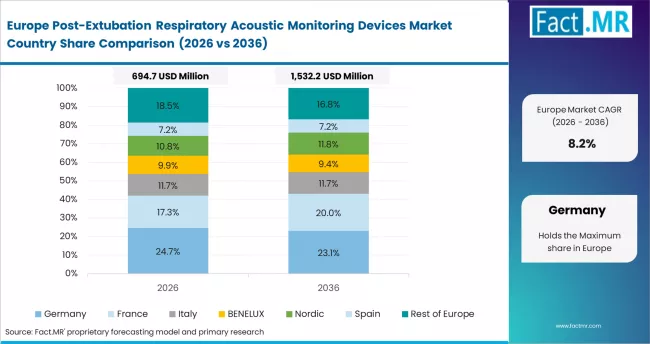
Post Extubation Respiratory Acoustic Monitoring Devices Market Europe Country Market Share Analysis, 2026 & 2036 | Source: Fact.MR
Europe is driven by healthcare system modernisation and regulatory compliance. Adoption is supported by national healthcare programs and increasing focus on patient safety. Hospitals are integrating advanced monitoring technologies into existing infrastructure to improve efficiency and outcomes.
- Germany: Germany grows at 7.5% CAGR through 2036. Strong hospital technology integration and advanced clinical infrastructure support adoption. Hospitals are investing in continuous monitoring systems to enhance ICU efficiency and reduce complication risks. The country’s emphasis on digital health transformation further supports market growth.
- United Kingdom: The United Kingdom grows at 6.8% CAGR through 2036. Adoption is driven by NHS-led digital transformation initiatives and patient safety priorities. Hospitals are expanding the use of connected monitoring systems to improve post-operative care. Increasing focus on remote and continuous monitoring is supporting long-term demand growth.
Fact.MR’s analysis covers Germany, the UK, France, Italy, Spain, and Rest of Europe. It includes regulatory frameworks, healthcare investment trends, and country-level adoption forecasts.
Competitive Aligners for Market Players
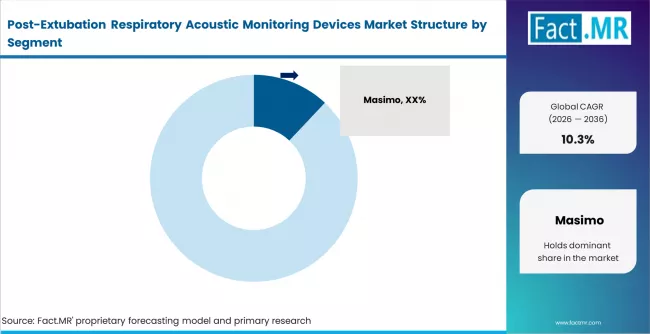
Post Extubation Respiratory Acoustic Monitoring Devices Market Analysis By Company | Source: Fact.MR
The competitive landscape of the post-extubation respiratory acoustic monitoring devices market is characterized by the dominance of large, diversified medical device companies alongside a growing layer of technology-focused innovators. Competition is shifting from conventional bedside monitoring toward advanced, wearable, and connected acoustic monitoring platforms, creating a clear divide between legacy device providers and next-generation solution developers.
Established leaders such as Medtronic, Masimo, and Koninklijke Philips hold strong positions due to their integrated patient monitoring ecosystems, global hospital relationships, and regulatory expertise. These companies are actively expanding acoustic respiratory monitoring capabilities within broader platforms, leveraging continuous innovation and R&D investments to maintain competitiveness.
Strategic partnerships are emerging as a key competitive lever. Collaborations such as those between Masimo and Philips are enabling integration of acoustic monitoring into multi-parameter systems, improving clinical workflow and adoption across hospital networks. Smaller and specialized players, including Vyaire Medical and Nonin Medical, are focusing on niche innovations in sensor accuracy and non-invasive monitoring technologies. The market is increasingly defined by regulatory clearance and digital integration capabilities. FDA approvals, interoperability with electronic health records, and reimbursement alignment are becoming critical entry barriers. Vendors without validated wearable solutions and connected monitoring platforms are being displaced from high-value hospital procurement cycles.
Key Players
- Masimo
- Medtronic
- GE Healthcare
- Koninklijke Philips
- Drägerwerk AG
- Nihon Kohden
- Vyaire Medical
- ResMed
Bibliography
- Masimo Corporation. (Q3 2024). FDA 510(k) Clearance Announcement: Acoustic Respiratory Monitoring Module Expansion for SET Platform Integration in U.S. Hospital ICU and Step-Down Unit Settings. Q3 2024. masimo.com/news
- Medtronic plc. (January 2025). Product Launch: Updated Patient Monitoring Wearable with Acoustic Respiratory Rate Detection for Post-Surgical ICU Step-Down Environments with EHR Integration. January 2025. medtronic.com/newsroom
- ECRI Institute. (2024). Top 10 Hospital Safety Technologies 2024: Continuous Acoustic Respiratory Monitoring as Priority Patient Safety Technology in U.S. Acute Care Hospitals. 2024. ecri.org
- Koninklijke Philips NV. (2024). Product Expansion: IntelliVue Patient Monitoring Portfolio Acoustic Monitoring Add-On for Post-Extubation ICU Care Across 150 Hospital Installations Globally. 2024. philips.com/newsroom
- The Joint Commission. (2024). Updated Post-Extubation Monitoring Guidelines: Continuous Respiratory Assessment Requirements for High-Risk Patients in Accredited U.S. Hospital ICU Settings. 2024. jointcommission.org
- Nihon Kohden Corporation. (Q2 2024). Product Launch: Acoustic Respiratory Monitoring Module for BSM Series Patient Monitors Targeting Post-Surgical Recovery Rooms in Japan and Export Markets. Q2 2024. nihonkohden.com/news
This Report Addresses
- Strategic intelligence on demand across wearable acoustic sensors, bedside monitors, and integrated ICU systems for post-extubation and chronic respiratory monitoring globally.
- Market forecast from USD 2.8 billion in 2026 to USD 7.7 billion by 2036 at a CAGR of 10.3%.
- Growth opportunities across India government biotech programmes, China ICU modernisation, U.S. CMS reimbursement expansion, UK NHS framework agreements, and Germany EU MDR compliance investment.
- Segment analysis by product (wearable sensors, bedside monitors, integrated systems), application (post-extubation, sleep apnea, COPD/asthma, general respiratory), and end user (hospitals, ASC, homecare).
- Regional outlook covering Asia Pacific ICU-led adoption, North America FDA-regulated penetration, and Europe compliance-driven procurement cycles.
- Competitive analysis of Masimo, Medtronic, GE Healthcare, Philips, Drägerwerk AG, Nihon Kohden, Vyaire Medical, and ResMed. Focus on clearance depth, EHR integration, and contract positioning.
- Regulatory analysis covering FDA 510(k) clearance pathways, EU MDR certification requirements, CMS reimbursement updates, NHS procurement framework agreements, and national ICU guideline mandates.
- Report delivered in PDF, Excel, and presentation formats. Supported by interviews, hospital procurement records, regulatory approval data, and manufacturer revenues.
Post-Extubation Respiratory Acoustic Monitoring Devices Market Definition
The market covers acoustic-based wearable sensors, bedside monitors, and integrated ICU systems for continuous respiratory monitoring following extubation. Devices use vibration and sound-based detection to track airway patency, breathing rate, and obstruction risk.
Post-Extubation Respiratory Acoustic Monitoring Devices Market Inclusions
Covers global forecasts (2026 to 2036) by product type, application, and end user. Includes wearable sensors, bedside monitors, and integrated systems. Covers ICU, ambulatory surgical center, and homecare procurement across hospital systems and home health providers.
Post-Extubation Respiratory Acoustic Monitoring Devices Market Exclusions
Excludes general pulse oximetry and capnography devices unless acoustically integrated. Omits standalone spirometry equipment and invasive airway monitoring tools. Focus remains on non-invasive acoustic monitoring platforms and their immediate clinical intermediates.
Post-Extubation Respiratory Acoustic Monitoring Devices Market Research Methodology
- Primary Research: Interviews with ICU directors, respiratory therapists, hospital procurement managers, and device manufacturers across key countries.
- Desk Research: Uses FDA clearance databases, CMS reimbursement records, NHS clinical guidelines, ECRI Institute reports, and company filings from Masimo, Medtronic, and GE Healthcare.
- Market-Sizing and Forecasting: Hybrid model using ICU bed counts, extubation procedure volumes, and device penetration by product type. Covers all major regions and end-user segments.
- Data Validation and Update Cycle: Validated with hospital procurement data, regulatory approvals, and company revenues. Cross-checked with expert interviews. Updated annually.
Segmentation
Scope of Report
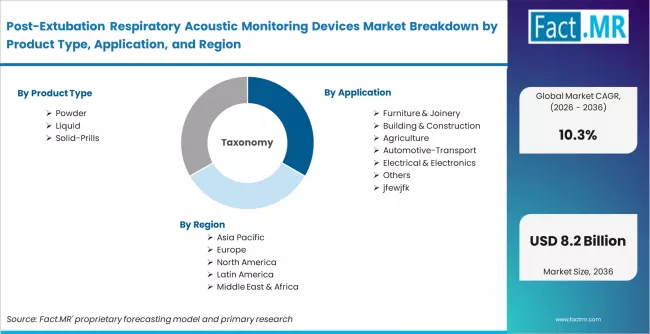
Post Extubation Respiratory Acoustic Monitoring Devices Market Breakdown By Product Type, Application, And Region | Source: Fact.MR
| Attribute | Details |
|---|---|
| Quantitative Units | USD 2.8 billion (2026) to USD 7.7 billion (2036), at a CAGR of 10.3% |
| Market Definition | Wearable acoustic sensors, bedside acoustic monitors, and integrated ICU monitoring systems for non-invasive continuous respiratory assessment in post-extubation clinical and homecare settings, procured by hospitals, ambulatory surgical centers, and homecare providers globally. |
| Product Type Segmentation | Wearable Acoustic Sensors, Bedside Acoustic Monitors, Integrated ICU Monitoring Systems |
| Application Segmentation | Post-Extubation Monitoring, Sleep Apnea Monitoring, COPD/Asthma Monitoring, General Respiratory Monitoring |
| End User Segmentation | Hospitals (ICU), Ambulatory Surgical Centers, Homecare |
| Application Coverage | ICU post-extubation surveillance, post-surgical respiratory monitoring, chronic respiratory disease management, homecare acoustic monitoring for COPD and sleep apnea, and ambulatory surgical center step-down monitoring. |
| Regions Covered | North America, Europe, Asia Pacific, Latin America, Middle East and Africa |
| Countries Covered | USA, Canada, Mexico, Germany, UK, France, Italy, Spain, Nordic, BENELUX, China, Japan, South Korea, India, ASEAN, Australia and New Zealand, Brazil, Argentina, Chile, Saudi Arabia, GCC, Turkey, South Africa, Rest of MEA |
| Key Companies Profiled | Masimo, Medtronic, GE Healthcare, Koninklijke Philips, Drägerwerk AG, Nihon Kohden, Vyaire Medical, ResMed |
| Forecast Period | 2026 to 2036 |
| Approach | Hybrid top-down and bottom-up model using ICU bed counts, extubation procedure volume estimates, device penetration by product type and end-user segment, average contract unit prices by specification grade, and primary interviews with ICU directors, respiratory therapists, and device manufacturers. |
Source: Fact.MR analysis. Updated Apr 21, 2026
Post-Extubation Respiratory Acoustic Monitoring Devices Market by Segments
-
By Product Type:
- Wearable Acoustic Sensors
- Bedside Acoustic Monitors
- Integrated ICU Monitoring Systems
-
By Application:
- Post-Extubation Monitoring
- Sleep Apnea Monitoring
- COPD/Asthma Monitoring
- General Respiratory Monitoring
-
By End User:
- Hospitals (ICU)
- Ambulatory Surgical Centers
- Homecare
-
By Region:
- North America
- United States
- Canada
- Mexico
- Latin America
- Brazil
- Mexico
- Argentina
- Chile
- Rest of Latin America
- Western Europe
- Germany
- United Kingdom
- France
- Italy
- Spain
- Nordic Countries
- BENELUX
- Rest of Western Europe
- Eastern Europe
- Russia
- Poland
- Hungary
- Balkan and Baltic
- Rest of Eastern Europe
- East Asia
- China
- Japan
- South Korea
- South Asia and Pacific
- India
- ASEAN
- Australia and New Zealand
- Rest of South Asia and Pacific
- Middle East and Africa
- Kingdom of Saudi Arabia
- Other GCC Countries
- Turkey
- South Africa
- Rest of Middle East and Africa
- North America
Frequently Asked Questions
How large is the post-extubation respiratory acoustic monitoring devices market in 2025?
What will the market size be by 2036?
What is the expected CAGR for the market from 2026 to 2036?
Which product type segment is poised to lead the market?
Which end-user segment is expected to dominate?
Which country shows the fastest growth?
What is driving demand for post-extubation respiratory acoustic monitoring devices?
What are the major restraints?
Who worked on this report


Preview the report firsthand - request a free sample
Free SampleGet the brochure for pricing and purchase details
Download PDF