The Small-molecule Respiratory Drug Market is analyzed across its key product, application and end-use segments, with the study covering market dynamics, regional trends and demand outlook, forecast 2026 to 2036.
By Fact.MR Healthcare DeskLead analyst:
S.N. JhaPublished :
Updated :
10 min read
Fact-checked under the Fact.MR editorial process
Small-molecule Respiratory Drug Market Forecast and Outlook By Fact.MR
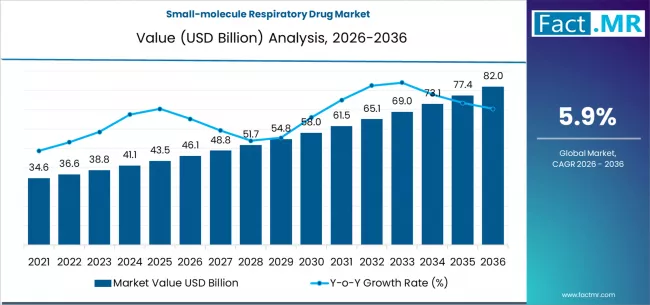
The global small-molecule respiratory drug market is projected to total USD 46.12 billion in 2026, advancing to USD 81.97 billion by 2036, achieving a compound annual growth rate of 5.9%. This expansion is fundamentally driven by the persistent and high global burden of chronic respiratory diseases, primarily asthma and COPD, which require long-term pharmacological management.
Small Molecule Respiratory Drug Market Market Value Analysis | Source: Fact.MR
Summary of Small-Molecule Respiratory Drug Market
Market Snapshot
Global small-molecule respiratory drug market revenue stood atUSD 46.12 billion in 2026and is forecast to reachUSD 81.97 billion by 2036.
At a5.9%CAGRfrom 2026 to 2036, this market is set to expand~1.8x in value, addingUSD 35.85 billion in absolute opportunity.
This marketrepresentsthecore therapeutic backbone of respiratory care, driven by high global prevalence of chronic respiratory diseases such as asthma andCOPD.
Small-molecule drugs continue to dominate due tocost efficiency,establishedclinical profiles, and scalability, especially compared to biologics.
Demand and Growth Drivers
Persistent global burden ofchronic respiratory diseases (asthma,COPD, bronchitis)is the primary growth driver.
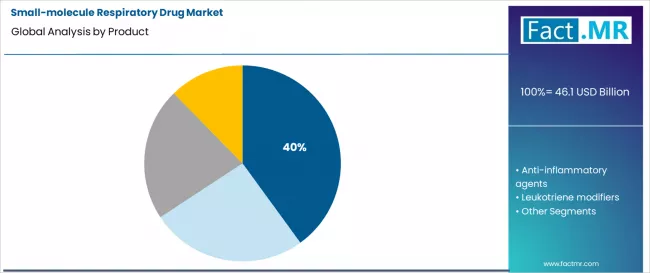
Bronchodilators hold 40.0% of product segment share in 2026,emergingas the leading segment due to their critical role in symptom relief and airway management.
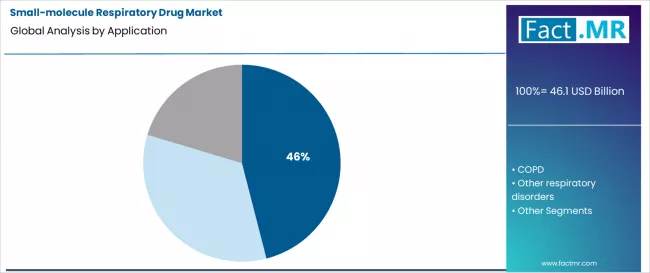
Asthma accounts for 46.0% of application share in 2026, positioning it as the dominant segment driven by high patient prevalence and chronic treatment needs.
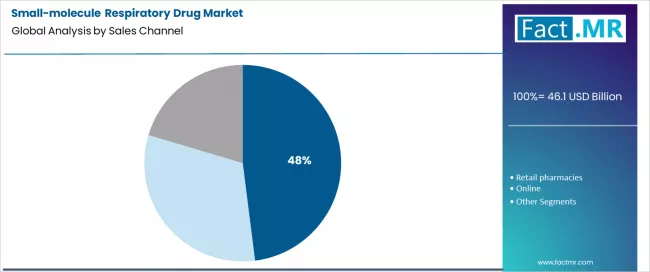
Hospital pharmacies account for 48.0% of sales channel share in 2026, reflecting the importance of institutional procurement in respiratory drug distribution.
Key product categories include:
Bronchodilators
Anti-inflammatory agents
Leukotriene modifiers
Combination therapies
Geography and Competitive Outlook
Growth is supported acrossNorth America, Europe, and Asia Pacific, driven by disease prevalence and healthcare infrastructure.
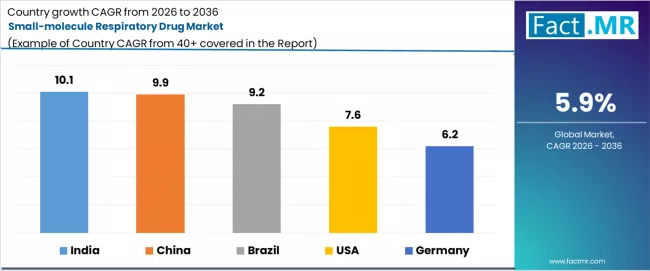
India (10.1%CAGR), China (9.9%), Brazil (9.2%), United States (7.6%), and Germany (6.2%)are key growth markets.
Market expansion is closely tied to:
Rising urban pollution and respiratory disease incidence
Expansion of healthcare access in emerging economies
Generic drug penetration and affordability
Key companies active in this market include AstraZeneca,GSK, Novartis,BoehringerIngelheim, andTeva.
Small-Molecule Respiratory Drug Market — At a Glance
Attribute
Details
Market Value 2026
USD 46.12 billion
Market Value 2036
USD 81.97 billion
Absolute Dollar Opportunity 2026–2036
USD 35.85 billion
Total Growth 2026–2036
77.7%
CAGR2026–2036
5.9%
Growth Multiple
~1.8x
Key Demand Theme
Continued reliance on cost-effective small-molecule therapies for chronic respiratory disease management
Leading Segment by Product (2026)
Bronchodilators
Segment Share (2026)
40.0%
Leading Segment by Application (2026)
Asthma
Segment Share (2026)
46.0%
Leading Segment by Channel (2026)
Hospital Pharmacies
Segment Share (2026)
48.0%
Key Growth Regions
North America, Europe, Asia Pacific
CountryCAGRs
India 10.1%, China 9.9%, Brazil 9.2%, USA 7.6%, Germany 6.2%
North America, Europe, Asia Pacific, Latin America, MEA
Source: Fact.MR analysis. Updated Apr 20, 2026
Continued reliance on established, effective small-molecule therapies will likely drive small-molecule respiratory drug demand in the future. These therapies form the backbone of daily symptom control for millions of patients worldwide. Despite the emergence of biologic therapies for severe phenotypes, small molecules retain dominance due to their oral or inhaled administration, well-understood safety profiles, cost-effectiveness, and accessibility across diverse healthcare systems. Growth is concentrated within the bronchodilator segment, which addresses the core symptomatic need for airway dilation in both asthma and COPD. The asthma application constitutes the largest share, reflecting its high prevalence across all age groups and the established treatment protocols that heavily feature small-molecule drugs. Emerging economies exhibit significant growth opportunities, with rising air pollution, smoking rates, and improving diagnostic capabilities uncovering a vast, previously underserved patient population. Mature markets are experiencing growth through the development of novel fixed-dose combinations, improved delivery devices, and the integration of digital health tools for adherence monitoring.
North America, Latin America, Western Europe, Eastern Europe, East Asia, South Asia & Pacific, MEA
Source: Fact.MR analysis. Updated Apr 20, 2026
Segmental Analysis
By Product, Which Class Provides Foundational Symptom Relief for Airway Constriction?
Small Molecule Respiratory Drug Market Analysis By Product | Source: Fact.MR
Bronchodilators command a leading 40.0 percent share. This dominance is attributed to their critical role as first-line and rescue therapy in both asthma and COPD management. By directly relaxing bronchial smooth muscle, they provide rapid relief from acute symptoms like shortness of breath and wheezing.
Their inclusion in nearly all treatment regimens, whether as short-acting agents for quick relief or long-acting agents for maintenance, solidifies their irreplaceable position in the respiratory therapeutic arsenal.
By Application, Which Chronic Condition Represents the Largest Patient Population?
Small Molecule Respiratory Drug Market Analysis By Application | Source: Fact.MR
Asthma constitutes the dominant application with a 46.0 percent share. This high prevalence stems from its widespread incidence in pediatric and adult populations globally. Asthma management relies heavily on small-molecule drugs, including inhaled corticosteroids paired with long-acting bronchodilators as controller therapy, and short-acting bronchodilators for relief, creating a sustained, high-volume demand for these pharmaceutical products.
By Sales Channel, Which Outlet is Central to Dispensing Chronic and Acute Care Medications?
Small Molecule Respiratory Drug Market Analysis By Sales Channel | Source: Fact.MR
Hospital pharmacies are the primary sales channel, holding a 48.0 percent share. This is due to several factors: the dispensing of medications during hospitalizations for severe exacerbations, the role of hospital outpatient clinics in managing complex COPD and severe asthma cases, and the fact that many advanced inhalation devices and combination therapies are initiated and monitored within formal healthcare settings before transitioning to community refills.
What are the Principal Drivers, Constraints, and Evolving Dynamics in the Small-molecule Respiratory Drug Market?
Attribute
Analysis
High Global Prevalence of Asthma/COPD
Demographic trends and environmental factors like air pollution continue to expand the chronic patient population requiring daily medication.
Patent Expiries and Generic Competition
Loss of exclusivity for major drug classes leads to intense price erosion, significantly compressing revenue for originator brands.
Development of Novel Fixed-Dose Triple Therapies
Advanced single-inhaler combinations for severe disease improve patient outcomes and adherence, creating a premium market segment.
Integration of Digital Inhalers and Adherence Monitoring
Connected devices enable remote patient management, improve disease control, and support differentiated, value-based pricing strategies.
Source: Fact.MR analysis. Updated Apr 20, 2026
Analysis of the Small-molecule Respiratory Drug Market by Key Countries
Small Molecule Respiratory Drug Market Cagr Analysis By Country | Source: Fact.MR
Country
CAGR 2026 to 2036
India
10.1%
China
9.9%
Brazil
9.2%
USA
7.6%
Germany
6.2%
Source: Fact.MR analysis. Updated Apr 20, 2026
What Distinguishes the USA's Advanced but Cost-Sensitive Treatment Landscape?
The USA's 7.6% CAGR is propelled by one of the highest prevalence rates of asthma and COPD in the world, a sophisticated healthcare infrastructure for specialist care, and high patient awareness. Growth is characterized by a dual dynamic: strong demand for innovative, premium-priced combination therapies and sustained volume from generics.
Formulary management from pharmacy benefit managers (PBMs) and insurance companies, which aggressively negotiate prices and promote generic substitution, making cost-effectiveness a critical success factor alongside clinical efficacy, heavily influences market evolution.
How is Brazil's Public Health System Shaping Access and Treatment Protocols?
Brazil's 9.2% CAGR is closely tied to its Unified Health System (SUS), which provides broad access to essential medicines, including many first-line respiratory drugs. Government programs for chronic disease management create a structured, high-volume demand channel.
The market is driven by a large and growing private healthcare sector. Growth is fueled by the need to manage a significant burden of COPD and asthma, with an increasing focus on improving diagnosis and standardizing treatment according to national guidelines, which drives the uptake of both older generics and newer recommended combinations.
What role does China's Pollution and Healthcare Modernization Play in Market Acceleration?
China's 9.9% CAGR is driven by the severe public health challenge of air pollution, contributing to high rates of COPD and rising asthma prevalence. Massive government investment in healthcare system modernization is improving diagnostic capabilities and treatment access in both urban and rural settings.
The market is expanding rapidly, characterized by the growing presence of multinational corporations and the simultaneous rise of domestic generic manufacturers producing affordable inhaled therapies, catering to the needs of a vast and increasingly health-conscious population.
How do India's Unique Demographic and Environmental Challenges Drive Specific Demand?
India's leading 10.1% CAGR is fueled by a catastrophic convergence of factors: extremely high levels of ambient and household air pollution, a genetic predisposition to airway sensitivity, and a massive population with rising rates of smoking and urbanization. This creates an enormous and growing patient pool.
Market growth is characterized by a critical need for ultra-affordable generic bronchodilators and corticosteroids, alongside the gradual penetration of branded combination therapies in metropolitan private healthcare, representing a market with extreme tiering and vast unmet need.
How does Germany's Structured Healthcare and Reimbursement Framework Guide Market Development?
Germany's 6.2% CAGR operates within a highly structured statutory health insurance system that emphasizes evidence-based medicine and cost-benefit analysis. The market is mature and stable, with growth driven by an aging population susceptible to COPD.
Adoption of new therapies is methodical, requiring demonstration of added therapeutic benefit for premium pricing. The strong role of sickness funds and reference pricing ensures that established, effective generics maintain a significant market share, while innovation is adopted for clear patient subgroups with unmet needs.
Competitive Landscape of the Small-molecule Respiratory Drug Market
Small Molecule Respiratory Drug Market Analysis By Company | Source: Fact.MR
A few multinational pharmaceutical giants with deep expertise in respiratory medicine and vast commercial infrastructures dominate the competitive landscape. Competition is intensely focused on portfolio breadth, life-cycle management of key brands, and the successful development of next-generation fixed-dose combinations.
Success is heavily dependent on maintaining strong relationships with pulmonologists and primary care physicians through extensive medical science liaison teams, while also navigating the complex procurement and formulary decisions of hospital networks and public health payers.
These companies invest billions in clinical trials to demonstrate superior efficacy or convenience of their combination products over the standard of care, seeking to secure favorable reimbursement and guideline inclusion.
Beyond the innovation race among originator companies, the landscape features fierce competition from generic and biosimilar manufacturers following patent expiries. This segment exerts continuous downward price pressure and captures significant volume, particularly in price-sensitive markets.
The competitive battleground also extends to inhalation device technology, where ease of use, dose consistency, and patient acceptability can be key differentiators even for drug products within the same class.
Strategic partnerships between large pharma and specialized drug delivery device companies are common. Ultimately, long-term leadership requires a balanced strategy of innovating for high-value segments, defending core brands against generics, and executing efficiently in high-volume, cost-competitive markets.
Key Players in the Small-molecule Respiratory Drug Market
AstraZeneca
GSK
Novartis AG
Boehringer Ingelheim
Teva Pharmaceutical Industries Ltd.
Others
References
Global Initiative for Asthma. (2025). Global strategy for asthma management and prevention. GINA Report.
Global Initiative for Chronic Obstructive Lung Disease. (2024). Global strategy for the diagnosis, management, and prevention of chronic obstructive pulmonary disease. GOLD Report.
Mukherjee, M., & Stoddart, A. (2024). The pharmacology of small-molecule therapies in respiratory disease. British Journal of Pharmacology.
Reddel, H. K., & FitzGerald, J. M. (2025). The future of asthma and COPD treatment: The role of small molecules and biologics. The Lancet Respiratory Medicine.
World Health Organization. (2024). Chronic respiratory diseases: Fact sheet. WHO Publications.
Comparative analysis of efficacy and safety profiles within drug classes; health-economic evaluations of triple vs. dual therapy; study of adherence rates across different inhalation devices; impact of air quality regulations on disease prevalence and drug demand; analysis of pipeline small-molecule candidates and their potential market disruption.
Source: Fact.MR analysis. Updated Apr 20, 2026
Market by Segments
Product :
Bronchodilators
Anti-inflammatory Agents
Leukotriene Modifiers
Others
Application :
Asthma
COPD
Other Respiratory Disorders
Sales Channel :
Hospital Pharmacies
Retail Pharmacies
Online
Region :
North America
USA
Canada
Latin America
Brazil
Mexico
Argentina
Rest of Latin America
Western Europe
Germany
France
Italy
Spain
UK
BENELUX
Rest of Western Europe
Eastern Europe
Russia
Poland
Czech Republic
Rest of Eastern Europe
East Asia
China
Japan
South Korea
Rest of East Asia
South Asia & Pacific
India
ASEAN
Australia
Rest of South Asia & Pacific
MEA
GCC Countries
South Africa
Turkiye
Rest of MEA
Questions Answered
Frequently Asked Questions
How big is the small-molecule respiratory drug market in 2026?
The global small-molecule respiratory drug market is estimated to be valued at USD 46.1 billion in 2026.
What will be the size of small-molecule respiratory drug market in 2036?
The market size for the small-molecule respiratory drug market is projected to reach USD 82.0 billion by 2036.
How much will be the small-molecule respiratory drug market growth between 2026 and 2036?
The small-molecule respiratory drug market is expected to grow at a 5.9% CAGR between 2026 and 2036.
What are the key product types in the small-molecule respiratory drug market?
The key product types in small-molecule respiratory drug market are bronchodilators, anti-inflammatory agents, leukotriene modifiers and others.
Which application segment to contribute significant share in the small-molecule respiratory drug market in 2026?
In terms of application, asthma segment to command 46.0% share in the small-molecule respiratory drug market in 2026.