- Base Value(2026): 718.5 Mn
- Forecast Value (2036): 2486.7 Mn
- CAGR (2036): 13.2%
Potting and Encapsulation Systems for EV Power Electronics Market Forecast and Outlook By Fact.MR
The potting and encapsulation systems for EV power electronics market reached USD 642.8 million in 2025. Fact MR estimates the market will expand to USD 718.5 million in 2026 and attain USD 2,486.7 million by 2036. The market is forecast to register a CAGR of 13.2% across the assessment period.
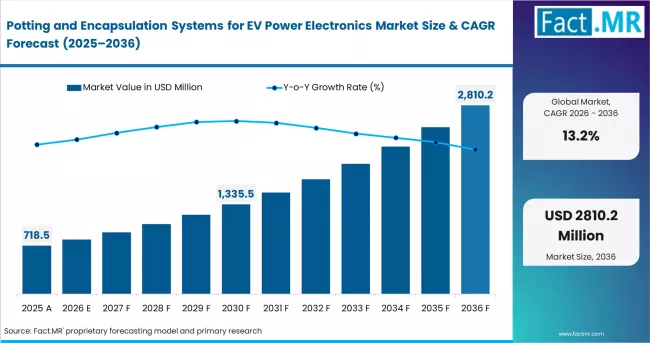
Potting And Encapsulation Systems For Ev Power Electronics Market Market Value Analysis | Source: Fact.MR
Potting and Encapsulation Systems for EV Power Electronics Market
| Metric | Details |
|---|---|
| Industry Size (2026E) | USD 718.5 million |
| Industry Value (2036F) | USD 2,486.7 million |
| CAGR (2026 to 2036) | 13.2% |
Source: Fact.MR analysis. Updated Apr 17, 2026
Summary of Potting and Encapsulation Systems for EV Power Electronics Market
- Market Definition
- The market includes resin dispensing equipment and encapsulation materials applied to EV power electronics to provide electrical insulation, thermal dissipation, vibration resistance, and environmental protection across inverters, converters, onboard chargers, and battery management modules.
- Demand Drivers
- Increasing production of electric vehicles requiring protection of high voltage electronic components.
- Rising need for thermal management materials supporting heat dissipation across power semiconductor assemblies.
- Growing integration of encapsulation resins improving resistance to vibration and moisture exposure.
- Expansion of compact inverter architectures requiring high dielectric strength insulation materials.
- Increasing use of automated dispensing equipment supporting uniform material application thickness.
- Rising adoption of thermally conductive polymers supporting reliability of silicon carbide power modules.
- Key Segments Analyzed
- System Type: Automated dispensing leads with 44% share supported by requirement for controlled material flow accuracy.
- Material: Epoxy holds 39% share due to strong dielectric strength and adhesion performance.
- Application Role: Inverters and DC DC converters represent primary deployment areas requiring insulation and thermal stability.
- Technology Role: Encapsulation systems support protection of semiconductor components exposed to electrical stress conditions.
- Geography: Asia Pacific and Europe maintain strong adoption supported by expansion of EV electronics manufacturing capacity.
- Analyst Opinion at Fact MR
- Shambhu Nath Jha, Principal Consultant, Fact MR, opines, 'In this updated edition of the Potting and Encapsulation Systems for EV Power Electronics Market report, industry participants observe sustained demand for advanced insulation materials supporting reliability of high voltage automotive electronics. Encapsulation technologies remain critical for maintaining electrical stability and thermal protection performance across electric drivetrain systems through 2036.'
- Strategic Implications or Executive Takeaways
- Invest in epoxy and silicone encapsulation materials supporting high dielectric strength performance.
- Strengthen automated dispensing capability supporting consistent encapsulation thickness across power modules.
- Improve thermal conductivity characteristics supporting heat dissipation across compact electronic assemblies.
- Expand integration capability across inverter and battery control unit manufacturing workflows.
- Focus on material qualification processes supporting long term durability across thermal cycling conditions.
- Enhance compatibility with silicon carbide power electronics requiring higher temperature resistance performance.
- Methodology
- Primary interviews conducted with resin formulators, dispensing equipment manufacturers, and EV component suppliers.
- Benchmarked against electric vehicle production indicators influencing demand for electronic protection materials.
- Evaluated deployment patterns across power module packaging environments requiring insulation and vibration resistance capability.
- Hybrid modeling applied combining top down EV electronics demand assessment with bottom up encapsulation material consumption benchmarking.
- Validation conducted using automotive electronics production indicators and supplier level material adoption data.
- Peer review applied using Fact MR analytical frameworks linking EV electrification trends with electronic packaging material demand patterns.
A CAGR of 13.2% indicates transformational expansion supported by increasing use of thermal management and insulation materials in EV power electronics. Growth remains driven by reliability requirements for inverters and battery control units, while constraints persist from formulation cost sensitivity, qualification timelines, and raw material price variability in specialty resins.
China leads with a projected CAGR of 14.3%, supported by expansion of electric vehicle power module manufacturing requiring thermal management encapsulation materials. India follows with a CAGR of 13.9%, driven by increasing integration of protective insulation compounds across EV electronic control units. The United Kingdom records a CAGR of 13.6%, reflecting steady adoption of resin-based encapsulation systems across automotive electronics production environments. Germany shows a CAGR of 13.5%, supported by consistent use of advanced potting materials across high-performance electric drivetrain components. The United States records the slowest growth at 13.2%, reflecting a relatively mature EV electronics supply chain tied to replacement demand within established automotive component manufacturing infrastructure.
Segmental Analysis
Potting and Encapsulation Systems for EV Power Electronics Market Analysis by System Type
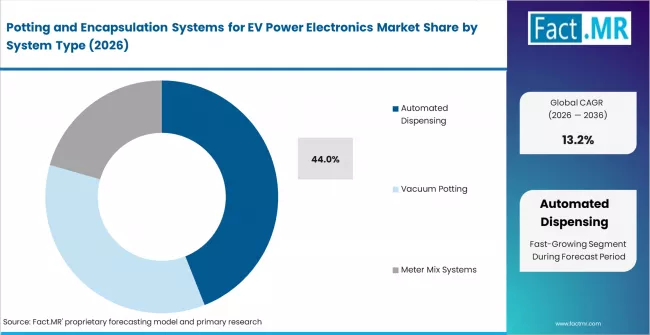
Potting And Encapsulation Systems For Ev Power Electronics Market Analysis By System Type | Source: Fact.MR
- Market Overview: Based on Fact MR assessment, automated dispensing systems are projected to account for 44% share of the potting and encapsulation systems for EV power electronics market in 2026. Automated dispensing equipment is integrated across power module assembly lines requiring controlled delivery of encapsulation compounds across circuit boards, inverters, and control modules. Precision metering systems support uniform material distribution enabling protection of electronic components from moisture ingress, vibration exposure, and thermal cycling conditions. Process automation supports repeatable application thickness enabling stable insulation performance across high voltage electronic assemblies requiring consistent dielectric protection characteristics.
- Demand Drivers:
- Dispensing Accuracy Requirements: Automated systems support controlled flow rate enabling uniform encapsulation layer formation across power electronic components.
- Production Consistency Parameters: Programmable dispensing equipment supports repeatable material application across batch controlled electronic assembly workflows.
- Process Integration Needs: Automated systems enable synchronization with assembly line equipment supporting continuous encapsulation operations.
Potting and Encapsulation Systems for EV Power Electronics Market Analysis by Material
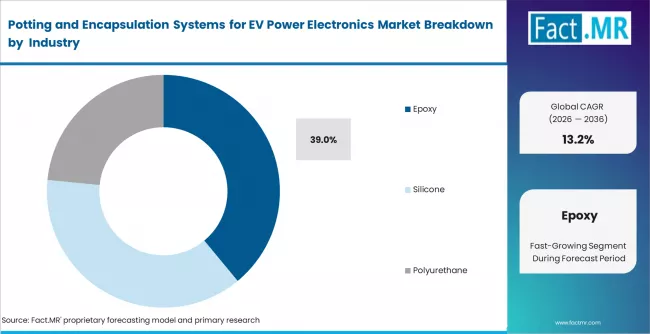
Potting And Encapsulation Systems For Ev Power Electronics Market Analysis By Material | Source: Fact.MR
- Market Overview: Epoxy materials are estimated to hold 39% share of the potting and encapsulation systems for EV power electronics market in 2026, supported by high dielectric strength and thermal stability characteristics required for protection of semiconductor devices. Epoxy encapsulants form crosslinked polymer networks enabling resistance to electrical stress, mechanical vibration, and temperature variation across high power electronic modules. Material compatibility supports adhesion to metal substrates, ceramic components, and printed circuit boards requiring stable insulation performance across electric vehicle power control systems.
- Demand Drivers:
- Electrical Insulation Requirements: Epoxy encapsulation materials support dielectric barrier formation enabling protection of high voltage electronic circuits.
- Thermal Stability Parameters: Crosslinked epoxy structure demonstrates resistance to degradation across elevated temperature operating environments.
- Mechanical Protection Needs: Encapsulation materials support structural stability of electronic assemblies exposed to vibration and mechanical stress conditions.
Key Dynamics
Potting and Encapsulation Systems for EV Power Electronics Market Drivers, Restraints, and Opportunities
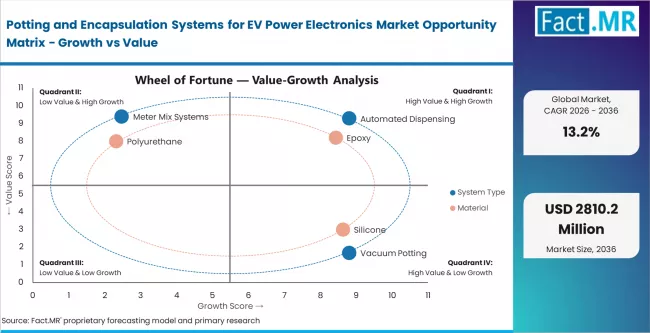
Potting And Encapsulation Systems For Ev Power Electronics Market Opportunity Matrix Growth Vs Value | Source: Fact.MR
FMR analysts observe that historical adoption of potting and encapsulation materials originates from power semiconductor packaging practices where electrical insulation and environmental sealing were required to ensure reliability in high-voltage assemblies. The current market size reflects a structural growth phase driven by electrified drivetrain architectures where inverters, onboard chargers, and DC-DC converters operate under elevated thermal loads and voltage stress conditions. Structural demand persists because thermally conductive polymers protect sensitive electronic assemblies from vibration, moisture ingress, and dielectric breakdown while enabling compact packaging of high-power modules. Transition from silicon IGBT modules toward silicon carbide power devices increases heat flux density, reinforcing demand for advanced encapsulation chemistries capable of maintaining insulation integrity at higher operating temperatures.
The current structural shift reflects declining reliance on conventional epoxy encapsulants as OEMs prioritize silicone and hybrid resin systems with improved thermal conductivity and reduced mechanical stress across wide temperature cycles. Higher per-unit material cost associated with advanced thermally conductive compounds is offset by improved inverter efficiency, longer component lifespan, and reduced thermal management complexity across compact drivetrain designs. Demand expansion is concentrated in regions with high electric vehicle production scale where packaging density and reliability requirements drive continuous material performance improvements.
- High-Voltage Insulation: Encapsulation materials maintain dielectric stability and partial discharge resistance in high-voltage power modules operating above conventional temperature limits.
- Thermal Conductivity Shift: Transition toward thermally conductive silicone and hybrid resins supports heat dissipation requirements associated with higher power density SiC inverter architectures.
- Asia EV Production: China, South Korea, and Japan drive demand due to large-scale electric drivetrain manufacturing requiring reliable electronic packaging materials.
Regional Analysis
The Potting and Encapsulation Systems for EV Power Electronics Market is assessed across North America, Europe, and Asia Pacific, segmented by country-level demand in battery management systems, inverter modules, onboard chargers, and thermal protection materials for electric vehicle electronics. Regional demand reflects expansion of EV production capacity and adoption of protective resin encapsulation technologies. The full report offers market attractiveness analysis.
.webp "Top Country Growth Comparison Potting And Encapsulation Systems For Ev Power Electronics Market Cagr (2026 2036)")
Top Country Growth Comparison Potting And Encapsulation Systems For Ev Power Electronics Market Cagr (2026 2036) | Source: Fact.MR
CAGR Table
| Country | CAGR (2026–2036) |
|---|---|
| China | 14.3% |
| India | 13.9% |
| United Kingdom | 13.6% |
| Germany | 13.5% |
| United States | 13.2% |
Source: Fact.MR analysis. Updated Apr 17, 2026
Source: Fact MR analysis, based on proprietary forecasting model and primary research
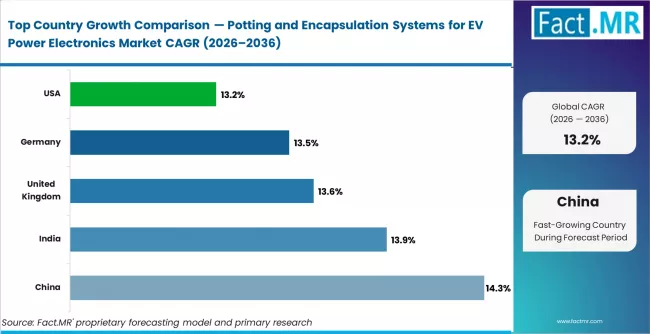
Potting And Encapsulation Systems For Ev Power Electronics Market Cagr Analysis By Country | Source: Fact.MR
Asia Pacific
Asia Pacific functions as the EV electronics material integration hub, supported by rapid expansion of battery manufacturing capacity and demand for thermal protection compounds. Henkel AG strengthens electronic encapsulation resin capability. Dow Inc. expands electrically insulating material portfolio. Shin Etsu Chemical Co., Ltd. supports silicone-based encapsulation innovation.
- China: China is projected to record 14.3% CAGR in potting and encapsulation systems for EV power electronics through 2036. New Energy Vehicle industrial development plan update (MIIT, March 2024) supports demand for protective electronic materials. Dow Inc. expanded EV-grade encapsulation resin supply capability (June 2023).
- India: Adoption of potting and encapsulation systems for EV power electronics in India is forecast to grow at 13.9% CAGR through 2036. FAME II electric mobility expansion framework update (Ministry of Heavy Industries, January 2024) supports battery electronics protection requirements. Henkel AG expanded electronic materials engineering support capability (May 2023).
Europe
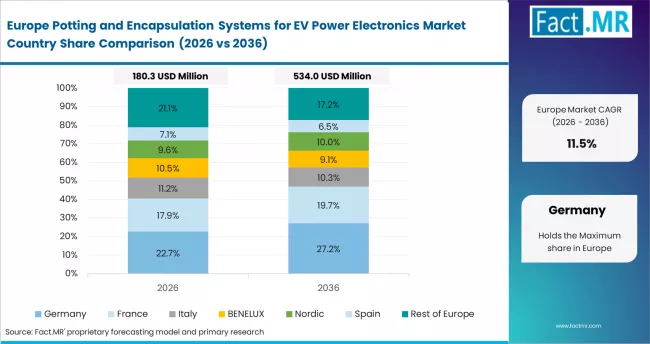
Potting And Encapsulation Systems For Ev Power Electronics Market Europe Country Market Share Analysis, 2026 & 2036 | Source: Fact.MR
Europe operates as the advanced automotive electronics materials engineering center, supported by strong EV manufacturing presence and structured material qualification standards. Wacker Chemie AG strengthens silicone encapsulation chemistry capability. Elantas GmbH expands electrical insulation resin portfolio. Henkel AG supports high-performance electronic protection solutions.
- United Kingdom: Utilization of potting and encapsulation systems for EV power electronics in United Kingdom is expected to expand at 13.6% CAGR through 2036. Zero Emission Vehicle mandate implementation update (Department for Transport, February 2024) supports EV component material demand. Wacker Chemie AG expanded electronic silicone material engineering capability (July 2023).
- Germany: Germany is anticipated to observe 13.5% CAGR in potting and encapsulation systems for EV power electronics through 2036. National Platform Future of Mobility materials innovation programme update (BMWK, October 2023) supports advanced electronic insulation adoption. Elantas GmbH expanded EV-grade encapsulation resin production capability (April 2023).
North America
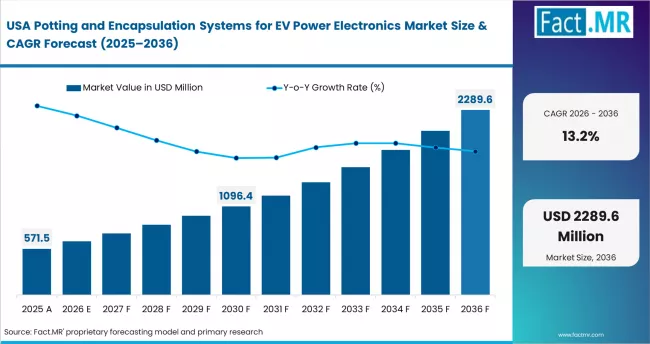
Potting And Encapsulation Systems For Ev Power Electronics Market Country Value Analysis | Source: Fact.MR
North America represents the automotive electronics material qualification environment, supported by EV platform development and demand for durable protective compounds for high-voltage components. 3M Company strengthens electronic insulation material capability. Huntsman Corporation expands polyurethane encapsulation technology portfolio. Dow Inc. supports advanced polymer protection material innovation.
- United States: The United States is forecast to witness 13.2% CAGR in potting and encapsulation systems for EV power electronics through 2036. Inflation Reduction Act EV supply chain localization provisions update (U.S. Department of Energy, April 2024) supports electronic component material demand. Huntsman Corporation expanded EV insulation resin capability (August 2023).
Fact MR's analysis of potting and encapsulation systems for EV power electronics market in global regions consists of country-wise assessment that includes China, India, United Kingdom, Germany, and United States. Readers can find EV electronics material trends, thermal protection developments, insulation resin innovation signals, and competitive positioning across key markets.
Competitive Landscape
Competitive Structure and Buyer Dynamics in the Potting and Encapsulation Systems for EV Power Electronics Market
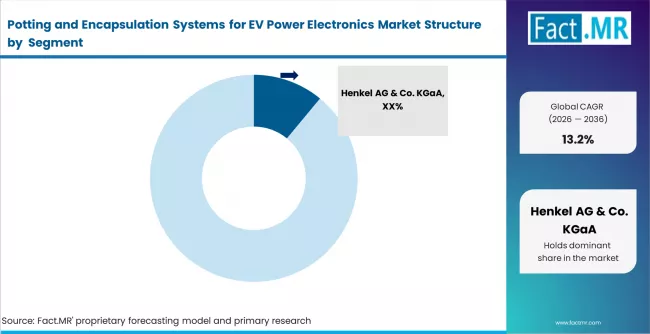
Potting And Encapsulation Systems For Ev Power Electronics Market Analysis By Company | Source: Fact.MR
The competitive structure of the Potting and Encapsulation Systems for EV Power Electronics Market is moderately concentrated, with specialty chemical companies controlling a significant share of thermoset resin and electronic protection material supply. Companies such as Henkel AG & Co. KGaA, Huntsman Corporation, Dow Inc., H.B. Fuller Company, 3M Company, ELANTAS GmbH, Dymax Corporation, and ITW Engineered Polymers maintain strong positions through established polymer formulation capabilities and global distribution networks serving electronics manufacturers. Additional participants including Master Bond Inc. and Intertronics Ltd contribute through specialized encapsulation adhesives and engineered polymer systems. Competition is primarily influenced by thermal conductivity performance, dielectric strength, curing efficiency, and compatibility with power electronics manufacturing processes.
Several companies maintain structural advantages through proprietary polymer chemistry expertise and established relationships with automotive electronics suppliers and EV component manufacturers. Firms such as Henkel AG & Co. KGaA and Dow Inc. benefit from extensive materials research capabilities and vertically integrated chemical production infrastructure supporting consistent formulation performance. Huntsman Corporation and ELANTAS GmbH maintain advantages through strong expertise in electrical insulation materials. EV component manufacturers often adopt multi supplier sourcing strategies to reduce dependence on a single encapsulation provider and ensure supply continuity. Procurement decisions evaluate suppliers based on material consistency, thermal performance reliability, and long term technical support, moderating supplier pricing leverage across EV electronics applications.
Key Players of the Potting and Encapsulation Systems for EV Power Electronics Market
- Henkel AG & Co. KGaA
- Huntsman Corporation
- Dymax Corporation
- ELANTAS GmbH
- H.B. Fuller Company
- Master Bond Inc.
- 3M Company
- Dow Inc.
- ITW Engineered Polymers
- Intertronics Ltd
Bibliographies
- [1] Tian, J., et al. (2024, May). Overview of Chinese new energy vehicle industry and policy progress and challenges. Sustainable Futures, 6, Article 100179.
- [2] Department for Transport. (2025, April). Government announces changes to zero emission vehicle mandate. UK Government.
- [3] acatech National Academy of Science and Engineering. (2023, October). Moderation of the German national platform for electric mobility. acatech.
- [4] U.S. Department of Energy. (2025, May). 50 million to help build the EV supply chain under Inflation Reduction Act. U.S. Department of Energy.
- [5] Press Information Bureau. (2024, September). Status and future of FAME scheme for electric vehicles EMPS extension. Government of India.
- [6] Henkel AG and Co KGaA. (2023, July). New developments in electronic adhesives and sealants for EV applications. Henkel AG and Co KGaA.
- [7] Varel, F. (2025, January). ELANTAS one stop solution for eMobility insulation including power electronics encapsulation. ELANTAS GmbH.
- [8] Huntsman Corporation. (2025, May). Huntsman unveils intumescent coating for EV fire safety POLYRESYST EV5005. Huntsman Corporation.
This Report Addresses
- Market size forecasts for 2026 to 2036 based on adoption of thermal insulation and dielectric protection materials across EV power electronics assemblies.
- Opportunity mapping across epoxy, silicone, polyurethane, and acrylic encapsulation materials supporting high-voltage electronic protection performance.
- Segment and regional forecasts covering inverters, battery management systems, onboard chargers, DC DC converters, and power modules.
- Competition benchmarking based on thermal conductivity capability, dielectric strength performance, and compatibility with automated dispensing systems.
- Standards and qualification assessment covering automotive electronics reliability validation requirements influencing encapsulation material selection.
- Report delivery in PDF, Excel, PPT, and dashboard formats supporting EV component manufacturers, electronic material engineers, and automotive electronics integrators.
- Operational risk analysis covering resin curing variability, thermal expansion stress, material viscosity control complexity, and integration constraints across automated dispensing workflows.
Potting and Encapsulation Systems for EV Power Electronics Market Definition
The Potting and Encapsulation Systems for EV Power Electronics Market includes dispensing equipment, materials, and process technologies used to apply protective resins around electronic components such as inverters, converters, onboard chargers, and battery control units to improve electrical insulation, thermal management, vibration resistance, and protection from moisture and chemicals in electric vehicles.
Potting and Encapsulation Systems for EV Power Electronics Market Inclusions
The report includes global and regional market size estimates, forecast analysis, and segmentation by resin type, dispensing system, application area, power electronics component, end use industry, pricing structure, and integration with EV electronics manufacturing processes.
Potting and Encapsulation Systems for EV Power Electronics Market Exclusions
The scope excludes standalone semiconductor devices, conformal coating solutions without full encapsulation capability, finished EV electronic assemblies, and adhesive materials not specifically used for potting or encapsulation of power electronic modules.
Potting and Encapsulation Systems for EV Power Electronics Market Research Methodology
- Primary Research: Interviews were conducted with dispensing equipment manufacturers, resin suppliers, EV component producers, electronics integrators, and automotive power electronics specialists.
- Desk Research: Public sources included electronics packaging literature, company technical documentation, patent filings, EV component manufacturing publications, and materials science research on encapsulation resins.
- Market-Sizing and Forecasting:A hybrid model combining top-down EV electronics demand evaluation and bottom-up analysis of potting and encapsulation material consumption across power electronics modules was applied.
- Data Validation and Update Cycle: Findings were validated through cross comparison of supplier data, expert consultation, and periodic monitoring of EV electrification and power electronics protection technology adoption trends.
Segmentation
Report Scope
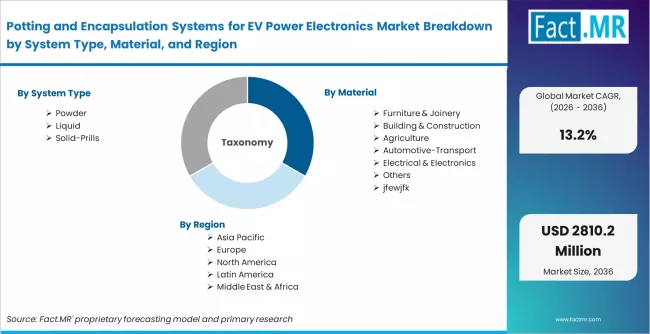
Potting And Encapsulation Systems For Ev Power Electronics Market Breakdown By System Type, Material, And Region | Source: Fact.MR
| Metric | Value |
|---|---|
| Quantitative Units | USD 718.5 million (2026) to USD 2,486.7 million (2036), at a CAGR of 13.2% |
| Market Definition | The potting and encapsulation systems for EV power electronics market includes resin dispensing and encapsulation solutions used to protect electronic components from thermal stress, vibration, moisture, and electrical insulation failure in electric vehicle powertrain systems. |
| Material Segmentation | Epoxy, Silicone, Polyurethane, Acrylic |
| Application Segmentation | Inverters, Battery management, Onboard chargers, DC DC converters, Power modules |
| System Type Segmentation | Automated dispensing, Vacuum potting, Meter mix systems |
| Regions Covered | North America, Latin America, Europe, East Asia, South Asia, Oceania, Middle East and Africa |
| Countries Covered | United States, Canada, Germany, France, United Kingdom, Italy, Spain, Netherlands, Sweden, China, Japan, South Korea, India, Thailand, Indonesia, Australia, Brazil, Mexico, and 40+ countries |
| Key Companies Profiled | Henkel AG & Co. KGaA, Huntsman Corporation, Dymax Corporation, ELANTAS GmbH, H.B. Fuller Company, Master Bond Inc., 3M Company, Dow Inc., ITW Engineered Polymers, Intertronics Ltd |
| Forecast Period | 2026 to 2036 |
| Approach | Hybrid top-down and bottom-up market estimation based on electric vehicle production growth benchmarking, power electronics thermal management material demand analysis, encapsulation resin consumption ratios, automotive electrification adoption trends, and validation through primary interviews with adhesive manufacturers, EV component suppliers, and electronic material formulators. |
Source: Fact.MR analysis. Updated Apr 17, 2026
Potting and Encapsulation Systems for EV Power Electronics Market Key Segments
-
Material
- Epoxy
- Silicone
- Polyurethane
- Acrylic
-
Application
- Inverters
- Battery Management
- Onboard Chargers
- DC DC Converters
- Power Modules
-
System Type
- Automated Dispensing
- Vacuum Potting
- Meter Mix Systems
-
Region
-
North America
- USA
- Canada
- Mexico
- Europe
- Germany
- UK
- France
- Italy
- Spain
- Nordic Countries
- BENELUX
- Rest of Europe
- Asia Pacific
- China
- Japan
- South Korea
- India
- Australia
- Rest of Asia Pacific
- Latin America
- Brazil
- Argentina
- Rest of Latin America
- Middle East and Africa
- Kingdom of Saudi Arabia
- United Arab Emirates
- South Africa
- Rest of Middle East and Africa
- Other Regions
- Oceania
- Central Asia
- Other Markets
-
Frequently Asked Questions
How large is the demand for Potting and Encapsulation Systems for EV Power Electronics in the global market in 2026?
What will be the market size of Potting and Encapsulation Systems for EV Power Electronics in the global market by 2036?
What is the expected demand growth for Potting and Encapsulation Systems for EV Power Electronics in the global market between 2026 and 2036?
Which company is identified as a leading provider in the Potting and Encapsulation Systems for EV Power Electronics market?
Which system type is projected to dominate potting and encapsulation deployment by 2026?
Why are automated dispensing systems widely used in EV power electronics encapsulation processes?
What is driving demand for potting and encapsulation systems in China?
What is the growth outlook for the Potting and Encapsulation Systems for EV Power Electronics market in China?
Why is India an important market for electronic encapsulation system adoption?
What is the growth outlook for the Potting and Encapsulation Systems for EV Power Electronics market in India?
How is demand for encapsulation systems evolving in the United Kingdom EV electronics sector?
What is the growth outlook for the Potting and Encapsulation Systems for EV Power Electronics market in the United Kingdom?
What is the growth outlook for the Potting and Encapsulation Systems for EV Power Electronics market in Germany?
How is the United States positioned in the Potting and Encapsulation Systems for EV Power Electronics market?
What is the growth outlook for the Potting and Encapsulation Systems for EV Power Electronics market in the United States?
What are potting and encapsulation systems and what are they mainly used for in EV power electronics?
What does the Potting and Encapsulation Systems for EV Power Electronics market include in this report?
What applications are included in the scope of the Potting and Encapsulation Systems for EV Power Electronics market?
What is excluded from the scope of the Potting and Encapsulation Systems for EV Power Electronics market report?
What does market forecast mean in the Potting and Encapsulation Systems for EV Power Electronics market report?
How is the Potting and Encapsulation Systems for EV Power Electronics market forecast developed in this report?
What does primary validation indicate in the Potting and Encapsulation Systems for EV Power Electronics market analysis?
Who worked on this report


Preview the report firsthand - request a free sample
Free SampleGet the brochure for pricing and purchase details
Download PDF