- Base Value(2025): 3.66 Bn
- Estimated Value(2026): 3.90 Bn
- Forecast Value (2036): 7.32 Bn
- CAGR (2026 - 2036): 6.50%
Demand for Automotive Composites in USA Size, Market Forecast and Outlook By Fact.MR
The demand for automotive composites in usa was valued at USD 3.66 billion in 2025, projected to reach USD 3.90 billion in 2026, and is forecast to expand to USD 7.32 billion by 2036 at a 6.50% CAGR. CAFE (Corporate Average Fuel Economy) standards and EPA vehicle greenhouse gas emission targets compel US automakers to reduce vehicle curb weight, positioning carbon fiber and glass fiber composites as engineering solutions that deliver 30 to 50% weight savings over steel in body panel and structural component applications. The US Department of Energy's carbon fiber cost reduction programme is targeting sub-USD 5 per pound production costs that would make carbon fiber composites cost-competitive with aluminum for high-volume vehicle platform applications.
The absolute dollar opportunity between 2026 and 2036 amounts to approximately USD 3.42 billion. Growth reflects the progressive adoption of composite materials from niche performance vehicles into mainstream production platforms as manufacturing costs decline and high-volume production methods mature. Carbon fiber leads the material segment because it offers the highest strength-to-weight ratio, making it the preferred reinforcement for body panels and structural components where maximum weight reduction justifies the material cost premium. Based on Fact.MR's report, body panels command the largest component share because exterior panels represent the most accessible application for composite adoption, requiring less stringent crash performance validation than structural load-bearing elements.
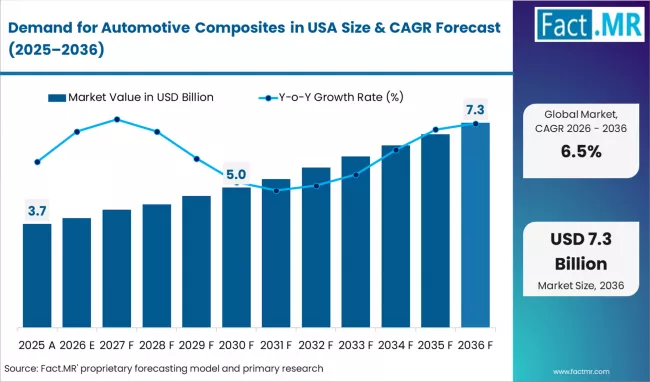
Demand For Automotive Composites In Usa Market Value Analysis | Source: Fact.MR
Demand for Automotive Composites in USA Key Takeaways
| Metric | Details |
|---|---|
| Industry Size (2026) | USD 3.90 billion |
| Industry Value (2036) | USD 7.32 billion |
| CAGR (2026 to 2036) | 6.50% |
Source: Fact.MR analysis. Updated Mar 26, 2026
The USA market is projected to grow at a 6.5% CAGR during 2026 to 2036, driven by CAFE compliance requirements, DOE-funded carbon fiber cost reduction programmes, and expanding OEM adoption of composite body panels and structural components on mainstream vehicle platforms.
Summary of Demand for Automotive Composites in USA
- Demand for Automotive Composites in USA Definition
- Automotive composites in the USA are fiber-reinforced polymer materials used for vehicle lightweighting, offering 30 to 50% weight savings over steel in body panels, chassis, and structural components to support CAFE fuel economy compliance.
- Demand Drivers
- CAFE fuel economy standards compel US automakers to reduce vehicle weight, positioning fiber-reinforced composites as engineering solutions that deliver measurable mass reduction without compromising structural performance or crash safety.
- US Department of Energy carbon fiber cost reduction programmes targeting sub-USD 5 per pound production costs are closing the price gap between carbon fiber composites and aluminum for high-volume automotive applications.
- Electric vehicle platform development accelerates composite adoption because the weight savings from composite body panels and structural components directly extend battery electric driving range, creating a quantifiable performance return on the material investment.
- Key Segments Analyzed in the Fact.MR Report
- Carbon Fiber: 42.3% share in 2026.
- Body Panels: 48.7% share in 2026.
- USA: 6.5% compound growth.
- Analyst Opinion at Fact.MR
- The US automotive composites market is transitioning from a low-volume, high-performance niche to a mid-volume technology approaching mainstream adoption as carbon fiber costs decline and glass fiber processing speeds improve. The critical threshold is carbon fiber pricing below USD 7 per pound, at which point the weight-to-cost trade-off becomes competitive with aluminum for body panel applications on vehicles produced at volumes exceeding 50,000 units annually. Glass fiber composites already compete on cost with steel for select body panel and interior applications, but their lower stiffness-to-weight ratio limits their use in primary structural elements. Body panels lead component adoption because they can be designed and manufactured with compression molding and resin transfer molding processes that are closest to achieving the cycle times required for high-volume production. Structural and chassis applications require more extensive crash validation testing, which extends the development timeline and limits near-term adoption to premium and electric vehicle platforms where the business case for weight reduction is strongest.
- Strategic Implications / Executive Takeaways
- Automakers must integrate composite material specifications into vehicle platform development at the earliest design stage because composite structures require fundamentally different joining, painting, and repair strategies compared to metal body construction.
- Carbon fiber manufacturers should target automotive-grade production capacity expansion that delivers sub-USD 7 per pound pricing to unlock mid-volume vehicle platform adoption beyond current niche performance applications.
- Tier-1 suppliers must develop high-speed compression molding and automated fiber placement capabilities that achieve sub-3-minute cycle times to meet the production rate requirements of mainstream US vehicle assembly lines.
Why is the USA Automotive Composites Industry Growing?
The USA automotive composites industry is experiencing robust growth, primarily fueled by a parallel expansion in the broader vehicle lightweighting sector. A significant surge in demand for both automotive modernization and advanced composite materials has created a larger base of automotive manufacturers, component suppliers, and automotive companies requiring reliable composite products. Furthermore, changing emission regulations and efficiency standards mandate the use of effective lightweight systems for optimal vehicle performance and fuel economy optimization. This automotive-driven demand establishes a consistent, efficiency-based foundation. As new manufacturers enter the electric vehicle segment and existing automotive practices are modernized, the need for standard-issue and specialized composite products forms a stable foundation for the industry's growth, ensuring a continuous stream of customers driven by performance necessity and operational efficiency.
Technological innovation serves as a powerful secondary engine for this growth. Modern composite systems are no longer just basic automotive materials; they are advanced lightweight manufacturing products. The rapid adoption of carbon fiber technologies has become a major selling point, significantly reducing vehicle weight and enhancing fuel efficiency. Beyond traditional options, manufacturers are integrating advanced processing features for seamless incorporation with digitally conscious automotive approaches, and compatibility with various electric vehicle requirements. These features, coupled with improvements in operational efficiency, system convenience, and product reliability, are compelling both automotive and manufacturing operators to upgrade from basic material systems, driving a cycle of replacement and premiumization within the industry.
The industry is benefiting from evolving automotive dynamics and a heightened focus on vehicle efficiency experience. An increasing emphasis on operational performance, particularly exploration of advanced lightweighting technologies, is pushing demand for higher-quality, more diverse composite varieties. The segment has also expanded beyond traditional automotive channels, with growing interest from the aerospace sector, renewable energy applications, and even automotive technology units. This diversification, combined with the rise of specialized platforms that improve accessibility for all manufacturers, ensures that suppliers can reach a wider audience than ever before. This confluence of efficiency, innovation, and accessibility creates a fertile ground for continued industry expansion.
Opportunity Pathways - Demand for Automotive Composites in the USA
The automotive composites demand in the USA is positioned for strong and steady expansion, growing from USD 4.13 billion in 2026 to USD 7.79 billion by 2036, reflecting a 6.5% CAGR. This growth is driven by the rising adoption of advanced, carbon fiber-based composite systems in vehicle manufacturing, body panel production, and specialty automotive applications. Manufacturers are seeking specialized composite solutions that maximize operational efficiency, weight reduction capabilities, and vehicle performance amidst evolving emission standards. Additionally, demand from electric vehicle trends, lightweight manufacturing innovations, and automated processing implementations strengthens opportunities for both high-performance material configurations and integrated manufacturing technology solutions. Suppliers focusing on carbon fiber systems, automated composite processing, and technical support stand to gain from evolving automotive landscapes and manufacturer expectations for material reliability, efficiency assurance, and technical documentation completeness.
- Pathway A - Electric Vehicle Manufacturing Operations. Automotive manufacturers face escalating demand for reliable, high-performance composites for extensive electric vehicle production and advanced automotive applications. Solutions targeting battery housing, structural components, and body panel collection can achieve strong adoption through optimized processing capacity, operational efficiency, and multi-application compatibility. Estimated revenue opportunity: USD 1.42-1.87 billion.
- Pathway B - Carbon Fiber Integration. The automotive industry requires increasingly sophisticated carbon fiber and automated composite solutions. Collaborations with technology developers for integrated lightweight systems (e.g., structural optimization, automated manufacturing, performance monitoring) can unlock long-term supply contracts and partnerships. Estimated revenue opportunity: USD 1.25-1.64 billion.
- Pathway C - Specialty Vehicle Applications. Growth in luxury vehicle production, sports car manufacturing, and specialty automotive applications creates robust demand for specialized composite materials. Suppliers offering proven application-specific composites with exceptional processing capabilities and operational versatility can build strategic relationships with top-tier automotive manufacturers. Estimated revenue opportunity: USD 0.98-1.28 billion.
- Pathway D - Custom Manufacturing Services. Expanding requirements for specialized manufacturing operations and contract production services are driving preference for versatile, high-performance materials. Suppliers offering composites with exceptional reliability and multi-application capability can differentiate offerings and attract service-focused organizations. Estimated revenue opportunity: USD 0.76-0.99 billion.
- Pathway E - Automotive Supplier Programs. Critical applications in tier-one suppliers, component manufacturing programs, and automotive partnerships require specialized composite configurations with advanced efficiency features, durability characteristics, and manufacturer-friendly systems. Suppliers investing in supplier-focused solutions can secure advantages in this growing segment. Estimated revenue opportunity: USD 0.54-0.71 billion.
- Pathway F - Technical Service, Training & Support Systems. Comprehensive support networks offering material guidance, manufacturer training programs, and technical documentation create recurring partnership opportunities. Companies building strong service capabilities can capture ongoing relationships and enhance customer operational excellence. Estimated revenue opportunity: USD 0.32-0.42 billion.
Segmental Analysis
The industry is segmented by material, component, and region. By material, the industry is divided into carbon fiber, glass fiber, hybrid composites, and other material types. In terms of component, the industry is segmented into body panels, chassis components, interior applications, with body panels representing a key growth and innovation hub for automotive technologies. Regionally, the industry is divided into West, Northeast, South, and Midwest.
Why Does Carbon Fiber Account for High Share of 42.30%?
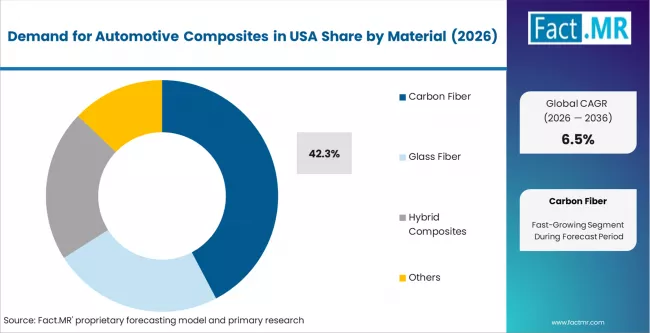
Demand For Automotive Composites In Usa Analysis By Material | Source: Fact.MR
The carbon fiber segment is projected to account for 42.30% of automotive composites demand in 2025, making it the leading material type across the sector. This dominance reflects the weight reduction requirements and operational efficiency needs of composite systems for existing automotive facilities and manufacturing applications where structural performance is optimized through established strength characteristics and integrated multi-function architecture.
In the USA, where substantial automotive infrastructure requires material integration without complete system redesign, carbon fiber solutions provide practical pathways for vehicle enhancement while maintaining cost preferences. Continuous innovations are improving processing efficiency, operational reliability, and performance parameters, enabling automotive manufacturers to achieve high performance standards while maximizing cost effectiveness.
- Cost compatibility and existing system integration make carbon fiber the preferred material type for enhancing automotive facilities and manufacturing operations.
- Processing reliability and performance demonstration track records are enhancing manufacturer confidence and production viability across large-scale adoption initiatives.
Why Does Body Panels Account for High Share of 48.50%?
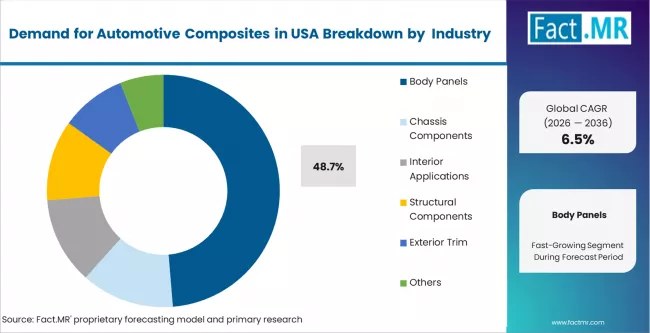
Demand For Automotive Composites In Usa Analysis By Component | Source: Fact.MR
Body panel components are expected to represent 48.50% of automotive composites demand in 2025, reflecting the critical role of exterior component processing requiring comprehensive efficiency solutions. Body panel operations including vehicle projects, automotive facilities, and component systems generate consistent demand for composites that support effective automotive utilization and performance optimization.
Composite systems are widely adopted for body panel facilities due to significant efficiency benefits and enhanced weight reduction capabilities. Their reliable, high-performance operation provides effective, cost-efficient automotive production solutions, enhancing operational independence for manufacturing operators.
- Vehicle component requirements and processing efficiency operations drive substantial demand for specialized composites designed for automotive applications.
- Performance optimization and operational efficiency demands create consistent automotive production requirements across major manufacturing regions and processing facilities.
What are the Drivers, Restraints, and Key Trends in the USA Automotive Composites Industry?
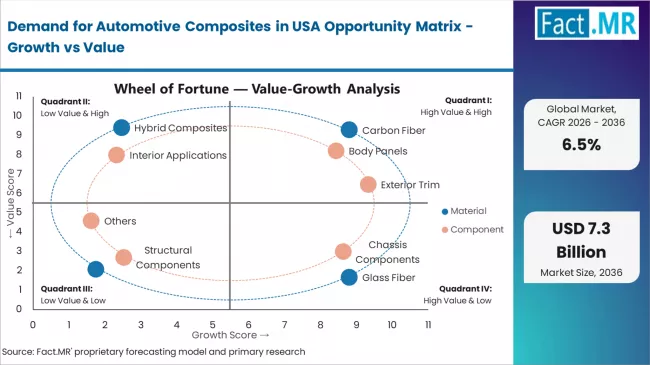
Demand For Automotive Composites In Usa Opportunity Matrix Growth Vs Value | Source: Fact.MR
The demand for automotive composites in the USA is advancing steadily due to increasing automotive requirements and growing recognition of advanced lightweighting necessity for operational efficiency, with the West region serving as a key driver of innovation and automotive advancement. The sector faces challenges including operational performance consistency optimization, material enhancement complexity, and ongoing concerns regarding operational cost considerations and efficiency variations.
Growth in Automotive Infrastructure Development and Manufacturing Modernization Programs
The enhancement of manufacturing standards, gaining particular significance through automotive lightweighting trends and efficiency education campaigns, is enabling composite providers to achieve differentiation without prohibitive development costs, providing predictable demand patterns through automotive requirements and manufacturer preferences. Enhanced manufacturing standards offering substantial opportunities for composite systems and integrated applications provide foundational dynamics while allowing providers to secure automotive facility agreements and distribution partnerships.
Deployment of Advanced Carbon Fiber Capabilities and High-Performance Efficiency Systems
Modern composite providers and automotive manufacturers are establishing advanced manufacturing networks and centralized production facilities that improve operational efficiency through process standardization and performance analytics. Integration of efficiency enhancement systems, high-performance material technology, and coordinated quality management enables more effective automotive operations across multiple manufacturing regions.
Development of Automated Manufacturing Systems and Enhanced Material Targeting Methods
The expansion of automated manufacturing systems and component segmentation is driving development of specialized composite systems with enhanced performance profiles, improved strength characteristics, and optimized efficiency attributes that address current limitations and expand automotive applications beyond traditional composites. These specialized systems require sophisticated performance capabilities and material expertise that exceed traditional manufacturing requirements, creating specialized demand segments with differentiated efficiency propositions. Producers are investing in material targeting and performance optimization to serve emerging automotive applications while supporting innovation in efficiency development and performance engagement.
Analysis of USA Automotive Composites Demand by Key Region
.webp "Top Country Growth Comparison Demand For Automotive Composites In Usa Cagr (2026 2036)")
Top Country Growth Comparison Demand For Automotive Composites In Usa Cagr (2026 2036) | Source: Fact.MR
| Region | CAGR (2026-2036) |
|---|---|
| West | 7.10% |
| Northeast | 6.80% |
| South | 6.20% |
| Midwest | 5.90% |
Source: Fact.MR analysis. Updated Mar 26, 2026
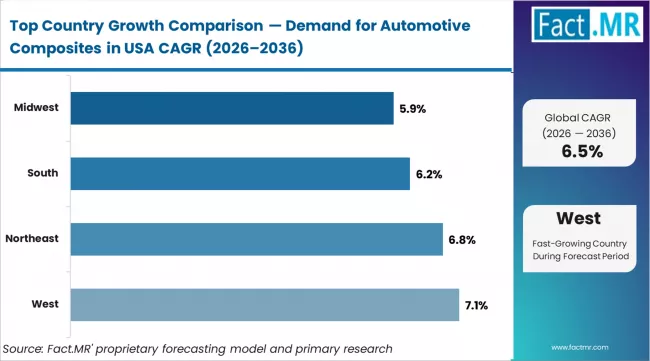
Demand For Automotive Composites In Usa Cagr Analysis By Country | Source: Fact.MR
The USA automotive composites demand is witnessing steady growth, supported by rising automotive requirements, expanding manufacturing modernization initiatives, and the deployment of advanced lightweighting technologies across regions. West leads the nation with a 7.10% CAGR, reflecting a strong innovation-conscious base, substantial automotive development, and established manufacturing advancement facilities.
Why Does the West Region Lead Automotive Composites Demand?
Demand for automotive composites in West is projected to exhibit strong growth with a CAGR of 7.10% through 2036, driven by a strong innovation-conscious automotive base, substantial manufacturing development creating premium performance opportunities, and a concentration of automotive advancement across California, Oregon, Washington, Nevada, and surrounding states.
Advanced automotive technology programs and lightweight manufacturing initiatives are expanding composite adoption among manufacturers, automotive facilities, and material suppliers pursuing efficiency optimization, performance development, and specialized manufacturing projects throughout major automotive hubs and manufacturing corridors.
- Innovation consciousness base and automotive infrastructure capabilities are requiring comprehensive performance strategies and efficiency solutions, driving demand for composite systems with demonstrated performance enhancement capabilities and permanent efficiency assurance throughout diverse automotive operations.
- Manufacturing development and automotive concentration are generating substantial composite demand across automotive companies, manufacturers, and efficiency suppliers serving manufacturing applications and automotive requirements.
Why Does the Northeast Region Demonstrate Strong Growth?
Demand for automotive composites in Northeast is projected to grow with a CAGR of 6.80% through 2036, supported by established automotive presence, comprehensive manufacturing development, and strong production facilities across New York, Pennsylvania, Massachusetts, New Jersey, and surrounding states.
Established automotive presence and manufacturing leadership are supporting composite adoption throughout manufacturer facilities, automotive operations, and efficiency distribution centers serving performance enhancement and lightweight applications.
- Strong automotive ecosystem and manufacturing networks are enabling composite integration across efficiency producers, manufacturers, and performance suppliers pursuing advanced efficiency development and automotive programs.
- Premium manufacturing capabilities and efficiency excellence are driving composite demand among leading automotive corporations, manufacturing centers, and specialized efficiency firms focused on performance enhancement, lightweight optimization, and operational development targeting automotive applications and advanced manufacturing operations.
What Factors Underpin Automotive Composites Demand in South Region?
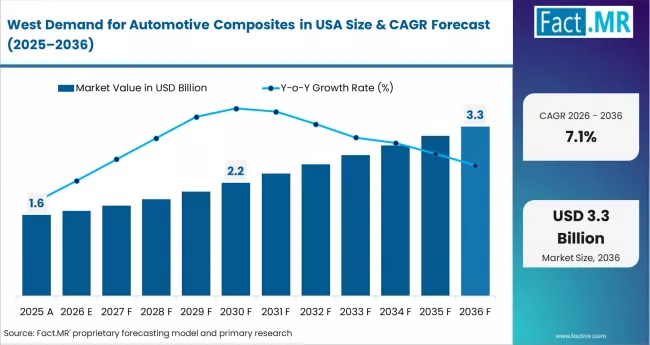
Demand For Automotive Composites In Usa Country Value Analysis | Source: Fact.MR
Demand for automotive composites in South is forecast to advance with a CAGR of 6.20% through 2036, driven by expanding automotive capabilities, growing performance investment, and increasing efficiency consciousness across Texas, Florida, Georgia, North Carolina, and surrounding states.
Rising manufacturing sector development and automotive partnerships are supporting composite integration across performance producers, manufacturer facilities, and efficiency distributors pursuing performance enhancement, automotive expansion, and manufacturing initiatives throughout expanding automotive regions and urban centers.
- Growing automotive infrastructure and manufacturing investment are creating opportunities for composite adoption across emerging performance hubs, manufacturer facilities, and efficiency distribution centers in major metropolitan areas and automotive corridors.
- Performance expansion and efficiency growth are driving composite demand among automotive manufacturers seeking enhanced performance capabilities and participation in advanced lightweight programs.
What Boosts Consistent Demand in the Midwest Region?
Demand for automotive composites in Midwest is expected to expand with a CAGR of 5.90% through 2036, supported by lightweight manufacturing capabilities, automotive infrastructure development, and growing manufacturer efficiency presence across Illinois, Ohio, Wisconsin, Michigan, and surrounding states.
Efficiency expertise and production capabilities are driving composite demand among performance producers, automotive suppliers, and manufacturing operators serving composite production and performance applications.
- Growing performance development and manufacturing investment are supporting composite adoption across emerging production hubs, automotive facilities, and manufacturer centers pursuing performance enhancement and lightweight programs.
- Expanding automotive infrastructure and performance integration are creating opportunities for composite utilization across efficiency suppliers, automotive production facilities, and manufacturer operations seeking performance composite production, efficiency support, and manufacturing capabilities throughout major automotive regions and emerging manufacturer efficiency centers.
Competitive Landscape of USA Automotive Composites Industry
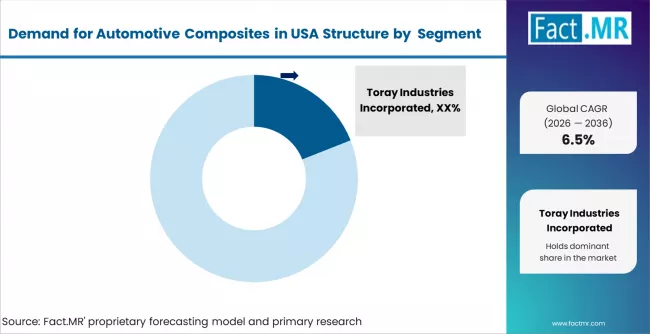
Demand For Automotive Composites In Usa Analysis By Company | Source: Fact.MR
USA automotive composites demand is defined by competition among established material corporations, specialized manufacturing companies, and integrated automotive producers, with major manufacturer organizations maintaining significant influence through production resources and manufacturing capabilities. Companies are investing in composite advancement, performance optimization, efficiency acceptance technologies, and comprehensive material services to deliver effective, reliable, and efficient automotive solutions across USA manufacturing and automotive applications.
Toray Industries Incorporated dominates with a 18.70% share, offering comprehensive performance solutions including advanced materials, efficiency enhancement technologies, and distribution services with a focus on automotive applications, efficiency consistency, and performance optimization across USA operations. The company continues investing in performance programs, distribution strategies, and composite innovation while expanding operational presence and advanced manufacturer applications.
SGL Carbon SE provides specialized performance solutions with emphasis on material development and manufacturing excellence. Hexcel Corporation focuses on premium composite development and automotive applications. Mitsubishi Chemical Group Corporation emphasizes performance development and specialized manufacturer material production. Gurit Holding AG offers performance technology solutions and professional material support. Teijin Limited specializes in automotive composite development and distribution programs.
Key Players in USA Automotive Composites Industry
- Toray Industries Incorporated
- SGL Carbon SE
- Hexcel Corporation
- Mitsubishi Chemical Group Corporation
- Gurit Holding AG
- Teijin Limited
- Owens Corning
- Solvay S.A.
- 3M Company
- BASF SE
- Huntsman Corporation
- DowAksa Advanced Composites Holdings B.V.
- Cytec Solvay Group
- Arkema S.A.
- Composites One LLC
Bibliography
- American Composites Manufacturers Association. (2024). ACMA state of the industry report: Automotive composites market size, application trends, and technology outlook. ACMA.
- Society of Automotive Engineers. (2024). SAE J2857: Recommended practice for the characterization of continuous fiber reinforced composite materials for automotive structural applications. SAE.
- National Highway Traffic Safety Administration. (2024). NHTSA crashworthiness research: Composite material energy absorption and occupant protection performance evaluation. NHTSA.
- U.S. Department of Energy. (2024). Vehicle Technologies Office: Lightweight materials R&D programme, carbon fiber cost reduction and manufacturing scale-up milestones. DOE.
- Oak Ridge National Laboratory. (2024). ORNL/TM-2024: Low-cost carbon fiber production technology assessment for automotive applications. ORNL.
- American Chemistry Council. (2024). ACC plastics and composites in automotive applications: Weight reduction contribution and lifecycle analysis. ACC.
This bibliography is provided for reader reference. The full Fact.MR report contains the complete reference list with primary research documentation.
This Report Addresses
- Market sizing and forecast metrics for demand for automotive composites in usa through 2036.
- Segmentation analysis across material, component categories.
- Regulatory compliance assessment shaping procurement specifications.
- Competitive landscape evaluation of leading participants.
- Strategic guidance for market positioning through the forecast period.
- Supply chain risk analysis identifying sourcing constraints.
- Custom data delivery formats including dashboards, Excel, and PDF reports.
Demand for Automotive Composites in USA Definition
Automotive composites in the USA market are fiber-reinforced polymer materials used in vehicle body panels, chassis components, structural elements, interior parts, and exterior trim to achieve weight reduction, corrosion resistance, and design flexibility compared to traditional steel and aluminum alternatives. The market covers carbon fiber, glass fiber, hybrid composites, and other reinforcement materials processed through various molding and layup techniques.
Demand for Automotive Composites in USA Inclusions
The report covers carbon fiber, glass fiber, hybrid, and other composite materials. Component segmentation spans body panels, chassis, interior, structural, exterior trim, and other applications within the USA market for 2026 to 2036.
Demand for Automotive Composites in USA Exclusions
Metal alloys (steel, aluminum, magnesium) used in vehicle structures, unreinforced plastic components, and composite materials used exclusively in aerospace, marine, or sporting goods applications are excluded. Raw carbon and glass fiber sold as intermediate textile products before automotive-grade processing fall outside the analytical scope.
Demand for Automotive Composites in USA Research Methodology
- Primary Research: Analysts engaged with procurement directors and operations leads across the demand for automotive composites in usa value chain.
- Desk Research: Regulatory filings, standards records, and corporate reports from allowed sources were aggregated.
- Market-Sizing and Forecasting: Hybrid top-down and bottom-up approach with region-specific curves projects demand through 2036.
- Data Validation and Update Cycle: Projections cross-validated against public financial guidance and industry benchmarks.
Segmentation
Scope of the Report
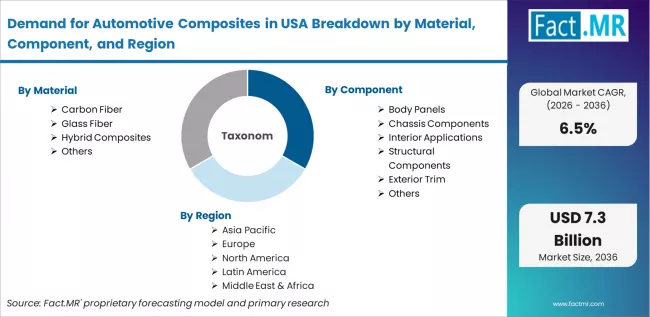
Demand For Automotive Composites In Usa Breakdown By Material, Component, And Region | Source: Fact.MR
| Metric | Value |
|---|---|
| Quantitative Units | USD 3.90 billion to USD 7.32 billion, at a CAGR of 6.50% |
| Market Definition | Automotive composites in the USA are fiber-reinforced polymer materials used for vehicle lightweighting, offering 30 to 50% weight savings over steel in body panels, chassis, and structural components to support CAFE fuel economy compliance. |
| Material Segmentation | Carbon Fiber, Glass Fiber, Hybrid Composites, Others |
| Component Segmentation | Body Panels, Chassis Components, Interior Applications, Structural Components, Exterior Trim, Others |
| Key Companies Profiled | Toray Industries Incorporated, SGL Carbon SE, Hexcel Corporation, Mitsubishi Chemical Group Corporation, Gurit Holding AG, Teijin Limited, Owens Corning, Solvay S.A., 3M Company, BASF SE, Huntsman Corporation, DowAksa Advanced Composites Holdings B.V., Cytec Solvay Group, Arkema S.A., Composites One LLC |
| Forecast Period | 2026 to 2036 |
| Approach | Hybrid top-down and bottom-up methodology, cross-validated against primary research and public industry filings. |
Source: Fact.MR analysis. Updated Mar 26, 2026
USA Automotive Composites Industry by Segments
-
Material :
- Carbon Fiber
- Glass Fiber
- Hybrid Composites
- Others
-
Component :
- Body Panels
- Chassis Components
- Interior Applications
- Structural Components
- Exterior Trim
- Others
-
Region :
- West
- Northeast
- South
- Midwest
Frequently Asked Questions
How large is the demand for automotive composites in usa in 2026?
What will the size be by 2036?
What is the expected CAGR?
Which material segment leads in 2026?
What methodology does Fact.MR use?
Which companies are profiled?
Who worked on this report


Preview the report firsthand - request a free sample
Free SampleGet the brochure for pricing and purchase details
Download PDF