- Base Value(2025): 66.5 Mn
- Estimated Value(2026): 75.6 Mn
- Forecast Value (2036): 273.0 Mn
- CAGR (2026 - 2036): 13.70%
Demand for Electric Vehicle Insulation in UK Size, Market Forecast and Outlook By Fact.MR
The demand for electric vehicle insulation in uk was valued at USD 66.5 million in 2025, projected to reach USD 75.6 million in 2026, and is forecast to expand to USD 273.0 million by 2036 at a 13.70% CAGR. The UK government's 2035 zero-emission vehicle mandate is accelerating EV production and assembly operations, generating proportional demand for insulation materials required at every battery pack, power electronics module, and electric motor assembly point. Each EV platform requires substantially more insulation content per vehicle than a conventional ICE vehicle because high-voltage battery systems demand electrical isolation, thermal management, and acoustic damping that conventional powertrains do not require.
The absolute dollar opportunity between 2026 and 2036 amounts to approximately USD 197.41 million. This rapid expansion reflects the early-stage growth of UK EV production where insulation content per vehicle is increasing as battery pack voltages rise from 400V to 800V architectures that require enhanced dielectric performance. Foamed plastics lead the material segment because they combine lightweight characteristics with thermal and acoustic insulation properties at cost points compatible with mass-market vehicle production. As per Fact.MR analysis, electrical insulation leads the product category because regulatory safety standards mandate minimum insulation resistance values at every high-voltage interface in the vehicle, creating a non-negotiable compliance requirement.
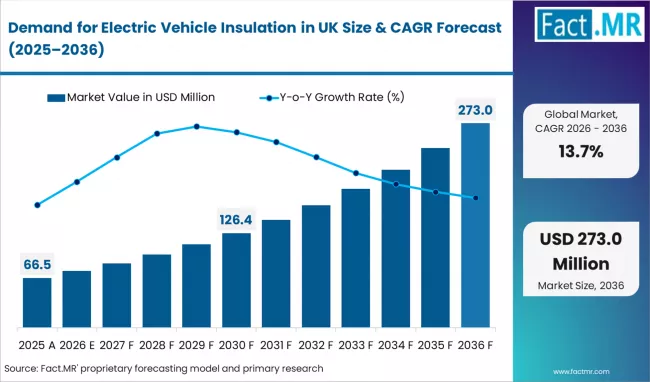
Demand For Electric Vehicle Insulation In Uk Market Value Analysis | Source: Fact.MR
Demand for Electric Vehicle Insulation in UK Key Takeaways
| Metric | Details |
|---|---|
| Industry Size (2026) | USD 75.6 million |
| Industry Value (2036) | USD 273.0 million |
| CAGR (2026 to 2036) | 13.70% |
Source: Fact.MR analysis. Updated Mar 26, 2026
The UK market is projected to grow at a 13.7% CAGR during 2026 to 2036, driven by the national zero-emission vehicle mandate, expanding domestic EV production capacity, and increasing insulation content per vehicle as battery voltages and energy densities rise.
Summary of Demand for Electric Vehicle Insulation in UK
- Demand for Electric Vehicle Insulation in UK Definition
- Electric vehicle insulation in the UK covers thermal, electrical, and acoustic insulation materials installed in EV battery packs, power electronics, and motor assemblies to ensure safe high-voltage operation, thermal management, and cabin noise reduction.
- Demand Drivers
- The UK 2035 zero-emission vehicle mandate accelerates EV production volumes, generating proportional demand for insulation materials at every battery, motor, and power electronics assembly point.
- Transition from 400V to 800V battery architectures increases dielectric performance requirements for electrical insulation materials, driving specification upgrades toward higher-rated compounds.
- Cabin noise standards for premium EVs require acoustic insulation solutions that compensate for the absence of engine masking noise, creating a new insulation application category that did not exist in conventional vehicles.
- Key Segments Analyzed in the Fact.MR Report
- Foamed Plastics: 61.3% share in 2026.
- Electrical Insulation: 49.7% share in 2026.
- UK: 13.7% compound growth.
- Analyst Opinion at Fact.MR
- The UK EV insulation market is one of the fastest-growing automotive material categories because the insulation content per electric vehicle substantially exceeds that of a conventional ICE vehicle. A typical BEV requires electrical insulation at every high-voltage busbar connection, thermal insulation between battery cells and the vehicle structure, and acoustic insulation to maintain cabin quietness in the absence of combustion engine noise. This content multiplication means that UK insulation demand will grow several multiples faster than overall vehicle production as the EV share of new sales increases toward the 2035 mandate. Foamed plastics dominate current specifications because they offer the best balance of insulation performance, weight, and cost, but ceramic and thermal interface materials are gaining share in high-performance battery applications where temperature management is the primary engineering challenge.
- Strategic Implications / Executive Takeaways
- Insulation material suppliers must develop product portfolios rated for 800V and above dielectric performance to capture the specification upgrade cycle as UK-assembled EVs transition to higher battery voltages.
- Manufacturers should establish UK-based production or warehousing to meet just-in-time delivery requirements from domestic EV assembly plants that cannot tolerate extended lead times on insulation components.
- R&D teams must address the combined electrical, thermal, and acoustic insulation requirements with multi-functional material solutions that reduce assembly complexity for EV manufacturers.
Why is the UK Electric Vehicle Insulation Industry Growing?
Modern automotive manufacturers and electric vehicle practitioners rely on professional electric vehicle insulation systems to ensure thermal competitiveness, safety improvement, and optimal pathway achievement toward manufacturing goals. Advanced automotive requirements necessitate comprehensive electric vehicle insulation solutions including specialized thermal capabilities, safety support systems, and performance enhancement infrastructure to address diverse application needs and manufacturing specifications.
Automotive manufacturers and electric vehicle practitioners are emphasizing sourcing and integrated thermal solutions to enhance battery profiles, access performance optimization trends, and demonstrate manufacturing leadership in competitive automotive environments. Advanced safety policies and electric vehicle insulation performance requirements are establishing standardized thermal pathways that require professional systems and performance assurance, with UK facilities often pioneering large-scale implementation of advanced electric vehicle insulation technologies.
UK automotive standards and Department for Transport guidelines provide the definitive thermal efficacy, safety, and quality-of-care requirements for insulation management interventions and thermal modalities, i.e., the thermal and regulatory specifications demanded by automotive products and service providers. Technical reviews in journals like Automotive Engineering further explain why these advanced systems improve thermal and functional outcomes versus conventional insulation approaches, citing superior temperature resistance and long-term durability rates, reinforcing their role as evidence-based automotive components within manufacturing and electric vehicle sectors.
Segmental Analysis
The industry is segmented by material, product, end use, and region. By material, the industry is divided into foamed plastics, ceramics, thermal interface materials, and others categories. In terms of product, industry is segmented into electrical insulation, thermal insulation, and acoustic insulation. By end use, the industry is categorized into hybrid electric vehicle (HEV), battery electric vehicle (BEV), plug-in hybrid EV (PHEV), and fuel cell EV (FCEV). Regionally, the industry is divided into England, Scotland, Wales, and Northern Ireland.
Why do Foamed Plastics Account for High Share of 61.3%?
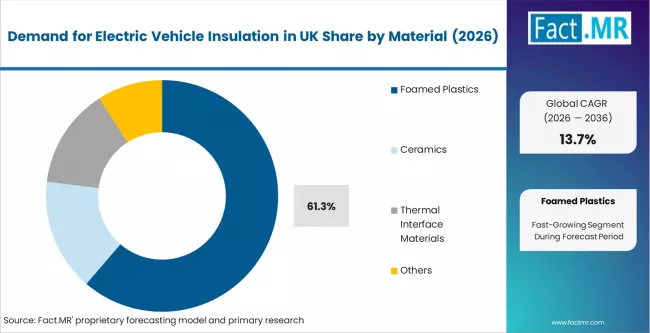
Demand For Electric Vehicle Insulation In Uk Analysis By Material | Source: Fact.MR
The foamed plastics segment is projected to account for 61.3% of electric vehicle insulation demand in 2025, making it the leading material category across the sector. This dominance reflects the thermal performance requirements and proven capabilities of foamed plastic systems for existing automotive operations and manufacturing applications where insulation precision is optimized through established thermal capabilities and integrated quality architecture. In the UK, where substantial automotive populations require electric vehicle insulation integration without complete system modification, foamed plastic platforms provide practical pathways for thermal enhancement while maintaining manufacturing integrity. Continuous innovations are improving thermal consistency, insulation characteristics, and material integration parameters, enabling manufacturers to achieve high performance standards while maximizing reliability. The segment's strong position is reinforced by the extensive existing automotive infrastructure requiring electric vehicle insulation adoption and growing availability of foamed plastic suppliers with proven commercial experience.
- Thermal compatibility and existing manufacturing integration make foamed plastic platforms the preferred material type for enhancing automotive operations and manufacturing installations.
- Performance reliability and commercial demonstration track records are enhancing manufacturer confidence and system viability across large-scale adoption initiatives.
Why do Electrical Insulation Applications Account for High Share of 49.7%?
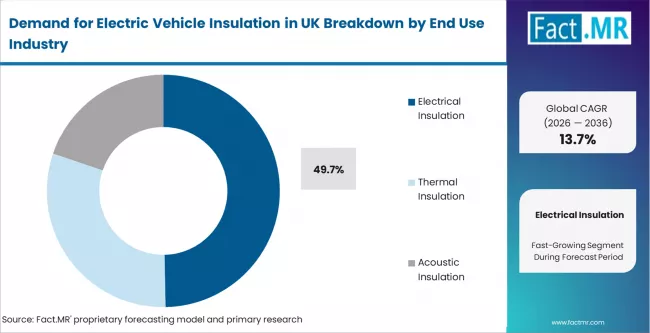
Demand For Electric Vehicle Insulation In Uk Analysis By Product | Source: Fact.MR
Electrical insulation applications are expected to represent 49.7% of electric vehicle insulation demand in 2025, demonstrating the significant role of high-voltage protection requiring comprehensive safety support solutions. Electrical insulation facilities including major battery manufacturers, component suppliers, assembly programs, and direct-to-automotive initiatives generate consistent demand for electric vehicle insulation systems that are technically and operationally favorable for high-voltage applications. The segment benefits from performance characteristics that provide safety optimization and integration capabilities for electrical processes. In the UK, where electrical insulation represents substantial portions of electric vehicle safety, performance excellence requires electric vehicle insulation integration across diverse manufacturing facilities. In England regions, where manufacturing concentrations are significant, electric vehicle insulation demand is elevated by emphasis on maintaining safety excellence while achieving performance targets.
- High-voltage requirements and safety optimization drive consistent demand across major battery manufacturers, component suppliers, assembly programs, and direct-to-automotive initiatives.
- The integration of electric vehicle insulation-based solutions enhances the efficiency, consistency, and effectiveness of electrical processes, further supporting the sector's need for high-performance safety systems in both electrical and thermal applications.
What are the Drivers, Restraints, and Key Trends in the UK Electric Vehicle Insulation Industry?
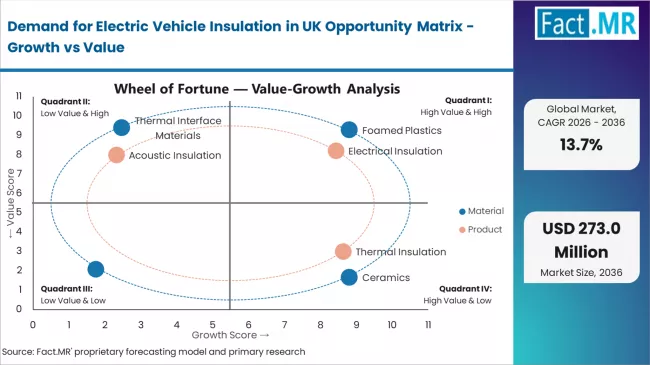
Demand For Electric Vehicle Insulation In Uk Opportunity Matrix Growth Vs Value | Source: Fact.MR
The country's electric vehicle insulation demand is advancing steadily due to increasing electric mobility requirements and growing recognition of thermal necessity for automotive development, with England region serving as a key driver of innovation and application development. The sector faces challenges including competition from alternative insulation systems, need for specialized thermal validation development, and ongoing concerns regarding insulation costs and regulatory considerations. National automotive guidelines and regional-level electric vehicle initiatives, particularly manufacturing programs in England and Scotland regions, continue to influence electric vehicle insulation selection and adoption timelines.
Expansion of Electric Mobility Requirements and Performance Standards
The enhancement of thermal regulations, gaining particular significance through automotive standards and advanced electric vehicle programs, is enabling electric vehicle insulation suppliers to achieve differentiation without prohibitive development costs, providing predictable demand patterns through thermal requirements and manufacturer preferences. Enhanced safety standards offering substantial opportunities for professional electric vehicle insulation systems and integrated applications provide foundational dynamics while allowing suppliers to secure automotive agreements and manufacturing partnerships. These trends are particularly valuable for first-mover suppliers and advanced system development that require substantial technical investments without immediate cost advantages.
Incorporation of Advanced Thermal Technologies and Safety Validation Systems
Modern electric vehicle insulation suppliers and automotive companies are establishing advanced thermal networks and centralized safety management facilities that improve insulation effectiveness through technical standardization and performance validation. Integration of thermal optimization systems, high-precision insulation technologies, and coordinated safety management enables more efficient electric vehicle insulation delivery across multiple manufacturing locations. Advanced thermal concepts also support next-generation automotive applications including specialized insulation integration, manufacturer optimization, and regional electric vehicle insulation supply networks that optimize system-level economics while enabling comprehensive performance monitoring across automotive regions, with UK developments increasingly adopting collaborative research models to reduce individual supplier costs and accelerate validation.
Analysis of UK Electric Vehicle Insulation Industry by Key Region
.webp "Top Country Growth Comparison Demand For Electric Vehicle Insulation In Uk Cagr (2026 2036)")
Top Country Growth Comparison Demand For Electric Vehicle Insulation In Uk Cagr (2026 2036) | Source: Fact.MR
| Region | CAGR (2026-2036) |
|---|---|
| England | 17.8% |
| Scotland | 13.7% |
| Wales | 17.2% |
| Northern Ireland | 16.9% |
Source: Fact.MR analysis. Updated Mar 26, 2026
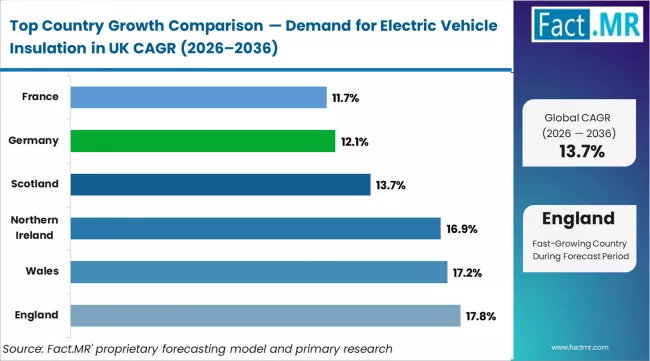
Demand For Electric Vehicle Insulation In Uk Cagr Analysis By Country | Source: Fact.MR
The UK electric vehicle insulation industry is witnessing robust growth, supported by rising electric mobility requirements, expanding automotive initiatives, and the deployment of advanced electric vehicle insulation technologies across regions. England leads the nation with a 17.8% CAGR, reflecting progressive automotive trends, substantial manufacturing innovation, and early adoption of professional electric vehicle insulation systems. Scotland follows with a 13.7% CAGR, driven by extensive automotive infrastructure, favorable manufacturer demographics, and concentration of specialized operations that enhance application development. Wales grows at 17.2%, as automotive modernization and manufacturing opportunities increasingly drive electric vehicle insulation adoption. Northern Ireland demonstrates growth at 16.9%, supported by expanding automotive facilities and regional manufacturing initiatives.
Why Does England Lead Electric Vehicle Insulation Demand?
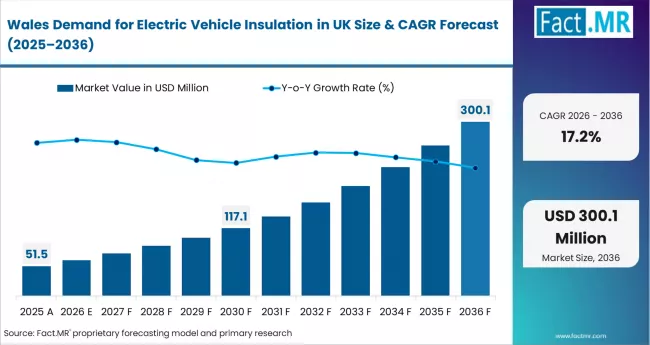
Demand For Electric Vehicle Insulation In Uk Country Value Analysis | Source: Fact.MR
Demand for electric vehicle insulation in England is projected to exhibit strong growth with a CAGR of 17.8% through 2036, driven by progressive automotive preferences, substantial manufacturing development creating advanced electric vehicle insulation opportunities, and concentration of automotive advancement across London and surrounding metropolitan areas.
As the dominant region with extensive automotive infrastructure and safety-focused manufacturing policies, England's emphasis on comprehensive thermal excellence and automotive leadership is creating significant demand for professional electric vehicle insulation systems with proven effectiveness and reliable application potential. Major electric vehicle insulation suppliers and automotive companies are establishing comprehensive manufacturing development programs to support innovation advancement and advanced system deployment across diverse applications.
- Manufacturing development trends and automotive preferences are requiring comprehensive thermal management strategies and electric vehicle insulation solutions, driving demand for systems with demonstrated thermal enhancement capabilities and permanent performance assurance throughout diverse automotive operations.
- Innovation ecosystem strength and manufacturing capital availability are supporting deployment of next-generation electric vehicle insulation technologies and novel application pathways that enhance commercial viability, reduce thermal costs, and create new insulation opportunities across automotive and safety-focused applications, positioning England as a national automotive leadership region.
Why Does Scotland Show Strong Growth?
Demand for electric vehicle insulation in Scotland is expanding at a CAGR of 13.7%, supported by extensive automotive facilities including large-scale manufacturing programs, automotive operations, and component companies generating concentrated demand favorable for electric vehicle insulation systems. The region's automotive characteristics, featuring substantial manufacturing infrastructure and thermal requirements ideal for electric vehicle insulation integration, provide natural advantages.
Automotive expertise concentrated in Edinburgh, Glasgow, and regional automotive corridors facilitates application development and thermal management. Electric vehicle insulation suppliers and automotive companies are implementing comprehensive manufacturing strategies to serve expanding safety-focused requirements throughout Scotland.
- Automotive concentration and favorable application economics are creating opportunities for specialized electric vehicle insulation suppliers that can integrate thermal systems with existing manufacturing operations.
- Electric vehicle insulation positioning and automotive awareness are building regional competitive advantages in manufacturing applications, enabling comprehensive automotive development and thermal cluster enhancement that meets insulation targets while accessing advanced pricing opportunities.
Why Does Wales Show Consistent Expansion?
Demand for electric vehicle insulation in Wales is growing at a CAGR of 17.2%, driven by substantial automotive facilities from manufacturing operations, automotive distributors, and regional operators requiring electric vehicle insulation pathways.
The region's automotive base, supporting critical manufacturing operations, is increasingly adopting electric vehicle insulation technologies to maintain competitiveness while meeting thermal expectations. Automotive companies and electric vehicle insulation suppliers are investing in thermal integration systems and regional supply infrastructure to address growing manufacturing requirements.
- Manufacturing modernization imperatives and automotive competitiveness concerns are facilitating adoption of electric vehicle insulation technologies that enable continued automotive operations while achieving thermal enhancement across manufacturing operations, automotive distributors, and operator facilities.
- Thermal optimization opportunities including regional automotive development and electric vehicle insulation utilization for enhanced manufacturing operations are creating unique regional advantages and diversified application types throughout Wales automotive operations.
What Factors Underpin Electric Vehicle Insulation Demand in Northern Ireland?
Demand for electric vehicle insulation in Northern Ireland is advancing at a CAGR of 16.9%, supported by expanding automotive facilities, regional manufacturing development including automotive and thermal operations, and growing emphasis on insulation solutions across the region.
Automotive modernization and manufacturing facility expansion are driving consideration of electric vehicle insulation systems as thermal enhancement pathways. Automotive companies and electric vehicle insulation suppliers are developing regional capabilities to support emerging thermal deployment requirements.
- Automotive expansion and manufacturing diversification are creating economic drivers for electric vehicle insulation technologies and system adoption across automotive and manufacturing facilities seeking competitive differentiation pathways.
- Regional automotive cooperation and coordinated manufacturing development are establishing consistent electric vehicle insulation environments and shared thermal infrastructure that support multi-regional automotive projects throughout Northern Ireland automotive operations.
Competitive Landscape of UK Electric Vehicle Insulation Industry
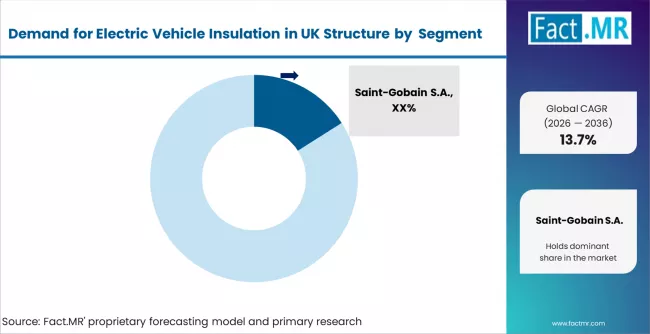
Demand For Electric Vehicle Insulation In Uk Analysis By Company | Source: Fact.MR
UK electric vehicle insulation industry is defined by competition among specialized automotive manufacturers, thermal component companies, and integrated solution providers, with major manufacturing corporations maintaining significant influence through research resources and application development capabilities. Companies are investing in thermal advancement, safety assurance infrastructure optimization, distribution network structures, and comprehensive technical validation services to deliver effective, reliable, and accessible thermal enhancement solutions across UK automotive and manufacturing applications. Strategic partnerships, research infrastructure development, and first-mover application execution are central to strengthening competitive positioning and presence across manufacturing, safety-focused, and automotive applications.
Saint-Gobain S.A. leads with a 16.2% share, offering comprehensive electric vehicle insulation solutions including manufacturing development, safety assurance, and distribution services with focus on automotive applications, manufacturing, and accessibility across UK operations. Parker Hannifin Corporation delivers full-service thermal supply including manufacturing distribution, custom integration, and technical support serving UK and international automotive projects.
Elkem Silicones emphasizes comprehensive advanced solutions with integrated thermal capabilities, safety management, and insulation features leveraging manufacturing sector expertise. BASF SE offers electric vehicle insulation application development and thermal optimization operations for automotive and manufacturing applications across UK operations.
Key Players in UK Electric Vehicle Insulation Industry
- Saint-Gobain S.A.
- Parker Hannifin Corporation
- Elkem Silicones
- Knauf Industries
- BASF SE
- Zotefoams Plc
- 3M Company
- Elmelin Ltd.
- Pyrophobic Systems Ltd.
- Morgan Advanced Materials
Bibliography
- Office for Zero Emission Vehicles. (2024). OZEV annual report: UK electric vehicle registrations, infrastructure investment, and supply chain development. OZEV.
- Society of Motor Manufacturers and Traders. (2024). SMMT electrified vehicle report: UK EV production volumes and component sourcing data 2024. SMMT.
- British Standards Institution. (2024). BS EN IEC 60664-1: Insulation coordination for equipment within low-voltage supply systems, EV application guidance. BSI.
- Health and Safety Executive. (2024). HSE guidance note: Electrical safety requirements for high-voltage vehicle systems in maintenance and repair environments. HSE.
- European Commission. (2024). UNECE Regulation No. 100: Specific requirements for electric power train safety, insulation resistance and isolation monitoring. UNECE.
- Innovate UK. (2024). Faraday Battery Challenge: UK EV component manufacturing capability assessment and insulation material innovation roadmap. Innovate UK.
This bibliography is provided for reader reference. The full Fact.MR report contains the complete reference list with primary research documentation.
This Report Addresses
- Market sizing and forecast metrics for demand for electric vehicle insulation in uk through 2036.
- Segmentation analysis across material, product, end use categories.
- Regulatory compliance assessment shaping procurement specifications.
- Competitive landscape evaluation of leading participants.
- Strategic guidance for market positioning through the forecast period.
- Supply chain risk analysis identifying sourcing constraints.
- Custom data delivery formats including dashboards, Excel, and PDF reports.
Demand for Electric Vehicle Insulation in UK Definition
Electric vehicle insulation in the UK market covers the thermal, electrical, and acoustic insulation materials and components installed in hybrid, battery electric, plug-in hybrid, and fuel cell electric vehicles to manage heat dissipation, prevent electrical discharge, and reduce cabin noise transmission from electric drivetrain and battery systems. Materials include foamed plastics, ceramics, thermal interface materials, and specialty insulation compounds.
Demand for Electric Vehicle Insulation in UK Inclusions
The report covers foamed plastics, ceramics, thermal interface materials, and other insulation material types. Product segmentation spans electrical, thermal, and acoustic insulation. End-use analysis covers HEV, BEV, PHEV, and FCEV platforms within the UK market for 2026 to 2036.
Demand for Electric Vehicle Insulation in UK Exclusions
Conventional ICE vehicle insulation, building and construction insulation, industrial process insulation, and raw insulation polymer resins sold as commodity inputs are excluded.
Demand for Electric Vehicle Insulation in UK Research Methodology
- Primary Research: Analysts engaged with procurement directors and operations leads across the demand for electric vehicle insulation in uk value chain.
- Desk Research: Regulatory filings, standards records, and corporate reports from allowed sources were aggregated.
- Market-Sizing and Forecasting: Hybrid top-down and bottom-up approach with region-specific curves projects demand through 2036.
- Data Validation and Update Cycle: Projections cross-validated against public financial guidance and industry benchmarks.
Segmentation
Scope of the Report
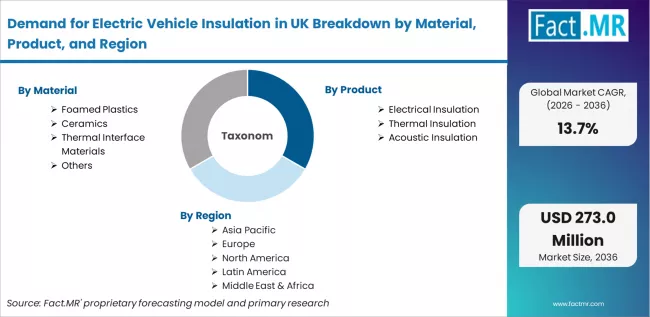
Demand For Electric Vehicle Insulation In Uk Breakdown By Material, Product, And Region | Source: Fact.MR
| Metric | Value |
|---|---|
| Quantitative Units | USD 75.6 million to USD 273.0 million, at a CAGR of 13.70% |
| Market Definition | Electric vehicle insulation in the UK covers thermal, electrical, and acoustic insulation materials installed in EV battery packs, power electronics, and motor assemblies to ensure safe high-voltage operation, thermal management, and cabin noise reduction. |
| Material Segmentation | Foamed Plastics, Ceramics, Thermal Interface Materials, Others |
| Product Segmentation | Electrical Insulation, Thermal Insulation, Acoustic Insulation |
| End Use Segmentation | Hybrid Electric Vehicle, Battery Electric Vehicle, Plug-in Hybrid EV, Fuel Cell EV |
| Key Companies Profiled | Saint-Gobain S.A., Parker Hannifin Corporation, Elkem Silicones, Knauf Industries, BASF SE, Zotefoams Plc, 3M Company, Elmelin Ltd., Pyrophobic Systems Ltd., Morgan Advanced Materials |
| Forecast Period | 2026 to 2036 |
| Approach | Hybrid top-down and bottom-up methodology, cross-validated against primary research and public industry filings. |
Source: Fact.MR analysis. Updated Mar 26, 2026
UK Electric Vehicle Insulation Industry by Segments
-
Material :
- Foamed Plastics
- Ceramics
- Thermal Interface Materials
- Others
-
Product :
- Electrical Insulation
- Thermal Insulation
- Acoustic Insulation
-
End Use :
- Hybrid Electric Vehicle (HEV)
- Battery Electric Vehicle (BEV)
- Plug-in Hybrid EV (PHEV)
- Fuel Cell EV (FCEV)
-
Region :
- England
- Scotland
- Wales
- Northern Ireland
Frequently Asked Questions
How large is the demand for electric vehicle insulation in uk in 2026?
What will the size be by 2036?
What is the expected CAGR?
Which material segment leads in 2026?
What methodology does Fact.MR use?
Which companies are profiled?
Who worked on this report


Preview the report firsthand - request a free sample
Free SampleGet the brochure for pricing and purchase details
Download PDF