- Market Value (2025): USD 309.7 Mn
- Estimated Value (2026): USD 350 Mn
- Forecast Value (2036): USD 1188 Mn
- CAGR (2026-2036): 13.0%
What is the Precision Flavor Enzymes Market forecast to be worth by 2036?
USD 350 million in 2026 to USD 1188 million by 2036 at a 13.0% CAGR.
- The precision flavor enzymes market reached USD 309.7 million in 2025.
- Demand is projected to increase from USD 350 million in 2026 to USD 1188 million by 2036.
- The market is forecast to record 13.0% CAGR from 2026 to 2036.
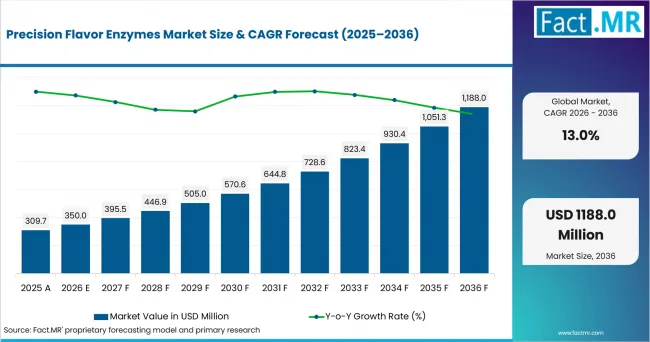
Precision Flavor Enzymes Market Value Analysis | Source: Fact.MR
What are the defining numbers behind Precision Flavor Enzymes Market growth?
An absolute opportunity of USD 838 million is expected between 2026 and 2036.
- Demand Drivers in the Market
- Dairy processors need controlled lipase activity when enzyme-modified cheese notes must stay consistent across milk lots and aging windows.
- Foodservice recipe teams require repeatable savory precursors as menu sauces move from kitchen batches into scaled manufacturing lines.
- Plant-based brands need bitterness reduction and clean flavor release because protein bases often carry bean, cereal or green notes.
- USDA ERS reported in June 2026 that inflation-adjusted total U.S. food spending reached USD 2.51 trillion in 2025. The scale of the U.S. food economy provides a broad commercial backdrop for ingredient innovation, including enzyme-enabled flavor reformulation.
- Key Segments Analyzed
- By Enzyme: Lipases are expected to hold 31.0% share in 2026 due to their direct role in cheese notes and fat-derived aroma formation.
- By Pathway: Dairy flavor is projected to account for 52.0% share in 2026 supported by cheese, butter and fermented dairy applications.
- By Application: Cheese-dairy is anticipated to capture 26.0% share in 2026 owing to controlled ripening and enzyme-modified ingredient use.
- By Form: Liquid is estimated to represent 41.0% share in 2026 because liquid dosing fits tanks, vats and beverage lines.
- Analyst Opinion at Fact.MR
- Shambhu Nath Jha, Principal Consultant at Fact.MR, states, “Flavor enzymes are being evaluated less as single ingredients and more as process tools. The market is expected to favor suppliers that can connect enzyme activity with sensory targets and process limits. Application labs, strain documentation and clean dosage guidance separate routine enzyme selling from precision flavor work.”
- Strategic Implications
- Enzyme producers should document activity curves against cheese, bakery, beverage and plant-protein matrices so formulators can compare sensory outcomes before pilot batches.
- Application teams should connect enzyme choice with heat treatment, pH and hold-time guidance since those process limits decide final flavor expression.
- Dairy specialists should use technical centers for scale-up work. Novonesis inaugurated a 900 m² Dairy Application Technology Center in Hørsholm in May 2025 to support dairy co-creation, product trials and scale-up toward commercial launches.
- Food brands should pair clean-label targets with sensory panels so enzyme benefits are measured against bitterness, aroma release and aftertaste.
Japan is projected to record 16.3% CAGR through 2036 supported by export-oriented fermented foods and dairy flavor systems. The UK is anticipated to post 14.1% CAGR as food spending and food manufacturing depth keep reformulation work active. South Korea is forecast to advance at 12.9% CAGR due to K-food exports and sauce innovation. Germany is expected to record 10.8% CAGR owing to industrial food processing and EU enzyme documentation. The USA is estimated to hold 9.7% CAGR as cheese output and bakery enzyme use keep demand broad.
How does the Precision Flavor Enzymes Market break down by segment?
Dairy flavor is projected to lead Pathway at 52.0% share in 2026; while Liquid leads Form at 41.0% share.
Which Enzyme dominates?
Lipases are expected to hold 31.0% share in 2026.
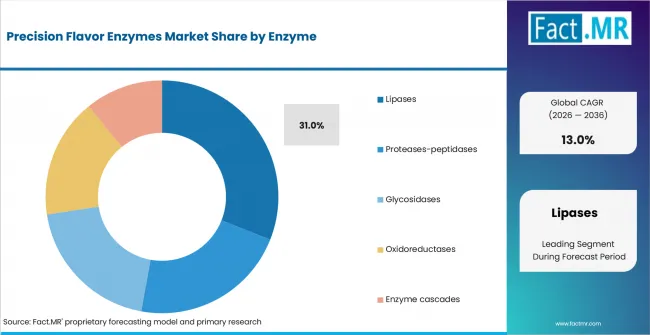
Precision Flavor Enzymes Market Analysis By Enzyme | Source: Fact.MR
Lipases lead the enzyme split because they convert fats into aroma-active compounds used in cheese, butter and dairy-style ingredients. Their role is especially visible where formulators want mature notes without long ripening cycles. Proteases-peptidases remain relevant for savory precursors and protein-derived taste. Glycosidases support fruit aroma release in beverages, while oxidoreductases and cascades serve more specialized flavor routes.
What leads the Pathway segment?
Dairy flavor is projected to account for 52.0% share in 2026.
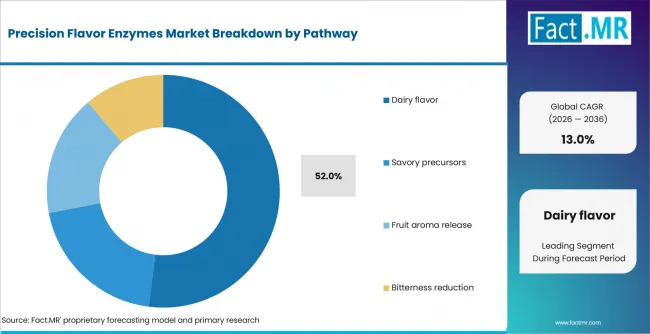
Precision Flavor Enzymes Market Analysis By Pathway | Source: Fact.MR
Dairy flavor leads the pathway mix because cheese, enzyme-modified dairy ingredients and dairy analogues have clear sensory targets. FDA completed its evaluation of GRN 001201 in March 2025 for a lipase enzyme preparation intended for use at up to 95.1 mg TOS/kg raw material in the production of cheese, enzyme-modified dairy ingredients, and plant-based analogues of milk and milk products. Savory precursors follow through yeast and protein routes, while fruit aroma release remains beverage-led.
How does Application shape demand?
Cheese-dairy is anticipated to capture 26.0% share in 2026.
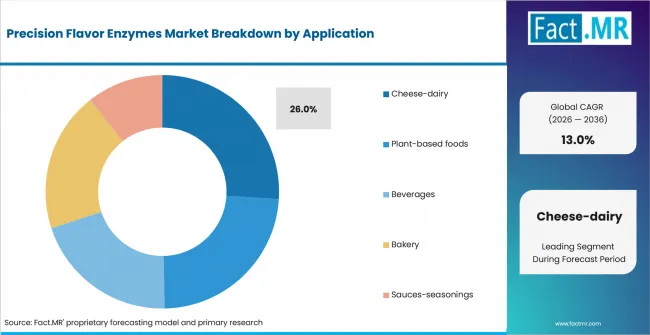
Precision Flavor Enzymes Market Analysis By Application | Source: Fact.MR
Cheese-dairy is the largest application because flavor release, ripening control and texture expectations meet in one process. Enzymes help processors build target notes while keeping process time and batch variation within planned limits. Plant-based foods use precision enzymes for masked bases and fuller profiles. Beverages, bakery and sauces-seasonings add demand where fruit aroma, freshness or savory depth must survive processing.
What leads Form demand?
Liquid is estimated to represent 41.0% share in 2026.
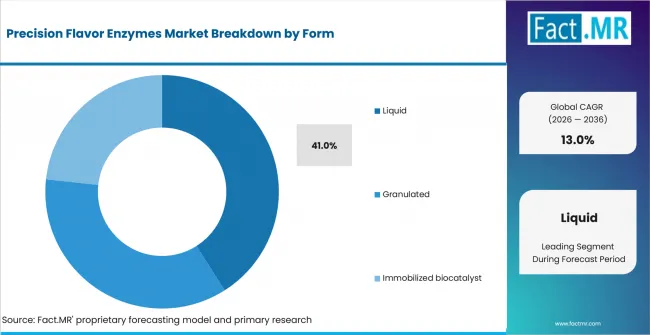
Precision Flavor Enzymes Market Analysis By Form | Source: Fact.MR
Liquid form leads because processors can dose it directly into tanks, vats and mixing systems. It also supports faster dispersion during dairy and beverage processing. Granulated formats fit dry blends and bakery systems where storage stability carries more weight. Immobilized biocatalysts remain smaller because they need process engineering and validation, but they suit controlled conversion in repeated production runs.
What is accelerating Precision Flavor Enzymes Market adoption, and what is holding it back?
Dairy flavor control drives it; sensory validation limits it.
Drivers Impact Analysis
| DRIVER | (~) % IMPACT ON CAGR | GEOGRAPHIC RELEVANCE | IMPACT TIMELINE |
|---|---|---|---|
| Dairy flavor standardization | +2.0% | Global | Short term (<= 2 years) |
| Clean-label reformulation | +1.4% | North America, Western Europe | Medium term (2-4 years) |
| Plant-protein taste correction | +1.1% | USA, UK, Germany | Medium term (2-4 years) |
| Process-ready liquid dosing | +0.7% | Global | Long term (>= 4 years) |
- Dairy flavor standardization: Cheese and dairy processors need repeatable flavor release across milk quality shifts and plant schedules. Lipases and proteases give product teams a way to control ripening notes within defined process windows. Demand is expected to rise where sensory panels link enzyme use with faster recipe approval.
- Clean-label reformulation: Brands are reducing reliance on broad flavor additives when labels need fewer unfamiliar terms. Enzyme routes help release native flavor from dairy, fruit or protein systems. Adoption is projected to improve where enzyme dossiers support clear processing status and residue expectations.
- Plant-protein taste correction: Plant-based foods often need help with bitterness and base-note masking. Precision enzymes are expected to support cleaner savory and dairy-style profiles when formulators work with pea, soy, oat or nut bases. The commercial gain depends on taste gains that consumers detect immediately.
- Process-ready liquid dosing: Liquid enzyme formats fit existing manufacturing lines with limited equipment change. This makes trials easier for processors that already meter cultures, flavors or processing aids. Scale-up is anticipated to favor suppliers that provide dosage, temperature and hold-time guidance together.
Opportunity Impact Analysis
| OPPORTUNITY | (~) % IMPACT ON CAGR | GEOGRAPHIC RELEVANCE | IMPACT TIMELINE |
|---|---|---|---|
| Enzyme cascades for layered flavors | +1.2% | Japan, South Korea, Western Europe | Medium term (2-4 years) |
| Bitterness reduction in plant foods | +0.9% | USA, UK, Germany | Short term (<= 2 years) |
| Application-lab co-creation | +0.7% | Global | Medium term (2-4 years) |
| Immobilized biocatalyst systems | +0.5% | Japan, Germany | Long term (>= 4 years) |
- Enzyme cascades for layered flavors: Cascade approaches combine reaction steps so one process can build broader aroma depth. They are anticipated to gain attention in sauces, fermented drinks and premium dairy bases. Commercial use depends on reproducible reaction control and proof that each step adds sensory value.
- Bitterness reduction in plant foods: Protein-rich plant bases create a visible need for enzymatic flavor smoothing. Enzyme providers are expected to gain from formulas where bitterness control improves repeat purchase. Product developers still need evidence that the same enzyme performs across different protein lots.
- Application-lab co-creation: Formulators increasingly want pilot support before changing recipe systems. Application labs reduce failed trials by testing enzyme activity against real process conditions. Suppliers with dairy vats, beverage trials and bakery benches are likely to move faster from sample request to production approval.
- Immobilized biocatalyst systems: Immobilized formats create opportunities where repeated conversion runs justify higher process design effort. These systems are projected to remain selective, but they fit high-value aroma release or controlled precursor generation. Adoption depends on cleaning, stability and throughput data.
Restraints Impact Analysis
| RESTRAINT | (~) % IMPACT ON CAGR | GEOGRAPHIC RELEVANCE | IMPACT TIMELINE |
|---|---|---|---|
| Production-organism documentation | -0.6% | USA, Europe, Japan | Short term (<= 2 years) |
| Sensory variance risk | -0.5% | Global | Medium term (2-4 years) |
| Heat and pH sensitivity | -0.4% | Global | Medium term (2-4 years) |
| Premium cost proof | -0.3% | USA, UK, South Korea | Long term (>= 4 years) |
- Production-organism documentation: Food enzyme approvals and customer questionnaires require clear strain identity, activity and use-level records. That workload slows switching when processors already use a qualified enzyme. Adoption is estimated to move faster where suppliers provide ready regulatory files with application data.
- Sensory variance risk: Small changes in bitterness, dairy note or fruit aroma can make a product fail internal panels. Formulators are expected to delay launches until enzyme performance is proven on their own ingredients. This keeps application testing central to purchase decisions.
- Heat and pH sensitivity: Enzymes react within defined process windows, so formulation teams must align activity with pasteurization, fermentation or baking conditions. Poor timing can reduce the intended flavor effect. Suppliers are anticipated to compete on practical process guidance as much as catalog breadth.
- Premium cost proof: Precision enzymes can add cost before savings appear in yield, flavor intensity or shorter processing time. Procurement teams are projected to request trial data that links dosage to measurable sensory or process gains. Routine flavors face slower replacement when the economic benefit remains unclear.
Which countries are scaling the Precision Flavor Enzymes Market through 2036?
- The country comparison spans 6.6 percentage points and forms three practical growth bands across the forecast period.
- Japan remains 2.2 percentage points above the UK through export-oriented dairy, sauce and fermented beverage innovation.
- The UK remains 1.2 percentage points above South Korea as food spending and retail reformulation keep clean-label enzymes visible.
- South Korea remains 2.1 percentage points above Germany through K-food exports and sauce-led flavor systems.
- Germany remains 1.1 percentage points above the USA through industrial food processing and EU enzyme dossier discipline.
- The USA closes the displayed range through large cheese output and bakery enzyme use.
Comparable CAGRs create different entry conditions due to export exposure, dairy processing scale, local food additive review and product development speed. Full report coverage includes North America, Latin America, Western Europe, Eastern Europe, East Asia, South Asia & Pacific, Middle East & Africa.
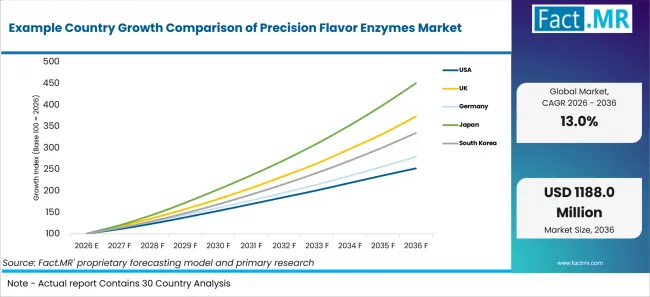
Example Country Growth Comparison Of Precision Flavor Enzymes Market | Source: Fact.MR
| Country | CAGR (2026-2036) |
|---|---|
| Japan | 16.3% |
| UK | 14.1% |
| South Korea | 12.9% |
| Germany | 10.8% |
| USA | 9.7% |
What supports Japan adoption?
16.3% CAGR, supported by export recipes and fermented flavor systems.
Japanese formulators are expected to use precision enzymes where export recipes need stable dairy, fruit and savory profiles. Japan is projected to record 16.3% CAGR through 2036. MAFF reported in February 2026 that Japan’s agricultural, forestry, fishery and food exports reached JPY 1.7005 trillion in 2025, up 12.8% year over year. The growing export base may increase the relevance of formulation approaches that maintain aroma and sensory quality across extended distribution chains.
How is the UK scaling demand?
14.1% CAGR, backed by food spending and clean-label dairy reformulation.
UK brands evaluate flavor enzymes through retail label rules and foodservice recovery. The market is anticipated to post 14.1% CAGR through 2036. Defra reported that consumer expenditure on food and alcoholic drinks reached GBP 303.3 billion in 2025 at constant 2023 prices. This spending base provides broad market context for continued reformulation and product-development activity across categories such as dairy, bakery and beverages.
What underpins South Korea growth?
12.9% CAGR, driven by K-food exports and sauce innovation.
South Korean processors are using flavor systems for noodles, sauces and fermented foods that carry export appeal. The country is forecast to advance at 12.9% CAGR through 2036. MAFRA reported in January 2026 that K-Food Plus exports reached USD 13.62 billion in 2025. Growth in exported processed foods may increase the relevance of repeatable umami and heat-balanced flavor formulations for international markets.
What supports Germany adoption?
10.8% CAGR, supported by food-industry scale and EU enzyme review.
German food manufacturers test flavor enzymes with a strong focus on documentation and consistent industrial batches. Germany is expected to record 10.8% CAGR through 2036. BVE reported in July 2026 that Germany’s food industry generated EUR 240.8 billion in 2025 revenue, creating a sizable base for cheese, bakery and prepared-meal flavor work.
How does the USA perform?
9.7% CAGR, led by cheese output and bakery enzyme use.
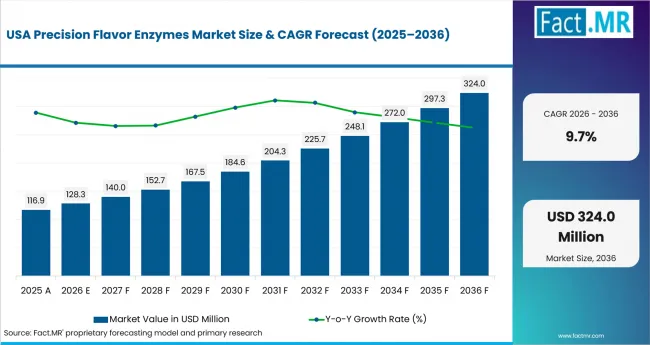
Precision Flavor Enzymes Market Country Value Analysis | Source: Fact.MR
U.S. demand is broad because dairy and bakery processors already work with enzyme systems at industrial scale. The USA is estimated to hold 9.7% CAGR through 2036. USDA NASS reported in April 2026 that total cheese output excluding cottage cheese reached 1.16 billion pounds in February 2026, keeping lipase and protease use close to commercial production needs.
Who leads the Precision Flavor Enzymes Market?
Novonesis, dsm-firmenich, IFF, Amano Enzyme Inc., Enzyme Development Corporation and Biocatalysts Ltd are profiled for relevant food-enzyme capabilities.
Novonesis has direct dairy and food biosolutions coverage, with technical support that fits enzyme selection and scale-up. dsm-firmenich has direct cheese-enzyme coverage through Maxiren®EVO, a fermentation-produced coagulant enzyme launched in March 2025 with texture, yield and flavor-development applications in cheese. IFF contributes enzyme, culture and taste-modulation capabilities across dairy and plant-based applications.
Amano Enzyme Inc. adds food-enzyme depth in savory and plant-protein routes, while Enzyme Development Corporation supports food processors with application-specific enzyme preparations. Biocatalysts Ltd strengthens custom enzyme development for brands and ingredient firms that need narrower activity targets. Competition is expected to be shaped by application support, regulatory files, sensory proof and clean process guidance.
Which companies are the key providers?
Key companies include Novonesis, IFF, dsm-firmenich, Amano Enzyme Inc., Enzyme Development Corporation, Biocatalysts Ltd.
- Novonesis
- IFF
- dsm-firmenich
- Amano Enzyme Inc.
- Enzyme Development Corporation
- Biocatalysts Ltd
Bibliography
- Bundesvereinigung der Deutschen Ernährungsindustrie e.V. (2026, July 9). Jahreszahlen 2025: Angespannte wirtschaftliche Lage setzt Ernährungsindustrie weiter unter Druck.
- Department for Environment, Food & Rural Affairs. (2026, July 29). Food statistics in your pocket. GOV.UK.
- dsm-firmenich. (2025, March 20). dsm-firmenich launches Maxiren®EVO: A revolutionary coagulant enzyme for enhanced cheese texture, taste, yield, and functionality.
- Ministry of Agriculture, Food and Rural Affairs. (2026, January 20). Exports of K-Food Plus reached USD 13.6 billion in 2025, up 5.1% year-over-year.
- Novonesis. (2025, May 19). Opening the doors to next level dairy.
- U.S. Department of Agriculture, National Agricultural Statistics Service. (2026, April 2). Dairy Products.
- U.S. Food and Drug Administration. (2025, July 3). GRAS Notice (GRN) 1201 agency response letter [Corrected response letter].
This Report Answers
- The report explains where precision flavor enzymes are used across enzyme type and flavor pathway. It also covers application, form and region.
- Segment analysis identifies the leading subsegments and the operational reasons food manufacturers prioritize them.
- Country analysis examines Japan, the UK, South Korea, Germany and the USA through export, production and food-spending signals.
- Competitive analysis reviews Novonesis, IFF, dsm-firmenich, Amano Enzyme Inc., Enzyme Development Corporation and Biocatalysts Ltd.
- Application analysis assesses how cheese-dairy, plant-based foods, beverages, bakery and sauces-seasonings shape formulation choices.
What does the Precision Flavor Enzymes Market cover?
The Precision Flavor Enzymes Market covers food-grade enzymes used to shape flavor through controlled biochemical reactions. It includes lipase, protease-peptidase, glycosidase, oxidoreductase and enzyme cascade systems when flavor creation or flavor adjustment is the commercial purpose.
The assessment covers dairy flavor, savory precursor generation, fruit aroma release and bitterness reduction across the listed food applications. General processing aids enter the scope only when the enzyme directly changes taste, aroma or flavor precursor formation.
What is included in the scope?
The scope includes food-grade enzyme preparations, custom biocatalyst systems and application support used by dairy processors, beverage developers, bakery formulators and plant-based brands. It covers lipases, proteases-peptidases, glycosidases, oxidoreductases and enzyme cascades when the commercial purpose is flavor formation. Adjacent coverage on industrial enzymes and food fungal enzymes is relevant where those technologies overlap with food flavor formation. Applications also connect with flavor enhancers and food additives when enzymes help build cheese notes, fruit aroma release or savory depth.
What is excluded from the scope?
General processing enzymes, therapeutic enzymes, diagnostic enzymes, animal-feed enzymes and detergent enzymes are outside the scope. Flavor compounds, cultures, preservatives and sweeteners are covered only when sold with an enzyme route that directly changes flavor formation or flavor release.
How Was the Analysis Built?
The analysis draws on 120+ sources, 35+ company portfolios, 25+ countries, and more than 20 industry interviews.
- Primary Research: Primary research includes discussions with manufacturers, service providers, technology developers, distributors, end users, procurement teams, and subject-matter experts. These conversations examine purchasing priorities, product adoption, operational challenges, approval requirements, competitive positioning, and the factors that influence wider market acceptance.
- Desk Research: Desk research covers government statistics, regulatory publications, company filings, trade data, technical studies, industry associations, standards, public policy, and other authoritative sources. Every source used in the analysis is documented in the bibliography.
- Market Sizing and Forecasting: Market estimates combine historical performance, demand indicators, pricing and volume trends, segment shares, company participation, country-level growth, adoption patterns, investment activity, and barriers to market expansion.
- Data Validation and Update Cycle: Findings are validated by comparing primary interviews with public data, company activity, regulatory changes, trade patterns, and industry developments. Regular updates review new product launches, capacity changes, partnerships, approvals, procurement trends, and shifts in commercial adoption.
What is the report’s scope and coverage?
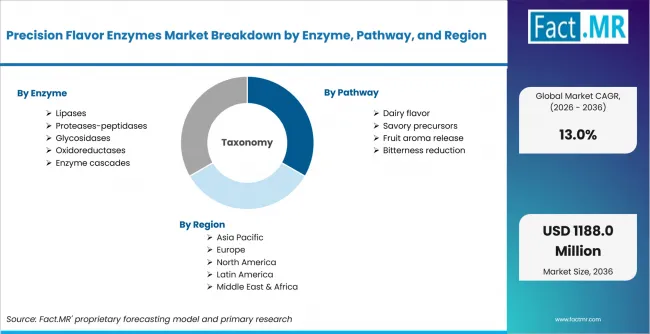
Precision Flavor Enzymes Market Breakdown By Enzyme, Pathway, And Region | Source: Fact.MR
| Attribute | Details |
|---|---|
| Quantitative Units | USD million |
| Market Definition | Food-grade enzyme systems used to create, release, balance or refine flavor in processed foods and beverages. |
| Enzyme | Lipases; Proteases-peptidases; Glycosidases; Oxidoreductases; Enzyme cascades |
| Pathway | Dairy flavor; Savory precursors; Fruit aroma release; Bitterness reduction |
| Application | Cheese-dairy; Plant-based foods; Beverages; Bakery; Sauces-seasonings |
| Form | Liquid; Granulated; Immobilized biocatalyst |
| Regions Covered | North America; Latin America; Western Europe; Eastern Europe; East Asia; South Asia & Pacific; Middle East & Africa |
| Countries Covered | USA; UK; Germany; Japan; South Korea |
| Key Companies Profiled | Novonesis, IFF, dsm-firmenich, Amano Enzyme Inc., Enzyme Development Corporation, Biocatalysts Ltd. |
| Forecast Period | 2026 to 2036 |
| Approach | Hybrid top-down and bottom-up approach using enzyme application mapping, food processing demand, supplier portfolio checks, country indicators and sensory validation requirements. |
How is the market segmented?
-
By Enzyme:
- Lipases
- Proteases-peptidases
- Glycosidases
- Oxidoreductases
- Enzyme cascades
-
By Pathway:
- Dairy flavor
- Savory precursors
- Fruit aroma release
- Bitterness reduction
-
By Application:
- Cheese-dairy
- Plant-based foods
- Beverages
- Bakery
- Sauces-seasonings
-
By Form:
- Liquid
- Granulated
- Immobilized biocatalyst
-
By Region:
- North America
- Latin America
- Western Europe
- Eastern Europe
- East Asia
- South Asia & Pacific
- Middle East & Africa