- Market Value (2025): USD 13.0 Bn
- Estimated Value (2026): USD 14.8 Bn
- Forecast Value (2036):USD 53.4 Bn
- CAGR (2026-2036): 13.7%
What is the Propulsion Inverter Modules Market forecast to be worth by 2036?
USD 14.8 billion in 2026 to USD 53.4 billion by 2036, at 13.7% CAGR.
- The Propulsion Inverter Modules Market crossed a valuation of USD 13.0 billion in 2025.
- Demand is projected to increase from USD 14.8 billion in 2026 to USD 53.4 billion by 2036.
- The market is forecast to record 13.7% CAGR from 2026 to 2036 as EV platform teams shift more powertrain value toward inverter efficiency and thermal control.
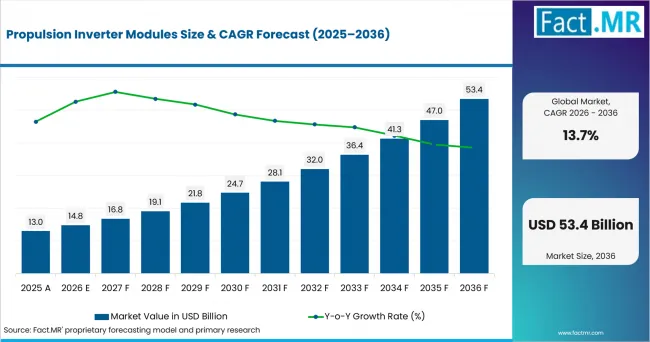
Propulsion Inverter Modules Value Analysis | Source: Fact.MR
What are the defining numbers behind Propulsion Inverter Modules Market growth?
USD 38.6 billion absolute opportunity by 2036, led by traction inverter modules, SiC MOSFETs and passenger EVs.
- Demand Drivers in the Market
- EV powertrain engineers need traction inverters that convert battery current into motor current with lower heat loss and stable torque control.
- Passenger vehicle teams need 800 V-ready modules as faster charging and higher motor output raise voltage and cooling requirements.
- Commercial fleet engineers need inverter and DC/DC integration so electric buses, vans and trucks reduce wiring and packaging complexity.
- The International Energy Agency reported in May 2026 that electric car sales exceeded 20 million units in 2025. That scale is expected to increase design work around traction inverters, SiC devices and compact eAxle packaging.
- Key Segments Analyzed
- By Module Type: Traction inverter is expected to hold 48.0% share in 2026 due to its direct role in motor torque control.
- By Semiconductor: SiC MOSFET is projected to account for 44.0% share in 2026 owing to lower switching loss in high-voltage propulsion designs.
- By Voltage: 800 V is anticipated to capture 45.0% share in 2026 as faster charging shifts voltage planning above legacy architectures.
- By Vehicle: Passenger EV is estimated to represent 51.0% share in 2026 since car programs create the widest design-win base for module suppliers.
- Analyst Opinion at Fact.MR
- Shambhu Nath Jha, Principal Consultant at Fact.MR, states, "Inverter modules are becoming a platform-level choice for automakers. Suppliers are expected to win programs by proving efficiency at the required voltage and by showing stable cooling under repeated load. The strongest offers combine SiC device access, control software knowledge and production-ready module packaging."
- Strategic Implications
- Module suppliers should publish efficiency and thermal data at the voltage levels targeted by each vehicle program.
- Automakers should align inverter selection with motor, battery and charging architecture early in platform planning.
- Semiconductor partners should prove SiC supply quality because device performance affects range and warranty exposure.
- Charging-network teams should align corridor capacity with higher-voltage vehicles. FHWA reported in January 2025 that the United States had more than 206,000 publicly available EV charging ports.
South Korea is forecast to advance at 14.5% CAGR through 2036, supported by eco-friendly vehicle production and export-linked electrified powertrain programs. The USA is expected to record 13.8% CAGR with hybrid, BEV and PHEV platform scale. Japan is anticipated to post 13.4% CAGR due to hybrid depth and SiC inverter work. Germany is projected to reach 13.1% CAGR, supported by electric-car registrations and charging capacity. The UK is estimated to reach 12.2% CAGR as zero-emission car registrations support passenger EV module demand.
How does the Propulsion Inverter Modules Market break down by segment?
Traction inverter leads at 48.0%; passenger EV leads at 51.0%.
Which Module Type dominates?
Traction inverter holds 48.0% share in 2026.
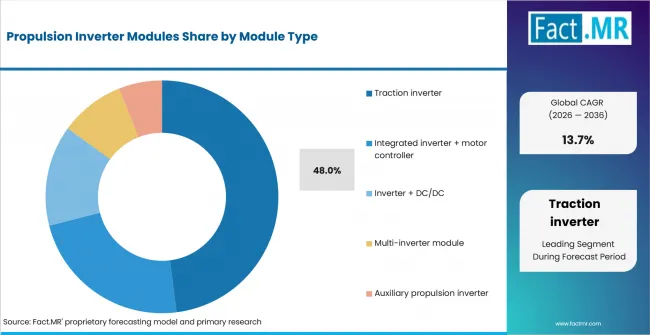
Propulsion Inverter Modules Analysis By Module Type | Source: Fact.MR
Traction inverter modules lead because they control the connection between the high-voltage battery and the electric motor. Their role is central to acceleration, regenerative braking and torque response. The segment is expected to hold share where automakers choose validated modules that fit BEV and hybrid platforms without adding unnecessary drivetrain size.
BorgWarner announced in April 2025 that it would showcase its next-generation double-sided-cooled 800 V SiC power module at the 46th Vienna Motor Symposium in May 2025 and would present next-generation inverter technology. The disclosure reinforces traction inverter relevance because the power module is a core conversion element inside the inverter assembly.
What leads the Semiconductor segment?
SiC MOSFET accounts for 44.0% share in 2026.
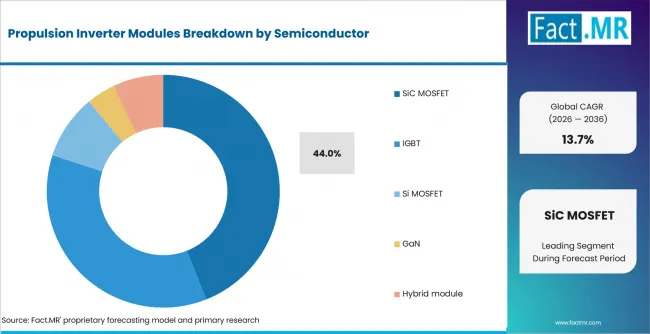
Propulsion Inverter Modules Analysis By Semiconductor | Source: Fact.MR
SiC MOSFETs are projected to lead semiconductor selection where higher voltage and heat limits shape module design. The device choice lowers switching loss and helps engineers reduce cooling load. DENSO reported in October 2025 that its new bZ4X inverter cut power loss by approximately 70% compared with earlier silicon-based products.
How does Voltage shape demand?
800 V leads with 45.0% share in 2026.
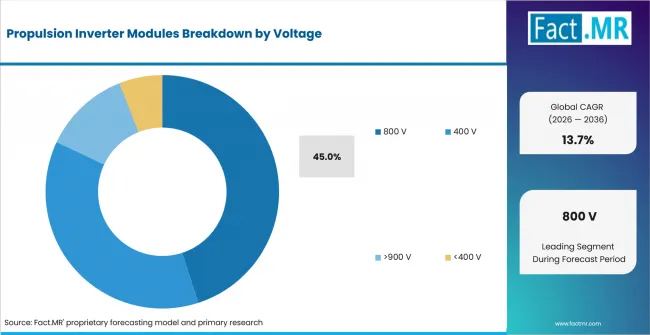
Propulsion Inverter Modules Analysis By Voltage | Source: Fact.MR
The 800 V segment is anticipated to lead as fast charging and higher motor output move deeper into passenger EV programs. Higher voltage reduces current for the same power level, which helps limit cable mass and thermal stress. Valeo announced in October 2025 that its new-generation dual inverter uses a scalable 400 V to 800 V design for current and next-generation electric vehicles.
What supports Passenger EV within Vehicle?
Passenger EV represents 51.0% share in 2026.
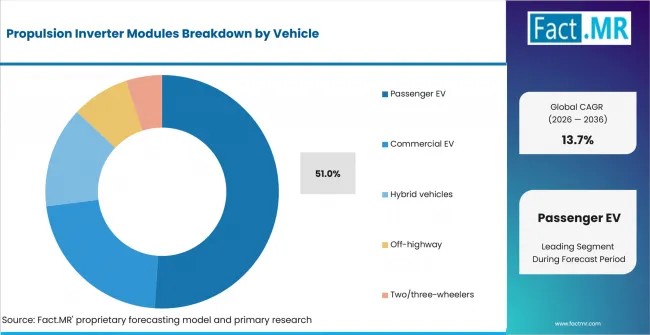
Propulsion Inverter Modules Analysis By Vehicle | Source: Fact.MR
Passenger EVs are estimated to account for the main vehicle share because car platforms create repeated module programs across trims, brands and drive layouts. Electric sedans, SUVs and crossovers require traction control that fits strict space and cooling limits.
What is accelerating Propulsion Inverter Modules Market adoption, and what is holding it back?
Demand rises through EV platform scale and 800 V architectures. Adoption is constrained by SiC cost, validation time and uneven charging readiness.
Drivers Impact Analysis
| DRIVER | (~) % IMPACT ON CAGR | GEOGRAPHIC RELEVANCE | IMPACT TIMELINE |
|---|---|---|---|
| Passenger EV platform expansion | +1.9% | Global | Short term (<= 2 years) |
| 800 V charging and propulsion architecture | +1.5% | North America, Europe, East Asia | Medium term (2-4 years) |
| SiC MOSFET transition in traction modules | +1.2% | Japan, Germany, South Korea | Medium term (2-4 years) |
| Integrated inverter and DC/DC packaging | +0.8% | Global | Long term (>= 4 years) |
- Passenger EV platform expansion: Every BEV requires a traction power-conversion stage, so higher electric-car sales raise module design wins.
- 800 V charging and propulsion architecture: Higher voltage systems increase the value of inverters that control current with less heat loss.
- SiC MOSFET transition: Wide-bandgap devices help module suppliers reduce switching losses in high-voltage applications.
Opportunity Impact Analysis
| OPPORTUNITY | (~) % IMPACT ON CAGR | GEOGRAPHIC RELEVANCE | IMPACT TIMELINE |
|---|---|---|---|
| Integrated inverter plus motor controller modules | +1.1% | East Asia, Europe | Medium term (2-4 years) |
| Commercial EV and e-bus inverter programs | +0.9% | North America, Europe, South Korea | Long term (>= 4 years) |
| GaN and hybrid-module development | +0.5% | Global | Long term (>= 4 years) |
- Integrated inverter plus motor controller modules: Combining control functions reduces packaging work and supports software-defined powertrain designs.
- Commercial EV and e-bus programs: Fleet electrification creates applications that value durability, cooling capacity and serviceability.
- GaN and hybrid-module development: New device mixes give suppliers room to tune cost and switching behavior for lower-voltage use cases.
Restraints Impact Analysis
| RESTRAINT | (~) % IMPACT ON CAGR | GEOGRAPHIC RELEVANCE | IMPACT TIMELINE |
|---|---|---|---|
| High SiC device and packaging cost | -0.6% | Global | Short term (<= 2 years) |
| Long vehicle validation cycles | -0.5% | Global | Medium term (2-4 years) |
| Uneven charging and grid readiness | -0.4% | USA, UK, Japan | Long term (>= 4 years) |
- High SiC cost: Automakers balance efficiency gains against device pricing, especially outside premium BEV programs.
- Long validation cycles: Inverters must pass thermal, safety and electromagnetic checks before high-volume vehicle release.
- Uneven charging readiness: Slower local charging rollout limits the case for faster high-voltage architectures in some markets.
Which countries are scaling the Propulsion Inverter Modules Market through 2036?
- The country comparison spans 2.3 percentage points across the five profiled markets.
- South Korea remains 0.7 percentage point above the USA as eco-friendly vehicle programs widen inverter opportunities.
- The USA stays 0.4 percentage point above Japan with hybrid, BEV and PHEV platform scale.
- Japan remains 0.3 percentage point above Germany due to hybrid depth and SiC device work.
- Germany stays 0.9 percentage point above the UK as electric-car registrations and charging capacity support module adoption.
- The UK closes the range at 12.2% as zero-emission car demand supports passenger EV inverter modules.
Comparable CAGRs create different entry conditions because each country uses a different mix of BEV scale, hybrid demand, charging readiness and domestic supplier capability. Full report coverage includes North America, Latin America, Western Europe, Eastern Europe, East Asia, South Asia and Pacific, Middle East and Africa.
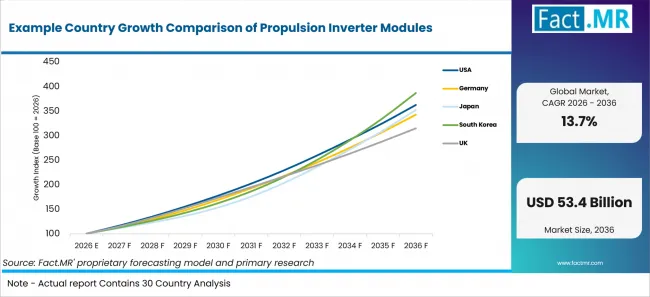
Example Country Growth Comparison Of Propulsion Inverter Modules | Source: Fact.MR
| Country | CAGR |
|---|---|
| South Korea | 14.5% |
| United States | 13.8% |
| Japan | 13.4% |
| Germany | 13.1% |
| United Kingdom | 12.2% |
What supports South Korea adoption?
14.5% CAGR, supported by eco-friendly vehicle scale and export-linked powertrain programs.
South Korea is expected to benefit from a deep local vehicle production base and a strong mix of hybrid and electric models. MOTIR reported in January 2026 that eco-friendly vehicle sales reached 813,000 units in 2025. The sales base is anticipated to lift inverter-module orders for HEV, PHEV and BEV programs because electrified platforms need motor-drive control and compact cooling design.
What supports USA adoption?
13.8% CAGR, supported by hybrid, BEV and PHEV platform scale.
The USA is projected to remain a large design-win market for propulsion inverter modules because vehicle platforms cover passenger cars, SUVs and pickups. The U.S. Energy Information Administration reported, using Omdia estimates, that hybrid electric, battery electric and plug-in hybrid electric vehicles accounted for 24% of U.S. new light-duty vehicle sales in 2Q26. That mix is expected to keep inverter requirements broad across traction, auxiliary and integrated module formats.
How is Japan scaling demand?
13.4% CAGR, led by hybrid depth and policy support for cleaner vehicle platforms.
Japan is anticipated to scale demand through hybrid engineering strength and gradual BEV support. METI stated in December 2025 that the maximum clean-energy vehicle subsidy for eligible EVs would rise to JPY 1.3 million from January 2026. The policy signal is expected to support new BEV launches while established hybrid programs sustain demand for inverter modules that handle repeated traction-control duty.
What is supporting Germany adoption?
13.1% CAGR, supported by electric-car registrations and local power-electronics capability.
Germany is estimated to support module demand through premium EV programs and close links between automakers and Tier-1 suppliers. Germany’s Federal Environment Agency, citing Kraftfahrt-Bundesamt data, reported 856,589 new passenger cars with electric drive in 2025, comprising battery-electric, plug-in hybrid and fuel-cell vehicles. The registration base is projected to support traction inverter demand where OEMs need validated 800 V designs, SiC device options and compact eAxle integration.
What supports United Kingdom growth?
12.2% CAGR, backed by zero-emission car registrations and charging access.
The United Kingdom is expected to expand through passenger EV platforms and fleet-led zero-emission adoption. DfT reported in April 2026 that 473,226 zero-emission cars were registered for the first time in the UK in 2025. New car demand is anticipated to support inverter modules that improve range, charging behavior and motor-control reliability across models sold into UK compliance programs
Who leads the Propulsion Inverter Modules Market?
Bosch, Denso, BorgWarner, Valeo, ZF and Marelli are active providers.
Bosch participates in propulsion power electronics through its Generation 4 inverter portfolio and silicon carbide technology. In April 2026, Bosch stated that it had started introducing third-generation SiC chips and had delivered more than 60 million SiC chips worldwide since first-generation production began in 2021. Its Generation 4 inverter portfolio uses SiC technology and supports both 400 V and 800 V electric-vehicle architectures.
DENSO supports the market through SiC inverter technology and eAxle integration for Toyota programs, including the new bZ4X. BorgWarner remains active through dual-inverter programs and SiC power-module technology for electrified propulsion. Valeo participates through high- and low-voltage electric-powertrain solutions, including its scalable 400 V to 800 V Dual Inverter platform for PHEV applications.
ZF contributes through the SELECT e-drive platform, with its in:SELECT inverter architecture covering 400 V to 800 V and the broader SELECT platform targeting all-electric passenger-car drives in the 100–300 kW range. Marelli’s electrification portfolio includes eMotors, IGBT and SiC high-voltage traction inverters, and eAxles integrating the gearbox, inverter and eMotor. Its April 2026 Auto China announcement separately highlighted propulsion and thermal-management technologies for hybrid and electric powertrains.
Competitive differentiation can be assessed across compact packaging, cooling and thermal-management performance, semiconductor technology and supply flexibility. These competitive implications are analytical conclusions based on the documented product capabilities rather than statements made directly by the manufacturers.
Which companies are the key providers?
Key companies include Bosch; Denso; BorgWarner; Valeo; ZF; and Marelli.
- Bosch
- Denso
- BorgWarner
- Valeo
- ZF
- Marelli
Bibliography
- International Energy Agency. (2026, May 20). Trends in electric cars. In Global EV Outlook 2026.
- U.S. Energy Information Administration. (2026, July 27). Hybrid sales rise while battery electric sales remain lower after tax credit expiration.
- U.S. Department of Transportation. (2025, January 10). INVESTING IN AMERICA: Biden-Harris Administration announces $635 million in awards to continue expanding zero-emission EV charging and refueling infrastructure.
- Department for Transport. (2026, April 29). Vehicle licensing statistics, United Kingdom: 2025.
- Department for Transport. (2026, August 27). Public electric vehicle charging infrastructure statistics: 1 July 2026.
- Geschäftsstelle der Arbeitsgruppe Erneuerbare Energien-Statistik (AGEE-Stat) am Umweltbundesamt. (2026, March). Erneuerbare Energien in Deutschland 2025: Daten zur Entwicklung im Jahr 2025. Umweltbundesamt.
- Ministry of Trade, Industry and Resources. (2026, January 15). Automobile exports hit record high of $72 billion in 2025.
- Ministry of Economy, Trade and Industry. (2025, December 19). Press conference by Minister Akazawa (Excerpt).
- DENSO Corporation. (2025, October 10). DENSO’s electrification products adopted for TOYOTA’s new “bZ4X”.
- Robert Bosch GmbH. (2026, April 22). A leap in semiconductor efficiency: Bosch introduces third generation of SiC chips.
- BorgWarner Inc. (2025, April 29). BorgWarner showcases latest power module technology at the 46th Vienna Motor Symposium.
- BorgWarner Inc. (2025, October 30). BorgWarner expands dual inverter collaboration with Great Wall Motor.
- Valeo. (2025, October 20). Valeo is awarded contracts to supply its new generation Dual Inverter solution to two leading Chinese automakers.
- ZF Friedrichshafen AG. (2025, June 3). SELECT platform gives car manufacturers a choice: ZF introduces more flexible concept for e-drives.
- Marelli. (2026, April 20). Marelli to showcase propulsion and thermal innovations supporting powertrain evolution at Auto China 2026.
This Report Answers
- The report explains where propulsion inverter modules are used across module type, semiconductor, voltage and vehicle.
- Segment analysis identifies why traction inverter, SiC MOSFET, 800 V and passenger EV demand shape supplier selection.
- Country analysis examines sales, policy and charging factors across five markets.
- Competitive analysis reviews providers across inverter modules, e-drive systems and SiC devices.
- Application analysis assesses how efficiency, cooling, packaging and validation influence module selection.
What does the Propulsion Inverter Modules Market cover?
The Propulsion Inverter Modules Market covers modules that manage electric propulsion power in BEVs, PHEVs, hybrids and selected off-highway or two-wheeler platforms. These modules convert battery power into motor-drive power and help control speed, torque, regenerative braking and heat inside the electric drivetrain.
The assessment aligns with coverage of traction inverter systems because traction power conversion defines the central use case for propulsion inverter modules. It also links with SiC power inverter applications where semiconductor choice affects voltage efficiency and thermal design.
Adjacent work on SiC traction modules helps frame module packaging and device selection. Coverage of automotive power electronics supports comparison with converters and other vehicle power-control components.
What is included in the scope?
The scope includes traction inverter modules, integrated inverter and motor controller modules, inverter plus DC/DC assemblies, multi-inverter modules and auxiliary propulsion inverter modules. It includes modules sold as part of eAxles or integrated electric-drive units when the inverter function is identifiable within the propulsion system.
The boundary connects with analysis of automotive semiconductor where SiC MOSFET, IGBT and GaN choices shape module economics. It also connects with e-axle inverter systems when inverter hardware is integrated with drive units and controller functions.
Voltage analysis is aligned with 800 V inverter modules across higher-voltage EV architectures. Validation work is treated as an enabling activity, with inverter and e-motor dyno test systems used only as adjacent qualification context.
What is excluded from the scope?
The scope excludes stand-alone motor controllers sold separately from propulsion power-conversion hardware. General onboard chargers, battery management systems, raw semiconductors and vehicle-control software are excluded when the product is sold outside a propulsion inverter module.
The report counts powertrain domain control platforms only when the product includes propulsion inverter module revenue. Validation equipment, simulation software and test benches are outside revenue coverage, even though they support module qualification before vehicle launch.
How Was the Analysis Built?
The analysis draws on 120+ sources, 35+ company portfolios, 25+ countries, and more than 20 industry interviews.
- Primary Research: Primary research includes discussions with manufacturers, service providers, technology developers, distributors, end users, and subject-matter experts. These conversations examine purchasing priorities, product adoption, operational challenges, approval requirements, competitive positioning, and the factors that influence wider market acceptance.
- Desk Research: Desk research covers government statistics, regulatory publications, company filings, trade data, technical studies, industry associations, standards, public policy, and other authoritative sources. Every source used in the analysis is documented in the bibliography.
- Market Sizing and Forecasting: Market estimates combine historical performance, demand indicators, pricing and volume trends, segment shares, company participation, country-level growth, adoption patterns, investment activity, and barriers to market expansion.
- Data Validation and Update Cycle: Findings are validated by comparing primary interviews with public data, company activity, regulatory changes, trade patterns, and industry developments. Regular updates review new product launches, capacity changes, partnerships, approvals, and shifts in commercial adoption.
What is the report's scope and coverage?
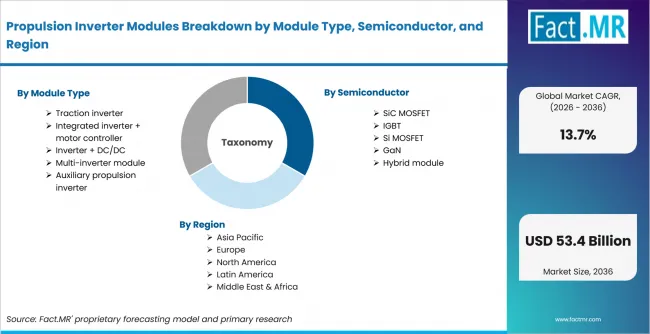
Propulsion Inverter Modules Breakdown By Module Type, Semiconductor, And Region | Source: Fact.MR
| Attribute | Details |
|---|---|
| Quantitative Units | USD billion |
| Market Definition | Propulsion inverter modules that convert battery direct current into controlled alternating current for electric traction motors and integrated electric-drive systems. |
| Module Type | Traction inverter; Integrated inverter + motor controller; Inverter + DC/DC; Multi-inverter module; Auxiliary propulsion inverter |
| Semiconductor | SiC MOSFET; IGBT; Si MOSFET; GaN; Hybrid module |
| Voltage | 800 V; 400 V; >900 V; <400 V |
| Vehicle | Passenger EV; Commercial EV; Hybrid vehicles; Off-highway; Two/three-wheelers |
| Regions Covered | North America; Latin America; Western Europe; Eastern Europe; East Asia; South Asia and Pacific; Middle East and Africa |
| Countries Covered | South Korea; United States; Japan; Germany; United Kingdom |
| Key Companies Profiled | Bosch; Denso; BorgWarner; Valeo; ZF; Marelli |
| Forecast Period | 2026 to 2036 |
| Approach | Hybrid top-down and bottom-up approach using EV production signals; inverter module mix; semiconductor choice; voltage platform mapping; country adoption; and provider portfolio review. |
How is the market segmented?
-
By Module Type
- Traction inverter
- Integrated inverter + motor controller
- Inverter + DC/DC
- Multi-inverter module
- Auxiliary propulsion inverter
-
By Semiconductor
- SiC MOSFET
- IGBT
- Si MOSFET
- GaN
- Hybrid module
-
By Voltage
- 800 V
- 400 V
- >900 V
- <400 V
-
By Vehicle
- Passenger EV
- Commercial EV
- Hybrid vehicles
- Off-highway
- Two/three-wheelers
-
By Region
- North America
- Latin America
- Western Europe
- Eastern Europe
- East Asia
- South Asia and Pacific
- Middle East and Africa