Protein Characterization and Identification Market Size, Share, Growth and Forecast (2026 - 2036)

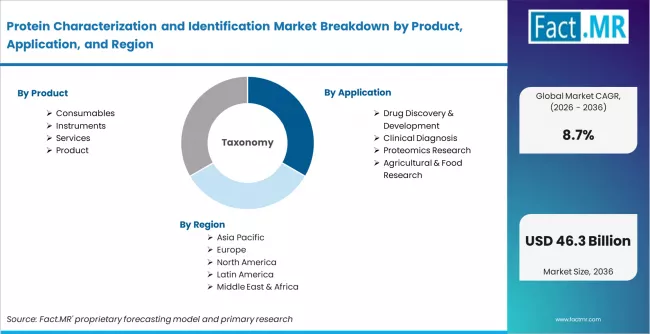
Protein Characterization and Identification Market is segmented by Product (Consumables, Instruments, Services, Product), Application (Drug Discovery & Development, Clinical Diagnosis, Proteomics Research, Agricultural & Food Research), End Use (Pharmaceutical & Biotechnology Companies, Academic & Research Institutes, Contract Research Organizations (CROs), Hospitals & Diagnostic Labs), and Region, with forecasts covering the period from 2026 to 2036.

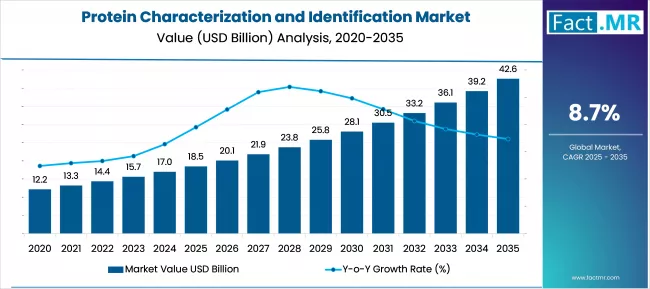
According to Fact.MR estimates, the global protein characterization and identification market market was valued at USD 18.5 billion in 2025. The market is projected to reach USD 20.1 billion in 2026 and is expected to grow to USD 46.3 billion by 2036, expanding at a CAGR of 8.7%. Consumables is anticipated to account for 49.0% of the product segment in 2026, while Drug Discovery & Development is expected to remain the leading application with around 44.0% share.
Protein Characterization and Identification Market Analysis and Forecast by Fact.MR

According to Fact.MR estimates, the global protein characterization and identification market market was valued at USD 18.5 billion in 2025. The market is projected to reach USD 20.1 billion in 2026 and is expected to grow to USD 46.3 billion by 2036, expanding at a CAGR of 8.7%. Consumables is anticipated to account for 49.0% of the product segment in 2026, while Drug Discovery & Development is expected to remain the leading application with around 44.0% share.

Protein Characterization And Identification Market Market Value Analysis

Summary of Protein Characterization and Identification Market

  • Market Snapshot
    • The Protein Characterization and Identification market was valued at USD 18.5 billion in 2025.
    • By 2036, the Protein Characterization and Identification market is expected to be worth USD 46.3 billion.
    • From 2026 to 2036, the market is projected to expand at a CAGR of 8.7%.
    • The market is projected to create an incremental opportunity of USD 26.2 billion between 2026 and 2036.
    • In 2026, Consumables are expected to account for 49% of the product segment, driven by high-frequency chromatography and mass spectrometry workflow consumption in biologics R&D and biosimilar characterization.
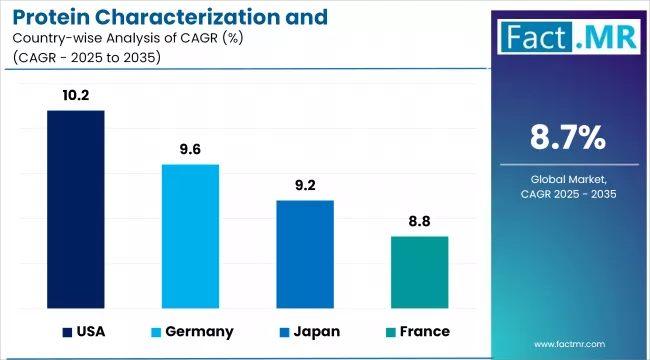
    • The United States (10.2%) and Germany (9.6%) are two of the fastest growing markets in the world.
  • Demand and Growth Drivers
    • Demand is shaped by the scale-up of biologics, biosimilars, and cell and gene therapy pipelines, all of which require extensive protein characterization for regulatory submission, process control, and batch release.
    • Growth reflects tightening regulatory expectations from the FDA and EMA on higher-order structure, post-translational modification profiling, and host cell protein analysis in biologics manufacturing.
    • Adoption is increasing due to mass spectrometer, chromatography, and automation upgrades across pharmaceutical R&D sites and CDMOs, which raise sample throughput and lower per-sample characterization cost.
  • Product and Segment View
    • Consumables lead the product segment with 49% share in 2026, driven by recurring spend on chromatography columns, mass spec calibration standards, electrophoresis gels, and reagents.
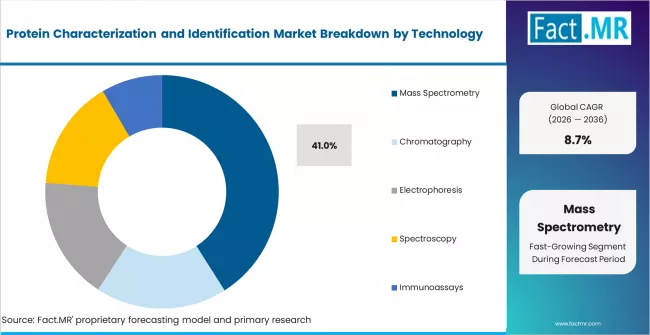
    • Mass Spectrometry dominates the technology segment with 41% share in 2026, anchored by LC-MS/MS workflows central to biologics characterization and proteomics research.
    • Drug Discovery and Development is the largest application segment at 44% share in 2026, supported by target identification, biologics characterization, and vaccine development activity.
  • Geography and Competitive Outlook
    • North America is the largest regional market, with the United States at a 10.2% CAGR on the back of biologics pipeline density, NIH funding, and strong CDMO demand.
    • Europe is led by Germany (9.6%) and France (8.0%), with sustained demand from biosimilar manufacturers, established biopharma hubs, and EMA-aligned quality frameworks.
    • Asia Pacific is led by Japan (8.8%) and South Korea (8.4%), where expanding biologics manufacturing and contract research capacity is pulling mass spec and chromatography adoption. Leading players include Thermo Fisher Scientific, Agilent Technologies, Waters Corporation, Bruker Corporation, Bio-Rad Laboratories, PerkinElmer Inc., Danaher Corporation, Shimadzu Corporation, SCIEX, and LECO Corporation.
  • Analyst Opinion
    • Protein characterization is structurally tied to the biologics boom. The customer is no longer just academic research. It is biopharma manufacturing, CDMOs, and regulators. Mass spectrometry instrument vendors that used to compete on peak resolution are now competing on workflow integration, software, and regulatory validation support. The real commercial leverage is in the recurring consumables and service stream that sits under the instrument, not in the capital sale. Companies that can pair high-end instruments with validated application libraries, regulatory-grade data handling, and global service networks will capture disproportionate share as biologics, biosimilars, and next-generation modalities scale.

Why is the Protein Characterization and Identification Market Growing?

  • Biologics and biosimilar pipeline growth is pulling high-volume protein characterization demand into both development and commercial manufacturing workflows.
  • Regulators are tightening expectations on comparability, higher-order structure, and host cell protein profiling, which forces deeper protein characterization into every biologics program.
  • CDMO capacity expansion and the rise of new modalities such as antibody-drug conjugates, bispecifics, and cell and gene therapies are generating new analytical demand pools.

Biologics now represent the largest source of pharmaceutical industry profit growth, and every biologic candidate requires extensive protein characterization through development, process validation, and commercial batch release. That structural tie means protein analytical spend scales directly with biopharma pipeline activity. Mass spectrometry and chromatography consumables are particularly exposed to this, because they are consumed per-sample and per-batch rather than as one-time capital purchases.

Regulatory expectations are the second key driver. FDA and EMA guidance on biosimilar comparability and on higher-order structure characterization for biologics has expanded the scope of required analytical work, pushing sponsors and CDMOs to invest in higher-resolution mass spectrometry, orthogonal chromatography methods, and more sophisticated data analysis software. This raises the analytical content per program rather than just the number of programs.

The third driver is the new modality pipeline. Cell and gene therapies, oligonucleotide therapeutics, and advanced protein conjugates all bring characterization challenges that expand the analytical method mix. Vendors that can supply validated workflows for these modalities capture disproportionate share of new pipeline spend, and that mix shift supports margin and price premium across the industry.

Segment-wise Analysis of Protein Characterization and Identification Market

  • Consumables lead the product segment at 49% share in 2026, reflecting the recurring nature of per-sample spend on columns, reagents, and calibration standards.
  • Mass Spectrometry is the dominant technology segment at 41% share in 2026, anchored by LC-MS/MS workflows that underpin biologics characterization and proteomics research.
  • Pharmaceutical and Biotechnology Companies lead the end-user segment at 48% share in 2026, with academic and research institutes and CROs making up the rest.

The market segments across product, application, end use, technology, distribution channel, and packaging. Product coverage includes consumables, instruments, services, and software. Technology coverage spans mass spectrometry, chromatography, electrophoresis, spectroscopy, and immunoassays. End-user coverage includes pharma and biotech companies, academic and research institutes, CROs, and hospital and diagnostic labs. Consumables-heavy revenue mix is a defining commercial characteristic of this market.

Consumables Lead the Product Segment
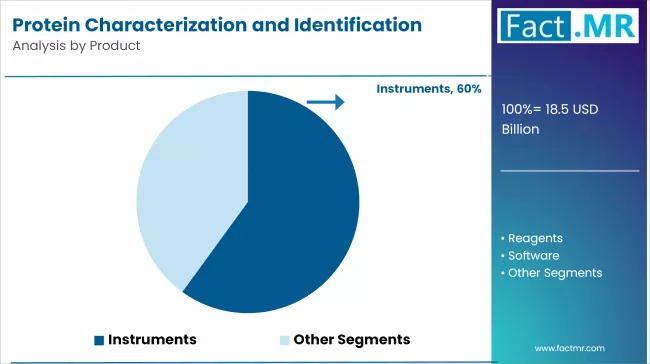
Protein Characterization And Identification Market Analysis By Product

Consumables account for 49% of product revenue in 2026, driven by per-sample spend across chromatography columns and resins, mass spec ionization consumables and calibration standards, and electrophoresis gels and reagents. The consumables revenue pool is attractive because it is tied to usage rather than to one-time capital expenditure. Once an instrument is placed, consumables revenue recurs for the life of that instrument, which often exceeds a decade. Vendors that sell both the instrument and the consumables on the same workflow capture the full lifetime revenue of each installation.

Instruments make up the second largest product category, anchored by mass spectrometry systems, HPLC and UHPLC systems, and electrophoresis platforms. Services, particularly outsourced protein analysis and contract characterization services, round out the third major pool and are growing faster as biopharma sponsors outsource more of their analytical work to CDMOs and CROs.

Mass Spectrometry Leads the Technology Segment
Protein Characterization And Identification Market Analysis By Technology

Mass spectrometry accounts for 41% of technology revenue in 2026, driven by LC-MS/MS, MALDI-TOF, and high-resolution mass spectrometry workflows that underpin biologics characterization, proteomics, and biosimilar comparability. The technology is structurally embedded in regulatory submissions, so any biologic or biosimilar program generates recurring mass spec demand from development through commercial manufacturing.

Chromatography is the second major technology category, anchored by HPLC and UHPLC systems used in routine protein purification and analysis. Electrophoresis remains relevant in gel-based and capillary workflows for specific protein characterization applications, while spectroscopy and immunoassays serve complementary analytical roles.

Key Growth Drivers, Constraints, and Market Scope
Protein Characterization And Identification Market Opportunity Matrix Growth Vs Value

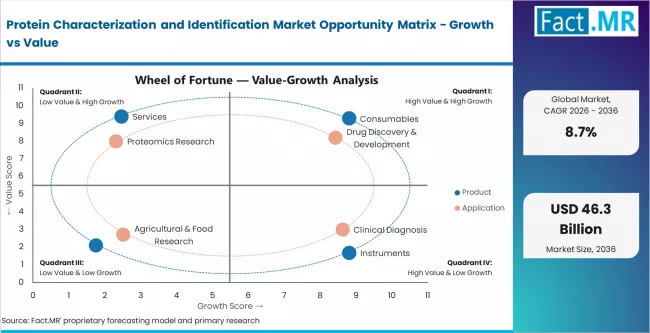
  • Biologics pipeline growth and tightening regulatory expectations are creating structural demand growth for protein characterization instruments, consumables, and services.
  • High capital costs and technical complexity limit adoption in smaller CROs, emerging market labs, and mid-sized biotech sponsors.
  • Expansion into cell and gene therapy, oligonucleotides, and advanced protein conjugates is opening new analytical demand pockets.

The protein characterization market sits at the intersection of the biologics industry, regulatory policy, and analytical technology advancement. Growth is consistent rather than explosive, supported by the structural tie between pharmaceutical pipeline activity and protein analytical spend, but it is tempered by capital intensity and the specialized skills required to operate and interpret the most advanced platforms.

Growth Drivers

Three factors shape primary demand. First, biologics and biosimilars together now represent the fastest-growing category of pharmaceutical spending, and every biologic requires extensive protein characterization through development and manufacturing. Second, regulatory frameworks in the United States, Europe, and Japan have expanded the scope of required protein analysis, particularly around higher-order structure, post-translational modifications, and host cell proteins. Third, modality expansion into antibody-drug conjugates, bispecifics, cell and gene therapies, and protein-based vaccines is raising the analytical content per program, which supports per-customer revenue growth even when program counts stay flat.

Constraints

Constraints sit on the capital intensity side. High-resolution mass spectrometry systems, advanced chromatography platforms, and validated software stacks represent multi-million-dollar investments that are out of reach for smaller sponsors and emerging-market labs. Skilled analytical operators are in limited supply, particularly for the most advanced platforms, and this creates bottlenecks even when capital is available. Regulatory complexity around method validation and data integrity adds overhead that smaller organizations struggle to absorb.

Opportunities

The biggest opportunity is workflow integration. Vendors that can bundle instruments, consumables, software, and application libraries into validated end-to-end workflows capture higher share per customer and lock in longer revenue durations. Cell and gene therapy analytics, oligonucleotide characterization, and advanced conjugate characterization represent new modality opportunity pools where vendors that move early can set the validated standard. Outsourced analytical services represent a third opportunity, as biopharma sponsors increasingly prefer to move specialized analytical work to CDMOs and CROs rather than build in-house capability.

Regional Outlook Across Key Markets

Top Country Growth Comparison Protein Characterization And Identification Market Cagr (2026 2036)

Country CAGR (2026-2036)
United States 10.2%
Germany 9.6%
United Kingdom 9.2%
Japan 8.8%
South Korea 8.4%
France 8.0%

Protein Characterization And Identification Market Cagr Analysis By Country

  • North America is the largest regional market by absolute revenue, led by the United States at 10.2% CAGR on the back of biologics pipeline density and NIH funding.
  • Europe is led by Germany (9.6%) and France (8.0%), supported by established biopharma hubs and consistent biosimilar manufacturing demand.
  • Asia Pacific growth is anchored by Japan (8.8%) and South Korea (8.4%), supported by expanding biologics manufacturing capacity and contract research activity.
  • The United Kingdom (9.2%) remains a consistent contributor, supported by strong academic research and biotech cluster density.

Regional dynamics track where biologics pipelines and manufacturing sit. North America retains the largest absolute revenue pool because of biopharma pipeline density, NIH research funding, and active CDMO capacity. Europe is structurally important because of biosimilar manufacturing depth in Germany and the UK, and France supports a mature pharmaceutical sector. Asia Pacific is scaling fastest from a lower base, driven by Japan's biopharma sector, South Korea's expanding CDMO capacity, and growing pipeline activity in China.

United States
Protein Characterization And Identification Market Country Value Analysis

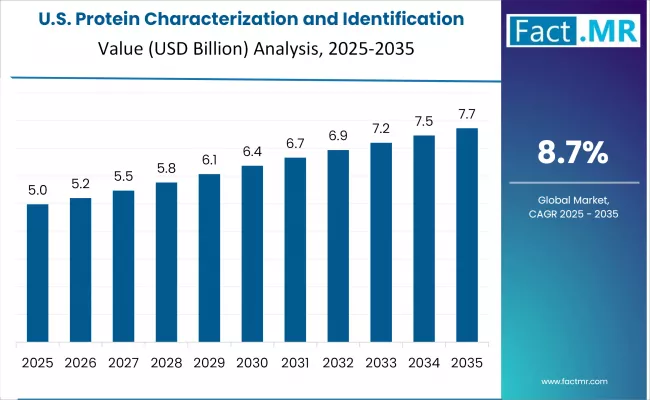
The United States is the largest single-country market, with 2026 revenue of approximately USD 6.98 billion and a 10.2% CAGR through 2036. The country combines the deepest biologics pipeline, concentrated CDMO capacity in Boston, San Francisco, and Research Triangle, and strong NIH-backed academic research that sustains discovery-side demand. FDA guidance on biosimilar comparability and biologic characterization keeps analytical content per program high.

  • Dense biologics pipeline and CDMO capacity anchor the largest consumables revenue pool globally.
  • NIH research funding sustains discovery-side demand for mass spec and chromatography platforms.
  • FDA guidance on higher-order structure and host cell protein analysis maintains high analytical content per program.

Germany

Germany posts a 9.6% CAGR through 2036, anchored by established biologics and biosimilar manufacturing in Bavaria and Baden-Württemberg, strong Max Planck and Fraunhofer research networks, and active CDMO capacity. The country is also a global center for industrial scale chromatography and mass spectrometry use in biosimilar manufacturing.

  • Biologics and biosimilar manufacturing in Bavaria and Baden-Württemberg drives sustained consumables demand.
  • Max Planck and Fraunhofer research networks support discovery-side analytical platforms.
  • CDMO capacity expansion continues to pull analytical instrument investment.

United Kingdom

The United Kingdom records a 9.2% CAGR through 2036. Cambridge and Oxford biotech clusters, strong academic research through the MRC and Wellcome Trust networks, and concentrated pharmaceutical R&D activity sustain demand. The UK is also a significant CRO and CDMO hub, which pulls in consumables and service spend alongside capital instrument investment.

  • Cambridge and Oxford biotech clusters sustain discovery-side protein analytical demand.
  • MRC and Wellcome Trust funding supports academic research spend on mass spec and chromatography.
  • Growing CDMO and CRO capacity pulls recurring consumables and service revenue.

Japan
Protein Characterization And Identification Market Japan Market Share Analysis By Product

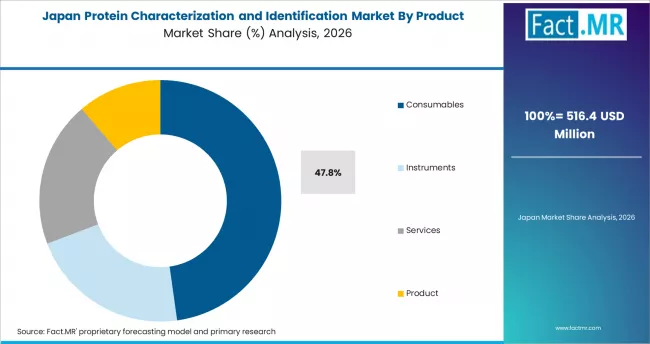
Japan is the leading Asian market for protein characterization, with an 8.8% CAGR through 2036. Domestic biopharmaceutical firms and CDMOs in Osaka and Kobe drive recurring analytical demand. Japanese instrument companies including Shimadzu hold strong domestic positions, and PMDA regulatory frameworks sustain the analytical content per biologic and biosimilar program.

  • Domestic biopharma and CDMO activity in Osaka and Kobe anchor sustained consumables demand.
  • Strong domestic instrument vendors including Shimadzu shape competitive dynamics.
  • PMDA regulatory frameworks maintain rigorous analytical expectations for biologics and biosimilars.

South Korea
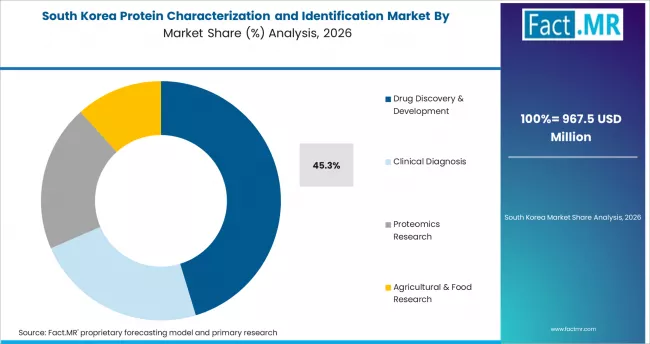
Protein Characterization And Identification Market South Korea Market Share Analysis By Application

South Korea records an 8.4% CAGR through 2036. The country has built one of the world's largest biologics and biosimilar manufacturing footprints through Samsung Biologics, Celltrion, and SK Biopharmaceuticals. That capacity directly pulls in mass spec and chromatography demand, and growing domestic biotech R&D adds discovery-side demand.

  • World-scale biologics and biosimilar manufacturing capacity at Samsung Biologics and Celltrion anchors demand.
  • Expanding domestic biotech R&D creates discovery-side instrument demand.
  • Government precision biomanufacturing programs direct public investment into analytical capability.

France

France posts an 8.0% CAGR through 2036. The country has a mature pharmaceutical sector anchored by Sanofi and an established CRO and CDMO base. Paris and Lyon support expanding biologics activity, and INSERM-backed academic research sustains discovery-side analytical demand.

  • Established pharmaceutical sector anchored by Sanofi sustains analytical spend.
  • Paris and Lyon biotech clusters support expanding biologics and biosimilar activity.
  • INSERM research networks maintain discovery-side instrument demand.

Competitive Benchmarking and Company Positioning
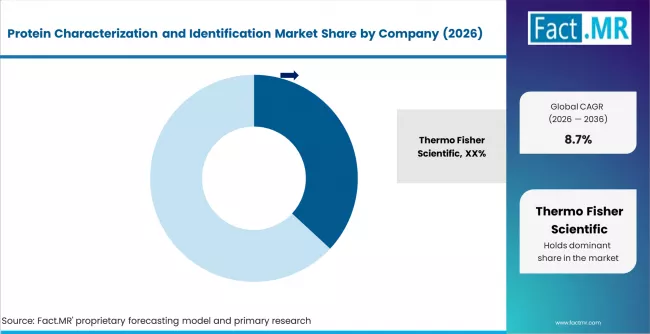
Protein Characterization And Identification Market Analysis By Company

  • Market leaders Thermo Fisher Scientific, Agilent Technologies, Waters Corporation, Bruker Corporation, and Bio-Rad Laboratories together control an estimated 58 to 63% of global market share in 2026.
  • Competition is shifting from single-instrument performance toward integrated workflow differentiation that combines instruments, consumables, software, and regulatory support.
  • Japanese players Shimadzu and specialist firms such as SCIEX and LECO compete through technology depth and regional strength rather than portfolio breadth.

The protein characterization market is moderately concentrated. Five vendors dominate global revenue, and concentration has been stable over the past decade. Barriers to entry are high because buyers require validated workflows, regulatory-grade data handling, and global service networks, which takes years and significant capital to build. The competitive question is not who enters the market, but how existing players compete for consumable share, service attachment, and new-modality workflow leadership.

Thermo Fisher Scientific leads the market with an estimated 36.9% share in 2026, built on broad instrument coverage, the deepest consumables catalog, and an integrated software and service stack. Agilent Technologies, Waters Corporation, Bruker Corporation, and Bio-Rad Laboratories compete through technology specialization and regional depth. Agilent is particularly strong in LC-MS and chromatography, Waters in LC and mass spec for biopharma, Bruker in high-end mass spec and NMR, and Bio-Rad in electrophoresis and immunoassay.

Specialist challengers include PerkinElmer, Danaher Corporation, Shimadzu Corporation, SCIEX, and LECO Corporation. Shimadzu is particularly strong in Japan and Asia Pacific, SCIEX in quantitative mass spectrometry, and LECO in specialized applications. These players compete on focused technology strength rather than on full-portfolio coverage.

Commercial leverage in this market sits in consumables and service attachment. Instrument sales carry lower gross margins and longer sales cycles, while consumables deliver recurring revenue at higher margins. The long-term winners will be firms that can install instruments in biologics manufacturing sites and CDMOs, lock in validated workflows, and grow consumables and service revenue off the installed base over decade-long lifecycles.

Competitive Analysis

Commercial competition is increasingly workflow-based. Biopharma customers do not just buy instruments. They buy validated analytical methods that survive regulatory audit, and they expect vendors to provide the software, consumables, and method libraries that support those methods. Vendors that can present a complete solution for biologics characterization or biosimilar comparability are winning share from those that can only sell hardware. The cell and gene therapy and oligonucleotide modalities are creating a new workflow competition that is still in flux, and market leaders are investing heavily to define those workflows before smaller specialists can lock in niche positions.

Benchmarking Table

Company Portfolio Breadth Consumables Depth Regional Reach Biopharma Customer Depth
Thermo Fisher Scientific Very High Very High Global Very High
Agilent Technologies High High Global High
Waters Corporation Medium-High High Global High
Bruker Corporation Medium (mass spec focus) Medium Global Medium-High
Shimadzu Corporation Medium-High Medium-High Strong in Asia Medium

Recent Developments

  • Thermo Fisher Scientific expanded its Orbitrap Astral mass spectrometer workflows for biologics characterization in 2025, targeting higher throughput in biopharma QC labs.
  • Waters Corporation launched expanded LC-MS platform integrations in 2026 aimed at biosimilar comparability workflows and high-throughput release testing.
  • Bruker Corporation announced expanded timsTOF applications for biologics characterization in 2025, with particular emphasis on structural mass spectrometry workflows.

Leading Companies Shaping Protein Characterization and Identification Market

  • Major Players

    • Thermo Fisher Scientific
    • Agilent Technologies
    • Waters Corporation
    • Bruker Corporation
    • Bio-Rad Laboratories
    • PerkinElmer Inc.
    • Shimadzu Corporation
  • Emerging Players

    • Danaher Corporation
    • SCIEX
    • LECO Corporation
    • JEOL Ltd.
    • Hitachi High-Tech
    • GE HealthCare (Cytiva)
    • Evosep
    • Biognosys
    • Seer Inc.
    • Nautilus Biotechnology

Sources and Research References

  • World Health Organization (WHO) biologicals program publications and global biosimilar regulatory updates
  • U.S. Food and Drug Administration (FDA) Center for Drug Evaluation and Research guidance on biologics characterization and biosimilar comparability
  • European Medicines Agency (EMA) Committee for Medicinal Products for Human Use (CHMP) guidelines on biologics and biosimilars
  • Thermo Fisher Scientific, Agilent Technologies, Waters Corporation, Bruker Corporation, and Shimadzu Corporation annual reports and investor presentations
  • Pharmaceutical Research and Manufacturers of America (PhRMA) biologics pipeline data
  • Peer-reviewed proteomics and analytical chemistry journals including Analytical Chemistry and Molecular and Cellular Proteomics
  • Primary interviews with analytical scientists, biologics QC leads, CDMO procurement teams, and mass spectrometry product managers

This bibliography is provided for reader reference and is not exhaustive. The full report contains the complete reference list and detailed citations.

Key Questions This Report Addresses

  • What is the size of the protein characterization and identification market in 2026 and 2036?
  • What CAGR is the market expected to record between 2026 and 2036?
  • Which product and technology segments are projected to lead the market in 2026?
  • Which application segment accounts for the largest share of demand?
  • How is biologics and biosimilar pipeline activity shaping market growth?
  • Which countries are the fastest-growing markets through 2036 and why?
  • Who are the leading companies in the market, and how are they competitively differentiated?
  • How does Fact.MR estimate and validate the market forecast?

Protein Characterization and Identification Market Definition

The protein characterization and identification market covers instruments, consumables, software, and services used to characterize and identify proteins for biopharmaceutical research, biologics development and manufacturing, biosimilar development, proteomics research, and clinical diagnostics. The scope spans mass spectrometry, chromatography, electrophoresis, spectroscopy, and immunoassay platforms along with their associated reagents, columns, kits, and analytical service engagements.

Protein Characterization and Identification Market Inclusions

The market includes all instrument categories used for protein analysis, including LC-MS, MALDI-TOF, HPLC, UHPLC, gel and capillary electrophoresis, NMR, UV-Vis, and ELISA and Western blotting platforms. It covers consumables such as chromatography columns and resins, mass spec ionization kits, calibration standards, electrophoresis gels and buffers, and related reagents. Services include outsourced protein analysis, contract research protein characterization, and analytical method development for biologics and biosimilars. Software used for data acquisition, processing, and regulatory-grade reporting is also included.

Protein Characterization and Identification Market Exclusions

The market excludes standalone therapeutic protein products, general-purpose molecular biology instruments used outside protein workflows, and routine clinical chemistry analyzers. Purely research-only reagents not tied to protein characterization workflows, as well as industrial-scale protein production and formulation equipment, are excluded. Protein structure prediction software without associated analytical instrument integration, and generic laboratory automation hardware not specific to protein workflows, are also excluded.

Protein Characterization and Identification Market Research Methodology

  • Primary Research: Interviews with protein analytical scientists, biologics QC leads, CDMO procurement teams, mass spectrometry product managers, and regulatory affairs professionals across major biopharma regions.
  • Desk Research: Regulatory guidance documents from FDA, EMA, and PMDA, pharmacopoeia updates, published biologics and biosimilar pipelines, annual reports of listed instrument vendors, and peer-reviewed proteomics literature.
  • Market Sizing: Demand-side model built on instrument installed base, consumable spend per instrument, service attach rates, and biologics pipeline indicators, triangulated with reported vendor segment revenues.
  • Data Validation: Cross-checked against vendor earnings disclosures, CDMO capacity expansions, and biopharma capital spending data. Sensitivity testing on consumable spend ratios and regional price dynamics.

Scope of Analysis

Protein Characterization And Identification Market Breakdown By Product, Application, And Region

Parameter Details
Quantitative Units USD 20.11 billion in 2026 to USD 46.31 billion by 2036, at a CAGR of 8.7%
Market Definition Instruments, consumables, software, and services used to characterize and identify proteins for biopharma R&D, biologics manufacturing, biosimilar development, proteomics research, and clinical diagnostics.
Regions North America, Latin America, Europe, East Asia, South Asia and Pacific, Middle East and Africa
Countries United States, Germany, United Kingdom, Japan, South Korea, France, and 25+ additional countries
Companies Thermo Fisher Scientific, Agilent Technologies, Waters Corporation, Bruker Corporation, Bio-Rad Laboratories, PerkinElmer Inc., Danaher Corporation, Shimadzu Corporation, SCIEX, LECO Corporation
Forecast Period 2026 to 2036
Approach Hybrid demand-side and top-down methodology built on instrument installed base, consumable attach rates, service revenue benchmarking, biologics pipeline indicators, and primary interviews with biopharma, CDMOs, and instrument vendors.

Analysis by Product, Application, End Use, Technology, Distribution Channel, Packaging, and Region

  • Protein Characterization and Identification Market Market Segmented by Product:

    • Consumables
      • Chromatography Consumables
        • Columns & Resins
        • Buffers & Reagents
      • Mass Spectrometry Consumables
        • Ionization Kits
        • Calibration Standards
      • Electrophoresis Consumables
        • Gels & Buffers
        • Staining Reagents
    • Instruments
      • Mass Spectrometers
        • LC-MS Systems
        • MALDI-TOF Systems
      • Chromatography Systems
        • HPLC Systems
        • UHPLC Systems
      • Electrophoresis Systems
        • Gel Electrophoresis Units
        • Capillary Electrophoresis Systems
    • Services
      • Protein Analysis Services
        • Contract Research Services
    • Product
    • Development & Process Development Services
      • LNP Formulation Development
        • Process Optimization Services
        • Scale-Up Development
    • cGMP Manufacturing Services
      • Clinical-Scale Manufacturing
        • Commercial-Scale Production
    • Analytical & Quality Control Services
      • Characterization & Stability Testing
        • Release Testing & Validation
    • Fill-Finish Services
      • Sterile Fill-Finish
        • Lyophilization Services
  • Protein Characterization and Identification Market Market Segmented by Application:

    • Drug Discovery & Development
      • Target Identification
        • Biologics Characterization
        • Vaccine Development
    • Clinical Diagnosis
      • Disease Biomarker Identification
        • Cancer Diagnostics
    • Proteomics Research
      • Protein Structure Analysis
        • Functional Proteomics
    • Agricultural & Food Research
      • Crop Protein Analysis
        • Food Quality Testing
  • Protein Characterization and Identification Market Market Segmented by End Use:

    • Pharmaceutical & Biotechnology Companies
      • Biopharmaceutical R&D
        • Biologics Manufacturing
    • Academic & Research Institutes
      • University Laboratories
        • Government Research Centers
    • Contract Research Organizations (CROs)
      • Outsourced Protein Analysis
        • Clinical Research Services
    • Hospitals & Diagnostic Labs
      • Clinical Testing Labs
        • Specialized Diagnostic Centers
  • Protein Characterization and Identification Market Market Segmented by Technology:

    • Mass Spectrometry
      • LC-MS/MS
        • MALDI-TOF
        • High-Resolution Mass Spectrometry
    • Chromatography
      • High-Performance Liquid Chromatography (HPLC)
        • Ultra-High Performance Liquid Chromatography (UHPLC)
    • Electrophoresis
      • Gel Electrophoresis
        • Capillary Electrophoresis
    • Spectroscopy
      • NMR Spectroscopy
        • UV-Vis Spectroscopy
    • Immunoassays
      • ELISA
        • Western Blotting
  • Protein Characterization and Identification Market Market Segmented by Distribution Channel:

    • Direct Sales
      • Manufacturer Contracts
        • Institutional Procurement
    • Distributors
      • Laboratory Equipment Suppliers
        • Regional Vendors
    • Service Providers
      • Contract Research Organizations
        • Analytical Service Providers
    • Protein Characterization and Identification Market Market Segmented by Packaging:

    • Reagent & Consumable Packaging
      • Bottles & Vials
        • Kit-Based Packaging
    • Instrument Packaging
      • Protective Equipment Packaging
        • Installation-Ready Systems
    • Cold Chain Packaging
      • Temperature-Controlled Shipping
        • Sample Transport Containers
  • Protein Characterization and Identification Market Market by Region:

    • North America
      • USA
      • Canada
      • Mexico
    • Latin America
      • Brazil
      • Chile
      • Rest of Latin America
    • Western Europe
      • Germany
      • UK
      • Italy
      • Spain
      • France
      • Nordic
      • BENELUX
      • Rest of Western Europe
    • Eastern Europe
      • Russia
      • Poland
      • Hungary
      • Balkan & Baltic
      • Rest of Eastern Europe
    • East Asia
      • China
      • Japan
      • South Korea
    • South Asia and Pacific
      • India
      • ASEAN
      • Australia & New Zealand
      • Rest of South Asia and Pacific
    • Middle East & Africa
      • Kingdom of Saudi Arabia
      • Other GCC Countries
      • Turkiye
      • South Africa
      • Other African Union
      • Rest of Middle East & Africa

- Frequently Asked Questions -

How big is the protein characterization and identification market in 2026?

The global protein characterization and identification market is valued at USD 20.11 billion in 2026.

What will be the size of the protein characterization and identification market in 2036?

The market is projected to reach USD 46.31 billion by 2036.

How fast is the market expected to grow between 2026 and 2036?

The market is expected to expand at a CAGR of 8.7% between 2026 and 2036.

Which product segment leads the market in 2026?

Consumables lead the product segment with 49% share in 2026.

Which country is the fastest-growing market?

The United States is the fastest-growing major market with a 10.2% CAGR through 2036.

Which is the second-fastest-growing market?

Germany is the second-fastest-growing market, expanding at a 9.6% CAGR through 2036.

What does the protein characterization and identification market include?

The market covers instruments, consumables, software, and services used to characterize and identify proteins across mass spectrometry, chromatography, electrophoresis, spectroscopy, and immunoassay platforms for biopharma R&D, biologics manufacturing, biosimilar development, proteomics research, and clinical diagnostics.

How does Fact.MR estimate and validate the market forecast?

The forecast is built on a hybrid demand-side and top-down methodology using instrument installed base, consumable attach rates, service revenue benchmarking, biologics pipeline indicators, and primary interviews with biopharma, CDMOs, and instrument vendors.

Table of Content

  1. Executive Summary
    • Global Market Outlook
    • Demand to side Trends
    • Supply to side Trends
    • Technology Roadmap Analysis
    • Analysis and Recommendations
  2. Market Overview
    • Market Coverage / Taxonomy
    • Market Definition / Scope / Limitations
  3. Research Methodology
    • Chapter Orientation
    • Analytical Lens and Working Hypotheses
      • Market Structure, Signals, and Trend Drivers
      • Benchmarking and Cross-market Comparability
      • Market Sizing, Forecasting, and Opportunity Mapping
    • Research Design and Evidence Framework
      • Desk Research Programme (Secondary Evidence)
        • Company Annual and Sustainability Reports
        • Peer-reviewed Journals and Academic Literature
        • Corporate Websites, Product Literature, and Technical Notes
        • Earnings Decks and Investor Briefings
        • Statutory Filings and Regulatory Disclosures
        • Technical White Papers and Standards Notes
        • Trade Journals, Industry Magazines, and Analyst Briefs
        • Conference Proceedings, Webinars, and Seminar Materials
        • Government Statistics Portals and Public Data Releases
        • Press Releases and Reputable Media Coverage
        • Specialist Newsletters and Curated Briefings
        • Sector Databases and Reference Repositories
        • Fact.MR Internal Proprietary Databases and Historical Market Datasets
        • Subscription Datasets and Paid Sources
        • Social Channels, Communities, and Digital Listening Inputs
        • Additional Desk Sources
      • Expert Input and Fieldwork (Primary Evidence)
        • Primary Modes
          • Qualitative Interviews and Expert Elicitation
          • Quantitative Surveys and Structured Data Capture
          • Blended Approach
        • Why Primary Evidence is Used
        • Field Techniques
          • Interviews
          • Surveys
          • Focus Groups
          • Observational and In-context Research
          • Social and Community Interactions
        • Stakeholder Universe Engaged
          • C-suite Leaders
          • Board Members
          • Presidents and Vice Presidents
          • R&D and Innovation Heads
          • Technical Specialists
          • Domain Subject-matter Experts
          • Scientists
          • Physicians and Other Healthcare Professionals
        • Governance, Ethics, and Data Stewardship
          • Research Ethics
          • Data Integrity and Handling
      • Tooling, Models, and Reference Databases
    • Data Engineering and Model Build
      • Data Acquisition and Ingestion
      • Cleaning, Normalisation, and Verification
      • Synthesis, Triangulation, and Analysis
    • Quality Assurance and Audit Trail
  4. Market Background
    • Market Dynamics
      • Drivers
      • Restraints
      • Opportunity
      • Trends
    • Scenario Forecast
      • Demand in Optimistic Scenario
      • Demand in Likely Scenario
      • Demand in Conservative Scenario
    • Opportunity Map Analysis
    • Product Life Cycle Analysis
    • Supply Chain Analysis
    • Investment Feasibility Matrix
    • Value Chain Analysis
    • PESTLE and Porter’s Analysis
    • Regulatory Landscape
    • Regional Parent Market Outlook
    • Production and Consumption Statistics
    • Import and Export Statistics
  5. Global Market Analysis 2021 to 2025 and Forecast, 2026 to 2036
    • Historical Market Size Value (USD Million) Analysis, 2021 to 2025
    • Current and Future Market Size Value (USD Million) Projections, 2026 to 2036
      • Y to o to Y Growth Trend Analysis
      • Absolute $ Opportunity Analysis
  6. Global Market Pricing Analysis 2021 to 2025 and Forecast 2026 to 2036
  7. Global Market Analysis 2021 to 2025 and Forecast 2026 to 2036, By Product
    • Introduction / Key Findings
    • Historical Market Size Value (USD Million) Analysis By Product , 2021 to 2025
    • Current and Future Market Size Value (USD Million) Analysis and Forecast By Product , 2026 to 2036
      • Consumables
        • Chromatography Consumables
        • _Columns & Resins
        • _Buffers & Reagents
        • Mass Spectrometry Consumables
        • _Ionization Kits
        • _Calibration Standards
        • Electrophoresis Consumables
        • _Gels & Buffers
        • _Staining Reagents
      • Instruments
        • Mass Spectrometers
        • _LC-MS Systems
        • _MALDI-TOF Systems
        • Chromatography Systems
        • _HPLC Systems
      • Services
        • Protein Analysis Services
        • _Contract Research Services
      • Product
    • Y to o to Y Growth Trend Analysis By Product , 2021 to 2025
    • Absolute $ Opportunity Analysis By Product , 2026 to 2036
  8. Global Market Analysis 2021 to 2025 and Forecast 2026 to 2036, By Application
    • Introduction / Key Findings
    • Historical Market Size Value (USD Million) Analysis By Application, 2021 to 2025
    • Current and Future Market Size Value (USD Million) Analysis and Forecast By Application, 2026 to 2036
      • Drug Discovery & Development
        • Target Identification
        • _Biologics Characterization
        • _Vaccine Development
      • Clinical Diagnosis
        • Disease Biomarker Identification
        • _Cancer Diagnostics
      • Proteomics Research
        • Protein Structure Analysis
        • _Functional Proteomics
      • Agricultural & Food Research
        • Crop Protein Analysis
        • _Food Quality Testing
    • Y to o to Y Growth Trend Analysis By Application, 2021 to 2025
    • Absolute $ Opportunity Analysis By Application, 2026 to 2036
  9. Global Market Analysis 2021 to 2025 and Forecast 2026 to 2036, By End Use
    • Introduction / Key Findings
    • Historical Market Size Value (USD Million) Analysis By End Use, 2021 to 2025
    • Current and Future Market Size Value (USD Million) Analysis and Forecast By End Use, 2026 to 2036
      • Pharmaceutical & Biotechnology Companies
        • Biopharmaceutical R&D
        • _Biologics Manufacturing
      • Academic & Research Institutes
        • University Laboratories
        • _Government Research Centers
      • Contract Research Organizations (CROs)
        • Outsourced Protein Analysis
        • _Clinical Research Services
      • Hospitals & Diagnostic Labs
        • Clinical Testing Labs
        • _Specialized Diagnostic Centers
    • Y to o to Y Growth Trend Analysis By End Use, 2021 to 2025
    • Absolute $ Opportunity Analysis By End Use, 2026 to 2036
  10. Global Market Analysis 2021 to 2025 and Forecast 2026 to 2036, By Technology
    • Introduction / Key Findings
    • Historical Market Size Value (USD Million) Analysis By Technology, 2021 to 2025
    • Current and Future Market Size Value (USD Million) Analysis and Forecast By Technology, 2026 to 2036
      • Mass Spectrometry
        • LC-MS/MS
        • _MALDI-TOF
        • _High-Resolution Mass Spectrometry
      • Chromatography
        • High-Performance Liquid Chromatography (HPLC)
        • _Ultra-High Performance Liquid Chromatography (UHPLC)
      • Electrophoresis
        • Gel Electrophoresis
        • _Capillary Electrophoresis
      • Spectroscopy
        • NMR Spectroscopy
        • _UV-Vis Spectroscopy
      • Immunoassays
        • ELISA
        • _Western Blotting
    • Y to o to Y Growth Trend Analysis By Technology, 2021 to 2025
    • Absolute $ Opportunity Analysis By Technology, 2026 to 2036
  11. Global Market Analysis 2021 to 2025 and Forecast 2026 to 2036, By Distribution Channel
    • Introduction / Key Findings
    • Historical Market Size Value (USD Million) Analysis By Distribution Channel, 2021 to 2025
    • Current and Future Market Size Value (USD Million) Analysis and Forecast By Distribution Channel, 2026 to 2036
      • Direct Sales
        • Manufacturer Contracts
        • _Institutional Procurement
      • Distributors
        • Laboratory Equipment Suppliers
        • _Regional Vendors
      • Service Providers
        • Contract Research Organizations
        • _Analytical Service Providers
    • Y to o to Y Growth Trend Analysis By Distribution Channel, 2021 to 2025
    • Absolute $ Opportunity Analysis By Distribution Channel, 2026 to 2036
  12. Global Market Analysis 2021 to 2025 and Forecast 2026 to 2036, By Packaging
    • Introduction / Key Findings
    • Historical Market Size Value (USD Million) Analysis By Packaging, 2021 to 2025
    • Current and Future Market Size Value (USD Million) Analysis and Forecast By Packaging, 2026 to 2036
      • Reagent & Consumable Packaging
        • Bottles & Vials
        • _Kit-Based Packaging
      • Instrument Packaging
        • Protective Equipment Packaging
        • _Installation-Ready Systems
      • Cold Chain Packaging
        • Temperature-Controlled Shipping
        • _Sample Transport Containers
    • Y to o to Y Growth Trend Analysis By Packaging, 2021 to 2025
    • Absolute $ Opportunity Analysis By Packaging, 2026 to 2036
  13. Global Market Analysis 2021 to 2025 and Forecast 2026 to 2036, By Region
    • Introduction
    • Historical Market Size Value (USD Million) Analysis By Region, 2021 to 2025
    • Current Market Size Value (USD Million) Analysis and Forecast By Region, 2026 to 2036
      • North America
      • Latin America
      • Western Europe
      • Eastern Europe
      • East Asia
      • South Asia and Pacific
      • Middle East & Africa
    • Market Attractiveness Analysis By Region
  14. North America Market Analysis 2021 to 2025 and Forecast 2026 to 2036, By Country
    • Historical Market Size Value (USD Million) Trend Analysis By Market Taxonomy, 2021 to 2025
    • Market Size Value (USD Million) Forecast By Market Taxonomy, 2026 to 2036
      • By Country
        • USA
        • Canada
        • Mexico
      • By Product
      • By Application
      • By End Use
      • By Technology
      • By Distribution Channel
      • By Packaging
    • Market Attractiveness Analysis
      • By Country
      • By Product
      • By Application
      • By End Use
      • By Technology
      • By Distribution Channel
      • By Packaging
    • Key Takeaways
  15. Latin America Market Analysis 2021 to 2025 and Forecast 2026 to 2036, By Country
    • Historical Market Size Value (USD Million) Trend Analysis By Market Taxonomy, 2021 to 2025
    • Market Size Value (USD Million) Forecast By Market Taxonomy, 2026 to 2036
      • By Country
        • Brazil
        • Chile
        • Rest of Latin America
      • By Product
      • By Application
      • By End Use
      • By Technology
      • By Distribution Channel
      • By Packaging
    • Market Attractiveness Analysis
      • By Country
      • By Product
      • By Application
      • By End Use
      • By Technology
      • By Distribution Channel
      • By Packaging
    • Key Takeaways
  16. Western Europe Market Analysis 2021 to 2025 and Forecast 2026 to 2036, By Country
    • Historical Market Size Value (USD Million) Trend Analysis By Market Taxonomy, 2021 to 2025
    • Market Size Value (USD Million) Forecast By Market Taxonomy, 2026 to 2036
      • By Country
        • Germany
        • UK
        • Italy
        • Spain
        • France
        • Nordic
        • BENELUX
        • Rest of Western Europe
      • By Product
      • By Application
      • By End Use
      • By Technology
      • By Distribution Channel
      • By Packaging
    • Market Attractiveness Analysis
      • By Country
      • By Product
      • By Application
      • By End Use
      • By Technology
      • By Distribution Channel
      • By Packaging
    • Key Takeaways
  17. Eastern Europe Market Analysis 2021 to 2025 and Forecast 2026 to 2036, By Country
    • Historical Market Size Value (USD Million) Trend Analysis By Market Taxonomy, 2021 to 2025
    • Market Size Value (USD Million) Forecast By Market Taxonomy, 2026 to 2036
      • By Country
        • Russia
        • Poland
        • Hungary
        • Balkan & Baltic
        • Rest of Eastern Europe
      • By Product
      • By Application
      • By End Use
      • By Technology
      • By Distribution Channel
      • By Packaging
    • Market Attractiveness Analysis
      • By Country
      • By Product
      • By Application
      • By End Use
      • By Technology
      • By Distribution Channel
      • By Packaging
    • Key Takeaways
  18. East Asia Market Analysis 2021 to 2025 and Forecast 2026 to 2036, By Country
    • Historical Market Size Value (USD Million) Trend Analysis By Market Taxonomy, 2021 to 2025
    • Market Size Value (USD Million) Forecast By Market Taxonomy, 2026 to 2036
      • By Country
        • China
        • Japan
        • South Korea
      • By Product
      • By Application
      • By End Use
      • By Technology
      • By Distribution Channel
      • By Packaging
    • Market Attractiveness Analysis
      • By Country
      • By Product
      • By Application
      • By End Use
      • By Technology
      • By Distribution Channel
      • By Packaging
    • Key Takeaways
  19. South Asia and Pacific Market Analysis 2021 to 2025 and Forecast 2026 to 2036, By Country
    • Historical Market Size Value (USD Million) Trend Analysis By Market Taxonomy, 2021 to 2025
    • Market Size Value (USD Million) Forecast By Market Taxonomy, 2026 to 2036
      • By Country
        • India
        • ASEAN
        • Australia & New Zealand
        • Rest of South Asia and Pacific
      • By Product
      • By Application
      • By End Use
      • By Technology
      • By Distribution Channel
      • By Packaging
    • Market Attractiveness Analysis
      • By Country
      • By Product
      • By Application
      • By End Use
      • By Technology
      • By Distribution Channel
      • By Packaging
    • Key Takeaways
  20. Middle East & Africa Market Analysis 2021 to 2025 and Forecast 2026 to 2036, By Country
    • Historical Market Size Value (USD Million) Trend Analysis By Market Taxonomy, 2021 to 2025
    • Market Size Value (USD Million) Forecast By Market Taxonomy, 2026 to 2036
      • By Country
        • Kingdom of Saudi Arabia
        • Other GCC Countries
        • Turkiye
        • South Africa
        • Other African Union
        • Rest of Middle East & Africa
      • By Product
      • By Application
      • By End Use
      • By Technology
      • By Distribution Channel
      • By Packaging
    • Market Attractiveness Analysis
      • By Country
      • By Product
      • By Application
      • By End Use
      • By Technology
      • By Distribution Channel
      • By Packaging
    • Key Takeaways
  21. Key Countries Market Analysis
    • USA
      • Pricing Analysis
      • Market Share Analysis, 2025
        • By Product
        • By Application
        • By End Use
        • By Technology
        • By Distribution Channel
        • By Packaging
    • Canada
      • Pricing Analysis
      • Market Share Analysis, 2025
        • By Product
        • By Application
        • By End Use
        • By Technology
        • By Distribution Channel
        • By Packaging
    • Mexico
      • Pricing Analysis
      • Market Share Analysis, 2025
        • By Product
        • By Application
        • By End Use
        • By Technology
        • By Distribution Channel
        • By Packaging
    • Brazil
      • Pricing Analysis
      • Market Share Analysis, 2025
        • By Product
        • By Application
        • By End Use
        • By Technology
        • By Distribution Channel
        • By Packaging
    • Chile
      • Pricing Analysis
      • Market Share Analysis, 2025
        • By Product
        • By Application
        • By End Use
        • By Technology
        • By Distribution Channel
        • By Packaging
    • Germany
      • Pricing Analysis
      • Market Share Analysis, 2025
        • By Product
        • By Application
        • By End Use
        • By Technology
        • By Distribution Channel
        • By Packaging
    • UK
      • Pricing Analysis
      • Market Share Analysis, 2025
        • By Product
        • By Application
        • By End Use
        • By Technology
        • By Distribution Channel
        • By Packaging
    • Italy
      • Pricing Analysis
      • Market Share Analysis, 2025
        • By Product
        • By Application
        • By End Use
        • By Technology
        • By Distribution Channel
        • By Packaging
    • Spain
      • Pricing Analysis
      • Market Share Analysis, 2025
        • By Product
        • By Application
        • By End Use
        • By Technology
        • By Distribution Channel
        • By Packaging
    • France
      • Pricing Analysis
      • Market Share Analysis, 2025
        • By Product
        • By Application
        • By End Use
        • By Technology
        • By Distribution Channel
        • By Packaging
    • India
      • Pricing Analysis
      • Market Share Analysis, 2025
        • By Product
        • By Application
        • By End Use
        • By Technology
        • By Distribution Channel
        • By Packaging
    • ASEAN
      • Pricing Analysis
      • Market Share Analysis, 2025
        • By Product
        • By Application
        • By End Use
        • By Technology
        • By Distribution Channel
        • By Packaging
    • Australia & New Zealand
      • Pricing Analysis
      • Market Share Analysis, 2025
        • By Product
        • By Application
        • By End Use
        • By Technology
        • By Distribution Channel
        • By Packaging
    • China
      • Pricing Analysis
      • Market Share Analysis, 2025
        • By Product
        • By Application
        • By End Use
        • By Technology
        • By Distribution Channel
        • By Packaging
    • Japan
      • Pricing Analysis
      • Market Share Analysis, 2025
        • By Product
        • By Application
        • By End Use
        • By Technology
        • By Distribution Channel
        • By Packaging
    • South Korea
      • Pricing Analysis
      • Market Share Analysis, 2025
        • By Product
        • By Application
        • By End Use
        • By Technology
        • By Distribution Channel
        • By Packaging
    • Russia
      • Pricing Analysis
      • Market Share Analysis, 2025
        • By Product
        • By Application
        • By End Use
        • By Technology
        • By Distribution Channel
        • By Packaging
    • Poland
      • Pricing Analysis
      • Market Share Analysis, 2025
        • By Product
        • By Application
        • By End Use
        • By Technology
        • By Distribution Channel
        • By Packaging
    • Hungary
      • Pricing Analysis
      • Market Share Analysis, 2025
        • By Product
        • By Application
        • By End Use
        • By Technology
        • By Distribution Channel
        • By Packaging
    • Kingdom of Saudi Arabia
      • Pricing Analysis
      • Market Share Analysis, 2025
        • By Product
        • By Application
        • By End Use
        • By Technology
        • By Distribution Channel
        • By Packaging
    • Turkiye
      • Pricing Analysis
      • Market Share Analysis, 2025
        • By Product
        • By Application
        • By End Use
        • By Technology
        • By Distribution Channel
        • By Packaging
    • South Africa
      • Pricing Analysis
      • Market Share Analysis, 2025
        • By Product
        • By Application
        • By End Use
        • By Technology
        • By Distribution Channel
        • By Packaging
  22. Market Structure Analysis
    • Competition Dashboard
    • Competition Benchmarking
    • Market Share Analysis of Top Players
      • By Regional
      • By Product
      • By Application
      • By End Use
      • By Technology
      • By Distribution Channel
      • By Packaging
  23. Competition Analysis
    • Competition Deep Dive
      • Thermo Fisher Scientific
        • Overview
        • Product Portfolio
        • Profitability by Market Segments (Product/Age /Sales Channel/Region)
        • Sales Footprint
        • Strategy Overview
          • Marketing Strategy
          • Product Strategy
          • Channel Strategy
      • Agilent Technologies
      • Waters Corporation
      • Bruker Corporation
      • Bio-Rad Laboratories
      • PerkinElmer Inc.
      • Danaher Corporation
      • Shimadzu Corporation
      • SCIEX
      • LECO Corporation
  24. Assumptions & Acronyms Used

List Of Table

  • Table 1: Global Market Value (USD Million) Forecast by Region, 2021 to 2036
  • Table 2: Global Market Value (USD Million) Forecast by Product , 2021 to 2036
  • Table 3: Global Market Value (USD Million) Forecast by Application, 2021 to 2036
  • Table 4: Global Market Value (USD Million) Forecast by End Use, 2021 to 2036
  • Table 5: Global Market Value (USD Million) Forecast by Technology, 2021 to 2036
  • Table 6: Global Market Value (USD Million) Forecast by Distribution Channel, 2021 to 2036
  • Table 7: Global Market Value (USD Million) Forecast by Packaging, 2021 to 2036
  • Table 8: North America Market Value (USD Million) Forecast by Country, 2021 to 2036
  • Table 9: North America Market Value (USD Million) Forecast by Product , 2021 to 2036
  • Table 10: North America Market Value (USD Million) Forecast by Application, 2021 to 2036
  • Table 11: North America Market Value (USD Million) Forecast by End Use, 2021 to 2036
  • Table 12: North America Market Value (USD Million) Forecast by Technology, 2021 to 2036
  • Table 13: North America Market Value (USD Million) Forecast by Distribution Channel, 2021 to 2036
  • Table 14: North America Market Value (USD Million) Forecast by Packaging, 2021 to 2036
  • Table 15: Latin America Market Value (USD Million) Forecast by Country, 2021 to 2036
  • Table 16: Latin America Market Value (USD Million) Forecast by Product , 2021 to 2036
  • Table 17: Latin America Market Value (USD Million) Forecast by Application, 2021 to 2036
  • Table 18: Latin America Market Value (USD Million) Forecast by End Use, 2021 to 2036
  • Table 19: Latin America Market Value (USD Million) Forecast by Technology, 2021 to 2036
  • Table 20: Latin America Market Value (USD Million) Forecast by Distribution Channel, 2021 to 2036
  • Table 21: Latin America Market Value (USD Million) Forecast by Packaging, 2021 to 2036
  • Table 22: Western Europe Market Value (USD Million) Forecast by Country, 2021 to 2036
  • Table 23: Western Europe Market Value (USD Million) Forecast by Product , 2021 to 2036
  • Table 24: Western Europe Market Value (USD Million) Forecast by Application, 2021 to 2036
  • Table 25: Western Europe Market Value (USD Million) Forecast by End Use, 2021 to 2036
  • Table 26: Western Europe Market Value (USD Million) Forecast by Technology, 2021 to 2036
  • Table 27: Western Europe Market Value (USD Million) Forecast by Distribution Channel, 2021 to 2036
  • Table 28: Western Europe Market Value (USD Million) Forecast by Packaging, 2021 to 2036
  • Table 29: Eastern Europe Market Value (USD Million) Forecast by Country, 2021 to 2036
  • Table 30: Eastern Europe Market Value (USD Million) Forecast by Product , 2021 to 2036
  • Table 31: Eastern Europe Market Value (USD Million) Forecast by Application, 2021 to 2036
  • Table 32: Eastern Europe Market Value (USD Million) Forecast by End Use, 2021 to 2036
  • Table 33: Eastern Europe Market Value (USD Million) Forecast by Technology, 2021 to 2036
  • Table 34: Eastern Europe Market Value (USD Million) Forecast by Distribution Channel, 2021 to 2036
  • Table 35: Eastern Europe Market Value (USD Million) Forecast by Packaging, 2021 to 2036
  • Table 36: East Asia Market Value (USD Million) Forecast by Country, 2021 to 2036
  • Table 37: East Asia Market Value (USD Million) Forecast by Product , 2021 to 2036
  • Table 38: East Asia Market Value (USD Million) Forecast by Application, 2021 to 2036
  • Table 39: East Asia Market Value (USD Million) Forecast by End Use, 2021 to 2036
  • Table 40: East Asia Market Value (USD Million) Forecast by Technology, 2021 to 2036
  • Table 41: East Asia Market Value (USD Million) Forecast by Distribution Channel, 2021 to 2036
  • Table 42: East Asia Market Value (USD Million) Forecast by Packaging, 2021 to 2036
  • Table 43: South Asia and Pacific Market Value (USD Million) Forecast by Country, 2021 to 2036
  • Table 44: South Asia and Pacific Market Value (USD Million) Forecast by Product , 2021 to 2036
  • Table 45: South Asia and Pacific Market Value (USD Million) Forecast by Application, 2021 to 2036
  • Table 46: South Asia and Pacific Market Value (USD Million) Forecast by End Use, 2021 to 2036
  • Table 47: South Asia and Pacific Market Value (USD Million) Forecast by Technology, 2021 to 2036
  • Table 48: South Asia and Pacific Market Value (USD Million) Forecast by Distribution Channel, 2021 to 2036
  • Table 49: South Asia and Pacific Market Value (USD Million) Forecast by Packaging, 2021 to 2036
  • Table 50: Middle East & Africa Market Value (USD Million) Forecast by Country, 2021 to 2036
  • Table 51: Middle East & Africa Market Value (USD Million) Forecast by Product , 2021 to 2036
  • Table 52: Middle East & Africa Market Value (USD Million) Forecast by Application, 2021 to 2036
  • Table 53: Middle East & Africa Market Value (USD Million) Forecast by End Use, 2021 to 2036
  • Table 54: Middle East & Africa Market Value (USD Million) Forecast by Technology, 2021 to 2036
  • Table 55: Middle East & Africa Market Value (USD Million) Forecast by Distribution Channel, 2021 to 2036
  • Table 56: Middle East & Africa Market Value (USD Million) Forecast by Packaging, 2021 to 2036

List Of Figures

  • Figure 1: Global Market Pricing Analysis
  • Figure 2: Global Market Value (USD Million) Forecast 2021-2036
  • Figure 3: Global Market Valuae Share and BPS Analysis by Product, 2026 and 2036
  • Figure 4: Global Market Y-o-Y Growth Comparison by Product, 2026 to 2036
  • Figure 5: Global Market Attractiveness Analysis by Product
  • Figure 6: Global Market Value Share and BPS Analysis by Application, 2026 and 2036
  • Figure 7: Global Market Y-o-Y Growth Comparison by Application, 2026 to 2036
  • Figure 8: Global Market Attractiveness Analysis by Application
  • Figure 9: Global Market Value Share and BPS Analysis by End Use, 2026 and 2036
  • Figure 10: Global Market Y-o-Y Growth Comparison by End Use, 2026 to 2036
  • Figure 11: Global Market Attractiveness Analysis by End Use
  • Figure 12: Global Market Value Share and BPS Analysis by Technology, 2026 and 2036
  • Figure 13: Global Market Y-o-Y Growth Comparison by Technology, 2026 to 2036
  • Figure 14: Global Market Attractiveness Analysis by Technology
  • Figure 15: Global Market Value Share and BPS Analysis by Distribution Channel, 2026 and 2036
  • Figure 16: Global Market Y-o-Y Growth Comparison by Distribution Channel, 2026 to 2036
  • Figure 17: Global Market Attractiveness Analysis by Distribution Channel
  • Figure 18: Global Market Value Share and BPS Analysis by Packaging, 2026 and 2036
  • Figure 19: Global Market Y-o-Y Growth Comparison by Packaging, 2026 to 2036
  • Figure 20: Global Market Attractiveness Analysis by Packaging
  • Figure 21: Global Market Value (USD Million) Share and BPS Analysis by Region, 2026 and 2036
  • Figure 22: Global Market Y-o-Y Growth Comparison by Region, 2026 to 2036
  • Figure 23: Global Market Attractiveness Analysis by Region
  • Figure 24: North America Market Incremental Dollar Opportunity, 2026 to 2036
  • Figure 25: Latin America Market Incremental Dollar Opportunity, 2026 to 2036
  • Figure 26: Western Europe Market Incremental Dollar Opportunity, 2026 to 2036
  • Figure 27: Eastern Europe Market Incremental Dollar Opportunity, 2026 to 2036
  • Figure 28: East Asia Market Incremental Dollar Opportunity, 2026 to 2036
  • Figure 29: South Asia and Pacific Market Incremental Dollar Opportunity, 2026 to 2036
  • Figure 30: Middle East & Africa Market Incremental Dollar Opportunity, 2026 to 2036
  • Figure 31: North America Market Value Share and BPS Analysis by Country, 2026 and 2036
  • Figure 32: North America Market Value Share and BPS Analysis by Product, 2026 and 2036
  • Figure 33: North America Market Y-o-Y Growth Comparison by Product, 2026 to 2036
  • Figure 34: North America Market Attractiveness Analysis by Product
  • Figure 35: North America Market Value Share and BPS Analysis by Application, 2026 and 2036
  • Figure 36: North America Market Y-o-Y Growth Comparison by Application, 2026 to 2036
  • Figure 37: North America Market Attractiveness Analysis by Application
  • Figure 38: North America Market Value Share and BPS Analysis by End Use, 2026 and 2036
  • Figure 39: North America Market Y-o-Y Growth Comparison by End Use, 2026 to 2036
  • Figure 40: North America Market Attractiveness Analysis by End Use
  • Figure 41: North America Market Value Share and BPS Analysis by Technology, 2026 and 2036
  • Figure 42: North America Market Y-o-Y Growth Comparison by Technology, 2026 to 2036
  • Figure 43: North America Market Attractiveness Analysis by Technology
  • Figure 44: North America Market Value Share and BPS Analysis by Distribution Channel, 2026 and 2036
  • Figure 45: North America Market Y-o-Y Growth Comparison by Distribution Channel, 2026 to 2036
  • Figure 46: North America Market Attractiveness Analysis by Distribution Channel
  • Figure 47: North America Market Value Share and BPS Analysis by Packaging, 2026 and 2036
  • Figure 48: North America Market Y-o-Y Growth Comparison by Packaging, 2026 to 2036
  • Figure 49: North America Market Attractiveness Analysis by Packaging
  • Figure 50: Latin America Market Value Share and BPS Analysis by Country, 2026 and 2036
  • Figure 51: Latin America Market Value Share and BPS Analysis by Product, 2026 and 2036
  • Figure 52: Latin America Market Y-o-Y Growth Comparison by Product, 2026 to 2036
  • Figure 53: Latin America Market Attractiveness Analysis by Product
  • Figure 54: Latin America Market Value Share and BPS Analysis by Application, 2026 and 2036
  • Figure 55: Latin America Market Y-o-Y Growth Comparison by Application, 2026 to 2036
  • Figure 56: Latin America Market Attractiveness Analysis by Application
  • Figure 57: Latin America Market Value Share and BPS Analysis by End Use, 2026 and 2036
  • Figure 58: Latin America Market Y-o-Y Growth Comparison by End Use, 2026 to 2036
  • Figure 59: Latin America Market Attractiveness Analysis by End Use
  • Figure 60: Latin America Market Value Share and BPS Analysis by Technology, 2026 and 2036
  • Figure 61: Latin America Market Y-o-Y Growth Comparison by Technology, 2026 to 2036
  • Figure 62: Latin America Market Attractiveness Analysis by Technology
  • Figure 63: Latin America Market Value Share and BPS Analysis by Distribution Channel, 2026 and 2036
  • Figure 64: Latin America Market Y-o-Y Growth Comparison by Distribution Channel, 2026 to 2036
  • Figure 65: Latin America Market Attractiveness Analysis by Distribution Channel
  • Figure 66: Latin America Market Value Share and BPS Analysis by Packaging, 2026 and 2036
  • Figure 67: Latin America Market Y-o-Y Growth Comparison by Packaging, 2026 to 2036
  • Figure 68: Latin America Market Attractiveness Analysis by Packaging
  • Figure 69: Western Europe Market Value Share and BPS Analysis by Country, 2026 and 2036
  • Figure 70: Western Europe Market Value Share and BPS Analysis by Product, 2026 and 2036
  • Figure 71: Western Europe Market Y-o-Y Growth Comparison by Product, 2026 to 2036
  • Figure 72: Western Europe Market Attractiveness Analysis by Product
  • Figure 73: Western Europe Market Value Share and BPS Analysis by Application, 2026 and 2036
  • Figure 74: Western Europe Market Y-o-Y Growth Comparison by Application, 2026 to 2036
  • Figure 75: Western Europe Market Attractiveness Analysis by Application
  • Figure 76: Western Europe Market Value Share and BPS Analysis by End Use, 2026 and 2036
  • Figure 77: Western Europe Market Y-o-Y Growth Comparison by End Use, 2026 to 2036
  • Figure 78: Western Europe Market Attractiveness Analysis by End Use
  • Figure 79: Western Europe Market Value Share and BPS Analysis by Technology, 2026 and 2036
  • Figure 80: Western Europe Market Y-o-Y Growth Comparison by Technology, 2026 to 2036
  • Figure 81: Western Europe Market Attractiveness Analysis by Technology
  • Figure 82: Western Europe Market Value Share and BPS Analysis by Distribution Channel, 2026 and 2036
  • Figure 83: Western Europe Market Y-o-Y Growth Comparison by Distribution Channel, 2026 to 2036
  • Figure 84: Western Europe Market Attractiveness Analysis by Distribution Channel
  • Figure 85: Western Europe Market Value Share and BPS Analysis by Packaging, 2026 and 2036
  • Figure 86: Western Europe Market Y-o-Y Growth Comparison by Packaging, 2026 to 2036
  • Figure 87: Western Europe Market Attractiveness Analysis by Packaging
  • Figure 88: Eastern Europe Market Value Share and BPS Analysis by Country, 2026 and 2036
  • Figure 89: Eastern Europe Market Value Share and BPS Analysis by Product, 2026 and 2036
  • Figure 90: Eastern Europe Market Y-o-Y Growth Comparison by Product, 2026 to 2036
  • Figure 91: Eastern Europe Market Attractiveness Analysis by Product
  • Figure 92: Eastern Europe Market Value Share and BPS Analysis by Application, 2026 and 2036
  • Figure 93: Eastern Europe Market Y-o-Y Growth Comparison by Application, 2026 to 2036
  • Figure 94: Eastern Europe Market Attractiveness Analysis by Application
  • Figure 95: Eastern Europe Market Value Share and BPS Analysis by End Use, 2026 and 2036
  • Figure 96: Eastern Europe Market Y-o-Y Growth Comparison by End Use, 2026 to 2036
  • Figure 97: Eastern Europe Market Attractiveness Analysis by End Use
  • Figure 98: Eastern Europe Market Value Share and BPS Analysis by Technology, 2026 and 2036
  • Figure 99: Eastern Europe Market Y-o-Y Growth Comparison by Technology, 2026 to 2036
  • Figure 100: Eastern Europe Market Attractiveness Analysis by Technology
  • Figure 101: Eastern Europe Market Value Share and BPS Analysis by Distribution Channel, 2026 and 2036
  • Figure 102: Eastern Europe Market Y-o-Y Growth Comparison by Distribution Channel, 2026 to 2036
  • Figure 103: Eastern Europe Market Attractiveness Analysis by Distribution Channel
  • Figure 104: Eastern Europe Market Value Share and BPS Analysis by Packaging, 2026 and 2036
  • Figure 105: Eastern Europe Market Y-o-Y Growth Comparison by Packaging, 2026 to 2036
  • Figure 106: Eastern Europe Market Attractiveness Analysis by Packaging
  • Figure 107: East Asia Market Value Share and BPS Analysis by Country, 2026 and 2036
  • Figure 108: East Asia Market Value Share and BPS Analysis by Product, 2026 and 2036
  • Figure 109: East Asia Market Y-o-Y Growth Comparison by Product, 2026 to 2036
  • Figure 110: East Asia Market Attractiveness Analysis by Product
  • Figure 111: East Asia Market Value Share and BPS Analysis by Application, 2026 and 2036
  • Figure 112: East Asia Market Y-o-Y Growth Comparison by Application, 2026 to 2036
  • Figure 113: East Asia Market Attractiveness Analysis by Application
  • Figure 114: East Asia Market Value Share and BPS Analysis by End Use, 2026 and 2036
  • Figure 115: East Asia Market Y-o-Y Growth Comparison by End Use, 2026 to 2036
  • Figure 116: East Asia Market Attractiveness Analysis by End Use
  • Figure 117: East Asia Market Value Share and BPS Analysis by Technology, 2026 and 2036
  • Figure 118: East Asia Market Y-o-Y Growth Comparison by Technology, 2026 to 2036
  • Figure 119: East Asia Market Attractiveness Analysis by Technology
  • Figure 120: East Asia Market Value Share and BPS Analysis by Distribution Channel, 2026 and 2036
  • Figure 121: East Asia Market Y-o-Y Growth Comparison by Distribution Channel, 2026 to 2036
  • Figure 122: East Asia Market Attractiveness Analysis by Distribution Channel
  • Figure 123: East Asia Market Value Share and BPS Analysis by Packaging, 2026 and 2036
  • Figure 124: East Asia Market Y-o-Y Growth Comparison by Packaging, 2026 to 2036
  • Figure 125: East Asia Market Attractiveness Analysis by Packaging
  • Figure 126: South Asia and Pacific Market Value Share and BPS Analysis by Country, 2026 and 2036
  • Figure 127: South Asia and Pacific Market Value Share and BPS Analysis by Product, 2026 and 2036
  • Figure 128: South Asia and Pacific Market Y-o-Y Growth Comparison by Product, 2026 to 2036
  • Figure 129: South Asia and Pacific Market Attractiveness Analysis by Product
  • Figure 130: South Asia and Pacific Market Value Share and BPS Analysis by Application, 2026 and 2036
  • Figure 131: South Asia and Pacific Market Y-o-Y Growth Comparison by Application, 2026 to 2036
  • Figure 132: South Asia and Pacific Market Attractiveness Analysis by Application
  • Figure 133: South Asia and Pacific Market Value Share and BPS Analysis by End Use, 2026 and 2036
  • Figure 134: South Asia and Pacific Market Y-o-Y Growth Comparison by End Use, 2026 to 2036
  • Figure 135: South Asia and Pacific Market Attractiveness Analysis by End Use
  • Figure 136: South Asia and Pacific Market Value Share and BPS Analysis by Technology, 2026 and 2036
  • Figure 137: South Asia and Pacific Market Y-o-Y Growth Comparison by Technology, 2026 to 2036
  • Figure 138: South Asia and Pacific Market Attractiveness Analysis by Technology
  • Figure 139: South Asia and Pacific Market Value Share and BPS Analysis by Distribution Channel, 2026 and 2036
  • Figure 140: South Asia and Pacific Market Y-o-Y Growth Comparison by Distribution Channel, 2026 to 2036
  • Figure 141: South Asia and Pacific Market Attractiveness Analysis by Distribution Channel
  • Figure 142: South Asia and Pacific Market Value Share and BPS Analysis by Packaging, 2026 and 2036
  • Figure 143: South Asia and Pacific Market Y-o-Y Growth Comparison by Packaging, 2026 to 2036
  • Figure 144: South Asia and Pacific Market Attractiveness Analysis by Packaging
  • Figure 145: Middle East & Africa Market Value Share and BPS Analysis by Country, 2026 and 2036
  • Figure 146: Middle East & Africa Market Value Share and BPS Analysis by Product, 2026 and 2036
  • Figure 147: Middle East & Africa Market Y-o-Y Growth Comparison by Product, 2026 to 2036
  • Figure 148: Middle East & Africa Market Attractiveness Analysis by Product
  • Figure 149: Middle East & Africa Market Value Share and BPS Analysis by Application, 2026 and 2036
  • Figure 150: Middle East & Africa Market Y-o-Y Growth Comparison by Application, 2026 to 2036
  • Figure 151: Middle East & Africa Market Attractiveness Analysis by Application
  • Figure 152: Middle East & Africa Market Value Share and BPS Analysis by End Use, 2026 and 2036
  • Figure 153: Middle East & Africa Market Y-o-Y Growth Comparison by End Use, 2026 to 2036
  • Figure 154: Middle East & Africa Market Attractiveness Analysis by End Use
  • Figure 155: Middle East & Africa Market Value Share and BPS Analysis by Technology, 2026 and 2036
  • Figure 156: Middle East & Africa Market Y-o-Y Growth Comparison by Technology, 2026 to 2036
  • Figure 157: Middle East & Africa Market Attractiveness Analysis by Technology
  • Figure 158: Middle East & Africa Market Value Share and BPS Analysis by Distribution Channel, 2026 and 2036
  • Figure 159: Middle East & Africa Market Y-o-Y Growth Comparison by Distribution Channel, 2026 to 2036
  • Figure 160: Middle East & Africa Market Attractiveness Analysis by Distribution Channel
  • Figure 161: Middle East & Africa Market Value Share and BPS Analysis by Packaging, 2026 and 2036
  • Figure 162: Middle East & Africa Market Y-o-Y Growth Comparison by Packaging, 2026 to 2036
  • Figure 163: Middle East & Africa Market Attractiveness Analysis by Packaging
  • Figure 164: Global Market - Tier Structure Analysis
  • Figure 165: Global Market - Company Share Analysis

Protein Characterization and Identification Market