- Market Value (2025):USD 390.0 Mn
- Estimated Value (2026):USD 430.0 Mn
- Forecast Value (2036):USD 940.0 Mn
- CAGR (2026-2036):8.1%
What is the PVA-free sizing agents market forecast to be worth by 2036?
USD 430.0 million in 2026 to USD 940.0 million by 2036, at 8.1% CAGR.
- The PVA-free sizing agents market crossed a valuation of USD 390.0 million in 2025.
- Demand is expected to increase from USD 430.0 million in 2026 to USD 940.0 million by 2036.
- The market is forecast to record 8.1% CAGR from 2026 to 2036 due to textile mills replacing polyvinyl alcohol in selected warp sizing recipes.
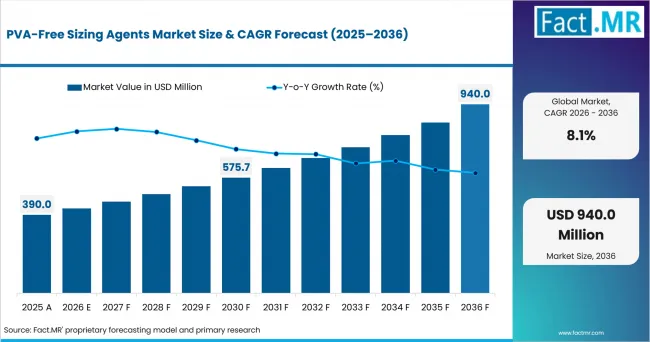
Pva Free Sizing Agents Market Market Value Analysis | Source: Fact.MR
What are the defining numbers behind PVA-free sizing agents growth?
USD 510.0 million absolute opportunity by 2036, led by India and Bangladesh.
- Demand Drivers in the Market
- Textile mills need sizing recipes that protect yarn without creating a high desizing load.
- Apparel suppliers need cleaner preparation evidence before brand audits extend to dyeing partners.
- Starch and CMC suppliers gain access when recipes run on existing sizing kitchens.
- Chemical distributors need trial support due to mill rejection of recipes that raise yarn breaks.
- Key Segments Analyzed
- By Chemistry: Modified starch is projected to hold 38.0% share in 2026 due to lower recipe cost and familiar desizing behavior.
- By Motivation: Lower wastewater load is estimated to account for 34.0% share in 2026 owing to treatment-cost visibility.
- By Yarn Type: Cotton is forecast to capture 31.0% share in 2026 supported by cotton-rich apparel and home textile weaving.
- By End User: Textile mills are anticipated to hold 46.0% share in 2026 attributable to direct sizing-house consumption.
- By Geography: East Asia is predicted to account for 32.0% share in 2026 led by China and nearby fabric production clusters.
- Analyst Opinion at Fact.MR
- Shambhu Nath Jha, Principal Analyst at Fact.MR states, “Mills do not buy a PVA-free size only for a claim on a product sheet. They buy it after the warp runs cleanly and the desizing bath carries less load. Suppliers that can prove both points on cotton and blended yarns gain the first repeat orders.”
- Strategic Implications
- Textile chemical suppliers should build mill-level trial data before asking buyers to replace PVA in full recipes.
- Starch processors need stable viscosity grades that keep loom shedding under control.
- CMC suppliers should position rheology control around lower pick-up variation and cleaner desizing.
- Chemical distributors need technical service teams that can troubleshoot yarn breaks during conversion trials.
Warp yarn sizing protects yarn during weaving. PVA-free recipes use modified starch, CMC and acrylic alternatives to lower wastewater load without raising loom breakage. The wider warp sizing agents category keeps the parent demand base broader than the replacement segment.
India is projected to record 9.7% CAGR through 2036 supported by export-led weaving and low-cost starch access. Bangladesh is expected to expand at 9.3% CAGR owing to apparel export scale. Vietnam is forecast to grow at 8.9% CAGR attributable to fabric localization. China is expected to advance at 8.6% CAGR led by large textile output. Türkiye is projected to rise at 7.8% CAGR supported by EU-facing apparel supply chains. Germany is forecast at 7.2% CAGR attributable to technical textile specifications. The United States is expected to post 6.8% CAGR due to technical fabrics and domestic mill shipments.
How does the PVA-free sizing agents market break down by segment?
Modified starch leads at 38.0%. Lower wastewater load follows at 34.0%.
Which chemistry dominates?
Modified starch holds 38.0% share in 2026.
Modified starch leads due to mill familiarity with starch cooking and viscosity control. The larger modified starch category shows why starch derivatives remain practical industrial inputs. PVA-free recipes use this familiarity to lower switching risk during mill trials.
Which motivation leads purchasing?
Lower wastewater load accounts for 34.0% share in 2026.
Lower wastewater load leads due to sizing material entering the desizing bath before dyeing and finishing. The European Environment Agency estimated 5,300 million cubic metres of blue water tied to EU textile consumption in its March 2025 circularity review. Mills selling into audited supply chains therefore evaluate sizing chemistry before effluent treatment becomes the only control point.
Which yarn type leads?
Cotton yarn holds 31.0% share in 2026.
Cotton yarn leads owing to common starch adhesion and enzyme desizing in cotton-rich weaving. CMC helps control pick-up where yarn counts vary. The carboxymethyl cellulose category supports this chemistry link across industrial uses. Substitution remains easier when mills can keep the same desizing route.
Which end user leads?
Textile mills lead with 46.0% share in 2026.
Textile mills lead owing to the sizing decision sitting inside weaving preparation. The polyvinyl alcohol category remains the direct replacement benchmark for PVA-free recipes. Dyeing and finishing houses influence switching when residue affects bath load. Apparel supply chains influence decisions when audit teams request evidence for lower wastewater pressure.
What is accelerating PVA-free sizing agent demand, and what is holding it back?
Wastewater review drives switching while loom-risk concerns slow full recipe replacement.
The main driver is the cost that desizing residue creates after weaving. Regulation adds pressure after the European Union adopted Regulation (EU) 2024/1781 in June 2024. The rule gives textile buyers a stronger product-design framework and moves chemical recordkeeping upstream. Textile chemicals suppliers therefore compete on recipe documentation and mill support.
The main restraint is yarn breakage risk during high-speed weaving. Mills may accept lower wastewater load only after the size film protects yarn strength. Conversion slows when sizing kitchens lack test data for blended yarns or when buyers do not pay for recipe changes.
Where do the biggest PVA-free sizing agents opportunities sit?
Enzyme-compatible desizing, technical textile conversion and acrylic blend trials.
- Enzyme-Compatible Desizing: Recipes that match textile enzymes can lower residue without changing the full mill route.
- Technical Textile Conversion: Faster looms raise the value of stable size films. Faster textile machinery makes trial evidence more valuable because mills must avoid yarn breaks at higher weaving speeds.
- Acrylic Blend Trials: Synthetic yarn producers can test acrylic-starch combinations where abrasion control matters more than recipe cost alone. The broader waterborne acrylic resin base supports acrylic dispersion know-how.
Which countries are scaling PVA-free sizing agents fastest?
India is the fastest country in the country set.
Based on regional analysis, the PVA-free sizing agents market is segmented into East Asia and South Asia. North America and Europe add technical textile demand. Latin America and Middle East and Africa complete coverage.
| Country | CAGR |
|---|---|
| India | 9.7% |
| Bangladesh | 9.3% |
| Vietnam | 8.9% |
| China | 8.6% |
| Türkiye | 7.8% |
| Germany | 7.2% |
| United States | 6.8% |
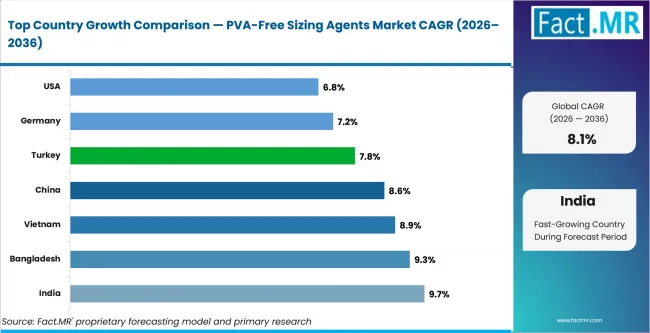
Pva Free Sizing Agents Market Cagr Analysis By Country | Source: Fact.MR
What is powering India’s lead?
9.7% CAGR, supported by export-led weaving and mill conversion trials.
India is projected to record 9.7% CAGR through 2036 supported by export-led weaving and lower-cost starch formulation. The Ministry of Textiles stated in December 2025 that textile exports had reached ₹3 lakh crore. Suppliers that combine local starch supply with mill trial service gain stronger access to Surat, Tiruppur and Panipat.
Why is Bangladesh a high-priority conversion market?
9.3% CAGR, driven by garment export scale and wastewater compliance needs.
Bangladesh mills buy sizing chemicals against apparel order reliability and buyer compliance checks. Bangladesh is expected to expand at 9.3% CAGR through 2036 owing to garment export scale and wastewater compliance checks. The Bangladesh Investment Development Authority stated that textiles and apparel recorded USD 38.48 billion in export earnings in 2024. Suppliers need recipes that lower desizing load without adding loom stops.
How does Vietnam build PVA-free sizing demand?
8.9% CAGR, led by fabric localization and export order recovery.
Vietnam is forecast to grow at 8.9% CAGR through 2036 attributable to fabric localization efforts and garment export recovery. The Asian Productivity Organization reported in October 2025 that Vietnam textile and garment exports had reached USD 44.0 billion. PVA-free suppliers can grow if they support local mills before export brands lock approved chemical lists.
What supports China’s conversion path?
8.6% CAGR, supported by output scale and formulation trials.
China is expected to advance at 8.6% CAGR through 2036 led by large textile output and chemical substitution trials. The United States Department of Agriculture Foreign Agricultural Service reported in April 2026 that China textile and apparel exports reached USD 173.5 billion during the first seven months of MY 25/26. Local suppliers can scale quickly when recipes pass mill trials across cotton and polyester-cotton yarns.
What keeps Türkiye relevant for PVA-free sizing suppliers?
7.8% CAGR, driven by EU-facing apparel chains and nearshore fabric production.
Türkiye is projected to rise at 7.8% CAGR through 2036 supported by EU-facing apparel supply chains and nearshore fabric production. Buyers in Europe ask Turkish mills for cleaner wet-processing evidence before approving supplier lists. Conversion is constrained by cost pressure and suppliers must prove recipe savings in working mill conditions.
Why does Germany remain important despite smaller volume?
7.2% CAGR, supported by regulation and technical textile specifications.
Germany is forecast at 7.2% CAGR through 2036 attributable to textile chemical regulation and technical textile buyers. The EU product framework adopted in 2024 gives German buyers a stronger compliance basis for chemical selection. Textile coatings producers face similar documentation pressure in technical textile chains. Suppliers that combine recipe data and application support can defend premium accounts.
How does the United States fit into the outlook?
6.8% CAGR, led by technical fabrics and domestic textile mill shipments.
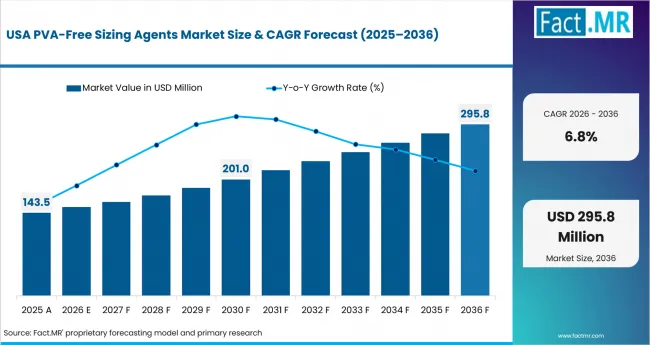
Pva Free Sizing Agents Market Country Value Analysis | Source: Fact.MR
The United States is expected to post 6.8% CAGR through 2036 supported by domestic textile mill shipments and technical fabric production. The U.S. Census Bureau reported April 2026 textile mill shipments of USD 2,009 million. Coated textiles producers add demand for controlled preparation steps. Suppliers win when trial service reduces production risk.
Who leads the PVA-free sizing agents landscape?
Archroma, and Ingredion lead due to textile chemistry and starch portfolio depth.
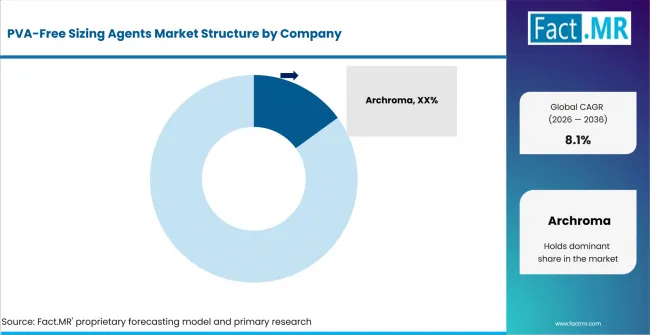
Pva Free Sizing Agents Market Analysis By Company | Source: Fact.MR
PVA-free sizing agents are used by mills that need yarn protection and cleaner desizing evidence. Archroma provides textile chemical systems and mill-facing application support. Ingredion support starch-based recipe economics. Ashland and Nouryon add CMC and rheology-control depth.
Bozzetto Group and Seydel bring sizing-specific reach. Bozzetto identifies sizing as a dedicated textile solution area and lists sulfonated polyester resins and acrylic resins for synthetic fibres.
Providers that maintain local application labs are better placed through 2036. Mills rarely change sizing recipes on price alone. Winning suppliers are expected to offer formula adjustment, wastewater-reduction evidence and loom-performance evidence.
Which companies are the key players?
Key players include textile chemical suppliers, starch processors and cellulose-ether producers.
- Archroma
- Ingredion
- Ashland
- Nouryon
- Bozzetto Group
- Seydel
Bibliography
- European Environment Agency. (2025, March 26). Circularity of the EU textiles value chain in numbers.
- European Union. (2024, June 28). Regulation (EU) 2024/1781 establishing a framework for the setting of ecodesign requirements for sustainable products. EUR-Lex.
- Press Information Bureau, Government of India. (2025, December 24). Year end review 2025 of Ministry of Textiles.
- Bangladesh Garment Manufacturers and Exporters Association. (2026). Export performance.
- Vietnam News Agency. (2024, December 16). Vietnam’s textile export turnover hits USD 44 billion in 2024.
- U.S. Department of Agriculture, Foreign Agricultural Service. (2026, April 22). Cotton and products annual: China.
- U.S. Census Bureau. (2026, July 2). Monthly full report on manufacturers’ shipments, inventories, and orders: May 2026.
- Archroma. (2024, April 12). Archroma brings Planet Conscious Solutions to Techtextil 2024.
- Bozzetto Group. (2026). Sizing.
- Nouryon. (2026). Finnfix® sodium carboxymethylcellulose.
- Seydel Companies. (2026). Textile sizing chemicals.
This Report Addresses
- Strategic intelligence on PVA-free sizing agents across chemistry, motivation, and yarn type.
- Segment analysis covering Modified Starch and Lower Wastewater Load. Cotton Yarn and Textile Mills are also covered.
- Regional outlook covering India and Bangladesh. Vietnam and China are also covered. Türkiye, Germany, and the United States complete the country set.
- Competitive analysis of Archroma. Ingredion and Ashland are also covered. Nouryon, Bozzetto Group and Seydel complete the supplier set.
- Service and sourcing assessment covering formulation trials, distributor access and mill-level validation.
- Primary interviews, official source review and supplier portfolio checks support the forecast.
What does the PVA-free sizing agents market cover?
Sizing agents used on warp yarns without polyvinyl alcohol in the main film-former role.
The PVA-free sizing agents market covers modified starch and CMC. It also covers acrylic alternatives, bio-based polymers and recyclable blends. Low-BOD sizing systems are included when sold for warp preparation. The market differs from total textile sizing due to the exclusion of PVA-led recipes.
What is included in the scope?
Warp sizing formulations sold for PVA-free or PVA-replacement systems.
The scope includes modified starch blends and CMC grades used in textile warp sizing. It includes acrylic alternatives and recyclable blends used to control shedding and yarn abrasion. It also includes low-BOD sizing systems sold to weaving mills and dyeing groups that manage desizing load.
What is excluded from the scope?
PVA-based sizing recipes and unrelated textile finishing chemicals are excluded.
The scope excludes polyvinyl alcohol where it remains the primary sizing polymer. It excludes textile dyes and softeners. Finishing resins and print thickeners are excluded unless sold directly for warp sizing. Paper sizing and packaging starch uses are also excluded.
How was the analysis built?
120+ sources, 45+ supplier portfolios, 30+ countries, and 25+ interviews supported the analysis.
- Primary Research:
- Primary research includes interviews with textile mill purchasing teams and sizing kitchen managers. It includes input from chemical distributors and weaving consultants.
- Desk Research:
- Desk research reviews textile policy sources and environmental agency data. It covers supplier portfolios and product pages for starch, CMC and textile sizing systems.
- Market-Sizing and Forecasting:
- Forecasting uses textile sizing consumption and PVA substitution ratios. Country CAGRs reflect textile output, export pressure and wastewater compliance intensity.
- Data Validation and Update Cycle:
- Forecasts are validated through supplier checks and mill conversion signals. Company product updates and regulation changes help confirm market direction.
What is the report’s scope and coverage?
| Attribute | Details |
|---|---|
| Quantitative Units | USD Million in 2026 to USD Million by 2036 |
| Market Definition | PVA-free warp sizing agents used to protect yarn before weaving |
| Chemistry | Modified Starch, CMC, Acrylic Alternatives, Bio-Based Polymers, Recyclable Blends, Low-BOD Systems |
| Motivation | Lower Wastewater Load, Easier Desizing, Lower Petrochemical Exposure, Regulatory Compliance, Cost Reduction |
| Yarn Type | Cotton, Polyester-Cotton, Viscose, Denim, Filament Yarn, Technical Textiles |
| End User | Textile Mills, Dyeing Houses, Denim Mills, Apparel Supply Chains, Chemical Distributors |
| Regions Covered | North America, Europe, East Asia, South Asia, Latin America, and Middle East and Africa |
| Countries Covered | India, Bangladesh, Vietnam, China, Türkiye, Germany, United States |
| Key Companies Profiled | Archroma, Ingredion, Ashland, Nouryon, Bozzetto Group, Seydel |
| Forecast Period | 2026 to 2036 |
| Approach | Hybrid top-down and bottom-up approach using sizing consumption, substitution ratios, supplier checks and mill conversion signals |
How is the market segmented?
-
By Chemistry:
- Modified Starch
- CMC
- Acrylic Alternatives
- Bio-Based Polymers
- Recyclable Blends
- Low-BOD Systems
-
By Motivation:
- Lower Wastewater Load
- Easier Desizing
- Lower Petrochemical Exposure
- Regulatory Compliance
- Cost Reduction
-
By Yarn Type:
- Cotton
- Polyester-Cotton
- Viscose
- Denim
- Filament Yarn
- Technical Textiles
-
By End User:
- Textile Mills
- Dyeing Houses
- Denim Mills
- Apparel Supply Chains
- Chemical Distributors
-
By Region:
- North America
- United States
- Canada
- Latin America
- Brazil
- Argentina
- Mexico
- Rest of Latin America
- Europe
- Germany
- United Kingdom
- France
- Italy
- Spain
- Türkiye
- Rest of Europe
- Asia Pacific
- China
- India
- Japan
- South Korea
- Bangladesh
- Vietnam
- ASEAN
- Middle East & Africa
- GCC Countries
- South Africa
- UAE
- Rest of Middle East & Africa
- North America