Warp Sizing Agents Market Size, Share, Growth and Forecast (2026 - 2036)

The Warp Sizing Agents Market is segmented by Chemistry, by Yarn Type, by Loom Type, by End Use and Region. Forecast for 2026 to 2036.

What is the warp sizing agents market forecast to be worth by 2036?

USD 2.67 billion in 2026 to USD 3.95 billion by 2036, at 4% CAGR.

  • The warp sizing agents market crossed a valuation of USD 2.56 billion in 2025.
  • Demand is expected to increase from USD 2.67 billion in 2026 to USD 3.95 billion by 2036.
  • The market is forecast to record 4% CAGR from 2026 to 2036 as textile mills specify lower-residue and process-stable sizing for cotton, polyester and blended yarns.
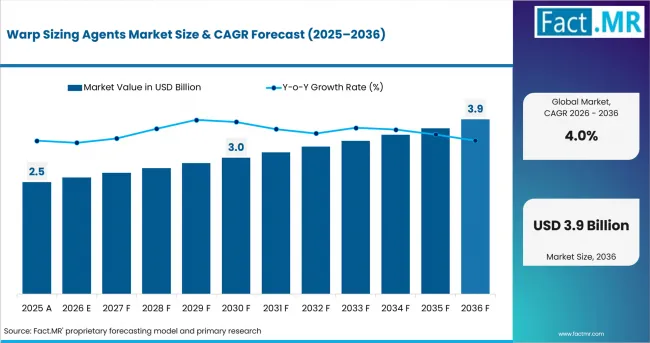
Warp Sizing Agents Market Value Analysis

What are the defining numbers behind warp sizing agents growth?

USD 1.29 billion absolute opportunity by 2036, led by East Asia and South Asia.

  • Demand Drivers in the Market
    • Shuttleless loom additions raise recipe consistency requirements because the International Textile Manufacturers Federation reported 226,000 shuttleless loom shipments in 2024, up 32% year over year. [1]
    • Cotton and blended yarn mills keep starch-based recipes active because these systems balance cost, film strength and enzyme desizing.
    • Synthetic yarn processing supports PVA, CMC and acrylic blends where mills need stronger films and smoother shed movement.
    • Export mills compare sizing recipes against fabric defects, downtime and wastewater cost before switching suppliers.
  • Key Segments Analyzed
    • By Chemistry: Starch and modified starch are expected to hold 36.5% share in 2026 because cotton-rich weaving still anchors volume use.
    • By Yarn Type: Cotton yarn leads because apparel, home textile and denim weaving use high recurring sizing volume. The segment is projected to capture 32% share in 2026.
    • By Loom Type: Air-jet looms are likely to account for 34% share in 2026 as high-speed weaving rewards low-shed and smooth-running size films.
    • By End Use: Apparel is projected to hold 41% share in 2026 since garment fabric production creates the highest recurring sizing need.
    • By Region: East Asia is expected to hold 38% share in 2026 because China anchors yarn, fabric and synthetic fiber output.
  • Analyst Opinion at Fact.MR
    • Shambhu Nath Jha, Senior Analyst at Fact.MR, states, "Warp sizing is a process-control purchase more than a simple chemical purchase. A weaving mill does not buy starch or PVA only for price. It buys fewer yarn breaks, cleaner loom sheds, less fabric damage and easier desizing. Suppliers with mill trials, sizing-kitchen guidance and blend adjustment support protect accounts better than firms that sell standard powders or emulsions. The next ten years should favor formulations that balance cotton cost discipline with synthetic yarn performance."
  • Strategic Implications
    • Sizing suppliers should build mill trial programs around loom speed, yarn count and fabric defect reduction.
    • Weaving mills need chemistry choices that reduce breakage without raising desizing or wastewater cost.
    • Starch suppliers can protect share by improving film strength, viscosity stability and enzyme-desizing compatibility.
    • PVA, CMC and acrylic suppliers need clearer claims around recovery, recyclability and lower residue in wastewater systems.

Sizing chemicals for weaving preparation form the core of this market. Starch and modified starch are used for cotton and blended yarn because they offer film strength and predictable desizing behavior. Polyvinyl alcohol, carboxymethyl cellulose, acrylics, waxes and blends are specified when mills need abrasion resistance, low shedding, smoother loom travel or compatibility with synthetic yarn.

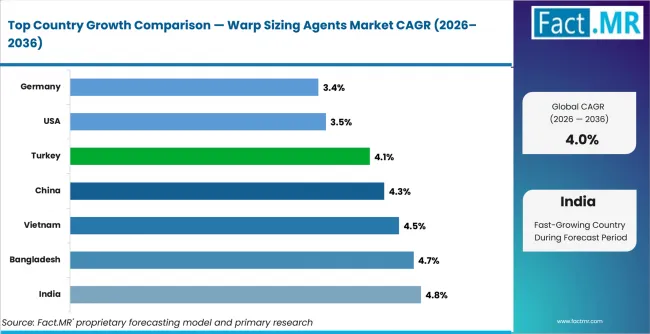
India is projected to record 4.8% CAGR through 2036 as textile export programs and weaving capacity upgrades support more sizing consumption. Bangladesh is expected to expand at 4.7% CAGR as apparel exports keep fabric preparation active. Vietnam is forecast to grow at 4.5% CAGR as garment exports and fabric localization improve. China is expected to advance at 4.3% CAGR because large yarn and fabric output sustains base demand. Turkey is projected to rise at 4.1% CAGR as near-shore apparel and home textile production supports steady purchases.

How does the warp sizing agents market break down by segment?

Starch and modified starch lead at 36.5%; cotton yarn leads at 32%.

Which chemistry leads?

Starch and modified starch hold 36.5% share in 2026.
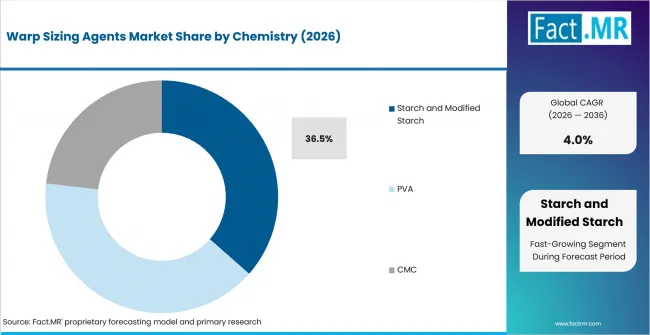
Warp Sizing Agents Market Analysis By Chemistry

Starch and modified starch are expected to hold 36.5% share in 2026 because cotton and blended yarn mills need cost-stable film formers with known desizing behavior. polyvinyl alcohol continues to be important in stronger films for synthetic and blended yarns. The segment mix changes slowly because mills test sizing changes on loom performance before changing full production recipes.

Which yarn type leads?

Cotton yarn holds 32% share in 2026.
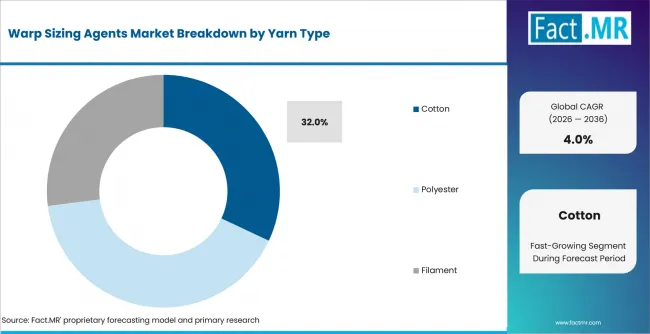
Warp Sizing Agents Market Analysis By Yarn Type

Cotton yarn accounts for 32% share in 2026 because apparel, home textile and denim weaving keep cotton-rich sizing recipes in constant use. Mills favor starch and modified starch where cotton yarn counts are stable and enzyme desizing is already established. Blended yarn grows faster, but cotton keeps the volume base because it is tied to recurring fabric orders.

Which loom type leads?

Air-jet looms hold 34% share in 2026.
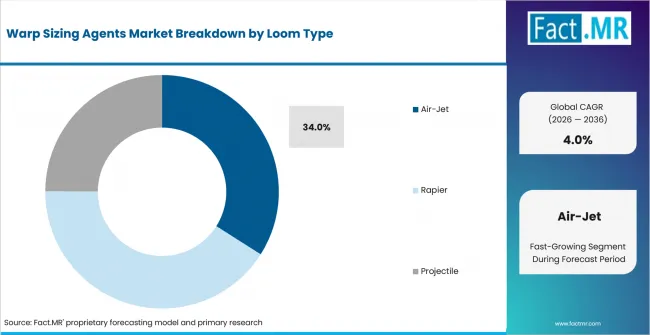
Warp Sizing Agents Market Analysis By Loom Type

Air-jet looms are likely to account for 34% share in 2026 because high-speed weaving needs stable viscosity, low linting and stronger yarn protection. textile machinery investment changes sizing needs because faster looms expose weak films and uneven pick-up more quickly. Suppliers that solve yarn breaks and shed deposits gain repeat orders in air-jet mills.

Which end use leads?

Apparel holds 41% share in 2026.
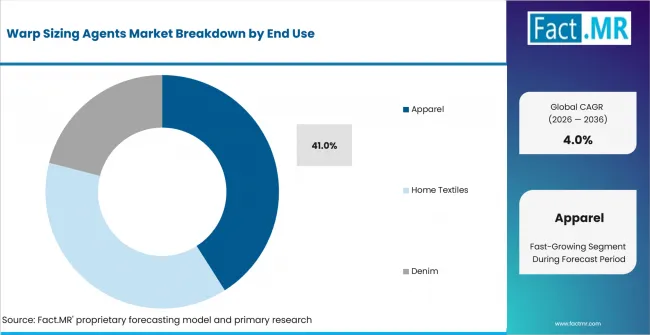
Warp Sizing Agents Market Analysis By End Use

Apparel is projected to hold 41% share in 2026 because garment fabric production creates high recurring sizing volume across export-oriented clusters. Denim, home textiles and coated textiles create additional demand for recipes that balance strength and clean removal. Apparel stays ahead because fabric throughput is high and mills purchase size continuously through recurring mill orders.

Which region leads?

East Asia holds 38% share in 2026.

East Asia leads because China anchors yarn, fabric and synthetic fiber output at scale. The region uses starch, PVA, acrylic and wax blends across cotton, polyester and viscose fabric production. South Asia grows faster, but East Asia holds the deeper installed weaving base and broader supplier network.

What is accelerating warp sizing agent demand, and what is holding it back?

High-speed weaving and export fabric quality requirements drive it; wastewater and desizing cost restrain it.
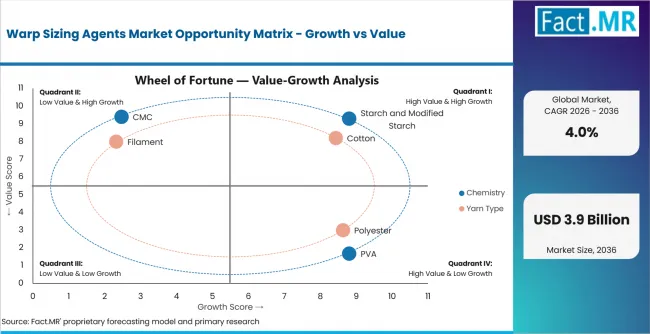
Warp Sizing Agents Market Opportunity Matrix Growth Vs Value

The main driver is tighter control in weaving preparation. Shuttleless looms raise yarn abrasion, so mills need recipes that reduce breaks while keeping fabric clean. Within textile chemicals, sizing is one of the few inputs that directly affects loom stoppages, fabric defects and downstream washing cost.

The main restraint is size removal and wastewater management. More polymer can protect yarn, but heavy residue increases desizing load and treatment cost. textile enzymes help downstream removal, yet mills still compare total recipe cost against loom efficiency before approving higher-specification blends.

Where do the biggest warp sizing agents opportunities sit?

Modified starch blends, synthetic-yarn sizing and low-residue technical fabric recipes.

  • Modified Starch Blends: Suppliers can improve viscosity stability and film strength while keeping cotton-mill economics workable.
  • Synthetic-Yarn Sizing: PVA, CMC and acrylic blends can target polyester, viscose and filament yarns that need stronger films.
  • Low-Residue Recipes: Mill customers are comparing sizing with textile adhesives and other substrate chemistries where application support shapes account retention.

Which countries are scaling warp sizing agents fastest?

India 4.8%, Bangladesh 4.7%, Vietnam 4.5%, China 4.3%, Turkey 4.1%, United States 3.5%, Germany 3.4%.

Based on regional analysis, the warp sizing agents market is segmented into East Asia, South Asia, North America, Europe, Latin America, and Middle East and Africa.

Top Country Growth Comparison Warp Sizing Agents Market Cagr (2026 2036)

Country CAGR
India 4.8%
Bangladesh 4.7%
Vietnam 4.5%
China 4.3%
Turkey 4.1%
United States 3.5%
Germany 3.4%

Warp Sizing Agents Market Cagr Analysis By Country

What supports India’s lead?

4.8% CAGR, supported by textile export programs and weaving capacity upgrades.

India combines cotton availability, apparel exports and a policy push for textile parks. The Press Information Bureau under the Ministry of Textiles reported in March 2025 that India held about 4% of global textile and apparel exports and that textile, apparel and handicraft exports rose 7% during April to December 2024. [3] This creates steady demand for recipes that run across cotton, polyester-cotton and viscose blends. Tiruppur and Surat mills also support performance knitted fabrics through fabric development and export supply chains. Supplier wins in India are tied to mill trials and price-stable modified starch blends.

Why does Bangladesh grow faster than the global average?

4.7% CAGR, supported by apparel exports and fabric localization.

Bangladesh buys sizing agents through a large apparel and fabric preparation base. Bangladesh Garment Manufacturers and Exporters Association data show total ready-made garment exports at USD 39.35 billion in 2024-2025. [4] The country imports a meaningful part of its fiber and yarn inputs, so mills value recipes that perform consistently across changing yarn sources. Sizing suppliers gain when they help mills reduce breakage in woven apparel and denim fabrics.

What is lifting Vietnam’s outlook?

4.5% CAGR, supported by yarn exports and local fabric sourcing.

Vietnam’s garment export base is pushing more fabric preparation and yarn handling inside the country. The United States Department of Agriculture Foreign Agricultural Service reported in April 2026 that Vietnam’s all-type yarn exports expanded 4% in calendar year 2025 to 1.95 million metric tons. [5] That yarn scale supports local demand for warp preparation chemicals when fabric mills handle cotton, polyester and blended yarns. Formulators that support synthetic-yarn sizing and quick recipe trials should see stronger access to export mills.

How is China shaping global sizing demand?

4.3% CAGR, supported by loom investment and synthetic fiber scale.

China stays the deepest volume base for warp sizing agents because yarn, fabric and synthetic fiber output remain high. The United States Department of Agriculture Foreign Agricultural Service reported in April 2025 that China’s 2025/26 cotton production was forecast at 6.35 million metric tons. [2] This supports steady consumption of starch, PVA, acrylic and wax blends in cotton-rich weaving. China’s rate is below India and Bangladesh because the base is larger, but the country still sets supplier expectations for high-volume consistency.

How does Turkey fit into the sizing agents market?

4.1% CAGR, supported by near-shore apparel and home textile production.

Turkey serves European apparel and home textile customers with shorter lead times. Its mills still rely on cotton-rich and synthetic blends for denim, towels and apparel fabrics. This supports yarn preparation and weaving chemistry demand in western textile clusters. Suppliers that offer fast technical support around recipe adjustment can defend accounts in Turkish clusters.

What supports the United States outlook?

3.5% CAGR, supported by technical textiles and selected domestic fabric capacity.
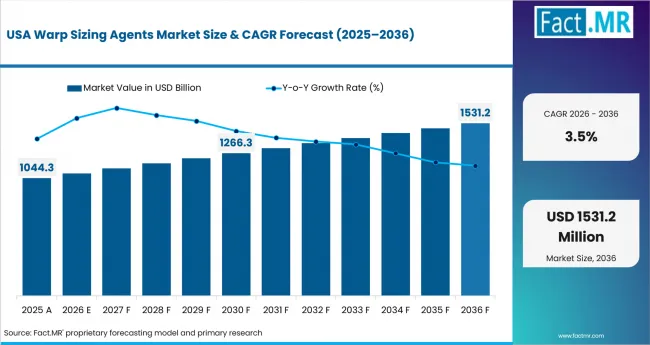
Warp Sizing Agents Market Country Value Analysis

The United States is smaller in commodity fabric volume than Asia, but specialty textile capacity keeps sizing needs active. The United States Bureau of Labor Statistics reported 78,400 textile mill jobs in May 2026 under NAICS 313. [6] Domestic mills often serve defense, medical, industrial and denim pockets where documentation and repeatability matter. Specialty plants also connect with nonwoven fabric and industrial textile channels that require cleaner processing records. The country grows below the global average because volume production is more selective.

Why is Germany still commercially important?

3.4% CAGR, supported by technical textiles and tighter chemical performance requirements.

Germany grows below the global average because its commodity weaving volume is limited compared with Asia. The country still matters because technical textiles, automotive textiles and specialty fabrics require careful chemistry selection. European Apparel and Textile Confederation commentary for 2024 to 2025 points to pressure on European textile output, while medical, defense and industrial textile applications show better value resilience. German mills producing odour control textiles and automotive fabrics often require low-residue sizing and clear technical documentation. Supplier access is shaped by consistency, regulation readiness and support for trial runs.

Who leads the warp sizing agents landscape?

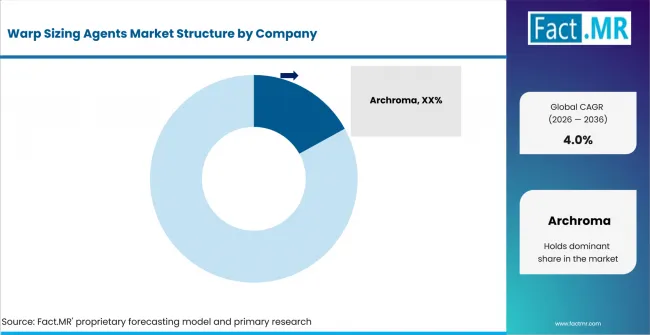
Archroma, Bozzetto Group, Avebe and Ingredion lead through sizing chemistry, starch systems and mill support.
Warp Sizing Agents Market Analysis By Company

Supplier competition is organized around application reliability. Large chemical companies bring polymer chemistry, regional supply and technical documentation. Starch and biopolymer specialists compete through price stability, modified starch performance and enzyme-desizing compatibility. Textile auxiliary firms win accounts when they adjust recipes quickly for yarn changes and loom problems.

Capability matters more than catalog size in difficult mills. Customers compare viscosity stability, film strength, yarn abrasion results and desizing cleanliness. Suppliers that understand technical textile yarns can serve higher-value woven applications where defect tolerance is lower.

The market has a broad supplier base, but large export mills tend to shortlist suppliers that offer mill trials and batch support. Archroma and Bozzetto Group have direct textile sizing portfolios. Avebe and Ingredion support starch-based systems, while Ashland, BASF, Dow, Kemira and Solenis are relevant through polymer, cellulose, process chemistry or related formulation capability. Seydel Companies adds regional textile auxiliary depth.

Which companies are the key players?

Archroma, BASF, Kemira, Avebe, Solenis, Ingredion, Ashland, Dow, Seydel and Bozzetto Group.

  • Archroma
  • BASF SE
  • Kemira Oyj
  • Avebe U.A.
  • Solenis LLC
  • Ingredion Incorporated
  • Ashland Inc.
  • Dow Inc.
  • Seydel Companies
  • Bozzetto Group

Bibliography

  • [1] International Textile Manufacturers Federation. (2025, June). Global textile machinery shipments show mixed performance in 2024. ITMF. https://www.itmf.org/images/dl/press-releases/2025/2025-06-20-ITMSS-2024-Press-release.pdf
  • [2] United States Department of Agriculture Foreign Agricultural Service. (2025, April 23). Cotton and products annual: China - People’s Republic of. USDA FAS. https://apps.fas.usda.gov/newgainapi/api/Report/DownloadReportByFileName?fileName=Cotton+and+Products+Annual_Beijing_China+-+People%27s+Republic+of_CH2025-0087.pdf
  • [3] Press Information Bureau, Ministry of Textiles, Government of India. (2025, March 21). Improving textile exports. Government of India. https://www.pib.gov.in/PressReleasePage.aspx?PRID=2113532
  • [4] Bangladesh Garment Manufacturers and Exporters Association. (2026, June 16). Export performance. BGMEA. https://www.bgmea.com.bd/page/Export_Performance
  • [5] United States Department of Agriculture Foreign Agricultural Service. (2026, April 13). Cotton and products annual: Vietnam. USDA FAS. https://www.fas.usda.gov/data/gain-report/2026/04/Cotton%20and%20Products%20Annual_Ho%20Chi%20Minh%20City_Vietnam_VM2026-0009.pdf
  • [6] United States Bureau of Labor Statistics. (2026, June). Textile mills: NAICS 313. BLS. https://www.bls.gov/iag/tgs/iag313.htm
  • [7] United States International Trade Commission. (2025, June 30). Trade shifts 2024: Textiles and apparel. USITC. https://www.usitc.gov/research_and_analysis/tradeshifts/2024/textiles
  • [8] United States Department of Agriculture Foreign Agricultural Service. (2026, June). Cotton: World markets and trade. USDA FAS. https://apps.fas.usda.gov/psdonline/circulars/cotton.pdf
  • [9] European Apparel and Textile Confederation. (2025). EU textile and clothing industry outlook 2024-2025. EURATEX. https://euratex.eu/news/eu-textile-clothing-outlook-2024-2025/
  • [10] Archroma. (2026). ARKOFIL sizing agents and compounds. Archroma. https://www.archroma.com/textile-effects/products/arkofil
  • [11] Bozzetto Group. (2026). Sizing. Bozzetto Group. https://www.bozzetto-group.com/textile-solutions/sizing/
  • [12] Sekisui Specialty Chemicals. (2025, July 30). Polyvinyl alcohol vs. starch as warp sizing chemical in textiles. Sekisui Specialty Chemicals. https://www.sekisui-sc.com/blog/polyvinyl-alcohol-vs-starch-as-warp-sizing-chemical-in-textiles/

This Report Address

  • Strategic intelligence on warp sizing agents across chemistry, yarn type, loom type, end use and region.
  • Segment analysis covering Starch, Modified Starch, PVA, CMC, Acrylics, Waxes and Blends.
  • Regional outlook covering India, Bangladesh, Vietnam, China, Turkey, United States and Germany.
  • Competitive analysis of Archroma, BASF, Kemira, Avebe, Solenis, Ingredion, Ashland, Dow, Seydel and Bozzetto Group.
  • Chemistry assessment covering film strength, viscosity stability, desizing behavior and low-residue recipe design.
  • Application assessment covering apparel, home textiles, denim, industrial textiles, automotive textiles and technical fabrics.
  • Primary interviews, supplier checks, official source review and textile output validation support the forecast.

What does the warp sizing agents market cover?

Film-forming agents applied to warp yarn before weaving to reduce breakage and improve loom efficiency.

The warp sizing agents market covers starches, polyvinyl alcohol, carboxymethyl cellulose, acrylics, waxes and performance blends used by weaving mills. It differs from general textile finishing because sizing is a preparatory step before weaving and is judged by loom performance, yarn protection, desizing behavior and fabric cleanliness.

What is included in the scope?

Sizing chemicals and blends used in warp preparation.

The scope includes starch, modified starch, PVA, CMC, acrylics, waxes, blends and bio-based sizing agents. It covers sizing for cotton, polyester, viscose, blended yarn, filament yarn, denim yarn and technical textile yarn. It also covers apparel, home textiles, denim, industrial textiles, automotive textiles and technical fabrics.

What is excluded from the scope?

General textile auxiliaries without warp preparation use are excluded.

The scope excludes dyes, pigments, softeners, printing thickeners and finishing resins unless sold as sizing components. It excludes sizing machinery, weaving looms, yarn manufacturing and desizing equipment sales. Paper sizing chemicals and packaging adhesives are also excluded unless used directly for textile warp yarn.

How was the analysis built?

120+ sources, 45+ supplier portfolios, 30+ countries, 25+ interviews.

  • Primary Research: Primary research includes interviews with textile chemical distributors, weaving mill managers and sizing-kitchen operators. It includes input from apparel exporters, denim mills and technical textile processors.
  • Desk Research: Desk research reviews textile machinery shipment data, national textile output data, apparel export data and supplier product portfolios. It covers starch, PVA, cellulose ether and acrylic sizing value chains.
  • Market-Sizing and Forecasting: Forecasting uses textile output, yarn consumption, loom shipment trends, sizing add-on rates and chemical pricing bands. Estimates are reconciled against supplier revenues and regional textile production patterns.
  • Data Validation and Update Cycle: Forecasts are validated through distributor checks, product substitution signals and mill-level buying patterns. Updates reflect loom investment, yarn mix, wastewater requirements and supplier portfolio changes.

What is the report’s scope and coverage?
Warp Sizing Agents Market Breakdown By Chemistry, Yarn Type, And Region

Attribute Details
Market Definition Film-forming agents applied to warp yarn before weaving to improve yarn strength, abrasion resistance and loom runnability
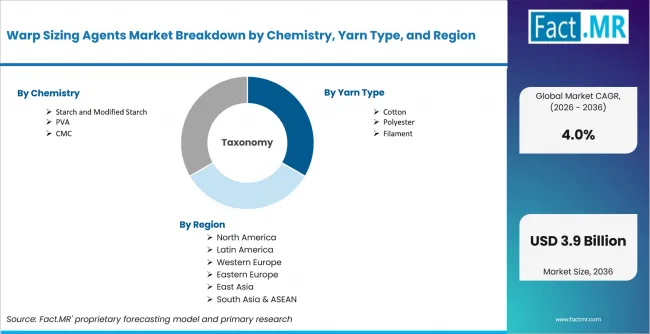
Chemistry Starch, Modified Starch, PVA, CMC, Acrylics, Waxes, Blends, Bio-Based Sizing Agents
Yarn Type Cotton, Polyester, Viscose, Blended Yarn, Filament Yarn, Denim Yarn, Technical Textile Yarn
Loom Type Air-Jet, Rapier, Projectile, Water-Jet, Shuttleless Weaving, High-Speed Looms
End Use Apparel, Home Textiles, Denim, Industrial Textiles, Automotive Textiles, Technical Fabrics
Regions Covered North America, Latin America, Europe, East Asia, South Asia, Middle East and Africa
Countries Covered India, Bangladesh, Vietnam, China, Turkey, United States and Germany
Key Companies Profiled Archroma, BASF, Kemira, Avebe, Solenis, Ingredion, Ashland, Dow, Seydel and Bozzetto Group
Forecast Period 2026 to 2036
Approach Hybrid top-down and bottom-up approach using textile output, loom shipments, sizing add-on rates and supplier validation

How is the market segmented?

  • By Chemistry:

    • Starch
    • Modified Starch
    • PVA
    • CMC
    • Acrylics
    • Waxes
    • Blends
    • Bio-Based Sizing Agents
  • By Yarn Type:

    • Cotton
    • Polyester
    • Viscose
    • Blended Yarn
    • Filament Yarn
    • Denim Yarn
    • Technical Textile Yarn
  • By Loom Type:

    • Air-Jet
    • Rapier
    • Projectile
    • Water-Jet
    • Shuttleless Weaving
    • High-Speed Looms
  • By End Use:

    • Apparel
    • Home Textiles
    • Denim
    • Industrial Textiles
    • Automotive Textiles
    • Technical Fabrics
  • By Region:

    • North America
      • United States
      • Canada
      • Mexico
    • Latin America
      • Brazil
      • Argentina
      • Rest of Latin America
    • Europe
      • Germany
      • United Kingdom
      • France
      • Italy
      • Spain
      • Turkey
      • Rest of Europe
    • East Asia
      • China
      • Japan
      • South Korea
    • South Asia
      • India
      • Bangladesh
      • Vietnam
      • Indonesia
      • Rest of South Asia
    • Middle East & Africa
      • GCC Countries
      • South Africa
      • Rest of Middle East & Africa

- Frequently Asked Questions -

Which chemistry leads the Warp Sizing Agents Market?

Starch and modified starch lead with 36.5% share in 2026 because cotton and blended yarn mills need cost-stable film formers with proven desizing behavior.

Which yarn type accounts for the highest sizing demand?

Cotton yarn accounts for 32% share in 2026. Apparel, home textile and denim weaving keep cotton-rich sizing recipes in regular use.

Which country expands faster in the Warp Sizing Agents Market?

India is projected to record 4.8% CAGR through 2036, supported by fabric capacity, export programs and cotton-blend weaving activity.

How does Bangladesh perform in the Warp Sizing Agents Market?

Bangladesh is expected to expand at 4.7% CAGR through 2036 as apparel exports and fabric localization support sizing consumption.

How does Vietnam perform in the Warp Sizing Agents Market?

Vietnam is forecast to grow at 4.5% CAGR through 2036 as garment exports and yarn handling increase local recipe needs.

Why is China important for warp sizing agents?

China is important because it has deep yarn, fabric and synthetic fiber capacity. This keeps base demand high across starch, PVA and acrylic blends.

What limits faster growth in warp sizing agents?

Faster growth is constrained by wastewater treatment cost, PVA recovery requirements and price pressure at export-oriented weaving mills.

Which end use leads the market?

Apparel leads with 41% share in 2026 because garment fabrics create high recurring weaving volume across Asia and export supply chains.

Who are the key companies in warp sizing agents?

Key companies include Archroma, BASF, Kemira, Avebe, Solenis, Ingredion, Ashland, Dow, Seydel and Bozzetto Group.

Table of Content

  1. Executive Summary
    • Global Market Outlook
    • Demand to side Trends
    • Supply to side Trends
    • Technology Roadmap Analysis
    • Analysis and Recommendations
  2. Market Overview
    • Market Coverage / Taxonomy
    • Market Definition / Scope / Limitations
  3. Research Methodology
    • Chapter Orientation
    • Analytical Lens and Working Hypotheses
      • Market Sizing, Forecasting, and Opportunity Mapping
    • Research Design and Evidence Framework
      • Desk Research Programme (Secondary Evidence)
        • Company Annual and Sustainability Reports
        • Peer-reviewed Journals and Academic Literature
        • Corporate Websites, Product Literature, and Technical Notes
        • Earnings Decks and Investor Briefings
        • Statutory Filings and Regulatory Disclosures
        • Technical White Papers and Standards Notes
        • Trade Journals, Industry Magazines, and Analyst Briefs
        • Conference Proceedings, Webinars, and Seminar Materials
        • Government Statistics Portals and Public Data Releases
        • Press Releases and Reputable Media Coverage
        • Specialist Newsletters and Curated Briefings
        • Sector Databases and Reference Repositories
        • Fact.MR Internal Proprietary Databases and Historical Market Datasets
        • Subscription Datasets and Paid Sources
        • Social Channels, Communities, and Digital Listening Inputs
        • Additional Desk Sources
      • Expert Input and Fieldwork (Primary Evidence)
        • Primary Modes
          • Qualitative Interviews and Expert Elicitation
          • Quantitative Surveys and Structured Data Capture
          • Blended Approach
        • Why Primary Evidence is Used
        • Observational and In-context Research
        • Social and Community Interactions
      • Stakeholder Universe Engaged
        • C-suite Leaders
        • Board Members
        • Presidents and Vice Presidents
        • R&D and Innovation Heads
        • Technical Specialists
        • Domain Subject-matter Experts
        • Scientists
        • Physicians and Other Healthcare Professionals
      • Governance, Ethics, and Data Stewardship
        • Research Ethics
        • Data Integrity and Handling
    • Tooling, Models, and Reference Databases
  4. Data Engineering and Model Build
    • Data Acquisition and Ingestion
    • Cleaning, Normalisation, and Verification
    • Synthesis, Triangulation, and Analysis
  5. Quality Assurance and Audit Trail
  6. Market Background
    • Market Dynamics
      • Drivers
      • Restraints
      • Opportunity
      • Trends
    • Scenario Forecast
      • Demand in Optimistic Scenario
      • Demand in Likely Scenario
      • Demand in Conservative Scenario
    • Opportunity Map Analysis
    • Product Life Cycle Analysis
    • Supply Chain Analysis
    • Investment Feasibility Matrix
    • Value Chain Analysis
    • PESTLE and Porter’s Analysis
    • Regulatory Landscape
    • Regional Parent Market Outlook
    • Production and Consumption Statistics
    • Import and Export Statistics
  7. Global Market Analysis 2021 to 2025 and Forecast, 2026 to 2036
    • Historical Market Size Value (USD Million) Analysis, 2021 to 2025
    • Current and Future Market Size Value (USD Million) Projections, 2026 to 2036
      • Y to o to Y Growth Trend Analysis
      • Absolute $ Opportunity Analysis
  8. Global Market Pricing Analysis 2021 to 2025 and Forecast 2026 to 2036
  9. Global Market Analysis 2021 to 2025 and Forecast 2026 to 2036, By Chemistry
    • Introduction / Key Findings
    • Historical Market Size Value (USD Million) Analysis By Chemistry , 2021 to 2025
    • Current and Future Market Size Value (USD Million) Analysis and Forecast By Chemistry , 2026 to 2036
      • Starch and Modified Starch
      • PVA
      • CMC
    • Y to o to Y Growth Trend Analysis By Chemistry , 2021 to 2025
    • Absolute $ Opportunity Analysis By Chemistry , 2026 to 2036
  10. Global Market Analysis 2021 to 2025 and Forecast 2026 to 2036, By Yarn Type
    • Introduction / Key Findings
    • Historical Market Size Value (USD Million) Analysis By Yarn Type, 2021 to 2025
    • Current and Future Market Size Value (USD Million) Analysis and Forecast By Yarn Type, 2026 to 2036
      • Cotton
      • Polyester
      • Filament
    • Y to o to Y Growth Trend Analysis By Yarn Type, 2021 to 2025
    • Absolute $ Opportunity Analysis By Yarn Type, 2026 to 2036
  11. Global Market Analysis 2021 to 2025 and Forecast 2026 to 2036, By Loom Type
    • Introduction / Key Findings
    • Historical Market Size Value (USD Million) Analysis By Loom Type, 2021 to 2025
    • Current and Future Market Size Value (USD Million) Analysis and Forecast By Loom Type, 2026 to 2036
      • Air-Jet
      • Rapier
      • Projectile
    • Y to o to Y Growth Trend Analysis By Loom Type, 2021 to 2025
    • Absolute $ Opportunity Analysis By Loom Type, 2026 to 2036
  12. Global Market Analysis 2021 to 2025 and Forecast 2026 to 2036, By End Use
    • Introduction / Key Findings
    • Historical Market Size Value (USD Million) Analysis By End Use, 2021 to 2025
    • Current and Future Market Size Value (USD Million) Analysis and Forecast By End Use, 2026 to 2036
      • Apparel
      • Home Textiles
      • Denim
    • Y to o to Y Growth Trend Analysis By End Use, 2021 to 2025
    • Absolute $ Opportunity Analysis By End Use, 2026 to 2036
  13. Global Market Analysis 2021 to 2025 and Forecast 2026 to 2036, By Region
    • Introduction
    • Historical Market Size Value (USD Million) Analysis By Region, 2021 to 2025
    • Current Market Size Value (USD Million) Analysis and Forecast By Region, 2026 to 2036
      • North America
      • Latin America
      • Western Europe
      • Eastern Europe
      • East Asia
      • South Asia and Pacific
      • Middle East & Africa
    • Market Attractiveness Analysis By Region
  14. North America Market Analysis 2021 to 2025 and Forecast 2026 to 2036, By Country
    • Historical Market Size Value (USD Million) Trend Analysis By Market Taxonomy, 2021 to 2025
    • Market Size Value (USD Million) Forecast By Market Taxonomy, 2026 to 2036
      • By Country
        • USA
        • Canada
        • Mexico
      • By Chemistry
      • By Yarn Type
      • By Loom Type
      • By End Use
    • Market Attractiveness Analysis
      • By Country
      • By Chemistry
      • By Yarn Type
      • By Loom Type
      • By End Use
    • Key Takeaways
  15. Latin America Market Analysis 2021 to 2025 and Forecast 2026 to 2036, By Country
    • Historical Market Size Value (USD Million) Trend Analysis By Market Taxonomy, 2021 to 2025
    • Market Size Value (USD Million) Forecast By Market Taxonomy, 2026 to 2036
      • By Country
        • Brazil
        • Chile
        • Rest of Latin America
      • By Chemistry
      • By Yarn Type
      • By Loom Type
      • By End Use
    • Market Attractiveness Analysis
      • By Country
      • By Chemistry
      • By Yarn Type
      • By Loom Type
      • By End Use
    • Key Takeaways
  16. Western Europe Market Analysis 2021 to 2025 and Forecast 2026 to 2036, By Country
    • Historical Market Size Value (USD Million) Trend Analysis By Market Taxonomy, 2021 to 2025
    • Market Size Value (USD Million) Forecast By Market Taxonomy, 2026 to 2036
      • By Country
        • Germany
        • UK
        • Italy
        • Spain
        • France
        • Nordic
        • BENELUX
        • Rest of Western Europe
      • By Chemistry
      • By Yarn Type
      • By Loom Type
      • By End Use
    • Market Attractiveness Analysis
      • By Country
      • By Chemistry
      • By Yarn Type
      • By Loom Type
      • By End Use
    • Key Takeaways
  17. Eastern Europe Market Analysis 2021 to 2025 and Forecast 2026 to 2036, By Country
    • Historical Market Size Value (USD Million) Trend Analysis By Market Taxonomy, 2021 to 2025
    • Market Size Value (USD Million) Forecast By Market Taxonomy, 2026 to 2036
      • By Country
        • Russia
        • Poland
        • Hungary
        • Balkan & Baltic
        • Rest of Eastern Europe
      • By Chemistry
      • By Yarn Type
      • By Loom Type
      • By End Use
    • Market Attractiveness Analysis
      • By Country
      • By Chemistry
      • By Yarn Type
      • By Loom Type
      • By End Use
    • Key Takeaways
  18. East Asia Market Analysis 2021 to 2025 and Forecast 2026 to 2036, By Country
    • Historical Market Size Value (USD Million) Trend Analysis By Market Taxonomy, 2021 to 2025
    • Market Size Value (USD Million) Forecast By Market Taxonomy, 2026 to 2036
      • By Country
        • China
        • Japan
        • South Korea
      • By Chemistry
      • By Yarn Type
      • By Loom Type
      • By End Use
    • Market Attractiveness Analysis
      • By Country
      • By Chemistry
      • By Yarn Type
      • By Loom Type
      • By End Use
    • Key Takeaways
  19. South Asia and Pacific Market Analysis 2021 to 2025 and Forecast 2026 to 2036, By Country
    • Historical Market Size Value (USD Million) Trend Analysis By Market Taxonomy, 2021 to 2025
    • Market Size Value (USD Million) Forecast By Market Taxonomy, 2026 to 2036
      • By Country
        • India
        • ASEAN
        • Australia & New Zealand
        • Rest of South Asia and Pacific
      • By Chemistry
      • By Yarn Type
      • By Loom Type
      • By End Use
    • Market Attractiveness Analysis
      • By Country
      • By Chemistry
      • By Yarn Type
      • By Loom Type
      • By End Use
    • Key Takeaways
  20. Middle East & Africa Market Analysis 2021 to 2025 and Forecast 2026 to 2036, By Country
    • Historical Market Size Value (USD Million) Trend Analysis By Market Taxonomy, 2021 to 2025
    • Market Size Value (USD Million) Forecast By Market Taxonomy, 2026 to 2036
      • By Country
        • Kingdom of Saudi Arabia
        • Other GCC Countries
        • Turkiye
        • South Africa
        • Other African Union
        • Rest of Middle East & Africa
      • By Chemistry
      • By Yarn Type
      • By Loom Type
      • By End Use
    • Market Attractiveness Analysis
      • By Country
      • By Chemistry
      • By Yarn Type
      • By Loom Type
      • By End Use
    • Key Takeaways
  21. Key Countries Market Analysis
    • USA
      • Pricing Analysis
      • Market Share Analysis, 2025
        • By Chemistry
        • By Yarn Type
        • By Loom Type
        • By End Use
    • Canada
      • Pricing Analysis
      • Market Share Analysis, 2025
        • By Chemistry
        • By Yarn Type
        • By Loom Type
        • By End Use
    • Mexico
      • Pricing Analysis
      • Market Share Analysis, 2025
        • By Chemistry
        • By Yarn Type
        • By Loom Type
        • By End Use
    • Brazil
      • Pricing Analysis
      • Market Share Analysis, 2025
        • By Chemistry
        • By Yarn Type
        • By Loom Type
        • By End Use
    • Chile
      • Pricing Analysis
      • Market Share Analysis, 2025
        • By Chemistry
        • By Yarn Type
        • By Loom Type
        • By End Use
    • Germany
      • Pricing Analysis
      • Market Share Analysis, 2025
        • By Chemistry
        • By Yarn Type
        • By Loom Type
        • By End Use
    • UK
      • Pricing Analysis
      • Market Share Analysis, 2025
        • By Chemistry
        • By Yarn Type
        • By Loom Type
        • By End Use
    • Italy
      • Pricing Analysis
      • Market Share Analysis, 2025
        • By Chemistry
        • By Yarn Type
        • By Loom Type
        • By End Use
    • Spain
      • Pricing Analysis
      • Market Share Analysis, 2025
        • By Chemistry
        • By Yarn Type
        • By Loom Type
        • By End Use
    • France
      • Pricing Analysis
      • Market Share Analysis, 2025
        • By Chemistry
        • By Yarn Type
        • By Loom Type
        • By End Use
    • India
      • Pricing Analysis
      • Market Share Analysis, 2025
        • By Chemistry
        • By Yarn Type
        • By Loom Type
        • By End Use
    • ASEAN
      • Pricing Analysis
      • Market Share Analysis, 2025
        • By Chemistry
        • By Yarn Type
        • By Loom Type
        • By End Use
    • Australia & New Zealand
      • Pricing Analysis
      • Market Share Analysis, 2025
        • By Chemistry
        • By Yarn Type
        • By Loom Type
        • By End Use
    • China
      • Pricing Analysis
      • Market Share Analysis, 2025
        • By Chemistry
        • By Yarn Type
        • By Loom Type
        • By End Use
    • Japan
      • Pricing Analysis
      • Market Share Analysis, 2025
        • By Chemistry
        • By Yarn Type
        • By Loom Type
        • By End Use
    • South Korea
      • Pricing Analysis
      • Market Share Analysis, 2025
        • By Chemistry
        • By Yarn Type
        • By Loom Type
        • By End Use
    • Russia
      • Pricing Analysis
      • Market Share Analysis, 2025
        • By Chemistry
        • By Yarn Type
        • By Loom Type
        • By End Use
    • Poland
      • Pricing Analysis
      • Market Share Analysis, 2025
        • By Chemistry
        • By Yarn Type
        • By Loom Type
        • By End Use
    • Hungary
      • Pricing Analysis
      • Market Share Analysis, 2025
        • By Chemistry
        • By Yarn Type
        • By Loom Type
        • By End Use
    • Kingdom of Saudi Arabia
      • Pricing Analysis
      • Market Share Analysis, 2025
        • By Chemistry
        • By Yarn Type
        • By Loom Type
        • By End Use
    • Turkiye
      • Pricing Analysis
      • Market Share Analysis, 2025
        • By Chemistry
        • By Yarn Type
        • By Loom Type
        • By End Use
    • South Africa
      • Pricing Analysis
      • Market Share Analysis, 2025
        • By Chemistry
        • By Yarn Type
        • By Loom Type
        • By End Use
  22. Market Structure Analysis
    • Competition Dashboard
    • Competition Benchmarking
    • Market Share Analysis of Top Players
      • By Regional
      • By Chemistry
      • By Yarn Type
      • By Loom Type
      • By End Use
  23. Competition Analysis
    • Competition Deep Dive
      • Archroma
        • Overview
        • Product Portfolio
        • Profitability by Market Segments (Product/Age /Sales Channel/Region)
        • Sales Footprint
        • Strategy Overview
          • Marketing Strategy
          • Product Strategy
          • Channel Strategy
      • BASF SE
      • Kemira Oyj
      • Avebe U.A.
      • Solenis LLC
      • Ingredion Incorporated
  24. Assumptions & Acronyms Used

List Of Table

  • Table 1: Global Market Value (USD Million) Forecast by Region, 2021 - 2036
  • Table 2: Global Market Value (USD Million) Forecast by Chemistry, 2021 - 2036
  • Table 3: Global Market Value (USD Million) Forecast by Yarn Type, 2021 - 2036
  • Table 4: Global Market Value (USD Million) Forecast by Loom Type, 2021 - 2036
  • Table 5: Global Market Value (USD Million) Forecast by End Use, 2021 - 2036
  • Table 6: North America Market Value (USD Million) Forecast by Country, 2021 - 2036
  • Table 7: North America Market Value (USD Million) Forecast by Chemistry, 2021 - 2036
  • Table 8: North America Market Value (USD Million) Forecast by Yarn Type, 2021 - 2036
  • Table 9: North America Market Value (USD Million) Forecast by Loom Type, 2021 - 2036
  • Table 10: North America Market Value (USD Million) Forecast by End Use, 2021 - 2036
  • Table 11: Latin America Market Value (USD Million) Forecast by Country, 2021 - 2036
  • Table 12: Latin America Market Value (USD Million) Forecast by Chemistry, 2021 - 2036
  • Table 13: Latin America Market Value (USD Million) Forecast by Yarn Type, 2021 - 2036
  • Table 14: Latin America Market Value (USD Million) Forecast by Loom Type, 2021 - 2036
  • Table 15: Latin America Market Value (USD Million) Forecast by End Use, 2021 - 2036
  • Table 16: Western Europe Market Value (USD Million) Forecast by Country, 2021 - 2036
  • Table 17: Western Europe Market Value (USD Million) Forecast by Chemistry, 2021 - 2036
  • Table 18: Western Europe Market Value (USD Million) Forecast by Yarn Type, 2021 - 2036
  • Table 19: Western Europe Market Value (USD Million) Forecast by Loom Type, 2021 - 2036
  • Table 20: Western Europe Market Value (USD Million) Forecast by End Use, 2021 - 2036
  • Table 21: Eastern Europe Market Value (USD Million) Forecast by Country, 2021 - 2036
  • Table 22: Eastern Europe Market Value (USD Million) Forecast by Chemistry, 2021 - 2036
  • Table 23: Eastern Europe Market Value (USD Million) Forecast by Yarn Type, 2021 - 2036
  • Table 24: Eastern Europe Market Value (USD Million) Forecast by Loom Type, 2021 - 2036
  • Table 25: Eastern Europe Market Value (USD Million) Forecast by End Use, 2021 - 2036
  • Table 26: East Asia Market Value (USD Million) Forecast by Country, 2021 - 2036
  • Table 27: East Asia Market Value (USD Million) Forecast by Chemistry, 2021 - 2036
  • Table 28: East Asia Market Value (USD Million) Forecast by Yarn Type, 2021 - 2036
  • Table 29: East Asia Market Value (USD Million) Forecast by Loom Type, 2021 - 2036
  • Table 30: East Asia Market Value (USD Million) Forecast by End Use, 2021 - 2036
  • Table 31: South Asia and Pacific Market Value (USD Million) Forecast by Country, 2021 - 2036
  • Table 32: South Asia and Pacific Market Value (USD Million) Forecast by Chemistry, 2021 - 2036
  • Table 33: South Asia and Pacific Market Value (USD Million) Forecast by Yarn Type, 2021 - 2036
  • Table 34: South Asia and Pacific Market Value (USD Million) Forecast by Loom Type, 2021 - 2036
  • Table 35: South Asia and Pacific Market Value (USD Million) Forecast by End Use, 2021 - 2036
  • Table 36: Middle East & Africa Market Value (USD Million) Forecast by Country, 2021 - 2036
  • Table 37: Middle East & Africa Market Value (USD Million) Forecast by Chemistry, 2021 - 2036
  • Table 38: Middle East & Africa Market Value (USD Million) Forecast by Yarn Type, 2021 - 2036
  • Table 39: Middle East & Africa Market Value (USD Million) Forecast by Loom Type, 2021 - 2036
  • Table 40: Middle East & Africa Market Value (USD Million) Forecast by End Use, 2021 - 2036

List Of Figures

  • Figure 1: Global Market Pricing Analysis
  • Figure 2: Global Market Value (USD Million) Forecast 2021-2036
  • Figure 3: Global Market Value Share and BPS Analysis by Chemistry, 2026 - 2036
  • Figure 4: Global Market Y-o-Y Growth Comparison by Chemistry, 2026 - 2036
  • Figure 5: Global Market Attractiveness Analysis by Chemistry
  • Figure 6: Global Market Value Share and BPS Analysis by Yarn Type, 2026 - 2036
  • Figure 7: Global Market Y-o-Y Growth Comparison by Yarn Type, 2026 - 2036
  • Figure 8: Global Market Attractiveness Analysis by Yarn Type
  • Figure 9: Global Market Value Share and BPS Analysis by Loom Type, 2026 - 2036
  • Figure 10: Global Market Y-o-Y Growth Comparison by Loom Type, 2026 - 2036
  • Figure 11: Global Market Attractiveness Analysis by Loom Type
  • Figure 12: Global Market Value Share and BPS Analysis by End Use, 2026 - 2036
  • Figure 13: Global Market Y-o-Y Growth Comparison by End Use, 2026 - 2036
  • Figure 14: Global Market Attractiveness Analysis by End Use
  • Figure 15: Global Market Value (USD Million) Share and BPS Analysis by Region, 2026 - 2036
  • Figure 16: Global Market Y-o-Y Growth Comparison by Region, 2026 - 2036
  • Figure 17: Global Market Attractiveness Analysis by Region
  • Figure 18: North America Market Incremental Dollar Opportunity, 2026 - 2036
  • Figure 19: Latin America Market Incremental Dollar Opportunity, 2026 - 2036
  • Figure 20: Western Europe Market Incremental Dollar Opportunity, 2026 - 2036
  • Figure 21: Eastern Europe Market Incremental Dollar Opportunity, 2026 - 2036
  • Figure 22: East Asia Market Incremental Dollar Opportunity, 2026 - 2036
  • Figure 23: South Asia and Pacific Market Incremental Dollar Opportunity, 2026 - 2036
  • Figure 24: Middle East & Africa Market Incremental Dollar Opportunity, 2026 - 2036
  • Figure 25: North America Market Value Share and BPS Analysis by Country, 2026 - 2036
  • Figure 26: North America Market Value Share and BPS Analysis by Chemistry, 2026 - 2036
  • Figure 27: North America Market Y-o-Y Growth Comparison by Chemistry, 2026 - 2036
  • Figure 28: North America Market Attractiveness Analysis by Chemistry
  • Figure 29: North America Market Value Share and BPS Analysis by Yarn Type, 2026 - 2036
  • Figure 30: North America Market Y-o-Y Growth Comparison by Yarn Type, 2026 - 2036
  • Figure 31: North America Market Attractiveness Analysis by Yarn Type
  • Figure 32: North America Market Value Share and BPS Analysis by Loom Type, 2026 - 2036
  • Figure 33: North America Market Y-o-Y Growth Comparison by Loom Type, 2026 - 2036
  • Figure 34: North America Market Attractiveness Analysis by Loom Type
  • Figure 35: North America Market Value Share and BPS Analysis by End Use, 2026 - 2036
  • Figure 36: North America Market Y-o-Y Growth Comparison by End Use, 2026 - 2036
  • Figure 37: North America Market Attractiveness Analysis by End Use
  • Figure 38: Latin America Market Value Share and BPS Analysis by Country, 2026 - 2036
  • Figure 39: Latin America Market Value Share and BPS Analysis by Chemistry, 2026 - 2036
  • Figure 40: Latin America Market Y-o-Y Growth Comparison by Chemistry, 2026 - 2036
  • Figure 41: Latin America Market Attractiveness Analysis by Chemistry
  • Figure 42: Latin America Market Value Share and BPS Analysis by Yarn Type, 2026 - 2036
  • Figure 43: Latin America Market Y-o-Y Growth Comparison by Yarn Type, 2026 - 2036
  • Figure 44: Latin America Market Attractiveness Analysis by Yarn Type
  • Figure 45: Latin America Market Value Share and BPS Analysis by Loom Type, 2026 - 2036
  • Figure 46: Latin America Market Y-o-Y Growth Comparison by Loom Type, 2026 - 2036
  • Figure 47: Latin America Market Attractiveness Analysis by Loom Type
  • Figure 48: Latin America Market Value Share and BPS Analysis by End Use, 2026 - 2036
  • Figure 49: Latin America Market Y-o-Y Growth Comparison by End Use, 2026 - 2036
  • Figure 50: Latin America Market Attractiveness Analysis by End Use
  • Figure 51: Western Europe Market Value Share and BPS Analysis by Country, 2026 - 2036
  • Figure 52: Western Europe Market Value Share and BPS Analysis by Chemistry, 2026 - 2036
  • Figure 53: Western Europe Market Y-o-Y Growth Comparison by Chemistry, 2026 - 2036
  • Figure 54: Western Europe Market Attractiveness Analysis by Chemistry
  • Figure 55: Western Europe Market Value Share and BPS Analysis by Yarn Type, 2026 - 2036
  • Figure 56: Western Europe Market Y-o-Y Growth Comparison by Yarn Type, 2026 - 2036
  • Figure 57: Western Europe Market Attractiveness Analysis by Yarn Type
  • Figure 58: Western Europe Market Value Share and BPS Analysis by Loom Type, 2026 - 2036
  • Figure 59: Western Europe Market Y-o-Y Growth Comparison by Loom Type, 2026 - 2036
  • Figure 60: Western Europe Market Attractiveness Analysis by Loom Type
  • Figure 61: Western Europe Market Value Share and BPS Analysis by End Use, 2026 - 2036
  • Figure 62: Western Europe Market Y-o-Y Growth Comparison by End Use, 2026 - 2036
  • Figure 63: Western Europe Market Attractiveness Analysis by End Use
  • Figure 64: Eastern Europe Market Value Share and BPS Analysis by Country, 2026 - 2036
  • Figure 65: Eastern Europe Market Value Share and BPS Analysis by Chemistry, 2026 - 2036
  • Figure 66: Eastern Europe Market Y-o-Y Growth Comparison by Chemistry, 2026 - 2036
  • Figure 67: Eastern Europe Market Attractiveness Analysis by Chemistry
  • Figure 68: Eastern Europe Market Value Share and BPS Analysis by Yarn Type, 2026 - 2036
  • Figure 69: Eastern Europe Market Y-o-Y Growth Comparison by Yarn Type, 2026 - 2036
  • Figure 70: Eastern Europe Market Attractiveness Analysis by Yarn Type
  • Figure 71: Eastern Europe Market Value Share and BPS Analysis by Loom Type, 2026 - 2036
  • Figure 72: Eastern Europe Market Y-o-Y Growth Comparison by Loom Type, 2026 - 2036
  • Figure 73: Eastern Europe Market Attractiveness Analysis by Loom Type
  • Figure 74: Eastern Europe Market Value Share and BPS Analysis by End Use, 2026 - 2036
  • Figure 75: Eastern Europe Market Y-o-Y Growth Comparison by End Use, 2026 - 2036
  • Figure 76: Eastern Europe Market Attractiveness Analysis by End Use
  • Figure 77: East Asia Market Value Share and BPS Analysis by Country, 2026 - 2036
  • Figure 78: East Asia Market Value Share and BPS Analysis by Chemistry, 2026 - 2036
  • Figure 79: East Asia Market Y-o-Y Growth Comparison by Chemistry, 2026 - 2036
  • Figure 80: East Asia Market Attractiveness Analysis by Chemistry
  • Figure 81: East Asia Market Value Share and BPS Analysis by Yarn Type, 2026 - 2036
  • Figure 82: East Asia Market Y-o-Y Growth Comparison by Yarn Type, 2026 - 2036
  • Figure 83: East Asia Market Attractiveness Analysis by Yarn Type
  • Figure 84: East Asia Market Value Share and BPS Analysis by Loom Type, 2026 - 2036
  • Figure 85: East Asia Market Y-o-Y Growth Comparison by Loom Type, 2026 - 2036
  • Figure 86: East Asia Market Attractiveness Analysis by Loom Type
  • Figure 87: East Asia Market Value Share and BPS Analysis by End Use, 2026 - 2036
  • Figure 88: East Asia Market Y-o-Y Growth Comparison by End Use, 2026 - 2036
  • Figure 89: East Asia Market Attractiveness Analysis by End Use
  • Figure 90: South Asia and Pacific Market Value Share and BPS Analysis by Country, 2026 - 2036
  • Figure 91: South Asia and Pacific Market Value Share and BPS Analysis by Chemistry, 2026 - 2036
  • Figure 92: South Asia and Pacific Market Y-o-Y Growth Comparison by Chemistry, 2026 - 2036
  • Figure 93: South Asia and Pacific Market Attractiveness Analysis by Chemistry
  • Figure 94: South Asia and Pacific Market Value Share and BPS Analysis by Yarn Type, 2026 - 2036
  • Figure 95: South Asia and Pacific Market Y-o-Y Growth Comparison by Yarn Type, 2026 - 2036
  • Figure 96: South Asia and Pacific Market Attractiveness Analysis by Yarn Type
  • Figure 97: South Asia and Pacific Market Value Share and BPS Analysis by Loom Type, 2026 - 2036
  • Figure 98: South Asia and Pacific Market Y-o-Y Growth Comparison by Loom Type, 2026 - 2036
  • Figure 99: South Asia and Pacific Market Attractiveness Analysis by Loom Type
  • Figure 100: South Asia and Pacific Market Value Share and BPS Analysis by End Use, 2026 - 2036
  • Figure 101: South Asia and Pacific Market Y-o-Y Growth Comparison by End Use, 2026 - 2036
  • Figure 102: South Asia and Pacific Market Attractiveness Analysis by End Use
  • Figure 103: Middle East & Africa Market Value Share and BPS Analysis by Country, 2026 - 2036
  • Figure 104: Middle East & Africa Market Value Share and BPS Analysis by Chemistry, 2026 - 2036
  • Figure 105: Middle East & Africa Market Y-o-Y Growth Comparison by Chemistry, 2026 - 2036
  • Figure 106: Middle East & Africa Market Attractiveness Analysis by Chemistry
  • Figure 107: Middle East & Africa Market Value Share and BPS Analysis by Yarn Type, 2026 - 2036
  • Figure 108: Middle East & Africa Market Y-o-Y Growth Comparison by Yarn Type, 2026 - 2036
  • Figure 109: Middle East & Africa Market Attractiveness Analysis by Yarn Type
  • Figure 110: Middle East & Africa Market Value Share and BPS Analysis by Loom Type, 2026 - 2036
  • Figure 111: Middle East & Africa Market Y-o-Y Growth Comparison by Loom Type, 2026 - 2036
  • Figure 112: Middle East & Africa Market Attractiveness Analysis by Loom Type
  • Figure 113: Middle East & Africa Market Value Share and BPS Analysis by End Use, 2026 - 2036
  • Figure 114: Middle East & Africa Market Y-o-Y Growth Comparison by End Use, 2026 - 2036
  • Figure 115: Middle East & Africa Market Attractiveness Analysis by End Use
  • Figure 116: Global Market - Tier Structure Analysis
  • Figure 117: Global Market - Company Share Analysis

Warp Sizing Agents Market

Buy Report Now