- Forecast Value (2036): 3.1 Bn
- CAGR (2036): 4.5%
What is the paper surface sizing agents market forecast to be worth by 2036?
USD 2.0 billion in 2026 to USD 3.1 billion by 2036, at 4.5% CAGR.
- The paper surface sizing agents market crossed a valuation of USD 1.9 billion in 2025.
- Demand is estimated to increase from USD 2.0 billion in 2026 to USD 3.1 billion by 2036.
- The market is forecast to record 4.5% CAGR from 2026 to 2036.
- Packaging paper and paperboard mills are expected to specify more surface treatment when recycled fiber content and print requirements rise together.
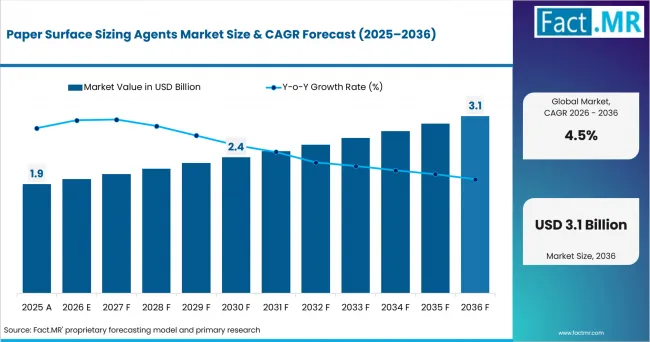
Paper Surface Sizing Agents Market Market Value Analysis | Source: Fact.MR
What are the defining numbers behind paper surface sizing agents growth?
USD 1.1 billion absolute opportunity by 2036, led by China and India.
- Demand Drivers in the Market
- Packaging paper mills need surface sizing to control water pickup during converting and printing.
- Recycled fiber use raises surface variability, which increases the need for dusting and picking control.
- Food-contact paper requires barrier and oil-resistance performance in grades where plastic replacement is being tested.
- Specialty paper producers use sizing to meet print, release and surface strength targets without changing the full furnish recipe.
- Key Segments Analyzed
- By Chemistry: Starch is expected to hold 38.0% share in 2026 due to mill familiarity and low treatment cost.
- By Paper Grade: Packaging paper is projected to account for 44.0% share in 2026 due to board, liner and food-contact use.
- By Function: Water resistance is forecast to hold 35.0% share in 2026 because Cobb value remains a first approval test.
- By Application Method: Film press is expected to capture 36.0% share in 2026 due to controlled pickup and smoother surface profiles.
- By Buyer Type: Integrated paper mills are projected to account for 46.0% share in 2026 because large mills approve chemicals through repeat trials.
- By Geography: China is projected to record 5.0% CAGR through 2036 due to paper output scale and packaging conversion.
- Analyst Opinion at Fact.MR
- Shambhu Nath Jha, Senior Analyst at Fact.MR states, “Surface sizing is a practical mill decision. Buyers are asking for water holdout, stable paper surfaces and reliable print performance. They want a stable paper surface that runs cleanly and prints reliably. They also need packaging specifications to be met without adding trial risk.”
- Strategic Implications
- Paper mills should treat surface sizing as a grade design choice instead of a late chemical add-on.
- Packaging converters need proof that sizing chemistry does not weaken glueability or print consistency.
- Chemical suppliers should pair starch and synthetic polymers with mill audits to reduce trial failure risk.
- Food packaging buyers need surface treatments aligned with water resistance and oil resistance requirements.
Testing and controlled pickup for surface sizing starch form the base of this market. Starch remains the first formulation layer before AKD, ASA or acrylic systems are added for water holdout and print performance.
China is forecast to record 5.0% CAGR through 2036 due to paper output scale and packaging conversion. India is expected to expand at 4.8% CAGR through 2036 led by packaging paper use. Brazil is projected to grow at 4.3% CAGR due to pulp and paperboard capacity. The United States is expected to match the global rate at 4.2% CAGR. Germany is forecast at 3.9% CAGR, while Japan and the United Kingdom remain below the global average.
How does the paper surface sizing agents market break down by segment?
Starch leads chemistry at 38.0%. Packaging paper leads grade use at 44.0%. Film press leads application method at 36.0%.
Which chemistry dominates?
Starch holds 38.0% share in 2026.
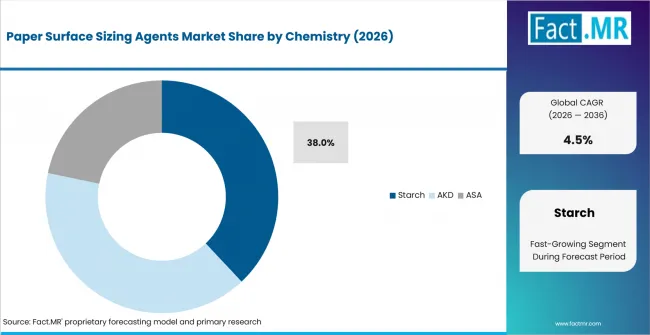
Paper Surface Sizing Agents Market Analysis By Chemistry | Source: Fact.MR
Starch remains the base chemistry because it strengthens the sheet surface and spreads well at size press or film press. Synthetic agents are added when mills need tighter water holdout or ink behavior. This keeps starch at the center of many commercial recipes while leaving room for AKD, ASA and acrylic upgrades.
Which paper grade dominates?
Packaging paper leads with 44.0% share in 2026.
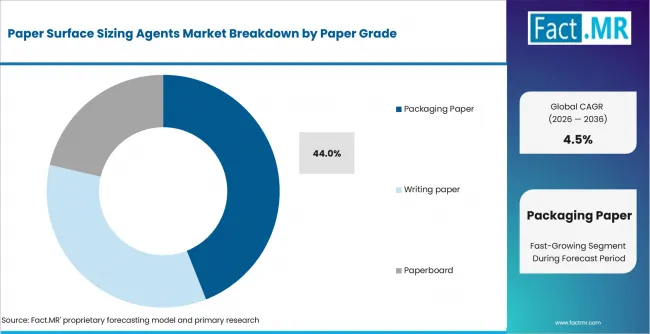
Paper Surface Sizing Agents Market Analysis By Paper Grade | Source: Fact.MR
Packaging paper leads because board and liner grades need moisture resistance during storage and clean print during branding. Surface sizing also supports paper packaging materials where converters need consistent folding, gluing and surface strength.
Higher-value opportunities appear in folding carton packaging where print appearance and oil resistance are both purchase criteria. This favors suppliers that can prove sizing performance during short mill trials.
Which function dominates?
Water resistance holds 35.0% share in 2026.
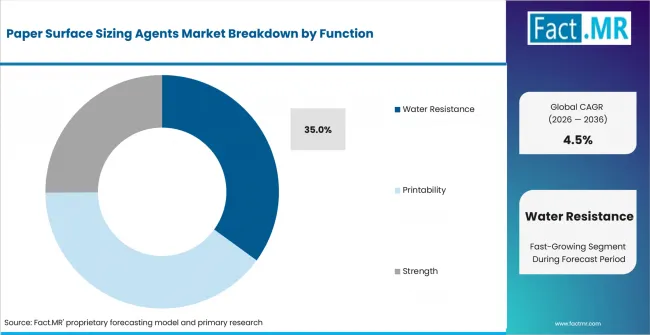
Paper Surface Sizing Agents Market Analysis By Function | Source: Fact.MR
Water resistance leads because Cobb value remains a practical mill test before commercial approval. The same surface-control logic applies to coated papers where print holdout and liquid resistance affect buyer acceptance.
Which application method dominates?
Film press accounts for 36.0% share in 2026.
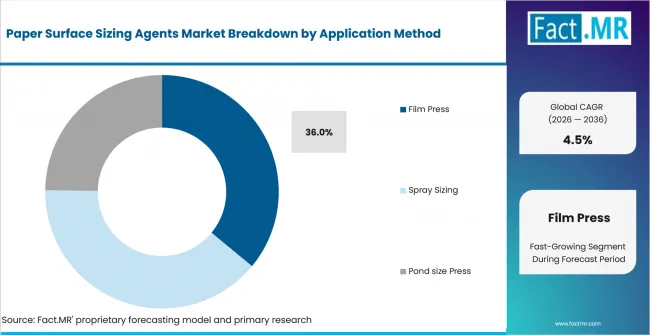
Paper Surface Sizing Agents Market Analysis By Application Method | Source: Fact.MR
Film press use is expected to stay ahead because it gives mills better control over pickup and surface uniformity. The method also reduces over-application risk when mills run lightweight grades or recycled fiber blends.
Which buyer type dominates?
Integrated paper mills hold 46.0% share in 2026.
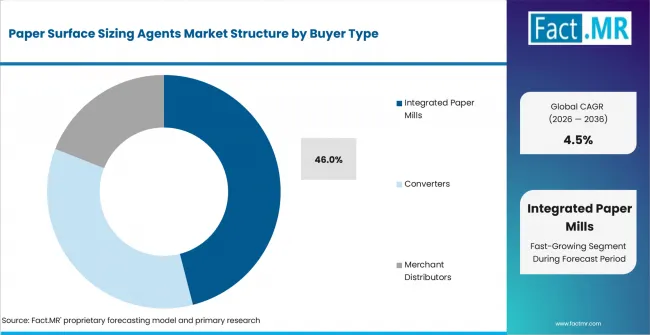
Paper Surface Sizing Agents Market Analysis By Buyer Type | Source: Fact.MR
Integrated paper mills lead because large sites approve chemicals through technical trials and repeat supply contracts. These buyers usually compare runnability, machine cleanliness and finished-sheet performance before switching suppliers.
What is accelerating paper surface sizing agents demand, and what is holding it back?
Packaging grade output and recycled fiber variability drive it. Graphic paper decline and drying energy cost restrain faster conversion.
The main driver is packaging-grade specification pressure. CEPI reported that packaging grades accounted for 63.9% of European paper and board production in 2025, and this production mix supports higher surface treatment use in secondary paper and paperboard luxury packaging. [2]
The main restraint is weaker graphic paper demand. CEPI reported a 7.2% decrease in graphic paper production in 2025, which limits sizing volumes tied to printing and writing grades. Supplier exposure to industrial packaging can partly offset that pressure when mills shift capacity toward board and transport packaging.
Where do the biggest paper surface sizing agents opportunities sit?
Food-grade packaging, recycled paperboard and specialty surface-control applications.
- Food-Grade Paper: Suppliers can support mills that need oil resistance and water holdout for fiber-based food packaging.
- Recycled Paperboard: Mills using variable recovered fiber need surface treatments that reduce dusting and improve print consistency.
- Specialty Surface Control: Release papers and coated sheets create smaller but higher-specification opportunities for sizing and barrier chemistries.
Which countries are scaling paper surface sizing agents fastest?
China leads at 5.0% CAGR. India follows at 4.8%. Brazil records 4.3%.
Based on regional analysis, the paper surface sizing agents market is segmented into North America and Latin America. Europe, East Asia and South Asia and Pacific are also covered. Middle East and Africa is included in the region taxonomy.
| Country | CAGR |
|---|---|
| China | 5.0% |
| India | 4.8% |
| Brazil | 4.3% |
| United States | 4.2% |
| Germany | 3.9% |
| Japan | 3.6% |
| United Kingdom | 3.2% |
Source: Fact.MR analysis. Updated Jun 25, 2026
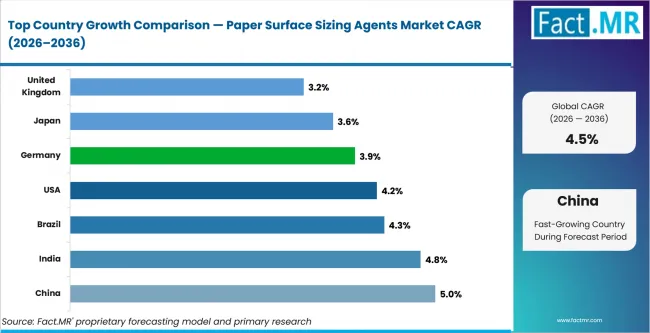
Paper Surface Sizing Agents Market Cagr Analysis By Country | Source: Fact.MR
What is powering China’s lead?
5.0% CAGR, supported by paper output scale and packaging conversion.
China is forecast to record 5.0% CAGR through 2036 due to its paper output scale and large packaging conversion base. The State Council of the People’s Republic of China reported that machine-made paper and paperboard output reached 22.42 million tonnes in the first two months of 2024. [3] This volume base gives sizing suppliers a large trial pool across board, packaging paper and food-contact grades.
Why is India an important sizing market?
4.8% CAGR, supported by packaging paper demand and low paper use per person.
India is expected to expand at 4.8% CAGR through 2036 as packaging buyers move into higher-volume paper formats. India Brand Equity Foundation reported that India’s paper packaging market reached USD 19.07 billion as of August 2025. [5] Suppliers that can serve board mills and converters with locally supported formulations are expected to gain better repeat business.
What supports Brazil’s outlook?
4.3% CAGR, backed by pulp strength and packaging capacity.
Brazil is projected to record 4.3% CAGR through 2036 because pulp availability and packaging paper exports support paperboard conversion. Brazilian Tree Industry reported forest-based product exports of USD 15.7 billion in its 2025 annual report release. [6] This export base supports domestic paper producers that need surface treatments for packaging and wrapping grades.
How does the United States perform?
4.2% CAGR, aligned with the global average.
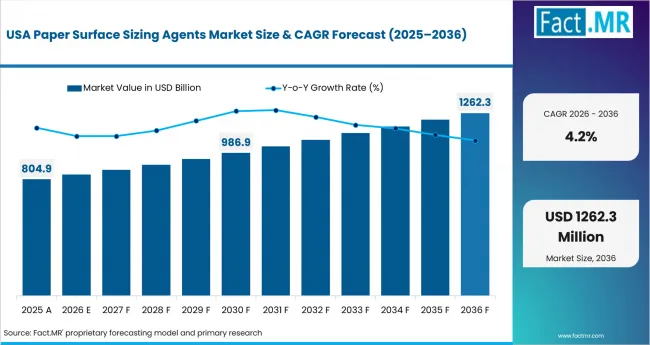
Paper Surface Sizing Agents Market Country Value Analysis | Source: Fact.MR
The United States is expected to match the global CAGR through 2036 because packaging papers offset part of the pressure on total paper production. The American Forest & Paper Association reported that U.S. paper and paperboard production reached 66.3 million tons in 2025. [1] Mills are likely to keep sizing programs where packaging papers need water holdout and controlled print surfaces.
What underpins Germany’s position?
3.9% CAGR, supported by specialty capability but restrained by cost.
Germany is forecast at 3.9% CAGR through 2036 because specialty paper capability supports higher-specification chemistry. Die Papierindustrie reported that the German paper and pulp industry recorded EUR 15 billion in annual turnover in 2024. [8] Cost pressure limits faster volume growth, but technical grades keep demand relevant for suppliers with mill support.
Why does Japan remain relevant?
3.6% CAGR, supported by specialty paper and conservative buyer testing.
Japan is expected to expand at 3.6% CAGR through 2036 as specialty paper producers retain a careful trial culture. Japan Paper Association data show ongoing paper and paperboard production tracking through 2025. [4] Buyers are expected to prefer suppliers that can document printability, water resistance and machine cleanliness before scale-up.
What limits the United Kingdom outlook?
3.2% CAGR, constrained by domestic production pressure.
The United Kingdom is forecast at 3.2% CAGR through 2036 because domestic paper production is smaller than major Asian and North American markets. The Confederation of Paper Industries reports 3.3 million tonnes of paper and board production for the UK industry. [7] Demand remains tied to packaging and recovered paper systems rather than broad new mill capacity.
Who leads the paper surface sizing agents landscape?
Solenis and Kemira lead through paper chemistry breadth. BASF SE competes through formulation capability and global customer access.
Paper surface sizing agents are sold through a mix of global chemical producers, paper chemical specialists and regional formulation suppliers. Solenis provides internal and surface sizing products for liquid holdout. Ecolab’s Nalco Water business lists internal and surface sizing among its paper functionals. [11] Kemira, BASF SE and Buckman compete through paper chemical programs and application support.
Archroma and Omya are stronger in barrier and paperboard surface treatment adjacencies. Archroma launched Cartaseal OGB F10 for oil and grease barrier coating in April 2024. [10] Solenis and HEIDELBERG also announced work on print-applied barrier coatings for paper packaging in September 2024. [9]
Chemistry breadth matters because buyers often compare surface sizing with barrier coatings and pine chemicals derivatives used in adjacent rosin chemistry. CHEMIPAZ CORPORATION is the current name for the company formerly known as SEIKO PMC CORPORATION after the April 2025 name change. [12]
Which companies are the key players?
The key players are Solenis, Kemira and BASF SE. Other suppliers include Archroma, Buckman and CHEMIPAZ CORPORATION. Harima Chemicals is also active in paper chemicals.
- Solenis
- Kemira
- BASF SE
- Archroma
- Buckman
- CHEMIPAZ CORPORATION, formerly SEIKO PMC CORPORATION
- Harima Chemicals
- Ecolab Nalco Water
- Ingredion Incorporated
- Omya
Bibliography
- [1] American Forest & Paper Association. (2026, May 29). AF&PA releases 66th annual paper industry capacity and fiber consumption survey. American Forest & Paper Association.
- [2] Confederation of European Paper Industries. (2026, February 17). New 2025 pulp and paper manufacturing figures show moderate resilience. CEPI.
- [3] State Council of the People’s Republic of China. (2024, May 2). China’s paper-making industry sees steady growth in first two months. English.gov.cn.
- [4] Japan Paper Association. (2025). Paper and paperboard production. Japan Paper Association.
- [5] India Brand Equity Foundation. (2026, February). Paper packaging presentation. India Brand Equity Foundation.
- [6] Brazilian Tree Industry. (2025, October 30). Ibá annual report 2025. Brazilian Tree Industry.
- [7] Confederation of Paper Industries. (2026). Key industry statistics. Confederation of Paper Industries.
- [8] Die Papierindustrie. (2025). PAPIER 2025: Ein Leistungsbericht. Die Papierindustrie.
- [9] Solenis. (2024, September 17). Solenis and HEIDELBERG collaborate to develop print-applied barrier coatings for paper packaging. Solenis.
- [10] Archroma. (2024, April). Archroma launches Cartaseal OGB F10 barrier coating for oil and grease applications. Archroma.
- [11] Ecolab. (2026). Sizing and functionals. Ecolab.
- [12] CHEMIPAZ CORPORATION. (2025, February 14). Announcement regarding company name change. CHEMIPAZ CORPORATION.
This Report Addresses
- This report provides strategic intelligence on paper surface sizing agents across chemistry and grade. Function, application method and buyer type are also covered.
- This report analyzes starch, packaging paper and water resistance. Film press use and integrated paper mills are also assessed.
- The regional outlook covers China, India and Brazil. It also covers the United States, Germany and Japan. The United Kingdom is included in the country review.
- The competitive analysis covers Solenis, Kemira and BASF SE. It also reviews Archroma, Buckman and CHEMIPAZ CORPORATION.
- The source review uses official paper production data and industry association statistics. Company product pages support the supplier analysis.
- The buyer assessment covers Cobb value and print holdout. Machine cleanliness and supplier trial support are also reviewed.
- The forecast validation uses supplied market anchors and paper output indicators. Surface treatment use logic supports the final estimate.
What does the paper surface sizing agents market cover?
Surface-applied sizing chemistries used to improve water resistance and printability. They also support oil resistance and surface strength in paper and board.
The paper surface sizing agents market covers a specific layer within specialty pulp and paper chemicals. It includes starch and AKD. ASA, acrylic and styrene maleic anhydride are included when applied to the sheet surface.
What is included in the scope?
Surface treatment chemicals sold for size press and film press use. Metered size press, spray sizing and coating line applications are also included.
The scope includes formulations applied after sheet formation to control water absorption and print holdout. It includes chemicals used in packaging paper and paperboard. Specialty paper and food-grade paper are included when surface performance is the purchase reason.
What is excluded from the scope?
Internal sizing-only chemistries, pigment coating binders and paper machine hardware are outside the market value.
The scope excludes wet-end sizing agents when they are not sold for surface application. It excludes paper machine equipment and coating binders purchased mainly for gloss or opacity. General papermaking starch is excluded when it is not positioned as a surface treatment formulation.
How was the analysis built?
100+ source checks and 40+ company portfolio reviews supported the analysis. 25+ country indicators and supplier validation logic were also reviewed.
- Primary Research:
- Primary research includes interviews with paper mill buyers and packaging converters. Chemical distributors were also reviewed. It tests how mills compare Cobb value and ink holdout. Dusting control and machine cleanliness are checked before supplier approval.
- Desk Research:
- paper output data, association statistics and supplier portfolios linked to pulp and paper processing chemicals. Company pages were checked to confirm current participation in sizing or paper surface treatment.
- Market-Sizing and Forecasting:
- Market sizing uses the supplied value anchors and a hybrid top-down method. Paper and board output was converted into addressable surface treatment volume. The result was reconciled against supplier portfolios and paper chemical pricing logic.
- Data Validation and Update Cycle:
- Forecasts were checked against packaging paper output, graphic paper pressure and country mill structure. Source-backed data points were used once to avoid repeated evidence across sections.
Segmentation
What is the report’s scope and coverage?
| Attribute | Details |
|---|---|
| Quantitative Units | USD Billion in 2026 to USD Billion by 2036 at CAGR |
| Market Definition | Surface-applied chemical formulations used to improve paper and board water resistance, printability, oil resistance and strength |
| Chemistry | Starch, AKD, ASA, acrylic, styrene maleic anhydride, polyurethane dispersions, bio-based polymers |
| Paper Grade | Packaging paper, writing paper, printing paper, specialty paper, paperboard, food-grade paper |
| Function | Water resistance, printability, oil resistance, strength, barrier performance, dust reduction |
| Application Method | Pond size press, film press, metered size press, spray sizing, coating line application |
| Buyer Type | Integrated paper mills, paperboard mills, converters, specialty paper producers, food packaging manufacturers, merchant distributors |
| Regions Covered | North America, Latin America, Europe, East Asia, South Asia and Pacific, Middle East and Africa |
| Countries Covered | China, India, Brazil, United States, Germany, Japan and United Kingdom |
| Key Companies Profiled | Solenis, Kemira, BASF SE, Archroma, Buckman, CHEMIPAZ CORPORATION, Harima Chemicals, Ecolab, Ingredion Incorporated and Omya |
| Forecast Period | 2026 to 2036 |
| Approach | Hybrid top-down and bottom-up approach using market sizing inputs, paper output indicators, grade mix and supplier portfolio checks |
Source: Fact.MR analysis. Updated Jun 25, 2026
How is the market segmented?
-
By Chemistry:
- Starch
- AKD
- ASA
- Acrylic
- Styrene maleic anhydride
- Polyurethane dispersions
- Bio-based polymers
-
By Paper Grade:
- Packaging paper
- Writing paper
- Printing paper
- Specialty paper
- Paperboard
- Food-grade paper
-
By Function:
- Water resistance
- Printability
- Oil resistance
- Strength
- Barrier performance
- Dust reduction
-
By Application Method:
- Pond size press
- Film press
- Metered size press
- Spray sizing
- Coating line application
-
By Buyer Type:
- Integrated paper mills
- Paperboard mills
- Converters
- Specialty paper producers
- Food packaging manufacturers
- Merchant distributors
-
By Region:
- North America
- United States
- Canada
- Mexico
- Latin America
- Brazil
- Argentina
- Rest of Latin America
- Europe
- Germany
- United Kingdom
- France
- Italy
- Spain
- Rest of Europe
- East Asia
- China
- Japan
- South Korea
- South Asia and Pacific
- India
- ASEAN
- Australia and New Zealand
- Middle East & Africa
- GCC Countries
- South Africa
- UAE
- Rest of Middle East & Africa
- North America
Frequently Asked Questions
Which chemistry leads the Paper Surface Sizing Agents Market?
Which paper grade uses the most paper surface sizing agents?
Which country expands fastest in the Paper Surface Sizing Agents Market?
How does India perform in the Paper Surface Sizing Agents Market?
How does Brazil perform in the Paper Surface Sizing Agents Market?
How does the United States perform in the Paper Surface Sizing Agents Market?
How does Germany perform in the Paper Surface Sizing Agents Market?
How does Japan perform in the Paper Surface Sizing Agents Market?
How does the United Kingdom perform in the Paper Surface Sizing Agents Market?
What is the primary driver in the Paper Surface Sizing Agents Market?
What is the main restraint in the Paper Surface Sizing Agents Market?
Why are film press applications important in this market?
Who worked on this report


Preview the report firsthand - request a free sample
Free SampleGet the brochure for pricing and purchase details
Download PDF