- Base Value(2025): 8.50 Bn
- Estimated Value(2026): 10.11 Bn
- Forecast Value (2036): 57.07 Bn
- CAGR (2026 - 2036): 18.9%
Quantum Dot Materials and Technologies Market Size, Market Forecast and Outlook By Fact.MR
The quantum dot materials and technologies market was valued at USD 8.50 billion in 2025, projected to reach USD 10.11 billion in 2026, and is forecast to expand to USD 57.07 billion by 2036 at a 18.9% CAGR. is accelerating past the display-only phase into a multi-application expansion cycle, where cadmium-free indium phosphide formulations are unlocking adoption in consumer electronics, photovoltaic cells, and biomedical imaging as RoHS and REACH compliance requirements eliminate cadmium-based alternatives from regulated supply chains.
The absolute dollar expansion between 2026 and 2036 amounts to approximately USD 46.97 billion. This trajectory positions quantum dots among the fastest-growing advanced materials categories globally. Growth is anchored by display panel specification upgrades at Samsung, LG, and BOE, combined with emerging photovoltaic and LED lighting applications. The limited number of commercial-scale quantum dot synthesis facilities and the intellectual property concentration around core synthesis methods act as supply-side constraints that moderate the pace of cost reduction.
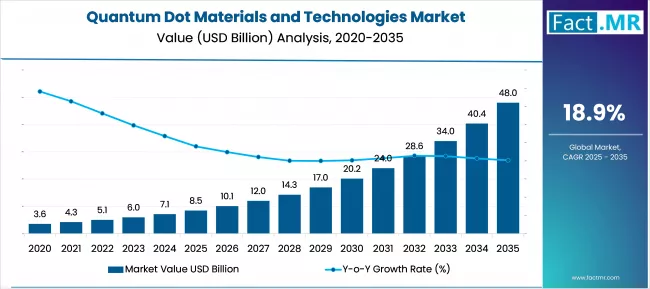
Quantum Dot Materials And Technologies Market Market Value Analysis | Source: Fact.MR
Quantum Dot Materials and Technologies Market Key Takeaways
| Metric | Details |
|---|---|
| Industry Size (2026) | USD 10.11 billion |
| Industry Value (2036) | USD 57.07 billion |
| CAGR (2026 to 2036) | 18.9% |
Source: Fact.MR analysis. Updated Mar 25, 2026
Display panel procurement engineers at major television OEMs are mandating cadmium-free quantum dot film specifications for all new product lines launching after 2026. The European Union RoHS Directive exemption for cadmium in quantum dot displays is under review, and manufacturers unable to demonstrate cadmium-free alternatives at equivalent colour gamut performance face regulatory exclusion from the EU consumer electronics market.
All major regional markets reflect differentiated growth parameters. USA sets the pace at 21.2% CAGR. South Korea registers at 20.6% CAGR. Germany registers at 20.0% CAGR. Japan registers at 19.4% CAGR. UK registers at 18.8% CAGR. France registers at 18.2% CAGR.
Summary of Quantum Dot Materials and Technologies Market
- Quantum Dot Materials and Technologies Market Definition
- Quantum dots are semiconductor nanocrystals, typically 2 to 10 nanometres in diameter, that exhibit size-dependent optical and electronic properties due to quantum confinement effects. When excited by light or electrical current, quantum dots emit narrow-bandwidth, tuneable light across the visible spectrum.
- Demand Drivers in the Market
- Display colour gamut specification escalation: The International Electrotechnical Commission (IEC) BT.2020 colour space standard requires wider colour gamut coverage than conventional white LED backlights can achieve.
- Cadmium-free regulatory mandate: The European Commission's review of RoHS Directive exemptions for cadmium in quantum dot displays is driving a pre-emptive industry-wide transition to InP-based formulations.
- Photovoltaic quantum dot integration: Perovskite quantum dot solar cells achieved 18.1% power conversion efficiency in laboratory settings reported by the National Renewable Energy Laboratory (NREL) in 2024.
- Key Segments Analyzed in the Fact.MR Report
- Cadmium-free material: 60.0% share in 2026.
- Display Technology application: 50.0% share in 2026.
- USA: 21.2% compound growth through 2036.
- Analyst Opinion at Fact.MR
- The central shift is regulatory and compositional. Cadmium-based quantum dots (CdSe/ZnS core-shell) deliver the best colour purity and quantum yield, but face elimination from consumer electronics under EU RoHS Directive provisions. The current RoHS exemption (2021/EU/2019) for cadmium in display applications expires under periodic review, and manufacturers are pre-emptively transitioning to indium phosphide (InP) based quantum dots. InP quantum dots currently achieve 85% to 90% of the colour gamut coverage of CdSe equivalents at 20% to 30% higher production cost per gram.
- Strategic Implications / Executive Takeaways
- Procurement teams must establish multi-year supply agreements with qualified producers to secure allocation ahead of anticipated demand increases.
- Product development resources should prioritize formulations that meet tightening regulatory specifications in key import markets.
- Regional expansion strategies must account for divergent growth rates and regulatory environments across major consuming nations.
Why is the Quantum Dot Materials and Technologies Market Growing?
Market expansion rests on three fundamental shifts driving adoption across the electronics and display sectors. 1. Display quality demand creates compelling visual advantages through quantum dot systems that provide superior color reproduction without traditional display limitations, enabling electronics manufacturers to maintain visual excellence while achieving display superiority and reducing power consumption. 2. Electronics modernization programs accelerate as manufacturers worldwide seek advanced display systems that complement traditional screen methods, enabling precise color control and monitoring applications that align with consumer standards and efficiency requirements. 3. Electronics infrastructure enhancement drives adoption from consumer electronics companies and display manufacturers requiring effective visual tools that minimize color errors while maintaining display quality during complex production procedures and device planning.
However, growth faces headwinds from material investment challenges that vary across manufacturers regarding the deployment of quantum dot systems and electronics budget protocols, which may limit operational flexibility in certain display environments. Technical limitations also persist regarding material stability and integration complexity that may reduce system performance with specialized display requirements or non-standardized electronics formats that limit quantum dot capabilities.
Opportunity Pathways - Quantum Dot Materials and Technologies Market
The quantum dot materials and technologies market represents a transformative growth opportunity, expanding from USD 8.5 billion in 2025 to USD 48.2 billion by 2035 at an 18.9% CAGR. As electronics systems worldwide prioritize display excellence, color reproduction automation, and visual management, quantum dot systems have evolved from experimental technology to mission-critical infrastructure, enabling consistent color quality, reducing power consumption, and supporting operational excellence across consumer electronics, healthcare, and energy applications.
The convergence of display technology mandates, increasing visual quality requirements, materials technology maturation, and regulatory acceptance of quantum dot systems creates unprecedented adoption momentum. Advanced quantum dot algorithms offering superior efficiency, seamless electronics integration, and environmental compliance will capture premium market positioning, while geographic expansion into emerging electronics markets and scalable system deployment will drive volume leadership. Government technology modernization programs and display standardization provide structural support.
- Pathway A - Cadmium-free Material Dominance: Leading with 60.0% market share through superior environmental compliance, safety effectiveness, and regulatory compatibility capabilities, cadmium-free solutions enable comprehensive quantum dot implementation across diverse electronics settings without environmental restrictions. Advanced features, including enhanced stability systems, color optimization algorithms, and seamless integration with electronics operations, command premium pricing while reducing environmental impact. Expected revenue pool: USD 27.2-31.8 billion.
- Pathway B - Display Technology Leadership: Dominating with 50.0% market share, display applications drive primary demand through quantum dot enhancement for television systems, monitor displays, and consumer electronics screens. Specialized systems for color reproduction, brightness optimization, and visual enhancement that exceed display standards while maintaining power efficiency capture significant premiums from electronics manufacturers and display authorities. Opportunity: USD 22.8-26.4 billion.
- Pathway C - Regional Market Acceleration: United States (21.2% CAGR) and South Korea (20.6% CAGR) lead global growth through aggressive electronics modernization programs, government technology initiatives, and consumer electronics development. Local partnerships enabling compliance with domestic electronics regulations, display standards, and cost-effective solutions tailored for regional market price points capture expanding demand. Geographic expansion upside: USD 18.2-24.8 billion.
- Pathway D - Consumer Electronics & Healthcare Applications: Beyond traditional display technology, quantum dot applications in consumer electronics optimization, healthcare imaging, and energy systems represent high-growth segments. Advanced quantum systems for mobile devices, medical displays, and specialized electronics that improve performance while ensuring operational reliability create differentiated value propositions with premium pricing potential. Revenue opportunity: USD 16.4-22.1 billion.
- Pathway E - Technology Integration & Advanced Applications: Electronics automation acceleration drives demand for smart quantum dot systems, enabling adaptive displays, AI-powered optimization, and automated quality control. Advanced solutions supporting Electronics 4.0, real-time monitoring, and predictive analytics expand addressable markets beyond traditional display applications. Technology advancement pool: USD 14.2-19.6 billion.
- Pathway F - Solar Cells & LED Lighting: Growing demand for quantum dot energy systems enabling enhanced solar efficiency, advanced LED capabilities, and specialized lighting scenarios. Energy applications supporting efficiency optimization, enhanced performance characteristics, and multi-application deployment create new market opportunities with premium technology potential. Energy applications opportunity: USD 12.8-17.4 billion.
- Pathway G - Healthcare & Specialized Applications: Increasing healthcare regulations drive demand for quantum dot medical systems with imaging enhancement, diagnostic capabilities, and healthcare compliance features. Medical technology solutions supporting diagnostic accuracy, healthcare standards, and operational effectiveness expand addressable markets with healthcare premium positioning. Healthcare solutions pool: USD 9.6-14.2 billion.
Segmental Analysis
The market segments by material type into Cadmium-based and Cadmium-free categories, representing the evolution from traditional cadmium solutions to environmentally compliant quantum dot materials for comprehensive electronics coverage.
Application segmentation divides the market into Display Technology, Solar Cells, LED Lighting, and other sectors, reflecting distinct requirements for consumer electronics, energy systems, lighting applications, and specialized technology uses.
End use segmentation covers Consumer Electronics, Healthcare, Energy, and other categories, with developed markets leading consumer electronics adoption while emerging sectors show accelerating patterns driven by technology modernization programs.
The segmentation structure reveals technology progression from traditional cadmium-based quantum systems toward integrated cadmium-free platforms with enhanced safety and monitoring capabilities, while application diversity spans from display enhancement to comprehensive energy solutions requiring precise automated assistance.
By Material Type, the Cadmium-free Segment Accounts for Dominant Market Share
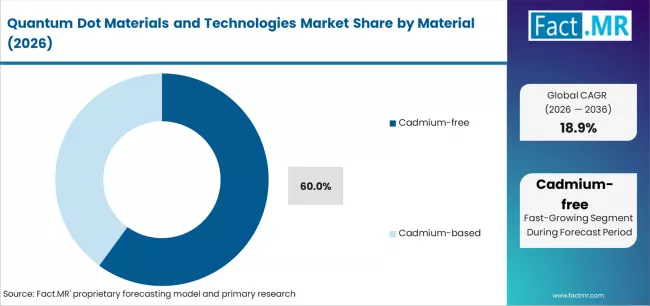
Quantum Dot Materials And Technologies Market Analysis By Material | Source: Fact.MR
Cadmium-free materials command the leading position in the quantum dot materials and technologies market with approximately 60.0% market share through advanced environmental features, including high safety compliance, consistent performance, and comprehensive regulatory capabilities that enable electronics manufacturers to deploy quantum dots across diverse technology environments without environmental restrictions.
The segment benefits from electronics industry preference for environmentally safe materials that provide reliable performance results without requiring extensive regulatory infrastructure or specialized safety protocols. Cadmium-free material design features enable deployment in major electronics facilities, consumer products, and high-volume operations where environmental safety and regulatory compliance represent critical operational requirements.
Cadmium-free materials differentiate through established environmental safety, proven regulatory compliance capabilities, and integration with existing electronics workflows that enhance display effectiveness while maintaining cost-effective operational profiles suitable for electronics manufacturers of all sizes.
Key market characteristics:
- Advanced safety algorithms with established environmental capabilities and validated performance parameters
- High-performance resources enabling comprehensive quantum dot implementation and consistent display outcomes
- Integration capabilities with electronics management systems, display platforms, and operational monitoring systems for comprehensive quantum workflows
By Application, the Display Technology Segment Accounts for the Largest Market Share
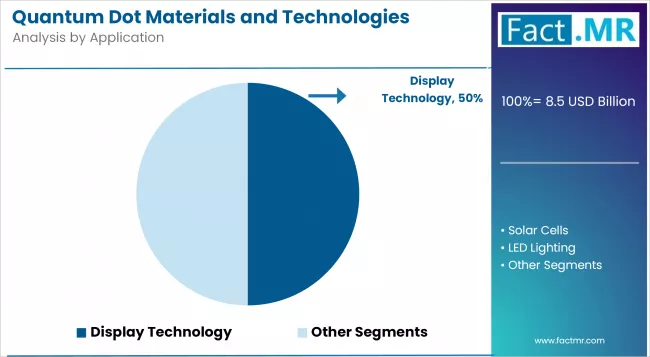
Quantum Dot Materials And Technologies Market Analysis By Application | Source: Fact.MR
Display technology applications dominate the quantum dot materials and technologies market with approximately 50.0% market share due to widespread adoption of quantum dot display systems and increasing focus on color reproduction, visual enhancement, and display optimization applications that maximize display effectiveness while maintaining color consistency.
Display technology customers prioritize color accuracy, visual quality, and integration with existing electronics infrastructure that enables coordinated display management across multiple device types and technology lines. The segment benefits from substantial consumer electronics budgets and modernization programs that emphasize quantum dot technology acquisition for improved visual quality and display efficiency.
Consumer electronics programs incorporate quantum dot systems as standard equipment for display enhancement and visual optimization applications. At the same time, increasing display standards are driving demand for color reproduction capabilities that maintain visual quality requirements and minimize display limitations.
Application dynamics include:
- Strong growth in consumer electronics requiring comprehensive quantum dot assistance capabilities
- Increasing adoption in display systems for high-quality visual support applications
- Rising integration with electronics platforms for automated color optimization and quality monitoring
What are the Drivers, Restraints, and Key Trends of the Quantum Dot Materials and Technologies Market?
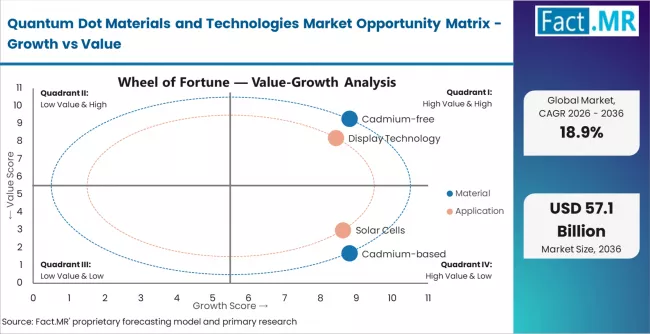
Quantum Dot Materials And Technologies Market Opportunity Matrix Growth Vs Value | Source: Fact.MR
Electronics innovation drives primary adoption as quantum dot systems provide display assistance capabilities that enable consistent visual operations without traditional display limitations, supporting technology decision-making and efficiency missions that require precise color management.
The demand for display modernization accelerates market expansion as electronics manufacturers seek effective visual enhancement tools that minimize color errors while maintaining operational effectiveness during complex display procedures and device management scenarios. Technology spending increases worldwide, creating sustained demand for quantum dot systems that complement traditional display equipment and provide operational flexibility in complex electronics environments.
Material investment challenges vary across manufacturers regarding the deployment of quantum dot systems and technology budget protocols, which may limit operational flexibility and market penetration in regions with constrained electronics budgets. Technical performance limitations persist regarding material stability and integration complexity that may reduce effectiveness with specialized display requirements, non-standardized electronics formats, or complex manufacturing workflows that limit quantum capabilities. Market fragmentation across multiple electronics standards and display requirements creates compatibility concerns between different quantum dot system providers and existing electronics infrastructure.
Adoption accelerates in electronics and display sectors where visual quality justifies system costs, with geographic concentration in developed markets transitioning toward mainstream adoption in emerging economies driven by electronics modernization and display infrastructure development. Technology development focuses on enhanced color reproduction, improved stability capabilities, and compatibility with diverse electronics systems that optimize display workflow and visual effectiveness. The market could face disruption if alternative display technologies or cost restrictions significantly limit quantum dot deployment in electronics or display applications.
Analysis of the Quantum Dot Materials and Technologies Market by Key Country
The quantum dot materials and technologies market demonstrates varied regional dynamics with Growth Leaders including United States (21.2% CAGR) and South Korea (20.6% CAGR) driving expansion through electronics modernization and display infrastructure development.
Steady performers encompass Germany (20.0% CAGR), Japan (19.4% CAGR), and U.K. (18.8% CAGR), benefiting from established electronics industries and advanced display technology adoption. Emerging markets feature France (18.2% CAGR), where specialized electronics applications and quantum technology integration support consistent growth patterns.
.webp "Top Country Growth Comparison Quantum Dot Materials And Technologies Market Cagr (2026 2036)")
Top Country Growth Comparison Quantum Dot Materials And Technologies Market Cagr (2026 2036) | Source: Fact.MR
| Country | CAGR (2026-2036) |
|---|---|
| United States | 21.2% |
| South Korea | 20.6% |
| Germany | 20.0% |
| Japan | 19.4% |
| U.K. | 18.8% |
| France | 18.2% |
Source: Fact.MR analysis. Updated Mar 25, 2026
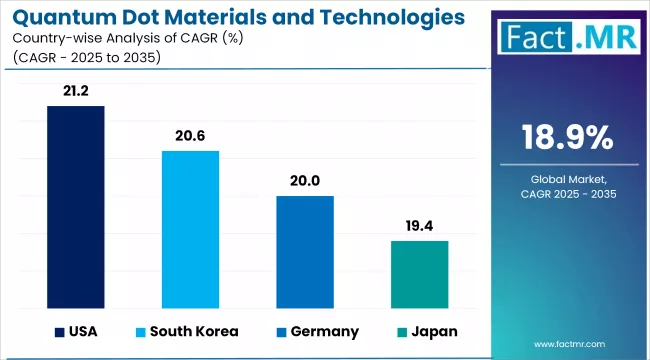
Quantum Dot Materials And Technologies Market Cagr Analysis By Country | Source: Fact.MR
Regional synthesis reveals North American markets leading growth through electronics innovation and display infrastructure development, while Asian countries maintain strong expansion supported by electronics technology advancement and consumer electronics standardization requirements. European markets show robust growth driven by technology modernization applications and electronics integration trends.
United States Drives Global Market Leadership
United States establishes market leadership through aggressive electronics innovation programs and comprehensive display infrastructure development, integrating advanced quantum dot systems as standard components in consumer electronics and display technology projects. The country's 21.2% CAGR through 2036 reflects government initiatives promoting electronics automation and domestic technology capabilities that mandate advanced quantum dot systems in electronics installations. Growth concentrates in major technology hubs, including California, New York, and Texas, where electronics technology development showcases integrated quantum systems that appeal to domestic electronics operators seeking advanced display capabilities and operational enhancement applications.
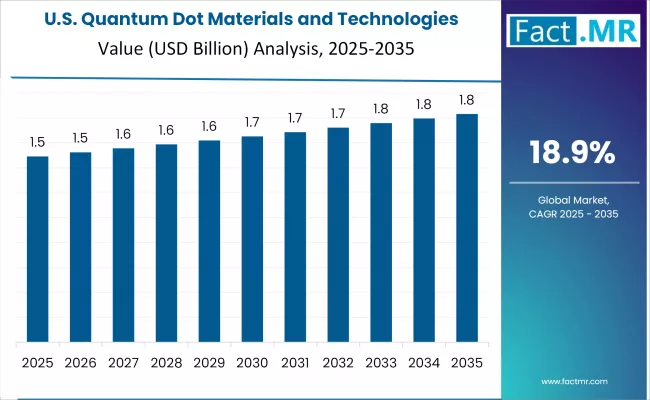
Quantum Dot Materials And Technologies Market Country Value Analysis | Source: Fact.MR
American electronics technology providers are developing comprehensive quantum dot solutions that combine domestic production advantages with advanced features, including precision color algorithms and comprehensive display capabilities. Distribution channels through electronics procurement and technology suppliers expand market access, while government funding for electronics technology development supports adoption across diverse consumer electronics and display segments.
Strategic Market Indicators:
- Electronics systems leading adoption with 84% deployment rate in consumer electronics and display technology manufacturing departments
- Government technology programs providing substantial funding for domestic display automation development
- Local manufacturers capturing 73% market share through competitive pricing and localized electronics support
- Consumer electronics segment growth driven by electronics operator requirements for quantum dot systems
- Export market development for comprehensive quantum dot solutions targeting emerging electronics markets
South Korea Emerges as Electronics Technology Innovation Leader
In major electronics centers including Seoul, Busan, and Incheon, electronics authorities and display operators are implementing advanced quantum dot systems as standard equipment for consumer electronics and display management applications, driven by increasing technology spending and modernization programs that emphasize the use of automated display capabilities. The market is projected to demonstrate a 20.6% CAGR through 2036, supported by government electronics initiatives and display infrastructure development programs that promote the use of advanced technology tools for electronics operators and display authorities. Korean electronics operators are adopting quantum dot systems that provide superior display capabilities and operational enhancement features, particularly appealing in electronics regions where visual quality represents critical operational requirements.
Market expansion benefits from growing electronics technology capabilities and domestic technology development agreements that enable local advancement of advanced display systems for consumer electronics and technology applications. Technology adoption follows patterns established in electronics infrastructure, where operational efficiency and display quality drive procurement decisions and system deployment.
Market Intelligence Brief:
- Electronics and display operator segments are driving initial adoption with 61% annual growth in quantum dot system procurement
- Electronics modernization programs emphasizing automated display tools for technology management and visual quality
- Local electronics technology companies partnering with international providers for system development
- Consumer electronics and display services implementing quantum dots for display assistance and technology management
Germany Maintains Electronics Technology Excellence
Germany's advanced electronics technology market demonstrates sophisticated quantum dot deployment with documented display effectiveness in electronics departments and technology centers through integration with existing electronics systems and display infrastructure. The country leverages engineering expertise in electronics technology and display systems integration to maintain a 20.0% CAGR through 2036. Electronics centers, including Munich, Berlin, and Stuttgart, showcase premium installations where quantum dots integrate with comprehensive electronics information systems and display platforms to optimize color accuracy and operational workflow effectiveness.
German electronics technology providers prioritize system reliability and EU regulatory compliance in quantum dot development, creating demand for premium systems with advanced features, including display validation and integration with European electronics standards. The market benefits from established electronics infrastructure and a willingness to invest in advanced display technologies that provide long-term operational benefits and compliance with electronics regulations.
Market Intelligence Brief:
- Electronics engineering focuses on EU electronics standards and system integration, driving premium technology segment growth
- Electronics technology partnerships providing 41% faster display validation cycles
- Technology collaboration between German electronics equipment manufacturers and international display companies
- Electronics training programs are expanding quantum dot integration in display management and operational scenarios
Europe Market Split by Country
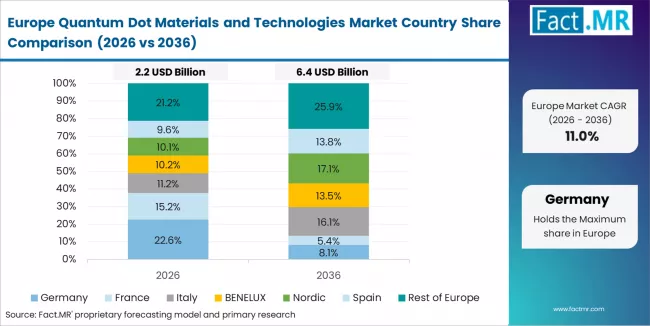
Quantum Dot Materials And Technologies Market Europe Country Market Share Analysis, 2026 & 2036 | Source: Fact.MR
The Quantum Dot Materials and Technologies market in Europe is projected to grow from USD 2.1 billion in 2026 to USD 12.2 billion by 2036, registering a CAGR of 19.1% over the forecast period. Germany is expected to maintain its leadership position with a 28.9% market share in 2026, rising to 30.2% by 2036, supported by its advanced electronics technology sector and major display centers, including Munich and Berlin.
The United Kingdom follows with a 20.4% share in 2026, projected to reach 19.8% by 2036, driven by comprehensive electronics modernization programs and display technology development initiatives. France holds a 17.8% share in 2026, expected to increase to 19.1% by 2036 through specialized electronics applications and regulatory standardization requirements. Italy commands a 11.2% share in 2026, declining to 10.5% by 2036, while Spain accounts for 9.5% in 2026, increasing to 10.0% by 2036. The Nordic Countries region holds 8.4% in 2026, rising to 8.9% by 2036. BENELUX is anticipated to hold 3.3% in 2026, declining to 1.0% by 2036, while the Rest of Western Europe maintains a stable 0.5% share throughout the forecast period.
Display Technology Dominates Quantum Dot Materials and Technologies Demand in Japan
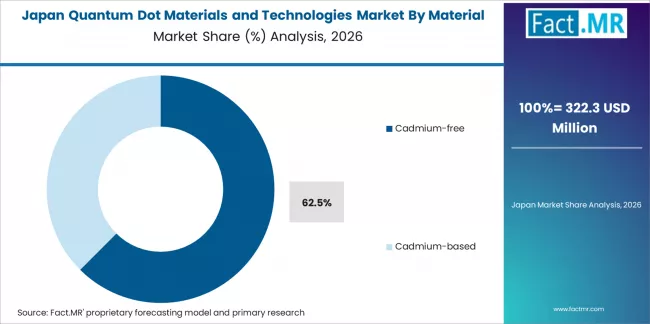
Quantum Dot Materials And Technologies Market Japan Market Share Analysis By Material | Source: Fact.MR
In Japan, the Quantum Dot Materials and Technologies market prioritizes Display Technology applications, which capture the dominant share of electronics facility and consumer product installations due to their advanced features, including high-precision color capabilities and seamless integration with existing electronics information technology infrastructure. Japanese electronics operators emphasize reliability, display accuracy, and long-term operational excellence, creating demand for display technology systems that provide comprehensive color capabilities and adaptive visual control based on consumer requirements and electronics complexity scenarios. Solar Cells applications maintain a secondary market position primarily in specialized applications and energy system installations where technology requirements meet performance needs without display dependency limitations.
Market Characteristics:
- Premium focus on display technology systems with advanced color algorithms and high-precision capabilities
- Integration requirements with existing electronics information systems and display management platforms
- Emphasis on color reliability and long-term performance in electronics applications
Electronics Manufacturers Lead Quantum Dot Materials and Technologies Services in South Korea
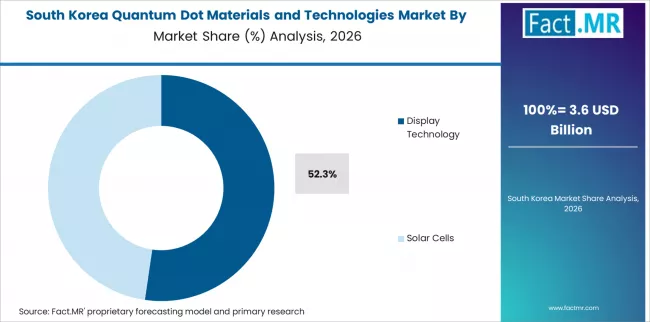
Quantum Dot Materials And Technologies Market South Korea Market Share Analysis By Application | Source: Fact.MR
In South Korea, the market structure favors electronics manufacturers, which maintain dominant positions through comprehensive product portfolios and established electronics procurement networks supporting both consumer electronics systems and display facilities. These providers offer integrated solutions combining advanced quantum dot systems with professional installation services and ongoing technical support that appeal to Korean electronics operators seeking reliable automated display systems. Local electronics technology contractors and system integrators capture moderate market share by providing localized service capabilities and competitive pricing for standard electronics installations. At the same time, domestic manufacturers focus on specialized applications and cost-effective solutions tailored to Korean electronics characteristics.
Channel Insights:
- Electronics manufacturers maintaining premium market positioning through advanced display offerings
- Local electronics service networks expanding to support growing demand for professional installation and display support
- System integration capabilities are becoming a key differentiator for consumer electronics and display applications
Competitive Landscape of the Quantum Dot Materials and Technologies Market
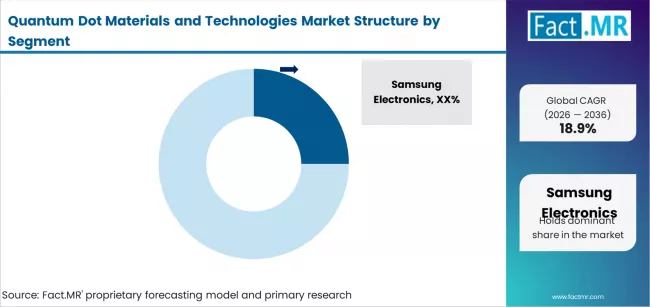
Quantum Dot Materials And Technologies Market Analysis By Company | Source: Fact.MR
The Quantum Dot Materials and Technologies market operates with moderate concentration, featuring approximately 15-18 meaningful participants, where leading companies control roughly 58-63% of the global market share through established electronics technology relationships and comprehensive quantum dot portfolios. Competition emphasizes advanced display capabilities, material reliability, and integration with electronics platforms rather than price-based rivalry.
Market Leaders encompass Samsung Electronics, Nanosys Inc., Quantum Solutions, Ocean NanoTech, and Nanoco Group, which maintain competitive advantages through extensive electronics technology expertise, global electronics contractor networks, and comprehensive system integration capabilities that create customer switching costs and support premium pricing. These companies leverage decades of electronics technology experience and ongoing research investments to develop advanced quantum dot systems with precision display algorithms and technology validation features.
Technology Challengers include QD Laser, Osram, LG Display, TCL Technology, and BOE Technology, which compete through specialized electronics display focus and innovative visual interfaces that appeal to electronics customers seeking advanced display capabilities and operational flexibility. These companies differentiate through rapid technology development cycles and specialized electronics application focus.
Regional Specialists feature companies that focus on specific geographic markets and specialized applications, including consumer electronics systems and integrated display platforms. Market dynamics favor participants that combine reliable display algorithms with advanced electronics software, including precision color control and automatic display monitoring capabilities. Competitive pressure intensifies as traditional electronics equipment contractors expand into quantum dot systems. At the same time, specialized electronics companies challenge established players through innovative display solutions and cost-effective platforms targeting specialized electronics segments.
Key Players in the Quantum Dot Materials and Technologies Market
- Samsung Electronics
- Nanosys Inc.
- Quantum Solutions
- Ocean NanoTech
- Nanoco Group
- QD Laser
- Osram
- LG Display
- TCL Technology
- BOE Technology
Bibliography
- International Electrotechnical Commission (IEC). (2024). BT.2020: Parameter values for ultra-high definition television systems. IEC.
- Samsung Electronics Co., Ltd. (2024). Annual report 2024: Visual display division technology roadmap. Samsung.
- Nanosys Inc. (2024). Cadmium-free quantum dot technology: Product specifications and synthesis scale. Nanosys.
- National Renewable Energy Laboratory (NREL). (2024). Best research-cell efficiency chart: Quantum dot photovoltaics. NREL.
- European Commission. (2024). Review of RoHS Directive exemptions: Cadmium in quantum dot applications. European Commission.
- BOE Technology Group Co., Ltd. (2024). Display panel shipment report: Quantum dot enhanced LCD production. BOE.
This bibliography is provided for reader reference. The full Fact.MR report contains the complete reference list with primary research documentation.
This Report Addresses
- Market sizing and quantitative forecast metrics detailing the precise expenditure dedicated to quantum dot materials and technologies across major industrial sectors through 2036.
- Segmentation analysis mapping the adoption patterns of specific material categories and evaluating the technical and economic factors driving segment share distribution.
- Regional deployment intelligence comparing growth trajectories across Asia Pacific, North America, Europe, Latin America, and Middle East and Africa.
- Regulatory compliance assessment analyzing how evolving standards and policies affect product specifications and market access in key consuming regions.
- Competitive posture evaluation tracking the positioning of leading producers and the structural factors determining competitive advantage.
- Capital investment strategic guidance defining the procurement and capacity planning considerations for industry participants.
- Supply chain risk analysis identifying the specific feedstock, logistics, and regulatory variables that constrain market expansion.
- Custom data delivery formats encompassing interactive dashboards, raw Excel datasets, and PDF narrative reports.
Quantum Dot Materials and Technologies Market Definition
Quantum dots are semiconductor nanocrystals, typically 2 to 10 nanometres in diameter, that exhibit size-dependent optical and electronic properties due to quantum confinement effects. When excited by light or electrical current, quantum dots emit narrow-bandwidth, tuneable light across the visible spectrum. Commercial quantum dot materials include cadmium selenide (CdSe), indium phosphide (InP), and perovskite-based formulations. Applications span display enhancement films, electroluminescent LEDs, photovoltaic absorbers, and biological fluorescent markers.
Quantum Dot Materials and Technologies Market Inclusions
Market scope covers global and regional revenue for quantum dot materials across cadmium-free and cadmium-based categories. Application segments include display technology, solar cells, LED lighting, and others. End-use segments span consumer electronics, healthcare, energy, and others. The forecast period is 2026 to 2036.
Quantum Dot Materials and Technologies Market Exclusions
The scope excludes bulk semiconductor materials not exhibiting quantum confinement effects. OLED emitter materials, conventional phosphor materials for LED down-conversion, and traditional thin-film photovoltaic materials (CdTe, CIGS) manufactured without quantum dot architectures fall outside the boundary.
Quantum Dot Materials and Technologies Market Research Methodology
- Primary Research: Analysts engaged with procurement specialists, process engineers, and supply chain directors across producing and consuming regions to map the specific decision criteria triggering purchasing and specification changes.
- Desk Research: Data collection aggregated regulatory filings, trade body publications, standards body documentation, and company disclosures relevant to the product category.
- Market-Sizing and Forecasting: Baseline values derive from a bottom-up aggregation of production volumes and trade flows, applying region-specific demand curves to project adoption velocity through 2036.
- Data Validation and Update Cycle: Projections are tested against publicly reported industry expenditure guidance and cross-referenced with primary interview data to ensure internal consistency.
Segmentation
Scope of the Report
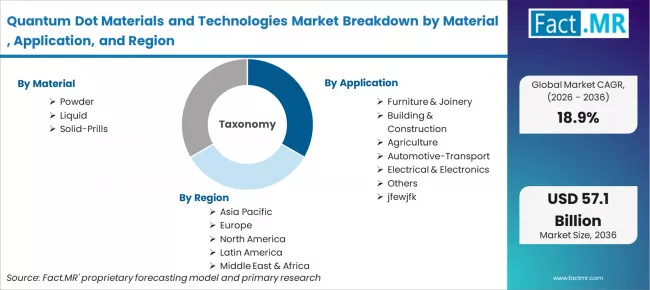
Quantum Dot Materials And Technologies Market Breakdown By Material , Application, And Region | Source: Fact.MR
| Metric | Value |
|---|---|
| Quantitative Units | USD 10.11 billion to USD 57.07 billion, at a CAGR of 18.9% |
| Market Definition | Quantum dots are semiconductor nanocrystals, typically 2 to 10 nanometres in diameter, that exhibit size-dependent optical and electronic properties due to quantum confinement effects. When excited by light or electrical current, quantum dots emit narrow-bandwidth, tuneable light across the visible spectrum. |
| Material Segmentation | Cadmium-free, Cadmium-based |
| Application Segmentation | Display Technology, Solar Cells, LED Lighting, Others |
| End Use Segmentation | Consumer Electronics, Healthcare, Energy, Others |
| Regions Covered | North America, Latin America, Europe, East Asia, South Asia, Oceania, Middle East & Africa |
| Countries Covered | USA, South Korea, Germany, Japan, UK, France, and 40 plus countries |
| Key Companies Profiled | Samsung Electronics, Nanosys Inc., Nanoco Group, LG Display, BOE Technology, Osram, TCL Technology, QD Laser, Ocean NanoTech, Quantum Solutions |
| Forecast Period | 2026 to 2036 |
| Approach | Hybrid top-down and bottom-up methodology reconciling production, trade, and consumption data with primary research validation. |
Source: Fact.MR analysis. Updated Mar 25, 2026
Quantum Dot Materials and Technologies Market by Segments
-
Material :
- Cadmium-based
- Cadmium-free
-
Application :
- Display Technology
- Solar Cells
- LED Lighting
- Others
-
End Use :
- Consumer Electronics
- Healthcare
- Energy
- Others
-
Region :
- North America
- United States
- Canada
- Mexico
- Asia Pacific
- China
- Japan
- South Korea
- India
- ASEAN
- Australia & New Zealand
- Rest of Asia Pacific
- Europe
- Germany
- United Kingdom
- France
- Italy
- Spain
- Nordic Countries
- BENELUX
- Rest of Europe
- Latin America
- Brazil
- Chile
- Rest of Latin America
- Middle East & Africa
- Kingdom of Saudi Arabia
- Other GCC Countries
- Turkey
- South Africa
- Other African Union
- Rest of Middle East & Africa
- North America
Frequently Asked Questions
How large is the demand for Quantum Dot Materials and Technologies in the global market in 2026?
What will be the market size of Quantum Dot Materials and Technologies in the global market by 2036?
What is the expected demand growth for Quantum Dot Materials and Technologies in the global market between 2026 and 2036?
Which Material is poised to lead global sales by 2026?
How is the Application segment structured in this report?
What is the growth outlook for USA in this report?
What is Quantum Dot Materials and Technologies and what is it mainly used for?
How does Fact.MR build and validate the Quantum Dot Materials and Technologies forecast?
Who worked on this report


Preview the report firsthand - request a free sample
Free SampleGet the brochure for pricing and purchase details
Download PDF