- Market Value (2025): USD 1.2 Bn
- Estimated Value (2026): USD 1.4 Bn
- Forecast Value (2036): USD 9.1 Bn
- CAGR (2026-2036): 20.2%
What is the Rapid-Response Deployable Launchers Market forecast to be worth by 2036?
USD 1.4 billion in 2026 to USD 9.1 billion by 2036, at 20.2% CAGR.
- The market is valued at USD 1.2 billion in 2025.
- Demand is projected to increase from USD 1.4 billion in 2026 to USD 9.1 billion by 2036.
- The market is forecast to record 20.2% CAGR from 2026 to 2036 as defence users and civil space agencies seek faster access to orbit for time-sensitive payloads.
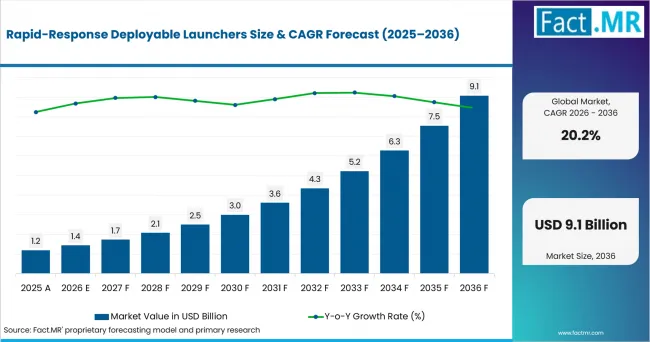
Rapid Response Deployable Launchers Value Analysis | Source: Fact.MR
What are the defining numbers behind Rapid-Response Deployable Launchers Market growth?
USD 7.6 billion absolute opportunity between 2026 and 2036.
The market is expected to create an absolute dollar opportunity of USD 7.6 billion between 2026 and 2036. Defence customers account for 46.0% of demand in 2026, while road-mobile TEL-like orbital launchers lead Launcher Form with 29.0% share.
- Demand Drivers in the Market
- Defence programs are placing more weight on assured access to orbit. The U.S. Government Accountability Office reported in June 2025 that the Department of Defense is expanding its National Security Space Launch supplier base while launch activity is putting more pressure on federal range infrastructure.
- Responsive-space programs are shortening the operational target for satellite deployment. DLR states that its Responsive Space Cluster Competence Center works across launch, ground, and space segments, while the REACTS program targets a European responsive network able to place satellites into low-Earth orbit within 72 hours.
- National launch policy is moving toward more flexible access routes. The UK Space Strategy published in September 2026 identifies Access to Space as one of four priority subsectors, while current UK licensing guidance covers vertical launch and air launch from carrier aircraft.
- European defence cooperation raises demand for interoperable space capability. The European Defence Agency supports capability development across 27 Member States and treats space as a formal defence capability domain.
- Key Segments Analyzed
- By Launcher Form: Road-mobile TEL-like orbital launchers lead with 29.0% share in 2026 because transportable platforms reduce reliance on a single permanent launch site and support dispersed deployment planning.
- By Payload Class: The 100-300 kg class accounts for 31.0% share in 2026 as responsive missions favor payloads that balance useful capability with shorter integration and handling cycles.
- By Readiness Time: The 1-3 days category leads with 31.0% share in 2026 because it gives operators time for payload checks and range coordination while preserving a rapid-response mission profile.
- By Customer: Defence accounts for 46.0% share in 2026, reflecting the value of reconstitution, surge capacity, and distributed access to orbit for national-security missions.
- Analyst Opinion at Fact.MR
- The central procurement issue is whether a deployable launch system can compress setup time without weakening flight assurance or payload readiness. Buyers are expected to evaluate mobility together with the time needed to integrate the payload and secure a launch window. Systems that can move between prepared sites while retaining repeatable test procedures are better aligned with responsive-space missions than designs that depend on extensive fixed infrastructure.
- Strategic Implications
- Launcher suppliers should treat deployment workflow as part of the product, with transport certification and repeatable setup procedures designed into the operating concept.
- Defence buyers should evaluate readiness time together with payload integration and range availability, since a mobile platform provides limited value when mission approval remains slow.
- Spaceport operators should prepare range-control processes for multiple launcher forms so that responsive missions do not depend on one fixed pad configuration.
- Civil space agencies can use deployable systems for replacement missions where continuity of Earth observation or communications services depends on restoring capacity quickly.
Australia is forecast to record 20.8% CAGR through 2036, followed by the USA at 20.4%, France at 20.0%, the UK at 19.7%, and Germany at 19.3%. The narrow spread indicates that market entry should be judged by launch policy and readiness infrastructure as much as by headline growth rate.
How does the Rapid-Response Deployable Launchers Market break down by segment?
The 100-300 kg class leads Payload Class at 31.0%; 1-3 days leads Readiness Time at 31.0%.
Why does Road-mobile TEL-like orbital launcher lead Launcher Form?
Road-mobile TEL-like orbital launchers hold 29.0% share in 2026.
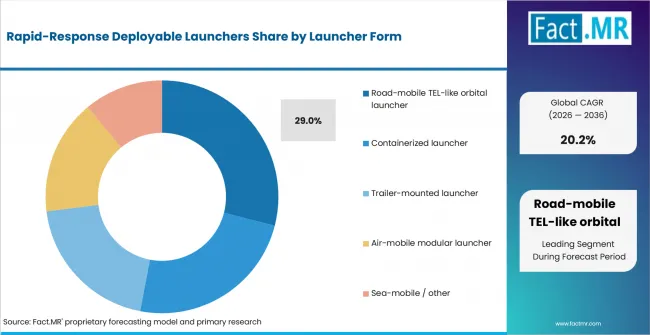
Rapid Response Deployable Launchers Analysis By Launcher Form | Source: Fact.MR
Road-mobile launcher architecture leads because it allows the launch system to be transported to prepared operating locations rather than tied to one fixed complex. The value is highest when transport, erection, checkout, and payload integration can be executed through a standardized sequence. UNOOSA's June 2026 issues brief on airspace integration for space transportation also highlights why mobile operations need early coordination with airspace authorities and launch-range processes.
What leads the Payload Class segment?
The 100-300 kg class accounts for 23.0% share in 2026.
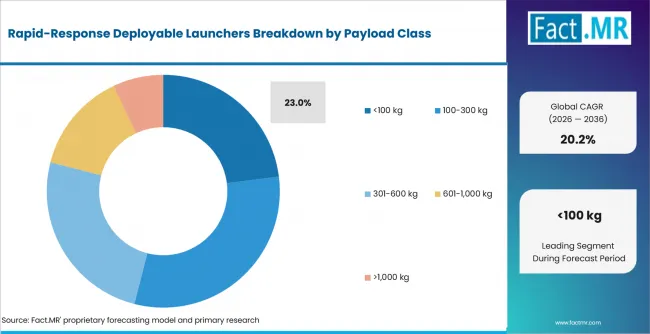
Rapid Response Deployable Launchers Analysis By Payload Class | Source: Fact.MR
The 100-300 kg class provides a practical balance between mission capability and responsive handling. It is large enough for many operational small-satellite payloads while remaining more compatible with mobile ground equipment and shorter integration cycles than heavier spacecraft. DLR describes Responsive Space as rapid deployment of small satellites to replace failed capability or expand an existing space service.
How does Readiness Time shape demand?
The 1-3 days category leads with 19.0% share in 2026.
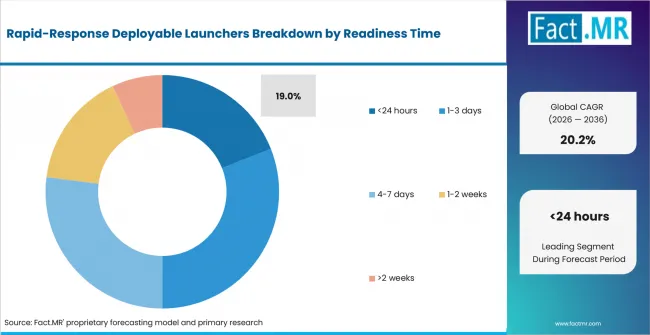
Rapid Response Deployable Launchers Analysis By Readiness Time | Source: Fact.MR
A 1-3 day readiness window is fast enough for reconstitution missions while leaving time for payload checkout and range coordination. A shorter target below 24 hours raises the burden on prequalified hardware and standing launch permissions. Longer windows reduce the operational advantage of a deployable launcher relative to conventional launch preparation.
Why does Defence lead Customer?
Defence accounts for 46.0% share in 2026.
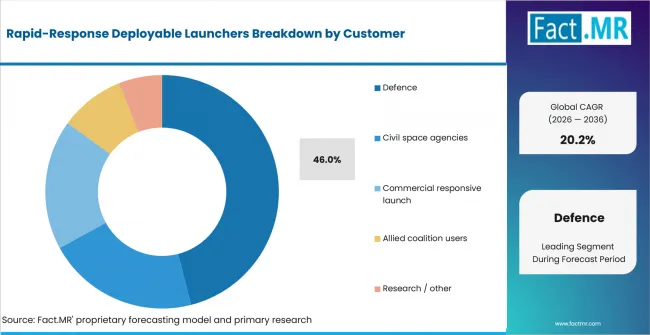
Rapid Response Deployable Launchers Analysis By Customer | Source: Fact.MR
Defence demand is tied to resilience and assured access to orbit. GAO reported in January 2026 that delays in satellite readiness can affect launch schedules and the delivery of operational capability. The European Defence Agency also treats space as a defence capability domain, supporting the case for systems that can restore or expand space-based services under compressed timelines.
What is accelerating Rapid-Response Deployable Launchers Market adoption, and what is holding it back?
Demand is expected to rise through responsive-space programs and distributed launch access; adoption is constrained by range coordination, qualification cycles, and mobile-infrastructure limits.
Drivers Impact Analysis
| Driver | (~) % Impact on CAGR | Geographic Relevance | Impact Timeline |
|---|---|---|---|
| Defence responsive-space procurement | +4.0% | USA; Western Europe | Short term (<= 2 years) |
| Rapid small-satellite reconstitution | +3.2% | USA; Germany; UK | Medium term (2-4 years) |
| Distributed launch-site access | +2.4% | Europe; North America | Medium term (2-4 years) |
| Allied space interoperability | +1.5% | Europe; North America | Long term (>= 4 years) |
The largest demand effect comes from defence programs that treat launch availability as part of space resilience. Mobile launcher architecture adds value when it is paired with prequalified payload interfaces and usable range capacity.
Opportunity Impact Analysis
| Opportunity | (~) % Impact on CAGR | Geographic Relevance | Impact Timeline |
|---|---|---|---|
| Sub-72-hour responsive launch concepts | +2.2% | Germany; Europe | Short term (<= 2 years) |
| Containerized and trailer mobility | +1.6% | Global | Medium term (2-4 years) |
| Civil replacement missions | +1.0% | Europe; Australia | Long term (>= 4 years) |
The strongest opportunity is the conversion of responsive-space concepts into standing operating capability. DLR's work on responsive deployment provides a public example of how launch, ground, and satellite segments are being developed as one architecture.
Restraints Impact Analysis
| Restraint | (~) % Impact on CAGR | Geographic Relevance | Impact Timeline |
|---|---|---|---|
| Range and airspace coordination | -1.4% | Global | Short term (<= 2 years) |
| Flight qualification and test burden | -1.1% | Global | Medium term (2-4 years) |
| Limited mobile support infrastructure | -0.8% | Emerging launch locations | Long term (>= 4 years) |
UNOOSA identifies airspace integration as a specific challenge for space transportation operations. ECSS standards also keep verification and product assurance central to launch hardware, which limits how far readiness time can be compressed without prior qualification.
Which countries are scaling the Rapid-Response Deployable Launchers Market through 2036?
- The country comparison spans 1.5 percentage points, indicating a tightly grouped growth profile across the five listed markets.
- Australia is 0.4 percentage point above the USA, supported by wider national space capability and mission-support infrastructure.
- The USA is 0.4 percentage point above France as national-security launch demand expands the need for assured access to space.
- France is 0.3 percentage point above the UK as the Guiana Space Centre broadens access for private micro- and mini-launchers.
- The UK is 0.4 percentage point above Germany, with current policy emphasizing Access to Space and a licensing framework that supports multiple launch modes.
Comparable CAGRs create different operating conditions. The USA is shaped by defence acquisition and range throughput, Germany by responsive-space research, the UK by licensing and national strategy, France by multi-launcher spaceport infrastructure, and Australia by national space research and mission-support capability. Full report coverage includes North America, Latin America, Western Europe, Eastern Europe, East Asia, South Asia & Pacific, Middle East & Africa.
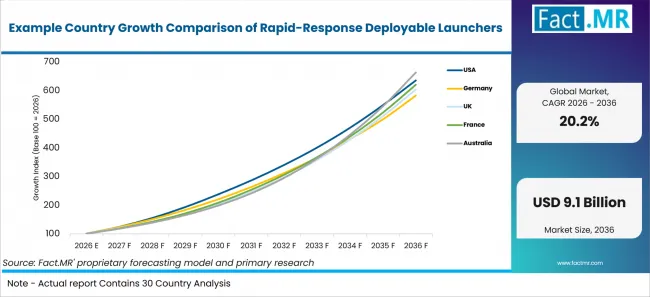
Example Country Growth Comparison Of Rapid Response Deployable Launchers | Source: Fact.MR
Country CAGR (2026-2036)
| Country | CAGR |
|---|---|
| Australia | 20.8% |
| USA | 20.4% |
| France | 20.0% |
| UK | 19.7% |
| Germany | 19.3% |
What is driving USA's growth through 2036?
20.4% CAGR, supported by national-security launch demand and federal range modernization.
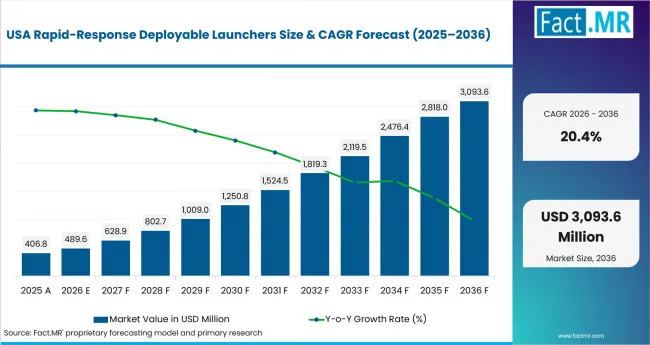
Rapid Response Deployable Launchers Country Value Analysis | Source: Fact.MR
U.S. demand is supported by the requirement to place national-security payloads into orbit while maintaining multiple commercial launch options. GAO reported in June 2025 that the National Security Space Launch Phase 3 strategy uses a dual-lane model intended to widen competition and assure access to space. The same review found that commercial launches at federal sites had more than quadrupled since 2021, increasing pressure on range infrastructure and scheduling.
What is driving Germany's growth through 2036?
19.3% CAGR, supported by a national Responsive Space technology program.
Germany has a direct institutional base for responsive deployment through DLR's Responsive Space Cluster Competence Center. DLR defines Responsive Space as the ability to meet short-term needs by rapidly deploying small satellites or reconfiguring systems already in use. Its launch segment studies independent reactive launch capability for small satellites, while the REACTS effort targets orbital deployment within 72 hours.
What is driving the UK's growth through 2036?
19.7% CAGR, supported by Access to Space policy and an active launch-licensing framework.
The UK Space Strategy published on 8 September 2026 names Access to Space as a priority subsector tied to national security and economic growth. UK guidance updated in July 2026 covers launch or return operator licences for vertically launched vehicles and air-launched vehicles from carrier aircraft. This regulatory structure supports a market in which mobile or distributed launch concepts need clear licensing routes before operational readiness can be claimed.
What is driving France's growth through 2036?
20.0% CAGR, supported by multi-launcher infrastructure at the Guiana Space Centre.
France is broadening launch infrastructure through CNES at the Guiana Space Centre. CNES is developing the ELM multi-launcher complex to host private micro- and mini-launchers alongside established European launch systems. The agency also coordinates launch operations and range safety, creating an institutional route for new launch systems to access common spaceport infrastructure.
What is driving Australia's growth through 2036?
20.8% CAGR, supported by national space research and mission-support capability.
Australia's demand case is supported by national space capability rather than a single publicly identified deployable-launcher program. CSIRO's 2026-27 Corporate Plan positions the agency as national science infrastructure for a productive and secure Australia. CSIRO also supported NASA's Artemis II mission through spacecraft communications and tracking expertise, showing the depth of mission-support capability that can complement future responsive launch activity.
Who Leads the Rapid-Response Deployable Launchers Market?
Competition includes Rocket Lab, Firefly Aerospace, Northrop Grumman, ABL Space Systems, Lockheed Martin, and Isar Aerospace.
Supplier competition is expected to center on deployability, readiness time, payload compatibility, and mission assurance. The market includes specialist launch companies as well as defence primes with systems-integration capability.
Public procurement and qualification requirements can favor suppliers that demonstrate repeatable mission preparation across different sites. ECSS standards reinforce the importance of verification and product assurance across space hardware, while national launch regulators determine whether mobile operations can be executed inside existing licensing and range-control frameworks.
Which companies are the key providers?
Key providers include Rocket Lab; Firefly Aerospace; Northrop Grumman; ABL Space Systems; Lockheed Martin; Isar Aerospace.
- Rocket Lab
- Firefly Aerospace
- Northrop Grumman
- ABL Space Systems
- Lockheed Martin
- Isar Aerospace
Bibliography
- U.S. Government Accountability Office. (2025, June 30). National Security Space Launch: Increased Commercial Use of Ranges Underscores Need for Improved Cost Recovery.
- U.S. Government Accountability Office. (2026, January 28). Missile Warning Satellites: Space Development Agency Should Be More Realistic and Transparent About Risks to Capability Delivery.
- German Aerospace Center (DLR). (2026). Responsive Space Cluster Competence Center.
- German Aerospace Center (DLR). (2026, June 15). DLR and the German Air Force extend cooperation.
- UK Space Agency, Department for Business, Innovation, Science and Trade, and Ministry of Defence. (2026, September 8). UK Space Strategy.
- UK Government. (2026, July 3). Launching or returning a rocket or space plane: rules and regulations.
- Centre national d'études spatiales. (2025, June 17). ELM-Diamant launch complex: space history in the making.
- Commonwealth Scientific and Industrial Research Organisation. (2026, August 31). Corporate Plan 2026-27.
- European Defence Agency. (2026). Capability Development and Space activities.
- United Nations Office for Outer Space Affairs. (2026, June). Challenges and Opportunities of Airspace Integration for Space Transportation Operations.
- European Cooperation for Space Standardization. (2025, October 15). Cleanliness and contamination control, ECSS-Q-ST-70-01C Rev.1.
- European Cooperation for Space Standardization. (2025, November 21). Description, implementation and general requirements, ECSS-S-ST-00C Rev.2.
This Report Answers
- The report explains how rapid-response deployable launchers are segmented by form, payload class, readiness time, and customer.
- Segment analysis identifies road-mobile launchers, 100-300 kg payloads, 1-3 day readiness, and defence customers as the leading 2026 subsegments.
- Country analysis compares Australia, USA, France, UK, and Germany through their 2026-2036 growth rates.
- Competitive analysis reviews Rocket Lab, Firefly Aerospace, Northrop Grumman, ABL Space Systems, Lockheed Martin, and Isar Aerospace.
- The scope explains how deployable orbital launch systems differ from fixed launch infrastructure and tactical missile-launch systems.
- The demand analysis assesses range access, qualification, responsive-space requirements, and mobility as factors shaping adoption.
What does the Rapid-Response Deployable Launchers Market cover?
The market covers transportable orbital-launch systems used to move a launch capability between prepared operating locations and execute missions under compressed readiness timelines. It intersects with satellite communication demand where replacement or surge capacity depends on fast orbital access. It also connects with military antenna requirements when mobile ground systems must maintain secure links during deployment.
The assessment also considers adjacent space cybersecurity needs where launch operations depend on protected command paths. defense-space computing and radiation-hardened electronics remain adjacent payload-enabling categories rather than deployable-launcher revenue unless they are sold as part of the launch system.
What is included in the scope?
The scope includes mobile orbital launch systems and the deployment hardware needed to establish a launch capability away from a single fixed pad.
Included configurations are road-mobile TEL-like orbital launchers, containerized launchers, trailer-mounted launchers, air-mobile modular launchers, and sea-mobile or other deployable systems. Payload coverage spans below 100 kg through above 1,000 kg. Readiness categories range from below 24 hours to more than two weeks.
What is excluded from the scope?
Fixed launch pads, standalone satellites, and tactical missile-launch systems are outside the market boundary.
The scope excludes revenue from fixed launch-site infrastructure when it is sold independently of a deployable launcher. It excludes satellite manufacturing, ground stations, and general spaceport services unless they are integrated into the deployable launch package. Here, TEL-like refers to road-mobile transport and erect functions adapted to orbital launch logistics; tactical weapon launchers are outside the market.
How Was the Analysis Built?
The analysis combines market sizing with institutional evidence on launch policy, responsive-space programs, regulation, and qualification.
- Desk Research: Evidence covers government launch policy, public research programs, defence capability material, UN space-transport guidance, and ECSS standards.
- Market Sizing and Forecasting: The forecast assesses historical market value, segment structure, country growth, customer mix, and adoption constraints across 2026 to 2036.
- Data Validation: Numerical consistency is checked across market values, CAGR, absolute opportunity, segment shares, and country growth rates before publication.
- Evidence Update Cycle: Policy and institutional evidence is reviewed against current 2025 and 2026 publications so country narratives reflect the latest available public position.
What is the report's scope and coverage?
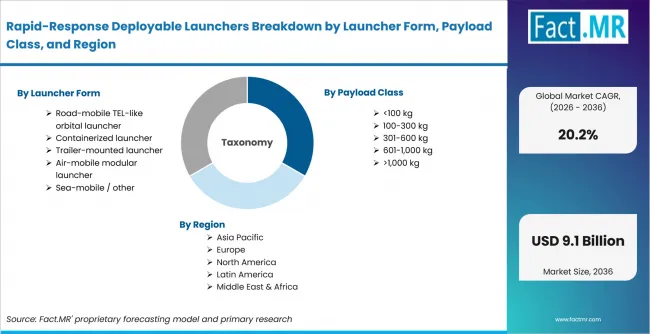
Rapid Response Deployable Launchers Breakdown By Launcher Form, Payload Class, And Region | Source: Fact.MR
| Attribute | Details |
|---|---|
| Quantitative Units | USD billion |
| Market Definition | Transportable orbital-launch systems designed for compressed readiness and deployment away from a single fixed launch complex. |
| Launcher Form | Road-mobile TEL-like orbital launcher; Containerized launcher; Trailer-mounted launcher; Air-mobile modular launcher; Sea-mobile / other |
| Payload Class | <100 kg; 100-300 kg; 301-600 kg; 601-1,000 kg; >1,000 kg |
| Readiness Time | <24 hours; 1-3 days; 4-7 days; 1-2 weeks; >2 weeks |
| Customer | Defence; Civil space agencies; Commercial responsive launch; Allied coalition users; Research / other |
| Regions Covered | North America; Latin America; Western Europe; Eastern Europe; East Asia; South Asia & Pacific; Middle East & Africa |
| Countries Covered | USA; Germany; UK; France; Australia |
| Key Companies | Rocket Lab; Firefly Aerospace; Northrop Grumman; ABL Space Systems; Lockheed Martin; Isar Aerospace |
| Forecast Period | 2026 to 2036 |
| Approach | Market sizing supported by segment analysis, country growth comparison, institutional launch-policy evidence, and standards-based qualification context. |
How is the market segmented?
-
By Launcher Form
- Road-mobile TEL-like orbital launcher
- Containerized launcher
- Trailer-mounted launcher
- Air-mobile modular launcher
- Sea-mobile / other
-
By Payload Class
- <100 kg
- 100-300 kg
- 301-600 kg
- 601-1,000 kg
- >1,000 kg
-
By Readiness Time
- <24 hours
- 1-3 days
- 4-7 days
- 1-2 weeks
- >2 weeks
-
By Customer
- Defence
- Civil space agencies
- Commercial responsive launch
- Allied coalition users
- Research / other
-
By Region
- North America
- Latin America
- Western Europe
- Eastern Europe
- East Asia
- South Asia & Pacific
- Middle East & Africa