- Market Value (2025): USD 4.7 Bn
- Estimated Value (2026): USD 5.4 Bn
- Forecast Value (2036): USD 24.0 Bn
- CAGR (2026-2036): 16.1%
What is the Stratospheric High-Altitude UAS Market forecast to be worth by 2036?
The Stratospheric High-Altitude UAS Market is projected to reach USD 24.0 billion by 2036, from USD 5.4 billion in 2026, at a 16.1% CAGR.
- The market is valued at USD 4.7 billion in 2025.
- Demand is valued at USD 5.4 billion in 2026 and is forecast to reach USD 24.0 billion by 2036.
- The market is projected to expand at 16.1% CAGR from 2026 to 2036 as long-endurance platforms gain relevance for communications, observation, and persistent surveillance missions.
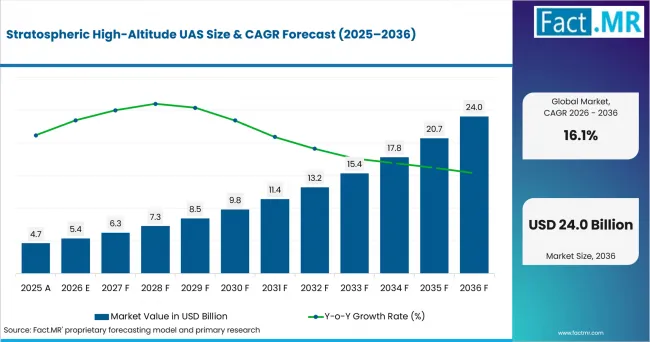
Stratospheric High Altitude Uas Value Analysis | Source: Fact.MR
What are the defining numbers behind Stratospheric High-Altitude UAS Market growth?
The absolute dollar opportunity between 2026 and 2036 is USD 18.6 billion.
Expansion is tied to longer platform persistence, more capable payload integration, and demand for coverage where satellites or conventional aircraft are too costly or operationally inflexible for the mission. Higher-airspace integration and spectrum coordination remain central to how quickly commercial deployment can scale.
- Demand Drivers in the Market
- High-altitude operations can extend communications coverage and situational awareness above most commercial traffic. NASA reported in 2026 that higher-airspace aircraft can support internet connectivity and disaster warning use cases while its research addresses traffic management for those altitudes. [1]
- Solar-electric platform development is improving the technical basis for persistent flight. DLR completed the first flight of HAP-alpha in September 2026 and states that the aircraft is intended to operate in the lower stratosphere at around 20 kilometres for Earth observation and communication technology testing. [3]
- Spectrum access is a direct constraint on communications missions. ITU identifies frequency bands for high-altitude platform stations and sets technical conditions intended to protect other radio services. [7]
- Regulatory work on higher airspace is becoming more explicit. EASA notes that high-altitude long-endurance UAS and other higher-airspace operations already occur in Europe in research or limited operational settings, although a harmonised framework is still developing. [6]
- Key Segments Analyzed
- By Platform Type, Solar fixed-wing HAPS leads with 34.0% share in 2026. The configuration combines long wings, solar generation, and low-speed flight to support extended operations in the lower stratosphere.
- By Altitude, 18-21 km leads with 36.0% share in 2026. This band aligns with the lower-stratosphere operating zone targeted by several high-altitude platform programs.
- By Mission, ISR leads with 31.0% share in 2026. Persistent line of sight and wide-area sensing can reduce the need for repeated sorties over the same area.
- By Endurance, 1-4 weeks leads with 29.0% share in 2026. Multi-week persistence offers a practical balance between continuous mission value and the power, weather, and maintenance limits of current platforms.
- Analyst Opinion at Fact.MR
- Shambhu Nath Jha, Senior Consultant, Fact.MR says The stratospheric market is entering a more commercially focused phase as advances in platform endurance, payload capability and deployment economics improve the feasibility of long-duration operations. Adoption will increasingly depend on whether providers can deliver reliable performance at a cost that supports scalable real-world applications.”
- Strategic Implications
- Platform developers should treat endurance as a system outcome involving energy balance, payload demand, weather tolerance, and flight-control reliability rather than as an airframe claim alone.
- Communications-focused suppliers need spectrum planning early in the program because radio-frequency access can determine the usable commercial mission set.
- Payload partners should design for the platform power budget and recovery cycle so sensing capability does not erode the endurance advantage that supports the purchase case.
- Operators entering higher airspace should plan for staged test activity and traffic-management integration before assuming routine large-scale operations.
How does the Stratospheric High-Altitude UAS Market break down by segment?
The stratospheric platforms market is segmented by Platform Type into High-Altitude Balloons, Solar-Powered Pseudo-Satellites (HAPS), Unmanned Stratospheric Airships, Fixed-Wing Stratospheric UAVs, Tethered Stratospheric Platforms, and Hybrid Stratospheric Platforms. By Altitude, the market is classified into 20–30 km, 30–40 km, 40–50 km, Above 50 km, and Variable-Altitude Platforms. By Mission, the market covers Telecommunication Coverage, Border & Maritime Surveillance, Weather Monitoring, Environmental Monitoring, Defense & Security Missions, and Other Missions. By Endurance, the market is divided into Short-Endurance, Medium-Endurance, Long-Endurance, and Ultra-Long-Endurance Platforms. Regional coverage includes North America, Latin America, Western Europe, Eastern Europe, East Asia, South Asia & Pacific, and Middle East & Africa.
Why does Solar fixed-wing HAPS lead Platform Type?
Solar fixed-wing HAPS holds 34.0% share of the Platform Type category in 2026.
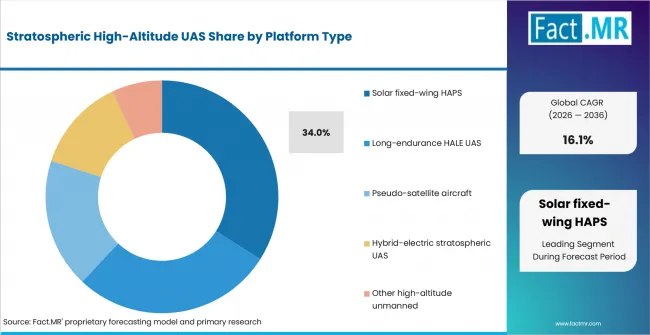
Stratospheric High Altitude Uas Analysis By Platform Type | Source: Fact.MR
The segment is positioned around very light airframes, large lifting surfaces, and solar-electric propulsion intended to support long dwell times at high altitude. DLR describes HAP-alpha as a purely solar-powered uncrewed platform designed for the lower stratosphere, where it can test Earth-observation and communication payloads. [3]
The commercial logic overlaps with fixed-wing drones where aerodynamic efficiency matters for range and persistence, but stratospheric platforms must operate for much longer periods and within a different airspace environment. Long-endurance HALE UAS, pseudo-satellite aircraft, and hybrid-electric platforms remain important alternatives when payload demand or mission flexibility outweighs the benefits of a solar-only design.
Why does the 18-21 km band lead Altitude?
The 18-21 km band accounts for 21.0% of the Altitude category in 2026.
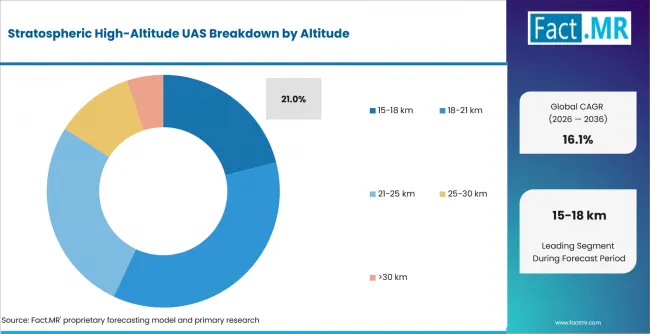
Stratospheric High Altitude Uas Analysis By Altitude | Source: Fact.MR
This range sits above conventional commercial traffic and within the lower-stratosphere zone targeted by high-altitude platform programs. DLR targets approximately 20 kilometres for HAP-alpha, while ITU defines high-altitude platform stations around a nominal altitude of 20 to 50 kilometres for radio-regulatory purposes. [3][7]
Operating near this band can give platforms wide line of sight without the launch cost or orbital mechanics of a satellite. Lower bands can ease energy demand and recovery. Higher bands can improve coverage geometry but impose tighter structural, thermal, and propulsion requirements. The leading share therefore reflects a practical concentration around current platform capability rather than a universal optimum for every mission.
Why does ISR lead Mission?
ISR holds 31.0% share of Mission in 2026.
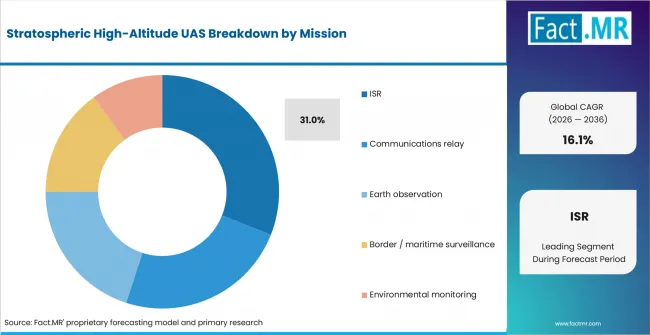
Stratospheric High Altitude Uas Analysis By Mission | Source: Fact.MR
High-altitude persistence allows one platform to maintain observation over a broad area for much longer than a conventional sortie. NASA identifies situational awareness and disaster warning among the uses being explored for high-altitude flight, while DLR is developing camera and radar payloads for HAP-alpha. [1][3]
The segment also overlaps with demand for surveillance drones but the value proposition is different. Stratospheric UAS are intended to trade rapid tactical mobility for longer on-station time and wider observation geometry. Communications relay follows with 24.0% share because a high-altitude node can extend coverage in remote or disrupted areas.
Why does 1-4 weeks lead Endurance?
The 1-4 weeks segment holds 12.0% share of Endurance in 2026.
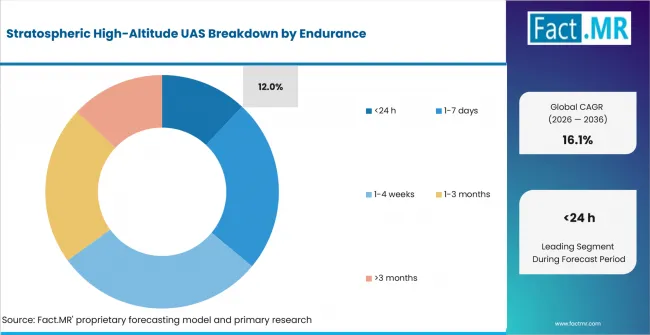
Stratospheric High Altitude Uas Analysis By Endurance | Source: Fact.MR
Multi-week operation is long enough to create a persistent service window, yet it remains closer to current technology limits than continuous multi-month station keeping. NASA TechPort describes a stratospheric HALE concept with a mission objective of at least 30 days above 60,000 feet, showing how endurance targets are moving toward month-scale operation. [2]
Longer endurance requires sufficient energy storage for night operation, a durable structure, autonomous flight control, and a payload that fits within the available power budget. The >3 months segment remains smaller at 13.0% because very long persistence raises the consequence of weather exposure, component degradation, and maintenance deferral.
What is accelerating Stratospheric High-Altitude UAS Market adoption, and what is holding it back?
Adoption is supported when a platform can replace repeated sorties or complement satellites with a recoverable asset that remains close enough to Earth for lower-latency sensing and communications. Growth is constrained when endurance claims cannot be sustained with the intended payload or when higher-airspace and spectrum approvals delay deployment. The effects below are directional and are evaluated independently rather than added together.
Drivers Impact Analysis
| Factor | (~) % Impact on CAGR | Geographic Relevance | Impact Timeline |
|---|---|---|---|
| Persistent coverage for ISR and monitoring | +2.1% | USA, Europe, Japan | 2026 to 2034 |
| Solar-electric endurance improvements | +1.6% | Germany, France, USA | 2026 to 2035 |
| High-altitude communications coverage | +1.2% | UK, USA, remote regions | 2027 to 2036 |
Source: Fact.MR analysis. Updated Sep 15, 2026
Persistent coverage creates the clearest commercial case where users would otherwise need repeated aircraft sorties or a dedicated orbital service. Solar-electric improvements increase usable endurance when they reduce the share of stored energy consumed by propulsion. Communications demand gains value when a platform can cover areas with weak terrestrial infrastructure.
Opportunity Impact Analysis
| Factor | (~) % Impact on CAGR | Geographic Relevance | Impact Timeline |
|---|---|---|---|
| Recoverable Earth-observation platforms | +1.7% | USA, France, Germany, Japan | 2027 to 2036 |
| Emergency and temporary connectivity | +1.2% | UK, USA, Europe | 2027 to 2035 |
| Payload modularity across missions | +0.9% | Global | 2028 to 2036 |
Source: Fact.MR analysis. Updated Sep 15, 2026
Recoverable high-altitude platforms can create a distinct position beside Earth observation services by allowing payloads to be returned, changed, and redeployed. Temporary connectivity is attractive where coverage is needed for a defined period rather than as permanent infrastructure. Modular payload interfaces can widen platform utilisation across civil sensing and security missions.
Restraints Impact Analysis
| Factor | (~) % Impact on CAGR | Geographic Relevance | Impact Timeline |
|---|---|---|---|
| Higher-airspace certification and traffic integration | -1.4% | USA, Europe, Japan | 2026 to 2036 |
| Spectrum coordination for relay missions | -1.0% | Global | 2026 to 2036 |
| Energy-storage and weather limits on persistence | -0.8% | Global | 2026 to 2034 |
Source: Fact.MR analysis. Updated Sep 15, 2026
EASA states that Europe does not yet have a dedicated harmonised regulatory framework for higher-airspace operations, which keeps large-scale commercial operations from becoming routine. [6] ITU spectrum conditions add another layer for communications missions. [7] Platform economics can weaken further when night-time energy needs or high-altitude weather force a shorter mission than planned.
Which countries are scaling the Stratospheric High-Altitude UAS Market through 2036?
- USA: Higher-airspace traffic-management work and active stratospheric research support testing of long-endurance platforms and mission concepts.
- UK: National space policy gives priority to resilient communications and security applications that can create demand for complementary high-altitude infrastructure.
- France: Long-running stratospheric flight programs provide an institutional base for high-altitude payload testing and atmospheric operations.
- Germany: HAP-alpha gives the country a direct solar-powered high-altitude UAS test program, although deployment remains tied to staged technical validation.
- Japan: Scientific balloon programs demonstrate sustained national capability in high-altitude operations and payload experimentation across the stratosphere.
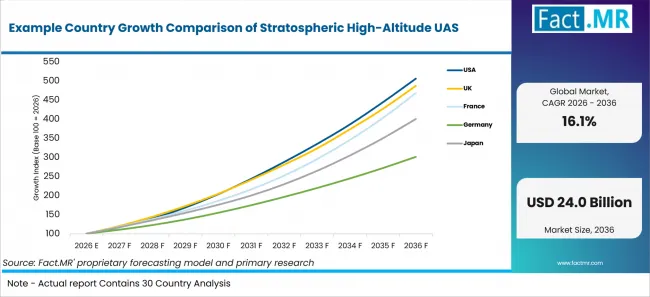
Example Country Growth Comparison Of Stratospheric High Altitude Uas | Source: Fact.MR
| Country | CAGR (2026-2036) |
|---|---|
| USA | 17.6% |
| UK | 17.2% |
| France | 16.7% |
| Japan | 14.9% |
| Germany | 11.7% |
Source: Fact.MR analysis. Updated Sep 15, 2026
What is driving USA's growth through 2036?
USA is projected to grow at 17.6% CAGR from 2026 to 2036.
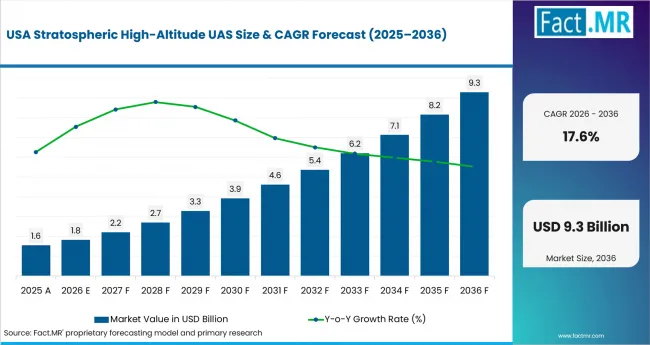
Stratospheric High Altitude Uas Country Value Analysis | Source: Fact.MR
NASA is working on traffic management for higher-altitude aircraft and has used real-time stratospheric balloon data in simulation work with industry partners. The agency links high-altitude flight with connectivity and ground situational awareness, which gives the market a concrete civil-operations pathway beyond defense use. [1]
The country also has an established industrial drone ecosystem that can supply flight-control, payload, and autonomy experience. The scaling challenge is moving from experimental flights to repeatable operations that meet airspace and mission-assurance requirements.
What is driving UK's growth through 2036?
UK demand is projected to expand at 17.2% CAGR.
The UK Space Strategy published in September 2026 prioritises satellite communications, space domain awareness, access to space, and in-orbit capabilities as part of a national security and growth agenda. High-altitude UAS can complement these priorities where a recoverable airborne node provides temporary coverage or sensing below orbital altitude. [4]
Communications-relay use has a clear adjacency to the satellite communication market, although stratospheric UAS operate within aviation and radio frameworks that differ from satellites. Buyers will therefore assess the platform as part of a layered network rather than as a direct substitute for every satellite service.
What is driving France's growth through 2036?
France is forecast to grow at 16.7% CAGR.
CNES has operated stratospheric balloon programs for decades and carried out Strato-Science 2025 with scientific payloads in the stratosphere. Its current balloon program includes long-duration campaigns and technology testing, giving France an established institutional environment for high-altitude flight operations and payload validation. [5]
For UAS suppliers, the opportunity is strongest where that operating experience can be transferred into autonomous platform control, payload integration, and mission planning. The market still depends on aircraft-specific certification and economics, so balloon experience should be viewed as technical context rather than direct commercial demand.
What is driving Germany's growth through 2036?
Germany is projected to record 11.7% CAGR.
the lowest rate among the five listed countries. DLR flew HAP-alpha for the first time in September 2026 and intends to move toward higher-altitude testing after completing low-altitude campaigns. The aircraft is designed for operation around 20 kilometres with Earth-observation and communication payloads. [3]
The comparatively lower CAGR is consistent with a market moving through deliberate test and validation steps. Platform reliability, higher-airspace procedures, and mission qualification must be demonstrated before routine commercial deployment can widen. Germany therefore has a strong technical mechanism for growth without requiring an assumption of immediate large-scale fleet adoption.
What is driving Japan's growth through 2036?
Japan is forecast to grow at 14.9% CAGR.
JAXA conducted its 2026 scientific balloon campaign from the Taiki Aerospace Research Field, including balloon flights that reached the stratosphere for payload and control experiments. A September 2026 flight reached a floating altitude of about 21 kilometres, directly within the leading altitude band used in this market segmentation. [8]
The relevance for stratospheric UAS is the national capability to operate payloads in thin-air conditions and recover flight hardware after experiments. Commercial UAS growth will still depend on propulsion, autonomous control, and airspace integration specific to aircraft rather than balloons.
Who Leads the Stratospheric High-Altitude UAS Market?
Key players in the Stratospheric High-Altitude UAS Market include Airbus, BAE Systems, AeroVironment, Thales, Kea Aerospace, and Prismatic / BAE Systems. Competition centres on endurance, payload capacity, flight-control reliability, launch and recovery requirements, and the ability to support mission-specific communications or sensing equipment.
Platform selection is likely to remain mission-led. Communications operators need stable coverage geometry and spectrum compatibility. ISR users place more weight on sensor persistence and secure data links. Earth-observation users need payload stability and repeatable geolocation. Suppliers able to prove endurance with the intended payload under realistic environmental conditions will be better positioned than those relying on headline altitude or duration alone.
Which companies are the key providers?
The key providers identified in the market coverage are: Airbus; BAE Systems; AeroVironment; Thales; Kea Aerospace; Prismatic / BAE Systems
- Airbus
- BAE Systems
- AeroVironment
- Thales
- Kea Aerospace
- Prismatic / BAE Systems
Bibliography
- [1] National Aeronautics and Space Administration. (2026). NASA Advances High-Altitude Traffic Management.
- [2] National Aeronautics and Space Administration TechPort. (2026). S-HALE Stratospheric HALE LTA Aircraft project update.
- [3] German Aerospace Center (DLR). (2026). DLR's HAP-alpha high-altitude platform takes off for the first time.
- [4] UK Space Agency, Department for Business and Trade, and Ministry of Defence. (2026). UK Space Strategy.
- [5] Centre National d'Etudes Spatiales (CNES). (2025). Strato-Science stratospheric balloon campaign and scientific ballooning programme.
- [6] European Union Aviation Safety Agency. (2026). Higher Airspace Operations guidance and FAQ.
- [7] International Telecommunication Union. (2025). HAPS - High-altitude platform systems.
- [8] Japan Aerospace Exploration Agency, Institute of Space and Astronautical Science. (2026). Scientific balloon campaign and B26-03 flight results.
- [9] European Space Agency. (2026). Space Environment Report 2026 and current space-environment statistics.
This Report Answers
- How does the Stratospheric High-Altitude UAS Market develop through 2036?
- Why do solar fixed-wing HAPS, the 18-21 km altitude band, ISR, and 1-4 week endurance lead their categories?
- How do higher-airspace regulation and spectrum coordination affect commercial deployment?
- What distinguishes growth in USA, UK, France, Germany, and Japan?
- Which platform capabilities matter most when buyers compare high-altitude UAS providers?
What does the Stratospheric High-Altitude UAS Market cover?
The market covers unmanned aircraft systems designed for sustained operation in the stratosphere or higher-airspace environment for communications relay, intelligence and surveillance, Earth observation, border or maritime surveillance, and environmental monitoring. The assessment includes solar fixed-wing HAPS, long-endurance HALE UAS, pseudo-satellite aircraft, hybrid-electric stratospheric UAS, and other high-altitude unmanned platforms within the stated segmentation.
What is included in the scope?
Revenue associated with the defined high-altitude unmanned aircraft platforms is included when the aircraft is sold or supplied for the covered missions. Integrated propulsion, flight-control, energy, communications, and mission-system components are included when they form part of the commercial platform configuration. Coverage is allocated by the aircraft's principal platform type, operating altitude, mission, and endurance category to avoid duplicate assignment.
What is excluded from the scope?
Satellites, crewed aircraft, conventional low-altitude drones, and scientific balloons are outside the market definition. Standalone telecommunications services, independent sensor sales, launch infrastructure, and ground-network revenue are excluded unless supplied as an inseparable part of the high-altitude UAS platform. The market does not treat orbital spacecraft or balloon programs as substitute revenue categories.
How Was the Analysis Built?
- Desk Research: Official aerospace agencies, aviation regulators, and international spectrum authorities are used to establish current high-altitude flight activity, higher-airspace constraints, mission use cases, and spectrum requirements.
- Market Sizing and Forecasting: The assessment is structured across Platform Type, Altitude, Mission, Endurance, and country growth. Market values are presented for 2025, 2026, and 2036 with a consistent 2026-2036 forecast period.
- Data Validation and Update Cycle: Segment shares are reconciled within each category and country growth rates are checked for consistent representation. Current technical and regulatory developments are reviewed against the market definition before publication updates.
Segmentation
What is the report's scope and coverage?
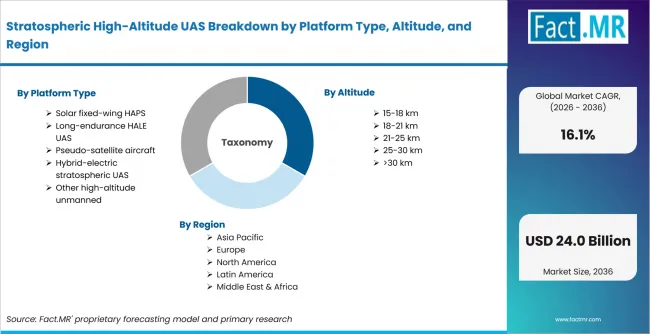
Stratospheric High Altitude Uas Breakdown By Platform Type, Altitude, And Region | Source: Fact.MR
| Attribute | Details |
|---|---|
| Quantitative Units | USD billion |
| Market Definition | Unmanned aircraft systems designed for sustained stratospheric or higher-airspace missions across the covered platform classes. |
| Segments Covered | Platform Type; Altitude; Mission; Endurance; Region |
| Regions Covered | Global |
| Countries Covered | USA; UK; France; Germany; Japan |
| Key Companies | Airbus; BAE Systems; AeroVironment; Thales; Kea Aerospace; Prismatic / BAE Systems |
| Base Year | 2025 |
| Forecast Period | 2026 to 2036 |
| Market Value, 2025 | USD 4.7 billion |
| Market Value, 2026 | USD 5.4 billion |
| Market Value, 2036 | USD 24.0 billion |
| CAGR, 2026-2036 | 16.1% |
| Absolute Opportunity | USD 18.6 billion |
| Approach | Platform, altitude, mission, endurance, and country-growth assessment supported by official aviation, space, and spectrum evidence. |
Source: Fact.MR analysis. Updated Sep 15, 2026
How is the market segmented?
-
By Platform Type
- Solar fixed-wing HAPS - 34.0%
- Long-endurance HALE UAS - 28.0%
- Pseudo-satellite aircraft - 18.0%
- Hybrid-electric stratospheric UAS - 13.0%
- Other high-altitude unmanned - 7.0%
-
By Altitude
- 15-18 km - 21.0%
- 18-21 km - 36.0%
- 21-25 km - 27.0%
- 25-30 km - 11.0%
- >30 km - 5.0%
-
By Mission
- ISR - 31.0%
- Communications relay - 24.0%
- Earth observation - 20.0%
- Border / maritime surveillance - 15.0%
- Environmental monitoring - 10.0%
-
By Endurance
- <24 h - 12.0%
- 1-7 days - 24.0%
- 1-4 weeks - 29.0%
- 1-3 months - 22.0%
- >3 months - 13.0%
-
By Region
- North America
- Latin America
- Western Europe
- Eastern Europe
- East Asia
- South Asia & Pacific
- Middle East & Africa
Frequently Asked Questions
How large was the Stratospheric High-Altitude UAS Market in 2025?
What is the Stratospheric High-Altitude UAS Market worth in 2026?
What is the projected market value by 2036?
What CAGR is projected from 2026 to 2036?
What absolute dollar opportunity is expected between 2026 and 2036?
Which Platform Type leads the market?
Which Altitude band leads the market?
Which Mission leads the market?
Which Endurance category leads the market?
Which listed country records the highest CAGR?
What is the primary demand driver?
What is the main restraint?
Which companies are included in the market assessment?
Who worked on this report


Preview the report firsthand - request a free sample
Free SampleGet the brochure for pricing and purchase details
Download PDF