- Base Value(2025): 1.9 Bn
- Estimated Value(2026): 2.0 Bn
- Forecast Value (2036): 2.9 Bn
- CAGR (2026 - 2036): 4.4%
Radiation Hardened Electronics Market Forecast and Outlook 2026 to 2036
In 2025, the radiation hardened electronics market was valued at USD 1.9 billion. Based on FACT.MR analysis, demand is estimated to reach USD 2.0 billion in 2026 and expand to USD 2.9 billion by 2036, reflecting a projected CAGR of 4.4% during the forecast period.
The absolute dollar growth from 2026 to 2036 represents an incremental gain of USD 0.9 billion. The expansion is steady rather than transformative, as the market remains closely tied to long cycle government space and defence programmes rather than consumer driven semiconductor volumes. Growth is moderated by the highly concentrated buyer base of fewer than 50 major global space and defence programme offices, by qualification timelines that often range from 18 to 36 months before a new device can be flight certified, and by the ongoing tension between commercial satellite cost reduction targets and the inherent premium associated with radiation tolerance engineering.
Lisa Napolitano, VP & General Manager, Space, Honeywell Aerospace Technologies states, "Honeywell's foundry business has grown rapidly. and we are committed to supporting the space community with technology that will increase performance, reduce risk, and improve mission success."
Country level growth reflects space programme maturity, with India leading at 9.0 percent CAGR, followed by China at 6.8 percent, the United States at 4.9 percent, France at 4.3 percent, and Brazil at 3.2 percent. Radiation hardened electronics are specialised semiconductors designed to withstand ionising radiation in space, nuclear, and defence environments. The report covers component, manufacturing, and regional analysis from 2026 to 2036, excluding non-qualified COTS devices and fully assembled systems.
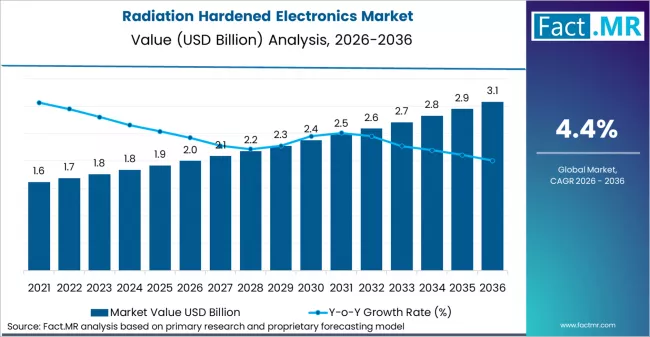
Radiation Hardened Electronics Market Market Value Analysis | Source: Fact.MR
Market Definition
Radiation hardened electronics are specialised semiconductor components designed to operate reliably in high radiation environments such as space, nuclear plants, and defence systems, where standard chips fail due to ionising damage.
Market Inclusions
The report analyses global market size from 2026 to 2036 by component type and hardening technique, including pricing trends and export control impacts.
Market Exclusions
Non-qualified COTS devices, full subsystems, monitoring sensors, and standalone EMP solutions are excluded.
Research Methodology
- Primary Research: Primary research involved structured interviews with space programme electronics procurement officers at national space agencies, rad-hard device application engineers at satellite bus manufacturers, nuclear plant instrumentation and control engineers, high-energy physics detector electronics specialists, and radiation effects test facility managers at facilities including the Brookhaven National Laboratory and ESTEC radiation test centre.
- Desk Research; Desk research synthesised data from NASA and ESA mission budget disclosures, US DoD procurement appropriations for space systems, national space agency launch manifests from ISRO, JAXA, CNSA, and ESA, JEDEC and MIL-PRF-38535 qualification standard publications, and company annual reports and investor disclosures from Microchip Technology, BAE Systems, Renesas Electronics, and Honeywell International.
- Market-Sizing and Forecasting: Market sizing employed a bottom-up approach building from active and planned satellite constellation programme component procurement requirements cross-referenced with disclosed satellite build rates and per-satellite rad-hard component content values supplemented by nuclear and defence segment top-down estimates derived from disclosed programme budgets and historical radiation hardened electronics content ratios.
- Data Validation and Update Cycle: Outputs were validated against Microchip Technology, BAE Systems, and Renesas Electronics space and defence segment revenue disclosures, US Air Force Space Systems Command procurement award databases, ESA ESTEC component qualification approval registers, and ISRO annual reports, reconciled annually with revised satellite constellation build schedules and DoD space systems programme milestone updates.
Key Takeaways
- Market Definition
- Radiation hardened electronics include processors, memory, power management ICs, mixed signal devices, and sensors designed to withstand total ionising dose and single event effects in space, nuclear, defence, and high energy physics environments where standard commercial components would fail.
- Demand Drivers
- Commercial low earth orbit satellite constellations such as Starlink, Project Kuiper, and OneWeb are increasing demand for radiation tolerant processors and memory as each satellite requires multiple protected devices for long term orbital reliability.
- India’s IN SPACe framework is creating compliance driven demand for domestically qualified rad hard electronics.
- Nuclear plant life extension programmes in the United States, France, and South Korea are also driving upgrades to radiation qualified digital control systems.
- Key Segments Analyzed
- By Component, Processors and Controllers lead the market with 32.8% share in 2025, reflecting their role as the computational core of radiation hardened systems where processor qualification determines overall system approval timelines and value.
- By Manufacturing Technique, Radiation Hardening by Design holds 33.4% share in 2025, preferred for advanced nodes as it enables radiation tolerance through circuit architecture while preserving commercial foundry cost structures.
- By Region, North America leads in market share due to NASA, Space Force, and LEO procurement, while Asia Pacific grows fastest driven by India’s 9.0% CAGR and China’s domestic semiconductor expansion.
- Analyst Opinion at FACT.MR
- Shambhu Nath Jha, Principal Consultant at FACT.MR, opines, ‘CXOs will find this report essential for understanding how the commercial LEO constellation proliferation is restructuring rad-hard component qualification economics, which manufacturing technique RHBD versus RHBP versus RHBS is capturing the greatest value from New Space programme procurement.
- Strategic Implications
- Radiation hardened suppliers should prioritise advanced node RHBD development at 28nm and 16/12nm to meet LEO constellation cost targets and reduce legacy pricing premiums.
- Space primes should expand second source qualification in India and South Korea to reduce ITAR dependency and secure alternative supply channels.
- Nuclear system suppliers should focus on IEC 61513 and IEEE 7-4.3.2 qualified components to capture long term plant life extension demand and stable recurring revenue.
- Methodology
- Market sizing is based on satellite build rate models and rad hard component content per platform, validated against company revenue disclosures.
- Manufacturing shares were cross checked using defence qualification lists and ESA approval registers.
- Regional forecasts were validated against ISRO, NASA, ESA, and CNSA programme budgets and mission plans.
Segmental Analysis
Radiation Hardened Electronics Market Analysis by Component
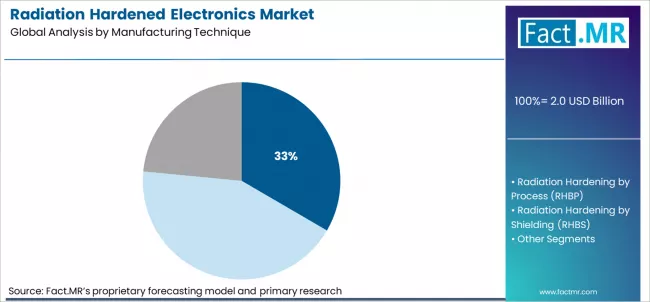
Radiation Hardened Electronics Market Analysis By Manufacturing Technique | Source: Fact.MR
Based on FACT.MR’s radiation hardened electronics market report, Processors and Controllers are estimated to hold 32.8% share in 2025. These devices form the computational core of satellites, launch vehicles, nuclear control systems, and research platforms. Processor qualification typically determines the full system approval timeline and represents the highest per unit value component in the bill of materials.
- Microchip Technology Investment: Microchip’s fiscal year 2024 report highlighted development of a 65nm RHBD space grade FPGA targeting commercial LEO satellites at USD 800 to 1,200 per unit, significantly below legacy rad hard FPGA pricing, with Sandia testing expected by Q3 2025 [1].
- BAE Systems Processor Technology: BAE Systems introduced the 28nm RHBD based RAD5545 processor delivering 12,000 MIPS at 15W, a fourfold performance improvement over RAD750 while meeting MIL-PRF-38535 Class V standards for NASA and defence missions [5].
- LEO Constellation Volume Trend: SpaceX filings indicate that approximately 6,000 Starlink Gen 2 satellites are planned through 2026, each incorporating multiple radiation tolerant processors, creating volumes exceeding the previous decade of GEO satellite procurement combined [6].
Radiation Hardened Electronics Market Analysis by Manufacturing Technique
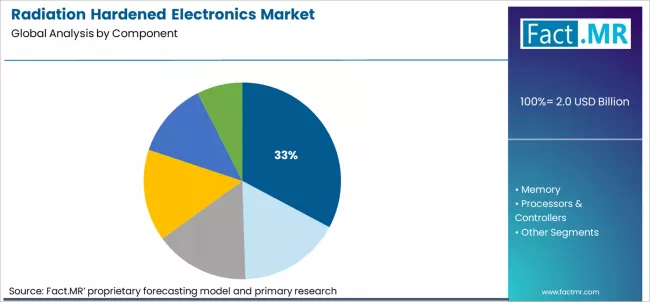
Radiation Hardened Electronics Market Analysis By Component | Source: Fact.MR
Based on FACT.MR’s report, Radiation Hardening by Design holds 33.4% share in 2025. RHBD enables radiation tolerance at the circuit architecture level on commercial CMOS nodes, providing access to advanced performance and cost structures that RHBP and shielding approaches cannot economically match for high volume LEO missions.
- Renesas RHBD Programme: Renesas disclosed an RHBD initiative for its RH850 microcontrollers using 40nm CMOS and triple modular redundancy architecture, with JAXA qualification testing underway as of Q2 2024 [7].
- RHBP Niche Strength: Honeywell’s SiGe RHBP platform continues to support applications exceeding 1 MRad Si, particularly in nuclear instrumentation and deep space analogue circuits, maintaining a 29 percent share in high radiation severity segments [8].
- RHBS Adoption Pattern: The ESCC 2024 report noted that shielding solutions accounted for 28 percent of ESA radiation protection procurement by value in 2023, particularly where moderate radiation exposure allows cost effective system level shielding instead of full device redesign.
Radiation Hardened Electronics Market Drivers, Restraints, And Opportunities
FACT.MR analysts observe that the radiation hardened electronics market remains closely tied to global space programme investment cycles, which are undergoing the most significant transformation since the early space race era due to the rise of commercial satellite constellations. Valued at USD 1.9 billion in 2025, the market reflects decades of qualification investment concentrated among fewer than ten globally capable suppliers. The market’s relatively small size understates its strategic importance, as rad hard components are essential for space, nuclear, and military environments where commercial substitutes simply cannot operate.
The central tension lies between the legacy model of low volume, high price procurement for GEO satellites and the new high volume, cost constrained model of LEO constellations. Traditional RHBP processes embed radiation tolerance at the transistor level but are costly and difficult to scale. In contrast, RHBD techniques allow radiation tolerance through circuit architecture on commercial CMOS nodes, enabling price reductions of 30 to 50 percent for LEO applications while benefiting from 20 to 50 times higher unit volumes.
- MIL-PRF-38535 Class V Requirements: The US MIL-PRF-38535 Class V specification requires documented testing above 100 kRad Si, immunity to single event latch up, and full lot acceptance testing for space level microcircuits. This restricts procurement to fewer than 500 qualified device families and supports premium pricing for listed suppliers regardless of broader semiconductor cost trends [2].
- India IN-SPACe Mandate: India’s IN-SPACe framework requires private space companies using ISRO launch infrastructure to adopt radiation hardened electronics with approved indigenous or foreign qualification. This policy is driving demand from companies such as Agnikul Cosmos and Skyroot Aerospace, expanding from minimal activity in 2022 to an estimated 12 to 18 satellite missions annually by 2026 [3].
- Nuclear IEC 61513 Upgrade Cycle: The IAEA revision of IEC 61513 requires digital safety systems in nuclear plants to use components qualified for reactor radiation conditions over the plant lifetime. This is contributing to a global digital upgrade cycle valued at approximately USD 3.5 billion through 2030, with rad hard microcontrollers and signal conditioning ICs representing high value components in each project [4].
Regional Analysis
The radiation hardened electronics market is analysed across North America, Latin America, Europe, Asia-Pacific, and Middle East & Africa, spanning 40+ countries aligned with national space agency programme footprints, defence electronics procurement centres, nuclear power plant operational inventories, and high-energy physics research facility locations. The report offers detailed market attractiveness analysis comparing space programme investment trajectories, domestic radiation hardened semiconductor qualification capability, and export control regulatory impacts across regional procurement markets.
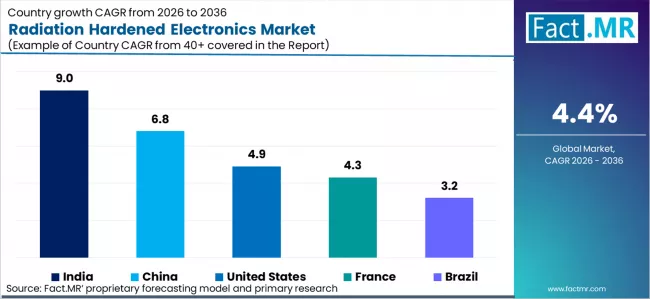
Radiation Hardened Electronics Market Cagr Analysis By Country | Source: Fact.MR
| Country | CAGR% |
|---|---|
| India | 9.0% |
| China | 6.8% |
| United States | 4.9% |
| Brazil | 3.2% |
| France | 4.3% |
Source: Fact.MR analysis. Updated Feb 19, 2026
Source: Fact.MR (FACT.MR) analysis, based on proprietary forecasting model and primary research
North America Radiation Hardened Electronics Market Analysis
North America serves as the primary qualification and sovereignty hub for radiation hardened electronics, supported by MIL PRF 38535 Class V standards and ITAR controls that favor US based suppliers. Companies such as Microchip Technology, BAE Systems, and Honeywell anchor the regional ecosystem through vertically integrated design and qualification capabilities.
- United States: Demand in the United States is projected to grow at 4.9% CAGR through 2036, driven by US Space Force satellite programmes, NASA Artemis missions requiring rad hard avionics, and steady commercial LEO constellation production from SpaceX and Amazon, which is increasing volumes while compressing unit prices.
FACT.MR’s analysis covers the United States and Canada, focusing on defence procurement cycles, QML supplier positioning, constellation demand, and nuclear digital upgrade requirements.
Europe Radiation Hardened Electronics Market Analysis
Europe operates as the second major qualification centre, where ESA ESTEC and ESCC standards shape procurement similar to US frameworks. STMicroelectronics and Infineon lead regional supply, while Thales Alenia Space and Airbus Defence remain key integrators. ITAR free sourcing is a growing advantage for European programmes.
- France: Demand in France is projected to expand at 4.3% CAGR through 2036, supported by ESA funded satellite programmes integrated in Toulouse, STMicroelectronics’ investment in 65nm RHBD memory development, and ongoing nuclear refurbishment projects under EDF’s Grand Carenage programme requiring qualified digital instrumentation components.
FACT.MR’s analysis includes France, Germany, the United Kingdom, Italy, and Nordic markets, covering ESA qualification timelines, supplier development, nuclear upgrades, and European supply independence.
Asia Pacific Radiation Hardened Electronics Market Analysis
Asia Pacific is the fastest growing region, driven by India’s expanding space activity and China’s state backed semiconductor investment. Japan contributes through Renesas and Hamamatsu, while regional qualification infrastructure is strengthening.
- India: Demand in India is projected to rise at 9.0% CAGR through 2036, fueled by ISRO’s rising launch cadence, private space companies under the in SPACe framework, and government backed semiconductor initiatives targeting domestic rad hard production capability by 2027.
- China: Demand in China is projected to grow at 6.8% CAGR through 2036, supported by BeiDou maintenance, Guowang LEO constellation plans, and significant funding under the Integrated Circuit Industry Investment Fund for domestic radiation hardened manufacturing.
FACT.MR’s analysis covers India, China, Japan, South Korea, and Southeast Asia, assessing mission pipelines, foundry investments, and qualification expansion.
Latin America Radiation Hardened Electronics Market Analysis
Latin America remains largely import dependent, with demand concentrated in Brazil’s space and nuclear sectors. Domestic production is limited, and procurement relies on US and European suppliers.
- Brazil: Demand in Brazil is projected to grow at 3.2% CAGR through 2036, driven by the SGDC 2 satellite programme, Angra 3 nuclear plant instrumentation upgrades, and government investment in radiation testing infrastructure to reduce long term technology gaps.
FACT.MR’s analysis centres on Brazil, covering satellite procurement, nuclear qualification requirements, and the region’s reliance on imported rad hard components.
Competitive Aligners for Market Players
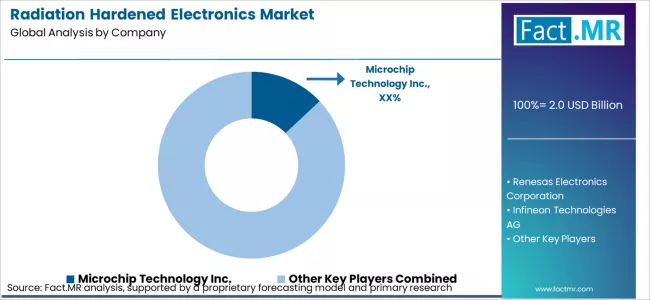
Radiation Hardened Electronics Market Analysis By Company | Source: Fact.MR
The radiation hardened electronics market is highly concentrated within the defence and space segment, where Microchip Technology, BAE Systems Microelectronics, Honeywell Defense Electronics, and Texas Instruments together account for roughly 55 to 65 percent of global revenue for space level qualified devices.
Entry barriers are significant, as each new device family requires substantial investment, long qualification timelines, and extensive radiation testing before approval. Competitive strength depends more on the breadth of Qualified Parts List coverage than on price, since replacing a certified component in a flight system is costly and disruptive.
Companies operating proprietary rad hard foundries hold clear structural advantages, particularly for process embedded radiation tolerance that cannot be replicated through standard commercial fabs. In government space and nuclear programmes, supplier lock in can last decades. In contrast, commercial LEO constellation operators apply dual sourcing and price discipline, encouraging competition among radiation tolerant suppliers.
Recent Development
- In October 2025, Infineon Technologies AG announced the industry’s first radiation-hardened buck controller with an integrated gate drive designed for power rails in commercial space systems and extreme environments, expanding rad-hard power solutions for satellites and FPGA/ASIC payloads.
- In 2025, NanoXplore and STMicroelectronics jointly announced the space qualification of the NG-ULTRA radiation-hardened system-on-chip FPGA under the ESCC 9030 standard, aimed at satellite onboard systems including Galileo and Copernicus constellations.
Key Players
- Microchip Technology Inc.
- Renesas Electronics Corporation
- Infineon Technologies AG
- STMicroelectronics N.V.
- BAE Systems plc
- Texas Instruments Incorporated
- Analog Devices, Inc.
- Honeywell International Inc.
- Advanced Micro Devices, Inc. (AMD)
- NXP Semiconductors N.V.
Bibliography
- [1] Microchip Technology Inc. (2024, June). Fiscal Year 2024 Annual Report: Space and Aviation Segment Revenue Growth and 65nm RHBD FPGA Development Programme Disclosure.
- [2] Defense Logistics Agency Land and Maritime. (2023, August). MIL-PRF-38535 Revision L: Performance Specification, Integrated Circuits (Microcircuits) Manufacturing, General Specification for.
- [3] Indian National Space Promotion and Authorisation Centre (IN-SPACe). (2023, January). Space Activities Amendment Framework: Private Sector Launch Slot Allocation Requirements and Electronics Qualification Conditions.
- [4] International Atomic Energy Agency. (2020, December). IEC 61513 Edition 2.0: Nuclear Power Plants Instrumentation and Control for Systems Important to Safety General Requirements for Systems.
- [5] BAE Systems. (2024, March). GOMAC Tech 2024: RAD5545 PowerPC Processor 28nm RHBD Architecture and NASA Deep Space Mission Qualification Disclosure.
- [6] Federal Communications Commission. (2022, December). SpaceX Starlink Generation 2 Non-Geostationary Satellite System FCC Application: Satellite Design and Production Rate Disclosures. Licence File Number SAT-MOD-20220411-00047.
- [7] Renesas Electronics Corporation. (2024, April). Investor Relations Presentation 2024: RH850 Space-Grade Microcontroller RHBD Programme and JAXA Qualification Timeline.
- [8] Honeywell International Inc. (2024, February). Defense Electronics Technology Programme Overview 2024: SiGe RHBP Process Platform Capabilities for Nuclear Instrumentation and Radar Applications.
This Report Addresses
- Market intelligence for strategic planning: comprehensive analysis of radiation hardened electronics qualification economics, MIL-PRF-38535 and ESCC procurement frameworks, RHBD versus RHBP manufacturing technique selection drivers, and application-specific adoption trajectories across space, defence, nuclear, and high-energy physics end-use segments.
- Market size and forecast: global radiation hardened electronics market valued at USD 2.0 billion in 2026, projected to reach USD 2.9 billion by 2036 at 4.4% CAGR, with segment-level sizing by component type and manufacturing technique.
- Growth opportunity mapping: identification of high-value subsegments including advanced-node RHBD processors and FPGAs for commercial LEO constellations at sub-USD 1,000 unit targets, RHBP analogue and mixed-signal ICs for nuclear instrumentation IEC 61513 upgrade cycles, and RHBS enclosures for COTS device protection in moderate radiation orbit profiles.
- Segment and regional forecasts: country-level CAGR analysis for India, China, United States, France, and Brazil, with component and manufacturing technique breakdowns revealing space programme-driven versus nuclear compliance-driven procurement patterns.
- Competition strategy assessment: competitive positioning analysis of Microchip Technology, BAE Systems MicroElectronics, Honeywell Defense Electronics, STMicroelectronics, and Renesas Electronics, including proprietary foundry advantages, MIL-PRF-38535 Qualified Parts List coverage, and commercial LEO constellation qualification strategies.
- Regulatory and standards impact analysis: assessment of MIL-PRF-38535 Class V qualification requirements, ESCC European space component standards, IEC 61513 nuclear safety I&C regulations, IN-SPACe Indian space electronics mandates, and ITAR restrictions on rad-hard component export determining global supply chain structure.
- Space programme pipeline analysis: satellite constellation build-rate models for SpaceX Starlink Gen 2, Amazon Project Kuiper, China Guowang, and India’s ISRO manifest, quantifying per-programme radiation hardened component procurement value through 2036.
- Report delivery formats: Excel data tables with segment-level forecasts and per-unit component price benchmarks by technique, PowerPoint executive summary with space programme procurement pipeline visualisation, and PDF comprehensive report with verifiable source citations.
Segmentation
Scope of Report
| Items | Values |
|---|---|
| Quantitative Units | USD 2.0 billion (2026) to USD 2.9 billion (2036), at a CAGR of 4.4% |
| Market Definition | Radiation hardened electronics are semiconductor devices including processors, controllers, memory, mixed-signal ICs, power management ICs, and sensors engineered to maintain reliable operation when exposed to ionising radiation environments encountered in space, nuclear, military, and high-energy physics applications, preventing single-event upsets, latch-up, and total ionising dose degradation that would disable standard commercial devices. |
| Component | Mixed Signal ICs, Memory, Processors & Controllers, Power Management, Sensors, Others |
| Solution | Commercial-Off-The-Shelf (COTS) And Custom-Made. |
| Packaging | Ceramic, Plastic, And Metal. |
| Manufacturing Technique | Radiation Hardening by Design (RHBD), Radiation Hardening by Process (RHBP), Radiation Hardening by Shielding (RHBS) |
| Regions Covered | Asia Pacific, Europe, North America, Latin America, Middle East & Africa |
| Countries Covered | India, China, Japan, South Korea, Indonesia, Australia & New Zealand, ASEAN, Rest of Asia Pacific, Germany, Italy, France, United Kingdom, Spain, Benelux, Nordics, Central & Eastern Europe, Rest of Europe, United States, Canada, Mexico, Brazil, Argentina, Chile, Rest of Latin America, Kingdom of Saudi Arabia, United Arab Emirates, South Africa, Turkey, Rest of Middle East & Africa |
| Key Companies Profiled | Microchip Technology Inc., Renesas Electronics, Infineon Technologies, STMicroelectronics, BAE Systems, Texas Instruments, Analog Devices, Honeywell International, AMD, NXP Semiconductors |
| Forecast Period | 2026 to 2036 |
| Approach | Top-down and bottom-up market modeling validated through primary interviews with space programme procurement officers, defence electronics engineers, nuclear plant instrumentation specialists, high-energy physics laboratory procurement leads, and rad-hard foundry operations managers, supported by NASA and ESA mission budgets, DoD appropriations, national space agency launch manifests, and OEM annual report disclosures from Microchip Technology, BAE Systems, and Renesas Electronics. |
Source: Fact.MR analysis. Updated Feb 19, 2026
Radiation Hardened Electronics Market by Segments
-
By Component :
- Mixed Signal ICs
- Memory
- Processors & Controllers
- Power Management
- Sensors
- Others
-
By Manufacturing Technique :
- Radiation Hardening by Design (RHBD)
- Radiation Hardening by Process (RHBP)
- Radiation Hardening by Shielding (RHBS)
-
Packaging :
- Ceramic
- Plastic
- Metal
-
Solution :
- Commercial-Off-The-Shelf (COTS)
- Custom-Made.
-
Region :
- Asia Pacific
- India
- China
- Japan
- South Korea
- Indonesia
- Australia & New Zealand
- ASEAN
- Rest of Asia Pacific
- Europe
- Germany
- Italy
- France
- United Kingdom
- Spain
- Benelux
- Nordics
- Central & Eastern Europe
- Rest of Europe
- North America
- United States
- Canada
- Mexico
- Latin America
- Brazil
- Argentina
- Chile
- Rest of Latin America
- Middle East & Africa
- Kingdom of Saudi Arabia
- United Arab Emirates
- South Africa
- Turkey
- Rest of Middle East & Africa
- Asia Pacific
Frequently Asked Questions
How large is the radiation hardened electronics market in 2025?
What will the market size be in 2026?
What will the market size be by 2036?
What is the expected CAGR for the 2026 to 2036 forecast period?
Which component segment is poised to lead the market?
Which manufacturing technique segment is poised to lead the market?
How significant is the RHBP manufacturing technique segment?
Which country is growing fastest in the radiation hardened electronics market?
What is the projected CAGR for China in the radiation hardened electronics market?
What is the projected CAGR for the United States in the radiation hardened electronics market?
What is the absolute dollar growth of the market from 2026 to 2036?
What is the projected CAGR for France in the radiation hardened electronics market?
What is the projected CAGR for Brazil in the radiation hardened electronics market?
Who worked on this report


Preview the report firsthand - request a free sample
Free SampleGet the brochure for pricing and purchase details
Download PDF