- Market Value (2025): USD 40.6 Mn
- Estimated Value (2026): USD 45.0 Mn
- Forecast Value (2036): USD 124.4 Mn
- CAGR (2026-2036): 10.7%
Rare Pediatric Disease Formulations Market Forecast and Outlook 2026 to 2036
Global rare pediatric disease formulations revenue is estimated at USD 45.0 million in 2026, reaching USD 124.4 million in 2036. Across the decade, this corresponds to a 10.7% compound annual growth rate for rare pediatric disease formulations.
Demand for rare pediatric disease formulations is growing as children with rare genetic, metabolic and neuromuscular diseases need medicines in forms they can take, such as oral liquids, dispersible tablets and granules, at doses that change as they grow. Many adult medicines cannot be split or swallowed by young children. For example, the EU Paediatric Regulation, in force since 2007, requires companies to agree pediatric investigation plans that include child-appropriate formulations. Taste, dose adjustment and stability will affect whether a formulation works for families and treatment centers.
Market Snapshot: Rare Pediatric Disease Formulations Market
- Sales of rare pediatric disease formulations stood at USD 40.6 million in 2025
- Rare Pediatric Disease Formulations Market Value (2026): USD 45.0 million
- Rare Pediatric Disease Formulations Market Forecast Value (2036): USD 124.4 million
- Rare Pediatric Disease Formulations Market Forecast CAGR (2026-2036): 10.7%
- Leading Pediatric rare disease form: Oral liquid (35.4%)
- Key Market Participants: Takeda, BioMarin, Sarepta Therapeutics, Ultragenyx, Sanofi, PTC Therapeutics
- Key Growth Regions: United States, United Kingdom, France, Germany, Japan
The Consolidated Appropriations Act, 2026, enacted on February 3, 2026, extended the US FDA rare pediatric disease priority review voucher program. The program is scheduled to sunset after September 30, 2029, subject to the statutory eligibility criteria. Orders for rare pediatric disease formulations are associated with restored voucher incentives improve the economics of small pediatric programs. Suppliers such as BioMarin, Ultragenyx, PTC Therapeutics and Takeda are advancing pediatric products. Developers will need dosage forms that children can swallow or receive accurately at different ages.
Rare Pediatric Disease Formulations Market
| Metric | Value |
|---|---|
| Estimated Value in (2026) | USD 45.0 million |
| Forecast Value in (2036) | USD 124.4 million |
| Forecast CAGR (2026 to 2036) | 10.7% |
Source: Fact.MR analysis. Updated Nov 19, 2026
Source: Fact.MR analysis.
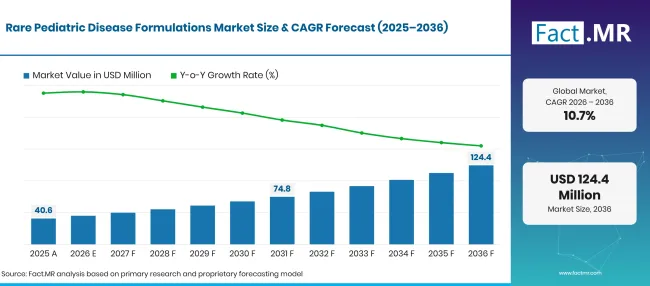
Rare Pediatric Disease Formulations Forecast Global | Source: Fact.MR
Category
| Category | Segments |
|---|---|
| Pediatric rare disease form | Oral liquid, Dispersible tablet, Granules / sprinkles, Injectable, Gene / cell therapy |
| Development / delivery route | Small molecule, Biologic, Gene therapy, Cell therapy, Combination / other |
| Care setting | Hospital inpatient, Specialist outpatient, Ambulatory center, Home-supported care, Research / clinical trial |
| Patient population | Pediatric, Adult, Older adult, Mixed age, Rare genotype-defined |
| Region | United States; United Kingdom; France; Germany; Japan |
Source: Fact.MR analysis. Updated Nov 19, 2026
Source: Fact.MR analysis.
Segmental Analysis
Why do oral liquids lead form demand in the Rare Pediatric Disease Formulations Market?
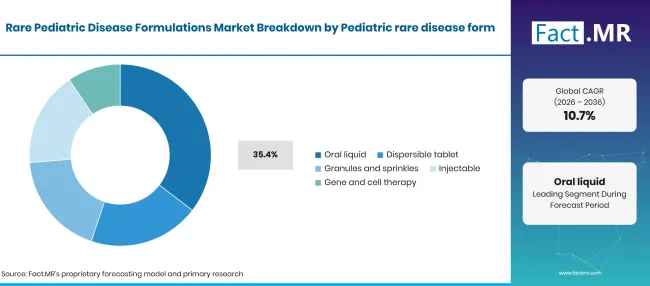
Rare Pediatric Disease Formulations Breakdown Pediatric Rare Disease Form | Source: Fact.MR
Oral liquids account for 35.4% of revenue in 2026, approximately USD 15.9 million, as they allow precise weight-based dosing for infants and children. Liquid formulations also support administration through feeding tubes when swallowing is difficult. Gene and cell therapies and injectables serve more complex treatment requirements. Manufacturers are improving taste, chemical stability and dosing accuracy to support safe pediatric medication administration.
Why does combination / other lead development-route demand in the Rare Pediatric Disease Formulations Market?
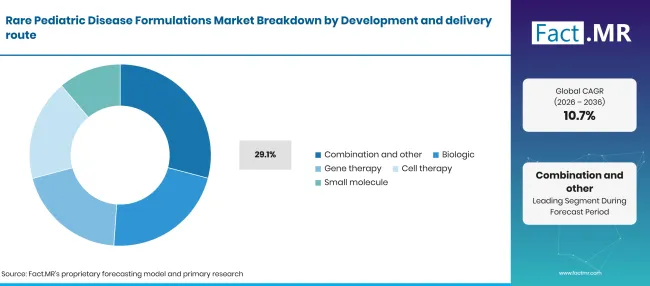
Rare Pediatric Disease Formulations Breakdown Development And Delivery Route | Source: Fact.MR
Combination and other approaches represent 29.1% of revenue in 2026, valued at approximately USD 13.1 million, reflecting the need for integrated treatment regimens in rare pediatric conditions. These approaches may combine medicines with dosing devices, specialized diets or supportive therapies. Cell therapies and small molecules provide additional treatment options. Developers are refining administration methods to improve treatment consistency and patient convenience.
Why does hospital inpatient lead care-setting demand in the Rare Pediatric Disease Formulations Market?
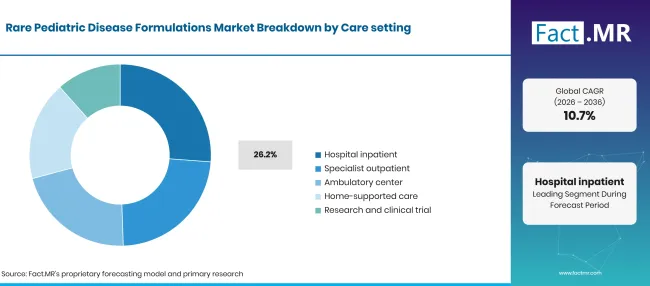
Rare Pediatric Disease Formulations Breakdown Care Setting | Source: Fact.MR
Hospital inpatient care holds 26.2% of revenue in 2026, equivalent to approximately USD 11.8 million, as children with rare diseases often require specialized diagnosis and treatment initiation. Pediatric hospitals provide facilities for complex therapies, initial dosing and clinical monitoring. Home-supported care offers continuity after discharge. Suppliers are developing formulations and administration systems that support hospital pharmacy operations and treatment safety.
Why does the mixed age group lead patient demand in the Rare Pediatric Disease Formulations Market?
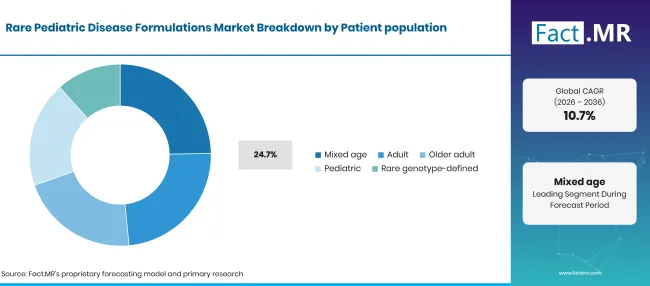
Rare Pediatric Disease Formulations Breakdown Patient Population | Source: Fact.MR
The mixed age group accounts for 24.7% of revenue in 2026, approximately USD 11.1 million, as patients diagnosed with rare childhood conditions may require treatment throughout adulthood. Long-term therapy creates demand for formulations suitable for changing age-related dosing requirements. Pediatric and older adult groups represent additional patient segments. Manufacturers are developing adaptable formulations that support treatment continuity, dosing accuracy and long-term medication management.
Rare Pediatric Disease Formulations Market-Drivers, Restraints & Trends
Drivers:
Demand for rare pediatric disease formulations is increasing as newborn screening and genomic testing enable earlier diagnosis of inherited disorders. The Generation Study, launched by Genomics England and NHS England in 2024, supports early identification of treatable genetic conditions. Manufacturers are developing pediatric medicines suited to early intervention.
Restraints:
Small patient populations, high development costs and uncertainty surrounding orphan drug incentives create challenges for pediatric formulation manufacturers. The interruption in US priority review voucher incentives during 2025 added regulatory uncertainty. Developers must address age-specific dosing, swallowing difficulties, formulation stability and commercial manufacturing requirements.
Trend: Age-Appropriate Formulations:
Pharmaceutical manufacturers are developing mini-tablets, granules and taste-masked oral liquids to improve medication administration for children with rare diseases. These formulations accommodate different ages and swallowing abilities. Suppliers are refining dosing flexibility, ingredient compatibility and product stability to support long-term pediatric treatment requirements.
Trend: Genomic Newborn Screening:
Genomic newborn screening programs are creating opportunities for earlier treatment of inherited pediatric conditions. Healthcare providers are examining genetic testing methods that identify diseases before symptoms develop. Pharmaceutical developers are collaborating with research institutions to prepare suitable therapies and age-appropriate formulations for newly diagnosed patients.
Rare Pediatric Disease Formulations Market by Analysis by Key Country
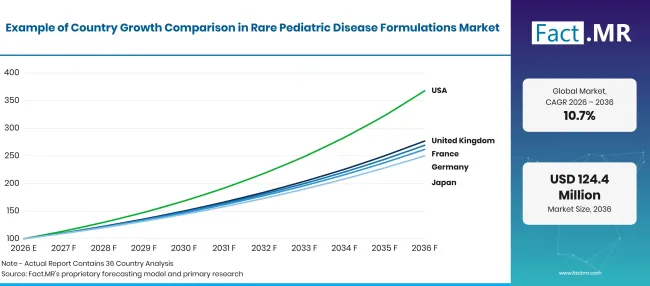
Rare Pediatric Disease Formulations Growth Index | Source: Fact.MR
| Country | CAGR (2026-2036) |
|---|---|
| United States | 14.4% |
| United Kingdom | 10.3% |
| France | 10.2% |
| Germany | 10.1% |
| Japan | 9.6% |
Source: Fact.MR analysis. Updated Nov 19, 2026
Source: Fact.MR analysis.
Why is the United States the fastest-growing market for rare pediatric disease formulations?
Demand for rare pediatric disease formulations in the United States is forecast to increase at a 14.4% CAGR through 2036, the fastest among the five countries.
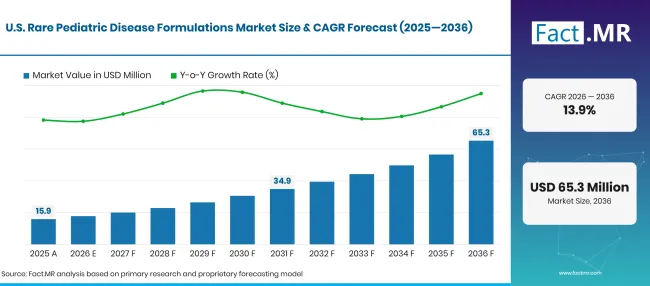
Rare Pediatric Disease Formulations Forecast Usa | Source: Fact.MR
FDA orphan drug incentives and pediatric development programs encourage pharmaceutical companies to develop treatments for uncommon childhood disorders. Expanded newborn screening also supports earlier diagnosis and treatment planning. Biotechnology companies are developing age-appropriate medicines, including oral liquids and specialized therapies. Commercial opportunities will depend on regulatory approvals, manufacturing capabilities, reimbursement coverage and access to specialized pediatric healthcare facilities.
What is shaping rare pediatric disease formulation demand in the United Kingdom?
Demand for rare pediatric disease formulations in the United Kingdom is set to rise at a 10.3% CAGR through 2036, supported by genomic screening initiatives and specialized pediatric healthcare programs.
The Generation Study, conducted by Genomics England and NHS England, aims to sequence the genomes of up to 100,000 newborns to identify treatable genetic conditions. Earlier diagnosis creates opportunities for targeted medicines and age-appropriate formulations. Pharmaceutical manufacturers are examining pediatric dosing requirements and treatment accessibility. Further adoption will reflect clinical evidence, NHS funding and specialist care availability.
What is shaping rare pediatric disease formulation demand in France?
Demand for rare pediatric disease formulations in France is likely to advance at a 10.2% CAGR through 2036 as specialized treatment centers improve access to medicines for uncommon childhood conditions.
France's early access framework allows eligible patients to receive promising therapies before standard reimbursement arrangements are completed, subject to regulatory requirements. Its national network of rare disease reference centers supports diagnosis, treatment planning and clinical research. Manufacturers are developing child-friendly formulations suited to different age groups. Wider adoption will depend on treatment effectiveness, reimbursement decisions and specialized care infrastructure.
What is shaping rare pediatric disease formulation demand in Germany?
Demand for rare pediatric disease formulations in Germany is forecast to expand at a 10.1% CAGR through 2036, supported by specialized treatment infrastructure and coordinated rare disease initiatives.
Germany's National Action Plan for People with Rare Diseases, known as NAMSE, promotes improvements in diagnosis, research and patient care. University hospitals and dedicated rare disease centers provide clinical expertise for children requiring complex treatments. Pharmaceutical developers are examining pediatric dosing and long-term treatment requirements. Market opportunities will reflect regulatory authorization, reimbursement arrangements, clinical evidence and access to specialist facilities.
Why is rare pediatric disease formulation growth slower in Japan?
Demand for rare pediatric disease formulations in Japan is expected to increase at a 9.6% CAGR through 2036, the slowest among the five countries.
Delays in introducing pediatric medicines already available in other markets continue to influence treatment access. Government measures introduced from 2024 aim to encourage development and regulatory submissions for pediatric indications. Domestic pharmaceutical manufacturers are examining opportunities for age-appropriate formulations and specialized treatments. Further expansion will depend on regulatory review timelines, reimbursement pricing, clinical research participation and the availability of pediatric treatment centers.
Competitive Market for Rare Pediatric Disease Formulations Market
Competition in the rare pediatric disease formulations market is concentrated among rare-disease drug developers. Takeda, Sanofi and BioMarin compete on enzyme and specialty therapies, while Sarepta Therapeutics, Ultragenyx and PTC Therapeutics compete on genetic and metabolic disease treatments. Buyers select products on efficacy, ease of administration, safety and access.
From 2025 onward, competition shifted toward child-friendly formulations amid changing US incentives. An advantage may accrue to suppliers with pediatric expertise as they seek to grow.
Recent Developments
- In April 2026, BioMarin completed its acquisition of Amicus Therapeutics, adding Galafold and Pombiliti with Opfolda to its rare-disease portfolio and expanding treatment options for patients with Fabry and Pompe diseases.
- In September 2026, PTC Therapeutics completed its acquisition of Sangamo's ST-920 gene therapy program, adding an investigational one-time treatment for Fabry disease to its pipeline and expanding its rare-disease gene therapy development capabilities.
Key Players in Rare Pediatric Disease Formulations Market
Key companies operating in the market include Takeda, BioMarin, Sarepta Therapeutics, Ultragenyx, Sanofi, and PTC Therapeutics.
- Takeda
- BioMarin
- Sarepta Therapeutics
- Ultragenyx
- Sanofi
- PTC Therapeutics
Bibliography
- BioMarin Pharmaceutical Inc. (2026, April 27). BioMarin completes acquisition of Amicus Therapeutics.
- Department of Health and Social Care. (2025, February 28). England Rare Diseases Action Plan 2025. GOV.UK.
- European Medicines Agency. (2026, January). Annual report on the use of the special contribution for orphan medicinal products: Year 2025.
- Genomics England. (2025, July 28). Generation Study: Process and impact evaluation—Interim report (Version 2.1).
- Genomics England. (2026, May). Conditions included in the Generation Study.
- National Institutes of Health. (2025, May 15). Infant with rare, incurable disease is first to successfully receive personalized gene therapy treatment.
- PTC Therapeutics, Inc. (2026, September 21). PTC completes acquisition of ST-920 Fabry disease gene therapy. Official acquisition announcement
- U.S. Congress, House of Representatives. (2025, December 1). Mikaela Naylon Give Kids a Chance Act (H.R. 1262, 119th Cong., 1st sess., engrossed in House). U.S. Government Publishing Office.
- U.S. Food and Drug Administration. (2025, December 9). FDA approves first gene therapy treatment for Wiskott-Aldrich syndrome.
- U.S. Food and Drug Administration. (2026, March 26). FDA approves first gene therapy for severe Leukocyte Adhesion Deficiency Type I.
- U.S. Food and Drug Administration. (2026, September 17). FDA approves first gene therapy for pediatric patients with Sanfilippo syndrome type A.
- World Health Organization. (2025, May 24). First-ever rare diseases resolution underscores equity and inclusion.
Segmentation
Scope of Report
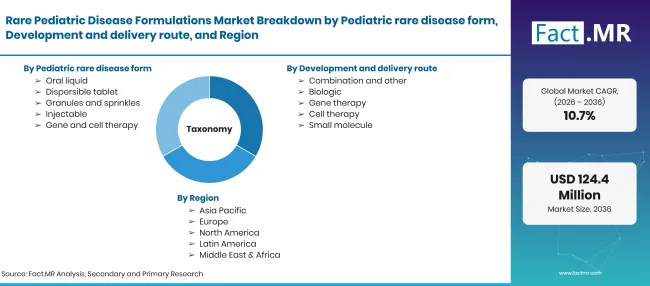
Rare Pediatric Disease Formulations Taxonomy | Source: Fact.MR
| Items | Values |
|---|---|
| Quantitative Units (2026) | USD 45.0 Million |
| Pediatric rare disease form | Oral liquid, Dispersible tablet, Granules / sprinkles, Injectable, Gene / cell therapy |
| Development / delivery route | Small molecule, Biologic, Gene therapy, Cell therapy, Combination / other |
| Care setting | Hospital inpatient, Specialist outpatient, Ambulatory center, Home-supported care, Research / clinical trial |
| Patient population | Pediatric, Adult, Older adult, Mixed age, Rare genotype-defined |
| Regions Covered | North America, Latin America, Europe, East Asia, South Asia and Pacific, Middle East & Africa |
| Countries Covered | United States, United Kingdom, France, Germany, Japan, and other countries |
| Key Companies Profiled | Takeda, BioMarin, Sarepta Therapeutics, Ultragenyx, Sanofi, PTC Therapeutics |
| Additional Attributes | Dollar revenue in the Rare Pediatric Disease Formulations Market is segmented by pediatric rare disease form (oral liquid, dispersible tablet, granules / sprinkles, injectable, gene / cell therapy); development / delivery route (small molecule, biologic, gene therapy, cell therapy, combination / other); care setting (hospital inpatient, specialist outpatient, ambulatory center, home-supported care, research / clinical trial); patient population (pediatric, adult, older adult, mixed age, rare genotype-defined) and region. |
Source: Fact.MR analysis. Updated Nov 19, 2026
Source: Fact.MR analysis.
Rare Pediatric Disease Formulations Market by Segments
-
Pediatric rare disease form
- Oral liquid
- Dispersible tablet
- Granules / sprinkles
- Injectable
- Gene / cell therapy
-
Development / delivery route
- Small molecule
- Biologic
- Gene therapy
- Cell therapy
- Combination / other
-
Care setting
- Hospital inpatient
- Specialist outpatient
- Ambulatory center
- Home-supported care
- Research / clinical trial
-
Patient population
- Pediatric
- Adult
- Older adult
- Mixed age
- Rare genotype-defined
-
Region:
- North America
- United States
- Canada
- Mexico
- Europe
- Germany
- United Kingdom
- France
- Italy
- Spain
- Rest of Europe
- Asia Pacific
- China
- India
- Japan
- South Korea
- Australia
- Rest of Asia Pacific
- Latin America
- Brazil
- Mexico
- Argentina
- Rest of Latin America
- Middle East & Africa
- GCC Countries
- South Africa
- Rest of Middle East & Africa
- North America
Frequently Asked Questions
How big is the global Rare Pediatric Disease Formulations Market in 2026?
What will be the size of the Rare Pediatric Disease Formulations Market by 2036?
How fast will the Rare Pediatric Disease Formulations Market grow during the forecast period?
Which pediatric rare disease form segment holds the largest share of the Rare Pediatric Disease Formulations Market?
Who worked on this report


Preview the report firsthand - request a free sample
Free SampleGet the brochure for pricing and purchase details
Download PDF