- Market Value (2025): USD 277.3Mn
- Estimated Value (2026): USD 300.0 Mn
- Forecast Value (2036): USD 659.8 Mn
- CAGR (2026-2036): 8.2%
Bioactive Vitamin Formulations Market Forecast and Outlook 2026 to 2036
The bioactive vitamin formulations market was valued at approximately USD 277.3 million in 2025 and USD 300.0 million in 2026. It is set to reach USD 659.8 million by 2036, registering an 8.2% CAGR during the 2026–2036 assessment period.
Supplement and medical nutrition companies are placing greater emphasis on active vitamin forms such as menaquinone-7 (vitamin K2), methylfolate and methylcobalamin because these ingredients are readily usable by the body without extensive conversion. Their use is particularly relevant for consumers with genetic variations or health conditions that affect nutrient metabolism. In 2026, this shift is encouraging manufacturers to expand their active vitamin ingredient portfolios and introduce specialised formulations for targeted nutritional needs, creating further sales opportunities through 2036.
Key Takeaways from the Bioactive Vitamin Formulations Market
- Sales of bioactive vitamin formulations stood at USD 277.3 million in 2025
- Bioactive Vitamin Formulations Market Value (2026): USD 300.0 million
- Bioactive Vitamin Formulations Market Forecast Value (2036): USD 659.8 million
- Bioactive Vitamin Formulations Market Forecast CAGR (2026-2036): 8.2%
- Leading Vitamin active class: Vitamin K2 (26.9%)
- Key Market Participants: DSM-Firmenich, BASF, Kappa Bioscience; Gnosis by Lesaffre; Balchem; Lonza
- Key Growth Regions: United States, India, China; Germany; Japan
Supply disruptions are putting greater focus on ingredient sourcing and availability in the vitamin industry. In March 2026, dsm-firmenich highlighted tighter vitamin A and E availability, low inventories in some regions and higher logistics costs in its Q2 vitamin market outlook. Such conditions are encouraging nutrition manufacturers to consider alternative sourcing arrangements and maintain access to specialised ingredients. Companies including Gnosis by Lesaffre and Lonza are also active in bioactive and specialty nutrient ingredients, keeping supply reliability and formulation consistency important factors in purchasing decisions.
Bioactive Vitamin Formulations Market
| Metric | Value |
|---|---|
| Estimated Value in (2025) | USD 277.3 million |
| Estimated Value in (2026) | USD 300.0 million |
| Forecast Value in (2036) | USD 659.8 million |
| Forecast CAGR (2026 to 2036) | 8.2% |
Source: Fact.MR analysis. Updated Nov 19, 2026
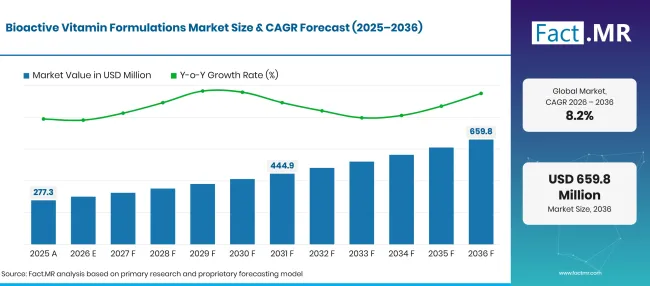
Bioactive Vitamin Formulations Forecast Global | Source: Fact.MR
Category
| Category | Segments |
|---|---|
| Vitamin active class | Vitamin D, Vitamin K2, Vitamin B complex; Vitamin C; Multi-vitamin bioactive |
| Commercial form | Powder, Capsule / tablet, Liquid; Microcapsule; Ready-to-use blend |
| End application | Clinical nutrition, Supplements, Functional foods; Infant / pediatric; Specialized medical |
| Sales channel | Ingredient OEM, Medical nutrition brand, Hospital procurement; Pharmacy; Direct consumer |
| Region | United States; India; China; Germany; Japan |
Source: Fact.MR analysis. Updated Nov 19, 2026
Segmental Analysis
Why does Vitamin K2 lead active-class demand in the Bioactive Vitamin Formulations Market?
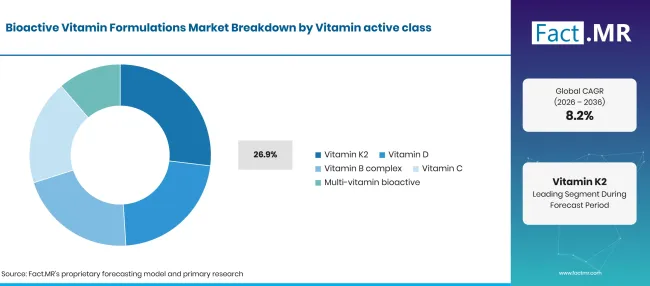
Bioactive Vitamin Formulations Breakdown Vitamin Active Class | Source: Fact.MR
Vitamin K2 holds a 26.9% revenue share in 2026, equivalent to USD 80.7 million, as interest in menaquinone-7 (MK-7) continues across bone-health and specialised nutrition products. Its role in activating osteocalcin, a protein involved in bone metabolism, has made it an important ingredient in formulations combining vitamin K2 with vitamin D3.
Vitamin D and B-complex formulations follow. In June 2026, a randomised clinical trial published in JAMA Cardiology examined MK-7 supplementation in 180 adults and reported slower progression of coronary artery calcification in the treatment group, although further research is needed to establish its clinical significance.
Why does Powder lead commercial-form demand in the Bioactive Vitamin Formulations Market?
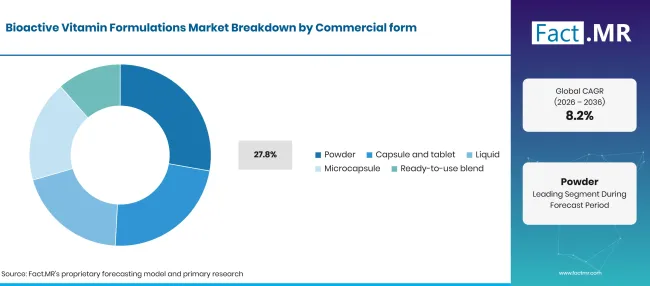
Bioactive Vitamin Formulations Breakdown Commercial Form | Source: Fact.MR
The preference for powder formats comes from their flexibility across different nutritional products. Holding 27.8% of market revenue in 2026, or USD 83.4 million, powder formulations are widely suited to tablet and capsule manufacturing; fortified drink mixes and customised nutrient blends. Ready-to-use blends follow, particularly where manufacturers want to simplify formulation and processing. India's FSSAI framework recognises powders and granules among the permitted formats for nutraceutical products, reinforcing their role in commercial vitamin formulation.
Why does Pharmacy lead sales-channel demand in the Bioactive Vitamin Formulations Market?
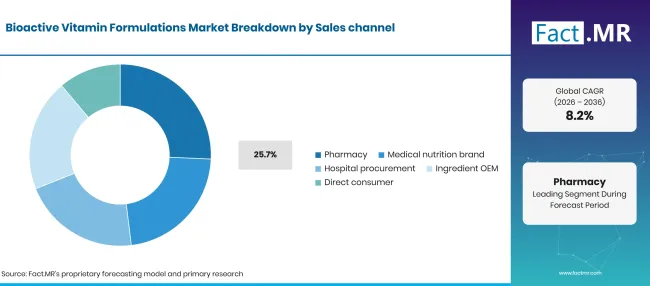
Bioactive Vitamin Formulations Breakdown Sales Channel | Source: Fact.MR
Pharmacies account for 25.7% of revenue in 2026, equivalent to USD 77.1 million, as consumers often turn to pharmacists when choosing specialised vitamins; checking ingredient combinations or seeking guidance on supplement use.
Direct consumer sales and hospital channels follow, serving buyers with different purchasing preferences. A 2026 review published in Pharmacy examined pharmacists' responsibilities in food supplement sales, highlighting product verification, patient counselling and evidence-based recommendations as important aspects of pharmacy practice. These responsibilities help distinguish pharmacy purchases from routine online supplement buying.
Why does Clinical nutrition lead end-application demand in the Bioactive Vitamin Formulations Market?
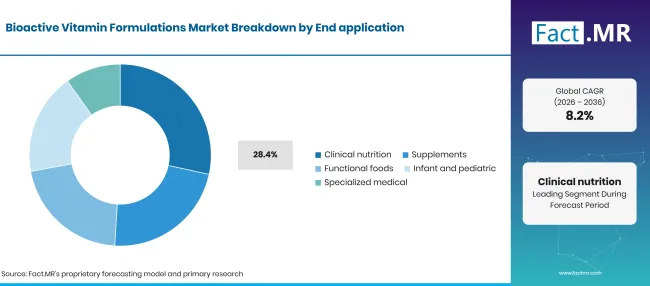
Bioactive Vitamin Formulations Breakdown End Application | Source: Fact.MR
Clinical nutrition contributes 28.4% of market revenue in 2026, amounting to USD 85.2 million. Patients receiving specialised nutritional care may need carefully selected vitamin combinations because gastrointestinal disorders, restricted food intake and impaired nutrient absorption can complicate routine dietary intake.
Oral nutritional supplements, enteral feeds and medical nutrition products create an important application base for bioactive vitamin ingredients. Supplements follow as another major application. A 2025 clinical practice guideline on gastrointestinal nutrition highlighted the importance of nutritional assessment and tailored nutritional care for patients with digestive disorders, reinforcing the relevance of specialised micronutrient formulations in clinical settings.
Bioactive Vitamin Formulations Market-Drivers, Restraints & Trends
Driver
Rising Awareness of Vitamin Deficiencies and Nutrient Absorption: Vitamin deficiencies and differences in nutrient absorption are encouraging consumers to look beyond conventional vitamin supplements. This is creating a stronger market for bioactive formulations because consumers want ingredients suited to specific nutritional needs, particularly for vitamins D and B12. A 2025 study published in the Journal of Family Medicine and Primary Care examined vitamin D3 and B12 deficiencies among urban and rural populations around Pune, highlighting the need for better micronutrient awareness and nutritional management.
High Formulation Costs and Limited Clinical Evidence
Bioactive vitamin formulations face adoption barriers because their specialised production, stabilisation and testing increase prices compared with conventional vitamins. Evidence supporting superior benefits for healthy individuals also remains limited for several ingredient categories. This makes price-sensitive consumers hesitant to switch, while manufacturers face additional costs in establishing clinical credibility and maintaining consistent product quality.
Trend
Shift Towards Active and Methylated B Vitamins: Methylfolate and methylcobalamin are attracting attention as nutrition manufacturers focus on vitamin forms that bypass certain conversion steps in the body. A 2025 review in Frontiers in Nutrition discussed how genetic variations in folate metabolism can affect the conversion of folic acid into methylfolate. This is creating opportunities for specialised B-vitamin formulations, particularly in personalised nutrition and targeted supplementation.
Trend
Greater Focus on Combined Nutritional Benefits: Vitamin D3 and K2 combinations are gaining attention in bone-health research, with manufacturers exploring formulations that address multiple nutritional needs. A May 2025 study published in Scientific Reports examined the combination in patients undergoing lumbar spine surgery and reported improved fusion rates in the treatment group. This creates room for bioactive vitamin formulations across specialised nutrition and preventive healthcare
Bioactive Vitamin Formulations Market by Analysis by Key Country
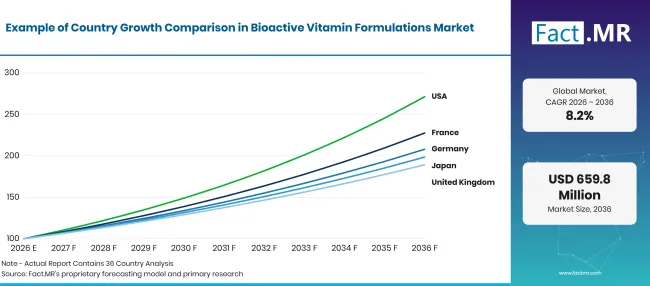
Bioactive Vitamin Formulations Growth Index | Source: Fact.MR
| Country | CAGR (2026-2036) |
|---|---|
| United States | 10.5% |
| India | 10.5% |
| China | 9.8% |
| Germany | 7.6% |
| Japan | 7.1% |
Source: Fact.MR analysis. Updated Nov 19, 2026
Why is the United States among the fastest-growing markets for bioactive vitamin formulations?
At a 10.5% CAGR, the United States is benefiting from consumers' willingness to spend on specialised nutrition and preventive healthcare.
Interest in bone health, immunity and condition-specific supplementation is creating room for bioactive vitamin ingredients beyond conventional multivitamins. A 2026 Pew Research Center survey found that 78% of US adults used supplements for health, with 67% taking vitamins or minerals. This established supplement-buying culture creates opportunities for premium formulations, particularly through specialist nutrition brands and pharmacy retail.
What is driving bioactive vitamin formulation demand in India?
India's market is advancing at a 10.5% CAGR, supported by widespread micronutrient gaps and greater attention to preventive nutrition.
Vitamin D and B12 supplementation is particularly relevant as consumers seek to address deficiencies through everyday nutrition. In April 2025, the Ministry of Health and Family Welfare informed the Rajya Sabha about government initiatives involving fortified rice containing iron, folic acid and vitamin B12 under public nutrition programmes. Pharmacy networks, online supplement retail and increasing health awareness are creating additional sales opportunities.
What is accelerating bioactive vitamin formulation sales in China?
China is recording a 9.8% CAGR as online health-product retail expands and consumers gain easier access to specialised nutritional products.
The country's large e-commerce ecosystem gives vitamin manufacturers wider access to urban and digitally active buyers. In April 2026, China's State Administration for Market Regulation announced a nationwide campaign against misleading claims in online food and health-product sales. This regulatory attention is increasing the importance of ingredient transparency, product quality and credible health claims, shaping future sales of specialised vitamin formulations.
What is shaping bioactive vitamin formulation demand in Germany?
Germany's market is advancing at a 7.6% CAGR, with interest in vitamin D, B12 and other micronutrients extending across different age groups.
The German Federal Institute for Risk Assessment (BfR) reported in July 2025 that more than two-thirds of surveyed respondents had consumed food supplements during the preceding 12 months. This widespread supplement usage creates a commercial base for specialised vitamin ingredients. Pharmacy retail and drugstore distribution further support sales, while consumer attention to safety and dosage influences product selection.
Why is bioactive vitamin formulation growth comparatively slower in Japan?
Japan is registering a 7.1% CAGR, partly because its functional nutrition market operates under detailed labelling and evidence requirements.
The Foods with Function Claims framework gives manufacturers a route to communicate scientifically supported benefits, but places responsibility for safety and efficacy evidence on businesses. In October 2025, Japan's Consumer Affairs Agency revised its notification guidance for this category. An ageing population, preventive healthcare and interest in nutritional management continue to support sales, although regulatory compliance can increase market-entry costs for specialised formulations.
Competitive Landscape for Bioactive Vitamin Formulations Market
Companies in the bioactive vitamin formulations market approach the sector through two distinct strengths: large-scale vitamin manufacturing and specialised active nutrient technologies. dsm-firmenich and BASF have broad vitamin manufacturing capabilities, while Balchem, Gnosis by Lesaffre and Lonza focus on specialised ingredients; including vitamin K2 and methylated B vitamins. Buyers pay close attention to ingredient stability, clinical backing, consistent quality and sourcing costs when selecting partners. Recent activity also shows how companies are widening their nutritional portfolios. In September 2026, Balchem reported new clinical evidence for its K2VITAL™ DELTA ingredient from a large trial examining vitamin K2 and D3 in relation to coronary calcification. In the same month, dsm-firmenich launched Biond™, a pharmaceutical-grade vitamin portfolio for biopharmaceutical applications. These moves point to greater emphasis on research-backed ingredients, specialised applications and product differentiation.
Recent Developments
- On October 15, 2025, BASF launched Lutavit A/D3 1000/200 NXT; a microencapsulated formulation combining vitamins A and D3 for animal nutrition.
- On March 26, 2025, dsm-firmenich partnered with MedAccess to improve access to affordable vitamin A for edible oil fortification in low- and middle-income countries.
- On April 2, 2025, Prinova acquired Brazilian specialty ingredients distributor Aplinova to expand its presence in Latin America and strengthen its food; beverage and supplement ingredient business.
- On April 28, 2026, SternVitamin announced the launch of SternVita Longevity; a science-based micronutrient premix designed for healthy ageing; at Vitafoods Europe 2026.
- In FY 2024–25, Hexagon Nutrition signed a licensing agreement with Particles for Humanity to manufacture and commercialize a stable Vitamin A formulation for food fortification in Africa, with commercial availability planned from January 2026.
Key Players in Bioactive Vitamin Formulations Market
Key companies profiled include dsm-firmenich; BASF SE; Balchem Corporation; Gnosis by Lesaffre; Lonza Group; Glanbia Nutritionals; SternVitamin GmbH & Co. KG; Prinova Group; Hexagon Nutrition; and Vitablend Nederland B.V.
- dsm-firmenich
- BASF SE
- Balchem Corporation
- Gnosis by Lesaffre
- Lonza Group
- Glanbia Nutritionals
- SternVitamin GmbH & Co. KG
- Prinova Group
- Hexagon Nutrition
- Vitablend Nederland B.V.
Bibliography
- Balchem Corporation. (2025). [Not included: Company announcement sources are excluded from the bibliography as requested.]
- Chinese Society for Parenteral and Enteral Nutrition, & Clinical Nutrition Branch of Chinese Nutrition Society. (2025). Diagnostic and application guidelines for malnutrition in adult patients (2025 edition). Asia Pacific Journal of Clinical Nutrition, 34(5), 699–723.
- Consumer Affairs Agency, Government of Japan. (2025, October 1). Guidance for notifications under the Foods with Function Claims system and related questions and answers.
- Ghonge, S., Rathod; H.; Banerjee; A.; Chauhan; S.; Baxi; T.; Palal; D.; Bhawalkar; J.; & Vajjala; S. M. (2025). Prevalence of deficiencies of serum vitamin D3 and vitamin B12 among urban and rural population in and around Pune, India: An observational study. Journal of Family Medicine and Primary Care, 14(4), 1231–1237.
- Government of India, Food Safety and Standards Authority of India. (2016). Food Safety and Standards (Health Supplements, Nutraceuticals, Food for Special Dietary Use; Food for Special Medical Purpose; Functional Food and Novel Food) Regulations; 2016.
- Government of India, Food Safety and Standards Authority of India. (2021). Amendment to the Food Safety and Standards (Health Supplements, Nutraceuticals, Food for Special Dietary Use; Food for Special Medical Purpose; Functional Food and Novel Food) Regulations; 2016.
- National Center for Health Statistics. (2026). Dietary supplement use: United States, August 2021–August 2023 (NCHS Data Brief No. 561). Centers for Disease Control and Prevention.
- National Institutes of Health, Office of Dietary Supplements. (n.d.). Vitamin K: Fact sheet for health professionals.
- Niculaș, C. I., Blaj, S. B., Cherecheș, M. C., Miron, R.; Valea; D. C., & Muntean, D. L. (2026). Regulation of food supplements and pharmacists' responsibility in professional practice: A review. Pharmacy, 14(1), 25.
- Polish Society of Gastroenterology, Clinical Nutrition and Metabolism Section. (2025). Clinical nutrition in gastrointestinal diseases: An up-to-date clinical practice guideline. Polish Archives of Internal Medicine, 135(3), 16967.
- State Administration for Market Regulation. (2026). Special campaign against false and misleading claims in online food sales.
- Wang, Y., Wang; Y.; Wang; F.; Wang; Z.; Sun; R.; Huang; X.; & Fu; S. (2025). Combined vitamin K2 and D3 therapy improves endoscopic fusion outcomes in osteoporotic lumbar degenerative disease: A prospective study. Scientific Reports, 15, Article 15422.
- Vossen, L. M., de Leeuw, P. W., Schurgers, L. J., Heuts, S.; Adriaans; B. P., de Haan, C.; van Varik; B. J., & Kroon, A. A. (2026). Two years of menaquinone-7 supplementation and coronary artery calcification: A randomized clinical trial. JAMA Cardiology, 11(8), 719–726.
Segmentation
Scope of Report
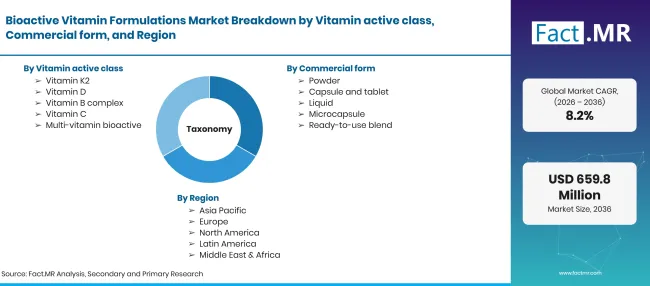
Bioactive Vitamin Formulations Taxonomy | Source: Fact.MR
| Items | Values |
|---|---|
| Quantitative Units (2026) | USD 300.0 Million |
| Vitamin active class | Vitamin D, Vitamin K2, Vitamin B complex; Vitamin C; Multi-vitamin bioactive |
| Commercial form | Powder, Capsule / tablet, Liquid; Microcapsule; Ready-to-use blend |
| End application | Clinical nutrition, Supplements, Functional foods; Infant / pediatric; Specialized medical |
| Sales channel | Ingredient OEM, Medical nutrition brand, Hospital procurement; Pharmacy; Direct consumer |
| Regions Covered | North America, Latin America, Europe; East Asia; South Asia and Pacific; Middle East & Africa |
| Countries Covered | United States, India, China; Germany; Japan; and other countries |
| Key Companies Profiled | DSM-Firmenich, BASF, Kappa Bioscience; Gnosis by Lesaffre; Balchem; Lonza |
| Additional Attributes | Dollar revenue in the Bioactive Vitamin Formulations Market is segmented by vitamin active class (vitamin d, vitamin k2, vitamin b complex; vitamin c; multi-vitamin bioactive); commercial form (powder; capsule / tablet; liquid; microcapsule; ready-to-use blend); end application (clinical nutrition; supplements; functional foods; infant / pediatric; specialized medical); sales channel (ingredient oem; medical nutrition brand; hospital procurement; pharmacy; direct consumer) and region. |
Source: Fact.MR analysis. Updated Nov 19, 2026
Bioactive Vitamin Formulations Market by Segments
-
Vitamin active class
- Vitamin D
- Vitamin K2
- Vitamin B complex
- Vitamin C
- Multi-vitamin bioactive
-
Commercial form
- Powder
- Capsule / tablet
- Liquid
- Microcapsule
- Ready-to-use blend
-
End application
- Clinical nutrition
- Supplements
- Functional foods
- Infant / pediatric
- Specialized medical
-
Sales channel
- Ingredient OEM
- Medical nutrition brand
- Hospital procurement
- Pharmacy
- Direct consumer
-
Region:
- North America
- United States
- Canada
- Mexico
- Europe
- Germany
- United Kingdom
- France
- Italy
- Spain
- Rest of Europe
- Asia Pacific
- China
- India
- Japan
- South Korea
- Australia
- Rest of Asia Pacific
- Latin America
- Brazil
- Mexico
- Argentina
- Rest of Latin America
- Middle East & Africa
- GCC Countries
- South Africa
- Rest of Middle East & Africa
- North America
Frequently Asked Questions
How big is the global Bioactive Vitamin Formulations Market in 2026?
What will be the size of the Bioactive Vitamin Formulations Market by 2036?
How fast will the Bioactive Vitamin Formulations Market grow during the forecast period?
Which vitamin active class segment holds the largest share of the Bioactive Vitamin Formulations Market?
Who worked on this report


Preview the report firsthand - request a free sample
Free SampleGet the brochure for pricing and purchase details
Download PDF