- Market Value (2025): USD 24.6 Mn
- Estimated Value (2026): USD 28.0 Mn
- Forecast Value (2036): USD 103.8 Mn
- CAGR (2026-2036): 14.0%
Long-Acting Anti-VEGF Formulations Market Forecast and Outlook 2026 to 2036
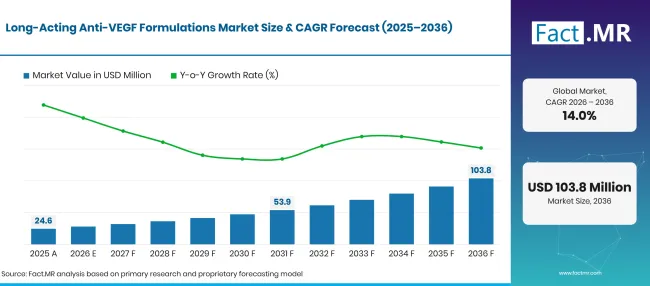
The long-acting anti-VEGF formulations market is projected to grow from USD 28.0 million in 2026 to USD 103.8 million by 2036. Demand for long-acting anti-VEGF formulations is likely to grow at a CAGR of 14.0% over the forecast period.
Demand for long-acting anti-VEGF formulations is growing as patients with wet age-related macular degeneration, diabetic macular edema and retinal vein occlusion need eye injections every one to two months with standard drugs, a heavy burden for patients and clinics. Long-acting versions, higher-dose biologics, refillable implants and gene therapies aim to stretch treatment intervals to four months or longer. For example, in August 2023, the US FDA approved high-dose aflibercept 8 mg (Eylea HD) with dosing intervals of up to 16 weeks after initial doses. Retina specialists will compare the durability of retinal disease control with safety data and the number of injections required.
Market Snapshot: Long-Acting Anti-VEGF Formulations Market
- Sales of long-acting anti-VEGF formulations stood at USD 24.6 million in 2025
- Long-Acting Anti-VEGF Formulations Market Value (2026): USD 28.0 million
- Long-Acting Anti-VEGF Formulations Market Forecast Value (2036): USD 103.8 million
- Long-Acting Anti-VEGF Formulations Market Forecast CAGR (2026-2036): 14.0%
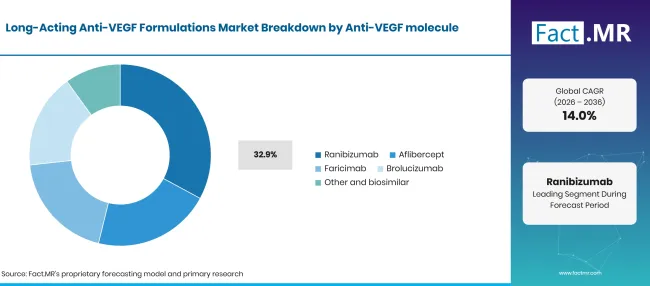
- Leading Anti-VEGF molecule: Ranibizumab (32.9%)
- Key Market Participants: Roche, Regeneron, Bayer, Novartis, AbbVie, Ocular Therapeutix
- Key Growth Regions: United States, China, France, Germany, Japan
Roche's Susvimo, a refillable port that delivers ranibizumab continuously, returned to the US market in 2024 after a recall and gained further approvals for diabetic eye disease in 2025. Orders for long-acting anti-VEGF formulations are associated with retina specialists look for ways to reduce injection visits. Suppliers such as Regeneron, Roche, Novartis and Ocular Therapeutix are developing longer-acting options. Clinic capacity and patients’ ability to return for treatment will influence use of longer-acting formulations.
Long-Acting Anti-VEGF Formulations Market
| Metric | Value |
|---|---|
| Estimated Value in (2026) | USD 28.0 million |
| Forecast Value in (2036) | USD 103.8 million |
| Forecast CAGR (2026 to 2036) | 14.0% |
Source: Fact.MR analysis. Updated Nov 19, 2026
Source: Fact.MR analysis.
Long Acting Anti Vegf Formulations Forecast Global | Source: Fact.MR
Category
| Category | Segments |
|---|---|
| Anti-VEGF molecule | Aflibercept, Ranibizumab, Faricimab, Brolucizumab, Other / biosimilar |
| Development / delivery route | Small molecule, Biologic, Gene therapy, Cell therapy, Combination / other |
| Care setting | Hospital inpatient, Specialist outpatient, Ambulatory center, Home-supported care, Research / clinical trial |
| Patient population | Pediatric, Adult, Older adult, Mixed age, Rare genotype-defined |
| Region | United States; China; France; Germany; Japan |
Source: Fact.MR analysis. Updated Nov 19, 2026
Source: Fact.MR analysis.
Segmental Analysis
Why does ranibizumab lead molecule demand in the Long-Acting Anti-VEGF Formulations Market?
Long Acting Anti Vegf Formulations Breakdown Anti Vegf Molecule | Source: Fact.MR
Ranibizumab accounts for 32.9% of revenue in 2026, approximately USD 9.2 million, supported by its use in long-acting retinal treatment systems. Roche's Susvimo port delivery system enables sustained administration of ranibizumab, reducing the frequency of conventional injections. Ranibizumab biosimilars provide additional treatment options. Manufacturers are developing sustained-release formulations to improve treatment durability, patient convenience and clinical management of retinal diseases.
Why do biologics lead delivery-route demand in the Long-Acting Anti-VEGF Formulations Market?
Long Acting Anti Vegf Formulations Breakdown Development And Delivery Route | Source: Fact.MR
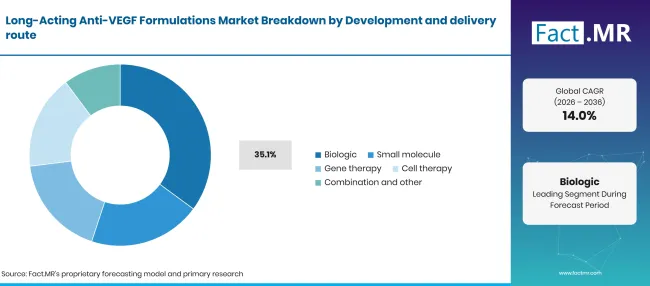
Biologics represent 35.1% of revenue in 2026, valued at approximately USD 9.8 million, reflecting their established use in treating retinal vascular diseases. Anti-VEGF antibodies and fusion proteins help control abnormal blood vessel growth and fluid leakage. Small-molecule implants and gene therapies remain under development. Pharmaceutical companies are improving biologic delivery technologies to extend treatment intervals and reduce injection frequency.
Why do ambulatory centers lead care-setting demand in the Long-Acting Anti-VEGF Formulations Market?
Long Acting Anti Vegf Formulations Breakdown Care Setting | Source: Fact.MR
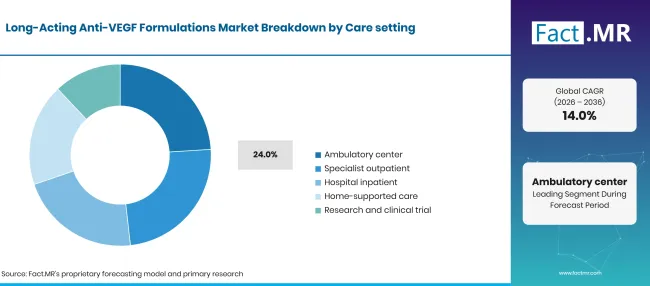
Ambulatory centers hold 24.0% of revenue in 2026, equivalent to approximately USD 6.7 million, as retinal injections and implant refill procedures are commonly performed in outpatient facilities. Specialized retina clinics provide treatment monitoring and follow-up care for patients with chronic eye diseases. Home-supported care serves selected patient needs. Manufacturers are developing delivery systems that support efficient clinical procedures and longer treatment intervals.
Why does the mixed age population lead patient demand in the Long-Acting Anti-VEGF Formulations Market?
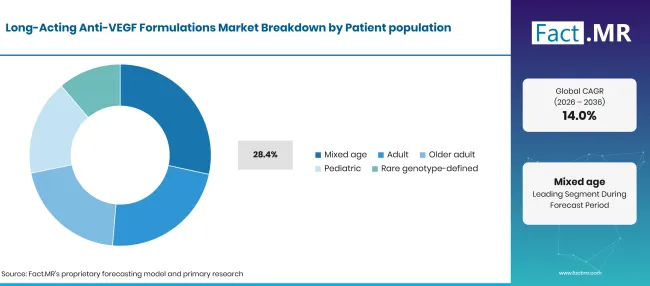
Long Acting Anti Vegf Formulations Breakdown Patient Population | Source: Fact.MR
The mixed age population accounts for 28.4% of revenue in 2026, approximately USD 8.0 million, as anti-VEGF treatments address retinal conditions affecting different age groups. Older adults commonly receive treatment for age-related macular degeneration, while working-age patients require care for diabetic retinal diseases. Rare pediatric conditions create additional specialized applications. Manufacturers are developing longer-acting therapies to reduce treatment burden across patient populations.
Long-Acting Anti-VEGF Formulations Market-Drivers, Restraints & Trends
Drivers:
Demand for long-acting anti-VEGF formulations is increasing as aging populations and diabetes contribute to retinal disease prevalence. Frequent injections create treatment burdens for patients and ophthalmology clinics. Pharmaceutical manufacturers are developing extended-delivery systems that reduce treatment visits while maintaining disease control and visual outcomes.
Restraints:
Safety concerns, including intraocular inflammation associated with certain anti-VEGF therapies such as brolucizumab, can limit treatment adoption. Lower-cost biosimilars also increase pricing pressure. Manufacturers must demonstrate sustained efficacy, acceptable safety profiles and clinical benefits that justify longer-acting formulations over conventional injection treatments.
Trend: Tyrosine Kinase Inhibitor Implants:
Pharmaceutical developers are investigating sustained-release implants containing tyrosine kinase inhibitors to extend treatment intervals for retinal diseases. Ocular Therapeutix's Axpaxli and EyePoint's Duravyu have entered late-stage clinical development. These technologies aim to maintain therapeutic drug exposure while reducing repeated intravitreal injections and clinic visits.
Trend: Anti-VEGF Biosimilars:
The US FDA approved Yesafili and Opuviz as interchangeable biosimilars to Eylea in May 2024, expanding conventional retinal treatment options. These products introduce pricing competition but differ from long-acting implants and high-dose formulations. Manufacturers must demonstrate clinical value beyond lower treatment costs and established injection schedules
Long-Acting Anti-VEGF Formulations Market by Analysis by Key Country
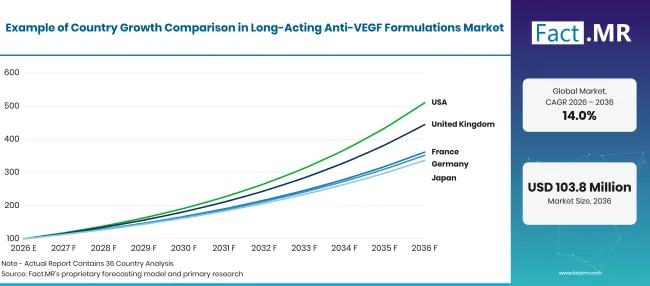
Long Acting Anti Vegf Formulations Growth Index | Source: Fact.MR
| Country | CAGR (2026-2036) |
|---|---|
| United States | 17.7% |
| China | 15.6% |
| France | 13.5% |
| Germany | 13.4% |
| Japan | 12.9% |
Source: Fact.MR analysis. Updated Nov 19, 2026
Source: Fact.MR analysis.
Why is the United States the fastest-growing market for long-acting anti-VEGF formulations?
Demand for long-acting anti-VEGF formulations in the United States is forecast to increase at a 17.7% CAGR through 2036, the fastest among the five countries.
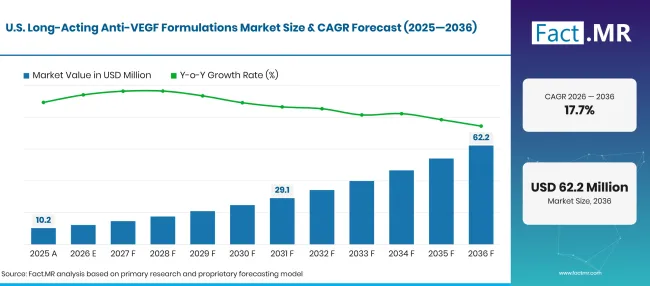
Long Acting Anti Vegf Formulations Forecast Usa | Source: Fact.MR
Available therapies, including Eylea HD, Vabysmo and Susvimo, provide treatment options with extended dosing intervals or sustained drug delivery. Pharmaceutical companies are also advancing longer-acting candidates through clinical development. Retina specialists are examining treatments that reduce frequent clinic visits while maintaining disease control. Further adoption will depend on clinical safety, treatment durability, insurance coverage and patient outcomes across retinal diseases.
What is driving long-acting anti-VEGF demand in China?
Sales of long-acting anti-VEGF formulations in China are set to rise at a 15.6% CAGR through 2036, supported by the country's substantial diabetic population and increasing retinal disease treatment needs.
National reimbursement coverage for anti-VEGF medicines, including conbercept, supports patient access to established therapies. Ophthalmology providers are examining longer treatment intervals to manage clinic workloads and improve patient convenience. Pharmaceutical manufacturers are developing sustained-delivery approaches for retinal conditions. Commercial uptake will reflect reimbursement eligibility, clinical effectiveness, treatment costs and access to specialized ophthalmology services.
What is shaping long-acting anti-VEGF demand in France?
Demand for long-acting anti-VEGF formulations in France is likely to advance at a 13.5% CAGR through 2036 as retina specialists adopt treatments offering extended dosing intervals.
Faricimab and aflibercept 8 mg provide options for managing retinal diseases with fewer injections in suitable patients. Limited ophthalmologist availability in rural areas is also increasing interest in reducing routine clinic visits. Healthcare providers are assessing treatment durability alongside visual outcomes and patient safety. Prescribing decisions will reflect clinical guidelines, reimbursement conditions and individual responses to anti-VEGF therapy.
What is shaping long-acting anti-VEGF demand in Germany?
Demand for long-acting anti-VEGF formulations in Germany is forecast to expand at a 13.4% CAGR through 2036, supported by the availability of extended-interval retinal therapies.
Leverkusen-based Bayer markets aflibercept 8 mg in Europe, providing ophthalmologists with another treatment option for eligible patients. The introduction of aflibercept biosimilars has also increased pricing competition across conventional anti-VEGF therapies. Retina clinics are examining treatment schedules that balance patient convenience with disease control. Manufacturers will compete through clinical evidence, dosing flexibility, reimbursement access and demonstrated treatment durability.
Why is long-acting anti-VEGF growth slower in Japan?
Demand for long-acting anti-VEGF formulations in Japan is expected to increase at a 12.9% CAGR through 2036, the slowest among the five countries.
Regular pharmaceutical price revisions influence revenue growth and commercial planning for retinal treatments. Chugai Pharmaceutical, part of the Roche Group, markets faricimab in Japan, supporting access to extended-interval anti-VEGF therapy. Ophthalmologists are evaluating longer dosing schedules for patients requiring repeated retinal injections. Further adoption will depend on treatment effectiveness, patient safety, reimbursement pricing and evidence supporting reduced injection frequency.
Competitive Market for Long-Acting Anti-VEGF Formulations Market
Competition in the long-acting anti-VEGF formulations market is concentrated among major ophthalmology drug makers and delivery innovators. Regeneron and Bayer compete with aflibercept, Roche with faricimab and Susvimo, and Novartis with brolucizumab and ranibizumab, while AbbVie and Ocular Therapeutix pursue gene therapy and implant approaches. Buyers select therapies on durability, safety, efficacy and cost.
From 2025 onward, competition shifted toward longer intervals and biosimilars. An advantage may accrue to suppliers with durable, safe options as they seek to grow.
Recent Developments
- In January 2026, RC BERG announced a new high-detail skirt armor kit for the 1/24 Scale Scopedog from Armored Trooper Votoms, expanding its specialized modeling accessories portfolio.
- In July 2026, WAVE Corporation introduced a reduced-xylene resin casting material in ivory and gray variants, supporting garage kit production with improved handling characteristics and material options for model makers.
Key Players in Long-Acting Anti-VEGF Formulations Market
Key companies operating in the market include Roche, Regeneron, Bayer, Novartis, AbbVie, and Ocular Therapeutix.
- Roche
- Regeneron
- Bayer
- Novartis
- AbbVie
- Ocular Therapeutix
Long-Acting Anti-VEGF Formulations Market by Segments
-
Anti-VEGF molecule
- Aflibercept
- Ranibizumab
- Faricimab
- Brolucizumab
- Other / biosimilar
-
Development / delivery route
- Small molecule
- Biologic
- Gene therapy
- Cell therapy
- Combination / other
-
Care setting
- Hospital inpatient
- Specialist outpatient
- Ambulatory center
- Home-supported care
- Research / clinical trial
-
Patient population
- Pediatric
- Adult
- Older adult
- Mixed age
- Rare genotype-defined
-
Region:
- North America
- United States
- Canada
- Mexico
- Europe
- Germany
- United Kingdom
- France
- Italy
- Spain
- Rest of Europe
- Asia Pacific
- China
- India
- Japan
- South Korea
- Australia
- Rest of Asia Pacific
- Latin America
- Brazil
- Mexico
- Argentina
- Rest of Latin America
- Middle East & Africa
- GCC Countries
- South Africa
- Rest of Middle East & Africa
- North America
Bibliography
- Bayer AG. (2025, June 27). Eylea™ 8 mg with extended 6-month treatment interval approved in the EU.
- Regeneron Pharmaceuticals, Inc. (2025, February 5). Annual report on Form 10-K for the fiscal year ended December 31, 2024.
- Regeneron Pharmaceuticals, Inc. (2025, November 19). EYLEA HD® (aflibercept) Injection 8 mg approved by FDA for the treatment of macular edema following retinal vein occlusion and for monthly dosing across approved indications.
- Regeneron Pharmaceuticals, Inc. (2026, April 2). EYLEA HD® (aflibercept) approved by FDA as first and only injectable anti-VEGF with dosing intervals up to 5 months for wet age-related macular degeneration and diabetic macular edema.
- RC BERG Ltd. (2026, January 29). Announcement of new 1/24 Scopedog high-detail skirt armor kit.
- Roche Holding AG. (2025, January 30). Annual report 2024.
- Roche Holding AG. (2025, September 5). New data for Roche’s Vabysmo reinforce its efficacy, safety and durability in neovascular or “wet” age-related macular degeneration.
- U.S. Food and Drug Administration. (2025, November). EYLEA HD® (aflibercept) injection: Prescribing information.
- U.S. Food and Drug Administration. (2026). Vabysmo (faricimab-svoa): Supplemental biologics license application approval, BLA 761235/S-008.
- U.S. National Library of Medicine. (2026, April 6). EYLEA HD—aflibercept injection, solution [Drug label]. DailyMed.
- WAVE Corporation. (2026, July). Wave Resin Cast Ex. 2kg non-xylene type. Official product announcement
Segmentation
Scope of Report
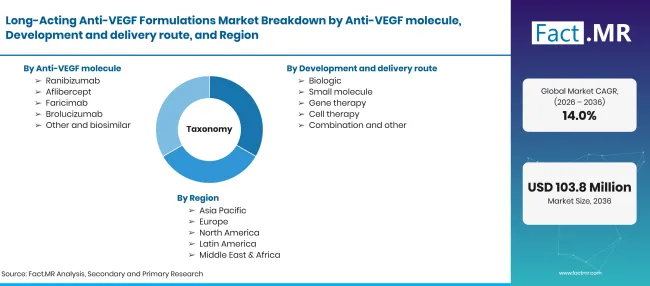
Long Acting Anti Vegf Formulations Taxonomy | Source: Fact.MR
| Items | Values |
|---|---|
| Quantitative Units (2026) | USD 28.0 Million |
| Anti-VEGF molecule | Aflibercept, Ranibizumab, Faricimab, Brolucizumab, Other / biosimilar |
| Development / delivery route | Small molecule, Biologic, Gene therapy, Cell therapy, Combination / other |
| Care setting | Hospital inpatient, Specialist outpatient, Ambulatory center, Home-supported care, Research / clinical trial |
| Patient population | Pediatric, Adult, Older adult, Mixed age, Rare genotype-defined |
| Regions Covered | North America, Latin America, Europe, East Asia, South Asia and Pacific, Middle East & Africa |
| Countries Covered | United States, China, France, Germany, Japan, and other countries |
| Key Companies Profiled | Roche, Regeneron, Bayer, Novartis, AbbVie, Ocular Therapeutix |
| Additional Attributes | Dollar revenue in the Long-Acting Anti-VEGF Formulations Market is segmented by anti-vegf molecule (aflibercept, ranibizumab, faricimab, brolucizumab, other / biosimilar); development / delivery route (small molecule, biologic, gene therapy, cell therapy, combination / other); care setting (hospital inpatient, specialist outpatient, ambulatory center, home-supported care, research / clinical trial); patient population (pediatric, adult, older adult, mixed age, rare genotype-defined) and region. |
Source: Fact.MR analysis. Updated Nov 19, 2026
Source: Fact.MR analysis.
Frequently Asked Questions
How big is the global Long-Acting Anti-VEGF Formulations Market in 2026?
What will be the size of the Long-Acting Anti-VEGF Formulations Market by 2036?
How fast will the Long-Acting Anti-VEGF Formulations Market grow during the forecast period?
Which anti-vegf molecule segment holds the largest share of the Long-Acting Anti-VEGF Formulations Market?
Who worked on this report


Preview the report firsthand - request a free sample
Free SampleGet the brochure for pricing and purchase details
Download PDF