- Market Value (2025): USD 39.6 Mn
- Estimated Value (2026): USD 45.0 Mn
- Forecast Value (2036): USD 161.1 Mn
- CAGR (2026-2036): 13.6%
Orphan Drug Delivery Platforms Market Forecast and Outlook 2026 to 2036
The orphan drug delivery platforms market is projected to grow from USD 45.0 million in 2026 to USD 161.1 million by 2036. Demand for orphan drug delivery platforms is likely to grow at a CAGR of 13.6% over the forecast period.
Demand for orphan drug delivery platforms is tied to how therapies for rare diseases increasingly rely on lipid nanoparticles, viral vectors, polymer particles, depots and targeted conjugates to get genetic medicines and enzymes into the right cells. Delivery is often the hardest part of making these drugs work. For example, Alnylam's patisiran (Onpattro), approved in 2018, was the first RNA interference drug and used a lipid nanoparticle to reach the liver. Developers will evaluate where the therapeutic material travels, how it is administered and the evidence needed to monitor safety.
Market Snapshot: Orphan Drug Delivery Platforms Market
- Sales of orphan drug delivery platforms stood at USD 39.6 million in 2025
- Orphan Drug Delivery Platforms Market Value (2026): USD 45.0 million
- Orphan Drug Delivery Platforms Market Forecast Value (2036): USD 161.1 million
- Orphan Drug Delivery Platforms Market Forecast CAGR (2026-2036): 13.6%
- Leading Orphan drug delivery: Lipid nanoparticle (29.8%)
- Key Market Participants: Sarepta Therapeutics, Ultragenyx, Sanofi, PTC Therapeutics
- Key Growth Regions: United States, China, Switzerland, Germany, Japan
On July 18, 2025, the US FDA requested that Sarepta Therapeutics suspend Elevidys distribution amid reports of fatal liver injury linked to AAVrh74 gene therapies. On July 28, the FDA recommended lifting the voluntary hold for ambulatory patients. In November 2025, the agency approved a boxed warning and restricted the Elevidys indication to ambulatory patients aged four years and older with Duchenne muscular dystrophy. Demand for orphan drug delivery platforms is shifting toward safer and more targeted delivery methods. Suppliers such as Ultragenyx are investing in alternative vectors, nanoparticles and conjugates. Developers will evaluate where the therapeutic material travels, how it is administered and the evidence needed to monitor safety.
Orphan Drug Delivery Platforms Market
| Metric | Value |
|---|---|
| Estimated Value in (2026) | USD 45.0 million |
| Forecast Value in (2036) | USD 161.1 million |
| Forecast CAGR (2026 to 2036) | 13.6% |
Source: Fact.MR analysis. Updated Nov 19, 2026
Source: Fact.MR analysis.
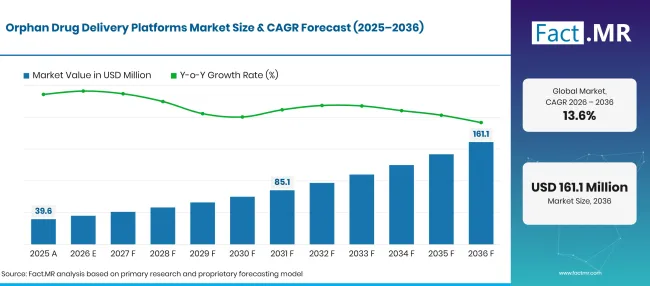
Orphan Drug Delivery Platforms Forecast Global | Source: Fact.MR
Category
| Category | Segments |
|---|---|
| Orphan drug delivery | Lipid nanoparticle, AAV vector, Polymer nanoparticle, Implant / depot, Targeted conjugate |
| Development / delivery route | Small molecule, Biologic, Gene therapy, Cell therapy, Combination / other |
| Care setting | Hospital inpatient, Specialist outpatient, Ambulatory center, Home-supported care, Research / clinical trial |
| Patient population | Pediatric, Adult, Older adult, Mixed age, Rare genotype-defined |
| Region | United States; China; Switzerland; Germany; Japan |
Source: Fact.MR analysis. Updated Nov 19, 2026
Source: Fact.MR analysis.
Segmental Analysis
Why do lipid nanoparticles lead delivery-platform demand in the Orphan Drug Delivery Platforms Market?
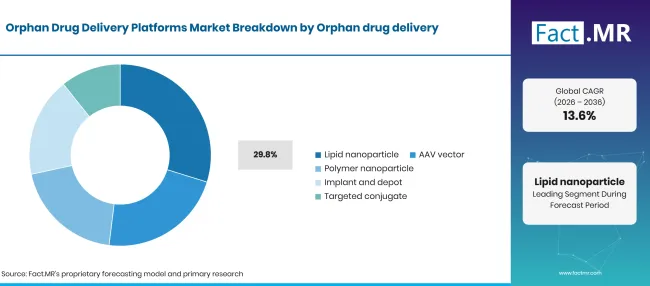
Orphan Drug Delivery Platforms Breakdown Orphan Drug Delivery | Source: Fact.MR
Lipid nanoparticles account for 29.8% of revenue in 2026, approximately USD 13.4 million, supported by their ability to deliver RNA and gene-editing payloads to targeted tissues. Their potential for repeated administration offers advantages over certain viral vectors. Implants, depots and AAV vectors provide alternative delivery approaches. Manufacturers are developing specialized lipid formulations to improve tissue targeting, delivery efficiency and treatment consistency.
Why does cell therapy lead development-route demand in the Orphan Drug Delivery Platforms Market?
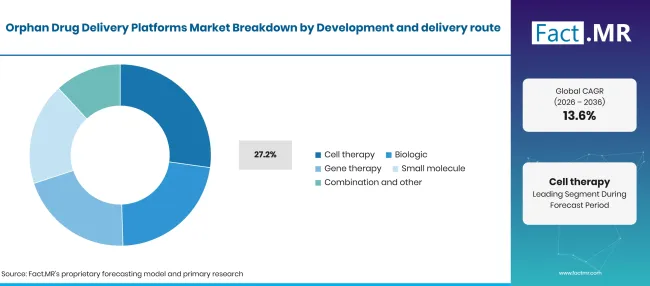
Orphan Drug Delivery Platforms Breakdown Development And Delivery Route | Source: Fact.MR
Cell therapy represents 27.2% of revenue in 2026, valued at approximately USD 12.2 million, reflecting the importance of engineered and gene-edited cells in rare disease treatment. Vertex and CRISPR Therapeutics' Casgevy demonstrates the clinical application of gene-edited cell therapies. Gene therapy provides another development route. Manufacturers are improving cell processing, delivery methods and production efficiency to support specialized treatments.
Why do specialist outpatients lead care-setting demand in the Orphan Drug Delivery Platforms Market?
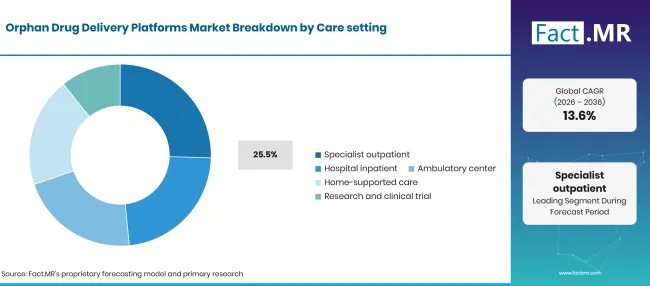
Orphan Drug Delivery Platforms Breakdown Care Setting | Source: Fact.MR
Specialist outpatient facilities hold 25.5% of revenue in 2026, equivalent to approximately USD 11.5 million, as rare disease treatments often require specialized clinical expertise and ongoing monitoring. These centers provide infusion services, treatment assessments and follow-up care for patients receiving advanced therapies. Hospital inpatient facilities serve more complex cases. Suppliers are developing delivery platforms that support clinical workflows and treatment administration.
Why does the pediatric population lead patient demand in the Orphan Drug Delivery Platforms Market?
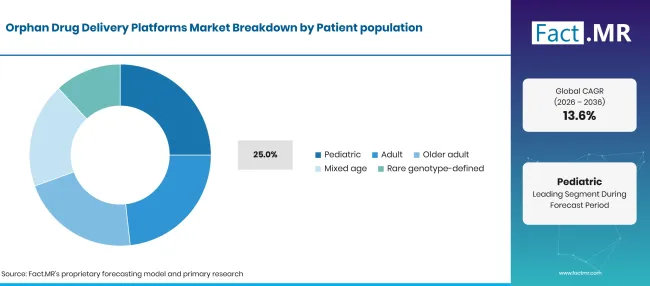
Orphan Drug Delivery Platforms Breakdown Patient Population | Source: Fact.MR
The pediatric population accounts for 25.0% of revenue in 2026, approximately USD 11.2 million, as many rare genetic disorders become apparent during childhood and require specialized treatment approaches. Early diagnosis creates opportunities for targeted therapies addressing inherited conditions. Adult patients represent another important treatment group. Manufacturers are developing delivery systems that accommodate pediatric dosing requirements, safety considerations and long-term treatment monitoring.
Orphan Drug Delivery Platforms Market-Drivers, Restraints & Trends
Drivers:
Demand for orphan drug delivery platforms is increasing as regulatory incentives in the United States, EU and Japan encourage rare disease treatment development. Advances in genetic diagnosis are helping identify eligible patients. Pharmaceutical companies are forming delivery technology partnerships to support targeted therapies and specialized drug administration.
Restraints:
High development costs, complex manufacturing processes and safety concerns associated with certain viral vectors restrict commercial expansion. Drug developers must assess tissue targeting, administration methods and potential immune responses. Suppliers are improving delivery efficiency and manufacturing consistency while developing safety monitoring approaches for advanced genetic therapies.
Trend: Non-Viral Gene Delivery:
Interest in non-viral delivery technologies is growing as pharmaceutical developers explore lipid nanoparticles and polymer-based carriers for genetic medicines. These platforms offer opportunities for targeted delivery without using viral vectors. Manufacturers are refining nanoparticle formulations to improve tissue distribution, payload protection and delivery efficiency.
Trend: In Vivo Gene Editing:
Pharmaceutical companies are investigating technologies that deliver gene-editing components directly into patients to address inherited disorders. Lipid nanoparticles are being studied as carriers for gene-editing payloads. Developers are concentrating on tissue targeting, controlled delivery and safety monitoring to support clinical development of rare disease treatments.
Orphan Drug Delivery Platforms Market by Analysis by Key Country
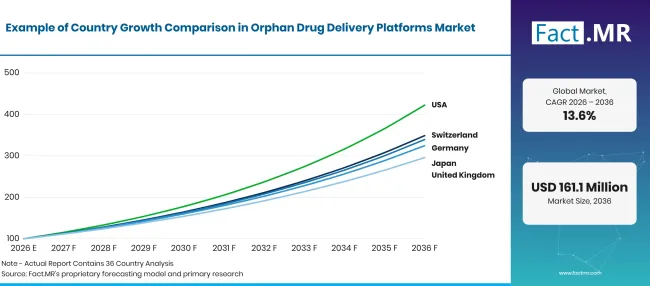
Orphan Drug Delivery Platforms Growth Index | Source: Fact.MR
| Country | CAGR (2026-2036) |
|---|---|
| United States | 15.5% |
| China | 15.2% |
| Switzerland | 13.2% |
| Germany | 13.0% |
| Japan | 12.5% |
Source: Fact.MR analysis. Updated Nov 19, 2026
Source: Fact.MR analysis.
Why is the United States the fastest-growing market for orphan drug delivery platforms?
Demand for orphan drug delivery platforms in the United States is forecast to increase at a 15.5% CAGR through 2036, the fastest among the five countries.
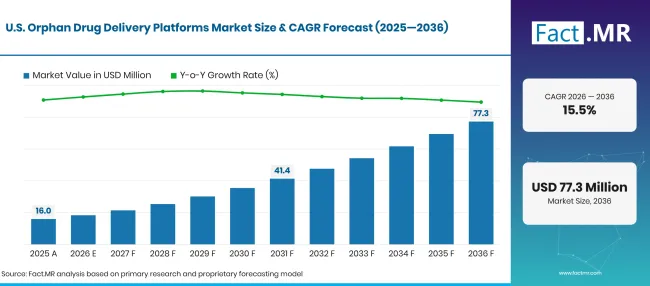
Orphan Drug Delivery Platforms Forecast Usa | Source: Fact.MR
The Orphan Drug Act provides incentives for developing treatments targeting rare conditions, while FDA approvals of gene and cell therapies support commercial opportunities. Pharmaceutical developers are investing in delivery technologies for genetic medicines and specialized treatments. Research institutions and biotechnology companies are examining targeted delivery approaches. Future adoption will depend on clinical outcomes, manufacturing scalability, regulatory requirements and reimbursement arrangements for advanced therapies.
What is driving orphan drug delivery platform demand in China?
Sales of orphan drug delivery platforms in China are set to rise at a 15.2% CAGR through 2036, supported by government attention to rare diseases and improvements in regulatory review processes.
National rare-disease lists have helped identify conditions requiring specialized treatment development. The National Medical Products Administration provides priority review pathways for qualifying rare-disease medicines. Domestic biotechnology companies are exploring gene delivery technologies and targeted treatment platforms. Commercial expansion will reflect clinical research progress, manufacturing capabilities, regulatory approvals and access to specialized treatment facilities across the country.
What is shaping orphan drug delivery platform demand in Switzerland?
Demand for orphan drug delivery platforms in Switzerland is likely to advance at a 13.2% CAGR through 2036, supported by pharmaceutical research and established biotechnology capabilities.
Basel-based Novartis, developer of the gene therapy Zolgensma, and Roche maintain activities involving treatments for rare and complex diseases. Swiss research institutions are also contributing to advanced therapeutic development. Pharmaceutical companies are examining delivery approaches that improve tissue targeting and treatment administration. Further commercial opportunities will depend on clinical evidence, manufacturing reliability, regulatory authorization and partnerships with specialized healthcare providers.
What is shaping orphan drug delivery platform demand in Germany?
Demand for orphan drug delivery platforms in Germany is forecast to expand at a 13.0% CAGR through 2036 as university hospitals and specialized rare-disease centers adopt advanced treatment technologies.
Gene and cell therapies require clinical expertise, dedicated infrastructure and ongoing patient monitoring. Germany's AMNOG framework influences reimbursement through health technology assessment and subsequent price negotiations. Pharmaceutical manufacturers are working with specialist healthcare institutions to support treatment delivery. Wider adoption will reflect clinical effectiveness, manufacturing availability, reimbursement conditions and the capacity of treatment centers to administer complex therapies.
Why is orphan drug delivery platform growth slower in Japan?
Demand for orphan drug delivery platforms in Japan is expected to increase at a 12.5% CAGR through 2036, the slowest among the five countries.
Regulatory evaluation and pharmaceutical pricing procedures influence the commercialization of advanced genetic treatments. Japan's conditional approval framework for regenerative medical products provides a pathway for eligible therapies under specified requirements. Zolgensma has received reimbursement coverage, demonstrating access to specialized gene treatment. Manufacturers are exploring delivery platforms for inherited disorders. Market expansion will depend on regulatory clearance, treatment safety, reimbursement decisions and specialized healthcare infrastructure.
Competitive Market for Orphan Drug Delivery Platforms Market
Competition in the orphan drug delivery platforms market is concentrated among rare-disease drug developers. Sanofi competes on enzyme and gene therapies, while Sarepta Therapeutics, Ultragenyx and PTC Therapeutics compete on genetic medicines and delivery platforms. Buyers select platforms on safety, efficacy, manufacturability and cost.
From 2025 onward, competition shifted toward safer, non-viral and targeted delivery. An advantage may accrue to suppliers with redosable platforms as they seek to grow.
Recent Developments
- In September 2026, PTC Therapeutics completed its acquisition of Sangamo's ST-920 gene therapy program for Fabry disease, expanding its rare-disease pipeline with a one-time treatment designed to address the underlying enzyme deficiency.
- In July 2025, Sanofi completed its acquisition of Blueprint Medicines, adding Ayvakit and investigational elenestinib to its portfolio, expanding treatment options and research capabilities for systemic mastocytosis and other rare immunological diseases.
Key Players in Orphan Drug Delivery Platforms Market
Key companies operating in the market include Sarepta Therapeutics, Ultragenyx, Sanofi, and PTC Therapeutics.
- Sarepta Therapeutics
- Ultragenyx
- Sanofi
- PTC Therapeutics
Bibliography
- Department of Health and Social Care. (2025, February 28). England Rare Diseases Action Plan 2025. GOV.UK.
- European Medicines Agency. (2026). Annual activity report 2025.
- National Health Commission of the People’s Republic of China. (2025, July 10). [Notice on issuing 2025 diagnosis and treatment guidelines for 86 rare diseases].
- National Institutes of Health. (2025, May 15). Infant with rare, incurable disease is first to successfully receive personalized gene therapy treatment.
- PTC Therapeutics, Inc. (2026, September 21). PTC completes acquisition of ST-920 Fabry disease gene therapy.
- Sanofi. (2025, July 18). Sanofi completes acquisition of Blueprint Medicines.
- U.S. Food and Drug Administration. (2025, November 14). FDA approves new safety warning and revised indication that limits use for Elevidys following reports of fatal liver injury.
- U.S. Food and Drug Administration. (2026, March 26). FDA approves first gene therapy for severe Leukocyte Adhesion Deficiency Type I.
- U.S. Food and Drug Administration. (2026, April 23). FDA approves first-ever gene therapy for treatment of genetic hearing loss under National Priority Voucher Program.
- U.S. Food and Drug Administration. (2026, July 1). FDA approves first gene therapy for young children with sickle cell disease.
- U.S. Food and Drug Administration. (2026, September 17). FDA approves first gene therapy for pediatric patients with Sanfilippo syndrome type A.
- World Health Organization. (2025, May 24). First-ever rare diseases resolution underscores equity and inclusion.
Segmentation
Scope of Report
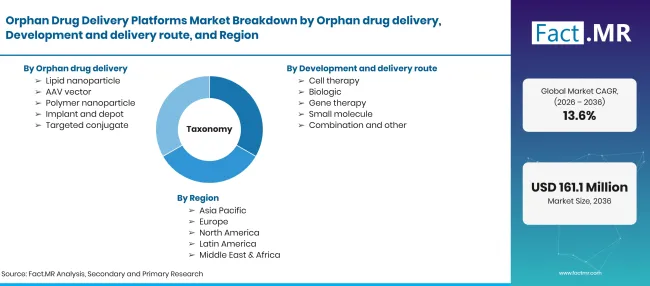
Orphan Drug Delivery Platforms Taxonomy | Source: Fact.MR
| Items | Values |
|---|---|
| Quantitative Units (2026) | USD 45.0 Million |
| Orphan drug delivery | Lipid nanoparticle, AAV vector, Polymer nanoparticle, Implant / depot, Targeted conjugate |
| Development / delivery route | Small molecule, Biologic, Gene therapy, Cell therapy, Combination / other |
| Care setting | Hospital inpatient, Specialist outpatient, Ambulatory center, Home-supported care, Research / clinical trial |
| Patient population | Pediatric, Adult, Older adult, Mixed age, Rare genotype-defined |
| Regions Covered | North America, Latin America, Europe, East Asia, South Asia and Pacific, Middle East & Africa |
| Countries Covered | United States, China, Switzerland, Germany, Japan, and other countries |
| Key Companies Profiled | Sarepta Therapeutics, Ultragenyx, Sanofi, PTC Therapeutics |
| Additional Attributes | Dollar revenue in the Orphan Drug Delivery Platforms Market is segmented by orphan drug delivery (lipid nanoparticle, AAV vector, polymer nanoparticle, implant / depot, targeted conjugate); development / delivery route (small molecule, biologic, gene therapy, cell therapy, combination / other); care setting (hospital inpatient, specialist outpatient, ambulatory center, home-supported care, research / clinical trial); patient population (pediatric, adult, older adult, mixed age, rare genotype-defined) and region. |
Source: Fact.MR analysis. Updated Nov 19, 2026
Source: Fact.MR analysis.
Orphan Drug Delivery Platforms Market by Segments
-
Orphan drug delivery
- Lipid nanoparticle
- AAV vector
- Polymer nanoparticle
- Implant / depot
- Targeted conjugate
-
Development / delivery route
- Small molecule
- Biologic
- Gene therapy
- Cell therapy
- Combination / other
-
Care setting
- Hospital inpatient
- Specialist outpatient
- Ambulatory center
- Home-supported care
- Research / clinical trial
-
Patient population
- Pediatric
- Adult
- Older adult
- Mixed age
- Rare genotype-defined
-
Region:
- North America
- United States
- Canada
- Mexico
- Europe
- Germany
- United Kingdom
- France
- Italy
- Spain
- Rest of Europe
- Asia Pacific
- China
- India
- Japan
- South Korea
- Australia
- Rest of Asia Pacific
- Latin America
- Brazil
- Mexico
- Argentina
- Rest of Latin America
- Middle East & Africa
- GCC Countries
- South Africa
- Rest of Middle East & Africa
- North America
Frequently Asked Questions
How big is the global Orphan Drug Delivery Platforms Market in 2026?
What will be the size of the Orphan Drug Delivery Platforms Market by 2036?
How fast will the Orphan Drug Delivery Platforms Market grow during the forecast period?
Which orphan drug delivery segment holds the largest share of the Orphan Drug Delivery Platforms Market?
Who worked on this report


Preview the report firsthand - request a free sample
Free SampleGet the brochure for pricing and purchase details
Download PDF