- Market Value (2025): USD 196.4 Mn
- Estimated Value (2026): USD 214.0 Mn
- Forecast Value (2036): USD 505.0 Mn
- CAGR (2026-2036): 9.0%
What is the Reactive Distillation Skids Market forecast to be worth by 2036?
USD 214.0 million in 2026 to USD 505.0 million by 2036 at 9.0% CAGR.
- The reactive distillation skids market surpassed a valuation of USD 196.4 million in 2025.
- Demand is projected to increase from USD 214.0 million in 2026 to USD 505.0 million by 2036.
- The market is forecast to record a 9.0% CAGR from 2026 to 2036, supported by compact process trains and catalyst-bearing column internals.
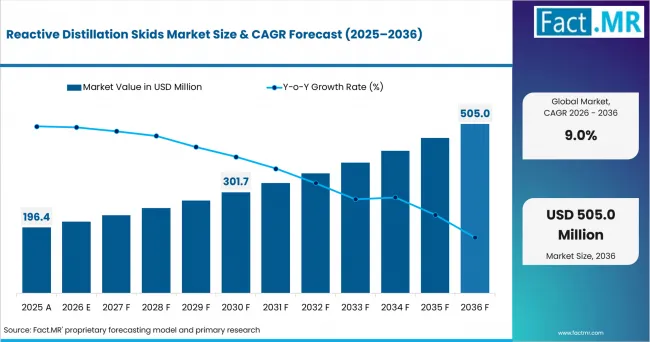
Reactive Distillation Skids Market Value Analysis | Source: Fact.MR
What are the defining numbers behind Reactive Distillation Skids Market growth?
USD 291.0 million absolute opportunity is expected by 2036. Structured catalytic packing and Esterification lead the early structure alongside Pilot skids, Ion-exchange resin and Bulk chemicals.
- Demand Drivers in the Market
- A reactive column removes one product while the reaction is still taking place. This can reduce the amount of material that has to be sent back through the process in ester and ether production.
- Pilot skids help companies see how the process performs outside the lab. They show how the catalyst wears over time, how much liquid stays inside the system, and how impurities in the feed affect results.
- Special packing holds the catalyst in one part of the column while vapor moves through it. This makes it easier to compare how well the reaction works against the pressure created inside the system.
- Biofuel and oleochemical projects are expected to support demand for these systems. They are useful where esterification or transesterification steps need compact equipment that can be installed as a complete unit.
- Key Segments Analyzed
- By Column Internal: Structured catalytic packing is expected to hold 33.0% share in 2026, supported by its use in catalyst pockets and predictable vapor-liquid contact.
- By Reaction Type: Esterification is projected to represent 30.0% share in 2026, owing to practical demand for water removal during equilibrium-limited reactions.
- By Capacity: Pilot skids are anticipated to capture 26.0% share in 2026 because scale-up proof is needed before producers approve a production column.
- By Catalyst System: Ion-exchange resin is estimated to represent 34.0% share in 2026, attributable to solid-acid use in esterification and etherification service.
- By End User: Bulk chemicals are forecast to hold 30.0% share in 2026, reflecting project economics where conversion gains affect large production volumes.
- Analyst Opinion at Fact.MR
- Shambhu Nath Jha, Senior Analyst at Fact.MR, states, “Reactive distillation skids earn trust only after they are tested with the company’s actual feed material. The main checks are how long the catalyst lasts and how much pressure builds inside the column. It is also important to see whether the pilot unit is built in a similar way to the full-size plant system.”
- Strategic Implications
- Companies selling these skids should use test results from the actual reaction when speaking with customers. General experience in separation work is not enough on its own.
- Catalyst companies and column makers should explain how parts are replaced and how the system is cleaned. They should also show what can reduce catalyst performance before the project receives final approval.
- Chemical producers should check the feed for unwanted materials at an early stage. Small amounts of water or metals can affect the catalyst, while heavy waste materials can make separation more difficult.
- Sales and service companies are expected to prefer equipment makers that provide column parts, spare items and on-site help through one project team.
Sulzer Chemtech's July 2025 alliance with Avalon Energy Group highlights the growing use of advanced process-intensification technologies in sustainable aviation fuel production, where compact modular processing can reduce plant footprint and improve process efficiency.
UAE is estimated to post a 9.7% CAGR through 2036 as downstream diversification supports packaged process equipment. USA is anticipated to advance at a 9.0% CAGR by 2036 due to specialty chemicals and refinery-adjacent catalyst expertise. Japan is forecast to record an 8.9% CAGR from 2026 to 2036 as producers remain selective about validated pilot data. UK is projected to post an 8.7% CAGR by 2036 through specialty chemical projects. Germany is estimated to record an 8.4% CAGR through 2036 as established chemical producers apply the technology where economics is clear.
How does the Reactive Distillation Skids Market break down by segment?
Structured catalytic packing is expected to lead Column Internal at 33.0% share in 2026. Esterification is projected to lead Reaction Type at 30.0% share in 2026.
Why does Structured Catalytic Packing Lead Column Internal?
Structured catalytic packing is estimated to hold 33.0% share in 2026.
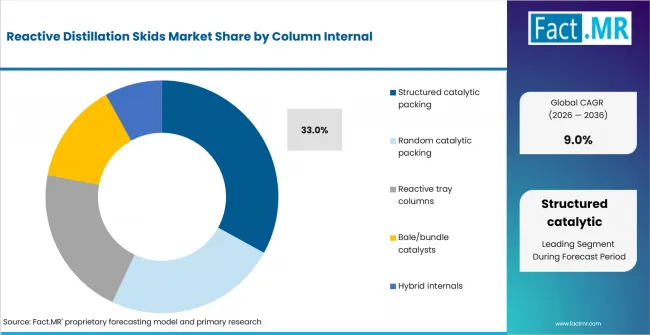
Reactive Distillation Skids Market Analysis By Column Internal | Source: Fact.MR
This design keeps the catalyst inside a fixed section of the column, where reaction and separation take place together. Sulzer offers Katapak for reactive distillation, while Koch-Glitsch includes KATAMAX packing in its reactor range. These established product lines make it easier for plant teams to move from pilot testing to a full commercial setup.
Why does Esterification lead Reaction Type?
Esterification is projected to represent 30.0% share in 2026.
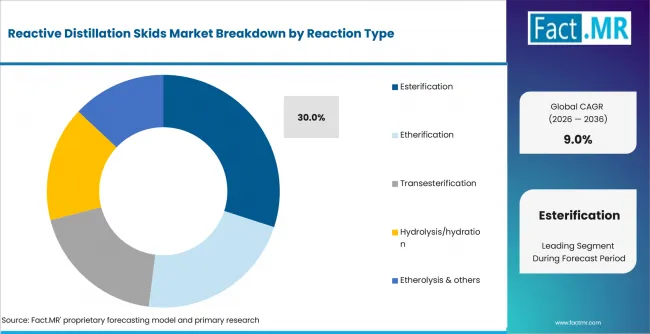
Reactive Distillation Skids Market Analysis By Reaction Type | Source: Fact.MR
Esterification works well in reactive distillation because removing water helps the reaction continue and improves output. The process is most effective when the acid catalyst can handle the column temperature and the final products separate without difficulty. This makes esterification easier to use than reactions that require very high temperatures or create several unwanted byproducts.
Why do Pilot Skids lead Capacity?
Pilot skids are anticipated to capture 26.0% share in 2026.
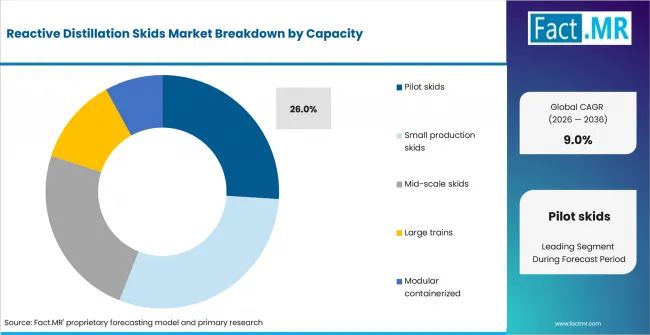
Reactive Distillation Skids Market Analysis By Capacity | Source: Fact.MR
Companies use pilot skids before placing full production orders. Tests with real feed material show whether the catalyst expands, whether deposits build up, and how vapor moves through the column. A smaller unit with similar internal parts also helps plant staff study heat use, processing time, and maintenance needs before moving to a larger system.
Why does Ion-Exchange Resin lead Catalyst System?
Ion-exchange resin is estimated to represent 34.0% share in 2026.
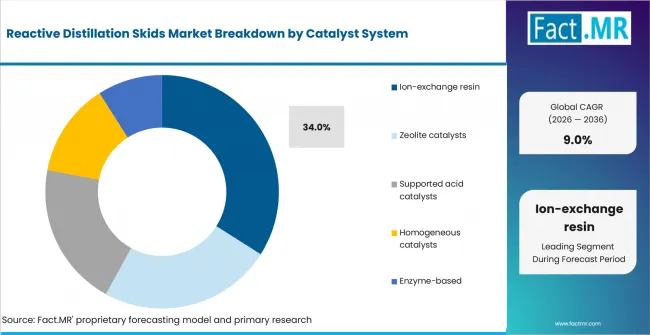
Reactive Distillation Skids Market Analysis By Catalyst System | Source: Fact.MR
Ion-exchange resin is widely used in acid-based reactions because it comes in solid form and is easier to remove and replace than liquid mineral acids. However, it does not suit every temperature range. The chosen resin must also work with the water level, alcohol feed, and cleaning or reuse plan. Its easy handling and fit with common reaction conditions support its leading share.
Why do Bulk Chemicals lead End User?
Bulk chemicals are forecast to hold 30.0% share in 2026.
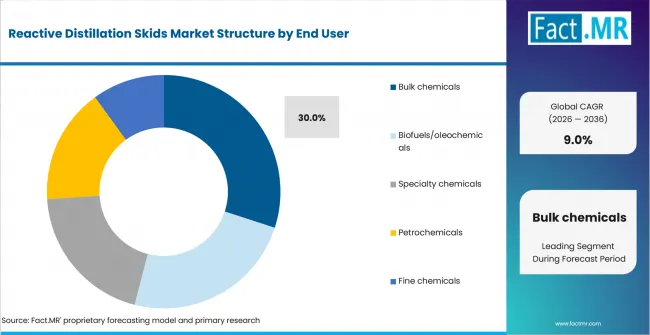
Reactive Distillation Skids Market Analysis By End User | Source: Fact.MR
Large chemical plants process enough material for small gains in output to create clear cost savings. These plants also follow careful approval steps before adding new equipment. Results from pilot skids and proven column parts therefore play an important role in final decisions. Reactive distillation is expected to gain the most interest where plant staff closely track recycled material, steam use, and product losses.
What is accelerating Reactive Distillation Skids Market adoption, and what is holding it back?
Process intensification is expected to support adoption, although chemistry fit and catalyst durability are anticipated to limit wider use.
Drivers Impact Analysis
| DRIVER | (~) % IMPACT ON CAGR | GEOGRAPHIC RELEVANCE | IMPACT TIMELINE |
|---|---|---|---|
| Reaction and separation in one column | +2.6% | USA; Germany | Short term (<= 2 years) |
| Pilot evidence before plant approval | +1.9% | USA; Japan; UK | Medium term (2-4 years) |
| Biofuel and oleochemical process trials | +1.4% | UAE; USA | Medium term (2-4 years) |
| Catalytic packing product availability | +1.1% | Germany; USA; UK | Long term (>= 4 years) |
Source: Fact.MR analysis. Updated Jul 22, 2026
- Reaction and separation in one column: The driver is strongest where the reaction product is removed during boiling and condensation. That mechanism is the reason ester and ether chemistries move first.
- Pilot evidence before plant approval: Plant teams rarely buy a reactive column from design theory alone. A pilot skid shows catalyst aging, pressure drop and impurity tolerance under live feed conditions.
- Biofuel and oleochemical process trials: Sustainable fuel and oleochemical projects are expected to test more compact process trains.
- Catalytic packing product availability: Katapak and KATAMAX reduce specification uncertainty. Engineers still need proof for each chemistry, but known packing families shorten the first vendor screen.
Opportunity Impact Analysis
| OPPORTUNITY | (~) % IMPACT ON CAGR | GEOGRAPHIC RELEVANCE | IMPACT TIMELINE |
|---|---|---|---|
| Retrofit modules for existing distillation assets | +1.8% | Germany; UK | Short term (<= 2 years) |
| Containerized pilot packages | +1.5% | USA; Japan; UAE | Medium term (2-4 years) |
| Esterification service for bio-based feedstocks | +1.2% | USA; UAE | Medium term (2-4 years) |
| Digital monitoring around catalyst replacement | +0.9% | Germany; Japan; USA | Long term (>= 4 years) |
Source: Fact.MR analysis. Updated Jul 22, 2026
- Retrofit modules for existing distillation assets: Older chemical plants are expected to test compact internals before they replace full separation trains.
- Containerized pilot packages: Containerized systems reduce the time between laboratory screening and plant decision. They also make test campaigns easier for sites that lack permanent pilot halls.
- Esterification service for bio-based feedstocks: Bio-based feedstocks carry more variability than standard petrochemical feeds. That variability is expected to make skid testing useful before producers lock a catalyst package.
- Digital monitoring around catalyst replacement: The next service layer is expected to come from better tracking of pressure drop and catalyst life. Service teams that link pressure-drop history with replacement planning have a clearer reason to stay involved after installation.
Restraints Impact Analysis
| RESTRAINT | (~) % IMPACT ON CAGR | GEOGRAPHIC RELEVANCE | IMPACT TIMELINE |
|---|---|---|---|
| Narrow chemistry window | -1.7% | All regions | Short term (<= 2 years) |
| Catalyst deactivation risk | -1.3% | USA; Japan | Medium term (2-4 years) |
| Modeling and control complexity | -1.0% | Germany; UK; USA | Medium term (2-4 years) |
| Small installed reference base for some reactions | -0.8% | UAE; Japan; UK | Long term (>= 4 years) |
Source: Fact.MR analysis. Updated Jul 22, 2026
- Narrow chemistry window: Reactive distillation is practical only when reaction rate, boiling points and catalyst temperature limits line up. Projects stop early when that fit is weak.
- Catalyst deactivation risk: Feed impurities and heavy byproducts shorten catalyst life in some systems. A buyer then compares the skid against simpler reactors with more predictable maintenance.
- Modeling and control complexity: Reaction and separation disturb each other inside the same column. That makes control design more sensitive than a conventional reactor followed by a tower.
- Small installed reference base for some reactions: Some chemistries lack public reference data at commercial scale. In those cases, plant managers ask for longer pilots and stronger performance guarantees.
Which countries are scaling Reactive Distillation Skids Market fastest?
The global growth rate is based on the combined performance of all countries covered in the study. For this reason, it does not have to match the rate of each country shown in the comparison. UAE is growing faster than the global average. The USA, Japan, the United Kingdom and Germany are closer to or below it. These six countries are included as examples to show how national growth can differ from the worldwide rate.
- UAE forms the fastest-growing group. Growth in the UAE comes more from new downstream projects and demand for complete plant units that are easier to install.
- The USA and Japan sit close together in the middle. Growth in the USA is supported by specialty chemical production and strong experience with catalyst-based processes. Japan places more focus on proven column parts, clear maintenance records and steady operating performance.
- The United Kingdom and Germany are moving at a slower pace. In both countries, companies are more careful about upgrade costs and new spending approvals.
- Countries with similar growth rates can still follow very different paths. The main differences come from pilot testing needs, energy-saving goals and the amount of technical help required before full installation.
The full report reviews these conditions across all countries covered in the study. It provides country-level CAGR analysis across North America, Latin America, Europe, East Asia, South Asia, Oceania and the Middle East and Africa.
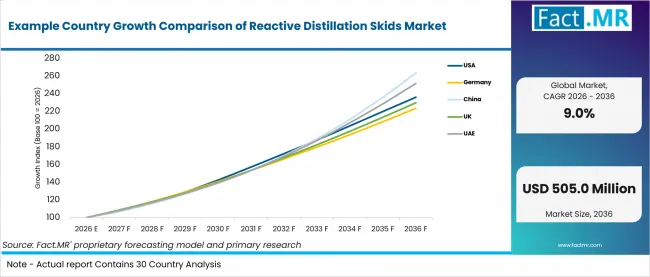
Example Country Growth Comparison Of Reactive Distillation Skids Market | Source: Fact.MR
| COUNTRY | CAGR |
|---|---|
| UAE | 9.7% |
| USA | 9.0% |
| Japan | 8.9% |
| United Kingdom | 8.7% |
| Germany | 8.4% |
Source: Fact.MR analysis. Updated Jul 22, 2026
What gives the UAE a clear route to adoption?
9.7% CAGR, linked to downstream diversification and modular project delivery.
UAE projects often place value on compact equipment that arrives with internals, controls and commissioning support already coordinated. Reactive distillation fits this model when plot space is limited and the chemistry offers a clear separation advantage. Demand is therefore expected to center on selected downstream projects rather than broad replacement of conventional columns.
Where does the USA opportunity come from?
9.0% CAGR, driven by specialty chemicals and pilot-led capital approval.
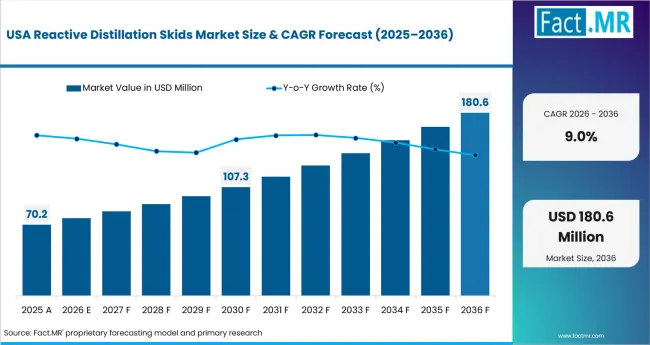
Reactive Distillation Skids Market Country Value Analysis | Source: Fact.MR
USA specialty chemical plants are well suited to trials built around a specific feed and product campaign. Project approval usually depends on showing a repeatable gain in conversion or solvent recovery under real operating conditions. Catalyst behavior and control stability are likely to decide whether pilot results move into commercial equipment.
Why does Japan take a selective approach?
8.9% CAGR, shaped by product-purity requirements and detailed equipment qualification.
Japanese producers tend to review temperature range, pressure control and catalyst life before accepting a new process arrangement. Reactive distillation vendors therefore need more than a broad energy-saving claim. Clear shutdown procedures, proven internals and maintenance evidence are expected to carry greater weight during approval.
How is the United Kingdom building demand?
8.7% CAGR, supported by specialty manufacturing and focused retrofit projects.
United Kingdom demand is expected to come from smaller chemical plants where one high-value process step affects yield and margin. A compact skid can improve solvent recovery or conversion without forcing a full site redesign. This creates a practical route for adoption in niche products and contract manufacturing.
What shapes Germany’s market outlook?
8.4% CAGR, tied to energy savings and strict industrial validation.
German chemical sites are likely to approve reactive distillation only after the project shows lower steam use and stable product quality. Established column systems create a high evidence bar for replacement. Suppliers with dependable service support and strong pilot records are therefore better placed to convert interest into orders.
Who leads the Reactive Distillation Skids Market?
Sulzer Chemtech and Koch-Glitsch have the strongest position in reactive distillation column parts. Montz (Koch Engineered Solutions) and Pfaudler also hold an important place through their experience in packed columns and liquid separation systems.
Sulzer Chemtech offers Katapak catalytic packing along with column upgrades, extraction systems and modular process equipment. Koch-Glitsch provides KATAMAX catalytic packing and a wider range of tower parts used in separation work. Montz (Koch Engineered Solutions) brings long experience in column design and catalytic packing for processes that combine reaction and separation. De Dietrich Process Systems also supports the market through catalyst work, process rights and separation systems.
Through 2036, companies are expected to compare how well the catalyst works with the feed and how much pressure builds inside the column. They will also look for proof that the reaction and separation steps can run steadily in one unit. Pilot testing, column design and service after installation are also expected to influence the final choice.
Which companies are the key providers?
Key companies include Sulzer Chemtech; Koch-Glitsch; Montz (Koch Engineered Solutions); Pfaudler; De Dietrich Process Systems.
- Sulzer Chemtech
- Koch-Glitsch
- Montz (Koch Engineered Solutions)
- Pfaudler
- De Dietrich Process Systems
Bibliography
- Federal Reserve Board. (2026, May 15). Industrial production and capacity utilization - G.17. Federal Reserve Board.
- German Federal Statistical Office. (2026, February 6). Production in December 2025: -1.9% on the previous month. Destatis.
- Sulzer. (2025, June 20). Sulzer launches OptimEXT™ – an integrated liquid-liquid extraction solution. Sulzer.
- Sulzer. (2025, July 7). Sulzer and Avalon Energy Group form strategic alliance to advance global production of sustainable aviation fuel.
This Report Addresses
- The report provides strategic intelligence on Reactive Distillation Skids Market across Column Internal and Reaction Type choices that shape purchasing decisions.
- Segment analysis covers Structured catalytic packing as the share leader within the 2026 market structure.
- Regional outlook evaluates. UAE alongside USA, Japan, UK and Germany complete the growth comparison.
- Competitive analysis profiles Sulzer Chemtech and Koch-Glitsch alongside Montz (Koch Engineered Solutions). Pfaudler and De Dietrich Process Systems complete the provider set.
- Use-case assessment covers esterification, pilot skids and catalyst-system decisions across the forecast period.
What does the Reactive Distillation Skids Market cover?
Packaged process systems that combine a chemical reaction and distillation inside one engineered column.
The Reactive Distillation Skids Market covers modular systems used for esterification, etherification, transesterification and other compatible reaction-separation duties. Coverage includes the column body, structured or random catalytic packing, reactive trays and catalyst bundles. Feed systems, reflux equipment, condensers, reboilers, circulation hardware, instruments and controls are included when sold with the skid or modular train.
The market differs from conventional distillation equipment since commercial value comes from carrying out reaction and separation in the same column. The process removes a product while the reaction continues, which can reduce recycle demand and improve conversion for suitable chemistries. Conventional towers and standalone reactors remain outside the boundary when they operate as separate units.
What is included in the scope?
Skid-mounted and packaged reactive distillation systems used across bulk chemicals, specialty chemicals, petrochemicals, biofuels and oleochemicals are included.
The scope covers Column Internal and Reaction Type alongside Capacity, Catalyst System and End User. Structured catalytic packing, random catalytic packing, reactive tray columns, catalyst bundles and hybrid internals are included. Capacity coverage extends from pilot skids and small production units to mid-scale systems, large trains and containerized packages. Ion-exchange resin, zeolite, supported acid, homogeneous and enzyme-based catalyst systems follow the same packaged-system rule.
What is excluded from the scope?
Conventional separation equipment and reaction systems sold outside an integrated reactive distillation package remain outside the market.
The scope excludes standalone reactors, conventional distillation columns and catalyst-only sales. General EPC work is also excluded when the reactive distillation skid cannot be identified as a separate equipment package. Complete chemical plants and unrelated process equipment are not counted within the market value.
How Was the Analysis Built?
The analysis draws on 120+ sources, 35+ company portfolios, 25+ countries, and more than 20 industry interviews.
- Primary Research: Primary research includes discussions with manufacturers, service providers, technology developers, distributors, end users, procurement teams, and subject-matter experts. These conversations examine purchasing priorities, product adoption, operational challenges, approval requirements, competitive positioning, and the factors that influence wider market acceptance.
- Desk Research: Desk research covers government statistics, regulatory publications, company filings, trade data, technical studies, industry associations, standards, public policy, and other authoritative sources. Every source used in the analysis is documented in the bibliography.
- Market Sizing and Forecasting: Market estimates combine historical performance, demand indicators, pricing and volume trends, segment shares, company participation, country-level growth, adoption patterns, investment activity, and barriers to market expansion.
- Data Validation and Update Cycle: Findings are validated by comparing primary interviews with public data, company activity, regulatory changes, trade patterns, and industry developments. Regular updates review new product launches, capacity changes, partnerships, approvals, procurement trends, and shifts in commercial adoption.
Segmentation
What is the report's scope and coverage?
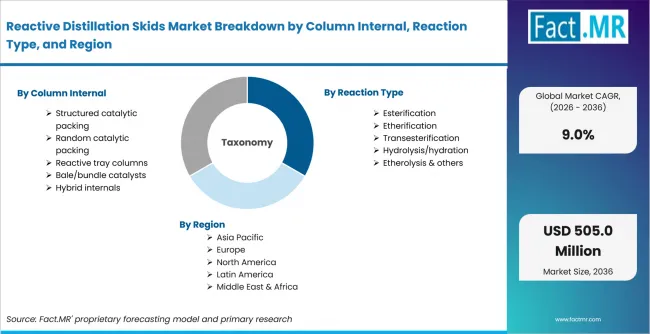
Reactive Distillation Skids Market Breakdown By Column Internal, Reaction Type, And Region | Source: Fact.MR
| Attribute | Details |
|---|---|
| Quantitative Units | USD Million in 2026 to USD Million by 2036 at CAGR |
| Market Definition | Reactive distillation collapses two process steps into one column: a chemical reaction happens on catalyst-bearing packing or trays at the same time vapor and liquid are separating above and below it. |
| Column Internal | Structured catalytic packing; Random catalytic packing; Reactive tray columns; Bale/bundle catalysts; Hybrid internals |
| Reaction Type | Esterification; Etherification; Transesterification; Hydrolysis/hydration; Etherolysis & others |
| Capacity | Pilot skids; Small production skids; Mid-scale skids; Large trains; Modular containerized |
| Catalyst System | Ion-exchange resin; Zeolite catalysts; Supported acid catalysts; Homogeneous catalysts; Enzyme-based |
| End User | Bulk chemicals; Biofuels/oleochemicals; Specialty chemicals; Petrochemicals; Fine chemicals |
| Regions Covered | North America; Latin America; Europe; East Asia; South Asia & Oceania; Middle East & Africa |
| Countries Covered | USA; Canada; Brazil; Mexico; Germany; U.K.; France; Italy; Spain; South Korea; Japan; Australia & New Zealand; GCC Countries; South Africa; UAE |
| Key Companies Profiled | Sulzer Chemtech; Koch-Glitsch; Montz (Koch Engineered Solutions); Pfaudler; De Dietrich Process Systems |
| Forecast Period | 2026 to 2036 |
| Approach | Hybrid top-down and bottom-up approach using demand indicators across Column Internal, Reaction Type, Capacity, Catalyst System, End User; country-level growth; company participation and outsourcing or adoption trends |
Source: Fact.MR analysis. Updated Jul 22, 2026
How is the market segmented?
-
By Column Internal:
- Structured catalytic packing
- Random catalytic packing
- Reactive tray columns
- Bale/bundle catalysts
- Hybrid internals
-
By Reaction Type:
- Esterification
- Etherification
- Transesterification
- Hydrolysis/hydration
- Etherolysis & others
-
By Capacity:
- Pilot skids
- Small production skids
- Mid-scale skids
- Large trains
- Modular containerized
-
By Catalyst System:
- Ion-exchange resin
- Zeolite catalysts
- Supported acid catalysts
- Homogeneous catalysts
- Enzyme-based
-
By End User:
- Bulk chemicals
- Biofuels/oleochemicals
- Specialty chemicals
- Petrochemicals
- Fine chemicals
-
By Region:
- North America
- USA
- Canada
- Latin America
- Brazil
- Mexico
- Rest of Latin America
- Europe
- Germany
- U.K.
- France
- Italy
- Spain
- Rest of Europe
- East Asia
- South Korea
- Japan
- South Asia & Oceania
- India
- Australia & New Zealand
- Rest of South Asia & Oceania
- Middle East & Africa
- GCC Countries
- South Africa
- UAE
- Rest of Middle East & Africa
- North America
Frequently Asked Questions
Which Column Internal leads the Reactive Distillation Skids Market?
Which Reaction Type leads the Reactive Distillation Skids Market?
Which Capacity leads the Reactive Distillation Skids Market?
Which Catalyst System leads the Reactive Distillation Skids Market?
Which End User leads the Reactive Distillation Skids Market?
How does UAE perform in the Reactive Distillation Skids Market?
How does USA perform in the Reactive Distillation Skids Market?
What is the primary driver in the Reactive Distillation Skids Market?
What is the main restraint in the Reactive Distillation Skids Market?
Who worked on this report


Preview the report firsthand - request a free sample
Free SampleGet the brochure for pricing and purchase details
Download PDF