
- Market Value (2025): USD 64.6 Mn
- Estimated Value (2026): USD 70.0 Mn
- Forecast Value (2036): USD 156.8 Mn
- CAGR (2026-2036): 8.4%
High-Leucine Medical Protein Isolates Market Forecast and Outlook 2026 to 2036
According to the Fact.MR analysis, the high-leucine medical protein isolates market surpassed a value of USD 64.6 million in 2025 and is projected to grow from USD 70.0 million in 2026 to USD 156.8 million by 2036. Demand for high-leucine medical protein isolates is likely to grow at a CAGR of 8.4% over the forecast period.
Demand for high-leucine medical protein isolates is rising as clinicians treat age-related muscle loss, frailty and recovery after surgery or illness with nutrition, and leucine is the amino acid that most strongly switches on muscle protein building, which matters in older people whose muscles respond less to ordinary protein. Suppliers of high-leucine medical protein isolates are offering whey and milk protein isolates naturally rich in leucine, leucine-fortified isolates, hydrolyzed grades and enriched plant isolates for medical nutrition. For example, in May 2026, FrieslandCampina announced an investment programme of more than EUR 90 million in high-value whey proteins. Similar investment is projected to drive sales of high-leucine medical protein isolates.
Key Takeaways from the High-Leucine Medical Protein Isolates Market
- High-Leucine Medical Protein Isolates Market Value (2025): USD 64.6 million
- High-Leucine Medical Protein Isolates Market Value (2026): USD 70.0 million
- High-Leucine Medical Protein Isolates Market Forecast Value (2036): USD 156.8 million
- High-Leucine Medical Protein Isolates Market Forecast CAGR (2026-2036): 8.4%
- Leading Product Type: Milk protein leucine-rich isolate (28.3%)
- Key Market Participants: Arla Foods Ingredients, FrieslandCampina Ingredients, Fonterra, Lactalis Ingredients, Glanbia Nutritionals, Hilmar Ingredients
- Key Growth Regions: Netherlands, United States, France, Switzerland, United Kingdom
In September 2026, Japan's internal affairs ministry reported that 36.24 million people, a record 29.6% of the population, were aged 65 or over. Demand for high-leucine medical protein isolates is growing as aging populations make sarcopenia a mainstream health concern and medical nutrition companies design products around muscle. Suppliers of high-leucine medical protein isolates are supplying low-volume, high-protein formats that older adults can finish. Similar demographics are projected to drive sales of high-leucine medical protein isolates across Europe, the United States and Japan.
High-Leucine Medical Protein Isolates Market
| Metric | Value |
|---|---|
| Estimated Value in (2026) | USD 70.0 million |
| Forecast Value in (2036) | USD 156.8 million |
| Forecast CAGR (2026 to 2036) | 8.4% |
Source: Fact.MR analysis.
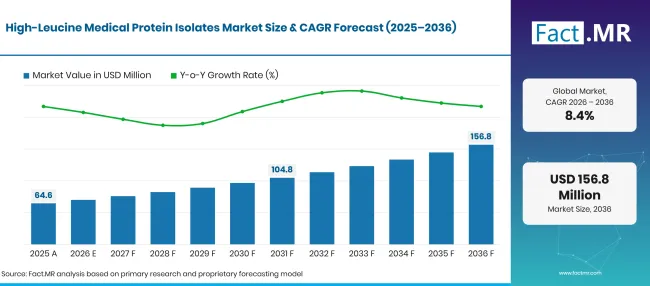
High Leucine Medical Protein Isolates Forecast Global 1 | Source: Fact.MR
Category
| Category | Segments |
|---|---|
| Product Type | Milk protein leucine-rich isolate, Hydrolyzed leucine-rich isolate, Fortified medical isolate, Plant enriched leucine isolate, Whey leucine-rich isolate |
| Product Form | Granule and agglomerate, Encapsulated, Custom premix, Liquid concentrate, Dry powder |
| Application | Oral nutritional supplements, Post-surgical recovery, Active aging nutrition, Enteral tube feeding, Sarcopenia management |
| Buyer Type | Pharmacies, Contract manufacturers, Hospitals, Sports nutrition brands, Medical nutrition brands |
| Region | Netherlands; United States; France; Switzerland; United Kingdom |
Source: Fact.MR analysis.
Segmental Analysis
Why do milk protein leucine-rich isolates lead product demand in the High-Leucine Medical Protein Isolates Market?
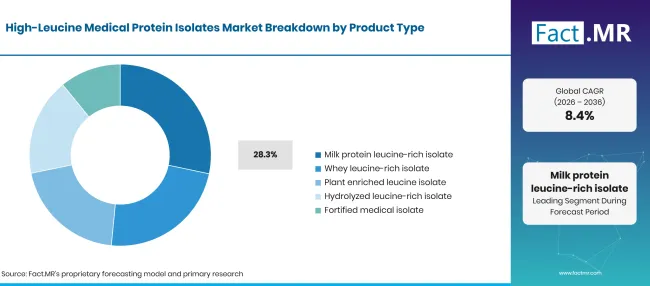
High Leucine Medical Protein Isolates Breakdown Product Type | Source: Fact.MR
Milk protein leucine-rich isolates account for 28.3% of the high-leucine medical protein isolates market in 2026, about USD 19.8 million, because isolates that keep both whey and casein give a fast and a sustained amino acid supply, are heat stable enough for ready-to-drink medical products and can be standardized or enriched to a high leucine content. They also cost less than pure whey isolate at current prices. Suppliers of high-leucine medical protein isolates are tailoring whey-to-casein ratios. Similar processing benefits are projected to keep milk protein isolates the leading product type.
How are granules and agglomerates leading form demand in the High-Leucine Medical Protein Isolates Market?
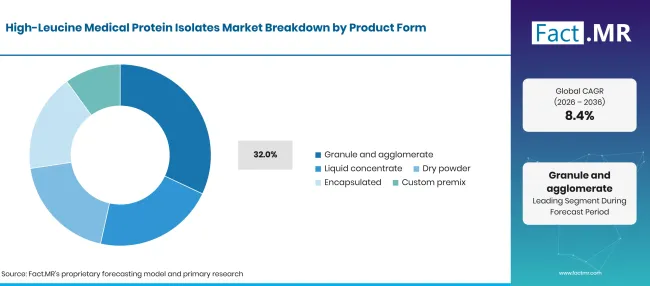
High Leucine Medical Protein Isolates Breakdown Product Form | Source: Fact.MR
Granule and agglomerate formats to represent 32.0% of high-leucine medical protein isolates revenue in 2026, about USD 22.4 million, because agglomerated protein wets and disperses quickly without lumps when patients or carers stir it into drinks or soft food, and it also flows well in factory blending. Free leucine is hard to wet, so instantizing matters. Suppliers of high-leucine medical protein isolates are improving dispersibility. Similar ease of use is projected to keep granules and agglomerates the leading product form.
Why do oral nutritional supplements lead application demand in the High-Leucine Medical Protein Isolates Market?
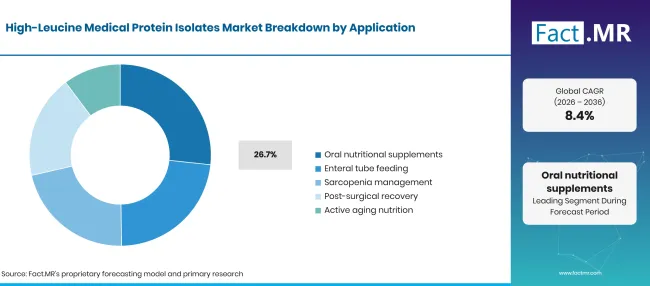
High Leucine Medical Protein Isolates Breakdown Application | Source: Fact.MR
Oral nutritional supplements hold 26.7% of high-leucine medical protein isolates revenue in 2026, about USD 18.7 million, as small-volume, high-protein sip feeds are the main way malnourished and frail patients receive extra protein in hospital and at home. Many are formulated with added leucine and vitamin D for muscle. Suppliers of high-leucine medical protein isolates are serving sip-feed manufacturers, as covered in the clinical nutrition market. Similar prescribing is projected to keep oral nutritional supplements the leading application.
Which factors make the pharmacies leading buyer demand in the High-Leucine Medical Protein Isolates Market?
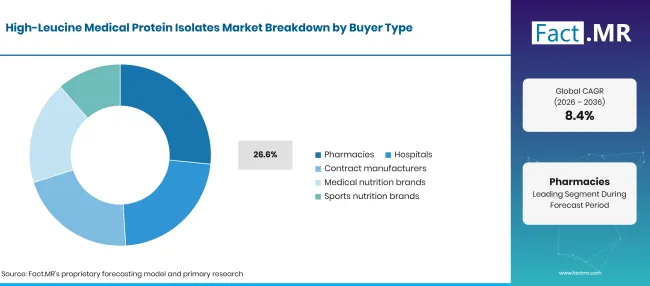
High Leucine Medical Protein Isolates Breakdown Buyer Type | Source: Fact.MR
Pharmacies segment to represent 26.6% of high-leucine medical protein isolates revenue in 2026, about USD 18.6 million, because medical protein products for muscle health are dispensed on prescription or recommended by pharmacists to older customers, and pharmacy brands market their own leucine-enriched powders. Advice at the counter builds trust. Suppliers of high-leucine medical protein isolates are supplying pharmacy brand owners. Similar dispensing routes are projected to keep pharmacies the leading buyer type.
High-Leucine Medical Protein Isolates Market-Drivers, Restraints & Trends
Drivers:
Demand for high-leucine medical protein isolates is rising as clinical consensus backs nutritional therapy. For example, a consensus report from the global clinical nutrition community, published in October 2026, set out indications for nutritional therapy and support, and Arla Foods Ingredients presented whey solutions for medical nutrition at Fi Europe in November 2026. Suppliers of high-leucine medical protein isolates are aligning products with such guidance. Similar clinical support is projected to drive sales of high-leucine medical protein isolates.
Restraints:
Demand for high-leucine medical protein isolates is constrained by very high whey protein costs and tight supply. For example, whey protein isolate reached a record of about USD 11 per pound in June 2026, and Glanbia reported that whey inflation raised its third-quarter 2026 pricing by about 26%. Similar costs are projected to strain medical nutrition budgets and reimbursement. Suppliers of high-leucine medical protein isolates must secure supply and consider blended sources.
Opportunity: Muscle Preservation During Weight Loss
Demand for leucine-rich protein is rising among people losing weight with medication, who risk losing muscle. Suppliers are developing compact protein products for this group. Glanbia said in August 2026 that weight-loss drugs were boosting protein demand. Similar use is projected to drive sales, alongside the high-leucine whey isolates market.
Trend: Plant and Hybrid Leucine-Enriched Proteins
In September 2026, a published study reported tolerance of tube feeds reformulated with plant-dominant protein blends. Demand for plant isolates fortified with leucine is rising in medical nutrition. Similar formulation work is projected to drive sales of high-leucine medical protein isolates. Suppliers of high-leucine medical protein isolates are also following the high-solubility protein isolates market.
High-Leucine Medical Protein Isolates Market by Analysis by Key Country
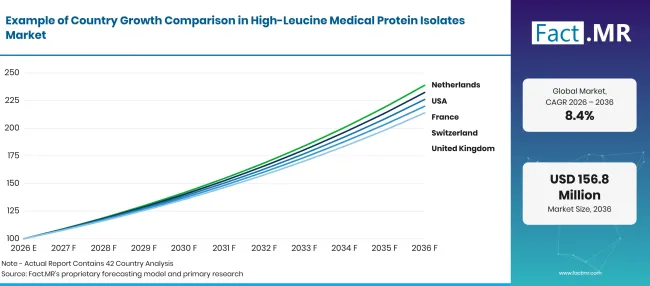
High Leucine Medical Protein Isolates Growth Index | Source: Fact.MR
| Country | CAGR (2026-2036) |
|---|---|
| Netherlands | 9.1% |
| United States | 8.8% |
| France | 8.5% |
| Switzerland | 8.2% |
| United Kingdom | 7.9% |
Source: Fact.MR analysis.
What is driving high-leucine medical protein isolates demand in the Netherlands?
In May 2026, FrieslandCampina said it would invest more than EUR 90 million to make more high-value whey proteins at Dutch sites including Bedum and Veghel.
Demand for high-leucine medical protein isolates in the Netherlands is projected to grow at a 9.1% CAGR, the fastest among the five key countries, as the country combines protein production with major medical nutrition research and manufacturing. Suppliers of high-leucine medical protein isolates are serving Dutch medical nutrition plants. Similar investment is projected to drive sales in the Netherlands.
How is protein demand supporting high-leucine medical protein isolates sales in the United States?
Sales of high-leucine medical protein isolates in the United States are projected to increase at an 8.8% CAGR, supported by healthy-ageing nutrition, clinical dietary formulations and increasing interest in muscle maintenance.
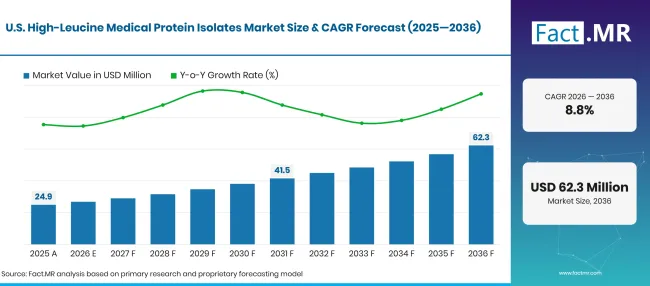
High Leucine Medical Protein Isolates Forecast Usa | Source: Fact.MR
According to the US Census Bureau's September 2026 report, adults aged 65 and above represented 18.9% of the US population in 2025, with their share projected to reach 23.4% by 2060. This demographic transition strengthens the long-term need for protein-enriched nutritional products. Glanbia's additional whey protein isolate capacity in New Mexico also supports ingredient availability for specialised nutrition manufacturers and brands targeting older consumers and clinical nutrition applications.
What is shaping high-leucine medical protein isolates demand in France?
Demand for high-leucine medical protein isolates in France is estimated to grow at an 8.5% CAGR through 2036, driven by population ageing and growing nutritional requirements among older patients.
According to France's National Institute of Statistics and Economic Studies (INSEE), 22.2% of the French population was aged 65 or above on 1 January 2026, while 11.1% was aged 75 or above. This demographic shift increases the importance of nutritional support in hospitals, care homes and elderly-care facilities. Lactalis Ingredients' specialty milk protein portfolio and Danone's medical nutrition activities further strengthen the country's position in specialised nutritional product development.
How is the nutrition industry shaping high-leucine medical protein isolates sales in Switzerland?
Sales of high-leucine medical protein isolates in Switzerland are estimated to record an 8.2% CAGR through 2036, supported by demographic ageing and the development of specialised healthy-ageing nutrition.
According to Switzerland's Federal Statistical Office, the country's permanent resident population reached 9,127,100 at the end of 2025, with people aged 65 and above outnumbering those below 20 for the first time. Published in August 2026, these findings highlight the expanding importance of products addressing age-related nutritional requirements. Nestlé Health Science's Swiss operations and muscle-health nutrition development provide additional commercial opportunities for suppliers of leucine-rich protein ingredients.
Why is growth slower for high-leucine medical protein isolates in the United Kingdom?
Demand for high-leucine medical protein isolates in the United Kingdom is projected to grow at a 7.9% CAGR through 2036, reflecting a comparatively measured expansion of specialised nutritional supplementation.
According to the Office for National Statistics (ONS), the number of people aged 65 and above increased by 2.0% in England, 1.5% in Wales and 2.1% in Scotland and Northern Ireland in the year to mid-2025. The ONS also recorded approximately 645,000 people aged 90 and above in 2025. Although ageing supports nutritional requirements, food-first healthcare approaches and careful supplement prescribing may moderate institutional demand, encouraging suppliers to target pharmacy and online nutrition channels.
Competitive Landscape for High-Leucine Medical Protein Isolates Market
Competition in the high-leucine medical protein isolates market is led by dairy ingredient companies. Arla Foods Ingredients competes with whey protein isolates and specialized fractions for medical nutrition, FrieslandCampina Ingredients competes with whey and milk protein isolates, Fonterra competes with functional dairy proteins from New Zealand, Lactalis Ingredients competes with native whey and milk proteins, and Glanbia Nutritionals and Hilmar Ingredients compete in the United States. Buyers select high-leucine medical protein isolates on leucine content, heat stability, taste, solubility and supply security.
From 2025 onward, competition shifted toward secure supply of specialized fractions. FrieslandCampina and Fonterra invested in protein capacity in 2026, whey prices hit records, and clinical consensus on nutritional therapy was published. Suppliers that guarantee supply and document muscle benefits are best placed to grow.
Recent Developments
- In November 2026, Glanbia reported that whey inflation raised third-quarter pricing by about 26%.
- In October 2026, a global consensus report on indications for nutritional therapy was published.
- In September 2026, Fonterra confirmed completion of its Studholme protein hub.
- In May 2026, FrieslandCampina announced more than EUR 90 million of whey protein investment.
Key Players in High-Leucine Medical Protein Isolates Market
Key companies operating in the market include Arla Foods Ingredients, FrieslandCampina Ingredients, Fonterra, Lactalis Ingredients, Glanbia Nutritionals, and Hilmar Ingredients.
- Arla Foods Ingredients
- FrieslandCampina Ingredients
- Fonterra
- Lactalis Ingredients
- Glanbia Nutritionals
- Hilmar Ingredients
High-Leucine Medical Protein Isolates Market by Segments
-
Product Type
- Milk protein leucine-rich isolate
- Hydrolyzed leucine-rich isolate
- Fortified medical isolate
- Plant enriched leucine isolate
- Whey leucine-rich isolate
-
Product Form
- Granule and agglomerate
- Encapsulated
- Custom premix
- Liquid concentrate
- Dry powder
-
Application
- Oral nutritional supplements
- Post-surgical recovery
- Active aging nutrition
- Enteral tube feeding
- Sarcopenia management
-
Buyer Type
- Pharmacies
- Contract manufacturers
- Hospitals
- Sports nutrition brands
- Medical nutrition brands
-
Region:
- North America
- United States
- Canada
- Mexico
- Europe
- Germany
- United Kingdom
- France
- Italy
- Spain
- Rest of Europe
- Asia Pacific
- China
- India
- Japan
- South Korea
- Australia
- Rest of Asia Pacific
- Latin America
- Brazil
- Mexico
- Argentina
- Rest of Latin America
- Middle East & Africa
- GCC Countries
- South Africa
- Rest of Middle East & Africa
- North America
Bibliography
- Checkpoint Surgical. (2026, August 20). Checkpoint Surgical expands peripheral nerve portfolio with new flexible nerve conduit. Checkpoint Surgical.
- Elsevier. (2026, August 25). Global Leadership Initiative on Indications to Nutritional Therapy and Support (GLINTS): A consensus report from the global clinical nutrition community. Clinical Nutrition.
- Fonterra Co-operative Group. (2026). Annual report 2026. Fonterra.
- FrieslandCampina. (2026, May 5). FrieslandCampina announces major investment programme to accelerate growth in high-value whey proteins. FrieslandCampina.
- Glanbia plc. (2026, November 4). Third quarter 2026 interim management statement. Glanbia.
- Ministry of Internal Affairs and Communications, Statistics Bureau of Japan. (2026). Statistical topics: Japan's elderly population. Statistics Bureau of Japan.
- Nestlé S.A. (2026, October 22). Third-quarter and nine-month 2026 sales. Nestlé Global.
- Important correction: The exact Statistics Bureau publication titled Statistical Topics: Japan's Elderly Population could not be verified. The following official 2026 population statistics PDF is a verifiable alternative: Statistics Bureau of Japan – Population Estimates, June 2026
Segmentation
Scope of Report
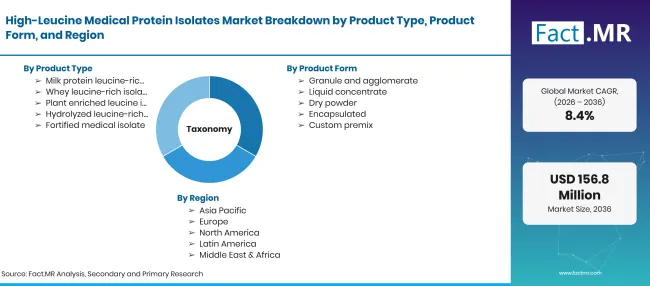
High Leucine Medical Protein Isolates Taxonomy | Source: Fact.MR
| Items | Values |
|---|---|
| Quantitative Units (2026) | USD 70.0 Million |
| Product Type | Milk protein leucine-rich isolate, Hydrolyzed leucine-rich isolate, Fortified medical isolate, Plant enriched leucine isolate, Whey leucine-rich isolate |
| Product Form | Granule and agglomerate, Encapsulated, Custom premix, Liquid concentrate, Dry powder |
| Application | Oral nutritional supplements, Post-surgical recovery, Active aging nutrition, Enteral tube feeding, Sarcopenia management |
| Buyer Type | Pharmacies, Contract manufacturers, Hospitals, Sports nutrition brands, Medical nutrition brands |
| Regions Covered | North America, Latin America, Europe, East Asia, South Asia and Pacific, Middle East & Africa |
| Countries Covered | Netherlands, United States, France, Switzerland, United Kingdom, and other countries |
| Key Companies Profiled | Arla Foods Ingredients, FrieslandCampina Ingredients, Fonterra, Lactalis Ingredients, Glanbia Nutritionals, Hilmar Ingredients |
| Additional Attributes | Dollar revenue in the High-Leucine Medical Protein Isolates Market is segmented by product type (milk protein leucine-rich, hydrolyzed leucine-rich, fortified medical, plant enriched, whey leucine-rich isolate), product form, application, buyer type and region. |
Source: Fact.MR analysis.
Table of Contents
Key Takeaways
- Market Size and CAGR
- Top Growth Driver
- Fastest Growing Segment
- Leading Region
- Key Companies
- Emerging Opportunities

