
- Market Value (2025): USD 417.8 Bn
- Estimated Value (2026): USD 445.0 Bn
- Forecast Value (2036): USD 1,150 Bn
- CAGR (2026-2036): 10.0%
Fact.MR studies that the medical-grade barrier formulations market crossed a valuation of USD 174.0 million in 2025 and is projected to grow from USD 190.0 million in 2026 to USD 458.1 million by 2036. Demand for medical-grade barrier formulations is likely to grow at a CAGR of 9.2% over the forecast period.
Medical-Grade Barrier Formulations Market Forecast and Outlook 2026 to 2036
Fact.MR studies that the medical-grade barrier formulations market crossed a valuation of USD 174.0 million in 2025 and is projected to grow from USD 190.0 million in 2026 to USD 458.1 million by 2036. Demand for medical-grade barrier formulations is likely to grow at a CAGR of 9.2% over the forecast period.
Demand for medical-grade barrier formulations is rising as hospitals, care homes and home carers work to prevent skin damage from urine, stool, wound fluid, stoma output and adhesive removal, which is painful for patients and costly to treat. Manufacturers of medical-grade barrier formulations are offering silicone, acrylic, polyurethane, hydrogel and bio-based film formers supplied as liquid films, wipes, sprays, gels and creams that leave a breathable, long-lasting protective layer. For example, on 18 November 2026, Convatec raised its full-year organic growth guidance to between 6.25% and 7% excluding one product line. Similar chronic care growth is projected to drive sales of medical-grade barrier formulations.
Key Takeaways from the Medical-Grade Barrier Formulations Market
- Medical-Grade Barrier Formulations Market Value (2025): USD 174.0 million
- Medical-Grade Barrier Formulations Market Value (2026): USD 190.0 million
- Medical-Grade Barrier Formulations Market Forecast Value (2036): USD 458.1 million
- Medical-Grade Barrier Formulations Market Forecast CAGR (2026-2036): 9.2%
- Leading Product Type: Hydrogel barrier (27.4%)
- Key Market Participants: 3M, Convatec, Coloplast, Smith+Nephew, Mölnlycke, Dow
- Key Growth Regions: Netherlands, France, United States, Japan, Germany
In November 2026, Coloplast reported 5% organic growth for the fourth quarter of its 2025/26 financial year, driven by Chronic Care, with Advanced Wound Dressings up 9% for the year. Demand for medical-grade barrier formulations is growing alongside ostomy, continence and wound care, the product lines they protect. Manufacturers of medical-grade barrier formulations are bundling skin protection with devices. Similar category growth is projected to drive sales of medical-grade barrier formulations across Europe, the United States and Japan.
Medical-Grade Barrier Formulations Market
| Metric | Value |
|---|---|
| Estimated Value in (2026) | USD 190.0 million |
| Forecast Value in (2036) | USD 458.1 million |
| Forecast CAGR (2026 to 2036) | 9.2% |
Source: Fact.MR analysis.
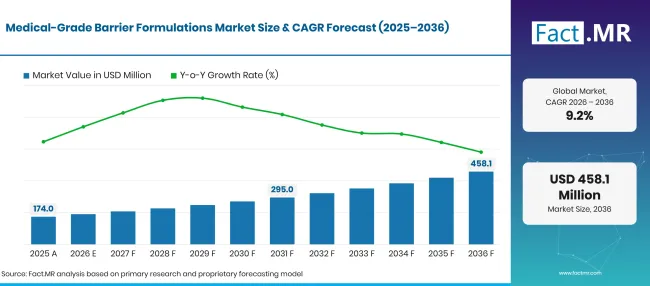
Medical Grade Barrier Formulations Forecast Global | Source: Fact.MR
Category
| Category | Segments |
|---|---|
| Product Type | Hydrogel barrier, Polyurethane barrier, Acrylic medical barrier, Bio-based medical barrier, Silicone skin barrier |
| Form | Liquid film, Wipe, Gel, Spray, Cream |
| Clinical Use | Incontinence care, Wound care, Ostomy care, Radiation dermatitis, Device securement |
| Purchasing Channel | Medical device OEMs, Hospitals, Long-term care, Home care, Pharmacies |
| Region | Netherlands; France; United States; Japan; Germany |
Source: Fact.MR analysis.
Segmental Analysis
Why do hydrogel barriers lead product demand in the Medical-Grade Barrier Formulations Market?
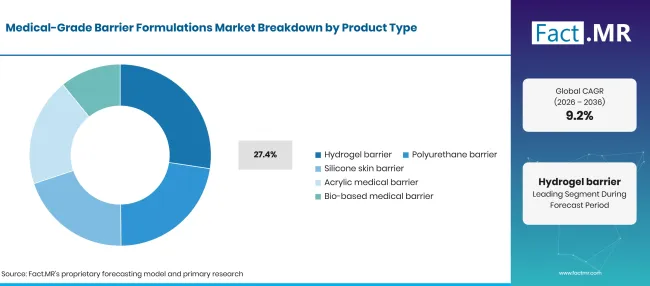
Medical Grade Barrier Formulations Breakdown Product Type | Source: Fact.MR
Demand for Hydrogel barriers account for 27.4% of the medical-grade barrier formulations market in 2026, about USD 52.1 million. Their demand is supported by water-rich formulations that help maintain skin hydration while providing a cooling and soothing effect on irritated or vulnerable skin. These properties make hydrogels relevant to wound-adjacent skin care and applications involving elderly and neonatal patients. Formulators are also exploring hydrogel matrices that incorporate skin-conditioning ingredients and improve adhesion without causing excessive discomfort during removal. Product development increasingly focuses on balancing moisture retention, breathability and barrier performance, particularly in clinical settings where repeated skin protection is required.
How is liquid film leading form demand in the Medical-Grade Barrier Formulations Market?
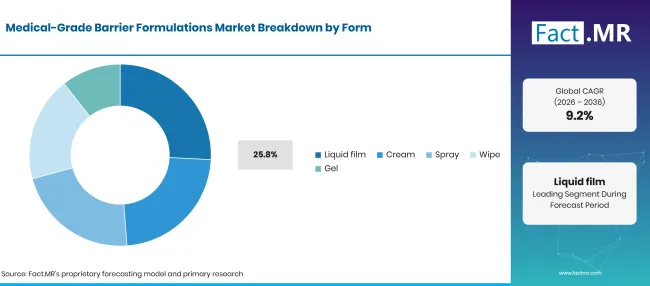
Medical Grade Barrier Formulations Breakdown Form | Source: Fact.MR
Sales of Liquid film formulations to represent 25.8% of medical-grade barrier formulations revenue in 2026, about USD 49.0 million. Their popularity stems from convenient application and the ability to dry into a thin, transparent protective layer without leaving a thick residue. Clinicians can inspect the underlying skin without routinely removing the barrier, while breathable polymer films help reduce exposure to moisture, friction and irritants. Certain formulations also remain effective through repeated cleansing, reducing the need for frequent reapplication. Manufacturers are focusing on improving film flexibility, drying time, skin compatibility and adhesion to support use around wound dressings, ostomy appliances and continence products.
Why does incontinence care lead clinical demand in the Medical-Grade Barrier Formulations Market?
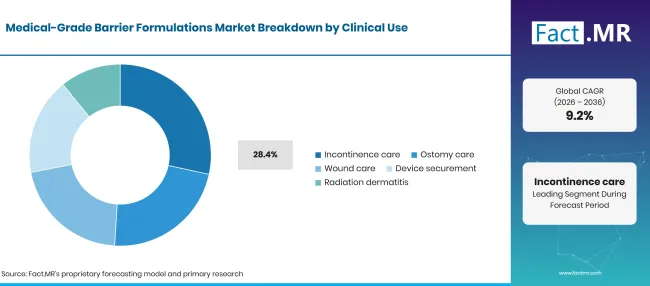
Medical Grade Barrier Formulations Breakdown Clinical Use | Source: Fact.MR
Demand from Incontinence care represents 28.4% of medical-grade barrier formulations revenue in 2026, about USD 54.0 million. Repeated exposure to urine and feces can weaken the skin barrier and contribute to incontinence-associated dermatitis, particularly among older adults, immobile patients and long-term care residents. Healthcare providers therefore incorporate skin protectants into routine cleansing and prevention protocols to limit moisture-related irritation. Product selection increasingly emphasizes durable protection, compatibility with continence products and ease of application during repeated care episodes. Manufacturers are developing formulations that combine protective and moisturizing functions, helping caregivers simplify skin-care routines across hospitals, intensive care units and residential facilities.
How are medical device OEMs leading channel demand in the Medical-Grade Barrier Formulations Market?
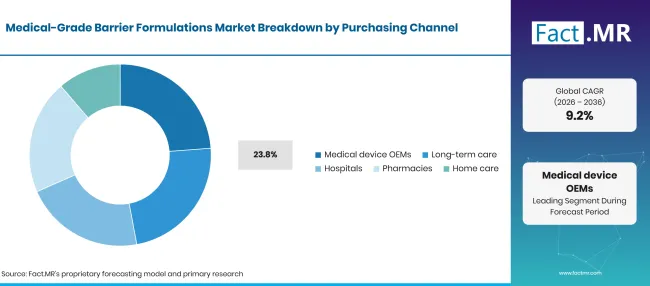
Medical Grade Barrier Formulations Breakdown Purchasing Channel | Source: Fact.MR
Medical device OEMs account for 23.8% of medical-grade barrier formulations revenue in 2026, about USD 45.2 million. These manufacturers purchase specialized skin-protection materials for integration into ostomy appliances, wound dressings, continence products and wearable medical devices. Barrier formulations help protect skin exposed to adhesives, friction, perspiration and prolonged device contact, making material compatibility an important purchasing consideration. OEM procurement teams also require consistent formulation quality, biocompatibility evidence and technical documentation to support product validation and regulatory compliance. Manufacturers such as medical adhesive and skin-care material developers are offering customizable film-forming and barrier solutions for device applications, including products serving the ostomy care market.
Medical-Grade Barrier Formulations Market-Drivers, Restraints & Trends
Drivers:
Demand for medical-grade barrier formulations is rising as chronic care companies report stronger growth. For example, Convatec said in November 2026 that it had raised growth expectations for its divisions, with ConvaFoam gaining share, and Coloplast reported continued strength in Chronic Care. Manufacturers of medical-grade barrier formulations are benefiting as these companies expand accessory and skin care ranges. Similar momentum is projected to drive sales of medical-grade barrier formulations.
Restraints:
Sales of medical-grade barrier formulations is constrained by tight reimbursement, low-cost zinc and petrolatum creams and soft wound care markets in some regions. For example, Convatec noted in November 2026 that one silver dressing line was growing only slightly ahead of soft markets. Similar softness is projected to pressure prices. Manufacturers of medical-grade barrier formulations must show that prevention lowers total cost of care.
Trend: Skin-Friendly Adhesive Interfaces
Demand for barrier films and silicone layers that prevent adhesive-related skin injury is rising with wearable sensors and longer-wear dressings. Manufacturers are designing barriers compatible with device adhesives. dsm-firmenich reported in November 2026 that its Biomedical business performed well. Similar device growth is projected to drive sales, as in the advanced wound care market.
Trend: Bio-Based and Solvent-Free Formulations
In 2026, the EU Packaging and Packaging Waste Regulation began to apply and chemical rules continued to tighten, encouraging lower-solvent products. Demand for water-based and bio-based barrier films is rising. Similar regulation is projected to shape sales of medical-grade barrier formulations. Manufacturers of medical-grade barrier formulations are reformulating for the active wound care market.
Medical-Grade Barrier Formulations Market by Analysis by Key Country
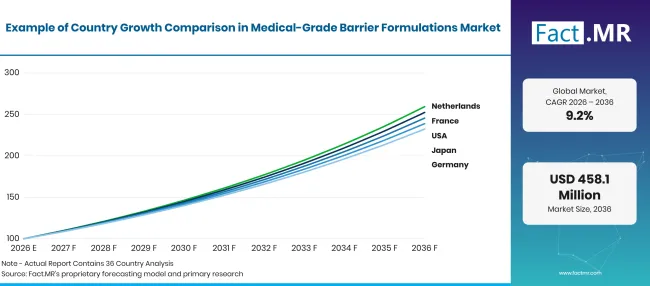
Medical Grade Barrier Formulations Growth Index | Source: Fact.MR
| Country | CAGR (2026-2036) |
|---|---|
| Netherlands | 10.0% |
| France | 9.7% |
| United States | 9.4% |
| Japan | 9.1% |
| Germany | 8.8% |
Source: Fact.MR analysis.
What is driving medical-grade barrier formulations demand in the Netherlands?
In November 2026, dsm-firmenich, with major biomedical operations in the Netherlands, reported that Biomedical performed well in the third quarter.
Demand for medical-grade barrier formulations in the Netherlands is projected to grow at a 10.0% CAGR, the fastest among the five key countries, as the Dutch system shifts care to the home and district nurses use structured skin protection for incontinence and stoma patients. Manufacturers of medical-grade barrier formulations are serving Dutch homecare suppliers. Similar care models are projected to drive sales in the Netherlands.
How is elder care supporting medical-grade barrier formulations sales in France?
Sales of medical-grade barrier formulations in France are projected to achieve a 9.7% CAGR in medical-grade barrier formulations sales through 2036, supported by its extensive elderly-care infrastructure and demand for preventive skin protection.
INSEE reported on November 18, 2026, that France had approximately 10,300 residential facilities for older people, providing 756,400 places at the end of 2023. Overall occupancy reached 92%, with nearly 697,000 people accommodated. This established institutional care network creates opportunities for products used in incontinence management, wound prevention and skin protection. Manufacturers can strengthen sales through hospital pharmacies, nursing homes and home-hospitalization providers serving older patients.
What is shaping medical-grade barrier formulations demand in the United States?
Demand for medical-grade barrier formulations in the United States is forecast to grow at a 9.4% CAGR through 2036, as hospitals strengthen preventive skin-care practices for vulnerable patients.
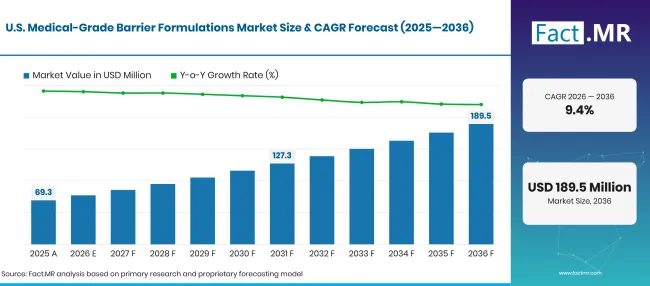
Medical Grade Barrier Formulations Forecast Usa | Source: Fact.MR
CMS identifies Stage III and Stage IV pressure ulcers among hospital-acquired conditions addressed under its Medicare payment policies. Its Hospital-Acquired Condition Reduction Program also imposes a 1% Medicare payment reduction on hospitals performing in the worst quartile for specified hospital-acquired condition measures. These policies encourage hospitals to strengthen patient-safety protocols and skin-integrity management. Manufacturers can target hospital procurement departments with barrier products designed for moisture protection and prevention of skin damage
How is aging shaping medical-grade barrier formulations sales in Japan?
Sales of medical-grade barrier formulations in Japan are projected to record a 9.1% CAGR, supported by its rapidly ageing population and increasing long-term care requirements.
Japan's Ministry of Internal Affairs and Communications reported on September 20, 2026, that people aged 65 and above reached 36.24 million, representing 29.6% of the national population, the highest proportion recorded. This demographic expansion increases the importance of continence management and preventive skin protection in nursing homes and homecare settings. Manufacturers offering gentle, fragrance-free and skin-compatible barrier formulations can address the requirements of elderly patients receiving regular personal care.
Why is growth slower for medical-grade barrier formulations in Germany?
Demand for medical-grade barrier formulations in Germany is estimated to grow at an 8.8% CAGR, as reimbursement limits influence purchasing decisions for eligible care products.
The Federal Ministry of Health's 2026 benefits schedule maintains a maximum monthly reimbursement of EUR 42 for consumable care aids under statutory long-term care insurance. The allowance covers eligible consumable products rather than every medical-grade barrier formulation, so reimbursement depends on product classification and eligibility. Germany's established nursing and homecare infrastructure nevertheless supports recurring demand. Manufacturers can compete through documented product performance, institutional procurement agreements and formulations suited to routine continence care.
Competitive Landscape for Medical-Grade Barrier Formulations Market
Competition in the medical-grade barrier formulations market involves wound, ostomy and continence care companies and material suppliers. 3M's health care spin-off competes with the long-established Cavilon barrier film line, Convatec and Coloplast compete with barrier products tied to ostomy and continence ranges, Smith+Nephew and Mölnlycke compete with skin protectants alongside dressings, and Dow competes as a supplier of medical silicones. Buyers select medical-grade barrier formulations on wear time, skin compatibility, ease of application, clinical evidence and cost per use.
From 2025 onward, competition shifted toward prevention bundles and gentle chemistries. Convatec raised guidance in November 2026, Coloplast reported chronic care growth, and biomedical materials businesses performed well. Manufacturers that prove fewer skin injuries and integrate with devices are best placed to grow.
Recent Developments
- In November 2026, Convatec raised its full-year organic growth guidance to between 6.25% and 7%.
- In November 2026, Coloplast reported 2025/26 full-year results with 5% organic growth in the fourth quarter.
- In November 2026, dsm-firmenich reported that its Biomedical business performed well.
- In September 2026, Japan reported a record 29.6% of its population aged 65 and over.
Key Players in Medical-Grade Barrier Formulations Market
Key companies operating in the market include 3M, Convatec, Coloplast, Smith+Nephew, Mölnlycke, and Dow.
- 3M
- Convatec
- Coloplast
- Smith+Nephew
- Mölnlycke
- Dow
Bibliography
- Coloplast A/S. (2026, November 2). Announcement no. 11/2026: 2025/26 full-year financial results.
- Convatec Group plc. (2026, November 18). Trading update for the ten months ended 31 October 2026.
- European Commission. (2026, August 11). New EU rules on packaging enter into application.
- Cabinet Office, Government of Japan. (2026). Annual report on the ageing society: 2026.
- Townsend, A. (2026, November 18). Convatec boosts full-year outlook, shares surge. Sharecast.
- dsm-firmenich. (2026, November 4). dsm-firmenich reports Q3 2026 trading update.
Segmentation
Scope of Report
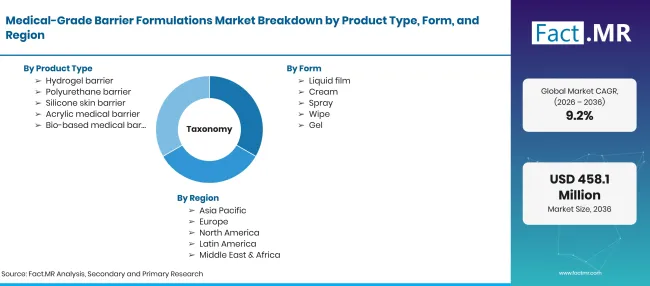
Medical Grade Barrier Formulations Taxonomy | Source: Fact.MR
| Items | Values |
|---|---|
| Quantitative Units (2026) | USD 190.0 Million |
| Product Type | Hydrogel barrier, Polyurethane barrier, Acrylic medical barrier, Bio-based medical barrier, Silicone skin barrier |
| Form | Liquid film, Wipe, Gel, Spray, Cream |
| Clinical Use | Incontinence care, Wound care, Ostomy care, Radiation dermatitis, Device securement |
| Purchasing Channel | Medical device OEMs, Hospitals, Long-term care, Home care, Pharmacies |
| Regions Covered | North America, Latin America, Europe, East Asia, South Asia and Pacific, Middle East & Africa |
| Countries Covered | Netherlands, France, United States, Japan, Germany, and other countries |
| Key Companies Profiled | 3M, Convatec, Coloplast, Smith+Nephew, Mölnlycke, Dow |
| Additional Attributes | Dollar revenue in the Medical-Grade Barrier Formulations Market is segmented by product type (hydrogel, polyurethane, acrylic, bio-based, silicone skin barrier), form, clinical use, purchasing channel and region. |
Source: Fact.MR analysis.
Medical-Grade Barrier Formulations Market by Segments
-
Product Type
- Hydrogel barrier
- Polyurethane barrier
- Acrylic medical barrier
- Bio-based medical barrier
- Silicone skin barrier
-
Form
- Liquid film
- Wipe
- Gel
- Spray
- Cream
-
Clinical Use
- Incontinence care
- Wound care
- Ostomy care
- Radiation dermatitis
- Device securement
-
Purchasing Channel
- Medical device OEMs
- Hospitals
- Long-term care
- Home care
- Pharmacies
-
Region:
- North America
- United States
- Canada
- Mexico
- Europe
- Germany
- United Kingdom
- France
- Italy
- Spain
- Rest of Europe
- Asia Pacific
- China
- India
- Japan
- South Korea
- Australia
- Rest of Asia Pacific
- Latin America
- Brazil
- Mexico
- Argentina
- Rest of Latin America
- Middle East & Africa
- GCC Countries
- South Africa
- Rest of Middle East & Africa
- North America
Table of Contents
Key Takeaways
- Market Size and CAGR
- Top Growth Driver
- Fastest Growing Segment
- Leading Region
- Key Companies
- Emerging Opportunities

