- Market Value (2025): USD 209.8 Mn
- Estimated Value (2026): USD 233.3 Mn
- Forecast Value (2036): USD 675.1 Mn
- CAGR (2026-2036): 11.2%
Predictive Sleep Systems Market Forecast and Outlook 2026 to 2036
The global predictive sleep systems market was valued at USD 209.8 million in 2025 and reached USD 233.3 million in 2026. The market is estimated to expand at a CAGR of 11.2% from 2026 to 2036, reaching USD 675.1 million by the end of the assessment period.
Consumers are moving beyond basic sleep tracking towards systems that identify potential sleep disruptions and respond through temperature, sound, lighting or breathing adjustments. This shift is encouraging manufacturers to combine bed sensors, wearable devices and AI-based analysis to make sleep interventions more responsive to individual sleep patterns. For example, in March 2026, Eight Sleep raised USD 50 million in a round led by Tether Investments at a USD 1.5 billion valuation to expand from sleep optimization into predictive, AI-driven health, while advancing FDA filings for sleep apnea detection. Such investment is encouraging the development of predictive sleep technologies and related monitoring services.
Key Takeaways from the Predictive Sleep Systems Market
- Sales of predictive sleep systems stood at USD 209.8 million in 2025
- Predictive Sleep Systems Market Value (2026): USD 233.3 million
- Predictive Sleep Systems Market Forecast Value (2036): USD 675.1 million
- Predictive Sleep Systems Market Forecast CAGR (2026 to 2036): 11.2%
- Leading Sleep Intervention: Respiratory feedback (28.3%)
- Key Market Participants: Eight Sleep, Oura, Withings, Sleep Number, Apple, Samsung
- Key Growth Regions: China, South Korea, United States, Germany, Japan
In November 2026, Samsung introduced an upgraded sleep apnea feature for the Galaxy Ring following clearance from the U.S. Food and Drug Administration in July 2026 and approval from South Korea's Ministry of Food and Drug Safety. The move marked the first integration of sleep apnea risk screening into a smart ring. Such additions are bringing clinical sleep monitoring into everyday consumer devices, while encouraging manufacturers to pursue regulatory approval for features that identify potential health concerns rather than simply record sleep patterns. Wider adoption of these capabilities could open new sales scope across North America, East Asia and Europe.
Predictive Sleep Systems Market
| Metric | Value |
|---|---|
| Estimated Value in (2025) | USD 209.8 million |
| Estimated Value in (2026) | USD 233.3 million |
| Forecast Value in (2036) | USD 675.1 million |
| Forecast CAGR (2026 to 2036) | 11.2% |
Source: Fact.MR analysis. Updated Nov 24, 2026
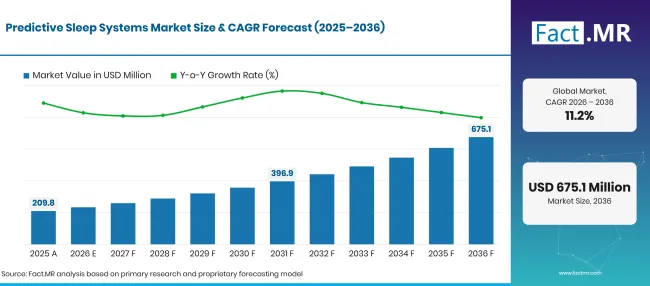
Predictive Sleep Systems Market Forecast Global | Source: Fact.MR
Category
| Category | Segments |
|---|---|
| Sleep Intervention | Respiratory feedback, Smart acoustic modulation, Thermal mattress control, Adaptive lighting, Closed-loop multimodal |
| Device Form Factor | Home tabletop / fixture, Head / ear wearable, Foot / body wearable, Wrist / finger wearable, Portable accessory |
| Data Processing | Hybrid edge-cloud, Smartphone companion, Cloud AI, Clinician-linked dashboard, On-device algorithm |
| Sales Channel | Brand direct online, Retail electronics, Pharmacy / wellness retail, Clinical / professional, B2B / institutional |
| Region | China; South Korea; United States; Germany; Japan |
Source: Fact.MR analysis. Updated Nov 24, 2026
Segmental Analysis
Why does respiratory feedback lead intervention demand in the Predictive Sleep Systems Market?
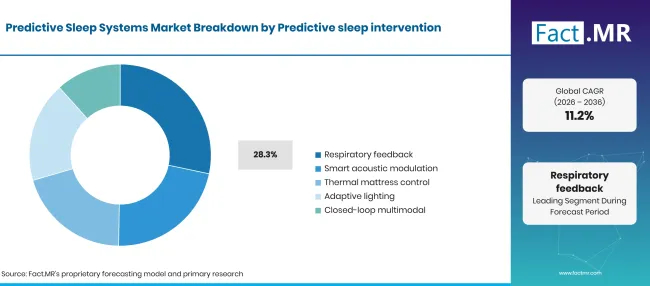
Predictive Sleep Systems Market Breakdown Predictive Sleep Intervention | Source: Fact.MR
Respiratory feedback leads with 28.3% of market revenue in 2026, reaching USD 66.0 million, as irregular breathing can indicate snoring, sleep apnea and repeated nighttime disturbances. Systems that identify these changes can trigger breathing guidance or alerts for medical assessment. Movement-based correction and temperature regulation are also gaining attention as consumers seek better sleep quality. A June 2026 study published in Sleep and Breathing examined under-mattress monitoring across 75 patients and 480 nights, comparing respiratory readings with CPAP data.
How are home tabletop and fixture devices leading form factor demand in the Predictive Sleep Systems Market?
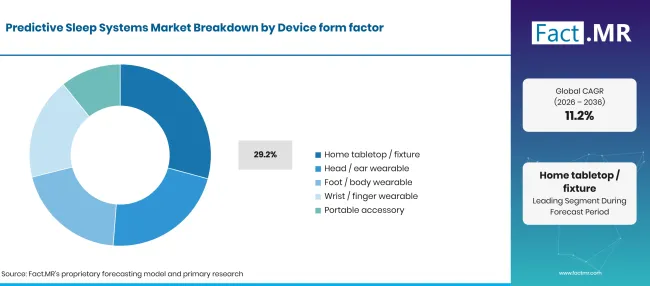
Predictive Sleep Systems Market Breakdown Device Form Factor | Source: Fact.MR
Mattress-integrated sensors, bedside units and connected sleep fixtures generate USD 68.1 million in 2026, representing 29.2% of the market. Their appeal comes from continuous monitoring without requiring users to wear a device overnight. Wearable rings and wristbands are also gaining traction among consumers who prefer portable sleep tracking. In September 2026, the FDA published a 510(k) clearance summary for the DistaSense System, describing a bed sensor that measures heart and respiration rates and transfers encrypted data for analysis.
Why does hybrid edge-cloud processing lead data processing demand in the Predictive Sleep Systems Market?
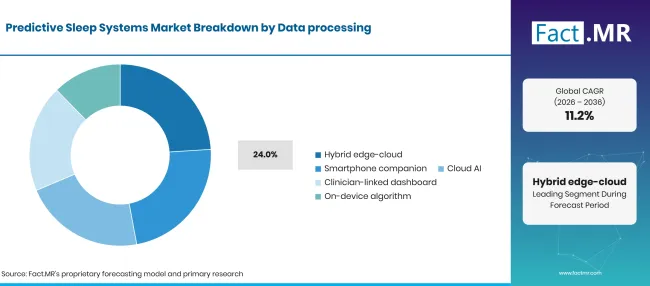
Predictive Sleep Systems Market Breakdown Data Processing | Source: Fact.MR
Hybrid edge-cloud processing generates USD 56.0 million in 2026, capturing 24.0% of market revenue. Processing immediate sleep signals locally allows devices to respond during the night, while cloud computing helps analyse longer-term patterns and refine predictive models. Edge-only processing is gaining interest for privacy, whereas cloud-based systems appeal to users seeking remote access and data integration. In February 2026, the FDA updated its medical-device cybersecurity guidance, addressing security design, software documentation and connected-device risks. These considerations are influencing how manufacturers structure sleep-data processing.
How are brand direct online channels leading sales in the Predictive Sleep Systems Market?
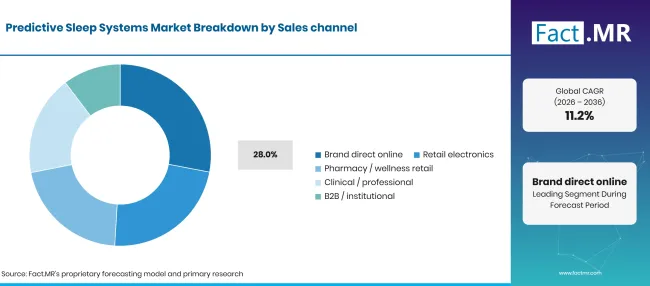
Predictive Sleep Systems Market Breakdown Sales Channel | Source: Fact.MR
Brand-owned websites and applications generate USD 65.3 million in 2026, representing 28.0% of market revenue. Direct online sales allow sleep-technology companies to bundle devices with subscriptions, offer software updates and maintain customer relationships after purchase. Retail stores and healthcare distribution are also gaining relevance as buyers seek product demonstrations and professional guidance. The U.S. Census Bureau reported that e-commerce sales reached USD 1,233.7 billion in 2025, increasing 5.4% from 2024 and accounting for 16.4% of total retail sales. This wider shift towards online purchasing strengthens the commercial case for direct digital channels.
Predictive Sleep Systems Market-Drivers, Restraints & Trends
Drivers: Rising preference for subscription-based sleep insights:
Consumers are showing greater interest in continuous sleep analysis, personalized recommendations and health alerts rather than purchasing devices for basic tracking alone. This creates room for recurring subscription revenue alongside hardware sales. Oura's September 2026 SEC filing reported USD 1,214.5 million in total revenue for the nine months ended June 30, 2026, including USD 240.5 million in membership revenue. However, its membership covers sleep, activity, stress, heart health and other wellness services. These overall figures demonstrate the commercial scale of subscription-based health platforms but should not be treated as sleep-specific market revenue. Only revenue directly attributable to sleep-related functionality falls within the predictive sleep systems market scope.
Restraints: Inconsistent accuracy across age groups:
Predictive sleep systems can produce misleading readings when algorithms do not account for age-related differences in sleep patterns. A January 2026 study in Sleep Advances, comparing consumer trackers with polysomnography, found larger measurement errors among older adults, particularly in total sleep time and deep sleep. Such inconsistencies can weaken user confidence, complicate clinical acceptance and increase validation costs for manufacturers.
Trends: Multi-Night Monitoring for Sleep Disorders:
Single-night testing can miss sleep apnea because breathing disturbances vary from one night to another. A June 2026 study published in npj Digital Medicine followed 100 people with suspected sleep apnea through three months of home monitoring, with 85 participants completing at least 14 valid nights of recordings in the first month.
Trend: Sleep Systems Moving Towards Preventive Health Platforms:
Sleep monitoring is increasingly being linked with respiratory, cardiovascular and metabolic indicators, giving users a broader picture of their health. Oura's September 2026 SEC filing described its Health Radar features for tracking respiratory and cardiovascular signals, alongside glucose data integration. These broader health capabilities create opportunities for connected wellness platforms, although only the sleep-specific portion of their functionality falls within this market's revenue scope.
Predictive Sleep Systems Market Analysis by Key Country
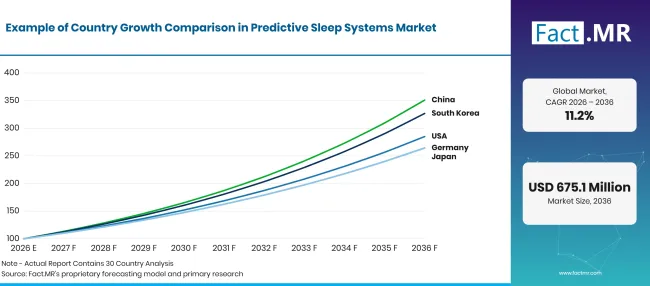
Predictive Sleep Systems Market Growth Index | Source: Fact.MR
| Country | CAGR (2026 to 2036) |
|---|---|
| China | 13.4% |
| South Korea | 12.6% |
| United States | 11.0% |
| Germany | 10.2% |
| Japan | 10.2% |
Source: Fact.MR analysis. Updated Nov 24, 2026
What is driving predictive sleep systems demand in China?
China's expanding focus on sleep-health management is creating room for predictive monitoring across homes, healthcare facilities and elderly-care settings.
In September 2026, China's national standards platform announced a proposed standard covering sleep-quality monitoring and intervention systems, including wearable, mattress-based and contactless technologies. The initiative addresses system performance, data security and intervention accuracy. Wider adoption of connected health devices and preventive monitoring is driving sales as sleep management gains attention among older consumers. Domestic electronics manufacturers are also exploring AI-enabled health monitoring to strengthen their presence in the connected wellness market.
How are rising sleep disorders supporting predictive sleep systems sales in South Korea?
South Korea's strong consumer electronics industry is helping sleep monitoring move into everyday wearable devices.
Samsung announced on October 28, 2026, that its upgraded sleep apnea feature had received approval from the Ministry of Food and Drug Safety, following U.S. FDA clearance in July. The feature analyses breathing disruptions during sleep. Wider access to AI-enabled health monitoring, connected wearables and smartphone-based health applications is strengthening domestic sales of predictive sleep systems. Integration with existing digital health ecosystems is also making advanced sleep assessment more accessible to mainstream consumers.
What is shaping predictive sleep systems demand in the United States?
Regulatory progress is making the United States an important market for consumer-oriented sleep assessment.
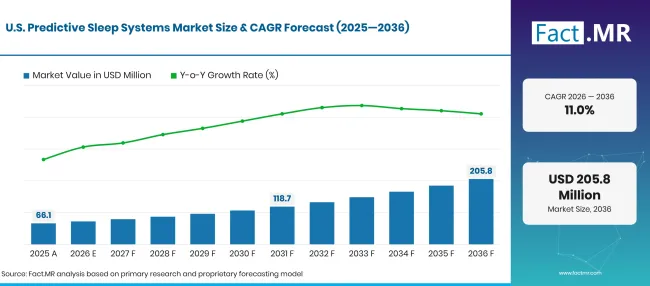
Predictive Sleep Systems Market Forecast Usa | Source: Fact.MR
On July 20, 2026, the FDA cleared Samsung's Sleep Apnea Feature v2.0 through the 510(k) pathway for use with compatible Galaxy wearables. The decision adds momentum to software-led sleep-risk screening. Consumer interest in preventive health, home monitoring and subscription-based wellness services is also encouraging purchases of connected sleep devices. Greater integration of sleep analytics with remote patient monitoring is creating additional commercial avenues for device manufacturers and digital health companies.
Why is Germany an important market for predictive sleep systems?
Germany's healthcare system is creating opportunities for predictive sleep monitoring through digitally connected patient care.
The G-BA Innovationsfonds' SLEEP WELL project, which ran through September 2025, examined telemedicine-supported diagnosis and follow-up for obstructive sleep apnea. The programme involved primary-care physicians, sleep specialists and remote monitoring. Demand for home-based assessment, shorter diagnostic pathways and digitally coordinated treatment is encouraging healthcare providers to consider connected sleep-monitoring systems. Greater coordination between sleep clinics and primary-care practices can further strengthen the use of continuous monitoring in patient follow-up.
How is short sleep duration shaping predictive sleep systems demand in Japan?
Japan's ageing population and interest in objective sleep assessment are strengthening the case for continuous monitoring.
In December 2025, Japan's Ministry of Health, Labour and Welfare documented research comparing wearable sleep measurements with polysomnography to assess device accuracy. The research began collecting simultaneous measurements in February 2025. Greater attention to sleep quality among older adults, alongside home-based testing and digital health research, is supporting sales of predictive sleep systems. Demand from elderly-care facilities and home healthcare providers is also creating scope for sleep monitoring that can identify changes in nighttime health patterns.
Competitive Landscape for Predictive Sleep Systems Market
Competition in the predictive sleep systems market comes from smart-bed manufacturers, wearable technology brands and established sleep-health companies. Eight Sleep and Sleep Number focus on connected mattresses and temperature regulation, while Oura and Withings attract users through wearable and contactless monitoring. Apple and Samsung bring large wearable ecosystems and are adding sleep scoring and sleep apnea screening features. Buyers compare these solutions on measurement accuracy, comfort, useful health insights, subscription costs and clinical reliability.
Eight Sleep raised USD 50 million in March 2026, while Samsung introduced sleep apnea screening on Galaxy Ring in November 2026 following regulatory approvals. Oura's September 2026 SEC filing also highlighted the commercial scale of its membership business. However, Oura's reported membership revenue covers multiple health and wellness categories and cannot be counted entirely as predictive sleep systems revenue. For market-sizing purposes, only the portion directly attributable to sleep-specific monitoring, prediction and intervention should be considered. These developments are pushing companies to strengthen predictive analytics and recurring service offerings.
Recent Developments
- On September 23, 2026, Eight Sleep introduced Pod 6, its latest smart sleep system, with improved temperature control and AI-powered sleep technology.
- On February 6, 2026, ŌURA was named the official wearable partner of Team USA and the LA28 Olympic and Paralympic Games, extending its presence in athlete health and performance monitoring.
- On October 22, 2026, Withings partnered with Function to connect daily health measurements with advanced laboratory testing, expanding its connected health monitoring services.
- On February 17, 2026, Sleep Number announced a strategic partnership with NFL player Travis Kelce, who also became an investor in the company.
- On September 9, 2025, Apple introduced Apple Watch Series 11 with a new Sleep Score feature that helps users understand their sleep quality through health data.
Key Players in Predictive Sleep Systems Market
Key companies operating in the market include Eight Sleep, Inc., Ōura Health Oy, Withings S.A., Sleep Number Corporation, Apple Inc., Samsung Electronics Co., Ltd., Google LLC (Fitbit), and Garmin Ltd.
- Eight Sleep, Inc.
- Ōura Health Oy
- Withings S.A.
- Sleep Number Corporation
- Apple Inc.
- Samsung Electronics Co., Ltd.
- Google LLC (Fitbit)
- Garmin Ltd.
Bibliography
- G-BA Innovationsfonds. (n.d.). SLEEP WELL: Digital unterstützte Schlafmedizin: Entwicklung optimierter Patientenwege bei obstruktiver Schlafapnoe.
- Lechat, B., Proctor, S., Manners, J., Loffler, K. A., Leviton, A., Toson, B., Vena, D., Vakulin, A., Fitton, J., Adams, R. J., Mukherjee, S., & Eckert, D. J. (2026). Zero burden multi night monitoring with AI enabled technology reduces obstructive sleep apnea misdiagnosis. npj Digital Medicine, 9, Article 753.
- Ministry of Health, Labour and Welfare. (2025). Research on promoting occupational health activities through the utilization of lifelog data obtained from wearable devices: FY2024 research report.
- National Standards Information Public Service Platform. (2026). Health informatics: General requirements of sleep monitoring and intervention systems (National Standard Project 20265643-T-424).
- Oura Inc. (2026). Amendment No. 1 to Form S-1: Registration statement under the Securities Act of 1933. U.S. Securities and Exchange Commission.
- Searles, M. E., Licata, A., Cucinotta, M., Kainec, K., & Spencer, R. M. C. (2026). Performance evaluation of consumer sleep-tracking wearables and nearables in healthy young and older adults. Sleep Advances, 7(1), zpag006.
- U.S. Census Bureau. (2026, March 10). Quarterly retail e-commerce sales: Fourth quarter 2025.
- U.S. Food and Drug Administration. (2026a, September 25). 510(k) summary: DistaSense system (K254058).
- U.S. Food and Drug Administration. (2026b, February 2). Cybersecurity in medical devices: Quality management system considerations and content of premarket submissions.
- U.S. Food and Drug Administration. (2026c, July 20). 510(k) summary: Samsung Sleep Apnea Feature v2.0 (K261011).
- Yang, R. Y., Seailles, T., Aisenberg, N., Felix, O., Sabil, A., & Escourrou, P. (2026). Comparison of under-mattress sensor and CPAP data for home monitoring in obstructive sleep apnea. Sleep and Breathing, 30, Article 194.
Segmentation
Scope of Report
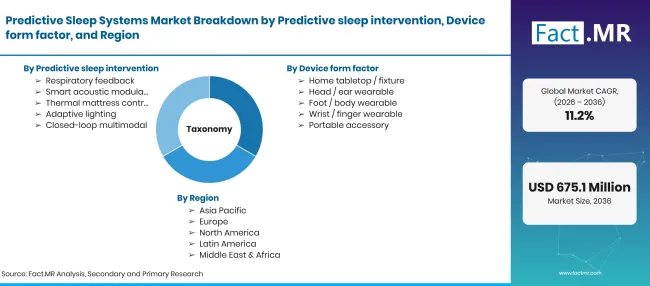
Predictive Sleep Systems Market Taxonomy | Source: Fact.MR
| Items | Values |
|---|---|
| Quantitative Units (2026) | USD Million |
| Sleep Intervention | Respiratory feedback, Smart acoustic modulation, Thermal mattress control, Adaptive lighting, Closed-loop multimodal |
| Device Form Factor | Home tabletop / fixture, Head / ear wearable, Foot / body wearable, Wrist / finger wearable, Portable accessory |
| Data Processing | Hybrid edge-cloud, Smartphone companion, Cloud AI, Clinician-linked dashboard, On-device algorithm |
| Sales Channel | Brand direct online, Retail electronics, Pharmacy / wellness retail, Clinical / professional, B2B / institutional |
| Regions Covered | North America, Latin America, Europe, Asia Pacific, Middle East & Africa |
| Countries Covered | China, South Korea, United States, Germany, Japan, and other countries |
| Key Companies Profiled | Eight Sleep, Oura, Withings, Sleep Number, Apple, Samsung |
| Additional Attributes | Dollar revenue in the Predictive Sleep Systems Market is segmented by sleep intervention (respiratory feedback, smart acoustic modulation, thermal mattress control, adaptive lighting, closed-loop multimodal), device form factor, data processing, sales channel and region. Market revenue includes sleep-specific products and services; broader health-platform and membership revenue is excluded unless directly attributable to sleep-related functionality. |
Source: Fact.MR analysis. Updated Nov 24, 2026
Predictive Sleep Systems Market by Segments
-
Sleep Intervention
- Respiratory feedback
- Smart acoustic modulation
- Thermal mattress control
- Adaptive lighting
- Closed-loop multimodal
-
Device Form Factor
- Home tabletop / fixture
- Head / ear wearable
- Foot / body wearable
- Wrist / finger wearable
- Portable accessory
-
Data Processing
- Hybrid edge-cloud
- Smartphone companion
- Cloud AI
- Clinician-linked dashboard
- On-device algorithm
-
Sales Channel
- Brand direct online
- Retail electronics
- Pharmacy / wellness retail
- Clinical / professional
- B2B / institutional
-
Region:
- North America
- United States
- Canada
- Europe
- Germany
- United Kingdom
- France
- Italy
- Spain
- Rest of Europe
- Asia Pacific
- China
- India
- Japan
- South Korea
- Australia
- Rest of Asia Pacific
- Latin America
- Brazil
- Mexico
- Argentina
- Rest of Latin America
- Middle East & Africa
- GCC Countries
- South Africa
- Rest of Middle East & Africa
- North America
Frequently Asked Questions
How big is the global Predictive Sleep Systems Market in 2026?
What will be the size of the Predictive Sleep Systems Market by 2036?
How fast will the Predictive Sleep Systems Market grow during the forecast period?
Which sleep intervention segment holds the largest share of the Predictive Sleep Systems Market?
Who worked on this report


Preview the report firsthand - request a free sample
Free SampleGet the brochure for pricing and purchase details
Download PDF