
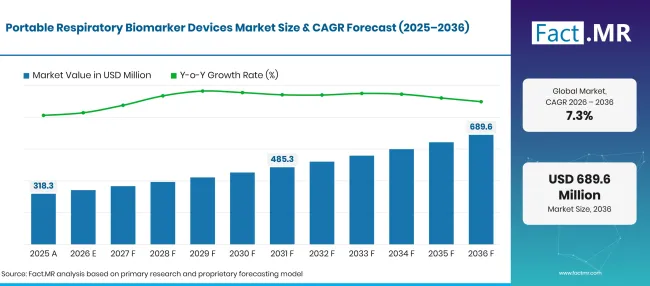
- Market Value (2025): USD 318.3 Mn
- Estimated Value (2026): USD 341.5 Mn
- Forecast Value (2036): USD 689.6 Mn
- CAGR (2026-2036): 7.3%
Portable Respiratory Biomarker Devices Market Forecast and Outlook 2026 to 2036
The global portable respiratory biomarker devices market was valued at USD 318.3 million in 2025 and reached USD 341.5 million in 2026. The market is projected to reach USD 689.6 million by 2036, expanding at a CAGR of 7.3% during the forecast period.
The market is gaining traction as healthcare providers look for quick, non-invasive methods to assess airway inflammation and respiratory conditions. Portable breath carbon monoxide monitors, FeNO analyzers, VOC sensors and exhaled breath condensate collection devices are extending respiratory biomarker testing beyond conventional hospital laboratories. The market valuation includes portable FeNO devices within the broader respiratory biomarker category. FeNO therefore represents one modality within the overall market rather than an additional revenue pool.
Key Takeaways from the Portable Respiratory Biomarker Devices Market
- Sales of portable respiratory biomarker devices stood at USD 318.3 million in 2025.
- Portable Respiratory Biomarker Devices Market Value (2026): USD 341.5 million.
- Portable Respiratory Biomarker Devices Market Forecast Value (2036): USD 689.6 million.
- Portable Respiratory Biomarker Devices Market Forecast CAGR (2026-2036): 7.3%.
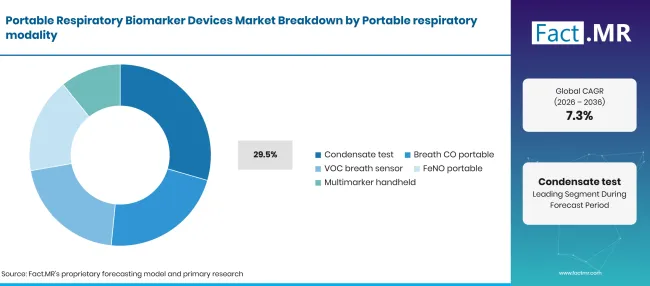
- Leading Respiratory Modality: Condensate test (29.5%).
- FeNO Portable Modality: 18.0%.
- Key Market Participants: NIOX Group, Bedfont Scientific, Eco Medics, Bosch Healthcare Solutions, Sunvou Medical Electronics, Vitalograph.
- Key Growth Regions: China, United States, United Kingdom, Germany, Japan.
In February 2026, MGC Diagnostics announced the US availability of its Fenom Flo portable FeNO monitoring system. The handheld device uses a six-second breath test to measure fractional exhaled nitric oxide in adults and children aged seven years and above. In August 2026, the company announced EU registration and CE marking for the same device, opening the way for its expansion into additional European markets. These developments illustrate how manufacturers are improving portable respiratory testing and expanding access to non-invasive airway inflammation assessment.
Portable Respiratory Biomarker Devices Market
| Metric | Value |
|---|---|
| Estimated Value in (2025) | USD 318.3 million |
| Estimated Value in (2026) | USD 341.5 million |
| Forecast Value in (2036) | USD 689.57 million |
| Forecast CAGR (2026 to 2036) | 7.3% |
Source: Fact.MR analysis. Updated Nov 24, 2026
Portable Respiratory Biomarker Devices Forecast Global | Source: Fact.MR
Category
| Category | Segments |
|---|---|
| Respiratory Modality | Condensate test, Breath CO portable, VOC breath sensor, FeNO portable, Multimarker handheld |
| Clinical Care Location | Pediatric care, Pulmonology clinic, Allergy / immunology, Primary care, Home / remote |
| Consumable Model | Calibration gas / kit, Disposable cartridge, Single-use mouthpiece, Reusable sensor, Service subscription |
| Patient Use Profile | Adult asthma, Pediatric asthma, COPD, Diagnostic evaluation, Longitudinal monitoring |
| Region | China, United States, United Kingdom, Germany, Japan |
Source: Fact.MR analysis. Updated Nov 24, 2026
Segmental Analysis
Why do condensate tests lead respiratory modality demand in the Portable Respiratory Biomarker Devices Market?
Portable Respiratory Biomarker Devices Breakdown Portable Respiratory Modality | Source: Fact.MR
Exhaled breath condensate tests lead the respiratory modality segment with a 29.5% market share in 2026, valued at USD 100.7 million. Their appeal comes from collecting airway-related compounds, including cytokines, pH markers and oxidative-stress products, without invasive sampling. Portable collection also makes bedside and community-based sample gathering easier. FeNO analyzers account for 18.0% of the broader market, while VOC sensors are attracting research interest in non-invasive disease screening. These modalities address different respiratory assessment needs and are included within the same consolidated market valuation.
How is pediatric care leading clinical demand in the Portable Respiratory Biomarker Devices Market?
Portable Respiratory Biomarker Devices Breakdown Clinical Care Location | Source: Fact.MR
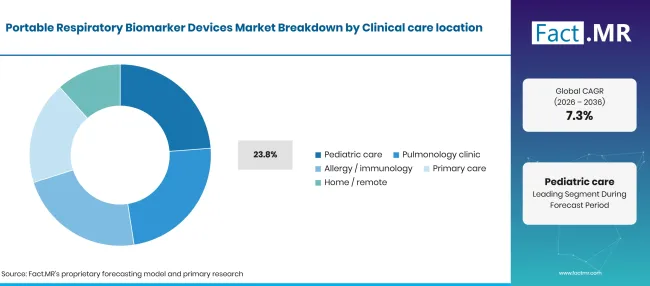
Pediatric care contributes 23.8% of market revenue in 2026, reaching USD 81.3 million. Children can find conventional lung-function tests difficult to perform, making non-invasive breath analysis useful in asthma assessment. NICE guidance identifies FeNO measurement as an important tool in asthma diagnosis for children aged 5 to 16 years, with a reading of 35 ppb or above supporting diagnosis. Adult respiratory clinics are also expanding device use for asthma monitoring, while specialist pulmonary centres are adopting biomarker testing for complex cases.
Why do calibration gas and kits lead consumable demand in the Portable Respiratory Biomarker Devices Market?
Portable Respiratory Biomarker Devices Breakdown Device Consumable Model | Source: Fact.MR
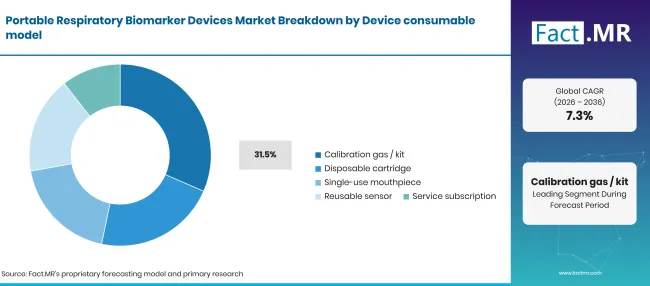
Calibration gas and kits lead consumable demand with a 31.5% share in 2026, valued at USD 107.6 million. Breath-monitor accuracy depends on routine checks, sensor maintenance and replacement of worn accessories. In 2025, Birmingham City Council issued a contract covering carbon monoxide monitors, mouthpiece distribution, maintenance and calibration for community smoking cessation services. Disposable mouthpieces and sample collection accessories also generate repeat purchases, while condensate collection tubes and testing materials are gaining attention as respiratory biomarker research expands.
How is adult asthma shaping patient demand in the Portable Respiratory Biomarker Devices Market?
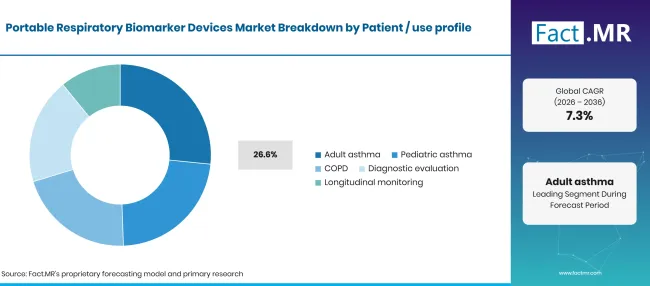
Portable Respiratory Biomarker Devices Breakdown Patient Use Profile | Source: Fact.MR
Adult asthma leads patient demand with a 26.6% market share in 2026, valued at USD 90.8 million. Clinicians use FeNO measurements to identify type 2 airway inflammation and assess treatment response, particularly in patients with difficult-to-control asthma. The 2025 Global Initiative for Asthma strategy report identifies FeNO and blood eosinophils as useful markers for asthma phenotyping and biologic treatment decisions. COPD patients are also attracting attention as researchers explore breath-based markers for disease monitoring, while respiratory infection screening is widening interest in VOC-based testing.
Portable Respiratory Biomarker Devices Market-Drivers, Restraints & Trends
Drivers: Public Funding for Smoking Cessation Services:
Public investment in smoking cessation is creating a stronger market for breath-based monitoring because healthcare programmes use exhaled carbon monoxide testing to verify smoking status. England's 2026 to 2027 Public Health Grant ring-fenced £152.8 million for smoking cessation services, strengthening the funding base for community-based interventions. This creates opportunities for portable respiratory biomarker testing beyond hospitals as local services expand.
Restraints: Delays in Community Healthcare Implementation:
Portable respiratory biomarker adoption can face difficulties when remote testing creates additional work for patients and healthcare teams. A 2026 study on remote smoking verification identified technical problems, unclear instructions and poor test completion as barriers. Such difficulties can discourage clinics from extending breath testing beyond supervised settings, while training costs and inconsistent testing procedures add further pressure on adoption.
Trend: Expansion of Breath-Based Cancer Research:
Breath analysis is moving into cancer detection research, widening the potential application of portable respiratory biomarker technologies. In September 2025, ARPA-H awarded Owlstone Medical up to USD 49.1 million for research involving breath-based volatile compounds and urine-based cancer detection. Further investment in non-invasive screening could create opportunities for respiratory biomarker analysis in community and home-based research.
Trend: Remote Verification of Respiratory Biomarkers:
Remote breath testing is attracting research interest as clinical studies explore ways to verify biomarkers without repeated hospital visits. A January 2026 study examined smartphone-based carbon monoxide breath testing and identified practical barriers involving test completion and digital guidance. Better remote verification methods could open opportunities for portable respiratory biomarker devices in decentralised clinical trials, smoking cessation programmes and home-based monitoring.
Portable Respiratory Biomarker Devices Market by Analysis by Key Country
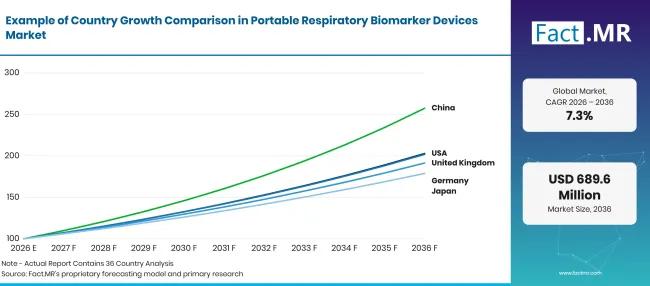
Portable Respiratory Biomarker Devices Growth Index | Source: Fact.MR
| Country | CAGR (2026-2036) |
|---|---|
| China | 9.9% |
| United States | 7.3% |
| United Kingdom | 7.3% |
| Germany | 6.7% |
| Japan | 6.0% |
Source: Fact.MR analysis. Updated Nov 24, 2026
What is driving portable respiratory biomarker devices demand in China?
China's focus on early respiratory disease detection is creating opportunities for portable biomarker testing, particularly in primary healthcare.
In June 2025, the National Health Commission raised per-capita government subsidies for basic public health services to RMB 99, with additional funding directed towards chronic disease management, including COPD. Expanded community respiratory care can create additional sales opportunities for portable testing equipment. Wider screening access across county hospitals and community health centres can further expand the use of non-invasive respiratory assessment.
How is research funding supporting portable respiratory biomarker devices sales in the United States?
The US market is benefiting from wider use of shorter, non-invasive respiratory diagnostic procedures.
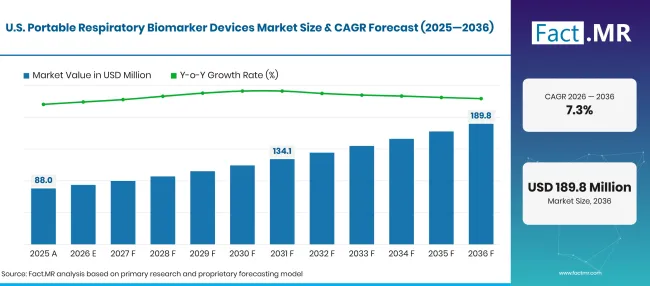
Portable Respiratory Biomarker Devices Forecast Usa | Source: Fact.MR
In February 2026, MGC Diagnostics announced the US availability of its Fenom Flo portable FeNO Monitoring System, which uses a six-second breath test to measure airway inflammation in adults and children aged seven years and above. This shorter testing procedure can make respiratory assessment easier for patients who struggle with longer exhalation requirements. Wider use of FeNO testing across outpatient clinics and specialist pulmonary practices is creating sales opportunities for portable respiratory biomarker devices.
Why is smoking cessation shaping portable respiratory biomarker devices demand in the United Kingdom?
Community-based asthma diagnosis is opening a larger market for portable respiratory testing in the UK.
In January 2026, the Department of Health and Social Care reported that 112 community diagnostic centre sites in England offered FeNO testing. NHS investment in additional respiratory diagnostic services is encouraging wider access outside specialist hospitals. These programmes are creating opportunities for portable FeNO analyzers and other breath-based testing technologies. Greater availability of community testing can also reduce dependence on hospital appointments for routine respiratory assessments.
What is shaping portable respiratory biomarker devices demand in Germany?
Germany's respiratory research and disease surveillance activities are strengthening the clinical case for accessible diagnostic tools.
In October 2026, the Robert Koch Institute published its 2025/26 respiratory infection report, drawing on multiple surveillance systems to assess respiratory disease activity. The country's clinical research into portable FeNO measurements also creates opportunities for non-invasive asthma assessment. Hospital diagnostics, specialist respiratory centres and research institutions are key sales channels. Greater attention to early identification of airway inflammation can encourage clinics to incorporate portable biomarker testing into routine patient evaluations.
How is respiratory surveillance shaping portable respiratory biomarker devices demand in Japan?
Japan's interest in biomarker-guided asthma management is creating opportunities for respiratory testing technologies.
In January 2026, Nagasaki University Hospital registered a prospective asthma study examining blood and sputum biomarkers, including their relationship with treatment response. Clinical research involving FeNO and airway inflammation is also strengthening the role of breath-based assessment. Specialist hospitals, asthma clinics and research centres are important avenues for portable respiratory biomarker device sales. Japan's emphasis on structured chronic disease management can further encourage the use of non-invasive respiratory measurements during follow-up care.
Competitive Landscape for Portable Respiratory Biomarker Devices Market
Competition in the portable respiratory biomarker devices market is centred on FeNO measurement, breath carbon monoxide testing and multi-biomarker breath analysis. NIOX Group competes through its NIOX VERO and NIOX PRO analyzers, while Bedfont Scientific offers NObreath FeNO and Smokerlyzer CO devices. Bosch Healthcare Solutions participates through its Vivatmo range for clinical and home-based FeNO monitoring, whereas Sunvou Medical Electronics focuses on multi-molecule breath analyzers that measure nitric oxide, carbon monoxide and other respiratory biomarkers. Eco Medics and Vitalograph also participate in respiratory diagnostic equipment. Buyers compare device accuracy, portability, testing speed, connectivity, operating costs and clinical usability.
From 2025 onward, competition has placed greater emphasis on portable testing, home monitoring and connected respiratory care. NIOX Group introduced its next-generation NIOX PRO device in 2025, with its first commercial sale in December 2025. The company has also advanced its NIOX Cloud platform to connect device users with digital respiratory testing services.
Bedfont Scientific showcased its NObreath and Smokerlyzer devices at ERS 2025 and continued expanding its respiratory diagnostics presence at international medical events in 2026. Bosch Healthcare Solutions continued promoting its Vivatmo home FeNO testing system, while Sunvou Medical Electronics focused on multi-molecule breath analysis systems for clinical and home-based testing.
The company-level market shares in the supplied assessment place NIOX Group at 6.6%, Vitalograph at 6.8%, Bosch Healthcare Solutions at 5.6%, Bedfont Scientific at 5.3%, Eco Medics at 5.3% and Sunvou Medical Electronics at 4.8%. These company shares are separate from the modality-level percentages and should not be added to the segment distribution.
Recent Developments
- On October 13, 2026, Bedfont Scientific acquired US-based coVita, its long-standing exclusive distributor, to strengthen its presence and expand its respiratory diagnostics business in the United States.
- On August 25, 2026, MGC Diagnostics announced EU registration and CE marking for its Fenom Flo portable FeNO monitoring system, opening the way for its expansion into European markets.
- On February 27, 2026, MGC Diagnostics announced the US availability of Fenom Flo, a portable FeNO monitoring system featuring a six-second breath test for adults and children aged seven years and above.
- On March 24, 2026, NIOX Group reported the first commercial sale of its next-generation NIOX PRO FeNO analyzer in December 2025, marking the introduction of its upgraded respiratory testing device.
Key Players in Portable Respiratory Biomarker Devices Market
Key companies operating in the market include NIOX Group plc, Bedfont Scientific Ltd., Bosch Healthcare Solutions GmbH, Sunvou Medical Electronics Co., Ltd., Eco Medics AG, and Vitalograph Ltd.
- NIOX Group plc
- Bedfont Scientific Ltd.
- Bosch Healthcare Solutions GmbH
- Sunvou Medical Electronics Co., Ltd.
- Eco Medics AG
- Vitalograph Ltd.
Bibliography
- Department of Health and Social Care. (2026). Public health ring-fenced grant financial year 2026 to 2027: Local authority circular. GOV.UK.
- Find a Tender Service. (2025, August 22). Respiratory CDC Braintree: Delivery of community respiratory diagnostic services including spirometry, FeNO and pulse oximetry. UK Government.
- Forum of International Respiratory Societies. (2025, May 6). Hundreds of millions living without access to inhaled medicines for COPD and asthma.
- Global Initiative for Asthma. (2025). Global strategy for asthma management and prevention.
- MGC Diagnostics. (2026, February 27). MGC Diagnostics introduces Fenom Flo in the U.S., a portable FeNO monitoring system approved for a 6-second breath test.
- MGC Diagnostics. (2026, August 25). MGC Diagnostics completes EU registration and CE marking for Fenom Flo.
- Ministry of Finance of the People's Republic of China. (2025). Report on the implementation of China's fiscal policy in the first half of 2025.
- National Institute for Health and Care Excellence. (2024). Asthma: Diagnosis, monitoring and chronic asthma management (NG245).
- Robert Koch-Institut. (2026). Bericht zu akuten respiratorischen Erkrankungen in der Saison 2025/26.
- Santiago-Torres, M., Mull, K. E., Sullivan, B. M., Fogel, C. A., Hwang, S. B., Keith, A. R., David, S. P., & Bricker, J. B. (2026). Overcoming challenges to remote biochemical verification of smoking status: Insights from participant interviews. Substance Use.
- U.S. Food and Drug Administration. (2025). 510(k) premarket notification: Fenom Flo FeNO Monitoring System (K251674).
- NIOX Group. (2026). Introducing NIOX PRO: The next generation of FeNO testing.
Segmentation
Scope of Report
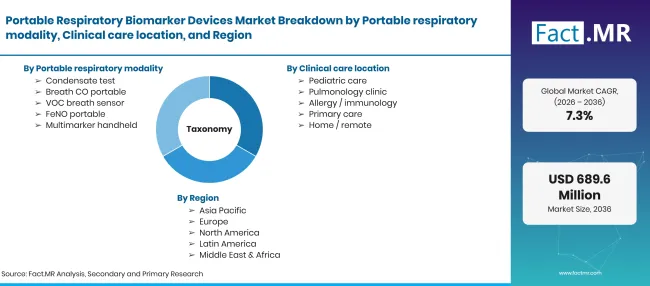
Portable Respiratory Biomarker Devices Taxonomy | Source: Fact.MR
| Items | Values |
|---|---|
| Quantitative Units (2026) | USD Million |
| Respiratory Modality | Condensate test, Breath CO portable, VOC breath sensor, FeNO portable, Multimarker handheld |
| Clinical Care Location | Pediatric care, Pulmonology clinic, Allergy / immunology, Primary care, Home / remote |
| Consumable Model | Calibration gas / kit, Disposable cartridge, Single-use mouthpiece, Reusable sensor, Service subscription |
| Patient Use Profile | Adult asthma, Pediatric asthma, COPD, Diagnostic evaluation, Longitudinal monitoring |
| Regions Covered | North America, Latin America, Europe, East Asia, South Asia and Pacific, Middle East & Africa |
| Countries Covered | China, United States, United Kingdom, Germany, Japan, and other countries |
| Key Companies Profiled | NIOX Group, Bedfont Scientific, Eco Medics, Bosch Healthcare Solutions, Sunvou Medical Electronics, Vitalograph |
| Additional Attributes | Dollar revenue in the Portable Respiratory Biomarker Devices Market is segmented by respiratory modality (condensate test, breath CO portable, VOC breath sensor, FeNO portable, multimarker handheld), clinical care location, consumable model, patient use profile and region. |
Source: Fact.MR analysis. Updated Nov 24, 2026
Portable Respiratory Biomarker Devices Market by Segments
-
Respiratory Modality
- Condensate test
- Breath CO portable
- VOC breath sensor
- FeNO portable
- Multimarker handheld
-
Clinical Care Location
- Pediatric care
- Pulmonology clinic
- Allergy / immunology
- Primary care
- Home / remote
-
Consumable Model
- Calibration gas / kit
- Disposable cartridge
- Single-use mouthpiece
- Reusable sensor
- Service subscription
-
Patient Use Profile
- Adult asthma
- Pediatric asthma
- COPD
- Diagnostic evaluation
- Longitudinal monitoring
-
Region:
- North America
- United States
- Canada
- Mexico
- Europe
- Germany
- United Kingdom
- France
- Italy
- Spain
- Rest of Europe
- Asia Pacific
- China
- India
- Japan
- South Korea
- Australia
- Rest of Asia Pacific
- Latin America
- Brazil
- Mexico
- Argentina
- Rest of Latin America
- Middle East & Africa
- GCC Countries
- South Africa
- Rest of Middle East & Africa
- North America
Table of Contents
Key Takeaways
- Market Size and CAGR
- Top Growth Driver
- Fastest Growing Segment
- Leading Region
- Key Companies
- Emerging Opportunities

